Glasses-Free AI 3D: Light-Steered Vision | Analysis by Brian Moineau

A future where 3D doesn’t come with glasses (for real this time)

Imagine sitting on your couch, a movie begins, and the characters step out of the screen—no clunky glasses, no parallax barriers, no weird double-images. That vision of true, comfortable glasses-free 3D has long been teased by prototypes and niche devices. This week a team from Shanghai AI Lab and Fudan University published a Nature paper describing EyeReal, a system that gets remarkably close to that dream by using AI to steer light exactly where your eyes are.

Why this feels like a turning point

  • Glasses-free (autostereoscopic) 3D has always faced a brutal physical constraint: the space-bandwidth product (SBP). In short, you can’t simultaneously have a very large, high-quality display and a wide viewing angle without paying an impossible information cost.
  • EyeReal doesn’t break physics. It sidesteps waste. Instead of broadcasting a complete, full-angle light field into the room, the system uses fast eye-tracking and a neural network to compute and emit the specific light needed for the viewer’s eyes in real time.
  • The result: a desktop-sized display prototype that achieves a viewing angle north of 100°, with full-parallax 3D rendering and dynamic content that adapts as you move and look around.

What EyeReal actually does (in plain language)

  • Hardware that’s surprisingly ordinary: EyeReal uses a stack of three LCD panels (not exotic holographic optics) plus a front-facing sensor for tracking.
  • Software that’s the secret sauce: a deep-learning model predicts the optimal light-field patterns to display on those panels so the correct rays reach each eye as they move.
  • Efficiency by focus: rather than trying to create every possible light ray in all directions, the system only generates what’s perceptually necessary for the viewer’s current gaze and head pose. That’s computation compensating for limited optical “bandwidth.”

Why that matters beyond neat demos

  • Practical manufacturing: because EyeReal leans on layered LCDs and computation, it’s potentially compatible with existing panel-making ecosystems—easier to scale than some entirely new optical technology.
  • Comfort and realism: prototype tests reportedly show smooth transitions, accurate depth cues as eyes change focus, and no notable motion sickness—one of the long-standing complaints about many 3D approaches.
  • Path to new applications: education, telepresence, product visualization, and gaming all benefit when realistic depth comes without extra wearables. Imagine museum exhibits or online shopping where a product truly “sits” in front of you.

What still needs work

  • Multi-viewer support: EyeReal currently targets a single viewer; scaling to multiple simultaneous viewers requires heavier sensing and more complex light routing.
  • Latency and reliability: the AI system must track and render at high speed to avoid perceptible lag. Real-world lighting, reflective environments, and unpredictable head motion will stress robustness.
  • Content pipeline and standards: filmmakers, game studios, and app creators will need accessible tools to produce light-field or depth-aware content that matches the system’s assumptions.
  • Commercial cost and power: stacked panels and continuous eye-tracking/compute come with cost, power draw, and heat considerations that affect consumer deployment.

A brief tech context

  • This effort is part of a larger trend where computation (especially deep learning) compensates for optical limits. We’ve seen similar shifts in computational photography and camera sensor design—where algorithms let modest hardware produce stunning results.
  • Autostereoscopic displays have taken many forms: lenticular lenses, parallax barriers, metagratings, time-multiplexed backlights, and holographic techniques. EyeReal’s contribution is marrying inexpensive layered displays with gaze-aware AI to maximize the effective use of available optical information.
  • Related research lines include foveated and gaze-driven light-field displays and recent industry demos of autostereoscopic handhelds and large-format displays—showing both industrial interest and technical convergence.

A few scenarios to imagine

  • A virtual product preview that you can walk around at your kitchen table, with correct depth and focus, without strapping on headgear.
  • Remote meetings where participants appear as volumetric, depth-correct images—more like being in the same room.
  • Games that use true, view-dependent parallax and depth, giving level designers a new palette for immersion.

My take

EyeReal isn’t magic glue that erases all engineering trade-offs. But it’s a smart, pragmatic pivot: use intelligence to reduce the optical “waste” that’s dogged glasses-free 3D for decades. The prototype’s reported 100°+ viewing angle on a desktop-scale display is impressive because it signals practical progress—this is the kind of advance that could migrate into real products faster than approaches that demand totally new manufacturing processes. If the team (or industry partners) can extend support to multiple viewers and make the system robust under everyday conditions, this could be the year glasses-free 3D stops being a novelty and becomes a real feature.

What to watch next

  • Progress on multi-user implementations and whether eye-tracking can be done discretely and cheaply.
  • Demonstrations of consumer-level prototypes (or licensing/partnership deals with panel makers).
  • Software toolchains for creators: depth capture, conversion to view-dependent assets, and runtime integrations for games and media players.

Sources

Final thought: the combination of modest optics plus smart computation keeps paying off. If EyeReal’s ideas scale, the next time you reach for 3D glasses, they might only be for nostalgia.


Related update: We recently published an article that expands on this topic: read the latest post.
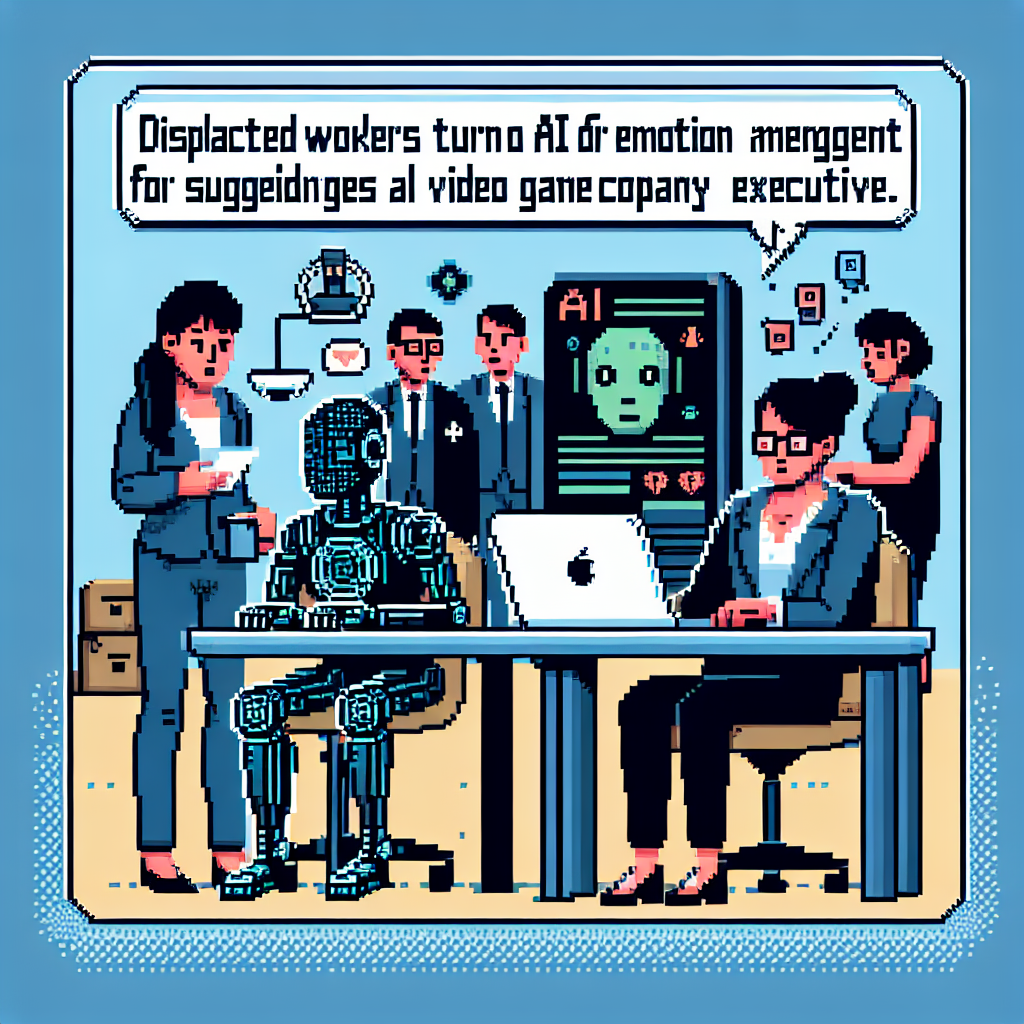
Laid-off workers should use AI to manage their emotions, says Xbox exec – The Verge | Analysis by Brian Moineau

Laid-off workers should use AI to manage their emotions, says Xbox exec - The Verge | Analysis by Brian Moineau

Navigating Job Loss in the Digital Age: Can AI Be Our Emotional Copilot?

In a world where technological advancements are reshaping every aspect of our lives, it's no surprise that even our emotional well-being is getting a digital upgrade. Recently, Xbox executive Matt Turnbull made headlines with a controversial suggestion: using AI to manage emotions during job loss. His post, which was quickly deleted, sparked a lively debate about the role of technology in personal and emotional spheres.

The Emotional Toll of Job Loss

Job loss is an emotional rollercoaster. It can lead to stress, anxiety, and a feeling of uncertainty about the future. Traditionally, people have turned to friends, family, or even professional counselors to navigate these choppy waters. However, Turnbull's suggestion points to a future where artificial intelligence could offer a new kind of support system.

Imagine an AI that can help process emotions, suggest coping strategies, and even provide motivational nudges when you're feeling down. It's not as far-fetched as it sounds. In fact, AI-driven mental health platforms like Woebot and Wysa are already providing support to individuals around the world. These platforms use natural language processing to engage users in therapeutic conversations, offering a glimpse into the potential of AI as a mental health ally.

AI: Friend or Foe?

While the idea of AI as an emotional copilot is intriguing, it's important to approach it with a healthy dose of skepticism. AI lacks the human touch – the empathy and understanding that comes from shared human experience. Critics argue that relying too heavily on AI for emotional support could lead to isolation and a diminished capacity for human connection.

Moreover, there's the question of data privacy. In an age where data is a commodity, users must be cautious about the information they share with AI platforms. Ensuring that personal data is protected and used ethically is paramount.

A Broader Technological Context

Turnbull's suggestion comes at a time when AI is making waves across various industries. From ChatGPT revolutionizing customer service to AI-powered tools enhancing creative processes, the technology is becoming an integral part of our daily lives. However, this rapid integration also raises questions about its impact on employment. AI is automating tasks that were once the domain of humans, leading to concerns about job displacement and the need for upskilling.

Interestingly, similar discussions are happening in other sectors. For example, in sports, AI is being used to analyze player performance and develop strategies, as seen with teams leveraging data analytics to gain a competitive edge. Coaches and players alike are learning to balance human intuition with data-driven insights.

Matt Turnbull: A Brief Commentary

Matt Turnbull, as an executive at Xbox, is no stranger to the intersection of technology and entertainment. His work in the gaming industry involves staying ahead of the curve, anticipating trends, and understanding how technology can enhance user experiences. It’s no wonder he’s pondering AI’s potential beyond gaming, even if his recent suggestion stirred the pot.

Final Thoughts

As we stand on the brink of a new era in technology and mental health, it's crucial to strike a balance. AI has the potential to be a powerful tool in managing emotions, but it should complement, not replace, human interaction. As we explore these new frontiers, let’s remain mindful of the ethical implications and prioritize the human element that makes life rich and meaningful.

In the end, whether you're navigating job loss or any other challenge, remember that reaching out to a trusted friend or professional remains invaluable. After all, some things are best left to the heart, not just the algorithm.

Read more about AI in Business

Read more about Latest Sports Trends

Read more about Technology Innovations

Valve CEO Gabe Newell’s Neuralink competitor is expecting its first brain chip this year – The Verge | Analysis by Brian Moineau

Valve CEO Gabe Newell’s Neuralink competitor is expecting its first brain chip this year - The Verge | Analysis by Brian Moineau

Title: Gaming Meets Neuroscience: Gabe Newell's Ambitious Leap into the Brain Chip Arena

In a world where gaming and technology often intertwine, few figures stand as prominently as Gabe Newell, the visionary CEO of Valve Corporation. Known for revolutionizing the gaming industry with platforms like Steam, Newell is now setting his sights on an entirely new frontier: brain-computer interfaces. His company, Starfish Neuroscience, is reportedly preparing to unveil its first brain chip later this year, positioning itself as a competitor to Elon Musk's Neuralink. But what exactly does this mean for both the tech world and the gaming industry as we know it?

Gabe Newell: A Visionary Beyond Gaming


Gabe Newell's journey from a Harvard dropout to one of the most influential figures in gaming is nothing short of extraordinary. After a successful stint at Microsoft, Newell co-founded Valve Corporation, and the company has since become synonymous with innovation in gaming. With titles like "Half-Life" and "Portal," Valve has consistently pushed the boundaries of what games can be. Yet, Newell's ambitions clearly extend beyond virtual landscapes.

With Starfish Neuroscience, Newell aims to make science fiction a reality by directly interfacing brains with computers. This venture isn't just a side project; it represents a potential paradigm shift in how humans interact with technology. It's reminiscent of the leaps in human-computer interaction we've seen from the likes of Apple's Steve Jobs or Microsoft's Bill Gates.

Brain Chips: The Next Big Frontier


The concept of brain-computer interfaces (BCIs) isn't new. Researchers have been exploring this field for decades, and we've seen significant advances in medical applications, particularly for individuals with mobility impairments. However, the potential applications of BCIs extend far beyond healthcare. Imagine a world where gaming becomes a fully immersive experience where the player's thoughts and emotions directly influence the game. This could be the future that Newell is envisioning.

Starfish Neuroscience's brain chip is expected to rival Neuralink, which has made headlines for its ambitious goals and high-profile demonstrations. While Musk's company focuses on medical applications and augmenting human intelligence, Newell's gaming background could bring a unique perspective to the table, potentially integrating BCIs into entertainment and everyday tech applications.

A World of Possibilities and Challenges


While the potential of brain chips is exciting, it's also fraught with ethical and practical challenges. Privacy concerns loom large. If our thoughts can be read by machines, who controls that data? Similarly, the implications of such technology on mental health and societal norms are vast and largely unexplored.

In addition, the timing of Starfish's announcement is noteworthy, as it coincides with a global surge in AI innovation. From OpenAI's advancements in natural language processing to robotics breakthroughs, we are living in an era defined by rapid technological evolution. Newell's entry into the brain chip arena is yet another testament to this trend.

Final Thoughts: A Game Changer?


Gabe Newell's journey from transforming the gaming industry to potentially transforming human-computer interaction is an exciting narrative. While we await the release of Starfish Neuroscience's first brain chip, it's clear that this development could have profound implications. Whether it's creating new gaming experiences or addressing complex medical challenges, the possibilities are endless.

As we stand on the brink of this new technological era, it's essential to approach these innovations with both enthusiasm and caution. After all, the future of brain-computer interfaces will not only redefine technology but also the very fabric of human experience. And if history has taught us anything, it's that visionaries like Gabe Newell often have a way of making the seemingly impossible a reality.

Read more about AI in Business

Read more about Latest Sports Trends

Read more about Technology Innovations