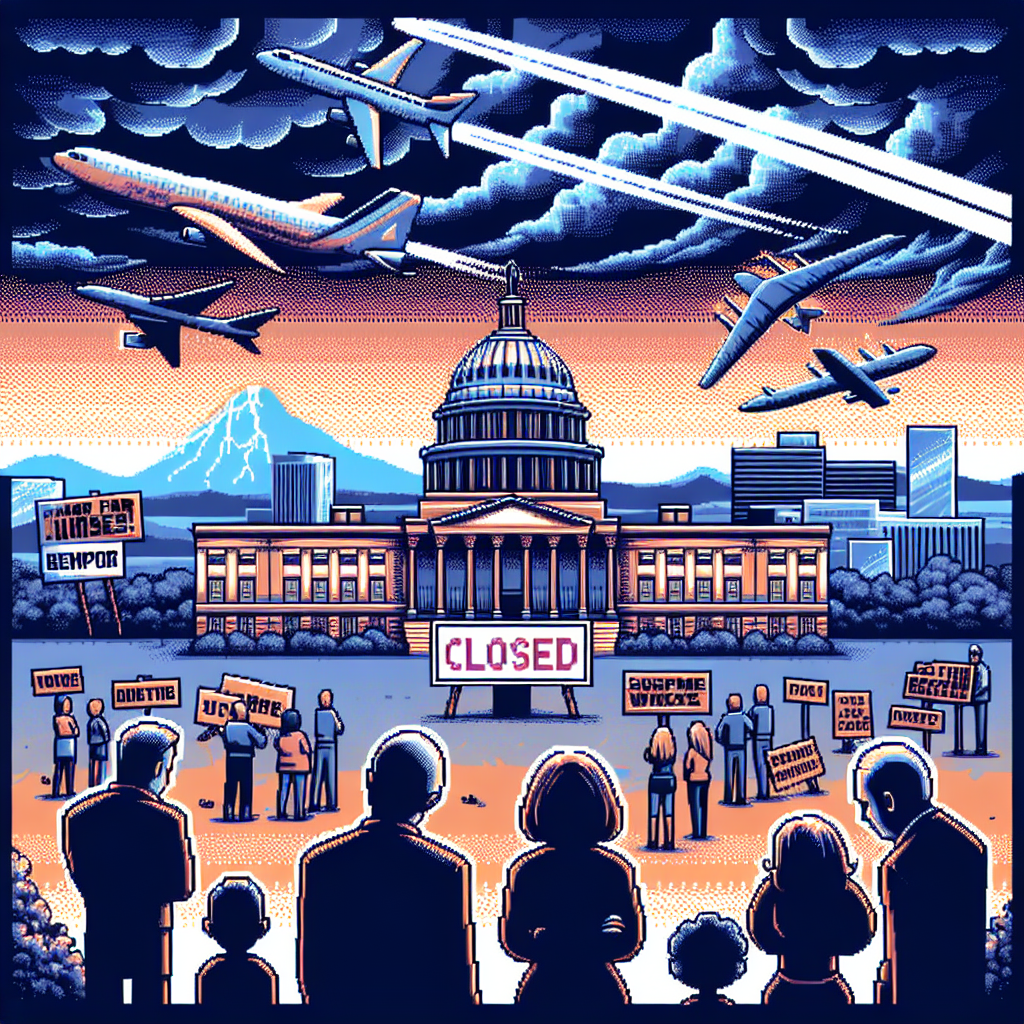
The day airspace shrank and sentiment soured: what the shutdown means now
The headlines this week felt like they were written for a thriller: parts of U.S. airspace being intentionally reduced, major carriers trimming flights, and consumer mood slipping to multi-year lows. But this isn’t fiction — it’s the real-world fallout of a prolonged federal government shutdown that began on October 1, 2025 and stretched into November. The question for travelers, investors and everyday Americans is simple: how bad could this get before it gets fixed?
What just happened
- On November 7, 2025 the Federal Aviation Administration began cutting scheduled flights at about 40 major U.S. airports to reduce controller workload and preserve safety as staffing gaps worsened. Initial cuts were modest (around 4% on the first day) with plans to scale to roughly 10% across the busiest markets and the possibility of larger reductions if conditions deteriorate. (apnews.com)
- The shutdown — which started October 1, 2025 — has left hundreds of thousands of federal workers furloughed or working without pay and pushed the federal workforce and certain benefits into operational limbo. That disruption is rippling through travel, construction and other sectors. (en.wikipedia.org)
- Consumer sentiment slid sharply in November, hitting its weakest point in about three years in University of Michigan polling, with many households growing more pessimistic about jobs and prices. Economists warn that the longer the stalemate lasts, the more likely temporary strains become persistent damage. (home.saxo)
Why reducing flights is more than an inconvenience
Cutting flights isn’t just about fewer seats for travelers. It’s a safety-management lever.
- Air traffic controllers have been stretched thin: many are working unpaid, others have taken leave, and fatigue and absences increase operational risk. Reducing traffic in high-volume centers buys time and reduces stress on the system. (apnews.com)
- Airlines respond quickly by cutting schedules — that produces cancellations, rebookings and lost revenue for carriers, airports, hotels and the broader travel ecosystem (rental cars, restaurants, even local retail). A string of canceled legs can ripple into lost bookings weeks out. (entrepreneur.com)
- If cuts escalate to the scale government officials have warned about (up to 20% in the worst-case messaging), we could see cascading disruptions that push the travel sector into a short-term downturn. White House advisers have said the economic impact is “far worse than expected” already. (reuters.com)
The economic picture in plain terms
- Consumer mood is a leading short-term indicator. When households are pessimistic about jobs or expect higher unemployment, they cut discretionary spending (dining out, travel, home projects) — which cools growth. University of Michigan sentiment data moved notably lower in early November. (home.saxo)
- The Congressional Budget Office and other forecasters have warned that output lost during a shutdown is often unrecoverable in the short term; construction delays, paused federal contracts, and disrupted benefits aren’t simply “made up” later. Several analysts estimate meaningful hits to Q4 growth if the standoff persists. (entrepreneur.com)
- Financial markets can look past short-term shocks, but prolonged uncertainty raises volatility. Stocks may temporarily rally on hopes of a legislative solution, while the real economy — payrolls, small business receipts, travel spending — reflects the lived pain.
Who’s feeling it most
- Travel and leisure: airlines, airports, hotels and ancillary services face immediate demand shocks. Cancellations and rebookings create operational costs and lost revenue. (apnews.com)
- Lower- and middle-income households: delayed benefits and furloughs hit these groups first and hardest, worsening the consumer split between higher-income households who still benefit from asset gains and everyone else. (entrepreneur.com)
- State and local governments and contractors: delayed federal payments and paused permits slow construction and local projects, which can feed into job losses in affected sectors. (reuters.com)
The political and practical constraints
- Fixing a shutdown requires Congress and the White House to agree on funding. Political incentives make compromises difficult, and each day of delay increases the economic bill and the human costs (missed paychecks, delayed benefits).
- Operationally, some agencies can’t simply “turn back on” overnight. Even if appropriations pass tomorrow, it may take time to restore normal staffing, release backlogged payments, and normalize schedules in complex systems like aviation. (apnews.com)
Signals markets and travelers should watch
- FAA notices and airline schedule reductions (daily): increasing planned cut percentages and cancellations signal growing systemic stress. (apnews.com)
- Consumer confidence and survey data (University of Michigan, Conference Board): sharp declines presage weaker consumer spending. (home.saxo)
- Official economic releases that are delayed or resumed: gaps in data flow complicate policymaking and investor assessments. (en.wikipedia.org)
What this means for you (practical tips)
- If you have upcoming travel, expect more last-minute changes and factor buffer time; consider refundable or flexible tickets and double-check carrier communications.
- If you’re a small business or contractor that depends on federal contracts or permits, document impacts carefully — that helps with recovery and any appeals for relief.
- For investors: consider the difference between short-term headline-driven volatility and long-term fundamentals. Prolonged shutdowns raise real risks to growth, but markets often look forward to resolution.
Main takeaways
- Flight reductions that started November 7, 2025 are a direct safety response to staffing shortages caused by the shutdown and risk becoming more severe if the stalemate continues. (apnews.com)
- Consumer sentiment has tumbled to a multi-year low, signaling weaker spending ahead and amplifying the economic cost beyond the immediate federal payroll disruptions. (home.saxo)
- The shutdown’s economic effects are already being described by administration advisers as “far worse than expected”; prolonged disruption could push travel and local economies into near-term downturns. (reuters.com)
My take
This shutdown feels different because a real-time safety system — the national airspace — is being throttled to prevent an accident born of understaffing and fatigue. That’s a stark, visceral sign that budget fights aren’t abstract political theater; they can change whether you get home for Thanksgiving or whether a paycheck arrives on time. The economic math is straightforward: the longer the pause, the harder recovery becomes. Fixing this means not just passing funding but stabilizing operations that have been frayed day by day.
Sources
-
FAA reducing air traffic by 10% across 40 'high-volume' markets during government shutdown — Associated Press.
https://apnews.com/article/e39c423facec2b0dcc2544af48de0fa1 -
Impact of US government shutdown far worse than expected, White House adviser says — Reuters.
https://www.reuters.com/business/retail-consumer/impact-us-government-shutdown-far-worse-than-expected-white-house-adviser-says-2025-11-07/ -
US shutdown drags economy to 3½-year sentiment low as flight cuts loom — Entrepreneur (summarizing consumer and economic impacts).
https://www.entrepreneur.com/article/499362 -
2025 United States federal government shutdown — Wikipedia (timeline and operational effects).
https://en.wikipedia.org/wiki/2025_United_States_federal_government_shutdown
(Note: URLs above point to non-paywalled reporting used to synthesize this post.)
Related update: We recently published an article that expands on this topic: read the latest post.
Related update: We recently published an article that expands on this topic: read the latest post.
Related update: We recently published an article that expands on this topic: read the latest post.
Related update: We recently published an article that expands on this topic: read the latest post.
Related update: We recently published an article that expands on this topic: read the latest post.