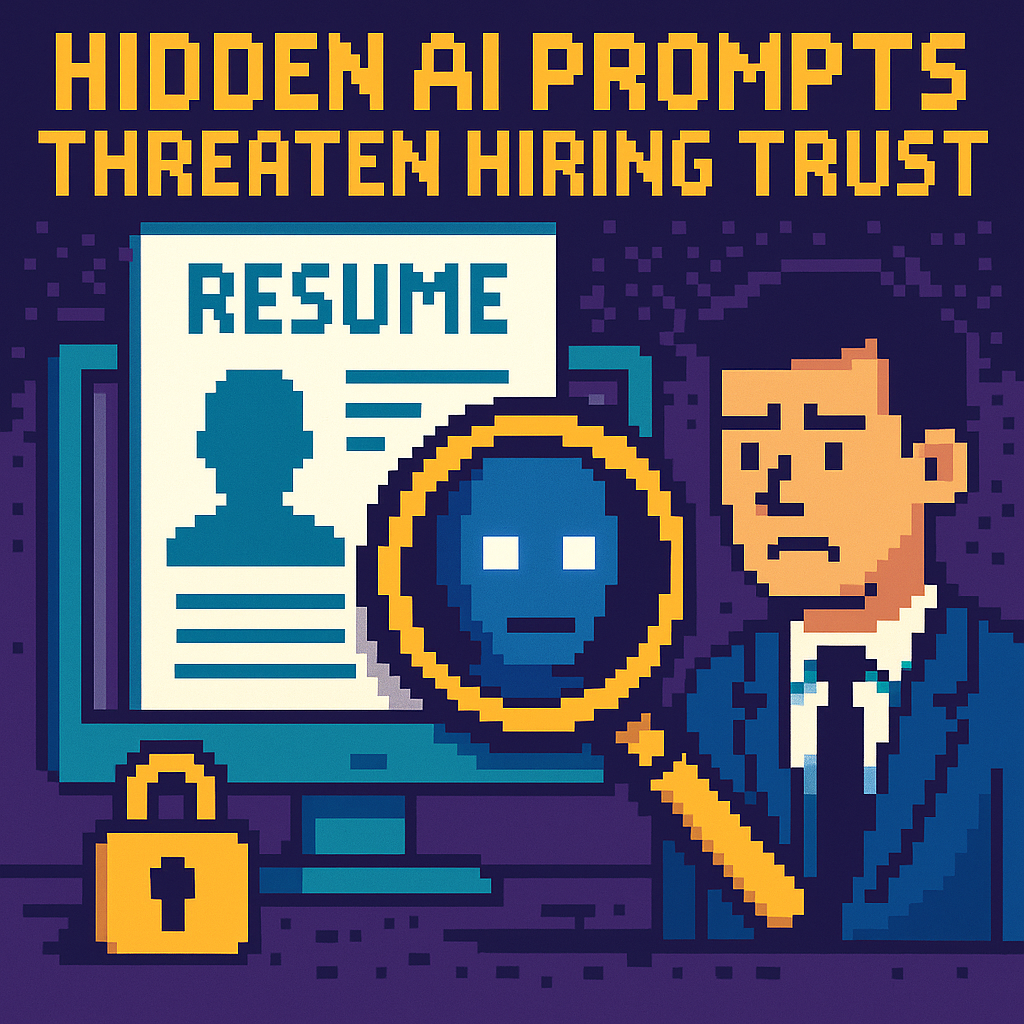
Hidden AI Prompts Threaten Hiring Trust | Analysis by Brian Moineau

TL;DR

  • Resume prompt injection is spilling from hacker forums into hiring pipelines; a Duke-led, USENIX Security 2026 study measured ~1% of 196,682 real resumes on hireEZ with hidden commands aimed at AI screeners. [2][3]
  • The near-term business risk isn’t “rogue candidates” winning jobs; it’s compliance, discovery, and reputational fallout for employers running brittle stacks in jurisdictions like New York City under Local Law 144 (effective July 5, 2023). [4][5]
  • Expect a vendor arms race: ATS and parsing tools will market “injection-resilient” screening, echoing how Google sanctioned white-text SEO tricks in the 2000s—only this time, audits and regulators are in the loop. [3][4][7]

What the source said

Business Insider (September 2026) reports that some job seekers are hiding AI prompts in white text on resumes to influence screening tools, with examples from small tech employers that caught and rejected applicants after detecting 1,500-character instructions urging systems to “ignore prior instructions” and rank the candidate as top-tier. It cites a May 2026 academic analysis of nearly 200,000 resumes estimating roughly 1% contained hidden prompt injections, attributing the dataset to hireEZ. [1][2][3] Recruiters in the report describe the tactic as an ethical red flag and say volume—not just AI—keeps many applications from human review. Employers are beginning to scan for injections, and some candidates have been blocked from reapplying after discovery. [1]

Why it matters

Three stakeholders sit on the fault line. First, employers and ATS vendors (Workday, Greenhouse, hireEZ, and others) shoulder legal and reputational risk if algorithmic decisions—even briefly—are steered by hidden instructions; this intersects with NYC’s Local Law 144 bias-audit regime and EEOC technical assistance under Title VII and the ADA. [4][5]

Second, applicants risk permanent blacklisting and, in regulated industries like finance and defense, negative inferences about integrity if hidden text shows up in discovery; third, regulators at NYC DCWP and the U.S. EEOC gain a visible, jury-friendly example of deception, reinforcing why Title VII (1964) and Local Law 144 oversight apply to AI-driven screening. [4][5]

Original analysis

Resume prompt injection is less about “cheating to the top” and more about an unforced error in enterprise risk management: too many hiring stacks let untrusted, invisible text flow from PDFs into LLM screeners (e.g., GPT-4-class models in 2026) that rank humans.

Contrarian read. Consensus: “It’s a gimmick; recruiters won’t be fooled.” My read: the tactic’s business impact is real because governance, not gullibility, is on trial. The Duke/USENIX team measures a nontrivial base rate—~1% across 196,682 resumes on hireEZ—and finds many injections are subtle “data injections” that detectors miss, not just explicit “ignore all instructions.” That’s enough to contaminate audit trails and invite legal second-guessing about any ranking produced by LLM screeners. [2][3]

Back-of-envelope math. Use the measured prevalence to bound exposure:

  • If injection prevalence is ~1% in the wild, then for every 100,000 applications touching an LLM screener, expect ~1,000 injected resumes. [2][3]
  • Suppose an employer operates in NYC and must post annual bias-audit results under Local Law 144; if 1,000 injected documents shift selection rates by even 0.2–0.5 percentage points across EEO-1 categories in requisitions of 5,000–10,000 applicants, audit ratios can move enough to require explanations and remediation plans. [4]

2×2: Where this actually breaks. Below is a mapping of two injection types observed in the 196,682-resume dataset against two stack conditions. [3]

  • Fragile stack (naive parsing + direct LLM prompts):
    • Instruction injection (“ignore prior instructions…”): High risk of rank inflation; often easy to detect after the fact; reputational harm when leaked. [2][3]
    • Data injection (invisible skills, job description clones): Silent distortions to embeddings and scoring; detector blind spots; bias-audit noise. [3]
  • Hardened stack (sanitization + policy-enforced LLM):
    • Instruction injection: Largely neutralized by prompt isolation, content filters, and allowlists; audit logs should show neutralization. [6]
    • Data injection: Reduced via PDF-to-text canonicalization, visibility checks, and parser diffing; flagged as “non-rendered text” and scored separately. [6]

Historical analogue. Early-2000s SEO saw “white text on white background” to game search crawlers; by 2005, Google’s Webmaster Guidelines explicitly banned hidden text and issued manual actions that flipped the economics of spam. Expect ATS/LLM vendors to copy this playbook: canonicalize inputs, penalize invisible text, and surface provenance in audit UIs. [7]

Named-stakeholder breakdown.

  • hireEZ: Collaborated on the 196,682-resume study; now positioned to sell “injection-aware” pipelines and detectors across its customer base. [3]
  • Workday: Already under litigation scrutiny over alleged algorithmic bias in hiring (e.g., a 2023 class action filing); injection risk adds another reliability question for audits and discovery. [8]
  • NYC DCWP (Local Law 144): Enforcement body with a tangible, testable failure mode (hidden text in resumes) to probe in audits and guidance updates. [4]
  • EEOC: Its Title VII/ADA technical assistance in 2023–2024 puts employers on notice; ignoring known injection vectors looks increasingly negligent. [5]
  • Lattice and InnoCaption (from the BI reporting): HR platform and small employer voices framing the ethics narrative—useful bellwethers for sentiment among buyers. [1]

What good defense looks like—concretely: treat resumes as hostile documents. Strip non-rendered text; flag nonstandard layers; block color-equal-to-background; normalize fonts; hash and quarantine deltas between rendered and extracted text; separate “rendered” from “extracted-only” tokens in scoring; run allowlists for instruction tokens; and require human review whenever invisible content exceeds a threshold; these are mundane, auditable controls aligned with NIST AI risk management and supply-chain hygiene. [6]

What others are missing

The overlooked angle is parser provenance. Most coverage focuses on “what the LLM did,” but the decisive control point is the PDF-to-text bridge and DOM normalizers upstream of any model: PDFMiner, Tesseract-OCR, and browser-based renderers produce different token streams from the same file, and injection lives in those ambiguities. If your audit and bias metrics ride on parser output that includes invisible layers, your “AI” audit is really a parser audit; DCWP and plaintiffs’ attorneys will ask which parser and version ran on which date, and whether non-rendered text was segregated from scoring features. [4][6]

What to watch next

  1. By Q1 2027, at least two major ATS vendors will add “injection-resilience” or “invisible-text quarantine” as named features in public release notes or marketing materials. [2][4]

  2. By Q2 2027, NYC DCWP will publish clarifying guidance or bring an enforcement action referencing invisible or non-rendered resume content affecting AEDT bias audits under Local Law 144. [4]

  3. By the U.S. hiring season in Fall 2027, at least one plaintiff-side filing will cite prompt injection or invisible-resume content to challenge the reliability of an employer’s AI-driven screening decision path; a court docket entry will document the claim. [5]

My take

I don’t buy the “savvy applicant” narrative. Hiding instructions in a resume is 2003-grade SEO spam pushed into a 2026 hiring stack. The winners here won’t be the sneaks; they’ll be vendors who render invisible text inert, log it cleanly for audits, and help employers pass bias and security sniff tests. If your pipeline lets non-rendered strings touch rankings, you’re not running AI—you’re running a liability; put a kill switch between parsers and models this quarter, or prepare to explain invisible content to auditors, regulators, and juries next year.

Sources

  1. The risky new résumé hack that some applicants are trying to get noticed — Business Insider (https://www.businessinsider.com/resume-ai-prompt-injection-applicants-job-search-2026-9#article) — Reporting on hidden AI prompts in resumes, real employer reactions, and a cited ~1% injection rate in a large-scale study.

  2. Tricking AI in the Job Hunt — Duke Today (https://today.duke.edu/2026/08/tricking-ai-job-hunt) — University write-up summarizing the large-scale analysis: ~1% of ~200,000 real resumes on hireEZ contained hidden instructions.

  3. Measuring Real-World Prompt Injection Attacks in LLM-based Resume Screening — USENIX Security 2026 (https://www.usenix.org/conference/usenixsecurity26/presentation/zhang-mohan) — Conference page for the Duke-led, hireEZ-collab study (196,682 resumes), underpinning prevalence and detection findings.

  4. Automated Employment Decision Tools (AEDT) — NYC Department of Consumer and Worker Protection (https://www.nyc.gov/site/dca/about/automated-employment-decision-tools.page) — Official overview of Local Law 144 requirements (annual bias audits, public posting, candidate notices) in effect since July 5, 2023.

  5. EEOC: Assessing Adverse Impact in Software, Algorithms, and AI Under Title VII; ADA AI Guidance — U.S. EEOC & DOJ (https://content.govdelivery.com/accounts/USEEOC/bulletins/35b435e) and (https://www.ada.gov/resources/ai-guidance/) — Federal technical assistance (2023–2024) framing employers’ obligations when AI influences hiring decisions.

  6. NIST AI Risk Management guidance (AI 100-2e2023) — NIST (https://nvlpubs.nist.gov/nistpubs/ai/NIST.AI.100-2e2023.pdf) — Enumerates prompt injection and supply-chain attack surfaces; maps practical mitigations for hiring pipelines.

  7. Spam Policies for Google Search: Hidden text or link abuse — Google Search Central (https://developers.google.com/search/docs/essentials/spam-policies) — Historical analogue: hidden-text manipulations are explicitly sanctioned in web search, a precedent for how platforms respond to deceptive, non-rendered content.

  8. Workday sued in class action over alleged bias in hiring screening tools — Reuters (2023-08-18) (https://www.reuters.com/legal/workday-sued-class-action-over-alleged-bias-hiring-screening-tools-2023-08-18/) — Establishes ongoing litigation scrutiny around ATS/AI hiring bias relevant to audit and discovery risk.


Related update: We recently published an article that expands on this topic: read the latest post.


Related update: We recently published an article that expands on this topic: read the latest post.

Epic nabs Fortnite leaker, seals deal | Analysis by Brian Moineau

TL;DR

  • Epic settled with ex-contractor Hayden Cohen over Fortnite leaks: a proposed court injunction would permanently bar Cohen from handling Epic Games’ confidential info, with no monetary relief disclosed—deterrence now runs through the Defend Trade Secrets Act (DTSA), not damages [1][2][4].
  • The core risk wasn’t a few skins; it was partner trust—brands like South Park, Minecraft (Mojang/Microsoft), and Overwatch (Blizzard) don’t tolerate surprise-killing leaks that derail synchronized co-marketing plans [1].
  • An injunction-first deal can be smarter than a damages fight: it avoids discovery that could surface partner decks and drafts, while creating a personal tripwire for any future breach under 18 U.S.C. § 1836 [2][4].

What the source said

Video Games Chronicle reported that Epic Games reached a settlement with Hayden Cohen, a former associate producer accused in March 2026 of leaking upcoming collaborations—South Park, Minecraft, and Overwatch—via an X account that gained roughly 13,000 followers before deletion [1]. The deal seeks a stipulated court injunction barring Cohen from possessing, accessing, using, or disclosing Epic’s confidential or trade secret information [1]. PC Gamer corroborated that the filing mentions no monetary relief, and Epic declined to comment on damages [2]. Epic spokesperson Natalie Munoz said the company sought the injunction “to ensure [Cohen] cannot publish or share Epic’s confidential information again” [1].

Why it matters

Three constituencies are on the line. First, Epic’s live-service cadence: Fortnite relies on tightly timed “surprise” drops that lift Item Shop conversions and engagement each season; a reliable insider leak collapses that timing [1]. Second, IP partners like Mojang/Microsoft (Minecraft), Blizzard (Overwatch), and South Park’s rights holders budget around synchronized beats; early spoilers blunt conversion and trigger contractual friction [1]. Third, the creator economy orbiting Fortnite—Support-A-Creator affiliates, Twitch streamers, and YouTube channels—plans sponsor slots and programming around reveal windows.

The settlement also draws a bright line between datamining and insider misappropriation. Datamining scrapes assets already in public builds; insider leaks extract pre-build plans and partner decks. Under the DTSA, federal courts can tailor injunctions to halt threatened misappropriation, which is exactly what Epic is asking the court to endorse here [4].

Original analysis

The consensus—and why it’s wrong

  • Consensus: “No damages? Then the Fortnite leaker settlement is a slap on the wrist.”
  • Contrarian read: a permanent injunction is the sharper penalty. Why?
    • It’s individualized and enforceable: violate it and you face contempt or enhanced DTSA remedies without relitigating liability; courts treat injunction breaches as defiance of the court itself [4].
    • It preserves partner confidence without messy discovery: depositions and brand-deck productions would risk fresh leaks. An injunction locks the door; a damages trial opens the blinds. That trade-off is rational for Epic and for licensors who prefer to stay out of the record [2][4].

Back-of-envelope: what a “spoiled” collab can cost (hypothetical scale)

  • Anchor: Sacra estimates Epic’s 2024 revenue at about $5.7 billion, with Fortnite as the driver [5].
  • Hypothesis: If diminished “surprise” clips even 0.5% of annual monetization across a few anchor drops, then:
    • $5.7B × 0.5% = $28.5M at risk in a year (scale illustration, not a damages claim) [5].

2x2: leak types Epic actually cares about

  • Axis A (Epic info location): internal systems vs. public game builds [4].

  • Axis B (timing window): pre-build plans vs. in-build assets, which dictates DTSA exposure and PR risk [4].

  • Insider pre-build (most severe): Internal roadmaps, partner pitch decks, and code names—what Epic alleged here. Consequence: direct DTSA exposure and reputational damage with licensors [2][4].

  • Insider in-build: Early access to staging/QA branches; still severe (see Epic’s 2019 case vs. a tester who leaked the Chapter 2 map) [6].

  • Public in-build (datamining): Players parse shipped binaries; often tolerated unless it prematurely reveals licensed IP like South Park or Minecraft [1].

  • External partner leak: Retail listings or vendor packshots. Contractual friction and takedowns usually contain it, but timing damage still lands [1].

Cohen’s case sits top-left (insider/pre-build), which explains a push for a permanent injunction rather than a headline damages number that would prolong attention on the leaks [1][2][4][6].

Historical analogue: Pokémon’s 2021 hammer vs. leakers

In 2021, The Pokémon Company secured $150,000 apiece from two Sword and Shield leakers who posted strategy-guide images ahead of launch, showing courts will back meaningful monetary penalties tied to pre-release marketing assets [7]. Epic’s path differs—favoring a stipulated injunction—but the throughline is similar: when surprise becomes product, premature disclosure is framed and treated as trade secret misappropriation under federal or state law [4][7].

Named-stakeholder breakdown

  • Epic Games: An injunction-centric outcome delivers a standing enforcement tool and reduces discovery that could expose internal processes or partner contracts. It also signals to staff and contractors that DTSA remedies—not just NDAs—govern insider conduct [2][4].
  • Microsoft/Mojang and Blizzard (Minecraft, Overwatch): Fewer uncontrolled spoilers mean cleaner timing across Xbox, Battle.net, and social beats, stabilizing conversion models for Item Shop windows and Twitch drops [1].
  • South Park rights holders (e.g., South Park Digital Studios/Paramount affiliates): Comedy IP depends on reveal timing; leaks dull punchlines. A consistent legal posture from Epic lowers brand risk on future crossovers [1].
  • “Leak economy” accounts on X/Discord: A federal injunction targeting an alleged insider shifts risk: amplify a known-insider leak and you may face subpoenas or preservation demands, even if you never touched Epic systems [2][4].
  • Competing publishers: Expect imitation. Nintendo, The Pokémon Company, and Epic are converging on a norm: escalate insider cases under DTSA or equivalents, reserve PR-friendly takedowns for datamining [6][7].

Why the Fortnite leaker settlement is more than PR cleanup

Epic’s complaint was filed March 5, 2026, in the Eastern District of North Carolina (Case No. 5:26-cv-00135-BO) and alleges Cohen—operating AdiraFN/AdiraFNInfo—“repeatedly misappropriated Epic’s trade secret information” via X and Discord while bound by an NDA, seeking injunctive relief plus compensatory damages and fees [3]. The proposed deal delivers the first ask: a court-ordered ban on accessing or sharing Epic’s confidential info, which removes the account’s unique edge [1][2][3]. Without insider pre-build access, any future presence would devolve into ordinary datamining rather than live-plan disclosure [1]. Under 18 U.S.C. § 1836, injunctions must be based on evidence of threatened misappropriation, cannot be used to bar employment per se, and can be paired with royalties or damages for future misuse—deterrence that follows the defendant across jobs and platforms [4].

What others are missing

Coverage focused on the absence of a damages figure. The overlooked angle is discovery risk management: a full-dress damages trial could force emails, roadmaps, or draft licensing terms into the record, compounding exposure for South Park Digital Studios, Mojang, and Blizzard. By securing a stipulated injunction under a federal statute tailored to trade secrets, Epic minimizes the chance of partner materials hitting PACER or the tech press while still obtaining ongoing relief [1][2][4].

What to watch next

  1. By Q3 2026, Epic will update contractor NDAs and onboarding to cite DTSA remedies and ex parte seizure provisions, and at least one hire will publicly reference these changes in job docs or a LinkedIn post.
  2. By Q4 2026, at least one major publisher besides Epic will file a DTSA-centered complaint against an insider leaker tied to a live-service crossover, with the primary prayer for relief being a permanent injunction.
  3. By Q2 2027, a Fortnite partner named in the 2026 leaks (Minecraft, Overwatch, or South Park) will run a synchronized relaunch or “reprise” event, confirming partner retention post-settlement.

My take

Epic picked the right hill to hold. A clean, court-backed injunction beats a pyrrhic damages press release that trades headlines for discovery risk [2][4]. When Fortnite remains a multibillion-dollar franchise on 2024 revenue estimates, even small percentage swings justify aggressive timing protection [5]. I expect more studios to mirror this template: move fast in federal court, lock the injunction, and starve the leak economy of its only real edge [2][4].

Sources

  1. Epic settles with Fortnite leaker who shared South Park, Minecraft and Overwatch collabs — Video Games Chronicle (https://www.videogameschronicle.com/news/epic-settles-with-fortnite-leaker-who-shared-south-park-minecraft-and-overwatch-collabs/) — Baseline report on the settlement, brands implicated, follower count, and Epic’s on-record statement.
  2. Epic reaches lawsuit settlement with former contractor who was also a notorious Fortnite leaker — PC Gamer (https://www.pcgamer.com/games/epic-reaches-lawsuit-settlement-with-former-contractor-who-was-also-a-notorious-fortnite-leaker/) — Confirms proposed settlement terms (permanent bar via injunction), timing, and lack of disclosed monetary relief.
  3. Complaint, Epic Games, Inc. v. Hayden Cohen (Case 5:26-cv-00135-BO) — DocumentCloud (https://s3.documentcloud.org/documents/27772901/epic-games-v-hayden-cohen-complaint.pdf) — Primary filing establishing venue, allegations of insider misappropriation, and requests for injunctive relief and damages.
  4. 18 U.S.C. § 1836 (Defend Trade Secrets Act) — Cornell Law School Legal Information Institute (https://www.law.cornell.edu/uscode/text/18/1836) — Statutory basis for injunctions and remedies in federal trade secret cases; explains the potency of tailored injunctive relief.
  5. Epic Games revenue estimate 2024 — Sacra (https://sacra.com/c/epic-games/) — Independent estimate used to size the hypothetical financial impact from “spoiled” surprise drops.
  6. Epic sues tester over Fortnite Chapter 2 leaks — Video Games Chronicle (https://www.videogameschronicle.com/news/epic-sues-tester-over-fortnite-chapter-2-leaks/) — Context on Epic’s prior insider-leak litigation in 2019 against a QA tester.
  7. Pokémon Sword and Shield leakers to pay $150,000 each — GameSpot (https://www.gamespot.com/articles/pokemon-sword-and-shield-leakers-to-pay-150000-each-to-nintendo-for-damages/1100-6493184/) — Historical analogue showing courts awarding significant damages for pre-release marketing asset leaks.