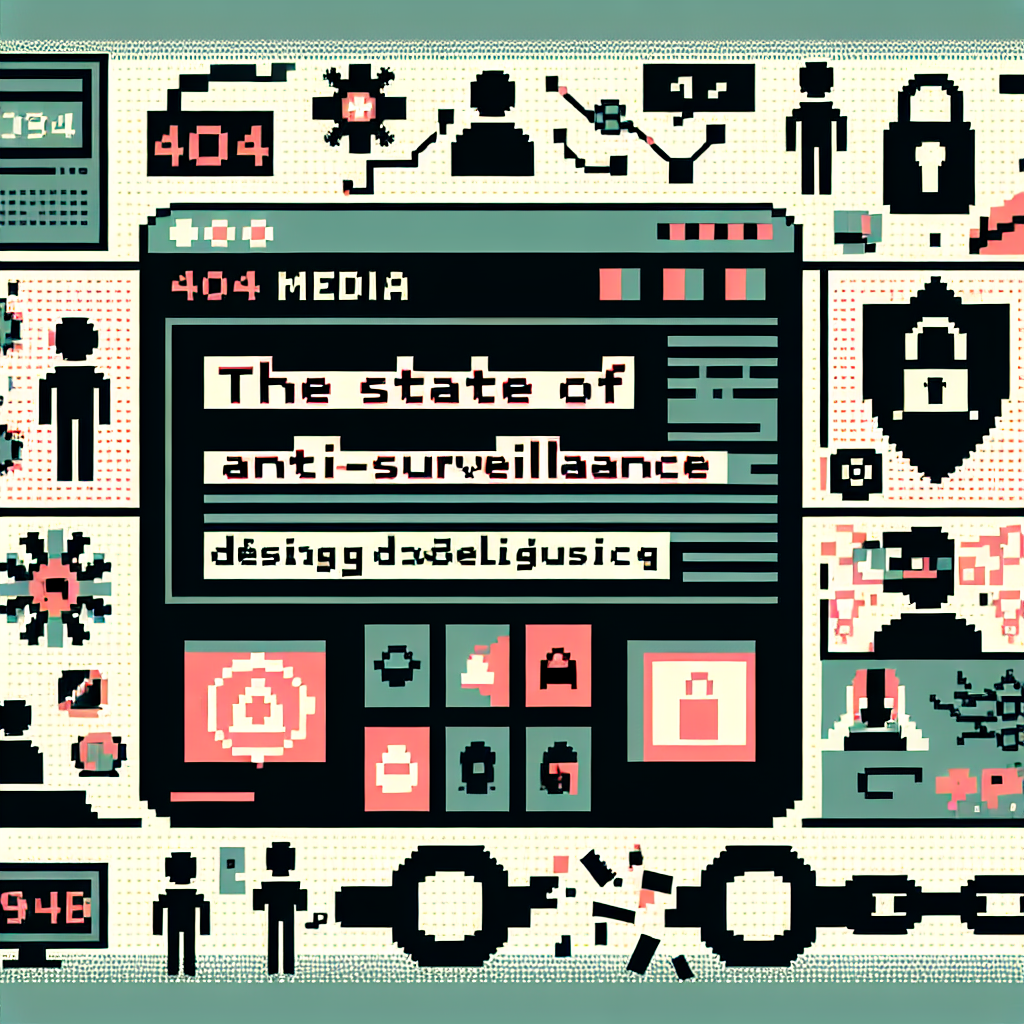
Everyday Clothes That Beat Surveillance | Analysis by Brian Moineau

The most effective anti‑surveillance gear might already be in your closet

Intro hook

You’ve seen the flashy anti‑surveillance hoodies and the pixelated face scarves in viral posts — the kind of gear that promises to “break” facial recognition. But the quiet truth, as Samantha Cole reports in 404 Media, is less glamorous and more practical: some of the best ways to evade automated identification are ordinary items people already own, and the cat-and-mouse game between designers and algorithms is changing faster than fashion trends.

Why this matters now

  • Surveillance systems powered by face recognition and other biometrics are no longer lab curiosities. Police departments, immigration authorities, and private companies routinely deploy models trained on billions of images.
  • The tactics that once worked (painted faces, printed patterns) often have a short shelf life. Algorithms evolve, datasets expand, and a design that confused an older model can fail against a current one.
  • Meanwhile, events over the last decade — from the post‑9/11 surveillance build‑out to the explosion of commercial biometric datasets — have created an environment where everyday movement can be tracked and matched by algorithmic tools.

What 404 Media reported

  • The article traces the evolution of anti‑surveillance design from early projects like “CV Dazzle” (high‑contrast face paint and hairstyles meant to confuse early algorithms) to modern interventions.
  • Adam Harvey and others have experimented with a wide range of approaches: adversarial clothing patterns, heat‑obscuring textiles for drones, Faraday pockets for phones, and LED arrays for camera glare.
  • Many commercial anti‑surveillance garments — often expensive and aesthetic — rely on 2D printed patterns that may only briefly succeed against specific systems in controlled conditions.
  • Simple, mainstream items (for example, cloth face masks or sunglasses) can meaningfully reduce recognition accuracy, especially when algorithms aren’t explicitly trained for masked faces or occlusions.

What the research and experts add

  • Masks and other occlusions do impact face recognition accuracy. Government and scientific studies during and after the COVID era showed that masks reduced performance for many algorithms, with variability across models. (NIST and related analyses documented substantial drops in accuracy for masked faces across multiple systems.) (epic.org)
  • Researchers have developed “adversarial masks” — patterned masks specifically optimized to break modern models — and some physical tests show these can dramatically lower match rates in narrow settings. But transferability is a problem: patterns optimized on one model may not work on another, and real‑world lighting, camera angle, and motion complicate things. (arxiv.org)
  • Beyond faces, systems increasingly rely on indirect biometric signals (gait, clothing, body shape, contextual tracking across cameras). Hiding a face doesn’t eliminate those other fingerprints; blending in is often more effective than standing out.

Practical, realistic anti‑surveillance strategies

  • Use ordinary items strategically.
    • Cloth masks and sunglasses: They reduce facial detail and can lower identification accuracy for many models, especially if those models were trained on unmasked faces. (epic.org)
    • Hats, scarves, hoods: Useful for obscuring angles or features; effectiveness varies with camera placement and algorithm robustness.
  • Favor blending over spectacle.
    • High‑contrast, attention‑grabbing patterns can create unique, trackable signatures. In many situations you want to be inconspicuous, not conspicuous.
  • Remember context matters.
    • Surveillance systems often fuse multiple cues (face, gait, time, location). One trick rarely makes you invisible.
  • Protect the data you carry.
    • Faraday pouches for devices, selective disabling of location services, and careful app permissions help reduce digital traces that link you to camera sightings.
  • Consider threat model and legal environment.
    • Different tactics suit different risks. Techniques that help everyday privacy are not the same as methods someone under active legal or state surveillance might need. Laws and local rules (e.g., rules about masking, obstruction) also vary.

The investor’s and designer’s dilemma

  • Anti‑surveillance design sits at an odd intersection of ethics, fashion, and engineering.
    • Designers want usable, attractive products.
    • Security researchers want robust adversarial techniques that generalize across models.
    • Consumers want affordable, practical solutions that won’t mark them as an outlier or get them hassled.
  • The market incentives are weak: a product that works yesterday can be obsolete tomorrow. That makes sustainable funding and broad adoption difficult.

Key points to remember

  • Ordinary clothing items — masks, sunglasses, hats — can still provide meaningful privacy benefits against many facial recognition models. (404media.co)
  • High‑profile adversarial wearables are often brittle: they may fail when algorithms or environmental conditions change. (404media.co)
  • Systems are moving beyond faces: gait, clothing, and cross‑camera linking reduce the protective power of any single tactic.
  • Blending in and reducing digital traces often provide better practical privacy than trying to “beat” recognition with gimmicks.

My take

There’s an appealing romance to specialized anti‑surveillance fashion: it promises the drama of outsmarting surveillance with a bold garment. But the more useful, defensible privacy moves are quieter and more mundane. A cloth mask, a hat pulled low, smart device hygiene, and awareness of how you move through spaces are all things people can use today. Real protection comes from a mix of personal practices and policy: better product choices buy you minutes or hours of anonymity, while public pressure, oversight, and bans on reckless biometric use create lasting impact.

Sources


Related update: We recently published an article that expands on this topic: read the latest post.

Related update: We recently published an article that expands on this topic: read the latest post.

NFL Top 100 countdown begins Monday: Who are contenders for No. 1 spot? – NFL.com | Analysis by Brian Moineau

NFL Top 100 countdown begins Monday: Who are contenders for No. 1 spot? - NFL.com | Analysis by Brian Moineau

The NFL Top 100 Countdown: A Quest for Gridiron Glory


Ladies and gentlemen, gather 'round! It's that time of year again when the pigskin pundits and gridiron gurus unite to celebrate the titans of the field. Yes, the NFL Top 100 countdown is back, marking its 15th consecutive year of honoring the crème de la crème of the football world. As current league players cast their votes, the burning question remains: who will claim the coveted No. 1 spot?

The Contenders: A Cavalcade of Talent


In the quest for the top spot, a few names naturally rise to the forefront. Chiefs' quarterback Patrick Mahomes, the league's reigning MVP, is undoubtedly a favorite. With his uncanny ability to throw from any angle and lead his team to victory, Mahomes has become a household name. But let’s not forget about Aaron Donald, the Rams' defensive juggernaut whose strength and agility make him a formidable force. Then there's Derrick Henry, the Titans' powerhouse running back who steamrolls defenders with ease.

The Portrait of a Top Player


While the fanfare surrounding these superstar athletes is palpable, it's essential to remember that the Top 100 isn't just about stats and championships. Players often vote based on respect and the impact a competitor has on the field. This human element adds a layer of intrigue, making the countdown not only a numerical ranking but a reflection of the players' admiration for their peers.

Connecting the Dots: Sports and Society


Interestingly, this countdown occurs amid broader societal events that echo some of the themes found within the NFL. As the world becomes more interconnected, the emphasis on collaboration and mutual respect in various sectors—from business to social activism—mirrors the NFL's internal voting process. It’s a reminder that recognition is not just about personal achievements but also about how one's efforts resonate with others.

Beyond the Field


Take Patrick Mahomes, for example. Off the field, he's been involved in numerous charitable endeavors, including initiatives to improve voter turnout and support underprivileged communities. His influence extends beyond his on-field heroics, inspiring both fans and fellow athletes. The same can be said for other top contenders, who use their platforms to advocate for change and give back to society.

A Final Thought


As the countdown unfolds and anticipation builds, it's worth reflecting on what makes this tradition so captivating. Whether it’s the thrill of competition, the appreciation of skill, or the acknowledgment of sportsmanship, the NFL Top 100 is a celebration of excellence in all its forms. It’s a testament to the enduring allure of the game and the players who make it extraordinary.

So, as the votes are tallied and the rankings revealed, let's enjoy the spectacle and celebrate the athletes who, week after week, remind us why we love this game. Here’s to another year of unforgettable moments and the players who make them possible.

Here's to the thrill of the game and the heroes of the gridiron!

Read more about AI in Business

Read more about Latest Sports Trends

Read more about Technology Innovations

Here come the glassholes, part II – Financial Times | Analysis by Brian Moineau

Here come the glassholes, part II - Financial Times | Analysis by Brian Moineau

Title: The Return of the Glassholes: Will Facial Recognition in Smart Glasses Ever Be a Good Look?

Ah, smart glasses. Remember the early 2010s when Google Glass promised to revolutionize how we view the world? Instead, it gifted us a new term - "glassholes" - for those who wore them with a bit too much enthusiasm, often at the expense of social norms. Fast forward to today, and we're on the brink of a sequel, thanks to the latest tech trend: integrating facial recognition into smart glasses.

Silicon Valley's dreamers are once again at the forefront, eagerly pushing the boundaries of what's technologically possible. But will their vision align with societal acceptance? If history has taught us anything, it's that the path from innovation to integration is often fraught with unforeseen twists.

The Tech Temptation


Facial recognition technology is no stranger to controversy. While its applications can be groundbreaking, such as aiding law enforcement or streamlining airport security, it also raises significant privacy concerns. Incorporating it into smart glasses could let users identify strangers on the street, an appeal to some, but a potential invasion of privacy to many others.

Consider the recent pushback against facial recognition in public spaces. Cities like San Francisco and Portland have already enacted bans on its use by government agencies, citing concerns over accuracy, bias, and civil liberties. If public sentiment is any indication, adding this feature to smart glasses may not be as warmly received as some tech enthusiasts hope.

A World Already on Edge


The timing of this innovation is particularly noteworthy. We're living in a world increasingly conscious of privacy, driven by revelations of data breaches and surveillance. The Cambridge Analytica scandal, which revealed how personal data could be weaponized, has made people more protective of their digital footprints.

Moreover, the COVID-19 pandemic has accelerated our dependence on technology, while simultaneously highlighting the importance of personal space and privacy. As we navigate this new normal, the idea of being constantly watched, even if just through a pair of glasses, might not sit well with the public.

Echoes of Innovation


This isn't the first time tech has faced resistance before eventual acceptance. The smartphone, now an indispensable part of daily life, was once met with skepticism. However, those devices offered clear, immediate benefits that outweighed privacy concerns for most users. Smart glasses with facial recognition, on the other hand, are yet to make a compelling case for how they will enhance, rather than intrude upon, our lives.

The Broader Implications


Beyond privacy, there's the question of social etiquette. How will society adapt to a world where anyone can know your name with a glance? The potential for misuse is high, from unwanted advances to more sinister applications like stalking or doxing.

Interestingly, this debate parallels discussions in other tech domains. Take, for example, the rise of AI-driven customer service bots. While they promise efficiency, they also risk depersonalizing interactions. Similarly, smart glasses must balance innovation with the human element, ensuring they serve rather than disrupt society.

Final Thoughts


As we stand on the precipice of another potential technological leap, it's crucial to remember that just because we can do something doesn't mean we should. The allure of smart glasses with facial recognition is undeniable, yet we must tread cautiously. Society must have a say in how this technology is developed and deployed.

In the end, perhaps the most significant lesson from the "glassholes" saga is that technology should enhance human interaction, not replace it. If smart glasses can find that balance, they might just avoid the pitfalls of their predecessors. Otherwise, we might find ourselves peering into a future where the promise of connectivity comes at the cost of our privacy.

Read more about AI in Business

Read more about Latest Sports Trends

Read more about Technology Innovations

Tech industry tried reducing AI’s pervasive bias. Now Trump wants to end its ‘woke AI’ efforts – AP News | Analysis by Brian Moineau

Tech industry tried reducing AI’s pervasive bias. Now Trump wants to end its ‘woke AI’ efforts – AP News | Analysis by Brian Moineau

Title: Navigating the Crossroads: AI, Bias, and the Quest for Balance

In a world where technology intertwines with every facet of our lives, the journey towards creating equitable AI systems has become a central narrative. Recently, the debate has taken a new turn with former President Donald Trump’s opposition to what he calls “woke AI” efforts, potentially shifting the tech industry’s direction. This development is reminiscent of a world on the brink of a technological crossroads, where the balance between innovation and ethics is more crucial than ever.

Artificial intelligence, once a fantastical concept, is now a tangible part of our everyday lives. From voice-activated assistants to personalized content recommendations, AI’s reach is extensive. However, the technology’s pervasive bias has been a point of contention, as highlighted in a recent article from AP News. The piece discusses how industry leaders, like Google, have made strides towards inclusivity by collaborating with experts, such as sociologist Ellis Monk, to ensure AI products serve a diverse global population. This drive for inclusivity isn’t just a moral imperative but also a business necessity in a world where nearly two-thirds of the population comprises people of color.

Yet, as with many progressive initiatives, resistance has emerged. Former President Trump’s call to end “woke AI” efforts reflects a broader cultural and political pushback against initiatives perceived as overly progressive or pandering to political correctness. This sentiment echoes a recurring theme in global politics, where technological advancements are scrutinized through the lenses of ideological belief.

The tech industry’s battle with bias isn’t new. As AI systems learn from vast datasets, they inadvertently mirror the prejudices embedded in those data. A well-documented example is the facial recognition technology that performs better on lighter skin tones than darker ones. This discrepancy has led to wrongful arrests and misidentifications, stirring public outcry and legislative scrutiny. It’s a reminder of the profound impact AI can have when it fails to account for diversity.

The significance of addressing AI bias extends beyond tech circles. In healthcare, biased algorithms can lead to disparities in treatment recommendations. In finance, they can affect loan approvals. The ripple effect of unaddressed bias in AI systems can perpetuate systemic inequalities, making the quest for fair AI not just a tech issue but a societal one.

Parallel to the tech world, the entertainment industry has faced similar reckonings. Hollywood, for instance, has been under pressure to diversify its storytelling and representation, recognizing the power of media to shape societal norms. The recent success of films like “Black Panther” and “Crazy Rich Asians” showcases the commercial viability of inclusivity, mirroring the tech industry’s realization that diversity drives innovation and growth.

Returning to Ellis Monk, his role in this narrative is crucial. As a sociologist and a voice for inclusivity, his contributions are a testament to the interdisciplinary approach needed to tackle AI bias. His work underscores the importance of blending social sciences with technological development to create systems that are not only efficient but also equitable.

As we stand at this technological crossroads, it’s essential to consider the broader implications of halting efforts to make AI more inclusive. While the debate over “woke AI” continues, it serves as a reminder of the delicate balance between innovation and ethics. The tech industry’s challenge is not just to create smarter systems but to ensure those systems work for everyone.

In conclusion, the journey towards inclusive AI is far from over. It requires a concerted effort from technologists, policymakers, and society at large to navigate the complexities of bias and ensure technology serves as a force for good. As we move forward, let us remember that the true measure of progress is not just in the sophistication of our technology but in its ability to uplift and empower all individuals, regardless of their background.

Read more about AI in Business

Read more about Latest Sports Trends

Read more about Technology Innovations


Related update: We recently published an article that expands on this topic: read the latest post.

Android 16 Beta lets more Pixels use screen-off fingerprint unlock – 9to5Google | Analysis by Brian Moineau

Android 16 Beta lets more Pixels use screen-off fingerprint unlock - 9to5Google | Analysis by Brian Moineau

Unlocking the Future: Android 16 Beta Expands Screen-Off Fingerprint Access to More Pixels

In the ever-evolving world of technology, Android users are eagerly embracing the latest developments, and the release of Android 16 Beta 3 (and Beta 3.1) is no exception. This update brings an exciting enhancement to the table: the ability for more Pixel devices to use screen-off fingerprint unlock. Originally a feature limited to the Pixel 9, it’s now making its way to a broader audience. This development not only enhances convenience but also aligns with broader trends in technology and security.

A Fingerprint on the Pulse of Innovation

Fingerprint technology has long been a staple in the realm of secure access, with its roots tracing back to early biometric systems. Apple made waves with Touch ID back in 2013, and since then, the technology has become a standard expectation for smartphones. Android's latest move to expand screen-off fingerprint capabilities to more Pixel devices is a testament to the ongoing commitment to user-friendly security.

This update is particularly significant in an age where cybersecurity is a growing concern. With more of our personal and financial data stored on our devices, the need for robust, yet accessible, security measures is more critical than ever. Android 16 Beta’s enhancement echoes a broader industry trend towards seamless security solutions, seen also in the rise of facial recognition and advanced encryption methods.

A Broader Context

Beyond the technical specs and user experience, this update is part of a larger narrative about how technology is evolving to meet user needs in real-time. As remote work and digital communication continue to dominate our lives, the demand for efficient and secure technology has never been higher. The expansion of features like screen-off fingerprint unlock is part of a broader push to make smartphones smarter, more secure, and ultimately, more aligned with our daily lives.

Interestingly, this development comes at a time when privacy concerns are at the forefront of public discourse. The debate over how to balance user convenience with data protection is ongoing. Companies like Google, with its Pixel line, are constantly innovating to ensure that user data remains secure without sacrificing functionality.

Connections to the World

This expansion of fingerprint technology also aligns with global shifts towards contactless solutions, accelerated by the COVID-19 pandemic. From contactless payments to touchless entry systems, the world is moving towards minimizing physical touchpoints, and screen-off fingerprint unlock fits snugly into this narrative. It’s a small, yet significant, step in a world increasingly focused on hygiene and convenience.

Additionally, we can draw parallels with the automotive industry, where keyless entry systems have become the norm. The seamless transition from physical keys to digital access mirrors what we're seeing with smartphones. Just as car manufacturers are enhancing security and ease of use, smartphone developers are doing the same, highlighting a cross-industry trend of innovation driven by user demand.

Final Thoughts

The Android 16 Beta’s expansion of screen-off fingerprint unlock to more devices is more than just a technical upgrade; it’s a reflection of a world increasingly reliant on and shaped by technology. As smartphones become ever more integral to our daily lives, the demand for intuitive and secure access methods will only grow. This update is a step forward in making technology work for us, seamlessly fitting into the fabric of our lives while ensuring that our data remains safe and accessible. In a rapidly changing world, it’s reassuring to see technology not just keeping pace, but setting the pace.

Read more about AI in Business

Read more about Latest Sports Trends

Read more about Technology Innovations