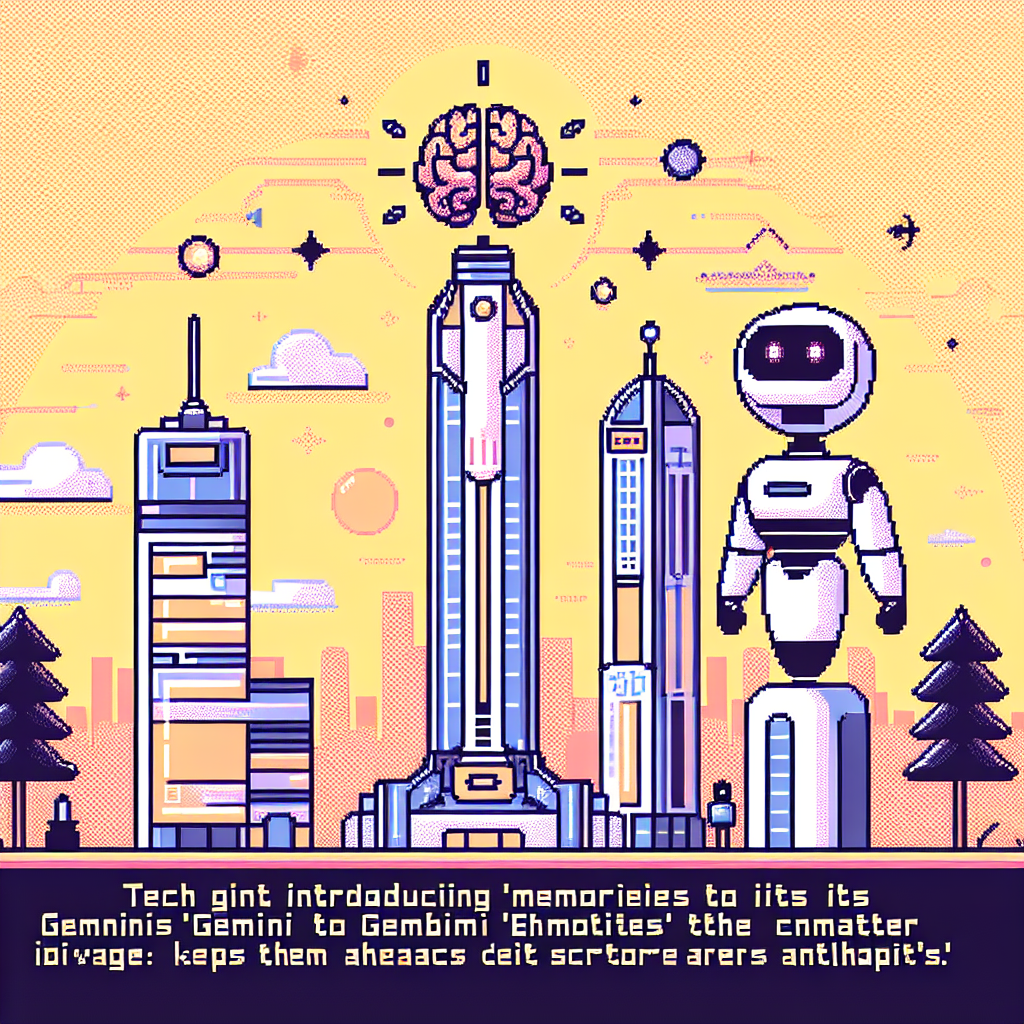
Google adds memories to the Gemini chatbot, staying a step ahead of Anthropic – Mashable | Analysis by Brian Moineau

Google adds memories to the Gemini chatbot, staying a step ahead of Anthropic - Mashable | Analysis by Brian Moineau

Title: Google’s Gemini: A Step Closer to Chatbot Sentience?

In the ever-evolving world of AI, Google’s latest move with its Gemini chatbot is creating quite a buzz. According to a recent article from Mashable, Google has introduced a memory feature to Gemini, allowing it to deliver more personalized responses. This development is not just another incremental step in AI evolution; it’s a leap towards creating chatbots that could potentially bridge the gap between human interaction and machine response.

Gemini and Its Memory: A New Era of Conversation

Imagine having a conversation with a friend who remembers every detail you’ve ever shared with them—your favorite foods, your last vacation spot, or that quirky hobby you picked up last summer. This is the vision Google is chasing with Gemini’s new memory feature. By remembering past interactions, Gemini can provide responses that are not only contextually relevant but also tailored to individual users. This personalized touch could revolutionize how we interact with AI, making it feel more human-like and intuitive.

This development places Google ahead of competitors like Anthropic, who are also racing to create the most advanced conversational agents. The addition of memory to chatbots isn’t just about improving AI; it’s about enhancing user experiences and setting new standards in digital communication.

Connecting the Dots: AI and Personalization in Today’s World

The introduction of memory to Gemini is part of a larger trend towards personalization in technology. From Netflix’s recommendation algorithms to Spotify’s curated playlists, personalization is becoming a cornerstone of modern digital experiences. It’s about creating a sense of connection and understanding between technology and users.

Interestingly, this move also comes at a time when privacy concerns are at an all-time high. As AI becomes more personalized, the balance between convenience and privacy becomes even more critical. Users are increasingly aware of how their data is used, and companies must tread carefully to maintain trust.

Beyond Chatbots: The Bigger Picture

Google’s advancements with Gemini resonate with other groundbreaking developments in the tech world. For instance, OpenAI’s GPT-4 has also been making waves with its impressive language processing capabilities, showcasing how AI can generate human-like text with remarkable accuracy. Similarly, in the autonomous vehicle industry, companies like Tesla are leveraging AI to create more intuitive and safer self-driving experiences.

Moreover, the gaming industry is seeing a surge in AI-driven characters that adapt to player behavior, adding layers of complexity and engagement to gaming narratives. These developments are not isolated; they are indicative of a broader AI renaissance, where machines are not just tools but collaborators in human endeavors.

Final Thoughts: The Future of AI Interaction

As Google continues to refine Gemini’s capabilities, the potential for AI to transform how we interact with technology is immense. While we’re not quite at the stage of having fully sentient AI companions, each advancement brings us closer to a future where technology seamlessly integrates into our lives, understanding and anticipating our needs.

However, as we embrace these innovations, it’s crucial to remain vigilant about ethical considerations and data privacy. The dialogue between convenience and security will continue to shape the trajectory of AI development.

In conclusion, Google’s Gemini, with its newfound memory, is more than just a chatbot; it’s a glimpse into the future of human-machine interaction—a future that promises to be as exciting as it is challenging. As we navigate this rapidly changing landscape, one thing is certain: the conversation about AI, its capabilities, and its impact on society is just getting started.

Read more about AI in Business
Read more about Latest Sports Trends

Read more about Technology Innovations

OpenAI announces GPT-4.5, warns it’s not a frontier AI model – The Verge | Analysis by Brian Moineau

OpenAI announces GPT-4.5, warns it’s not a frontier AI model - The Verge | Analysis by Brian Moineau

**Title: GPT-4.5: A New Star in the AI Cosmos or Just Another Satellite?**

In the ever-evolving universe of artificial intelligence, the announcement of a new model is akin to the discovery of a new celestial body. OpenAI recently unveiled GPT-4.5, codenamed Orion, a name that conjures images of starry constellations and cosmic wonders. But while the name may suggest a groundbreaking leap, OpenAI has been candid in stating that GPT-4.5 is not a frontier AI model. This revelation invites both intrigue and speculation: what exactly is GPT-4.5, and where does it position itself within the constellation of AI advancements?

**Orion: Shining Bright, But Not a Supernova**

In astronomical terms, a frontier model would be like a supernova, exploding with new capabilities and redefining what we know about AI. GPT-4.5, however, is more like a steadily burning star, enhancing existing features but not revolutionizing the field. This isn't to diminish its significance; any iteration in AI is a step toward more sophisticated and nuanced interactions between humans and machines.

OpenAI has positioned GPT-4.5 as a bridge between GPT-4 and the much-anticipated GPT-5, offering incremental improvements in language understanding and generation. This strategic move mirrors the tech industry's broader trend of iterative upgrades, akin to Apple's annual iPhone releases, where each new model refines and builds upon its predecessor rather than reimagining the wheel.

**A Broader Canvas of AI Developments**

While GPT-4.5 itself may not be a frontier model, its introduction is emblematic of the rapid pace of AI development. Just as the world has seen with advancements in robotics—like Boston Dynamics' ever-improving Atlas robot—progress often comes in steps rather than leaps. Each step, however, is crucial for the eventual leap.

Similarly, AI's role in creative fields, such as music and art, has been expanding. Take, for example, AI-generated music platforms that blend human creativity with machine learning to produce new soundscapes, or AI art exhibits that challenge our understanding of creativity itself. These applications highlight AI's growing presence and its potential to augment, rather than replace, human ingenuity.

**A Constellation of Ethical Considerations**

With each new AI model, ethical considerations loom large. The introduction of GPT-4.5 is no exception. As AI becomes more integrated into our daily lives, questions around data privacy, algorithmic bias, and the potential for misuse become ever more pressing. The tech community, policymakers, and society at large must navigate these challenges collaboratively to ensure AI's benefits are maximized while minimizing its risks.

**Final Thought: Navigating the AI Cosmos**

The launch of GPT-4.5, or Orion, is a reminder that in the vast cosmos of technological advancement, not every new star is a supernova. Yet, each one contributes to the broader tapestry of innovation. As we await the eventual arrival of GPT-5, or watch other tech giants unveil their AI models, it's crucial to appreciate these developments for what they are: important steps in a long journey toward a more advanced and integrated technological future.

In a world where technology is as much a part of our lives as the air we breathe, staying informed and engaged with these developments is not just beneficial—it's essential. So, while GPT-4.5 may not be the frontier model some anticipated, it represents progress, and in the world of AI, progress is always worth celebrating.

Read more about AI in Business

Read more about Latest Sports Trends

Read more about Technology Innovations