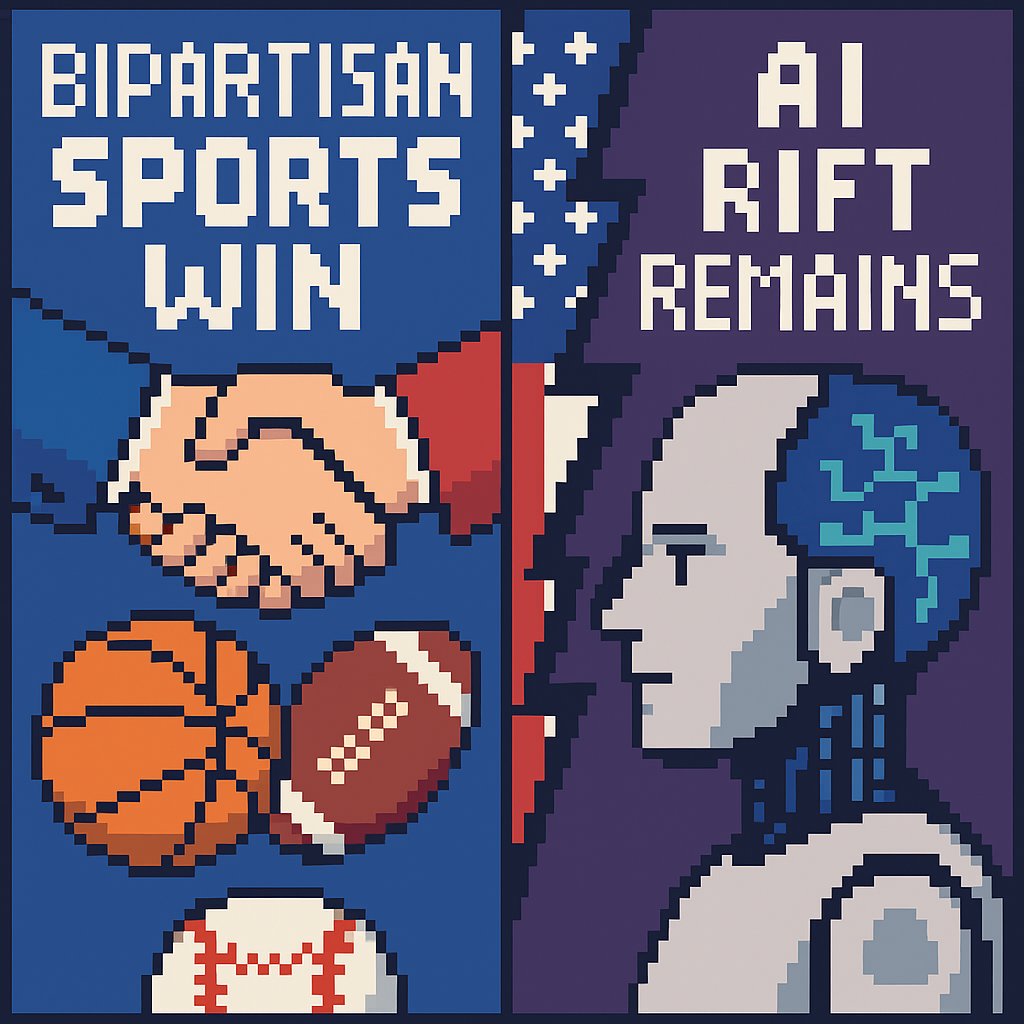
TL;DR
- The Senate’s 77–22 passage of the Protect College Sports Act (PCSA) is a real bipartisan win for Ted Cruz (R‑TX) and Maria Cantwell (D‑WA), but it won’t translate to an AI deal before the Nov. 3, 2026 election because the AI coalition is split on state preemption, agency power, and liability. [3], [4], [5]
- The college sports bill hard‑codes dollars, caps, and carve‑outs (e.g., a new retention pool that can lift per‑school athlete payouts from ~$21.5M to ~$48.8M), producing clear winners; AI talks lack those concrete trade‑offs. [2], [8]
- Trump’s “self‑policing” accord with industry gives Senate Republicans cover to slow‑walk AI safety boards and standards, while Cantwell and allies demand stricter guardrails—another reason Cruz–Cantwell comity on sports won’t repeat on AI. [6], [4], [5]
What the source said
Politico reported on Oct. 5, 2026 that while Commerce Committee leaders Ted Cruz and Maria Cantwell just notched a bipartisan victory on college sports, those vibes won’t carry over to artificial intelligence. The piece says their alliance on the Protect College Sports Act (PCSA) masks unresolved divides on AI: who writes enforceable rules, whether federal law should override tougher state measures, and how far to go on liability. With the Nov. 3, 2026 election weeks away, distrust and dueling priorities make an AI breakthrough unlikely before a lame‑duck window—if at all. [1]
Why it matters
Two policy arenas, one chair–ranking pair on the Senate Commerce Committee. In college sports, Congress is deciding how to allocate real money among athletes, schools, and conferences. The PCSA’s retention pool and roster protections create immediate cash flows and compliance checklists that athletic directors, the SEC, and the Big Ten can rally around; that coalition is why the bill cleared the Senate on Sept. 28, 2026. [3], [7]
AI is the inverse. The stakeholders—OpenAI, Anthropic, state attorneys general, NIST, the FTC, and national security voices—don’t agree on first principles: who sets standards, which risks matter, who pays when things go wrong. Republicans can point to Trump’s “self‑policing” pact announced by the White House with “top tech firms” to argue regulation should lag innovation, while Cantwell and Senate Democrats are demanding federal guardrails and resist preempting aggressive state regimes. That split is why an AI deal is stuck this year. [6], [4], [5]
Original analysis
Why Cruz–Cantwell’s college sports win won’t make an AI breakthrough easier
Consensus in sports is a budgeting exercise; consensus in AI is a worldview. The PCSA picks numbers, timeframes, and enforcement venues—and it enjoys buy‑in from TV‑money incumbents (SEC/Big Ten) who endorsed the revised text in a Senate Commerce release. AI talks are about power: who can halt a model launch, whether states can go further, and what “catastrophic risk” means in statute. Those fights don’t yield to the same horse‑trading. [7], [4], [5]
Back‑of‑envelope calculation
The PCSA lets schools expand athlete compensation using a new “retention pool,” raising the effective cap from ~$21.5M to ~$48.8M per school. If 60 major programs use the full delta, that’s 60 × ($48.8M − $21.5M) ≈ 60 × $27.3M = ~$1.64B in additional annual athlete pay—before any non‑revenue‑sports add‑ons. Even if only half of those schools go to 80% of the delta: 30 × (0.8 × $27.3M) ≈ $655M/year. These are budget lines ADs can plan around; they are not abstractions. [2]Named‑stakeholder breakdown
- USOPC: The bill’s $27M retention pool per school includes a $5M women’s/Olympic carve‑out and preserves roster slots for non‑revenue sports for a period—an immediate hedge against cuts ahead of LA28. [8]
- Big Ten and SEC: Early endorsers of the revised PCSA; national standards stabilize media‑rights pooling and rein in state‑by‑state NIL chaos. [7]
- House GOP leadership: Axios reports no plan to reconvene solely for the PCSA; the bill likely waits until post‑election, where intraparty splits over “employee” status and bargaining rights reemerge. [3]
- AI labs (OpenAI, Anthropic): Divided on federal preemption and the shape of a safety board; support for “do something” fractures when “who decides” and “how binding” show up in bill text. [4]
- State attorneys general: They prefer keeping room for tougher state rules; Cantwell has publicly resisted a weak federal floor that wipes out stronger state protections. [4]
A contrarian read
Consensus view: The Cruz–Cantwell sports deal proves the Senate can still legislate at speed, so an AI package is within reach this year.
Counter: The Senate didn’t just pass “a sports bill”—it passed a settlement‑anchored framework that codifies numbers the market already priced in (e.g., revenue‑share caps tethered to the House settlement), with visible winners and a sunset. On Sept. 29, 2026, Cruz said on the floor he’s not willing to green‑light a board that can unilaterally set U.S. AI standards—especially with sweeping national‑security justifications—and he emphasized there isn’t bipartisan agreement yet. That’s not a timing issue; it’s a governance issue. [5], [4]A 2×2 to organize the mismatch
- Axis 1 (Problem type): Concrete allocation (who gets how much) vs. abstract risk (how to prevent catastrophic failures).
- Axis 2 (Authority): Narrow, time‑boxed authority (codifying a settlement; targeted antitrust carve‑outs) vs. broad, ongoing authority (a federal AI safety board with standard‑setting power).
PCSA sits in “concrete/narrow.” Proposed AI bills sit in “abstract/broad.” Deals close in the first quadrant; they stall in the fourth. [7], [5], [4]
What others are missing
The House choke point isn’t just “calendar” or “election‑year politics.” It’s whether passing the PCSA hardens the case for treating athletes as employees—and how that interacts with the bill’s antitrust safe harbors and pooled media rights endorsed by SEC and Big Ten commissioners in 2026. Roll Call flags employee status as a central House fault line, and that’s the domino that could snap coalitions otherwise aligned on NIL cleanup and roster protection. On AI, most coverage fixates on “Will the Senate mark up?” while missing how Trump’s public embrace of voluntary self‑regulation shifts the negotiating BATNA: Cruz can now credibly argue that Congress should not delegate sweeping power to an executive‑branch safety board without crisper limits and faster sunsets. Those positions aren’t rhetorical; they’re structural roadblocks. [6], [9], [5]
What to watch next
- By November 30, 2026, the House will not have held a floor vote on the PCSA; any movement will be kicked to a lame‑duck session or the next Congress. [3]
- By December 31, 2026, there will be no Senate Commerce Committee markup on an AI safety package; any AI action will be limited to UC attempts or narrower sectoral bills. [4], [5]
- By March 31, 2027, at least 25 Division I schools will publicly announce retention‑pool allocations above $10M for 2026–27, validating the bill’s budgeting logic if it becomes law—or replicating it via settlement changes if the House stalls. [2]
My take
If you’re betting on policy momentum in 2026, don’t conflate Cruz–Cantwell’s 77–22 sports win with an AI blueprint. The PCSA rides a court‑blessed settlement, conference endorsements from the SEC and Big Ten, and arithmetic that tells ADs exactly what to do on Monday morning. AI is a sovereignty fight dressed up as safety: who governs, whose rules preempt, and who pays when a model goes sideways. Until Senate Republicans accept a binding federal safety regime—or Democrats accept a narrower, sunsetted authority with minimal preemption—there is no center to hold this year. [7], [5], [4]
Sources
- Ted Cruz and Maria Cantwell’s big college sports win won’t make an AI breakthrough easier — Politico (https://www.politico.com/news/2026/10/05/cruz-cantwell-college-sports-ai-01106003) — Frames why a bipartisan sports victory won’t map to AI given deeper divides.
- Now that it has passed the Senate, what comes next with the Protect College Sports Act? — AP (https://apnews.com/article/6daad95b402fb37f142a7cc018080f0c) — Details the $21.5M to $48.8M per‑school cap math and House scenarios.
- College sports bill faces tough path in House — Axios (https://www.axios.com/2026/09/30/mike-johnson-college-sports-bill-house) — Confirms 77–22 Senate vote on Sep. 28 and House leadership’s reluctance to act pre‑election.
- Bipartisan AI safety talks stall out in Senate — Semafor (https://www.semafor.com/article/09/29/2026/bipartisan-ai-safety-talks-stall-out-in-senate) — Reports the stall in Senate AI talks and the lack of pre‑election committee action.
- Congressional Record, September 29, 2026 (S5132–S5139) — GovInfo (https://www.govinfo.gov/content/pkg/CREC-2026-09-29/pdf/CREC-2026-09-29-senate.pdf) — Captures Cruz’s floor remarks opposing a sweeping AI safety board and noting no bipartisan agreement yet.
- Trump says top tech firms have signed accord to ‘self‑police’ AI development — AP (https://apnews.com/article/595796511f110fc006cca0d01329733e) — Documents the administration’s voluntary approach that shifts Senate GOP bargaining posture.
- Committee Releases Revised Protect College Sports Act — U.S. Senate Commerce Committee (https://www.commerce.senate.gov/press/rep/release/committee-releases-revised-protect-college-sports-act/) — Notes SEC/Big Ten endorsement and settlement‑linked structure.
- How a bill intended to rein in NIL and ‘protect’ college sports could also save the U.S. Olympic team — AP (https://apnews.com/article/2a2836fbcb0d2e9a8ee6aafa7f10f9e8) — Breaks out the $27M retention pool and the $5M women’s/Olympic carve‑out.
- Employee question could stall Senate college sports bill at midfield in House — Roll Call (https://rollcall.com/2026/10/05/employee-question-could-stall-senate-college-sports-bill-at-midfield-in-house/) — Explains the “employee status” fault line likely to dominate House debate.