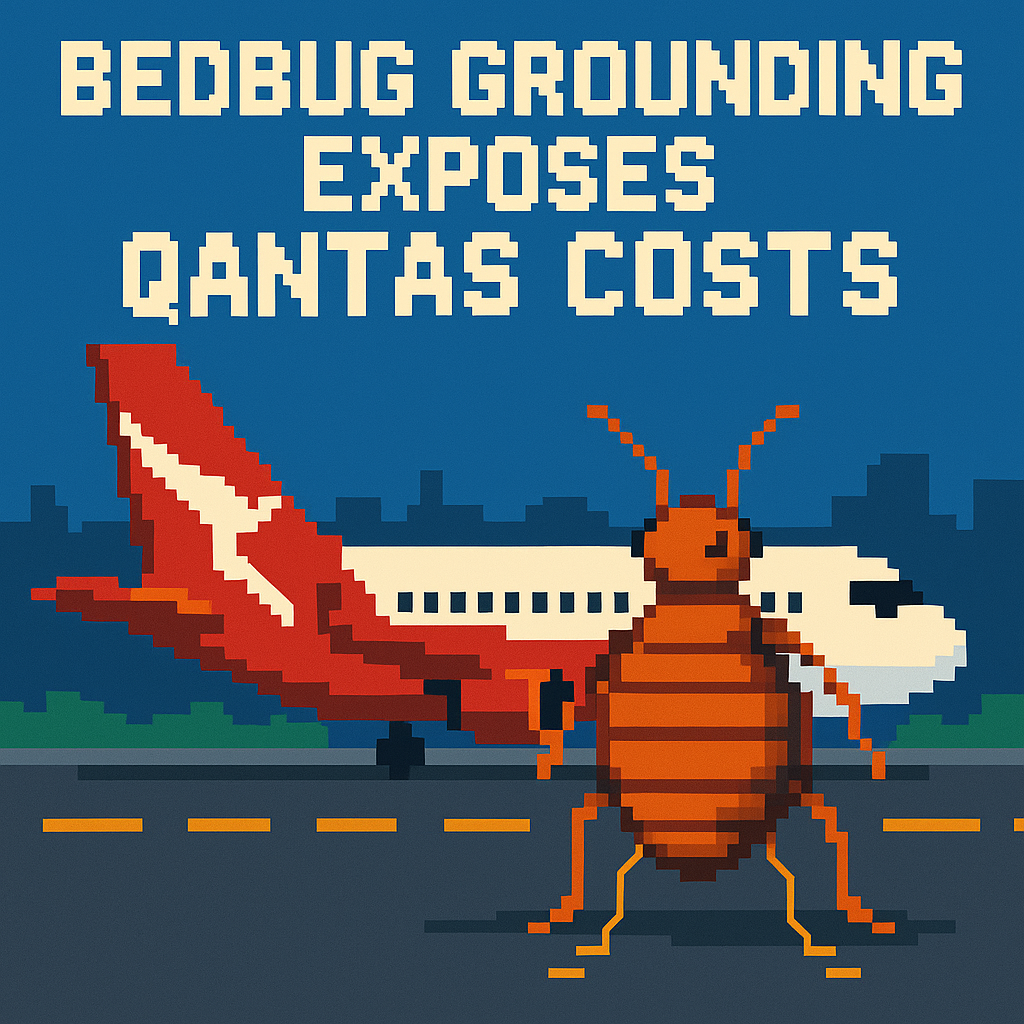
TL;DR
- Qantas grounded a Boeing 787‑9 (236 seats) in Rome Fiumicino after passengers on the prior 17‑hour Perth–Rome sector (QF5 arrival on 9 October 2026) reported bedbug bites; the 10 October Rome–Perth return (QF6) was canceled for a deep clean. [1][2][3]
- The headline risk is EU261: a Rome-origin cancellation exposes Qantas to up to €600 per passenger, or a theoretical €141,600 on a full 236‑seat 787‑9, before hotels and rebooking costs. [3][4]
- Similar hygiene‑and‑virality flare‑ups hit British Airways in 2017, Turkish Airlines reports surfaced in 2024, and French transport operators were summoned in 2023—reputation spreads globally in hours, while remediation takes days. [6][7][8][9]
What the source said
Newser and The Guardian report Qantas canceled its Rome–Perth flight on 10 October 2026 after travelers on the prior Perth–Rome leg reported bites during a 17‑hour crossing. Cabin crew handed out antihistamines until supplies ran out, and Qantas pulled the 787‑9 for “intensive cleaning” focused on a small number of economy seats, then apologized, offered hotels, and rebooked within 48 hours. Experts quoted by The Guardian, including a Macquarie University parasitologist in Sydney, said bedbugs likely hitchhiked via clothing or luggage; they seldom cause serious illness but take time and money to eradicate. [1][2]
Why it matters
Because the return sector originated in the European Union (Rome, Italy), Qantas—a non‑EU carrier—faces EU261 duties: up to €600 compensation per passenger for a canceled flight over 3,500 km, plus hotels, meals, and rebooking during the disruption window. Those payments stack on top of aircraft downtime and crew rescheduling costs. [2][4]
This is a network problem, not a one‑airline quirk: bedbugs travel in bags through the same hubs as passengers, and social media amplifies incidents long after a deep clean. French transport officials convened operators in 2023 during a bedbug scare, signaling regulators will step in when anxiety spikes across airports, rail, and airlines. [8][9]
Original analysis
A contrarian read
- Consensus: “Gross, but a one‑off hygiene issue—clean the plane and move on.”
- My take: The core threat is regulatory and reputational, not medical—EU261 converts one canceled Rome–Perth into a cash flow event while TikTok, X, and Instagram entrench a brand story in hours; CDC guidance stresses minimal disease transmission, but that doesn’t mute claims. [2][4][5]
Back‑of‑envelope calculation (with the math)
- Inputs
- EU261 compensation for EU‑departing flights over 3,500 km: €600 per passenger. [4]
- Qantas 787‑9 international configuration: 236 seats (42J/28W/166Y). [3]
- Maximum direct compensation exposure (ignoring exemptions and non‑claims):
- 236 × €600 = €141,600 potential liability on the canceled Rome–Perth sector. [3][4]
- Duty of care adds hotels, meals, ground transport, and rebooking; Qantas says passengers were put in hotels and rebooked within 48 hours, which aligns with EU assistance rules. [2][4]
Two caveats. EU261 compensation is waived if an airline proves “extraordinary circumstances” and that it took all reasonable measures. CJEU precedent in Wallentin‑Hermann (C‑549/07) narrows that defense to events truly external to operations; pests hitchhiking in luggage look operationally inherent, not like ash clouds. Bedbugs haven’t been tested in court widely, but the logic points against an easy exemption. [10]
A named‑stakeholder breakdown
- Qantas: Short‑term hits include EU261 exposure, hotel blocks in Rome, and a grounded 787‑9; medium‑term risk lives on a premium nonstop that competes with one‑stop rivals via Dubai and Singapore. Expect updated SOPs, faster triage protocols, and public comms pledging tighter inspection cycles. [2][4]
- Passengers: Clear EU261 jurisdiction because departure was Rome; claims up to €600 each are plausible unless Qantas proves extraordinary circumstances—a high bar post‑Wallentin‑Hermann. [4][10]
- ENAC (Italy’s civil aviation authority) and EU enforcers: Live test case on whether hygiene events meet “extraordinary”; any guidance will ripple across carriers operating from EU airports. [4]
- Competing carriers (Emirates via DXB, Singapore Airlines via SIN): Marketing chance to underline reliability on Europe–Australia routes, even though pests can appear on any airline.
- Pest‑management vendors (Rentokil, Ecolab): More RFPs for aviation‑specific detection, targeted heat/chemical treatments, and turnaround protocols compatible with 90‑ to 180‑minute turns.
- Public‑health voices (CDC): Consistent message—bedbugs rarely transmit disease—tempers fear but won’t stem compensation flows or brand damage. [5]
A historical analogue
- In 2017, British Airways apologized after a Vancouver–London flyer reported bedbug bites, and the coverage outpaced the cleanup, reinforcing that cleanliness issues metastasize online. [6]
- In 2023, France’s transport minister Clément Beaune convened rail, metro, and airport operators amid viral clips, showing authorities will coordinate when infestations trend across platforms. [8][9]
A simple 2×2: Biology vs virality
- Low biological risk, high virality: Bedbugs on a long‑haul—minimal medical danger, maximal memetic spread.
- High biological risk, high virality: Communicable disease outbreaks—rare but headline‑dominant.
- Low biological risk, low virality: Routine pre‑departure pest detection—contained.
- High biological risk, low virality: Nearly theoretical in aviation—true pathogens trigger rapid comms and surge coverage.
Qantas’s Rome case sits in low‑risk/high‑virality, where EU261 turns PR heat into euros—reason enough to treat “bugs on board” as a regulatory scenario, not just a cleaning job. [2][4][5]
What others are missing
The hinge is jurisdiction, not hygiene. Because the canceled flight was Rome–Perth on 10 October 2026, EU261 applies regardless of Qantas’s Australian flag, creating a €600‑per‑ticket compensation path unless Qantas proves extraordinary circumstances and all reasonable measures—an exception CJEU has interpreted narrowly in operational contexts. Bedbugs, which hitchhike in passenger luggage per the Macquarie expert, look inherent to normal operations, making that defense uncertain and opening a template for coordinated claims. [2][4][10]
What to watch next
-
By 31 December 2026: Qantas publishes an updated cabin‑pest SOP that shortens its cited “every 50 days” prophylactic treatment cadence and adds same‑day triage steps for long‑haul turns. [2]
-
By Q1 2027: An organized EU261 mass‑claim effort targets the 10 October Rome–Perth cancellation, forcing an explicit ruling on whether bedbug groundings are “extraordinary circumstances.” [4][10]
-
By Northern Summer 2027: Another EU‑origin long‑haul carrier cancels a sector due to bedbugs and publicly references EU261 exposure in investor or media remarks, prompting cross‑carrier SOP harmonization. [4]
My take
This is a tiny‑vector, big‑ticket problem. If I ran Qantas network ops, I’d treat cabin pests as an AOG‑class risk with clear escalation triggers, publish a 24‑, 48‑, and 72‑hour remediation timeline, and over‑communicate EU261 options on EU departures. Budget for €600 per head when an EU leg cancels, then compress dwell times, spin up targeted inspections, and close the viral window before it opens. [4]
Sources
-
It’s Probably for the Best This Qantas Flight Was Grounded — Newser (https://www.newser.com/story/398038/qantas-grounds-flight-after-pesky-bedbug-infestation.html) — Starting report: Rome–Perth cancellation after bedbug complaints on the prior sector; hotels and 48‑hour rebooking window.
-
Bedbug infestation forces Qantas to ground plane in Rome — The Guardian (https://www.theguardian.com/business/2026/oct/13/bedbug-infestation-forces-qantas-to-ground-plane-in-rome) — Confirms dates (9 Oct QF5 arrival; 10 Oct cancellation), affected seats in front of economy, 50‑day disinfectant cadence, and Macquarie expert’s “hitchhiking” view.
-
Boeing 787 and seat map | Qantas — Qantas (https://www.qantas.com/en-us/onboard/fleet/787) — Official 787‑9 capacity (236 seats: 42J/28W/166Y) to size potential compensation exposure.
-
Regulation (EC) No 261/2004: Air passenger rights — EUR‑Lex / Council of the EU (https://eur-lex.europa.eu/legal-content/en/ALL/?uri=CELEX%3A32004R0261) and (https://www.consilium.europa.eu/en/policies/air-passenger-rights/) — Establishes €600 compensation for EU‑departing cancellations >3,500 km and duty‑of‑care obligations.
-
Bed Bugs — CDC (https://www.cdc.gov/bed-bugs/about/) and (https://www.cdc.gov/dpdx/bedbugs/) — Clinical context: bedbugs rarely transmit disease; primary risks are bites, irritation, and secondary infection.
-
British Airways apologises for bed bug infestation — The Guardian (https://www.theguardian.com/business/2017/oct/19/british-airways-issues-apology-for-bedbug-infestation) — 2017 analogue showing reputational dynamics from prior airline incidents.
-
Passengers say Turkish Airlines flights have unwelcome guests – bedbugs — The Straits Times (https://www.straitstimes.com/life/travel/passengers-say-turkish-airlines-flights-have-unwelcome-guests-bedbugs) — Cross‑carrier examples, underlining hitchhiking risk.
-
Clément Beaune to convene transport operators on bedbugs — French Government (https://www.ecologie.gouv.fr/presse/clement-beaune-reunira-operateurs-transports-associations-dusagers-reunion-durgence-punaises) — Evidence that authorities mobilize transit systems (including airports) when bedbug narratives spread.
-
‘No need for psychosis’: French transport minister urges calm over bedbug sightings — Euronews (https://www.euronews.com/travel/2023/09/29/trains-and-cinemas-in-france-reportedly-infested-with-bedbugs-as-paris-officials-urge-acti) — 2023 France context: meetings with operators and public messaging.
-
Wallentin‑Hermann (C‑549/07) judgment on “extraordinary circumstances” — Court of Justice of the EU (https://infocuria.curia.europa.eu/tabs/redirect/juris/documents.jsf?num=C-549%2F07) — Precedent narrowing airlines’ extraordinary‑circumstances defense; relevant to hygiene‑driven disruptions.
Related update: We recently published an article that expands on this topic: read the latest post.
Related update: We recently published an article that expands on this topic: read the latest post.
Related update: We recently published an article that expands on this topic: read the latest post.