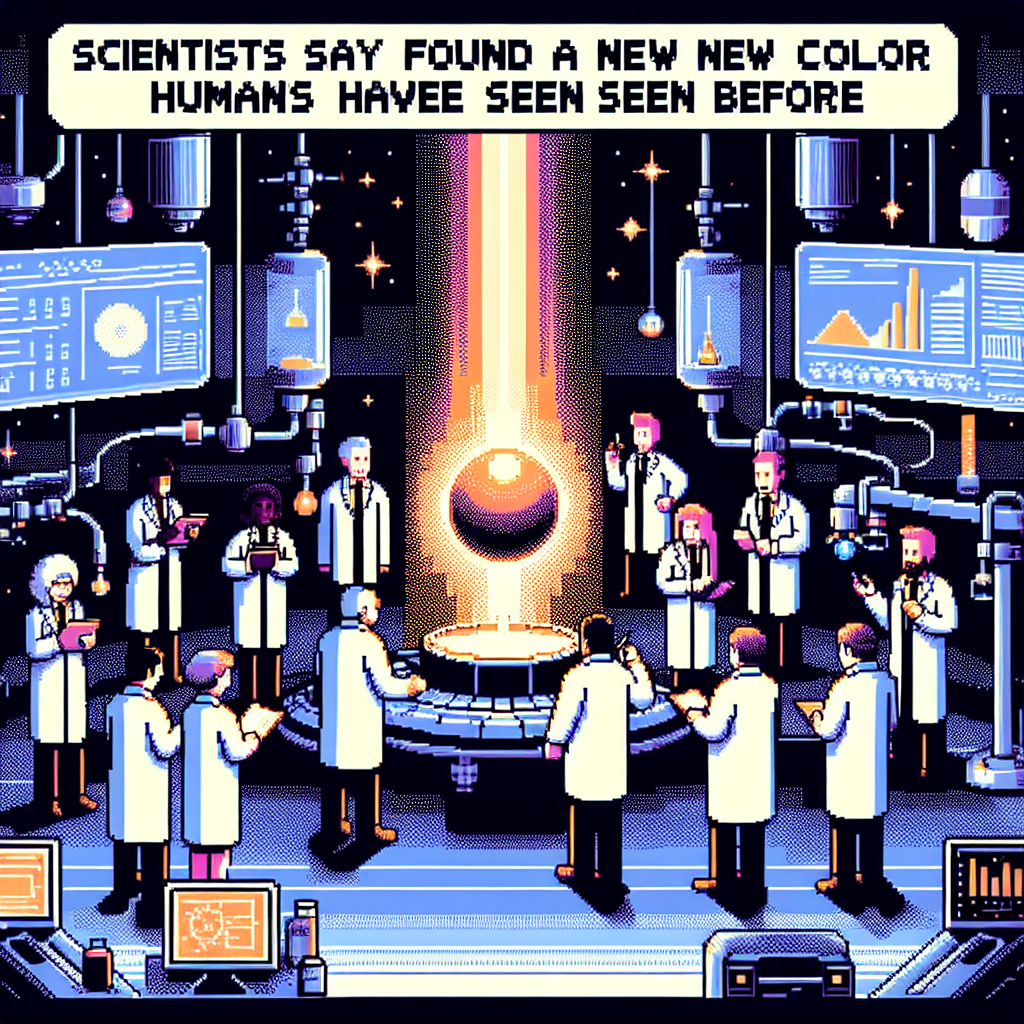
Scientists Say They Found a New Color Humans Have Never Seen Before - ScienceAlert | Analysis by Brian Moineau
Title: The Unseen Spectrum: A New Color Discovery Sparks Wonder and Possibility
In a world where technology and science constantly push the boundaries of our understanding, a new discovery has emerged that quite literally adds color to our lives. Scientists have reportedly identified a new color – a "blue-green of unprecedented saturation" – that humans have never seen before. This news, highlighted by ScienceAlert, invites us to ponder the kaleidoscopic possibilities of our universe, just waiting to be explored.
It's an awe-inspiring thought: a color that exists beyond the spectrum visible to the human eye. This discovery not only challenges our perception but also adds a layer of intrigue to the natural world, reminiscent of how the mantis shrimp perceives colors we can't even fathom with its 16 color-receptive cones compared to our mere three. Imagine a reality where the sky isn't just blue but possesses a depth and saturation unlike anything we've encountered. This discovery is akin to finding a new planet in our solar system – a revelation that redefines our view of the familiar.
But what does this mean for us? The implications stretch beyond just the visual delight. Consider the fields of art and design, where color is an essential tool for expression and communication. Artists might soon have the opportunity to incorporate this new hue into their palettes, offering a fresh medium to convey emotion and narrative. In fashion, this could lead to garments that shimmer with a vibrancy previously unimaginable, challenging the very core of color theory and design.
Moreover, this discovery comes at a time when technology is striving to enhance human capabilities. From augmented reality to advanced display technologies, our way of experiencing the world is evolving. In the same vein as virtual reality headsets that immerse us in digital realms, the ability to perceive this new color could transform how we interact with visual media. Imagine screens that burst with colors beyond the standard RGB spectrum, creating images that are more lifelike and immersive than ever before.
This revelation also parallels the ongoing exploration of augmented human senses. Projects like Neuralink, spearheaded by Elon Musk, aim to expand the boundaries of human experience through technological means. While primarily focused on cognitive enhancement, one could speculate about future innovations allowing us to perceive these newly discovered colors, thus expanding our sensory world.
While the scientific community continues to unravel the mysteries behind this discovery, it serves as a reminder of the boundless potential of human curiosity and innovation. Just as astronomers peer into the depths of space to find new galaxies, scientists are now peering into the spectrum of light to find colors that have been hiding in plain sight.
In conclusion, the unveiling of a color never seen before by human eyes is a testament to the relentless pursuit of knowledge. It challenges us to rethink our understanding of the world and opens the door to numerous possibilities across various fields. As we stand on the threshold of this new discovery, one can't help but wonder what other hidden wonders are waiting to be uncovered. In a universe teeming with the unknown, the discovery of a new color is a vibrant reminder that there is always more to see.
Read more about AI in Business