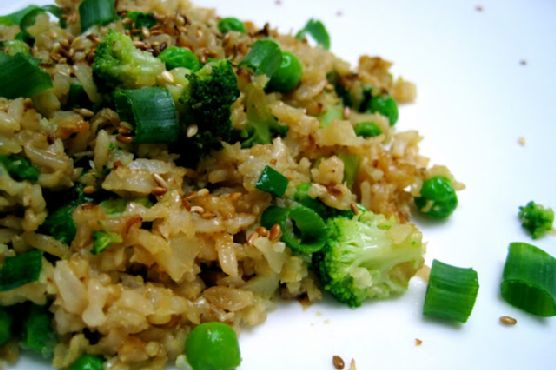
Cauliflower, Brown Rice, and Vegetable Fried Rice | Made by Meaghan Moineau

So there I was, standing in the kitchen on a Tuesday night, staring at my pantry like it was a black hole of culinary despair. You know those nights when you crave something satisfying but don’t want to spend an eternity making it? Enter this Cauliflower, Brown Rice, and Vegetable Fried Rice. It’s my go-to when I’m in the mood for something cozy yet packed with veggies. I promise, even if you’re a notorious takeout lover, you’ll want to make this at home. It’s got that perfect balance of taste and texture, and let’s be real, sneaking cauliflower into anything is a win in my book. Plus, it’s a great way to use up leftover rice and that stubborn head of cauliflower that’s been giving you the side-eye from the fridge. Jump to Recipe

What You’ll Need

This ingredient list is your best friend on a busy night. Chances are you already have most of this hanging out in your kitchen.

  • 1 tablespoon grapeseed oil
  • 1 tablespoon coconut oil
  • 4 green dark scallions, sliced (white and green parts separated)
  • 3 cloves garlic, minced
  • 1 medium head of raw cauliflower, cut into florets
  • 2 cups cooked brown rice
  • 1 cup cooked broccoli
  • 1 cup frozen peas
  • 2 tablespoons low sodium soy sauce
  • 1 teaspoon sesame oil
  • 1 tablespoon sesame seeds
  • Additional scallion tops for garnish
  • Salt, to taste

How to Make Cauliflower, Brown Rice, and Vegetable Fried Rice

  1. Start by removing the cauliflower’s tough stem and save it for another day (hello, veggie broth!). Pulse the florets in a food processor until they look like rice or couscous. You’ll end up with about four cups of this magic “cauliflower rice.”
  2. Heat 1 tablespoon of butter and 1 tablespoon of grapeseed oil in a large skillet over medium heat. Add the garlic and the white and light green parts of the scallions. Sauté until they start smelling amazing, about a minute.
  3. Toss the cauliflower rice into the pan. Stir it to coat with oil, then spread it out in the pan. Let it sit so it can caramelize a bit—this is where the sweetness comes out. After a couple of minutes, give it a stir and spread it out again.
  4. Add the cold brown rice to the skillet along with the remaining grapeseed and coconut oil. Crank up the heat to medium-high. Mix everything together and spread it out over the whole pan, pressing it down slightly. This helps it toast up and get a little crispy, which is what we’re going for.
  5. Next, add the peas and broccoli. Mix them in with the rice. Drizzle the soy sauce and sesame oil on top and give it all a good stir. Cook for another minute or so, then turn off the heat.
  6. Top everything with the chopped scallion tops. Toast some sesame seeds in a dry pan until they’re golden, then sprinkle them along with some raw, chopped scallion over the rice. Give it a taste and season with salt if needed. If you’re pairing this with something salty, like teriyaki chicken, keep the salt in check.

Cook’s Notes

For the best results, use day-old rice. Freshly cooked rice tends to be too moist and can turn your dish into a mushy mess. If you make rice specifically for this, spread it out on a baking sheet and pop it in the fridge for an hour to dry it out a bit. You can store leftovers in an airtight container in the fridge for up to 3 days. Just reheat in a pan over medium heat — adding a splash of water helps bring it back to life.

If you’re a meal prepper (is that even a word?), this dish is your friend. The cauliflower ‘rice’ can be made ahead and stored in the fridge for a couple of days. Just keep it in an airtight container, and you’re good to go.

Make It Your Own

  • Swap the broccoli for any other veggie you love — bell peppers and snap peas are excellent choices.
  • If you’re in the mood for protein, add some crispy tofu or a scrambled egg for extra goodies.
  • For a spicy kick, throw in a pinch of red pepper flakes or a drizzle of sriracha.
  • Make it nutty by tossing in a handful of cashews or almonds before serving.

If you try this, I’d love to hear how it turns out — drop a comment or tag me! I’m always here for your kitchen adventures. Happy cooking!

Related update: Cauliflower, Brown Rice, and Vegetable Fried Rice

iPhone 18 Pro: Sensible Upgrades Ahead | Analysis by Brian Moineau

The iPhone 18 Pro could become Apple’s best and most responsible upgrade in a long time

Apple’s rumor mill rarely goes quiet, but the current wave of leaks around the iPhone 18 Pro is different — upbeat, focused, and oddly reassuring. The iPhone 18 Pro could become Apple’s best and most responsible upgrade in a long time, not because it promises headline-grabbing gimmicks, but because the whispers point to sensible engineering: bigger batteries, a genuinely faster A20 Pro chip, smarter camera hardware, and a cleaner front display. Those are the kinds of changes that improve everyday life, not just spec sheets.

Let’s walk through what the leaks say, why they matter, and why this could be the rare Apple upgrade that’s both bold and pragmatic.

What the leaks are actually shouting (quietly)

  • Several reputable rumor hubs and supply chain leaks now align on a few themes: an A20 Pro system-on-chip (TSMC 2nm), larger batteries (reports suggest 5,000mAh+ in Pro Max variants), and camera improvements that include a variable aperture and a larger-aperture telephoto. (phonearena.com)
  • On the design front, the chatter is more restrained. Instead of dramatic exterior changes, Apple may keep the overall look similar to the iPhone 17 Pro while subtly shrinking the Dynamic Island and cleaning up the bezel. That indicates a focus on internal, user-facing improvements rather than a visual overhaul. (macrumors.com)
  • Importantly, rumors about under-display Face ID and a full-screen revolution are mixed. Some leakers say the tech is being tested; others think it will land later (possibly iPhone 19). For 18 Pro, expect refinement over reinvention. (macrumors.com)

Transitioning from rumor to reality, these elements combine into a narrative of incremental but meaningful upgrades — the kind that change daily experience more than a flashy one-off feature ever could.

Why this could be Apple’s smartest upgrade strategy

First, performance where it counts. Moving to a 2nm-class A20 Pro with wafer-level multi-chip packaging suggests Apple is chasing sustained performance and efficiency, not just headline benchmark scores. That matters for battery life, on-device AI (Apple Intelligence), and longevity — features that benefit users year-round, not only on launch day. (phonearena.com)

Second, battery life finally getting the attention it deserves. Bigger cells paired with a more efficient SoC will actually extend real-world usage. People upgrade for better cameras and speed, but they keep a phone because the battery lasts. A meaningful jump here is a responsible upgrade: it reduces the need for accessory batteries and stretches the usable lifespan of the device.

Third, camera tech that respects practical photography. Variable aperture and larger-aperture telephoto lenses are not just marketing bullets — they allow for better low-light shots, more natural shallow depth-of-field, and improved telephoto performance without relying solely on digital tricks. That’s a smart path toward pro-grade imaging without radically changing form factors. (9to5mac.com)

Finally, conservative design changes can be a virtue. A smaller Dynamic Island and subtle front-panel improvements reduce the risk of early hardware issues and keep manufacturing yields healthy. In short, Apple is apparently choosing to perfect the internals and user experience rather than chase an all-or-nothing visual pivot.

The investor’s and consumer’s dilemma — balanced upgrades beat gimmicks

  • For investors and analysts, efficient, chip-driven upgrades are easier to scale and monetize: better chip yields, consistent parts sourcing, and a clearer roadmap to new services (think on-device AI).
  • For consumers, these are the upgrades you notice every day: faster app launches, better battery life, more reliable low-light photos, and fewer software compromises.

Put simply, risk-averse, quality-focused improvements are a responsible move for a company facing supply chain pressures and demanding customers.

Questions that still need answers

  • Will the variable aperture land on both Pro models or only on the Pro Max? Early leaks suggest it might be limited to the largest model. (9to5mac.com)
  • How much of Apple’s AI ambitions will be truly on-device versus cloud-assisted? The A20 Pro’s packaging hints at stronger on-device AI, but software and privacy trade-offs will define the experience. (phonearena.com)
  • What about price and timing? Rumors suggest a split launch cadence for iPhone models in 2026–2027, and Apple’s choices here could affect who upgrades and when. (macrumors.com)

These unknowns matter because they determine who benefits most from the improvements: early adopters, prosumers, or the mass market.

Why this matters to everyday users

  • Better battery life and efficiency means fewer battery replacements and less e-waste.
  • Practical camera upgrades reduce the need to carry separate gear for travel or events.
  • More on-device AI can improve privacy and responsiveness compared with cloud-first approaches.

In short, the rumored direction for the iPhone 18 Pro aligns product design with user welfare: more useful features, less forced obsolescence.

Key points to remember

  • The iPhone 18 Pro looks set to favor meaningful hardware and software improvements over dramatic design flips. (phonearena.com)
  • Camera upgrades (variable aperture, larger telephoto aperture) could be the most tangible benefit for everyday photography. (9to5mac.com)
  • An A20 Pro built on 2nm packaging promises better battery life and stronger on-device AI capabilities. (phonearena.com)

My take

If the leaks hold up, Apple is playing the long game: smaller visual changes, bigger quality-of-life wins. That’s a responsible upgrade path — one that respects user needs, manufacturing realities, and the company’s ambitions for on-device intelligence. For most people, the iPhone 18 Pro won’t be about a single showy feature; it will be the phone that simply works better, longer, and smarter.

Final thoughts

Excitement around smartphones often skews toward the novel. But there’s beauty in iterative excellence. The iPhone 18 Pro’s rumored mix of a more efficient chip, longer battery life, and camera improvements could deliver the most meaningful upgrade for many users in years — and do so without the usual risks of radical redesigns. If Apple follows this path, the smash hit everyone wants might come from doing the basics exceptionally well.

Sources