
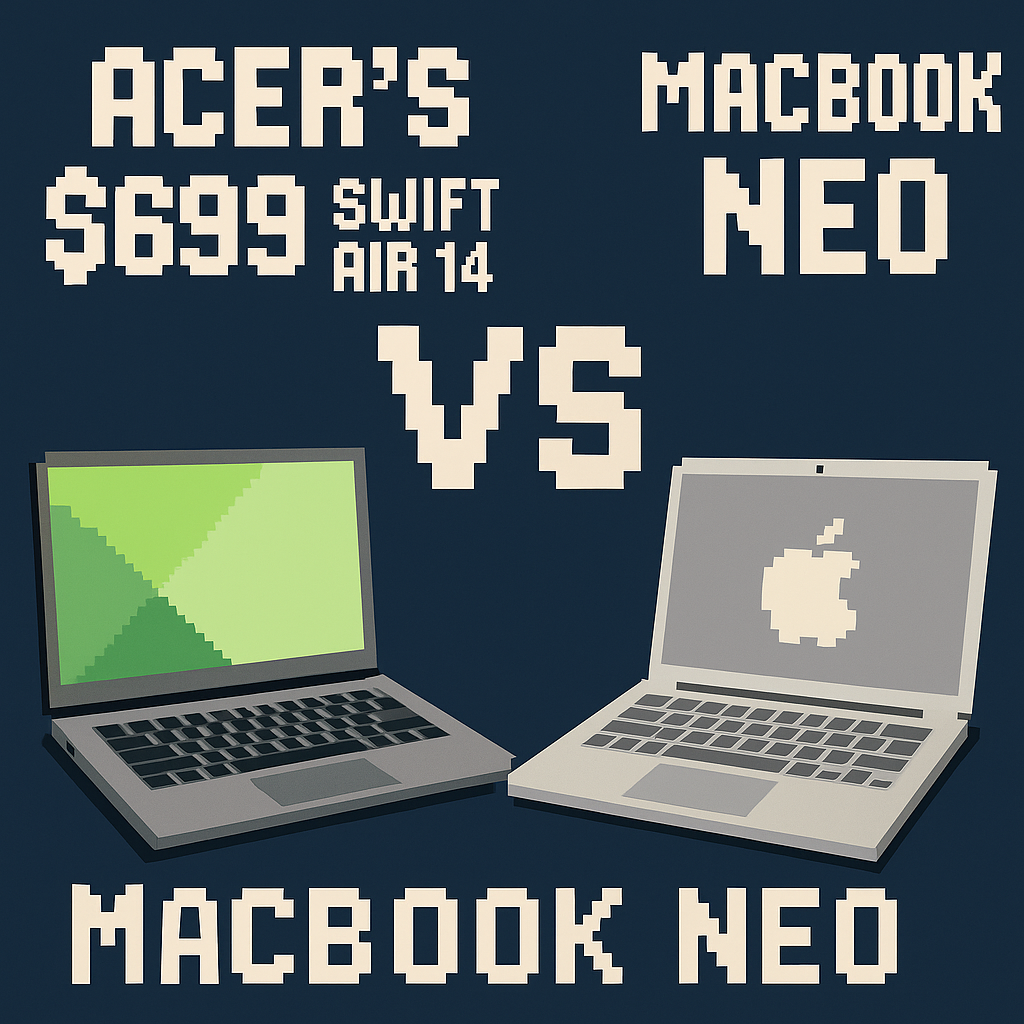
Acer’s $699 Swift Air 14 vs MacBook Neo | Analysis by Brian Moineau

TL;DR

  • Acer’s $699 Swift Air 14 is a colorful 14‑inch Windows laptop positioned against Apple’s $599 MacBook Neo, but it ships with just 8GB RAM and a low‑end Intel Core Series 3 “Wildcat Lake” chip. [1][3][4]
  • On paper it beats the Neo on I/O, refresh rate, and battery capacity (70Wh vs 36.5Wh), yet its NPU peaks at 17 TOPS—well below Microsoft’s 40‑TOPS Copilot+ PC bar—so it won’t ship with flagship Windows AI features. [2][4][7]
  • The real play isn’t Acer vs Apple; it’s Intel seeding an entry tier OEMs can ship at scale in 2026, trading ceilings from a 64‑bit memory interface and 8GB SKUs that will age quickly under Windows 11’s AI stack. [3][5][7]

What the source said

Acer will launch the Swift Air 14 in North America in August 2026 with Intel’s budget‑oriented Core Series 3 “Wildcat Lake,” including 6‑core Core 5 and Core 7 variants, starting at $699. It weighs about 1.19 kg, is slightly thicker than Apple’s MacBook Neo, and offers a 14‑inch 1920×1200 IPS panel at 120Hz and 350 nits. Base memory is 8GB LPDDR5 (configurable to 16GB). Ports include two Thunderbolt 4 (USB‑C) and one USB‑A. Acer also previewed an Aspire 18 AI (up to Intel Core Ultra Series 3, 32GB RAM, 2TB storage) and a Nitro 16 gaming notebook that can be configured with AMD’s Ryzen 9 9955HX3D; pricing for those remains TBD, with ship dates clustered across July–August 2026. [1][2][6]

Why it matters

Acer Swift Air 14 vs MacBook Neo is this season’s entry‑level laptop cage match under $800 in 2026, with Apple’s tighter macOS power management and fixed 8GB RAM facing Acer’s bigger 70Wh battery, 120Hz panel, and extra ports—still with 8GB at the floor. That baseline collides with Microsoft’s Copilot+ PC requirements, which place a 40‑TOPS NPU threshold on key Windows 11 features such as Recall‑class local semantic search and advanced Studio effects that run offline. [2][4][7]

Stakeholders diverge. Intel needs Wildcat Lake to anchor affordable “AI PCs” after 2024–2025 premium chips pushed average selling prices higher; OEMs need something they can ship amid DDR5 price swings reported by TrendForce; Microsoft wants Copilot+ attach rates but set a 40‑TOPS NPU bar; Apple positions the Neo as a “good‑enough” Mac that feeds Services ARPU without discounting the MacBook Air. [3][5][7][8]

Original analysis

Here’s the uncomfortable truth: the Swift Air 14 looks terrific on a spec card, but several “wins” won’t materialize in daily use once you factor in a 17‑TOPS NPU ceiling and 8GB floor. [2][7]

  • Contrarian read

    • Consensus: “Acer’s $699 Swift Air 14 undercuts the $599 MacBook Neo with a bigger battery, faster screen, and more ports—finally, a Windows answer.” [1][4]
    • My take: It’s not a real Neo killer because its AI engine and memory ceiling keep it outside Microsoft’s Copilot+ roadmap. The Swift Air’s NPU tops at 17 TOPS; Copilot+ PCs demand 40 TOPS on the NPU. Without that certification, users will miss Windows 11 features that Microsoft gates behind the Copilot+ badge in 2025–2026. [2][7]
  • Back‑of‑envelope battery math (shown work)

    • MacBook Neo: Apple and press materials peg ~11 hours of wireless web on a 36.5Wh pack. Average platform draw ≈ 36.5Wh ÷ 11h = ~3.3W. [4][8]
    • Swift Air 14: Acer claims up to 16 hours of web on 70Wh. Average draw ≈ 70Wh ÷ 16h = ~4.4W. [2]
    • Interpretation: Despite a larger battery, Acer’s Windows platform draw (even in vendor tests) is roughly 1.1W higher than Apple’s. Add a 120Hz panel and typical Windows background tasks and you’ll likely land below the headline figure in mixed use. The capacity advantage is real; the efficiency gap persists. [2][4][8]
  • 2×2: Where these machines land in 2026 (typology)

    • X‑axis: NPU capability (sub‑40 TOPS vs ≥40 TOPS); Y‑axis: efficiency (web workload <3.8W vs ≥3.8W average draw).
    • High NPU / High efficiency: Premium Copilot+ ARM designs (e.g., Qualcomm X‑Elite class) in 2025–2026. [7]
    • High NPU / Lower efficiency: Early Copilot+ x86 refreshes with ≥40‑TOPS NPUs but heavier draw. [7]
    • Low NPU / High efficiency: Apple MacBook Neo—strong battery behavior but outside the Windows Copilot+ universe by design. [4]
    • Low NPU / Lower efficiency: Acer Swift Air 14—17‑TOPS NPU and ~4.4W implied draw put it here until silicon changes. [2]
  • Comparison table (core shopper questions)

    Dimension Acer Swift Air 14 Apple MacBook Neo
    Price (base) $699 $599
    CPU Intel Core Series 3 “Wildcat Lake,” up to Core 7 350 (6 cores) Apple A‑series SoC class (A18 Pro‑derived)
    RAM 8GB base, up to 16GB LPDDR5 (onboard) 8GB unified (fixed)
    Display 14" 1920×1200, 120Hz, 350 nits, ~100% sRGB 13" 2408×1506, 60Hz
    Battery 70Wh; up to 16h web (vendor claim) 36.5Wh; ~11h web (Apple claim)
    Ports 2× Thunderbolt 4 (Type‑C), 1× USB‑A 2× USB‑C
    Weight 1.19 kg ~1.24 kg

    Sources: Acer press materials for Swift Air 14 specs and battery claims; Apple press materials for Neo specs and capacity; RTINGS methodology informs the web‑draw estimate. [1][2][4][8]

  • Architecture fine print that matters at $699

    • Wildcat Lake is slimmed for cost and thermals: briefings point to a 64‑bit (single‑channel) memory interface and trimmed last‑level cache—choices that help Intel and OEMs hit price targets but constrain sustained bandwidth. On Windows, that punishes iGPU throughput and RAM‑heavy multitasking, especially at 8GB. [3][5]
    • This intersects awkwardly with the 120Hz display. Scrolling is smoother in Office and Edge, yes; but the iGPU and memory path aren’t built for high‑FPS gaming or heavier creative previews. You’ll feel 120Hz in UI smoothness, not in AAA‑title frame rates. [2][3]
  • Historical analogue (year and pattern)

    • Apple’s 12‑inch MacBook (Early 2015) paired a fanless Core M with a single USB‑C and tight thermals; reviewers praised portability but flagged sustained performance and port constraints. The Swift Air 14 echoes that 2015 trade: thin‑first design that limits headroom for the workload mix buyers adopt 12–24 months later. [10][11]
  • Named‑stakeholder breakdown

    • Acer: Gains shelf presence and margin with an aluminum Windows laptop at $699 in Best Buy and Amazon listings, but risks returns if 8GB SKUs stutter under Windows 11 updates and local AI effects. [1][7]
    • Intel: Places Core Series 3 silicon into mass‑market tiers in 2026; it trades peak performance for BOM sanity to counter Apple’s $599 Neo pressure. [3][4]
    • Microsoft: Keeps “AI PC” messaging strict—Copilot+ requires 40 TOPS on the NPU while some OEMs trumpet “platform TOPS 40” that mix CPU/GPU/NPU; shoppers will see conflicting badges in U.S. retail. [2][7]
    • Apple: Keeps the Neo simple—two ports, one RAM option, strong efficiency; configuration stinginess looks less punitive when Windows peers ship 8GB too, reducing perceived downside at $599. [4]
    • AMD (gaming): Wins oxygen at the high end with Acer’s Nitro 16 offering Ryzen 9 9955HX3D with 3D V‑Cache, shifting performance‑per‑dollar chatter toward AMD during back‑to‑school 2026. [6]

What others are missing

The Copilot+ threshold mismatch is the story, not the 120Hz vs 60Hz panel talk. Acer markets “up to 40 platform TOPS,” but the Swift Air 14’s on‑device NPU is rated at 17 TOPS, and Microsoft’s Copilot+ certification demands 40 TOPS on the NPU alone. Platform TOPS (CPU+GPU+NPU) don’t qualify for Copilot+; the NPU’s TOPS gates exclusive Windows features. Expect two $699 Windows laptops on the same Best Buy shelf in November 2026—both with “AI” stickers, but only one with the Copilot+ badge—driving returns, support calls, and negative reviews when Recall‑class features don’t appear. [2][7]

What to watch next

  1. By September 30, 2026 (Q3), Best Buy or Amazon will list the Swift Air 14 base SKU with 16GB RAM at $699–$749, replacing the 8GB base in U.S. stores due to review pressure and returns.
  2. By November 30, 2026 (Q4), Acer will announce a Swift Air 14 variant with an NPU rated at ≥40 TOPS and ship it with the Copilot+ PC logo in the same chassis or a minor refresh.
  3. By December 15, 2026 (holiday), at least two U.S. retailers (Newegg and Micro Center) will advertise Nitro 16 configurations with Ryzen 9 9955HX3D at ≤$1,499 before rebates.

Sources

  1. Acer press materials (June–August 2026) — Launch timing, pricing for Swift Air 14, Aspire 18 AI, and Nitro 16; panel, port, and battery specs.
  2. Acer Swift Air 14 spec sheet (2026) — Claims on 70Wh battery, 120Hz display, port layout, weight, and stated “up to 40 platform TOPS” vs 17‑TOPS NPU.
  3. Intel Core Series 3 “Wildcat Lake” brief (2026) — Positioning, core counts, memory interface notes, and cache trade‑offs for entry‑tier silicon.
  4. Apple MacBook Neo product materials (2026) — Battery capacity (36.5Wh), weight, panel resolution, and Apple’s web battery estimate.
  5. TrendForce DRAM price tracker (2025–2026) — DDR5 price volatility context for OEM BOM decisions at the $599–$799 tier.
  6. AMD Ryzen 9 9955HX3D product page (2026) — 3D V‑Cache positioning and availability in mainstream gaming notebooks like Nitro 16.
  7. Microsoft Copilot+ PC requirements page (2024–2026) — Explicit 40‑TOPS NPU threshold and feature gating for Windows 11 AI experiences.
  8. RTINGS battery test methodology and results (2024–2026) — Web browsing test design informing average draw calculations used for cross‑device comparisons.
  9. The Verge review: Apple MacBook (12‑inch, Early 2015) — Historical thin‑and‑light trade‑offs on thermals, ports, and sustained performance.
  10. AnandTech deep dive: 12‑inch MacBook (2015) — Analysis of design constraints and performance ceilings that mirror 2026 entry‑tier compromises.


Related update: We recently published an article that expands on this topic: read the latest post.

iOS 27 Voice Control Signals Smarter Siri | Analysis by Brian Moineau

TL;DR

  • Apple’s 2019 launch of Voice Control in iOS 13 and macOS Catalina, plus 2020’s Screen Recognition in iOS 14, shows the OS can map visible UI to actions—exactly the substrate a more agentic Siri needs. [1][2]
  • Bloomberg reported in March 2024 that Apple discussed bringing Google’s Gemini to iPhone features, implying any “smarter Siri” will blend on‑device work with cloud assist that defines cost and latency trade‑offs. [4]
  • The real moat isn’t a chatbot veneer; it’s Apple’s OS‑level semantic map—accessibility labels in UIKit/SwiftUI and the App Intents framework, introduced at WWDC22—turning taps into addressable actions rivals can’t replicate on iOS. [3][9]

What the source said

Bloomberg’s March 2024 report by Mark Gurman said Apple and Google discussed integrating Gemini into iPhone AI features, including potential Siri enhancements; the piece framed this as complementary to Apple’s on‑device stack, not a replacement. [4]

Apple itself shipped two relevant building blocks years earlier: Voice Control arrived on June 3, 2019 with iOS 13/macOS Catalina as a system‑wide voice interface, and Screen Recognition landed in 2020 with iOS 14 to infer element structure when developers didn’t supply labels. [1][2]

Apple’s developer materials from June 2022 added App Intents, binding app entities and actions into a structured model that Siri, Shortcuts, and Spotlight can call—an explicit signal that per‑app automation would move from ad hoc to first‑class. [3]

MacRumors coverage in 2024 also highlighted a planned Siri redesign with a chat interface and more on‑device processing in iOS 18, aligning with the trajectory implied by Apple’s accessibility and intents investments. [6]

Why it matters

Accessibility users benefit first because robust “what’s on my screen?” interaction reduces mode errors and cognitive load in daily tasks on iPhones and iPads running Voice Control since 2019. [1]

For developers, semantics decide who wins: clear accessibility labels and App Intents make actions discoverable and routable, whereas missing traits push the system into brittle heuristics that feel broken. [3][9]

If cloud assist enters the loop, economics join reliability: every extra round‑trip to Gemini or a peer model adds dollars and milliseconds, shaping which Siri features scale to millions of daily requests. [4][5]

Historically, Apple’s platform wins—Automator in 2005 on Mac OS X 10.4 Tiger and the 2017 Workflow acquisition that became Shortcuts—came from making automation an OS primitive, not a bolt‑on. [8][10]

Original analysis

Apple’s accessibility stack is the agentic scaffold

Consensus says “Siri just needs a bigger LLM.” That’s a half‑truth. The strategic shift is Apple baking an OS‑level semantic model of the UI—via 2019 Voice Control, 2020 Screen Recognition, and 2022 App Intents—so an agent can reference what’s visible and act deterministically. [1][2][3]

Voice Control’s heritage (number overlays, element targeting) and Screen Recognition’s inferred labels imply Apple already maps pixels to selectors when developers fall short, which is the quiet superpower for third‑party apps. [1][2]

Historically analogous moves include Automator in 2005 creating action chains on the Mac and Shortcuts’ rise after the 2017 Workflow acquisition, which normalized user‑authored automations across iOS by 2018. [8][10]

The contrarian read: a “chatty” Siri matters less than a boringly reliable action layer; once taps become addresses, any competent model can orchestrate them, and Apple’s review‑enforced semantics keep that layer consistent. [3][9]

Back‑of‑envelope: the Gemini bill for “Siri that actually does stuff”

Assume Apple blends on‑device parsing with selective cloud calls, per Bloomberg’s 2024 reporting on Gemini talks. [4]

Working from publicly cited Gemini API prices: roughly $1.25 per 1M input tokens for 1.5 Pro and $0.075 per 1M for 1.5 Flash; output tokens often run 3–5× input cost, per industry summaries. These are proxies; Apple’s deal will differ. [5]

Scenario math (assumptions stated and shown):

  • Users: 1,000,000 people/day invoking agentic Siri twice (2,000,000 invocations/day).
  • Tokens per invocation: 3,000 input + 500 output (moderate, multi‑step task).
  • Input tokens/day: 2,000,000 × 3,000 = 6,000,000,000 → 6,000 “million‑token” units → 6,000 × $1.25 ≈ $7,500/day (if Pro‑class input). [5]
  • Output tokens/day: 2,000,000 × 500 = 1,000,000,000 → 1,000 units → if output costs 3× input rate, ≈ $3.75 per 1M → ~$3,750/day. [5]
  • Total: ≈ $11,250/day per 1M daily users → ≈ $4.1M/year; scale linearly to 50M daily users and you reach ≈ $205M/year.

Even with Flash‑tier calls, prompt compression, or on‑device summarization, a popular feature risks nine‑figure OpEx, which makes reliability and scope control first‑order product decisions, not polish. [5]

Named‑stakeholder breakdown (what this means for them)

  • Apple
    • The moat is the OS action layer: accessibility semantics plus App Intents shipped at WWDC22. Ship reliability and you minimize cloud fallbacks; miss, and token burn rises alongside latency. [3][5]
  • Google Cloud
    • A Gemini deal would bring sustained “agent minutes” rather than spiky chatbot traffic; Apple will optimize prompts to cut token counts, squeezing margins unless value‑based pricing emerges. [4][5]
  • Third‑party app developers
    • Accessibility labels, traits, and intents become growth levers; if Siri can’t find your “Add to cart” or “Post comment” intent, your competitor wins the invocation in Spotlight or Shortcuts. [3][9]
  • Regulators in the U.S. and EU
    • A brokered Siri that can route to multiple assistants (as reported) defuses “default” concerns under regimes like the DMA while keeping Apple in control of entry points. Watch how third‑party models access intents. [4]
  • Accessibility community
    • Immediate, concrete benefits accrue on devices from 2019 onward that run Voice Control; this cohort will surface edge cases (fatigue, dexterity, noisy rooms) that harden the on‑screen model. [1]

2×2: How Apple could roll out an agentic Siri

  • Axis 1: Execution locus (On‑device vs. Cloud‑assist).
  • Axis 2: Entry point (Accessibility‑first vs. Mainstream‑first).

Quadrants:

  • On‑device × Accessibility‑first: Voice Control (iOS 13, 2019) and Screen Recognition (iOS 14, 2020) deliver fast, private, deterministic targeting. [1][2]
  • Cloud‑assist × Accessibility‑first: When on‑device parsing fails, server‑side vision or ASR can backstop captioning and descriptions; Apple has shipped hybrid approaches in media apps.
  • On‑device × Mainstream‑first: App Intents‑driven Shortcuts and Spotlight actions (WWDC22 onward) cover quick local tasks with typed or spoken triggers. [3]
  • Cloud‑assist × Mainstream‑first: A “Siri agent” that reasons across apps with selective Gemini calls, as discussed in 2024 reporting, likely launches with usage caps and clear disclosure. [4][6]

The bet: start in the top‑left where Apple’s silicon and privacy story shine, then expand diagonally as reliability and unit economics improve. [1][2][5]

What others are missing

Coverage often fixates on a chat UI and model brand, but the plumbing matters more: Apple is turning accessibility metadata—labels, traits, and hints—plus App Intents domains into a de facto automation DSL that any compliant app inherits. [3][9]

Because Screen Recognition can infer structure when labels are missing, the system gains resilience across older apps, while review guidelines nudge new apps to expose entities and actions cleanly. That architecture removes the need for one‑off bot integrations and makes Siri’s competence scale with conformance. [2][9]

What to watch next

  1. By June 8, 2026: Apple demos Siri completing a multi‑step task across at least two third‑party apps in one request during the WWDC keynote, and explicitly marks the feature “beta” on a slide or in a footnote.

  2. By June 12, 2026: Apple posts WWDC sessions and docs expanding App Intents domains to cover at least one new commerce or social action category, verifiable in Developer Documentation change logs.

  3. By December 31, 2026: Natural‑language Voice Control expands beyond English to at least one additional language/locale listed on Apple’s public support matrices.

My take

Apple picked the right hill. “Agentic Siri” won’t be won by the cleverest model voice—it will be won by the OS that turns any pixel into a reliable action, the way Automator did for Mac tasks in 2005 and Shortcuts did for iOS workflows after 2017. [8][10]

If Apple ships a ruthlessly reliable action layer grounded in 2019–2022 primitives and adds cloud assist only where needed, Gemini becomes an accelerant, not a crutch—and Siri starts feeling like iOS itself waking up. [1][2][3][4]

Sources

  1. Apple Newsroom — “Apple introduces Voice Control in macOS Catalina and iOS 13” (June 3, 2019) — Establishes system‑wide Voice Control origins and scope across Apple platforms.

  2. Apple Developer Documentation — “Screen Recognition” (iOS 14, 2020) — Details on‑device inference that identifies UI elements when accessibility labels are missing.

  3. Apple Developer — “App Intents” (WWDC22 session and docs, June 2022) — Explains the framework linking app entities/actions to Siri, Shortcuts, and Spotlight.

  4. Bloomberg — “Apple in Talks With Google to Bring Gemini AI to iPhone” by Mark Gurman (March 2024) — Reports discussions that frame potential cloud assist for Siri.

  5. TechTarget — “Google Gemini pricing and models explained” (2024) — Provides indicative token pricing for Gemini 1.5 Pro and 1.5 Flash used in cost estimates.

  6. MacRumors — “iOS 18 to Feature Revamped Siri With On‑Device AI” (2024) — Summarizes expected Siri redesign and greater on‑device processing.

  7. Apple Newsroom — “Apple announces WWDC24 for June 10–14” (March 26, 2024) — Confirms Apple’s June WWDC cadence used for dating predictions.

  8. Wikipedia — “Automator (software)” (first released with Mac OS X 10.4 Tiger in 2005) — Historical analogue for OS‑level automation on the Mac.

  9. Apple Human Interface Guidelines — “Accessibility” (ongoing) — Documents labels, traits, and patterns that form the semantic substrate for automation.

  10. The Verge — “Apple acquires Workflow, the iOS automation app” (March 2017) — Context for Shortcuts’ lineage and Apple’s automation strategy.


Related update: We recently published an article that expands on this topic: read the latest post.

Intel-Apple Chip Pact Spurs Market Surge | Analysis by Brian Moineau

When a Washington Bet Turns into Silicon Valley Momentum

Intel stocks jump after reaching preliminary chip manufacturing deal with Apple – qz.com — that headline grabbed headlines for a reason. Within the first 100 words: the news that Intel and Apple have a preliminary chip-manufacturing understanding sent Intel shares soaring, and the U.S. government’s roughly 10% stake in Intel helped bring Apple to the negotiating table after more than a year of talks.

This isn’t just another supplier story. It’s a confluence of industrial policy, corporate strategy, and the geopolitics of supply chains — with real market consequences. Investors cheered. Policymakers quietly celebrated. And Apple, historically loyal to TSMC for its cutting-edge processors, is signaling a willingness to diversify where and how its chips are made.

Why this matters now

  • The report of a deal — first widely flagged by major outlets on May 8–9, 2026 — came after more than a year of intensive negotiations between Apple and Intel.
  • The U.S. government converted nearly $9 billion in CHIPS Act grants into an equity stake in Intel last year, creating a strategic link between industrial policy and private-sector partnerships.
  • Intel’s foundry revival has been central to Presidental-era efforts to bring advanced chipmaking back to U.S. soil; Apple’s interest validates that push at scale.

Put simply, the story matters because it reshapes incentives. Apple gains an onshore manufacturing option for some chips. Intel gains a marquee client and credibility for its foundry ambition. The U.S. government, with a minority stake, sees policy aims inch toward commercial reality.

What led up to the preliminary agreement

Over the past decade, Apple designed world-class systems-on-chip but relied largely on Taiwan Semiconductor Manufacturing Company (TSMC) for fabrication. TSMC’s technological lead made that a no-brainer. Yet two trends nudged Apple to explore alternatives:

  • Geopolitical risk and the desire for diversification of supply chains.
  • U.S. policy and subsidies aimed at rebuilding domestic chip capacity, notably via the CHIPS Act.

After the U.S. government converted federal grants into about a 10% stake in Intel, the company’s balance sheet and strategic posture changed. That shift didn’t instantly close technology gaps, but it made Intel a more politically and commercially viable partner for firms that face scrutiny for where their chips are made.

Consequently, Apple entered exploratory talks with potential onshore partners, including Intel and Samsung. Those conversations evolved into more serious negotiations lasting over a year, culminating in the preliminary understanding reported in early May 2026.

Intel stocks jump after reaching preliminary chip manufacturing deal with Apple

The market reaction was immediate. Intel’s stock surged after the reports, reflecting a mix of relief and forward-looking optimism.

  • Relief: Intel’s foundry business has faced skepticism after years of missed milestones. A high-profile customer like Apple signals validation.
  • Optimism: If Intel can capture a meaningful slice of Apple’s volumes — or other major customers follow suit — the revenue and margin upside could be material.

However, the market is forward-looking and conditional. Investors are pricing in the possibility that Intel can scale yields, control costs, and deliver the quality Apple demands. Should Intel stumble on execution, the initial euphoria could fade quickly.

The cautious case: technical and commercial hurdles

Transitioning from a report of a preliminary deal to large-scale production is nontrivial.

  • Process parity: TSMC remains the leader at the most advanced nodes. Intel needs to match Apple’s performance, power, and yield requirements on those nodes or find an acceptable compromise on which chips will shift production.
  • Scale and timing: Apple ships hundreds of millions of devices annually. Meeting that scale in the U.S. requires flawless ramp plans and predictable yields.
  • Contract details: “Preliminary” is the operative word. Pricing, IP protections, and long-term commitments all matter and can slow or alter final outcomes.

Thus, while the headline explains why stocks jumped, the mechanics of execution will decide whether the trade endures.

Policy stitched into corporate strategy

This episode is a case study in how industrial policy can change corporate calculus. The U.S. government’s roughly 10% stake in Intel — the result of converting CHIPS Act grants into equity — altered incentives in two ways:

  • It made Intel a more stable partner with explicit federal backing, addressing concerns about the viability of onshore manufacturing.
  • It gave Apple a stronger diplomatic and regulatory argument to work more closely with a U.S.-based foundry, easing political friction around supply chain choices.

In short, policy and private-sector strategy are converging. That alignment produces market movement, but not necessarily guaranteed production outcomes.

A few practical scenarios to watch

  • If Apple uses Intel for older or non-bleeding-edge chips, the transition could be faster and less risky.
  • If Apple insists on leading-edge nodes, Intel will face a steeper technical climb and longer timelines.
  • Other companies (Nvidia, Tesla, large cloud providers) may look at the arrangement and reassess their options with Intel, creating network effects — or revealing limits in Intel’s capacity.

Points to remember

  • Headlines reflected both politics and possibility: the U.S. stake in Intel helped open doors that industry conversations had already been nudging through.
  • A preliminary deal is meaningful, but delivery is what will ultimately matter for Apple, Intel, and investors.
  • The wider implication is a reshaping of the semiconductor supply chain toward greater onshore capacity — if the economics and technology align.

My take

This story reads like a turning point story: a government nudge plus corporate pragmatism producing a potentially seismic shift in where the world’s most important chips are made. That said, skeptics are right to press for details. Preliminary agreements make headlines; yields, costs, and contractual specifics move economies and product roadmaps.

If Intel manages to convert the headline into consistent, high-quality production for Apple — even on selected chips — this will be a major validation of U.S. industrial strategy and a big win for Intel’s turnaround. If not, the episode will still have value: it will accelerate conversations, investments, and perhaps partnerships that reshape the semiconductor landscape over the next several years.

Sources


Related update: We recently published an article that expands on this topic: read the latest post.


Related update: We recently published an article that expands on this topic: read the latest post.
Apple, Intel Strike U.S. Chip Deal | Analysis by Brian Moineau

When geopolitics meets the silicon supply chain

Apple, Intel have reached preliminary chip-making agreement — and the headline lands like a political plot twist wrapped in a semiconductor roadmap. Within the first 100 words: the iPhone maker and U.S. silicon giant will work together on chips for Apple devices, a move the Trump administration actively pushed. That combination of corporate strategy and government nudging changes the texture of how we think about where our phones and laptops are actually made.

This isn’t just another supplier update. It’s the next chapter in a multi-year effort to re-shore advanced semiconductor manufacturing to the United States, and to diversify Apple’s historically Taiwan-centered foundry strategy. The implications ripple across supply chains, national security conversations, and the tech industry’s competitive map.

Why this deal matters

  • It signals Apple’s willingness to add a major U.S. foundry to its roster — not to replace Taiwan Semiconductor Manufacturing Co. (TSMC) outright, but to reduce single-source risk.
  • For Intel, it’s validation: the company has been investing heavily in foundry tech and advanced nodes. Landing Apple would be a marquee client and a vote of confidence.
  • For U.S. policy, it’s a win for industrial policy: public funds and political pressure are being used to secure domestic chip capacity.

Together, these forces turn a corporate procurement decision into a strategic pivot with economic and geopolitical consequences.

Apple, Intel have reached preliminary chip-making agreement — what actually happened

According to multiple reports, Apple and Intel reached a preliminary understanding that would see Intel manufacturing some chips for Apple devices. Discussions had reportedly been underway for more than a year, and the White House played an active role in encouraging the partnership. The administration’s push followed earlier moves — including federal funding and stakes in domestic chip capacity — aimed at reducing America’s reliance on overseas fabs.

This preliminary deal is framed as part of Apple’s broader efforts to expand U.S. manufacturing participation in its supply chain. Apple has also been working on its American Manufacturing Program, and TSMC’s Arizona facility has already begun producing chips destined for Apple products. In that context, adding Intel as a manufacturing partner creates redundancy and political alignment.

The investor and industry angle

Intel gets a potential high-profile customer at a time when the company has doubled down on foundry services and advanced process nodes. That helps justify the heavy capex required to compete with TSMC and Samsung in the contract manufacturing space.

Apple gains bargaining power and operational flexibility. Having chips produced domestically — even if on different nodes for different product tiers — reduces exposure to cross-strait tensions and supply disruptions. It could also help Apple meet government preferences for domestic sourcing, particularly for products sold in the U.S. market.

But there are technical caveats. Apple’s custom silicon has set performance and power-efficiency expectations that are tightly coupled to TSMC’s leading-edge processes. Transitioning designs, toolchains, and yields to a new foundry takes time and investment. So the initial scope may focus on select chips — perhaps entry-level M-series or specific components — rather than the flagship A- or top-tier M-series processors right away.

What the government involvement means

This deal underscores a crucial point: industrial policy can and does shape corporate outcomes. The Trump administration reportedly converted federal semiconductor grants into an equity stake in Intel, and those policy moves appear to have been leveraged to encourage closer ties between U.S. tech champions.

That raises healthy questions about when government nudges help national resilience, and when they risk tilting commercial decisions toward political goals. In this case, proponents argue that stronger domestic production protects critical supply chains and good-paying manufacturing jobs. Skeptics worry that political pressure could distort long-term efficiency or lead to compromises on technical suitability.

The broader semiconductor chessboard

  • TSMC remains a leader with unmatched scale and yield experience on bleeding-edge nodes. Apple has long relied on that partnership.
  • Samsung and other foundries are investing in U.S. capacity too. Apple reportedly explored Samsung and Intel as backups, not just Intel alone.
  • The industry is moving toward a multi-supplier model for resilience: wafer fabs, packaging, and advanced materials will be distributed across regions to mitigate geopolitical shocks.

This deal, preliminary as it is, nudges that multi-supplier reality forward. It’s less a single coup and more a signal that the era of geographically concentrated manufacturing is slowly giving way to a more diversified map.

Potential downsides and friction points

  • Technical alignment: moving Apple’s high-performance designs to a new process requires time, design-porting effort, and iteration on yields.
  • Cost and efficiency: U.S. fabs typically have higher operating costs than some overseas competitors; those margins matter for product pricing and margins.
  • Perception risk: consumers and investors may read heavily government-influenced deals in different ways — as patriotic industrial strategy or as politicized commerce.

So while the headlines are dramatic, the practical rollout will likely be measured and phased.

My take

This preliminary Apple–Intel agreement feels like a turning point more for symbolism than for immediate product changes. Practically, it’s about resilience, geopolitical hedging, and signalling: to governments, to investors, and to competitors that domestic chipmaking matters again.

Expect a slow burn. Apple won’t abruptly move its flagship silicon overnight. Instead, watch for incremental steps: pilot runs, selective chip families produced domestically, and deeper collaboration on packaging and testing in the U.S. Over time, those steps could reshape where the world’s favorite devices get their brains.

Final thoughts

The story blends engineering complexity with geopolitics and corporate strategy. If this preliminary agreement becomes a durable partnership, it will mark a notable shift toward a more regionally diversified semiconductor industry. That’s likely good for supply-chain resilience — and it will keep the next few years interesting for anyone who cares about where the chips in their pockets actually come from.

Sources


Related update: We recently published an article that expands on this topic: read the latest post.
Apple settles Siri suit; owners may get | Analysis by Brian Moineau

When marketing races ahead of product: Apple agrees to settle case for $250 million — and some iPhone owners may see up to $95

Apple agrees to settle case for $250 million is the headline everyone’s seeing after a new class-action deal over Siri’s promised AI capabilities. If you bought an iPhone 16 (or certain other recent models) because Apple touted a new, AI-powered Siri, you might be eligible for a payment — estimated at $25 per device, but potentially rising to as much as $95 depending on how many people file claims.

This feels like a sideways win for consumers and a reminder to tech companies: hype has costs. Below I unpack what happened, who may qualify, and why this settlement matters beyond a handful of dollars.

What the settlement says — the basics

  • Apple agreed to a $250 million settlement in a U.S. class-action lawsuit brought over advertising for “Apple Intelligence” and an upgraded Siri that didn’t ship as marketed when the iPhone 16 launched in 2024. (apnews.com)
  • Eligible purchasers appear to include U.S. buyers of certain devices (reports mention iPhone 16, iPhone 15 Pro, and iPhone 15 Pro Max among covered models) who purchased within a specific window tied to Apple’s promotional period. (tomsguide.com)
  • The settlement sets a baseline per-device payment of about $25, but that figure could increase — up to $95 per device — if fewer claimants file, leaving more money to distribute per valid claim. (macrumors.com)

So yes: some iPhone owners may get cash. But don’t expect Apple to admit wrongdoing; the reports note the company settled without admitting liability. That’s common in these corporate settlements.

Why the payout varies (and what “per device” really means)

The math behind class-action payouts is often simple in form but messy in practice. This settlement creates a pot: $250 million. Claimants file for eligible devices. If many people file, the per-device share shrinks; if few file, each device’s share grows.

  • Practically, you’ll likely submit a claim form that lists device serials or purchase dates.
  • The baseline guarantee appears to be $25 per eligible device, with the potential bump to $95 if the claim volume is low. That’s how these distributions typically work. (macrumors.com)

Timing matters, too. Settlement administrators normally open a claims portal and set a deadline. Expect the official claim website and instructions to follow in the coming weeks.

A little context: Apple Intelligence, Siri, and the hype cycle

At WWDC 2024 Apple unveiled “Apple Intelligence,” promising a more personalized, generative-AI-infused Siri. The marketing suggested immediate benefits for new iPhone buyers. However, some of those features were delayed into 2025 and later, prompting frustration — and ultimately litigation.

  • The essence of the plaintiffs’ claim: Apple marketed capabilities tied to purchases that didn’t exist at the time of sale.
  • Importantly, this isn’t a technical debate about whether Siri is good or bad; it’s a consumer-protection claim about advertising and timing. (apnews.com)

Beyond the legal theory, this episode exposes a real tension in tech: companies race to promise transformative AI benefits to excite buyers, while engineering timelines and regulatory caution sometimes push actual releases back. When billions of dollars in sales are at stake, disappointed customers and class-action lawyers notice.

Why this matters beyond a few dollars

On the surface, $25–$95 per device isn’t life-changing. Yet the settlement has broader implications:

  • It sets a precedent that marketing AI features before they’re available can create legal exposure.
  • It nudges companies toward clearer timelines and more cautious language when advertising future capabilities.
  • It reminds consumers and regulators that generative-AI claims will be carefully scrutinized. In short, the settlement is part of a larger pattern of legal pushback as AI becomes central to product pitches. (apnews.com)

Moreover, companies are learning that regulatory and legal costs — even if small relative to revenue — can chip away at goodwill and influence marketing strategy. For Apple, a $250 million tab is meaningful even if it’s a small fraction of quarterly sales. The reputational hit may matter more.

Who should pay attention and what to do next

  • If you bought an eligible iPhone between the dates specified in the lawsuit (reports cite purchases tied to the iPhone 16 launch and the subsequent period), watch for the official claims website and deadline notices. (macrumors.com)
  • Keep proof of purchase, device serials, and relevant dates handy; you’ll likely need these to file a claim.
  • If you’re a U.S. buyer, you’re more likely covered; class definitions in these suits are often geographically limited. Read the settlement notice carefully once released.

Also note: third-party posts and social media will fill with misinformation. Rely on the settlement notice for authoritative details.

My take

This settlement is a small but telling inflection point in the AI era. Companies will keep promoting AI because it sells — but they’ll also learn to be more precise about what’s available now versus what’s coming. For consumers, the payout is welcome but modest; the bigger win is a clearer standard for truthful advertising when AI is the headline.

In other words, the money matters, but the message matters more: flashy AI promises will face closer scrutiny from buyers, courts, and regulators going forward.

Further reading

Sources

iPhone Pro 2026: quad‑curved redesign | Analysis by Brian Moineau

A new look for the iPhone’s milestone year: the 20th anniversary iPhone might actually just be an all-new design that’s coming to next year’s iPhone Pro models

Apple loves an anniversary moment — and the rumor mill is heating up around the idea that the 20th anniversary iPhone will bring more than just a sticker and a commemorative wallpaper. The core whisper — that the 20th anniversary iPhone might actually just be an all-new design that’s coming to next year’s iPhone Pro models — has been amplified by recent reports pointing to a “quad-curved” display and a drastic rethinking of how Apple hides bezels and sensors.

Let’s unpack what’s being reported, why this matters, and what it might mean for the broader iPhone line.

What the latest rumors are actually saying

  • According to 9to5Mac, analyst Jeff Pu suggests the special anniversary design could land on Apple’s Pro models next year rather than being a standalone one-off. (9to5mac.com)
  • Multiple leakers and outlets (MacRumors, Notebookcheck, and others) have picked up a consistent image: Apple is testing an “equal-depth quad-curved” OLED panel — essentially a display that curves subtly along all four edges to create a near bezel-free look. (macrumors.com)
  • Bloomberg’s prior reporting has also hinted at a big redesign roadmap that includes an all-glass, all-screen ambition for the iPhone’s milestone model, plus major changes across the Pro lineup. (macrumors.com)

In short: the “20th anniversary iPhone” story may be less about a special edition and more about the moment Apple flips the switch on a new design language — starting with the Pro models.

Quad-curved display: what is it and why would Apple use it?

Put simply, a quad-curved display gently wraps the panel over all four edges of the phone, blurring the line between screen and glass. It’s not new to the concept wars — manufacturers like Samsung experimented with heavily curved edges years ago — but Apple seems to be leaning toward a much subtler, “equal-depth” micro-curve that reduces visible bezel without the usability problems of deep curves.

  • Benefits: cleaner edge-to-edge visuals, the illusion of fewer bezels, and a refined, premium aesthetic.
  • Challenges: manufacturing complexity, accidental touch rejection, and the technical headache of placing sensors (front camera, Face ID) under a curved panel without degrading performance.

Therefore, it makes sense Apple would start the push with Pro models, where margins and customer expectations allow for experimental and more expensive components. (macrumors.com)

The strategy: why debut the new design on Pro models

There are a few practical reasons Apple would introduce a major design shift on the Pro line first.

  • Pro buyers are historically more willing to pay for new materials and features, giving Apple room to absorb higher component costs.
  • Rolling changes into the Pro line allows Apple to iterate on tricky engineering problems — like under-display Face ID or front cameras — before applying them to mass-market models.
  • Apple has precedent: the iPhone X’s design debuted as a premium model in 2017 and became the template for later generations.

Hence, introducing a new look via Pro models is both a product and risk-management decision. (macrumors.com)

The roadmap and timeline context

To add context, Bloomberg and others have sketched a multi-year roadmap: Apple’s been testing bold shifts including a foldable iPhone and an all-glass, cutout-free design aimed at the 20th anniversary in 2027. Meanwhile, the rumor timeline suggests incremental steps — smaller Dynamic Island, punch-hole approaches, and then a more radical all-screen rollout. So, the quad-curved Pro models could be the pivotal middle step in that evolution. (macrumors.com)

Importantly, rumors shift and timelines slip: prototypes don’t always become products, and under-display sensors remain a tough engineering puzzle. Still, the volume and consistency of recent reporting suggest Apple is committed to a major display evolution.

What this means for users and the market

  • For consumers: expect a more immersive visual experience and a sleeker feel in hand if the quad-curved approach arrives. However, durability and repairability will be questions to watch — curved glass can affect screen protectors and case compatibility.
  • For competitors: Apple adopting micro-curves at scale would pull Android makers toward subtler styling and under-display solutions, not the dramatic curves of earlier years.
  • For the accessory industry: cases, screen protectors, and repair services will need to adapt quickly — a new edge profile changes a lot.

Transitioning to this design primarily in Pro models means early adopters get the novelty first, while Apple buys time to refine broader rollout.

Design trade-offs and realism check

There’s a balance between spectacle and utility. Historically, dramatic curves created glare and accidental touches that annoyed users. Apple’s rumored “micro” or “equal-depth” curve sounds like an attempt to capture the cinematic look without the downsides.

Moreover, under-display Face ID and camera tech still face performance trade-offs. Reports vary: some sources claim Apple will hide sensors under the panel in a true all-screen device; others say those systems may remain partially visible for now. So, while the visual change is plausible, some core functions might remain conservative until the technology matures. (macrumors.com)

My take

If Apple is indeed planning to roll a quad-curved display into next year’s Pro models, it’s a smart move. It’s evolutionary rather than purely revolutionary: Apple tightens the visual beltline and moves closer to the “all-screen” ideal without betting the whole company on a fragile new component. Practically, that minimizes user disruption while resetting the design language for the next half-decade of iPhones.

Plus, anniversaries are marketing gold. Even if the 20th anniversary device isn’t a one-off luxury edition, treating the milestone as the start of a new era—rather than a single commemorative release—makes more sense for product continuity.

Final thoughts

Rumors are only as good as their evidence, and Apple is famously cagey. Nevertheless, several outlets now point to a consistent direction: a quad-curved, near bezel-free look debuting on Pro models as Apple marches toward an all-screen future. Whether this becomes the next iPhone signature or an experiment that’s refined later, it’s clear Apple is pushing design boundaries again — and that’s what keeps the iPhone conversation exciting every year.

Sources


Related update: We recently published an article that expands on this topic: read the latest post.


Related update: We recently published an article that expands on this topic: read the latest post.
Ternus: Apple’s Return to Product Focus | Analysis by Brian Moineau

A new chapter at Apple: why John Ternus might revive Jobs‑era decisiveness

When Apple announced that longtime leader Tim Cook would be replaced by John Ternus, it published an image of the two executives walking side by side at the company’s campus in Cupertino, California. Apple Bets New CEO John Ternus Will Bring Back Jobs‑Era Decisiveness has become the shorthand for a big idea: the company is signaling a return to product‑first leadership under an engineer who rose through hardware ranks. The image was deliberate. It told us this handoff is both carefully planned and meant to reassure investors, employees and customers that core values — speed, focus and product rigor — remain intact.

Why the timing and optics matter

Cook’s 15‑year run transformed Apple from the company Steve Jobs left into a diversified tech empire: services, wearables, finance and a vastly larger balance sheet. Yet many observers have argued Apple’s operational discipline and product urgency softened over time. The decision to shift Cook to executive chairman while elevating Ternus — effective September 1, 2026 — reads like a strategic reset without theatrical upheaval.

  • The transition is orderly: Apple announced the change publicly and set a clear effective date.
  • The image of the two leaders walking together served to emphasize continuity.
  • Appointing a hardware engineering veteran highlights product execution as a renewed priority.

Those elements matter because Apple’s strength has always been the marriage of design, engineering and a ruthless focus on shipping great products. The messaging suggests leadership wants to recapture that formula.

Apple Bets New CEO John Ternus Will Bring Back Jobs‑Era Decisiveness

John Ternus is not a Silicon Valley outsider or a flashy media face. He’s the engineer who shepherded major hardware launches and who, in recent months, absorbed expanded responsibilities over design. That background is exactly the point: Apple appears to be betting that a leader with deep product chops will re‑center the company on decisions that favor speed, technical rigor and cross‑discipline coordination.

This is significant for three reasons:

  1. Product focus. Ternus’s pedigree — years in hardware engineering and recent oversight of design — signals priorities: fewer distractions, clearer product roadmaps.
  2. Institutional memory. He was part of the company during Apple’s most transformational moves (custom silicon transitions, AirPods, Watch). That experience buys him credibility internally.
  3. Cultural reset. Jobs’s era was defined by decisive product calls. Ternus’s technical leadership style suggests Apple wants decisions to be driven more by engineering conviction than by layered consensus.

What challenges Ternus inherits

Transitioning from SVP of hardware engineering to CEO of a $4‑trillion company is a leap. The role expands far beyond product and supply‑chain mastery into areas where Tim Cook has been especially active: regulatory relations, services growth, and global operations.

  • Services: Under Cook, Apple grew services into a business rivaling Fortune companies in size. Ternus will need to sustain that margin‑rich revenue engine while integrating it with hardware advantages.
  • AI and software strategy: The industry’s AI race demands investments that straddle hardware, software and cloud. Ternus must make bets that keep Apple relevant without abandoning its privacy and device‑centric ethos.
  • Talent and culture: Decisiveness means different things to different teams. He’ll need to balance speed with collaboration so novelty isn’t stifled.

Put simply, Ternus must be both the product visionary and the politician who manages regulators, shareholders and a global workforce.

The investor dilemma and product bets

Investors will watch two things closely: near‑term execution (new hardware launches, supply chain stability) and strategic direction (AI, mixed reality, and services integration). A hardware‑first CEO can reassure the market on reliability and product cadence, but the risk is underinvesting in platform plays where Apple lags competitors.

On the other hand, Ternus’s background could catalyze tighter integration across Apple’s stack — custom silicon, optimized OS releases, and hardware that showcases software advances. That synergy is where Apple historically outperformed peers. If he delivers on that promise, Apple’s moat could widen again.

How this compares to past transitions

Steve Jobs’s return to Apple in the late 1990s was a dramatic course correction that prioritized product excellence over short‑term profitability. Tim Cook’s succession in 2011 emphasized operational mastery and global scale. This latest handoff lands somewhere between: continuity with a recalibration toward faster, product‑led decision making.

Moreover, unlike surprises of the past, this transition looks planned and consensual. Cook’s move to executive chairman keeps institutional memory intact while handing the keys to someone who has been positioned to lead for a while.

Near‑term signs to watch

  • Product roadmap clarity at Apple’s next events and its September transition date.
  • Messaging from the new CEO: tone and frequency of public addresses will show whether he will be visible or prefer to lead from within.
  • Investment in AI and services: does Apple accelerate partnerships or build new infrastructure?
  • Executive shuffles: whether Ternus reshapes the leadership team will reveal how deeply he intends to change decision‑making.

These cues will indicate whether the company is simply swapping the titleholder or pursuing a substantive cultural shift.

What this means for users and employees

For customers, the bet is comforting: expect Apple to prioritize well‑crafted devices that feel cohesive across hardware and software. For employees, the message is mixed — renewed emphasis on product speed could sharpen execution demands, but it may also restore clarity of purpose.

As Apple approaches its 50th anniversary, the company must prove it can still surprise and delight. A product‑centric leader increases the odds that Apple’s next set of surprises will be tangible, useful devices rather than incremental services.

Final thoughts

This is a pivotal moment. Apple Bets New CEO John Ternus Will Bring Back Jobs‑Era Decisiveness is not just a headline; it’s a roadmap for how the company hopes to reassert its identity. Ternus’s strengths — engineering credibility, hardware sensibility, and design oversight — position him to steer Apple back toward the kind of decisive product leadership that built its legendary reputation.

Still, the transition carries tradeoffs. Balance will be everything: sustaining services growth, engaging in the AI era, and maintaining global operations while moving faster on product bets. If Ternus can hold those plates together, the image of him walking beside Tim Cook will be remembered as the start of a new, energetic chapter rather than a nostalgic photo op.

Key takeaways

  • Apple’s announcement and imagery emphasize continuity plus a product‑first reset.
  • John Ternus’s hardware and design background signals renewed focus on decisive product leadership.
  • Major challenges include sustaining services growth, competing in AI, and managing global regulatory pressures.
  • Near‑term indicators (product cadence, executive moves, messaging) will reveal whether this is symbolic or substantive.

Sources


Related update: We recently published an article that expands on this topic: read the latest post.
iPhone Selfies Capture Moon Mission View | Analysis by Brian Moineau

A tiny phone, a giant view: why Apple’s “Shot on iPhone” just went to the Moon

They say a picture is worth a thousand words, but when that picture is a selfie of astronauts floating in the Orion capsule with Earth glowing behind them, it suddenly feels priceless. Apple Highlights Photos Shot on iPhone During NASA's Mission to Moon – MacRumors is the headline that did the rounds this week, and for good reason: crew members aboard NASA’s Artemis II used iPhone 17 Pro Max devices to capture intimate, cinematic moments of humanity’s first crewed lunar flyby in over five decades. (macrumors.com)

The images are striking not just because of the scenery — Earth hanging like a marble beyond a tiny window — but because they collapse distance and technology into a single, very human frame. A commercial smartphone, in the hands of astronauts, helped document a milestone in space exploration. That collision of everyday tech and extraordinary context is what makes these photos remarkable.

Why the photos matter beyond the hashtag

  • They prove that modern consumer cameras can work under rigorous spaceflight constraints, at least for documentary purposes. NASA cleared iPhone 17 Pro Max units for extended use aboard Orion, which is a notable operational decision. (nasa.gov)
  • The images humanize the mission. A telescope or telemetry can tell you where the spacecraft is and how it’s operating. A selfie shows who’s in it, how they feel, and what the Earth looks like from their vantage. (macrumors.com)
  • For Apple, this is organic marketing gold: the “Shot on iPhone” narrative now includes literal shots taken near the Moon. For NASA, it’s a practical win — lightweight, familiar devices that let astronauts document life aboard Orion without complex camera rigs. (macrumors.com)

These points are why the story landed with more heat than a typical product-relations mention. It’s not only about specs or brand prestige; it’s about the cultural meaning of a handheld device recording a human story at an extraordinary frontier.

Apple Highlights Photos Shot on iPhone During NASA's Mission to Moon — what actually happened

On April 1, 2026, Artemis II launched and began its roughly 10-day trip around the Moon. During the mission, NASA shared photos from the crew — including shots credited to iPhone 17 Pro Max front cameras — that show astronauts Reid Wiseman, Christina Koch, Victor Glover, and Jeremy Hansen with Earth in the background. NASA posted multiple images and the agency’s Flickr archive lists EXIF metadata indicating the device used in some photos. (nasa.gov)

One of the images that circulated widely, captioned “Home, Seen from Orion,” shows Commander Reid Wiseman peering out a cabin window with Earth luminous beyond him. Other photos include dramatic lunar surface detail captured during the flyby and the crew viewing a rare total solar eclipse from deep space. The phones did not have internet connectivity while deployed — they were acting purely as cameras and documenters. (nasa.gov)

The technical and symbolic layers

Technically, there’s nothing magical going on beyond excellent optics, high-ISO capability, and good composition — all within a phone small enough to float in microgravity. But there are constraints to consider: radiation, thermal cycling, launch vibrations, and strict safety reviews before any consumer device rides inside a crew capsule. That NASA cleared off-the-shelf iPhone 17 Pro Max units for extended onboard use signals trust in the devices’ robustness for non-critical photography and documentation. (nasa.gov)

Symbolically, images like these do a few things at once:

  • They update our visual vocabulary of space. The Apollo-era photos defined generations; these iPhone frames show space as both epic and intimate.
  • They connect everyday users with exploration. Millions of people know how an iPhone works; seeing one in space makes the mission feel more accessible.
  • They shift expectations about who can document extraordinary moments. You no longer need a dedicated film crew or heavy equipment to capture an iconic space image — sometimes, a pocketable device suffices. (macrumors.com)

What this means for brands and science communication

For Apple, the optics are clear: organic association with a historic mission is the sort of earned exposure marketing teams dream about. For NASA and other agencies, allowing familiar consumer tech into the cabin opens doors for more naturalistic storytelling. It’s important, though, to keep expectations realistic: professional scientific imaging and mission-critical cameras remain indispensable for research-grade data. The iPhones function as narrative tools and personal recorders, not replacements for calibrated scientific instruments. (nasa.gov)

Media reactions varied from admiration to amused envy — many pointed out that Apple’s “Shot on iPhone” campaign just gained the ultimate endorsement. Observers also debated whether Apple would capitalize on the moment commercially (billboards, campaign tie-ins), but regardless of what marketing does next, the images already exist as public artifacts in NASA’s photo stream. (macworld.com)

Visual culture and the future of documentation in space

As missions become more routine and more actors — commercial and governmental — operate beyond low Earth orbit, expect to see a widening range of devices used to tell those stories. Phones, action cameras, and small mirrorless systems each have roles. The crucial idea here is accessibility: when anyone aboard a spacecraft can capture and share a moment (within mission rules), we get more varied, immediate, and human documentation of exploration.

There’s also a subtle but real archival question: who curates these images, and how will they be preserved for history? NASA has long been meticulous about archiving; adding consumer-device imagery to official streams requires diligence in metadata, provenance, and storage. The good news is that NASA’s photo release of these iPhone shots already includes useful details and contextual captions. (nasa.gov)

Final thoughts

My take: the story isn’t just that an iPhone took some pretty pictures — it’s that these pictures reframed how we think about presence in space. They make the immense feel intimate and the technical feel personal. Seeing Earth behind astronauts in a casually framed selfie collapses distance in a way raw telemetry never will. Whether you care about smartphones, space exploration, or just plain beautiful photos, these images matter because they remind us why we look up in the first place.

Sources


Related update: We recently published an article that expands on this topic: read the latest post.

Related update: We recently published an article that expands on this topic: read the latest post.
iPhone 18 Pro: Sensible Upgrades Ahead | Analysis by Brian Moineau

The iPhone 18 Pro could become Apple’s best and most responsible upgrade in a long time

Apple’s rumor mill rarely goes quiet, but the current wave of leaks around the iPhone 18 Pro is different — upbeat, focused, and oddly reassuring. The iPhone 18 Pro could become Apple’s best and most responsible upgrade in a long time, not because it promises headline-grabbing gimmicks, but because the whispers point to sensible engineering: bigger batteries, a genuinely faster A20 Pro chip, smarter camera hardware, and a cleaner front display. Those are the kinds of changes that improve everyday life, not just spec sheets.

Let’s walk through what the leaks say, why they matter, and why this could be the rare Apple upgrade that’s both bold and pragmatic.

What the leaks are actually shouting (quietly)

  • Several reputable rumor hubs and supply chain leaks now align on a few themes: an A20 Pro system-on-chip (TSMC 2nm), larger batteries (reports suggest 5,000mAh+ in Pro Max variants), and camera improvements that include a variable aperture and a larger-aperture telephoto. (phonearena.com)
  • On the design front, the chatter is more restrained. Instead of dramatic exterior changes, Apple may keep the overall look similar to the iPhone 17 Pro while subtly shrinking the Dynamic Island and cleaning up the bezel. That indicates a focus on internal, user-facing improvements rather than a visual overhaul. (macrumors.com)
  • Importantly, rumors about under-display Face ID and a full-screen revolution are mixed. Some leakers say the tech is being tested; others think it will land later (possibly iPhone 19). For 18 Pro, expect refinement over reinvention. (macrumors.com)

Transitioning from rumor to reality, these elements combine into a narrative of incremental but meaningful upgrades — the kind that change daily experience more than a flashy one-off feature ever could.

Why this could be Apple’s smartest upgrade strategy

First, performance where it counts. Moving to a 2nm-class A20 Pro with wafer-level multi-chip packaging suggests Apple is chasing sustained performance and efficiency, not just headline benchmark scores. That matters for battery life, on-device AI (Apple Intelligence), and longevity — features that benefit users year-round, not only on launch day. (phonearena.com)

Second, battery life finally getting the attention it deserves. Bigger cells paired with a more efficient SoC will actually extend real-world usage. People upgrade for better cameras and speed, but they keep a phone because the battery lasts. A meaningful jump here is a responsible upgrade: it reduces the need for accessory batteries and stretches the usable lifespan of the device.

Third, camera tech that respects practical photography. Variable aperture and larger-aperture telephoto lenses are not just marketing bullets — they allow for better low-light shots, more natural shallow depth-of-field, and improved telephoto performance without relying solely on digital tricks. That’s a smart path toward pro-grade imaging without radically changing form factors. (9to5mac.com)

Finally, conservative design changes can be a virtue. A smaller Dynamic Island and subtle front-panel improvements reduce the risk of early hardware issues and keep manufacturing yields healthy. In short, Apple is apparently choosing to perfect the internals and user experience rather than chase an all-or-nothing visual pivot.

The investor’s and consumer’s dilemma — balanced upgrades beat gimmicks

  • For investors and analysts, efficient, chip-driven upgrades are easier to scale and monetize: better chip yields, consistent parts sourcing, and a clearer roadmap to new services (think on-device AI).
  • For consumers, these are the upgrades you notice every day: faster app launches, better battery life, more reliable low-light photos, and fewer software compromises.

Put simply, risk-averse, quality-focused improvements are a responsible move for a company facing supply chain pressures and demanding customers.

Questions that still need answers

  • Will the variable aperture land on both Pro models or only on the Pro Max? Early leaks suggest it might be limited to the largest model. (9to5mac.com)
  • How much of Apple’s AI ambitions will be truly on-device versus cloud-assisted? The A20 Pro’s packaging hints at stronger on-device AI, but software and privacy trade-offs will define the experience. (phonearena.com)
  • What about price and timing? Rumors suggest a split launch cadence for iPhone models in 2026–2027, and Apple’s choices here could affect who upgrades and when. (macrumors.com)

These unknowns matter because they determine who benefits most from the improvements: early adopters, prosumers, or the mass market.

Why this matters to everyday users

  • Better battery life and efficiency means fewer battery replacements and less e-waste.
  • Practical camera upgrades reduce the need to carry separate gear for travel or events.
  • More on-device AI can improve privacy and responsiveness compared with cloud-first approaches.

In short, the rumored direction for the iPhone 18 Pro aligns product design with user welfare: more useful features, less forced obsolescence.

Key points to remember

  • The iPhone 18 Pro looks set to favor meaningful hardware and software improvements over dramatic design flips. (phonearena.com)
  • Camera upgrades (variable aperture, larger telephoto aperture) could be the most tangible benefit for everyday photography. (9to5mac.com)
  • An A20 Pro built on 2nm packaging promises better battery life and stronger on-device AI capabilities. (phonearena.com)

My take

If the leaks hold up, Apple is playing the long game: smaller visual changes, bigger quality-of-life wins. That’s a responsible upgrade path — one that respects user needs, manufacturing realities, and the company’s ambitions for on-device intelligence. For most people, the iPhone 18 Pro won’t be about a single showy feature; it will be the phone that simply works better, longer, and smarter.

Final thoughts

Excitement around smartphones often skews toward the novel. But there’s beauty in iterative excellence. The iPhone 18 Pro’s rumored mix of a more efficient chip, longer battery life, and camera improvements could deliver the most meaningful upgrade for many users in years — and do so without the usual risks of radical redesigns. If Apple follows this path, the smash hit everyone wants might come from doing the basics exceptionally well.

Sources


Related update: We recently published an article that expands on this topic: read the latest post.

Berkshire’s New CEO Labels Four Forever | Analysis by Brian Moineau

Why Berkshire’s new boss just named four “forever” stocks — and quietly shrugged at two others

When a company built by Warren Buffett hands the reins to Greg Abel, investors listen. In his first shareholder letter as Berkshire Hathaway’s CEO (published in early March 2026), Abel did more than salute the past — he clarified which holdings he views as “forever” and which ones didn’t make that inner circle. The choices are equal parts reassurance and subtle signal about what matters when stewardship changes but the mandate to preserve value doesn’t.

This matters because Berkshire’s portfolio is enormous, concentrated, and iconic. What the company says about its biggest positions matters for markets and for anyone trying to think long term about durable businesses.

What Abel called “forever” — and why it matters

Abel described four holdings as core, long-term positions Berkshire expects to own for decades:

  • Apple
  • American Express
  • Coca-Cola
  • Moody’s

Why those four? The common thread is clarity: strong brand moats, predictable cash flow, management teams Berkshire trusts, and business models that have shown resilience across cycles. Abel’s naming of these companies signals continuity with Buffett’s playbook: identify exceptional businesses, buy sizeable stakes at attractive prices, and hold through time.

A few quick context points:

  • These four companies make up a large portion of Berkshire’s equity portfolio — together they’re a center of gravity for the firm’s public-equity bets.
  • Apple in particular is massive for Berkshire by market value; Coke and AmEx are classic Buffett examples of consumer and financial moats; Moody’s offers a high-margin, durable niche in credit-rating services.

The two notable omissions

Two of Berkshire’s other very large holdings were notably absent from Abel’s “forever” roster:

  • Bank of America
  • Chevron

That doesn’t mean they’re being sold tomorrow. But omission is itself information. In Bank of America’s case, Berkshire has already trimmed its position significantly in recent quarters, and Buffett historically points to stakes he truly intends to “maintain indefinitely” — the omission hints at reduced conviction or simply a pragmatic reweighting. Chevron remains a huge position but is more exposed to commodity cycles and capital allocation debates than the four Abel singled out.

Why this distinction matters for investors

  • Signaling vs. action: Naming a stock as “forever” is not a trade order, but it is a governance signal. It tells shareholders what management views as reliable anchors of capital allocation.
  • Style clarity: The four “forever” names reinforce Buffett-era core principles — brands, margins, predictability — while the omitted names underscore that portfolio composition can shift even at a company famous for buy-and-hold.
  • Succession risk and continuity: Abel’s list reassures those worried that Berkshire might abandon Buffett’s temperament. It also highlights the open question of who will make day-to-day portfolio choices; Abel inherited stewardship responsibilities but doesn’t have the same public track record as Buffett.

How to think about “forever” stocks for your own portfolio

  • “Forever” for Berkshire ≠ forever for every investor. Berkshire’s stake sizes, tax position, and horizon are unique.
  • Look for durable cash flows and pricing power, not just nostalgia. Coca-Cola’s brand vs. Chevron’s commodity exposure illustrates the difference.
  • Be honest about concentration: Berkshire’s approach is concentrated bets. Most individual investors should balance conviction with diversification.
  • Reassess when the business changes, not when the stock price does. Holding forever means monitoring the business — management quality, competitive edge, and capital allocation — not checking charts daily.

A few concrete investor takeaways

  • If you admire Buffett-style investing, study why Apple, AmEx, Coke, and Moody’s fit that mold rather than simply copy the tickers.
  • Treat the omission of Bank of America and Chevron as a reminder that even blue-chip holdings can be downgraded in conviction.
  • For long-term investors, focus on business durability and management incentives; for traders, these signals may matter more for short-term flows than long-term fundamentals.

What this moment reveals about Berkshire itself

  • Continuity with adaptation: Abel’s letter emphasizes sticking to durable businesses while acknowledging an evolving portfolio and new capital-allocation dynamics.
  • Cash pile and patience: Berkshire still holds massive cash reserves — a tactical advantage if valuations wobble and buying opportunities appear.
  • Uncertainty in day-to-day management: With the portfolio’s traditional stewards reshuffled, the market is watching how Berkshire will source new big ideas and allocate capital at scale.

My take

Abel’s naming of four “forever” stocks reads like a careful bridge: it comforts investors who feared a wholesale departure from Buffett’s philosophy, while also hinting that practical decisions — trimming, adding, and pivoting — will continue. For most individual investors, the lesson isn’t to buy these exact names blindly; it’s to adopt Berkshire’s discipline: buy strong businesses with durable advantages and hold them until the story truly changes.

Sources


Related update: We recently published an article that expands on this topic: read the latest post.


Related update: We recently published an article that expands on this topic: read the latest post.
Apple’s Colorful $699 A18 MacBook Debut | Analysis by Brian Moineau

A colorful bet: Apple’s low-cost MacBook might arrive next month — and it won’t be boring

Apple making a budget MacBook feel fun again is exactly the sort of headline that stops you mid-scroll. The rumor mill says the company is readying a smaller, A18 Pro–powered MacBook with an aluminum shell, likely priced well under $1,000 — and in playful colors that echo the old iMac vibes. If true, this could be Apple’s clearest move yet to win entry-level buyers without sacrificing the brand’s design cues. (9to5mac.com)

Quick hits

  • Rumored chip: A18 Pro (an iPhone-class SoC) powering a Mac laptop. (9to5mac.com)
  • Size and price: A display just under 13 inches, price estimates between ~$599–$899 (most speculation clusters around $699–$799). (macrumors.com)
  • Design: All‑metal (aluminum) chassis produced with a new cost-effective process, and a palette that includes light green, blue, yellow, pink, and silver. (digitaltrends.com)
  • Timing: Multiple outlets point to a March 2026 launch window (Apple announced a March 4 event). (theverge.com)

Why this matters (beyond “cute colors”)

Apple hasn’t aimed squarely at the lower-price laptop market for a while. The MacBook Air sits near the $999 entry point, leaving Chromebooks and low-cost Windows laptops to own the student and education segments. A sub-$1,000 MacBook running an efficient A-series chip could:

  • Bring strong battery life and tight integration for typical student workflows (Safari, Pages, iPad/Apple ecosystem continuity). (macrumors.com)
  • Let Apple trade peak performance for affordability while keeping its hallmark build quality — especially if that allegedly new aluminum forging process pans out. (digitaltrends.com)
  • Reintroduce distinctive, friendly colors to Mac hardware in a way that doubles as marketing (think back to the colorful iMac lineup) and product differentiation. (cultofmac.com)

All of that could help Apple grow market share in education and emerging markets without dramatically cannibalizing higher-end MacBook sales.

What the rumors say (a readable timeline)

  • 2025: Analysts and supply-chain trackers started predicting a lower-cost MacBook project with modest specs and a roughly 13-inch display. (9to5mac.com)
  • Early 2026 reporting: Bloomberg’s Mark Gurman (via his newsletter) and outlets synthesizing his reporting say Apple has been testing colors and a new manufacturing process for an aluminum body; he pegged a possible March launch. (digitaltrends.com)
  • March 4, 2026: Apple’s announced “special” event in New York (the invite uses segmented colors) aligns neatly with the rumored timing and color direction. Industry outlets tie the invite’s palette to the low-cost MacBook rumor. (theverge.com)

What to watch for at the event (and afterward)

  • Official naming and price: Will Apple call it “MacBook,” “MacBook Air (entry),” or something new? The price point matters more than the label. (macrumors.com)
  • Exact specs: RAM, storage tiers, and whether Apple throttles ports or display resolution to hit the price target. (macrumors.com)
  • Color availability: Will all colors ship at launch or will Apple stagger them like past product rollouts? (cultofmac.com)
  • Education discounts and volume availability: If Apple wants institutional adoption, special SKUs and supply constraints will be telling. (appleinsider.com)

The market angle

  • Competitors: Chromebooks and budget Windows laptops will feel pressure if Apple really hits a $599–$799 price with solid battery life and macOS compatibility for education apps. (macrumors.com)
  • Margins vs. volume: Apple typically maintains premium margins; this product suggests a strategic trade toward volume and ecosystem expansion — the sort of long-term move that can pay off if it draws users into services and higher‑end hardware later. (forbes.com)

My take

If Apple launches a compact, colorful MacBook around $699 with the A18 Pro and a quality aluminum chassis, it’s a smart play. It preserves design DNA while opening the door to buyers who previously dismissed Macs as too expensive or too buttoned-up. The colors are more than a styling choice — they’re a signal: Apple wants this machine to be approachable, visible in classrooms, and conversation-starting on café tables.

The risk: price too low and margins suffer; price too high and it won’t disrupt the entry market. Execution on build quality and supply will decide whether this is a novelty or a genuine volume driver.

Final thoughts

Apple leaning into playful hardware again is an appealing idea — it reminds us that design and emotion still move technology markets. A low-cost MacBook that looks and feels like a proper Mac (not a compromised knockoff) could be the best way for Apple to expand the Mac family without watering down the brand. Watch March 4, 2026 — the invite colors might tell us everything we need to know. (theverge.com)

Sources


Related update: We recently published an article that expands on this topic: read the latest post.

iPhone 17e: Affordable Game-Changer | Analysis by Brian Moineau

Apple’s classic playbook, but cheaper: why the iPhone 17e could be a real game-changer

Apple has a knack for two moves: make something feel essential, then make it feel reachable. If the latest reports are right, that familiar choreography is about to play out again — with an iPhone that keeps price pressure front and center while quietly adding the features that actually matter to most users.

A quick hook

Imagine getting the performance and ecosystem perks you care about (speed, accessories, reliable connectivity) without the sticker shock of a flagship. That’s the bet behind the rumored iPhone 17e: modest on paper, meaningful in everyday use — and priced to widen the funnel.

Why this matters now

  • Apple just reported another blockbuster quarter and is sitting on an installed base north of 2.5 billion active devices. That scale lets incremental changes have outsized effects.
  • Component costs — especially memory — are rising, which puts pressure on margins across the industry. Apple can either pass those costs to buyers or absorb them strategically.
  • Rivals are fragmenting: Google’s Pixel “a” line and mid-tier Samsung models are focusing on value. Apple’s answer appears to be a product that’s genuinely more capable at its price point, not merely a stripped-down option.

What the 17e reportedly brings (and why it matters)

  • A19 chip: faster performance that narrows the gap with the premium line — real-world responsiveness improves across apps and gaming.
  • MagSafe support: not a gimmick. MagSafe unlocks an entire accessory ecosystem (car mounts, chargers, wallets) that enhances convenience and makes the phone feel newer than just “one more model.”
  • New in-house modem and connectivity chips (C1X/N1): better, more consistent wireless performance and lower total cost of ownership for enterprise and international buyers.
  • No price increase: reports peg the starting price at $599 — a psychological and marketable threshold that signals affordability without undercutting perceived value. (thestreet.com)

The strategic play: classic Apple, tweaked for affordability

Apple’s playbook has often been to introduce a high-end product that defines desirability, then cascade features downward over time. The 17e feels like a flipped version of that strategy: push premium connectivity and accessory compatibility into the affordable tier to convert holdouts who keep older phones because “new ones are too expensive.”

That does three things for Apple:

  • Expands the addressable market in price-sensitive segments and emerging markets.
  • Keeps users inside the Apple ecosystem (accessories, services, app purchases).
  • Lets Apple absorb some margin pressure now, betting on scale and services revenue to offset component cost inflation. (thestreet.com)

What to watch (risks and limits)

  • Incremental upgrades: If the 17e is mainly a chipset and MagSafe update without display or camera leaps, it may disappoint buyers used to headline specs.
  • Margin pressure: Apple could be taking near-term margin hits to protect market share; if memory costs stay high, that strategy isn’t forever.
  • Timing and market reaction: An aggressive value play could pressure rivals — or it could shift perception that Apple’s best value comes in “e” models rather than top-tier devices, subtly changing brand dynamics.

How this could reshape buying decisions

  • For upgrade-averse users: A real alternative to “my phone still works fine” — enough value at $599 to tip the scales.
  • For enterprise buyers: Lower upfront costs with better connectivity and long Apple support lifecycles improves total cost of ownership.
  • For accessory makers and retailers: MagSafe at a lower price point could revive accessory purchases and spur a new cycle of add-ons.

My take

Apple pulling this move would be classic: keep the core premium brand intact while using a well-priced, capable model to grab incremental market share. It’s smart defensive strategy — not a dramatic reinvention — but it’s precisely the kind of product-level nuance that alters ecosystem economics: more active devices, more accessory spend, more services subscribers. If the price holds at $599 and the device truly matches the rumored connectivity and MagSafe upgrades, expect a quiet but meaningful reshaping of the iPhone lineup’s value ladder.

What to expect next

  • An official reveal or event window tied to spring updates (rumors point to mid/late February announcements and iOS developer betas soon after). (techradar.com)
  • Coverage focused less on flashy hardware headlines and more on real-world use cases: battery life, MagSafe ecosystem activity, and carrier/enterprise promotions.
  • Short-term investor chatter about margins, but medium-term effects that favor ecosystem monetization.

Final thoughts

This isn’t a headline-grabbing revolution. It’s a tactical, high-leverage move: give more of what people actually use, at a price that invites them in. If Apple executes, the 17e could quietly become the model that nudges millions toward an iPhone upgrade — and that’s a different kind of game-changer.

Sources

iOS 12.5.8 Revives iMessage and FaceTime | Analysis by Brian Moineau

When old iPhones get a lifeline: iOS 12.5.8 keeps iMessage and FaceTime alive

A small update can feel like a minor miracle when it suddenly makes an ancient phone useful again. On January 26, 2026, Apple quietly pushed iOS 12.5.8 to a handful of legacy devices — an unexpected but welcome move that ensures iMessage, FaceTime and device activation keep working on models that can’t run modern iOS releases.

Why this matters more than it sounds

  • Many people still rely on older phones as spare devices, handed-down hardware, or phones for kids and elders.
  • Some core services — iMessage, FaceTime and device activation — depend on security certificates that can expire. When that happens, even a perfectly functional battery and screen can’t redeem a device that can’t authenticate with Apple’s services.
  • Apple’s 12.5.8 update renews those certificates so these services continue to work past the original expiration window (Apple’s release notes say this extends functionality beyond January 2027).

That’s not a flashy feature update — no redesign, no new widgets — but it’s practical maintenance that keeps devices online and useful for everyday communication.

Which devices are covered

  • iPhone 5s
  • iPhone 6 and iPhone 6 Plus
  • iPad Air (original)
  • iPad mini 2 and iPad mini 3
  • iPod touch (6th generation)

If you own (or inherit) any of these models and still rely on Messages or FaceTime, installing iOS 12.5.8 is the simple way to avoid service interruption.

A little context: Apple’s approach to legacy support

  • Apple has a reputation for longer OS support than many Android vendors. This update extends the lifespan of devices launched in 2013–2014 — a 12–13 year span for the iPhone 5s and iPhone 6.
  • Historically, Apple issues focused security patches and certificate renewals for legacy OS branches (like iOS 12) when a backend change would otherwise break key functionality.
  • This particular update appears targeted and intentional: it replaces an expiring certificate rather than modernizing the platform.

What to do if you have one of these older devices

  • Back up the device first (iCloud or a local backup) in case anything goes wrong.
  • Check Settings > General > Software Update and install iOS 12.5.8 when it appears.
  • After updating, verify iMessage and FaceTime activation by sending a message or placing a FaceTime call.
  • Remember that app compatibility, security protections, and modern features remain limited on these devices — this update preserves core Apple services, not modern app support.

Why Apple might care about keeping old devices working

  • User experience: Broken messaging or activation is an outsized annoyance for users who otherwise have functioning hardware.
  • Device activation matters for transfer, resale, repairs and emergency calls — so certificate renewals protect many downstream scenarios.
  • Environmental and social impact: Extending useful life reduces e-waste and helps people who can’t or don’t want to upgrade frequently.
  • Brand consistency: Apple benefits when its services remain reliable across generations, even if hardware is dated.

A few caveats

  • This update does not make old hardware secure in the same way a modern iPhone is. Newer iOS releases get deeper security architecture upgrades and broader app compatibility.
  • Apple has also briefly stopped signing a few recently released updates (reported January 28, 2026), which can affect the availability of specific builds. If an update doesn’t appear or seems blocked, check Apple’s official notes and retry later.

Quick takeaways

  • iOS 12.5.8 (released January 26, 2026) extends the certificates that let iMessage, FaceTime and device activation continue to work on older Apple devices.
  • The update is small and targeted but meaningful: it keeps legacy hardware useful for communication and activation tasks.
  • If you use an iPhone 5s, iPhone 6, original iPad Air, older iPad mini, or iPod touch (6th gen), install the update after backing up.

My take

This is the kind of practical, unspectacular move that quietly matters to real users. It’s not about headlines or feature lists; it’s about keeping connections alive. For people holding onto older devices for budget, sentimental, or environmental reasons, Apple’s certificate renewal is a small mercy — one that nudges the device’s useful life forward without pretending it’s modern. Companies don’t always prioritize these low-glamour fixes, so when they do, it’s worth noticing.

Sources


Related update: We recently published an article that expands on this topic: read the latest post.


Related update: We recently published an article that expands on this topic: read the latest post.
OpenAIs 2026 Device: AI Goes Physical | Analysis by Brian Moineau

OpenAI’s Hardware Play: Why a 2026 Device Could Change How We Live with AI

A little of the future just walked onto the stage: OpenAI says its first consumer device is on track for the second half of 2026. That short sentence—uttered by Chris Lehane at an Axios event in Davos—does more than announce a product timeline. It signals a strategic shift for the company that built ChatGPT: from cloud‑first software maker to contender in the messy, expensive world of physical consumer hardware.

The hook

Imagine an always‑available, pocketable AI that understands context instead of just answering queries—a device designed by creative minds who shaped the modern smartphone look and feel. That’s the ambition flying around today. It’s tantalizing, but it also raises familiar questions: privacy, battery life, compute costs, and whether consumers really want yet another connected gadget.

What we know so far

  • OpenAI’s timeline: executives have told reporters they’re “looking at” unveiling a device in the latter part of 2026. More concrete plans and specs will be revealed later in the year. (Axios) (axios.com)
  • Design pedigree: OpenAI’s hardware push follows its acquisition/partnerships with design talent associated with Jony Ive (the former Apple design chief), suggesting a heavy emphasis on industrial design and user experience. (axios.com)
  • Rumors and supply chain signals: reporting from suppliers and industry outlets has pointed to small, possibly screenless form factors (wearable or pocketable), engagement with Apple‑era suppliers, and various prototypes from earbuds to pin‑style devices. Timelines in some reports stretch into late 2026 or 2027 depending on hurdles. (tomshardware.com)

Why this matters beyond a new gadget

  • Productization of advanced LLMs: Turning a model into a responsive, always‑on product requires different engineering priorities—latency, offline inference, secure context retention, and efficient wake‑word detection. A working device would be one of the first mainstream bridges between large multimodal models and daily, ambient interactions.
  • Platform power and partnerships: If OpenAI ships hardware, it won’t just sell a device—it will create another platform for models, apps, and integrations. That has implications for existing tech partnerships (including those with cloud providers and phone makers) and competition with companies that already own both hardware and ecosystems.
  • Design as differentiation: Pairing top‑tier AI with high‑end design could reshape expectations. People tolerated clunky early smart speakers and prototypes; a device with compelling industrial design and thoughtful UX could accelerate adoption.
  • Privacy and regulation: An always‑listening, context‑aware device intensifies privacy scrutiny. How data is processed (on‑device vs. cloud), what’s retained, and how transparent the device is about listening will likely determine public and regulatory reception.

Opportunities and risks

  • Opportunities

    • More natural interaction: voice and ambient context could make AI feel less like a search box and more like a helpful companion.
    • New experiences: context memory and multimodal sensors (audio, possibly vision) could enable truly proactive assistive features.
    • Market differentiation: OpenAI’s brand and model strength, combined with great design, could attract buyers dissatisfied with current assistants.
  • Risks

    • Compute and cost: serving powerful models at scale (especially if interactions rely on cloud inference) could be prohibitively expensive or require compromises in performance.
    • Privacy backlash: always‑on sensors and context retention will invite scrutiny and could deter mainstream uptake unless privacy is baked in and clearly communicated.
    • Hardware pitfalls: manufacturing, supply chain, battery life, and durability are areas where software companies often stumble.
    • Ecosystem friction: device makers and platform owners may be wary of a third‑party assistant competing on their hardware.

What to watch in 2026

  • Concrete specs and pricing: Are we seeing a $99 companion device or a premium $299+ product? Price frames adoption potential.
  • Architecture choices: How much processing happens on device versus in the cloud? That will reveal tradeoffs OpenAI is willing to make on latency, cost, and privacy.
  • Integrations and partnerships: Will it be tightly integrated with phones/OSes, or positioned as a neutral companion that works across platforms?
  • Regulatory and privacy disclosures: Transparent, simple explanations of how data is used will be crucial to avoid regulatory headaches and consumer distrust.

A few comparisons to keep in mind

  • Humane AI Pin and Rabbit R1 showed the appetite—and the pitfalls—for new form factors that try to shift interactions away from phones. OpenAI has stronger model tech and deeper user familiarity with ChatGPT, but hardware execution is a new test.
  • Apple, Google, Amazon: each company already mixes hardware, software, and cloud in distinct ways. OpenAI’s entrance could disrupt how voice and ambient assistants are designed and monetized.

My take

This isn’t just another gadget announcement. If OpenAI ships a polished, privacy‑conscious device that leverages its models intelligently, it could nudge the market toward more ambient AI experiences—where the interaction model is context and conversation, not tapping apps. But the company faces steep non‑AI challenges: supply chains, cost control, battery engineering, and the thorny politics of always‑listening products. Success will depend less on model size and more on product judgment: what to process locally, what to ask the cloud, and how to earn user trust.

Sources

Final thoughts

We’re at an inflection point: combining the conversational strengths of modern LLMs with thoughtful hardware could make AI feel like a native part of daily life instead of an app you visit. That’s exciting—but the real test will be whether OpenAI can translate AI brilliance into a device people actually want to live with. The second half of 2026 may give us the answer.


Related update: We recently published an article that expands on this topic: read the latest post.


Related update: We recently published an article that expands on this topic: read the latest post.


Related update: We recently published an article that expands on this topic: read the latest post.

Apple Engineers Teach Factories AI Quality | Analysis by Brian Moineau

Why Apple engineers are checking bacon labels — and why that matters for U.S. manufacturing

The image is deliciously odd: senior Apple engineers hunkered down beside a label press in Vermont, teaching a 54-person label maker how to use cameras and open-source AI to spot slightly off-color bacon packaging before it ships. It’s the kind of moment that makes headlines because it’s unexpected — but the story behind it reveals something more consequential about tech, supply chains, and how large companies can influence manufacturing on the ground.

What happened (the quick version)

  • Apple launched the Apple Manufacturing Academy in Detroit this year in partnership with Michigan State University as part of a broader U.S. manufacturing investment program.
  • Through the Academy and follow-up consultations, Apple engineers have been working with smaller manufacturers — not just Apple suppliers — on practical problems: sensor deployments, predictive maintenance, and computer vision for quality control.
  • A notable example: ImageTek, a small label printer in Vermont, received help creating a computer-vision tool that flagged bacon labels with a wrong tint before they reached a customer. That catch likely saved contracts and revenue. (Reported by WIRED on December 17, 2025.)

A few things that make this worth watching

  • It’s hands-on, real work. This isn’t a glossy PR class where executives talk about strategy; Apple staff are helping with shop-floor problems: cameras, algorithms, Little’s Law to find bottlenecks, and low-cost sensor networks. For many small manufacturers, that level of applied engineering is prohibitively expensive or simply unavailable.
  • The help is practical and tactical, not just theoretical. Small manufacturers described the Apple teams as candid, experienced, and willing to hand off code and guidance rather than locking up IP. That lowers friction for adoption.
  • The timing is strategic. Apple’s program ties into a much larger U.S. investment push (Apple increased its U.S. commitment and opened a server factory in Houston, among other moves). Helping suppliers and adjacent manufacturers strengthens the domestic ecosystem that supports high-tech production.
  • It’s a PR win — and potentially a policy lever. Demonstrating concrete investments in U.S. manufacturing can influence political conversations about tariffs, incentives, and reshoring.

Lessons for small manufacturers

  • Define a clear problem statement. Apple’s Academy reportedly prioritizes companies that can articulate a concrete challenge. That turns vague interest into feasible pilots.
  • Start with affordable pilots. ImageTek’s camera-and-vision setup sits beside the press for now — a low-risk way to prove value before full integration. Polygon expects to spend around $50k for fixes that might otherwise cost ten times as much through traditional consultancies.
  • Data-based decisions beat “muddle through” approaches. Sensors and simple analytics can quickly surface root causes — humidity, worn rollers, timing issues — that manual inspection can miss.

What this means for bigger debates

  • Reshoring isn’t just about moving final assembly. Building resilient supply chains requires investment across tiers — tooling, sensors, software skills, testing culture, and quality processes. Apple’s effort suggests that the “soft infrastructure” of expertise and training matters as much as factory square footage.
  • Large firms can raise the tide, but they won’t (and likely won’t want to) carry every ship. Apple’s engineers can seed capability and show paths; scaling will require equipment vendors, local consultants, community colleges, and public programs.
  • There are potential tensions. Even if Apple hands off code and claims no ownership now, tighter relationships between platform companies and small manufacturers raise questions about dependency, standards, and who benefits from later upgrades or downstream sales.

Examples from the Academy that illuminate the approach

  • ImageTek (Vermont): AI-enabled color-checking on labels prevented a costly quality slip for a food customer.
  • Amtech Electrocircuits (Detroit area): Sensors and analytics to reduce downtime on electronics lines used in agriculture and medicine.
  • Polygon (Indiana): Industrial engineering advice using Little’s Law to map bottlenecks and inexpensive sensor-driven diagnostics to double throughput ambitions.

These are small, specific wins — but they’re the kinds of wins that add up to stronger local competitiveness.

Practical takeaways for manufacturers and policymakers

  • Manufacturers: invest in problem definition, partner with programs that provide both training and hands-on follow-through, and pilot low-cost solutions first.
  • Industry groups and community colleges: scale hands-on curricula that teach applied machine vision, sensors, and basic industrial engineering so more firms don’t have to rely on a single large corporate partner for expertise.
  • Policymakers: incentive programs that combine capital grants with training and technical assistance amplify impact. The “last mile” of deployment is often where public funding can make a difference.

My take

It would be easy to write this off as a cute PR vignette — Apple folks inspecting bacon labels — but that misses the point. The striking detail is not the bacon; it’s the mode of intervention: experienced engineers applying practical, low-cost fixes and coaching teams how to adopt them. That’s the kind of catalytic help small manufacturers often lack. If Apple’s effort scales — through the Academy’s virtual programs, MSU partnership, and other ecosystem players — it could help lower the barriers for many businesses to adopt modern manufacturing methods. That’s not just good for those companies’ bottom lines; it’s how a sustainable, competitive domestic manufacturing base gets rebuilt: one practical fix at a time.

Final thoughts

Technology giants stepping into the training and transformation space changes the game from “let’s talk about reshoring” to “let’s make factories measurably better.” The story of bacon labels is an entertaining hook, but the enduring value will be measured in throughput, contract wins, and a generation of smaller manufacturers who can compete because they were taught how to instrument and measure their own operations. If more big firms follow suit — and if public institutions and local trainers scale these methods — U.S. manufacturing may indeed get a meaningful productivity boost.

Sources

iOS 26 Fix: Keep AirPods | Analysis by Brian Moineau

When your headphones should stay put: iOS 26’s little setting that matters more than you think

Ever had that jolt of embarrassment when your podcast — or worse, your midnight karaoke — suddenly starts booming through the car speakers as you climb in? Or fallen asleep with your AirPods on only to wake up to silence because your phone auto-switched? iOS 26 quietly fixes one of those tiny, annoying interruptions with a toggle that deserves a place on every AirPods user's settings screen.

Why this matters more than it sounds

We live in an ecosystem where devices are supposed to make things seamless. But “seamless” became a problem when your iPhone decided to be helpful by switching audio to whatever Bluetooth device it connected to next — often your car or a speaker — without asking. That handoff can be harmless, awkward, or flat-out embarrassing depending on the context.

iOS 26 introduces a new option that gives control back to you: keep your audio in your headphones until you explicitly move it elsewhere. For people who use AirPods while commuting, exercising, or winding down at night, that’s a tiny change with a big quality-of-life payoff.

What the setting does (and where to find it)

  • Name: Keep Audio with Headphones.
  • What it does: Prevents your iPhone from automatically rerouting audio from your headphones to other devices (CarPlay, car Bluetooth, speakers) when it connects to them.
  • Where it lives: Settings > General > AirPlay & Continuity > Keep Audio with Headphones. Toggle it on.

This is a system-level setting, not limited to Apple’s own buds — it works for AirPods and most other Bluetooth headphones.

Who should turn it on

  • Nighttime listeners and nap-timers

    • If you fall asleep wearing AirPods, this setting helps avoid sudden switches that interrupt sleep or stop the audio unexpectedly. Combined with iOS features that can pause audio when sleep is detected, it makes listening while dozing much less fragile.
  • Commuters and privacy-minded users

    • If you want a private call or podcast to stay private when you step into a vehicle, this keeps the audio in your ears until you choose otherwise.
  • People who jump between Apple devices (but not always intentionally)

    • Auto-switching across iPhones, Macs, and iPads is handy — but not when it happens at the worst time. This setting lets you keep the output anchored.

A couple of caveats

  • Manual switching still works

    • With the setting on you can always move audio to your car or speakers manually through Control Center or CarPlay. The setting just stops the phone from doing it automatically.
  • It’s not a safety endorsement

    • Using earbuds while driving can be illegal or unsafe in some places. The setting doesn’t change local laws or safety recommendations — it just prevents unwanted audio handoffs.
  • Behavior can vary by device & firmware

    • Some users report differences depending on car systems and Bluetooth stack behaviors; generally, the setting improves predictability, but your mileage may vary.

A broader trend: Apple tightening up audio control

iOS 26 isn’t just about this toggle. Apple has been rolling out a series of refinements that make audio behavior more sensible — from improved AirPods gestures and camera controls to sleep-aware audio pausing and smarter device switching. The “Keep Audio with Headphones” option fits into a larger pattern: give users simple, explicit controls for things the OS used to guess about automatically.

Small change, big comfort

For a feature that’s easy to miss, this one is quietly powerful. It’s the kind of fix that doesn’t make headlines but saves you from small moments of irritation — and, for people who fall asleep with their earbuds in, preserves a peaceful night.

A quick checklist

  • Want private playback that won’t hop to your car? Turn it on.
  • Sleep with AirPods and hate sudden silence? Turn it on.
  • Prefer the system to decide automatically? Leave it off.

My take

I love features that respect the user’s intent rather than guessing for them. This toggle is a great example of Apple listening to the little frustrations that add up. It doesn’t reinvent the wheel — it simply stops the wheel from rolling away when you don’t want it to. If you wear AirPods (or any Bluetooth buds) regularly, it’s worth flipping on and forgetting about it.

Sources


Related update: We recently published an article that expands on this topic: read the latest post.

Has Apple Launched Products in November | Analysis by Brian Moineau

When was the last time Apple launched new products in November? A quick history as we wait for Apple TV, AirTag, and more

Apple fans have gotten very used to a cadence: big iPhone and Apple Watch news in September, occasional Mac and iPad moments in October, and then the company fades into a quieter holiday rhythm. So when rumors start swirling in late October about a new Apple TV, a HomePod mini 2, or AirTag 2, the question naturally follows — how often does Apple actually drop new hardware in November?

Below I walk through the recent history, call out the most notable late‑year launches, and offer a perspective on whether November 2025 could really be the month Apple surprises us again.

Why November feels surprising

  • Apple’s publicity machine is built around big, planned events. September has been the home for flagship iPhone launches for years, and October has been the fallback for Macs, iPads, and some Apple Services reveals.
  • November is often a shipping or retail month — announced products that trickle into stores, rather than brand‑new unveilings. That makes a fresh product announcement in November feel like a break from the pattern.
  • Still, Apple has used late‑year timing when it mattered: supply chains, software readiness, or pandemic delays have all shifted release calendars before.

Recent late‑year Apple product launches

  • November 10, 2020 — Apple unveiled the first M1 Macs (MacBook Air, 13‑inch MacBook Pro, Mac mini). That was a major architectural shift and one of Apple’s most consequential late‑year announcements in recent memory. (9to5mac.com)
  • December 2020 — AirPods Max were introduced via a press release in December 2020 (announced later in the year rather than at a major event). This illustrates Apple sometimes prefers quiet, non‑event rollouts late in the year. (9to5mac.com)
  • November 13, 2019 — Apple released the 16‑inch MacBook Pro in mid‑November, another example of a significant product arriving outside the usual September/October window. (9to5mac.com)
  • Other late releases have included products that were announced earlier and shipped in November or December (for example, the M4 Macs shipped in November after an October announcement). That pattern makes November a shipping month more than an unveiling month most years. (9to5mac.com)

What the rumors say for November 2025

  • Multiple outlets (including 9to5Mac, MacRumors, and coverage of Mark Gurman’s reporting) suggest Apple could be preparing new hardware in November 2025: a refreshed Apple TV 4K with a faster chip (reportedly A17 Pro), a second‑generation HomePod mini, and possibly AirTag 2 with improved Ultra Wideband and security features. These are described as likely “coming soon” or “in the coming months,” and several reports point to mid‑November retail refresh activity around November 11, 2025. (9to5mac.com)
  • Retail overnight store refreshes (an internal Apple practice ahead of product rollouts or merch changes) are often a hint but not definitive proof of a product launch. Apple has used this approach for both product introductions and seasonal store updates. (macrumors.com)

What history suggests about the chances of a November unveiling

  • Uncommon but not unprecedented: Major, headline‑making November launches are rare (2020 and 2019 stand out), but November product introductions do happen, especially when timing or logistics push Apple off its usual calendar. (9to5mac.com)
  • Apple’s habits favor September/October announcements, then November as a month to ship announced products or refresh retail displays. If Apple does announce an Apple TV, HomePod mini 2, or AirTag 2 in November 2025, it will be notable only because it bucks that trend — but the trend is not a rule.
  • Leaks and supply signals matter: limited availability of current models and internal retail plans increase the odds that something is imminent. Still, leaks can be wrong or refer only to shipping schedules rather than announcement events. (macrumors.com)

What to watch this November

  • November 11, 2025 — multiple reports flagged this date as a likely overnight store refresh. Keep an eye on Apple Store pages and press releases around that date. (macrumors.com)
  • Software release cadence — Apple often aligns hardware availability with software updates. The iOS/tvOS/wide system updates expected in early November could be paired with hardware availability or new product support notes. (9to5mac.com)
  • Short, quiet press releases — not every Apple product gets a keynote. AirPods Max and a few other products launched via press release or small announcements late in the year. Watch Apple’s Newsroom for those. (apple.com)

What this means for buyers and fans

  • If you want the rumored Apple TV 4K or AirTag 2, be ready for two possibilities:
    1. A quick, quiet Apple announcement (press release and product page) in November with immediate preorders or shipments.
    2. A short announcement that the product will ship later (December or early 2026), which is Apple’s typical holiday logistics play.
  • Holiday shopping windows could push Apple to time product availability for November even if the formal unveiling happened earlier — that’s why stock and shipping updates can be as telling as announcements.

Notable dates to remember

  • November 10, 2020 — M1 Macs unveiled. (9to5mac.com)
  • November 13, 2019 — 16‑inch MacBook Pro announced/arrived. (9to5mac.com)
  • November 11, 2025 — rumored retail refresh date many outlets flagged as a possible product timing hint. (timesofindia.indiatimes.com)

Quick takeaways

  • Apple launching hardware in November is uncommon but has happened in recent years (notably 2020 and 2019). (9to5mac.com)
  • November is more often a shipping or retail refresh month than a debut month, but supply cues and internal retail scheduling can presage real product drops. (9to5mac.com)
  • For November 2025 there are credible signals (rumors, retail refresh plans, and supply scarcity) that Apple could introduce or make available Apple TV 4K, HomePod mini 2, and AirTag 2 — but nothing is confirmed until Apple’s Newsroom or product pages change. (9to5mac.com)

Final thoughts

Apple doesn’t have to follow a calendar — and sometimes the company’s most interesting moves arrive when we least expect them. Historically, November announcements are rarer, but when they happen they’re often meaningful (we’re still feeling the impact of the M1 Macs announced on November 10, 2020). Keep an eye on Apple’s official channels and the November 11 retail timing that reporters are watching. Whether Apple surprises us with a shiny new Apple TV or quietly drops updated AirTags, the end of the year is a great time to revisit how Apple times product launches for market, shipping, and holiday reasons.

Sources


Related update: We recently published an article that expands on this topic: read the latest post.

When Family Sharing Becomes Control | Analysis by Brian Moineau

Apple Family Sharing’s hidden risk when families split: what one mother’s story reveals

You know those tech features that feel magic—until life happens? Apple’s Family Sharing is one of them. It makes it easy to share purchases, screen time limits, and locations across iPhones and iPads. But when a relationship ends, that convenience can turn into control. A recent story shared via 9to5Mac highlights how an ex-partner used Family Sharing’s one-organizer design to keep digital power over his children—even after a court granted the mother custody. (https://machash.com/9to5mac/399382/mother-describes-dark-side-apples-family-sharing-when/)

What happened—and why it matters

According to reporting summarized by 9to5Mac and detailed by WIRED, Family Sharing assumes a stable, “one household, one organizer” model. In the case described, the ex-spouse was the Family Sharing organizer and refused to disband the group or approve moving the kids’ Apple IDs to a new family group. Because Apple’s policy requires the current organizer’s approval to transfer a child’s account, the mother—despite holding a court order—was effectively stuck. Apple support staff reportedly sympathized but said they couldn’t override the organizer role. (https://machash.com/9to5mac/399382/mother-describes-dark-side-apples-family-sharing-when/)

The policy gap isn’t theoretical; it’s built into Apple’s own documentation. Moving a child under 13 to another Family Sharing group requires an invitation “in person” and approval by the existing organizer. If the organizer won’t cooperate, there’s no self-serve way to transfer the child’s account. Apple’s legal and support pages reinforce that organizers control group membership, and children must remain in a managed family group. In practice, that can give a noncustodial or abusive parent ongoing access to location and Screen Time controls. (https://support.apple.com/en-us/102634?utm_source=openai)

Context:

Family tech in the real world Family Sharing launched in 2014 to simplify shared purchases, iCloud storage, and parental controls. It works well in harmonious households—but family structures are complicated, and coercive control can move from the physical world into the digital one. Advocacy groups have long warned that seemingly helpful features can be repurposed by abusers. Apple has added tools like Safety Check to help users rapidly cut off shared access, but Safety Check doesn’t change Family Sharing’s organizer rules or move child accounts; it’s a separate emergency control panel. (https://www.macrumors.com/2022/06/06/ios-16-safety-check-abusive-relationships/?utm_source=openai)

Practical steps if you’re in this situation:

Document everything. If there’s a court order, keep it accessible for any escalation with Apple or your carrier. WIRED’s reporting notes Apple declined comment on policy changes, and Apple’s current support flow still centers organizer approval. (https://www.wired.com/story/apples-family-sharing-helps-keep-children-safe-until-it-doesnt?utm_source=openai) – Use Safety Check on iOS to immediately reset sharing permissions, review who has access, and sign out of other devices. This can limit data exposure while you work on longer-term account changes. (https://support.apple.com/en-al/guide/personal-safety/ips2aad835e1/web?utm_source=openai) – Get specialist advice. The National Domestic Violence Hotline and NNEDV’s Safety Net project provide guidance on technology safety planning, including steps around accounts, devices, and location sharing. (https://www.thehotline.org/resources/apple-safety-check-how-it-works/?utm_source=openai) – Consider the nuclear option—carefully. Some support threads and news coverage note that creating new Apple IDs can break the stalemate, but you may lose access to past purchases. Back up and migrate photos and videos first, then make a clean break if that’s safest. Apple’s policies confirm content sharing and purchase access


Related update: We recently published an article that expands on this topic: read the latest post.

iPhone 20: The End of Physical Buttons | Analysis by Brian Moineau

The Future of iPhones: Will the iPhone 20 Ditch Physical Buttons for Haptics?

Imagine a world where your smartphone is a seamless extension of your thoughts and gestures, responding to your every command without the need for physical buttons. Sounds futuristic, right? Well, according to a recent leak, the upcoming “iPhone 20,” celebrating its 20th anniversary, may just take a monumental leap in that direction by eliminating all physical buttons in favor of haptic feedback technology. Let’s dive in!

A New Era for iPhones

As we approach the milestone of the iPhone’s 20th anniversary, it’s hard not to reflect on how far we’ve come since the original device revolutionized the mobile landscape back in 2007. From groundbreaking features like the App Store to innovations in camera technology and processing power, Apple has consistently pushed the envelope. Now, with rumors swirling about the iPhone 20, the tech giant appears ready to embark on yet another ambitious journey.

Recent reports from 9to5Mac suggest that Apple plans to integrate haptic feedback technology throughout the iPhone 20, eliminating physical buttons altogether. This shift could offer a more streamlined and immersive user experience, allowing for customizable feedback based on user preferences and interactions.

The Haptic Revolution

But what does it mean to go all-in on haptics? Haptic technology uses vibrations and motion to simulate the feeling of touch, creating a more tactile user experience. Instead of pressing a button, users would interact with virtual buttons on the screen, receiving feedback that mimics the sensation of pressing something physical.

This innovation aligns with a broader trend in the tech industry. Companies are increasingly recognizing the potential of haptic feedback to enhance user engagement and satisfaction. With the iPhone 20, Apple could be setting the stage for a new standard in smartphone design.

Key Takeaways

Physical Buttons Might Be History: The iPhone 20 could completely eliminate physical buttons, relying solely on haptic feedback for user interaction.

Enhanced User Experience: Haptic feedback technology can provide a more immersive and customizable experience, making interactions feel more intuitive.

Celebrating 20 Years of Innovation: The iPhone 20 marks a significant milestone, and Apple appears ready to celebrate with groundbreaking technology.

Aligning with Industry Trends: The shift to haptic feedback mirrors broader trends in tech, as companies explore ways to enhance user engagement through tactile experiences.

What’s Next?: If this leak holds true, it raises questions about the future of smartphone design and user interfaces beyond the iPhone 20.

A Glimpse into the Future

As we await the official announcement from Apple, the potential for the iPhone 20 to redefine how we interact with our devices is exciting. The move away from physical buttons signifies not just a technological shift but also a philosophical one—embracing a world where our devices are more intuitive and responsive to our needs.

While we can only speculate about the full implications of this design choice, one thing is for sure: the iPhone 20 could set a new benchmark for what we expect from our smartphones. The question remains—are we ready to embrace a buttonless future?

Sources

– “Leaker says ‘iPhone 20’ will drop every physical button, go all-in on haptics” – 9to5Mac
(https://9to5mac.com/2023/10/22/iphone-20-haptics-buttonless/)

Stay tuned for more updates as we continue to follow this exciting development in the world of technology!


Related update: We recently published an article that expands on this topic: read the latest post.

Apple Stock: New Price Target Sparks Hope | Analysis by Brian Moineau

Apple Stock: A New Dawn Amidst iPhone Adoption and AI Challenges

Apple Inc. (NASDAQ:AAPL) has long been synonymous with innovation and market dominance. Yet, as the tech landscape evolves, the company finds itself navigating a new reality. With Loop Capital recently raising its price target for Apple stock, there’s a renewed buzz around the tech giant, particularly in light of its latest iPhone adoption cycle. But what does this mean for investors and the broader tech ecosystem? Let’s dive in!

The Context: Apple’s Shifting Landscape

For years, Apple reigned supreme as the world’s most valuable company, a title it lost partly due to its slower adaptation to the artificial intelligence (AI) revolution. While competitors have sprinted ahead in AI capabilities, Apple has taken a more cautious approach, focusing on enhancing user experience rather than racing to implement cutting-edge AI features. This strategic decision has led to a perception that Apple is lagging behind, despite its impressive portfolio of products and services.

However, the recent iPhone adoption cycle has sparked optimism among analysts, particularly at Loop Capital. They suggest that the anticipated surge in iPhone sales could provide a significant boost to Apple’s stock price. With new models and features appealing to consumers, the timing of this adoption cycle could not be better.

Key Takeaways

iPhone Adoption Cycle: Loop Capital’s analysis highlights an expected surge in iPhone sales, which is poised to positively impact Apple’s stock price.

AI Challenges: Apple has faced criticism for its slower integration of AI compared to competitors, contributing to its decline from the top spot in market valuation.

Market Reaction: Analysts believe the robust adoption cycle could offset concerns regarding Apple’s AI strategy, making it a key focus for investors.

Stock Price Outlook: Loop Capital has set a Street-high price target for Apple, reflecting optimism about its potential growth stemming from the new iPhone models.

Consumer Loyalty: Despite challenges, Apple’s strong brand loyalty and ecosystem continue to attract consumers, ensuring sustained revenue streams.

A Concluding Reflection

In a rapidly evolving tech landscape, Apple’s journey is a testament to the challenges that even the most established brands face. While its cautious approach to AI may have raised eyebrows, the company’s strong brand loyalty and the upcoming iPhone adoption cycle present a promising opportunity for growth. Investors and consumers alike will be watching closely to see how Apple adapts to these challenges and positions itself for future success.

As we continue to monitor Apple’s progress, it’s clear that the intersection of innovation, consumer demand, and market strategy will determine the tech giant’s future trajectory.

Sources

– Loop Capital Analysis on Apple Stock: [TipRanks – Apple Stock Analysis](https://www.tipranks.com/news/article/apple-stock-big-iphone-adoption-cycle-merits-street-high-price-target-says-loop-capital)

Remember, whether you’re an investor or a tech enthusiast, staying informed about Apple’s journey can provide valuable insights into the broader tech landscape. Let’s see how the next chapter unfolds!


Related update: We recently published an article that expands on this topic: read the latest post.