
Toyota’s $1B U.S. Boost: Jobs and Strategy | Analysis by Brian Moineau

Why Toyota’s $1 billion U.S. push matters — and what it signals for American manufacturing

Toyota to invest $1 billion to increase U.S. production in Kentucky, Indiana plants — that headline lands like a familiar drumbeat, but it’s worth listening to closely. Beyond the dollars, the move is a window into how the world’s largest automaker is balancing electrification, hybrid demand, political pressure to reshore, and the economics of making cars in America. This post unpacks the news, the context, and what it could mean for workers, communities, and the broader auto market.

A quick snapshot of the announcement

  • Toyota said it would invest roughly $1 billion to expand production at its Kentucky and Indiana plants as part of a broader commitment to boost U.S. manufacturing.
  • The investment is tied to Toyota’s multi-pathway approach: increasing hybrid capacity now while preparing for more battery-electric vehicle (BEV) production over time.
  • The move sits alongside a larger pledge — Toyota announced plans to invest up to $10 billion in U.S. manufacturing over the next five years — and a string of other recent investments in U.S. battery and assembly operations. (Sources below.)

Now let’s zoom out and connect the dots.

The bigger picture: why Toyota is accelerating U.S. plant investments

There are at least three big forces pushing Toyota’s decision.

  • Demand dynamics. Hybrid vehicles still command strong buyer interest in the U.S., and Toyota leads in hybrid tech. Investing in U.S. plants to increase hybrid production shortens supply chains and helps meet local demand faster.
  • Policy and geopolitics. Governments on both sides of the Pacific have nudged automakers toward local production and domestic battery supply, from tax credits to trade rhetoric. A visible U.S. footprint helps Toyota remain aligned with incentives and reduce tariff or political risk.
  • Long-term electrification strategy. Toyota’s “multi-pathway” approach — investing in hybrids, BEVs, hydrogen, and battery tech — requires flexible, modernized plants. Some of the funds go to retooling and capacity that can serve hybrid and future electrified models.

Transitioning into electrification while keeping hybrids competitive is an expensive balancing act. The $1 billion is one piece of that puzzle.

What this means for Kentucky and Indiana

  • Job stability and creation. Expansions typically bring both direct manufacturing hires and upstream supplier work. Communities that host Toyota plants can expect a short-to-medium-term boost in economic activity.
  • Plant evolution. Facilities in Kentucky and Indiana have already received substantial past investments; this new money will often target hybrid assembly lines, powertrain machining, paint and body upgrades, and battery pack assembly lines. That makes the plants more flexible for different vehicle architectures.
  • Local economies. Increased plant investment tends to ripple outward — local suppliers, logistics, and service sectors often see gains. State and local governments usually support these moves with tax incentives or workforce training programs.

Yet it’s not an automatic win. Automation trends mean that not every dollar translates into proportionate new hiring, and the type of skills required is shifting toward electrified systems and software.

How Toyota’s strategy differs from rivals

Many automakers have publicly committed massive BEV build-outs. Toyota, by contrast, has been more cautious with an explicit multi-pathway stance. Two differences stand out:

  • Hybrid-first emphasis. While players such as Ford, GM, and Hyundai have accelerated pure BEV programs, Toyota continues to view hybrids as a transitional technology with sustained market demand — hence investment in hybrid capacity at U.S. plants.
  • Measured BEV expansion. Toyota has invested in large U.S. battery facilities and BEV assembly plans, but it hasn’t pivoted overnight. The company is layering BEV investments (battery plants, new assembly lines) on top of expanding hybrid production.

That hedging may feel conservative — but it reduces exposure to a single technological bet as consumer adoption and battery supply chains continue evolving.

Risks and open questions

  • Timing and execution. Announcing dollars is one thing; getting lines retooled, suppliers aligned, and product ramped is another. Delays or cost overruns could blunt the impact.
  • Labor dynamics. Automakers are modernizing plants with more automation; the jobs added may be fewer or require different skills than traditional assembly roles. Workforce training will be pivotal.
  • Market shifts. If BEV adoption accelerates faster than expected, investments tilted toward hybrids could lose value; conversely, if hybrids remain dominant in many buyer segments, Toyota’s emphasis could pay off handsomely.

These uncertainties make each investment a strategic bet, not just an economic one.

Toyota to invest $1 billion to increase U.S. production in Kentucky, Indiana plants — a closer read

This specific $1 billion move is best viewed as tactical within a far larger playbook. It strengthens Toyota’s near-term ability to supply the U.S. market with electrified vehicles that consumers are still buying today (hybrids), while keeping the door open to scale BEV production as battery supply and customer adoption mature.

  • It reduces logistics friction by localizing production.
  • It signals to policymakers and consumers that Toyota is committed to U.S. manufacturing.
  • It preserves product flexibility at key North American plants.

Taken together, the dollars both respond to immediate market needs and buy Toyota time to execute longer-term electrification goals.

My take

Automotive transitions are multi-decade endeavors, not quarterly decisions. Toyota’s latest investment is pragmatic: it shores up capacity where demand exists today while continuing to lay groundwork for tomorrow’s BEV reality. Economically, it’s smart risk management. Politically and socially, it helps anchor manufacturing jobs in U.S. communities that have been partners for decades.

For the regions involved, the announcement is welcome news — but communities, workers, and policymakers will need to push the conversation beyond headlines. Workforce training, supplier development, and local infrastructure planning will determine whether the investment translates into durable prosperity.

Final thoughts

The headline — Toyota to invest $1 billion to increase U.S. production in Kentucky, Indiana plants — captures the money, but the more interesting story is strategy. Toyota is threading a needle: scaling hybrids now, investing in batteries and BEVs for the future, and doing both on U.S. soil. That layered approach won’t satisfy every investor or activist, but it reflects a company trying to manage technology risk, political realities, and market demand all at once.

If the past few years taught us anything, it’s that the auto industry will continue changing fast. Bets like this one reveal which way the wind is blowing — and which communities might ride it.

Sources


Related update: We recently published an article that expands on this topic: read the latest post.

Related update: We recently published an article that expands on this topic: read the latest post.


Related update: We recently published an article that expands on this topic: read the latest post.

Related update: We recently published an article that expands on this topic: read the latest post.

When Companies Blame AI for Layoffs | Analysis by Brian Moineau

Why “AI did it” sounds convenient — and often incomplete

Tech companies are blaming massive layoffs on AI. What’s really going on? That line has become a familiar squeeze play in corporate communications: tidy, forward-looking, and investor-friendly. But peel back the memo and the explanation usually looks messier — a mix of pandemic-era overhiring, macro pressures, strategic pivots, and sometimes genuine automation opportunities. Let’s walk through what companies mean (and don’t mean) when they point to AI as the reason for job cuts — and why the distinction matters for workers, managers and policymakers.

The narrative everyone hears: AI as an efficiency engine

Since the generative-AI boom, executives have leaned into one message: AI will make work dramatically more efficient. Saying “we’re reducing roles because AI can handle X” serves two purposes for companies.

  • It signals to investors that the firm is modernizing and prioritizing high-margin AI projects.
  • It frames layoffs as forward-looking, not a punishment for past mistakes.

That framing is seductive — and occasionally accurate. Some tasks, especially routine customer support, data labeling, and certain content generation chores, are clearly within AI’s current reach. But the louder trend is that many layoffs announced as “AI-driven” are actually about other business realities.

The inconvenient background causes

Look beyond the memo and you often find traditional drivers:

  • Overhiring after the pandemic boom. Many firms expanded aggressively in 2020–2022 and are now trimming layers that grew in that rush.
  • Cost-cutting to protect margins. Even profitable companies prune headcount to boost profit per share or free up cash for capital-intensive AI investments.
  • Poor strategic bets. Companies sometimes pivot away from projects or markets that didn’t deliver, which triggers reorganizations and cuts.
  • Market slowdown or demand shifts. Ad revenue, enterprise spending, or product demand can drop, forcing layoffs unrelated to automation.

Research and reporting show this nuance. For example, Fortune’s recent reporting notes that AI was explicitly mentioned in only a small share of overall 2025 job-cut announcements, and many large cuts — including at companies with strong financials — still reflected trimming “bloat” rather than direct AI substitution. The Guardian and other outlets have documented similar patterns: executives using AI as a palatable public reason while underlying motives include over-expansion and economic recalibration. (fortune.com)

The “AI-washing” problem

A growing critique calls this messaging “AI-washing”: portraying layoffs as technology-driven when they’re not. OpenAI’s CEO and several analysts have used that term to describe cases where AI is a convenient cover for business mistakes or standard restructuring.

Why does AI-washing matter?

  • It erodes trust. Employees who survive cuts often distrust leadership claims about the future role of technology.
  • It misleads policymakers. If governments assume AI is already displacing huge swaths of labor, they may craft the wrong training or social-safety policies.
  • It manufactures fear. Public anxiety around automation can distort labor markets and political debates, even when the data don’t support mass displacement yet.

That’s not to say companies never replace workers with automation; they do, and the pace will vary by industry and role. The key point is transparency: leaders should specify which tasks are being automated, what the timeline looks like, and what support (retraining, redeployment, severance) they’ll provide.

What the data actually show

Empirical work is still catching up to the rhetoric. Several analyses indicate that, while AI is reshaping jobs, the proportion of layoffs that are demonstrably caused by deployed AI systems remains modest so far.

  • Much of the observable impact has been in task redefinition rather than outright replacement: job descriptions change, junior roles shift, and organizations hire different skills (AI-savvy engineers, data product managers). (phys.org)
  • Market-research firms have flagged that companies citing AI as a factor often mean anticipatory efficiency gains — "we expect AI will allow us to do more with fewer people sometime down the road" — not immediate automated replacement. (fortune.com)

So the labor market is changing, but not uniformly or instantaneously. Think slow remapping of roles and skills, punctuated by real but targeted automation in certain domains.

What this means for workers and managers

Transitioning into an AI-augmented workplace looks different depending on your role and company. Practical takeaways:

  • For workers: document the value you add that AI cannot replicate easily — judgment, cross-domain context, relationship-building, ethical oversight, and domain expertise. Learn to work with AI tools rather than only worry about them.
  • For managers: be specific in layoff and reskilling communications. Vague claims that “AI made this role unnecessary” breed cynicism and harm morale.
  • For leaders and boards: weigh the reputational and operational costs of premature layoffs aimed at signaling AI progress. Investors may cheer initial cost cuts, but churn, rehiring and lost institutional knowledge are expensive.

A pivot-and-reskill reality

Companies that handle the transition well will combine three moves: realistic assessment of which tasks can be automated, investment in high-impact AI capabilities, and meaningful reskilling pathways for displaced or redeployed staff.

That isn’t easy. Reskilling at scale takes time and money, and AI adoption itself is complex. But firms that treat automation as a reallocation of human effort (not a one-way replacement) will likely sustain better performance and workplace trust.

The conversation deserves better honesty

Tech companies are blaming massive layoffs on AI. What’s really going on? In many cases it’s a tangle of overhiring, margin pressure, and strategic reorientation — with AI invoked as a tidy explanation. Calling out that storytelling isn’t anti-AI; it’s pro-transparency. Honest communication about motives and timelines would help employees plan, policymakers design better supports, and investors set reasonable expectations.

My take

AI is real and powerful, and it will reshape work over the coming decade. But narrative matters. When leaders over-attribute layoffs to AI, they risk undermining the very workforce they’ll need to build, deploy and govern these systems. The healthier path is candidness: name the financial and strategic reasons for changes, explain how AI fits into the plan, and invest in the people who’ll make that future work.

Sources


Related update: We recently published an article that expands on this topic: read the latest post.

Related update: We recently published an article that expands on this topic: read the latest post.
Why CEOs are using AI to scare workers – Axios | Analysis by Brian Moineau

Why CEOs are using AI to scare workers - Axios | Analysis by Brian Moineau

The AI Paradox: Why CEOs are Using Artificial Intelligence as a Boogeyman


In the age of rapid technological advancement, few things spark as much intrigue—and anxiety—as artificial intelligence (AI). An article from Axios titled "Why CEOs are using AI to scare workers" delves into the intriguing dynamic where leaders of large corporations are simultaneously heralding AI as the future while also warning their workforce of its potential to disrupt and displace. This intriguing paradox raises questions about the motives and implications of such messaging, especially in today’s fast-evolving work landscape.

AI: The New Corporate Tool of Motivation?


Imagine being part of a workforce where the CEO encourages you to embrace a new technology that could, paradoxically, make your role obsolete. It's akin to being handed a double-edged sword. On one hand, AI is positioned as a tool for enhancing productivity and efficiency, while on the other, it's depicted as a looming threat to job security. This duality isn't just a strategic move; it's a reflection of the broader societal shift towards automation and digital transformation.

CEOs might be using AI as a scare tactic for a few reasons. First, it might be a strategic push to accelerate digital literacy and adaptability among employees. By highlighting the potential for job displacement, they create an urgency for workers to upskill and integrate AI into their work. This tactic isn't new. Historically, the introduction of any groundbreaking technology—from the steam engine to personal computers—has been met with both enthusiasm and caution.

Drawing Parallels: AI and the Gig Economy


The current discourse around AI and job security is reminiscent of the rise of the gig economy. Platforms like Uber and Airbnb transformed traditional sectors, offering flexibility but also raising questions about job stability and benefits. As AI continues to evolve, it’s likely to further blur the lines between traditional employment and gig work. Just as workers adapted to the gig economy, they'll need to navigate the AI-driven landscape.

The Global AI Race


On the global stage, nations are racing to harness AI’s potential, with countries like China and the US making substantial investments in AI research and development. This global competition further fuels the narrative of urgency and inevitability surrounding AI adoption. The World Economic Forum has noted that while AI could displace some jobs, it also has the potential to create new roles that we can scarcely imagine today.

Final Thoughts: Embracing Change with Caution


While the rhetoric from CEOs might seem daunting, it’s crucial for both employees and leaders to approach AI with a balanced perspective. Embracing AI doesn’t mean surrendering to it. Instead, it’s about integrating it intelligently to augment human capabilities, not replace them. Workers should focus on building skills that complement AI, such as emotional intelligence, creativity, and complex problem-solving—areas where machines still lag behind humans.

In this era of digital transformation, the key is not to fear the machine, but to understand and work alongside it. As we’ve seen with previous technological shifts, adaptability and learning are our greatest allies. So, while AI might be the latest bogeyman in the corporate world, it also holds the promise of a future where humans and machines collaborate to achieve the unimaginable. Let's embrace this brave new world with informed optimism.

Read more about AI in Business

Read more about Latest Sports Trends

Read more about Technology Innovations

Nvidia CEO reveals the person who will replace you thanks to AI—’every job will be affected, and immediately – Fortune | Analysis by Brian Moineau

Nvidia CEO reveals the person who will replace you thanks to AI—'every job will be affected, and immediately - Fortune | Analysis by Brian Moineau

Navigating the AI Revolution: Lessons from Nvidia's CEO

In a world where technology seems to be advancing at warp speed, the words of Nvidia’s CEO, Jensen Huang, resonate with both urgency and opportunity: “Ignoring AI may be a one-way ticket to unemployment.” As someone who has led Nvidia to become a powerhouse in the tech industry, Huang's insights are worth noting, especially as he predicts that AI will impact every job “immediately.”

The AI Tsunami

Huang’s comment is not just a warning; it’s a wake-up call. AI is no longer a futuristic concept confined to sci-fi novels or tech conferences. It’s here, and it’s rapidly transforming the way we work. From retail to healthcare, and finance to education, AI’s footprint is expanding. According to a study by McKinsey, by 2030, 70% of companies might have adopted at least one type of AI technology. But what does this mean for the average worker?

Well, it’s not all doom and gloom. Yes, AI will automate certain tasks, but it will also create new opportunities. Historical precedents, like the Industrial Revolution, show us that technological advancements often lead to more jobs, albeit different ones. The key is adaptability. Workers who are willing to learn and evolve with the technology are more likely to thrive in this new landscape.

Jensen Huang: The Man Behind the Vision

Jensen Huang is not just a tech titan; he's a visionary who has a knack for spotting trends before they become mainstream. Under his leadership, Nvidia has not only become synonymous with high-performance graphics cards but also a pivotal player in AI computing. His ability to pivot and innovate has been a major factor in Nvidia's success. Huang’s background in electrical engineering and his relentless curiosity have established him as a thought leader in AI.

AI and the World Stage

Huang’s remarks come at a time when AI is making headlines globally. For instance, the European Union is working on legislation to regulate AI, aiming to balance innovation with ethical considerations. Meanwhile, in the U.S., companies are scrambling to integrate AI into their operations to stay competitive. AI's role in global geopolitics is also growing, as nations vie for supremacy in this critical field.

Embracing the Change

The narrative around AI shouldn't only focus on replacement but also on augmentation. AI can be a powerful tool that enhances human capabilities. Consider the healthcare industry, where AI is being used to predict patient outcomes and personalize treatments. In education, AI-driven platforms are offering personalized learning experiences that cater to individual student needs.

Final Thoughts

As we stand on the brink of this AI revolution, it’s crucial to remember that technology is a tool, not a master. The future of work will undoubtedly be different from today, but it can also be brighter. By embracing change and harnessing the power of AI, we can create a future that’s not just automated, but also innovative and inclusive. As Huang implies, the choice is ours: adapt and thrive, or ignore and risk obsolescence. It’s time to choose wisely.

Read more about AI in Business

Read more about Latest Sports Trends

Read more about Technology Innovations

Nvidia CEO Jensen Huang Sounds Alarm As 50% Of AI Researchers Are Chinese, Urges America To Reskill Amid ‘Infinite Game’ – Yahoo Finance | Analysis by Brian Moineau

Nvidia CEO Jensen Huang Sounds Alarm As 50% Of AI Researchers Are Chinese, Urges America To Reskill Amid 'Infinite Game' - Yahoo Finance | Analysis by Brian Moineau

The AI Global Race: A Call to Action from Nvidia's Jensen Huang

In a world where technology evolves faster than the latest TikTok trend, Nvidia CEO Jensen Huang is sounding the alarm on America’s need to embrace artificial intelligence (AI) as a strategic imperative. During a recent address, Huang highlighted a striking statistic: 50% of AI researchers are Chinese. This revelation is both a wake-up call and a rallying cry for the United States to revamp its approach to AI and technology education.

Huang's message is clear—America needs to reskill its workforce to remain competitive in what he describes as an "infinite game." Unlike a finite game, where players vie for a clear endpoint, this infinite game of AI innovation has no finish line. It's all about persistence, adaptation, and continuous improvement. The stakes are high, and the competition is fierce.

The Global AI Landscape

The global AI landscape is evolving rapidly, with countries like China making significant strides. China's investment in AI research and development is substantial, supported by robust government policies and a vast pool of tech-savvy talent. Their progress in AI, particularly in areas like facial recognition and data analytics, underscores the importance of strategic investment and education in the field.

Meanwhile, in the United States, tech giants like Google, IBM, and Microsoft are leading the charge in AI innovation. However, Huang's comments suggest a broader need for a national strategy that goes beyond the efforts of a few companies. This involves not only investing in emerging technologies but also fostering a culture of continuous learning and adaptation across all sectors.

Jensen Huang: A Visionary Leader in Tech

Jensen Huang, a Taiwanese-American entrepreneur, co-founded Nvidia in 1993. Under his leadership, Nvidia has become a powerhouse in the semiconductor industry, known for its graphics processing units (GPUs) that power everything from gaming to AI research. Huang's foresight and commitment to innovation have positioned Nvidia at the forefront of technological advancements, particularly in AI and machine learning.

Huang's insights are not only shaped by his experience at Nvidia but also reflect broader trends within the tech industry. His call to action is a reminder of the importance of leadership in navigating the complexities of technological change. As AI continues to transform industries and societies, leaders like Huang play a crucial role in guiding the conversation and shaping the future.

The Bigger Picture: Education and Policy

Huang’s emphasis on reskilling resonates with ongoing discussions about the future of work and education. As AI and automation reshape job markets, the need for adaptive learning and skills training becomes increasingly urgent. Initiatives like coding boot camps, online courses, and collaborative tech hubs are essential in equipping the workforce with the skills needed to thrive in an AI-driven economy.

Moreover, policymakers must consider the implications of AI on privacy, ethics, and security. Collaborative efforts between government, academia, and industry are vital in developing frameworks that balance innovation with societal well-being.

Final Thoughts

Jensen Huang’s call for America to fully embrace AI is more than just a strategic recommendation—it's a vision for future-proofing the nation in an ever-evolving technological landscape. As we navigate this infinite game, the ability to learn, adapt, and innovate will determine our success. By investing in education, fostering collaboration, and embracing change, America can secure its position as a leader in AI and technology for generations to come.

In the words of Charles Darwin, “It is not the strongest of the species that survive, nor the most intelligent, but the one most responsive to change.” In the realm of AI, this mantra rings truer than ever. Let's heed Huang's call to action and embrace the infinite possibilities ahead.

Read more about AI in Business

Read more about Latest Sports Trends

Read more about Technology Innovations

Experts Alarmed by China’s Enormous Army of Robots – futurism.com | Analysis by Brian Moineau

Experts Alarmed by China's Enormous Army of Robots - futurism.com | Analysis by Brian Moineau

Title: China's Great Wall of Robots: Should We Be Alarmed or Impressed?

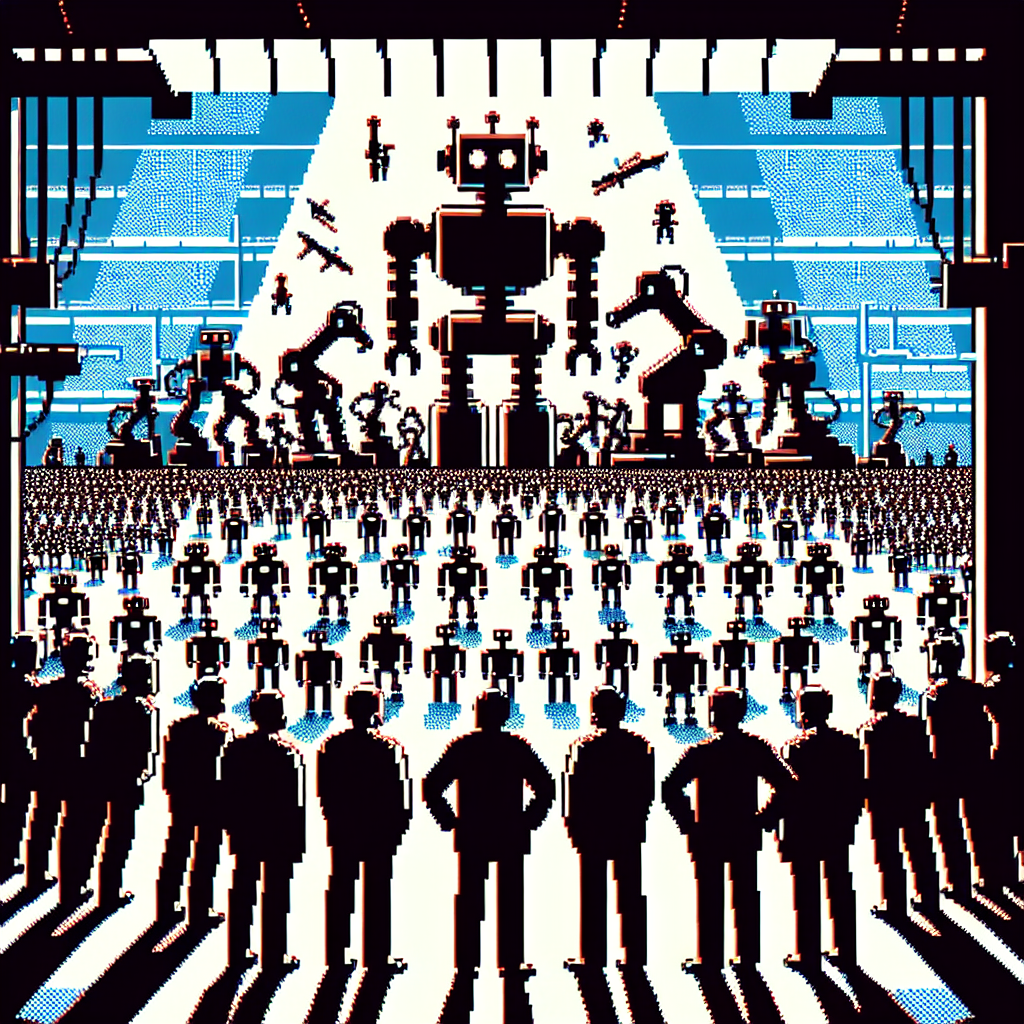
In a world where technology advances faster than you can say "artificial intelligence," China's latest robotic feat is both impressive and a tad unsettling. According to a recent Business article on futurism.com, China's manufacturing prowess has reached new heights, with over 276,000 robots coming online between 2022 and 2023. If you think that's a lot of robots, you're not alone—experts are sounding the alarm about this massive technological deployment.

What's Happening in China?


China has long been a global manufacturing hub, but its recent leap in robotics is setting new benchmarks. The country is now home to what can only be described as an army of robots, designed to outpace the rest of the world in production efficiency. While automation in manufacturing isn't new—think assembly lines and conveyor belts—China's scale of adoption is unprecedented. This raises an intriguing question: Is China leading us into a robotic utopia or a dystopian future?

The Global Robotics Race


China's rapid expansion in robotics isn't happening in a vacuum. As nations around the globe strive for technological innovation, robotics has become a key area of focus. For example, the United States has been exploring the use of AI and robotics in sectors like healthcare and defense. Meanwhile, Europe is making strides in ethical AI and sustainable automation, aiming to balance technological advancement with social responsibility.

The question of ethics is particularly pertinent. As robots take on more roles traditionally performed by humans, concerns about job displacement and privacy are mounting. According to a report by the World Economic Forum, "The Future of Jobs," automation could displace 85 million jobs by 2025, while also creating 97 million new roles. The challenge lies in ensuring that the workforce is prepared for this shift, and that the robots are used ethically and responsibly.

Connections to the Broader World


China's robotic revolution is part of a broader narrative about the changing nature of work and society. In the tech industry, giants like Amazon and Tesla are heavily investing in robotics to enhance operational efficiency. Even small startups are getting in on the action, using robots for everything from food delivery to elder care.

The rapid growth of robotics also ties into global supply chain dynamics. The COVID-19 pandemic exposed vulnerabilities in traditional supply chains, prompting companies to seek more resilient, automated solutions. China's robotics boom can be seen as a strategic move to fortify its position in global manufacturing and supply chain management.

A Final Thought


So, should we be alarmed or impressed by China's enormous army of robots? Perhaps a bit of both. On one hand, the scale and speed of China's robotic deployment is a testament to human ingenuity and the relentless pursuit of progress. On the other hand, it serves as a cautionary tale about the need for ethical considerations and global cooperation in the age of automation.

As we stand on the brink of a new robotic era, it's crucial to remember that technology should serve humanity, not the other way around. Whether China's robotic revolution leads to a brighter future or a more challenging one will depend on how we navigate this brave new world. In the meantime, let's keep our eyes on the horizon—and perhaps, just a little bit on the robots.

Read more about AI in Business

Read more about Latest Sports Trends

Read more about Technology Innovations

Trump thinks tariffs can bring back the glory days of US manufacturing. Here’s why he’s wrong – The Conversation | Analysis by Brian Moineau

Trump thinks tariffs can bring back the glory days of US manufacturing. Here's why he's wrong - The Conversation | Analysis by Brian Moineau

Title: The Tariff Tango: Nostalgia vs. Reality in US Manufacturing

There’s an old saying that nostalgia isn’t what it used to be. Recently, this sentiment seems to ring especially true in the context of US manufacturing, as former President Donald Trump attempts to reignite the glory of American industry through the use of tariffs. However, as The Conversation highlights in an insightful piece, these actions are driven more by a longing for the past than by the current economic landscape.

A Rose-Tinted Vision of Manufacturing

Donald Trump has always had a flair for the dramatic, and his economic policies are no exception. His approach to reviving US manufacturing often involves imposing tariffs, with the hope that these will encourage domestic production and deter reliance on foreign imports. It’s a strategy that harks back to a time when American factories were bustling, and “Made in the USA” was a ubiquitous label.

However, the world has changed since those days. Global supply chains are complex and intertwined, and a blanket approach to tariffs can lead to unintended consequences, such as higher prices for consumers and retaliatory measures from other countries. The manufacturing sector today is driven by technology and automation, rather than sheer manpower, and this evolution requires a more nuanced strategy than simply looking to the past.

Global Context: A Shifting Landscape

It's not just the US grappling with these economic challenges. Across the Atlantic, the UK is navigating its post-Brexit reality, seeking to strike new trade deals while maintaining economic stability. Similarly, China is strategically positioning itself as a leader in high-tech manufacturing, leaving traditional manufacturing powerhouses like the US in need of innovation rather than nostalgia.

In the tech world, companies like Tesla are redefining manufacturing with their gigafactories, blending cutting-edge technology with production. This shift highlights the need for forward-thinking policies that embrace technological advancements rather than relying solely on tariffs to protect old industries.

A Walk Down Memory Lane with Trump

Donald Trump, known for his larger-than-life persona, often draws from his unique blend of business acumen and celebrity status. His tenure as president was characterized by bold claims and actions that resonated with a segment of the American population yearning for simpler times. Yet, his approach often overlooked the complexities of modern economics.

His nostalgic perspective on manufacturing is reminiscent of his campaign slogan, "Make America Great Again," which taps into a desire to return to an idealized past. However, as the adage goes, you can’t step into the same river twice. The economic landscape has shifted, and so must the strategies to navigate it.

Final Thoughts: Embracing the Future

As we consider the future of US manufacturing, it’s important to acknowledge the power of nostalgia while recognizing its limitations. Tariffs alone cannot turn back the clock to a bygone era of manufacturing dominance. Instead, investment in education, innovation, and sustainable practices will pave the way for a robust industrial future.

The conversation around tariffs and manufacturing is a reminder that while the past shapes us, it is the future that demands our creativity and courage. By embracing change and crafting policies that reflect the realities of today’s world, we can honor our history while building a brighter economic future.

In an ever-globalizing world, the true measure of progress lies in our ability to adapt and evolve. As we move forward, let’s do so with a clear-eyed vision and a commitment to both preserving and progressing the American dream.

Read more about AI in Business

Read more about Latest Sports Trends

Read more about Technology Innovations