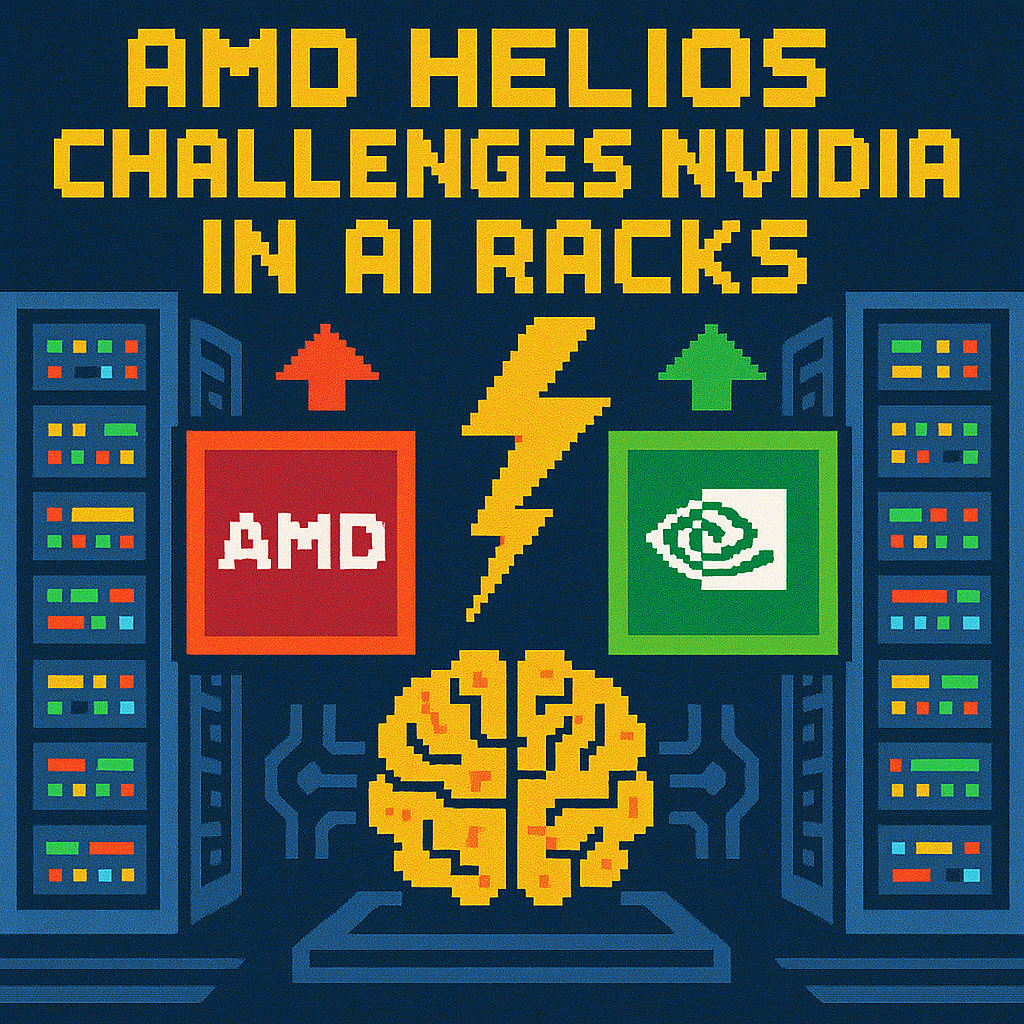
AMD Helios Challenges Nvidia in AI Racks | Analysis by Brian Moineau

TL;DR

  • AMD just won Microsoft as a buyer for its AMD Helios rack AI system, putting real heat on Nvidia’s rack-scale offerings and signaling that Azure wants diversity at the rack, not just the chip. [1][2][3]
  • The strategic bet isn’t raw FLOPS; it’s procurement resilience and lower “cost per token” on inference, enabled by an open ORW rack design and 72‑GPU double‑wide racks from multiple OEMs. [1][4][5]
  • If AMD sells roughly 1,900 Helios racks in 2027 at ~$5.25M each, that’s a $10B run-rate—precisely the scale AMD says it’s chasing as it courts eight of the top ten AI companies. [1][7]

What the source said

CNBC reports that AMD will ship its first rack-scale AI system, Helios, in 2H 2026, with Microsoft joining Meta, OpenAI, and Oracle as customers. Microsoft says Helios will power frontier model inference for Azure and add new EPYC “Venice” CPU instances. Futurum pegs Helios at $5–$5.5 million per rack, compared with Nvidia’s Vera Rubin at $3.5–$4 million, while Nvidia still holds ~95% data center GPU market share and analysts float a 20–25% AMD path. Shares of AMD rose more than 4% on the news in July 2026. [1]

Why it matters

This isn’t just about “AMD vs. Nvidia.” The real stakeholders are the hyperscale buyers—Microsoft, Meta, OpenAI, and Oracle—who need predictable delivery schedules, second sources, and better inference economics as model counts and context windows expand. Microsoft adding Helios means Azure can hedge against single-vendor risk while tuning for lower cost per token on inference-heavy workloads. [1][2][3]

For AMD, Helios is the vehicle to convert GPU credibility into system-scale revenue in 2026–2027. An open, standards-based rack (built on Meta’s ORW OCP design) lets ODMs like Supermicro ship at volume, which spreads manufacturing risk and accelerates field deployment across North America, Europe, and APAC. If that flywheel spins, AMD doesn’t need 50% share to win; it needs enough racks landing on time to anchor a multi‑billion‑dollar AI systems business. [4][5]

Original analysis

AMD Helios vs Nvidia rack systems: a 2x2

  • Open rack + inference-first (AMD Helios today)
    • ORW/OCP design, 72‑GPU double‑wide racks via multiple OEMs; pitched as “lowest cost per token.” Strong fit for large-scale inference and retrieval‑augmented serving under tight TCO constraints. [1][4][5]
  • Open rack + training-first (Helios roadmap)
    • As MI4xx/MI5xx mature, the same ORW chassis can host newer GPUs/NICs; training viability rises if software and interconnects keep pace with multi‑rack scale. [4]
  • Proprietary rack + training-first (Nvidia GB/“Rubin” pedigree)
    • NVLink/NVSwitch coherence and tight CPU‑GPU coupling remain the gold standard for training scale, but lock in procurement to one roadmap and supply queue. [6]
  • Proprietary rack + inference-at-scale (Nvidia Rubin/Vera Rubin)
    • Excellent perf/latency at the node, but customers carry lock‑in risk and single‑vendor supply exposure when quarterly capacity allocations drive product timelines. [6]

Back‑of‑envelope calculation

  • AMD says it plans to book “tens of billions” in data center AI revenue starting in 2027, with Helios as the majority. Assume an average Helios rack price of $5.25M (midpoint of the $5–$5.5M range cited by Futurum via CNBC). To hit $10B in 2027 AI systems revenue purely from racks: $10,000M ÷ $5.25M ≈ 1,905 racks; for $20B: ≈ 3,810 racks. This frames the task: win a few thousand rack installs across Microsoft, Meta, OpenAI, Oracle, and others. [1]

Historical analogue

  • In 2003, Opteron’s integrated memory controller upended Intel Xeon’s front‑side bus and briefly drove AMD to ~25% server CPU share before execution stumbles reversed the gains. The lesson is clear: when an incumbent optimizes for one axis (raw training scale), a challenger can wedge in on TCO and platform modularity. Helios pairs AMD’s regained CPU credibility (EPYC “Venice”) with an open rack and multiple OEMs to avoid the single‑supplier trap that hurt AMD in the late 2000s. [1][3][7]

Contrarian read

  • Consensus says Microsoft chose Helios to squeeze Nvidia on GPU price. My read: it’s mainly schedule insurance plus inference TCO for Azure’s frontier‑model services. Helios’s ORW/OCP lineage and OEM diversity (e.g., Supermicro) spread manufacturing risk when midplane or liquid‑cooling parts slip. Reports also flag shifting Nvidia rack timelines, which strengthens the appeal of a rack‑level second source. [1][2][3][5][6]

Named‑stakeholder breakdown

  • AMD: Helios is the bridge from GPU share to system revenue; openness and OEM breadth become differentiators, not just chip perf. Hitting a 2,000‑rack year in 2027 would validate the strategy. [1][4][5]
  • Microsoft: Gains bargaining power and faster time‑to‑capacity for inference workloads; adds new “Venice” CPU instances for agentic AI, EDA, and data pipelines in Azure. [1][3]
  • Nvidia: Still the training default in 2026–2027, but now faces procurement‑driven share leakage in inference and expansion phases where open racks and second sources are board‑level KPIs. [1][6]
  • Supermicro: Positioned to capture high‑margin rack integration, liquid cooling, and service revenue if Helios deployments scale through 2H 2026–2027. [5]
  • Meta/OpenAI/Oracle: More credible timelines for multi‑GW rollouts if a single vendor under‑delivers in a given quarter; ORW compatibility reduces integration friction at fleet scale. [1][4]

What others are missing

The story is less “AMD versus Nvidia silicon” and more “open ORW racks versus proprietary rack ecosystems.” ORW/OCP alignment means Helios can be built, qualified, and serviced by multiple OEMs, de‑risking freight lanes, liquid‑cooling manifolds, and midplane supply across regions like Texas, Frankfurt, and Singapore. That matters when a one‑quarter slip in rack deliveries pushes out a model launch date. Supermicro has already positioned a 72‑GPU double‑wide Helios configuration—evidence that this is a multi‑vendor program, not a single SKU—and that weakens the hold of proprietary rack interconnects by giving buyers a rack‑level second source. [4][5]

What to watch next

  1. By December 31, 2026, Azure announces general availability of at least one Helios‑backed instance family for inference or agentic AI, beyond private preview. Verification: Microsoft Azure blog or product pages. [3]

  2. By June 30, 2027, AMD reports an annualized data center AI systems revenue run‑rate of ≥$10B, with Helios cited as a majority contributor. Verification: AMD earnings materials and investor presentations. [1]

  3. By September 30, 2027, at least two OEMs (e.g., Supermicro and one other named partner) announce customer production deployments of Helios racks outside “Tier‑1” hyperscalers. Verification: OEM press releases and customer case studies. [5]

My take

Microsoft buying Helios isn’t a headline about FLOPS; it’s a procurement thesis for Azure. If you think AI will be bound by supply chains and power more than by paper specs, you buy the most open, multi‑source rack you can qualify in 2026–2027. Nvidia will remain the training yardstick, but the hyperscalers live and die by rollout calendars, not benchmarks. If AMD can ship a couple thousand racks on time and keep cost per token trending down, Helios will carve a durable inference beachhead. [1][2][3][4][5]

Sources

  1. AMD launches Helios, its first rack AI system to rival Nvidia, adding Microsoft as newest buyer — CNBC (https://www.cnbc.com/2026/07/20/amd-helios-microsoft-ai-nvidia.html) — News of Microsoft adopting Helios, pricing estimates via Futurum, market share context, and AMD’s “cost per token” positioning.

  2. Microsoft to Deploy Next-Gen AMD Instinct and AMD EPYC Processors as the Companies Expand Their Long-Term Strategic Partnership — AMD Press Release (https://www.amd.com/en/newsroom/press-releases/2026-7-20-microsoft-to-deploy-next-gen-amd-instinct-and-amd-.html) — Confirms Microsoft will deploy AMD Helios on Azure and shipping begins in 2H 2026.

  3. Microsoft expands Azure AI and HPC infrastructure with AMD — Microsoft Official Blog (https://blogs.microsoft.com/blog/2026/07/20/microsoft-expands-azure-ai-and-hpc-infrastructure-with-amd/) — Details Azure’s use of Helios for frontier model inference and new EPYC “Venice” CPU instances.

  4. AMD Helios: Advancing Openness in AI Infrastructure — AMD Product Page (https://www.amd.com/en/products/rackscale-solutions/helios.html) — Documents ORW/OCP alignment, open architecture intent, and deployment timing.

  5. Supermicro Expands Rack-Scale AI Leadership with AMD Helios Platform — Supermicro (https://www.supermicro.com/en/pressreleases/supermicro-expands-rack-scale-ai-leadership-amd-helios-platform-accelerating) — Provides 72‑GPU double‑wide rack configuration and OEM execution details.

  6. Nvidia’s Huang vows to deliver “giant amounts” of Vera Rubin — Tom’s Hardware (https://www.tomshardware.com/tech-industry/artificial-intelligence/nvidias-huang-vows-to-deliver-giant-amounts-of-vera-rubin-company-says-that-our-roadmap-is-intact) — Context on Nvidia’s rack-scale roadmap and shipment cadence discussions.

  7. 2025 Annual Report — AMD (https://ir.amd.com/financial-information/sec-filings/content/0001193125-26-129106/0001193125-26-129106.pdf) — States “eight of the world’s top ten AI companies” use AMD Instinct and outlines Helios/“Venice” roadmap context.

Earnings Lift Fuels 2026 Bull Market | Analysis by Brian Moineau

P/E Compression Is the 2026 Bull Market’s Tell

TL;DR

  • In the 2026 bull market, the wrinkle is P/E compression: the S&P 500’s forward P/E sits below where it began the year even as prices climbed, because earnings rose faster than prices [1].
  • FactSet pegs Q2 2026 S&P 500 earnings growth at 23.3%, with 10 of 11 sectors up, led by Energy, Information Technology, and Materials—fuel for prices without needing multiple expansion [2].
  • Math check: with the S&P 500 at 7,499 and a 20.4x forward P/E on June 30, the market discounts roughly $368 in next-12‑month EPS; if forward EPS lifts to $380–$400 by Q4 while the multiple merely holds 20x–21x, you still get 7,600–8,400 [3].

What the source said

Yahoo Finance reported that the 2026 rally left the S&P 500 cheaper on a forward basis than where it started the year, because the “E” outran the “P,” compressing the index’s forward P/E [1]. The article pointed to an “earnings boom,” with back‑to‑back 20%+ EPS growth quarters and a 23.3% estimate for Q2 2026 from FactSet [2]. Ten of eleven GICS sectors should post year‑over‑year profit gains, with Energy, Information Technology, and Materials leading the pack [2]. The takeaway: if Q2 beats again, analysts raise numbers into Q3 2026, while prices can climb even if the multiple stays flat [1][2].

Original analysis

  • Shown work on valuation math using June 30, 2026 inputs: S&P 500 = 7,499; forward P/E = 20.4x [3]. Implied next‑12‑month EPS = 7,499 ÷ 20.4 = $367.6, which rounds to $368 [3]. Scenario A: if forward EPS = $380 and P/E = 20.0x, price = 20.0 × 380 = 7,600 [3]. Scenario B: if forward EPS = $400 and P/E = 21.0x, price = 21.0 × 400 = 8,400 [3]. Risk case: if EPS = $380 and P/E compresses to 19.0x, price = 19.0 × 380 = 7,220, which shows downside even with higher earnings [3].

  • A 2×2 for 2H 2026:

    • High earnings growth + Flat/Down P/E (compression): steady grind higher; resembles mid‑cycle periods like 2004 when profit momentum outpaced sentiment.
    • High earnings growth + Up P/E: melt‑up risk; think of 2013 as a year when both earnings and multiples helped.
    • Low earnings growth + Flat/Up P/E: brittle rally; vulnerable to guidance cuts during October–November 2026 earnings season.
    • Low earnings growth + Down P/E: drawdown; typically follows negative revisions clusters across at least 6 of 11 sectors.
  • Contrarian read: leadership concentration in mega‑cap AI names such as Nvidia, Microsoft, and Alphabet could mean broad EPS beats help equal‑weight indices more than the cap‑weighted S&P 500 in 2H 2026, while pockets like Utilities and Real Estate remain rate‑sensitive even if Energy and Tech print strong results [2].

What others are missing

The market underestimates how 2026 AI data‑center buildouts at Microsoft (Quincy, Washington), Amazon (Hilliard, Ohio), and Alphabet (Council Bluffs, Iowa) flow through GAAP EPS via depreciation schedules that stretch 6–8 years, which can lift reported margins even before full cash returns materialize; that accounting timing could fortify EPS in Information Technology and Communication Services while masking capital‑intensity risk that shows up in free cash flow.

What to watch next

  1. By November 15, 2026, FactSet’s published S&P 500 forward 12‑month EPS will print at or above $390.
  2. On December 31, 2026, if the S&P 500 forward P/E closes between 19.5x and 21.5x, the index will finish between 7,600 and 8,400.
  3. By November 30, 2026, at least 8 of 11 GICS sectors will show positive year‑over‑year EPS growth for Q3 2026 in the FactSet scorecard.

Sources

  1. Yahoo Finance (malaysia.news.yahoo.com) — Summarizes 2026 P/E compression alongside price gains, framing why valuations look less stretched than headlines imply.
  2. FactSet Insight (insight.factset.com) — Provides the Q2 2026 23.3% S&P 500 EPS growth estimate and notes 10 of 11 sectors with positive YoY earnings, plus sector leadership.
  3. J.P. Morgan Asset Management, Guide to the Markets (am.jpmorgan.com) — Supplies the June 30, 2026 forward P/E of 20.4x and context for index‑level valuation math.


Related update: We recently published an article that expands on this topic: read the latest post.
SpaceX Monetizes Colossus for AI Compute | Analysis by Brian Moineau

TL;DR

  • SpaceX just turned “Colossus” into a real business line: Reflection will pay $150 million per month for GB300‑class compute starting July 1, 2026—up to $6.3 billion through December 2029—on a contract both sides can cancel with 90 days’ notice after the first quarter. [1], [4]
  • This is not “more cloud.” It’s asset‑backed AI utilities: 72‑GPU GB300 NVL72 racks with 130 TB/s NVLink domains selling time like power plants sell megawatt‑hours; scarcity is the product. [2]
  • The open‑source angle is strategic, not ideological: Reflection (seeking a ~$25B valuation) gets sovereign‑grade control without building hyperscale, while SpaceX monetizes idle Colossus cycles alongside existing Anthropic capacity commitments from Colossus 1. [1], [3], [9]

What the source said

CNBC reports that SpaceX signed a computing power agreement with Reflection AI, an open‑source lab, for access to Nvidia GB300 chips at SpaceX’s Colossus data center near Memphis, Tennessee. Reflection will pay $150 million monthly starting July 1, 2026, through 2029, implying ~$6.3 billion if the deal runs full term; either party can terminate with 90 days’ notice after the first three months. CNBC frames the deal as SpaceX productizing Colossus—built initially to train Grok—and notes prior compute arrangements with Anthropic, Google and Cursor, plus SpaceX’s post‑IPO push into AI infrastructure. Reflection positions the move as “American open intelligence,” courting government and national security buyers who want inspectable models and deployment control. [1]

Why it matters

The real stakeholders here are not just SpaceX and Reflection. They’re governments with procurement needs, enterprises chafing under closed‑model terms, chipmakers like Nvidia, and utilities in Tennessee and Mississippi that must deliver hundreds of megawatts on tight timelines. The Colossus platform already hosted more than 220,000 Nvidia GPUs and >300 MW at Colossus 1 for Anthropic—evidence of a compute market reallocating capital from model labs to whoever controls dense power and racks. [3]

SpaceX’s record IPO in June 2026 set the financial stage to package data centers as a revenue line alongside launch and Starlink. Deals like this convert capex into contracted cash flows and push “AI compute” toward a utility model: long‑dated offtake, power‑first engineering, and stickiness via NVLink/InfiniBand fabric topologies in GB300 NVL72 clusters. [6], [2]

Original analysis

SpaceX–Reflection compute deal: the economics and the bet

  • Back‑of‑envelope calculation for 2026–2029 cash flows

    • Total value if it runs full term: $150 million × 42 months (Jul 2026–Dec 2029) ≈ $6.3 billion. That’s $900 million for 2H26 and $1.8 billion per full year thereafter. [1], [4]
    • Capacity lens: If Colossus 1 was ~220,000 Nvidia GPUs across >300 MW for Anthropic, Reflection’s tranche likely targets Colossus 2’s newer GB300 inventory. GB300 NVL72 packs 72 Blackwell Ultra GPUs per rack with an in‑rack 130 TB/s NVLink domain; selling time slices of such tightly coupled racks commands premium pricing because many training runs don’t decompose across disjoint clusters without heavy efficiency penalties. [3], [2]
  • A 2×2 to decode the 2026–2029 market

    • Axis A: Model strategy
      • Open models (Reflection, select academia/defense pilots)
      • Closed models (OpenAI, Anthropic, Google)
    • Axis B: Compute sourcing
      • Asset‑light buyers (rent compute): Reflection today; many Series B–D labs
      • Asset‑heavy builders (own DCs): Microsoft, Google; portions of OpenAI
    • Where this deal sits: Open × Asset‑light. Advantages: speed to train, procurement optionality, and political palatability for U.S. government buyers who want source‑inspectable systems. Risks: termination rights (90‑day clause after the initial quarter) and renewal pricing exposure if GB300 supply tightens further. [1], [2], [4]
  • Named‑stakeholder breakdown (2026–2029)

    • SpaceX: Proves Colossus is not a vanity project. It’s monetizable, modular, and now diversified across Anthropic (Colossus 1) and Reflection (Colossus 2). Post‑IPO, it becomes a credible third pillar beside Starlink and launch, with utility‑like revenue visibility. [3], [6]
    • Reflection: Gains frontier‑class compute without a decade of data‑center capex and permitting. That turns its ~$25B valuation ambition from story into schedule: models out sooner, pilots with DOE and defense in a posture consistent with open procurement. [9], [1]
    • Nvidia: Sells the picks and shovels, then benefits twice as labs rent time on GB300 NVL72 racks that entrench Nvidia’s full stack (NVLink, Quantum‑X, libraries). Every GB300 domain increases switching costs away from Nvidia. [2]
    • Anthropic: Counter‑intuitively benefits from SpaceX scaling as a neutral lessor; its own deal locked up Colossus 1, and a bigger, healthier lessor reduces counterparty risk—until queues collide. [3]
    • Utilities and regulators (TVA, MLGW; Mississippi Southaven build): Must keep adding firm power, water, and interconnects to maintain SLAs tied to Colossus near Memphis and the new Mississippi site. Delays would hit SpaceX’s compute P&L as contracted racks sit idle. [3], [5]
  • Contrarian read in 2026

    • Consensus: “SpaceX is becoming a cloud provider.”
    • My take: SpaceX is becoming an AI utility, not a cloud. Clouds multiplex VMs; Colossus monetizes whole‑rack, high‑bandwidth NVLink islands engineered for tightly coupled training and reasoning. The product isn’t elastic compute; it’s guaranteed access to a specific fabric topology with deterministic latency and power—closer to capacity offtake in energy markets than AWS‑style instances, and the contract form (fixed monthly, cancelable after a lock‑in) looks more like a power purchase agreement. [2], [1], [4]

What others are missing

Coverage fixates on the $6.3 billion headline but glosses over topology risk: GB300 NVL72’s value lies in the 72‑GPU NVLink domain and 130 TB/s in‑rack bandwidth. If SpaceX overbooks or slices domains poorly, customers eat efficiency losses that can turn an eight‑week run into twelve, erasing savings from list‑price discounts. Because GB300 clusters reward scale‑up over scale‑out, the real moat is scheduler sovereignty over complete NVL72 “islands” and the power‑and‑cooling envelopes that keep them pinned. This is why Reflection is paying for guaranteed monthly access to full domains, not just ad‑hoc GPU hours, and why adding megawatts in Tennessee and Mississippi without derating capacity is existential to the SKU. [2], [7], [3]

What to watch next

  1. By Q4 2026, SpaceX discloses at least one more third‑party Colossus 2 customer with GB300 access on contracts ≥$100 million/year, signaling a standing product SKU rather than one‑offs. [2], [4]

  2. By mid‑2027, Reflection ships a publicly usable open‑weight model trained primarily on SpaceX GB300 infrastructure, with documented reproducibility and optional on‑prem deployment terms for U.S. agencies. [1], [4], [9]

  3. By 2027 year‑end, SpaceX files or announces at least 500 MW of additional power procurement tied to Colossus expansions in Tennessee/Mississippi, pairing long‑term interconnects with gas or renewables behind‑the‑meter to stabilize rack uptime SLAs. [5]

My take

SpaceX just priced compute like infrastructure, not software, and that’s the pivot the AI market needed in 2026. Renting GB300 NVL72 islands with hard SLAs will beat best‑effort cloud for anyone training state‑of‑the‑art models—or serving high‑stakes reasoning—where 72‑GPU NVLink domains matter. If Reflection turns this capacity into a credible, open‑weight alternative, the procurement map inside agencies and critical industries flips faster than expected by late 2027.

Sources

  1. SpaceX signs computing power deal with open-source AI startup Reflection worth up to $6.3 billion — CNBC (https://www.cnbc.com/2026/06/22/spacex-ai-colossus-data-center-reflection.html) — Original report with contract value, $150M/month schedule from July 1, 2026, and 90‑day termination clause.

  2. Designed for AI Reasoning Performance & Efficiency | NVIDIA GB300 NVL72 — NVIDIA (https://www.nvidia.com/en-us/data-center/gb300-nvl72/) — Official GB300 NVL72 specs: 72 Blackwell Ultra GPUs per rack and 130 TB/s NVLink domain; explains why full‑rack topology matters.

  3. Anthropic to use all of SpaceX‑xAI’s Colossus 1 data center compute — Data Center Dynamics (https://www.datacenterdynamics.com/en/news/anthropic-to-use-all-of-spacex-xais-colossus-1-data-center-compute/) — Establishes prior Colossus 1 commitments (~220,000 GPUs; >300 MW) and the Anthropic leasing context.

  4. Open‑source AI gets more compute from SpaceX — Axios (https://www.axios.com/2026/06/22/open-source-ai-gets-more-compute-from-spacex) — Independent confirmation of the Reflection deal terms, timing, and cancellation mechanics; frames open‑source rationale.

  5. Musk’s xAI to invest over $20 billion in Mississippi data center — Reuters via Investing.com (https://www.investing.com/news/economy-news/musks-xai-to-invest-over-20-billion-in-mississippi-data-center-4438483) — Corroborates the broader Colossus footprint (Mississippi build) and regional power expansion linked to xAI/SpaceX data centers.

  6. Musk’s SpaceX prices record IPO at $135 a share — Reuters via Moneycontrol (https://www.moneycontrol.com/news/business/musk-s-spacex-prices-record-75-billion-ipo-at-135-a-share-13947633.html) — Confirms SpaceX’s June 2026 record IPO, relevant to financing the Colossus expansion and compute commercialization narrative.

  7. Microsoft Azure Unveils World’s First NVIDIA GB300 NVL72 Supercomputing Cluster for OpenAI — NVIDIA Blog (https://blogs.nvidia.com/blog/microsoft-azure-worlds-first-gb300-nvl72-supercomputing-cluster-openai/) — Provides GB300 context in the wider market, including NVLink bandwidth and scale‑up behavior.

  8. Open‑source AI startup Reflection locks in SpaceXAI compute — Axios (https://www.axios.com/2026/06/22/open-source-ai-gets-more-compute-from-spacex) — Used for cross‑validation of the $150M/month and 90‑day cancellation clause; notes industry positioning among open‑source labs.

  9. Nvidia‑backed Reflection AI seeks $25B valuation — Investing.com (https://www.investing.com/news/stock-market-news/nvidiabacked-reflection-ai-seeks-25-bln-valuation-wsj-reports-4581362) — Documents Reflection’s funding target and Nvidia backing, grounding the “open‑source at scale” capital story.


Related update: We recently published an article that expands on this topic: read the latest post.



Related update: We recently published an article that expands on this topic: read the latest post.


Related update: We recently published an article that expands on this topic: read the latest post.
Surface Laptop Ultra: Nvidia‑Powered AI | Analysis by Brian Moineau

TL;DR

  • Microsoft’s Surface Laptop Ultra is the first flagship Windows laptop built around Nvidia’s RTX Spark SoC, advertising up to 1 PFLOP of local AI compute and 128GB unified memory, but a 110W design target signals “desktop-class” throughput will hit battery walls in mobile use [2][3][5].
  • The story is stack control in 2026: Microsoft and Nvidia are bringing CUDA and Blackwell‑class GPU tech to Windows on Arm, a strategic end‑run around Intel and AMD and a direct challenge to Apple’s MacBook Pro line [2][5].
  • If RTX Spark laptops ship in volume and key ISVs optimize Windows‑on‑Arm CUDA paths, 2026–2027 could echo Apple’s 2020 M1 inflection—only with Nvidia setting the cadence for PC “AI laptops” [5][6].

What the source said

ZDNET’s hands‑on from Taipei at Computex 2026 calls Surface Laptop Ultra the standout RTX Spark device, noting a 15‑inch 3:2 PixelSense Ultra mini‑LED panel rated at 2000 nits HDR and 262 ppi, plus creator‑friendly I/O (2×USB‑C, USB‑A, HDMI, SD, 3.5 mm) in a metal chassis [1]. It reports Nvidia’s ARM‑based RTX Spark pairing a 20‑core CPU with GPU performance “roughly equivalent” to a GeForce RTX 5070, and configurations up to 128GB unified memory aimed at local AI [1]. Thermal changes include a dual‑fan, dual‑heat‑pipe layout and a slightly raised base to improve airflow in the 15‑inch form factor [1]. Open items include price tiers, RAM options, measured battery life, and preorder timing signaled as “late summer/early fall” 2026 [1].

Why it matters

For Microsoft in 2026, Surface Laptop Ultra is public proof that Windows on Arm can lead the “AI PC” story with CUDA, fifth‑gen‑class Tensor Cores, and unified memory, rather than trailing x86 laptops on battery life alone [2][5]. The device provides a credible counter to Apple’s MacBook Pro narrative in creative and on‑device inference workloads just as developers decide where to target Stable Diffusion, Llama‑3, and NeRF pipelines for client compute [2][5].

For Nvidia, Spark PCs extend its data‑center CUDA dominance into client devices on Windows, which could bind independent software vendors to CUDA toolchains across 2026–2027 [3][5]. If the bet pays off, Intel and AMD face a squeeze from an Arm+Blackwell package while Apple maintains its integrated stack; studios and consumers win on local LLMs and video tools—if battery life and price don’t dull the pitch [3][6].

Original analysis

Surface Laptop Ultra is a stack play masquerading as a laptop

The spec sheet grabs attention—1 PFLOP AI, 20 Arm CPU cores, and up to 128GB unified memory—but the strategic move is CUDA on Windows on Arm delivered via a Blackwell‑class GPU in a unified‑memory SoC [2][4][5]. That gives Microsoft a first‑party flagship where ISVs can ship the same CUDA kernels across workstation, data center, and laptop without re‑architecting for disparate memory models [2][5].

Consensus take: “Surface Laptop Ultra is a MacBook Pro killer because it matches performance with AI flair” [1]. Contrarian read: this is a CUDA land grab on Windows, not a copy‑paste of Apple’s 16‑inch formula [2][5].

Apple’s edge remains vertically integrated silicon, hardware media engines, and battery efficiency proven since the M1 in 2020; Microsoft’s counter is a developer‑first path where Stable Diffusion XL, Llama‑3 variants, NeRFs, and video upscaling run on familiar CUDA code in 2026 [2][5]. For teams already standardized on CUDA for training and inference, developer gravity favors Spark even if Metal and Core ML perform well in Apple’s ecosystem [2][5].

Back‑of‑envelope: battery reality check

Assume an 84 Wh battery; display at ~350 nits draws ~7 W; platform idle ~5 W; sustained AI/video averages ~55 W on a 110 W‑TDP Spark SoC under creator workloads [3].

  • Total draw ≈ 5 + 7 + 55 = ~67 W.
  • Heavy AI runtime ≈ 84 Wh / 67 W ≈ 1.25 hours.
  • Mixed creator session (35 W average) ≈ 84 / (5 + 7 + 35) ≈ 1.9 hours.
    Takeaway: expect “AI at the desk” performance and short unplugged runs in 2026 unless workloads throttle or displays dim aggressively [3].
2×2: Where Surface Laptop Ultra sits

Axes: Y = AI throughput; X = mobility/endurance.

  • High throughput, low endurance: Surface Laptop Ultra (RTX Spark, 110 W target) and creator rigs like Razer Blade 15 with H‑class CPUs/GPUs [3].
  • High throughput, high endurance: MacBook Pro with M3 Max‑class efficiency and media engines for ProRes/HEVC/AV1 workflows [1].
  • Low throughput, high endurance: Snapdragon X‑class ultrabooks tuned for office tasks and light copilots at <20 W sustained.
  • Low throughput, low endurance: Legacy thin‑and‑lights with small dGPUs that throttle under sustained loads.

The trade: Ultra prioritizes CUDA‑grade throughput on Windows over battery endurance, which fits desk‑bound creator sessions in 2026 [3][6].

Historical analogue: 2020’s M1 reset

In 2020, Apple’s M1 unified CPU+GPU+NPU and memory architecture shifted laptop performance‑per‑watt, but the win crystallized when Final Cut Pro, Logic Pro, and Metal‑optimized Adobe/Blender updates arrived in the same year [2020][1]. Spark laptops echo that pattern in 2026: silicon is newsworthy, yet success hinges on ISVs shipping Windows‑on‑Arm CUDA builds and model toolchains that “just work” [2][5]. Nvidia’s advantage is portability from DGX/GeForce to client via CUDA and Blackwell Tensor Cores, while Microsoft supplies Windows compatibility and Surface industrial design [2][5].

Named‑stakeholder breakdown
  • Microsoft: Gains a flagship to anchor Windows on Arm for creators; must defend pricing and battery optics in 2026 channel reviews [1][2].
  • Nvidia: Extends CUDA from DGX and GeForce into “AI PCs,” setting de facto client inference standards during the 2026–2027 cycle [5].
  • Apple: Retains endurance and media‑engine leadership on MacBook Pro, but faces CUDA gravity nudging cross‑platform studios toward Windows.
  • Intel/AMD: Risk losing high‑margin creator tiers if OEMs adopt Arm+Blackwell; need clear x86 AI acceleration roadmaps before CES 2027.
  • Qualcomm: Remains vital for mainstream Arm laptops, but Spark grabs the performance spotlight at Computex 2026 [6].
  • ISVs (Adobe, Blackmagic, Topaz, Autodesk): Biggest upside is one CUDA pipeline scaling from RTX desktop to Spark laptops; challenge is engineering Windows‑on‑Arm releases on 2026 timelines [2][5].

What others are missing

Unified memory at “up to 128GB” is not a vanity spec; it eliminates costly PCIe host‑to‑device copies for multi‑gigabyte KV caches and tiles in LLM/VLM and 4K–8K video pipelines that blow past VRAM limits on split‑memory designs [2][5]. Diffusion models with long context windows, multi‑stream color‑managed timelines, and 16‑bit float buffers gain when CPU and GPU share a coherent pool in 2026 workflows [2][5]. Nvidia’s messaging highlights a coherent CPU‑GPU memory model with full CUDA on Windows on Arm; Microsoft echoes this in its Surface Ultra post [2][5]. If ISVs expose that coherency in their schedulers, Spark laptops can outperform similar‑TFLOP rivals on memory‑bound tasks even at the same wattage [2][5].

What to watch next

  1. By Q4 2026, independent reviews will record under‑2‑hour battery life for sustained local AI video upscaling on Surface Laptop Ultra at default panel brightness, using repeatable benchmarks [3][6].
  2. By December 31, 2026, at least two top creative ISVs (for example, Adobe or Blackmagic) will ship Windows‑on‑Arm CUDA builds that beat their own x86 Windows versions on identical workloads at matched power settings by a statistically significant margin [2][5].
  3. By CES 2027 (January 2027), three or more major OEMs beyond Microsoft will announce second‑wave RTX Spark laptops with ≤80 W TDP bins aimed at all‑day assistant and light‑creator use cases [6].

My take

Surface Laptop Ultra aims to be the CUDA laptop you can carry to a 2026 shoot, not the longest‑lasting notebook in a 12‑hour flight [2][5]. If I’m editing 6K ProRes, iterating Gen‑2 diffusion shots, and fine‑tuning a 13B LLM locally, identical CUDA code paths on a premium Windows machine beat two extra hours of battery for my workflow [2][5]. Microsoft and Nvidia are betting creators will plug in at the desk and want accelerated local inference at home and studio [3][5]. If ISVs deliver Arm‑CUDA builds this year, the “AI PC” label graduates from marketing to measurable gains in 2026 [2][5].

Sources

  1. ZDNET — Hands‑on with Microsoft Surface Laptop Ultra at Computex 2026 — What this contributes: concrete display specs (2000‑nit HDR, 262 ppi), ports, thermal layout, and open questions on pricing and battery.

  2. Microsoft Devices Blog — Introducing Surface Laptop Ultra (May 2026) — What this contributes: official confirmation of RTX Spark on Windows on Arm, Blackwell‑class GPU, CUDA support, and up to 128GB unified memory.

  3. Tom’s Hardware — Surface Laptop Ultra targets 110W TDP for RTX Spark Superchip (2026) — What this contributes: reported 110 W design target and realistic performance/power trade‑offs for the 15‑inch chassis.

  4. TechSpot — Microsoft unveils Surface Laptop Ultra with Nvidia RTX Spark and up to 128GB RAM (2026) — What this contributes: launch summary including 20‑core Arm CPU and 15‑inch form factor context.

  5. NVIDIA Newsroom — NVIDIA and Microsoft bring RTX Spark PCs with up to 1 PFLOP AI and unified memory (2026) — What this contributes: Nvidia’s framing of CUDA, Blackwell‑class Tensor Cores, and the Windows client stack.

  6. Tom’s Guide — I tested Microsoft Surface Laptop Ultra at Computex 2026 — What this contributes: independent hands‑on and confirmation that multiple Spark laptops debuted at the Taipei show.

Adopt an OpenClaw Strategy or Fall Behind | Analysis by Brian Moineau

Why an OpenClaw strategy might be your next competitive move

Jensen Huang called it “the new computer” and said this release could be “the single most important release of software, probably ever.” If that sounds dramatic, consider why the idea of an OpenClaw strategy already appears in boardrooms and engineering roadmaps across tech: OpenClaw-style agent platforms change how products get built, data is controlled, and value is captured.

The phrase OpenClaw strategy needs to land early because it pins the entire post-foundation-model debate: not just which model you use, but how you orchestrate, secure, and productize agents that do real work. This post unpacks what that means, why Nvidia — and the broader ecosystem — is racing to operationalize it, and what leaders should be thinking about next.

Why the OpenClaw conversation matters now

OpenClaw began as an open-source agent framework that lets developers compose persistent, multi-step AI agents running on local or hosted infrastructure. Within months it exploded into a vibrant ecosystem of forks, managed hosting, and enterprise toolkits. Critics flagged safety, governance, and data-exfiltration risks; supporters touted massive productivity gains from autonomous agents that can schedule, research, synthesize, and act.

Nvidia’s recent moves at GTC and in its blog underscore a key shift: the battleground has moved from raw model size to the system that safely and efficiently runs agents at scale. Nvidia’s messaging frames this as the next generation of compute — where hardware, models, and an agent orchestration layer work together. For companies, that means an OpenClaw strategy is less about adopting one open project and more about designing how agents interact with your data, users, and infrastructure.

A few developments that shaped the moment

  • OpenClaw and its forks rapidly gained broad community adoption and attention earlier this year.
  • Enterprise concerns about agent safety and governance pushed vendors to build hardened, hybrid solutions that combine local models with controlled cloud routing.
  • Nvidia’s announcements (and competing vendor responses) signaled that hardware and systems vendors will bundle agent capabilities with performance and security tooling.

These events mean that being “behind” isn’t about ignorance of the term; it’s about not having a clear plan for how agents will affect product architecture, compliance, and differentiation.

What an OpenClaw strategy actually looks like

An OpenClaw strategy is a practical blueprint, not a slogan. Core ingredients include:

  • Hybrid model routing
    • Local, privacy-preserving models for sensitive work.
    • Selective cloud access to frontier models for high-compute tasks.
  • Agent governance and capability controls
    • Sandboxed execution, permissioned APIs, and auditable action logs.
  • Data plumbing and lineage
    • Clear boundaries for what data agents can access, with encryption and retention policies.
  • Product UX rethinking
    • Design agents as cooperative teammates, with clear handoffs and graceful failure modes.
  • Commercial and legal posture
    • Licensing choices, vendor lock-in assessments, and regulatory compliance readiness.

Companies that implement these elements will turn agents from experimental toys into reliable product features that scale responsibly.

The investor dilemma (short takeaways)

  • Investors must evaluate not just model exposure but operational risk — how a company runs agents matters for privacy, safety, and liability.
  • Startups that nail agent governance can unlock defensible product experiences without competing on model scale alone.
  • Enterprises should ask vendors for concrete deployment patterns: can the agent run on-premises? How are logs retained? Who owns derived outputs?

Why Nvidia’s play matters

Nvidia has the rare combination of system-level influence: GPUs, software stacks, and an enormous install base. When a company with that leverage signals it will ship components that make agent deployment easier, safer, or faster, adoption accelerates. The practical effect:

  • Lower friction for enterprises to try hybrid agent setups.
  • Pressure on smaller vendors to offer hardened agent runtimes.
  • A faster convergence on standards for safe agent execution and data routing.

Put bluntly, when the platform that companies use to run models starts offering baked-in agent primitives, the platform becomes the standard for how agents are built — unless rivals offer compelling alternatives.

Risks and pitfalls to watch

  • Security shortcuts: Agents with broad access can accidentally leak secrets or initiate unwanted actions.
  • False assurances: “Open source” branding doesn’t automatically mean open governance or permissive licensing; read licenses and contribution policies.
  • UX fragility: Poorly designed agents create more friction than they remove — users must understand agent limits and be able to recover when things go wrong.
  • Regulatory exposure: Autonomy on customer data invites scrutiny; companies should document decision-making chains and retention rules.

These pitfalls are manageable, but they require intentional engineering and organizational alignment.

OpenClaw strategy: practical first steps

  • Map high-value workflows that could benefit from agentization (e.g., customer ops, research triage, scheduling).
  • Prototype with strict guardrails: start local, apply role-based access, and log every action.
  • Establish a cross-functional governance team: engineering, legal, security, and product.
  • Evaluate vendor roadmaps: prioritize options that let you retain control over sensitive data and model routing.
  • Build user-facing affordances that make agent behavior predictable and reversible.

Small, governed pilots beat big, uncontrolled bets.

My take

We’re not watching another incremental SDK release. We’re watching the assembly of a new software layer — an operating model for personal and enterprise AI agents. Companies that treat OpenClaw strategy as a narrow engineering project will get surprised. Those that treat it as a cross-cutting change to product architecture, data governance, and vendor strategy will unlock sustained advantage.

Move deliberately. Start small. Lock the doors. But don’t wait so long that the “claw” is already gripping customer expectations and market share.

Sources


Related update: We recently published an article that expands on this topic: read the latest post.

Related update: We recently published an article that expands on this topic: read the latest post.

Related update: We recently published an article that expands on this topic: read the latest post.

Related update: We recently published an article that expands on this topic: read the latest post.

Nvidias $2B Bet to Build AI Data Centers | Analysis by Brian Moineau

Hook: When the chipmaker becomes the cloud-builder

Nvidia Invests $2 Billion in Nebius for New Data Center Deal – Bloomberg — those eight words landed like an industry earthquake: Nvidia is once again writing huge checks, this time committing $2 billion to Nebius to build out AI data centers. The move signals more than a capital infusion; it’s a bet on an ecosystem where chip vendors, cloud operators, and hyperscalers lock arms to control not just the silicon but the stacks that run the AI revolution.

Why this matters now

Nvidia’s investment in Nebius arrives after a year in which demand for large-scale GPU capacity has exploded. Training and running modern generative AI models require specialized hardware and dense, power-hungry data centers. By taking an ownership stake and forming a strategic partnership, Nvidia reduces friction between chip supply and infrastructure deployment — and positions itself to capture value at multiple layers of the stack.

Transitioning from chips to compute services is a natural evolution. Nvidia has already invested in or partnered with several infrastructure players; this deal underscores how the company is shifting from a parts supplier to an architect of AI ecosystems.

What the deal actually is

  • Nvidia will invest $2 billion in Nebius through a strategic placement tied to a partnership to develop AI-focused data centers.
  • Nebius is a cloud and data center operator that has been scaling GPU capacity and signing multibillion-dollar contracts with large cloud consumers.
  • The partnership ties Nebius’ data center deployments closely to Nvidia’s accelerated computing platforms, including next-generation GPUs and networking.

This combination gives Nebius access to capital and prioritized tech, while giving Nvidia a more direct channel to monetize increased GPU demand and to influence the design of future data-center offerings.

A closer look: the industry choreography

First, the supply-side squeeze. GPU manufacturing is capital-intensive and capacity is limited. Companies that can promise committed demand and long-term partnerships often get preferential access to the newest hardware. By investing in Nebius, Nvidia helps ensure there’s a motivated buyer for its next-gen chips — and it helps shape how those chips are configured in real-world data centers.

Second, the margin story. Selling chips is lucrative. Selling whole racks, networking, and managed AI services is potentially even more lucrative and sticky. Nvidia’s move resembles vertical integration: it doesn’t replace cloud providers, but it creates third-party “neoclouds” that lock in workload demand for Nvidia hardware.

Third, the competition. Hyperscalers (Amazon, Microsoft, Google) still dominate the cloud market, but specialized neoclouds like Nebius — and peers such as CoreWeave and Lambda — have carved niches delivering high-density GPU capacity and specialized services. Large chipmakers investing in these operators accelerates their growth and changes competitive dynamics.

Implications for customers, partners, and markets

  • Customers could see faster availability of cutting-edge GPU-backed services and more turnkey AI infrastructure options.
  • Cloud incumbents may face sharper competition on price and specialized configurations tailored to AI training and inference.
  • Investors will watch Nebius’ valuation and stock volatility closely; strategic capital from Nvidia usually carries both a growth premium and questions about control and dilution.

Moreover, when an upstream supplier takes a stake in a downstream operator, governance and commercial tensions can appear. Expect close scrutiny from customers and regulators about preferential access to hardware, pricing, and whether such deals tilt markets.

A quick historical context

Nvidia has been increasingly active beyond GPU sales — investing in software, partnerships, and infrastructure deals that push adoption of its architecture. Nebius itself has recently announced major contracts (including large deals with hyperscalers) and has been rapidly expanding data-center footprints in North America and Europe.

This isn’t the first time Nvidia placed big bets: earlier investments in infrastructure providers and strategic collaborations have aimed at securing demand for its chips while shaping the cloud ecosystems that run modern AI.

Key takeaways

  • Nvidia’s $2 billion investment accelerates a trend: chipmakers moving downstream into infrastructure to capture more value.
  • The partnership reduces friction between GPU supply and large-scale deployments, potentially speeding time-to-market for advanced AI services.
  • The deal strengthens Nebius financially and technologically but raises competitive and governance questions for customers and rivals.
  • For the market, look for faster hardware rollouts, tighter chip-to-data-center integration, and renewed attention from regulators and large cloud customers.

My take

This deal feels like a logical — and inevitable — next step. The economics of modern AI favor vertical cooperation: companies that design chips want those chips to be used at scale, and companies that build data centers need reliable access to the latest silicon and the capital to deploy it. Nvidia’s move into Nebius stitches those needs together.

That said, the long-term winners will be the organizations that translate raw compute into differentiated services and tightly controlled cost structures. Capital plus silicon doesn’t guarantee superior software, platform adoption, or customer trust. Nebius now has resources and a preferred vendor; success depends on execution, customer relationships, and the ability to scale sustainably.

Looking ahead

Expect to see:

  • Rapid deployments of next-gen Nvidia hardware inside Nebius facilities.
  • More strategic investments by chipmakers into infrastructure players.
  • Increased scrutiny — both commercial and regulatory — over preferential supply arrangements.

These shifts will reshape how enterprises procure AI infrastructure. The convenience of dedicated, optimized AI clouds may win many customers, but hyperscalers won’t cede ground easily.

Final thoughts

Nvidia’s $2 billion leap into Nebius is less an isolated headline than a signpost: the AI value chain is consolidating around a few powerful alliances between silicon designers and infrastructure builders. For businesses, that could mean faster access to world-class compute. For the industry, it raises the stakes for competition, governance, and who ultimately controls the architecture of tomorrow’s intelligence.

Sources


Related update: We recently published an article that expands on this topic: read the latest post.

Nvidia Rally Fueled by GPU Cloud Deals | Analysis by Brian Moineau

Why Nvidia Popped Again: GPUs, Cloud Deals, and the Iris Energy Spark

Nvidia’s stock shrugged off a quiet market and ticked higher again after a 2% regular-session gain on Wednesday — then continued to push in after-hours trading. The immediate spark? News from Iris Energy (IREN) about fresh AI cloud deals and expanded Nvidia-GPU deployments. But the story is bigger than one announcement: it’s a snapshot of how GPU demand, strategic cloud partnerships, and macro sentiment keep feeding Nvidia’s rally.

What happened (the short version)

  • Iris Energy said it secured multi-year cloud services contracts and has been buying Nvidia Blackwell/H200 GPUs for its AI cloud business.
  • That announcement lifted IREN shares and helped support demand narratives for Nvidia chips, contributing to NVDA’s 2% regular-session gain and further after-hours strength.
  • Investors are treating each large-scale GPU order or cloud partnership as another piece of evidence that AI infrastructure spending remains robust — and that’s bullish for Nvidia, the dominant GPU supplier.

Why Iris Energy matters for Nvidia’s stock

  • Iris Energy has pivoted from crypto mining to building an AI cloud business, buying thousands of GPUs (including H200/Blackwell-class accelerators) and signing multi-year customer contracts. Those purchases translate directly into Nvidia revenue and order visibility.
  • Public, large GPU orders — or publicized partnerships that require Nvidia silicon — are high-signal events for markets because they show concrete, near-term demand for expensive AI accelerators.
  • When smaller cloud providers or GPU operators announce deals, investors update expectations for both current revenue and future order flow for Nvidia. That can nudge NVDA shares even on otherwise quiet trading days.

The broader drivers behind the rally

  • Ongoing AI infrastructure buildout: Enterprises and cloud providers continue to scale GPU fleets to run large language models and other AI workloads. That persistent demand is the core fundamental supporting NVDA’s multiple.
  • Supply and product leadership: Nvidia’s H200 / Blackwell architecture and its software stack (CUDA, AI frameworks) keep it the preferred choice for many customers, helping it capture a disproportionate share of large orders.
  • Market sentiment and momentum: Nvidia’s size and role in the AI story mean each positive data point — earnings beats, new partnerships, or big GPU orders — can trigger momentum flows from funds and retail investors.
  • Macro cross-currents: Even when macro data or Fed signals wobble, durable secular stories like AI infrastructure can keep investor interest concentrated in a handful of winners.

Signals to watch next

  • More large-scale GPU purchase announcements from cloud operators, service providers, or hyperscalers.
  • Nvidia guidance and order backlog disclosures (earnings or investor updates).
  • Customer wins or multi-year service contracts (like the ones Iris announced) that convert GPU units into recurring revenue.
  • Macro triggers that could deflate momentum (rate surprises, recession risk) — these can amplify volatility even for high-growth leaders.

What this means for investors

  • For growth-oriented investors: The NVDA rally continues to be supported by structural demand for GPUs and Nvidia’s competitive position. Each big GPU contract — public or private — is treated as incremental validation.
  • For risk-conscious investors: A string of positive headlines can lift NVDA sharply, but share prices are also sensitive to sentiment and valuation rotation. Big rallies can reverse quickly on macro surprises.
  • For traders: After-hours and headline-driven moves are opportunities for short-term plays, but they come with elevated volatility and order-flow risk.

Investor cues from the Iris Energy example

  • Even non-hyperscaler players matter. Iris Energy is not Microsoft or Google, but its pivot and large GPU purchases still moved markets — showing that demand breadth (multiple types of buyers) matters.
  • Publicized customer contracts are especially important: they translate hardware purchases into revenue streams investors can model, boosting conviction.
  • Watch the chain: GPU orders → deployment in data centers → customer-facing cloud capacity → recurring revenue. Each link increases visibility for Nvidia’s TAM (total addressable market) and revenue predictability.

Quick takeaways

  • Nvidia’s 2% gain and after-hours follow-through were driven in part by Iris Energy’s announcement about multi-year AI cloud deals and Nvidia GPU deployments.
  • Large GPU orders and cloud contracts act as direct signals of demand for Nvidia hardware, and markets reward visible demand.
  • The NVDA rally is structural (AI infrastructure) but also fragile to sentiment shifts and macro surprises.

My take

Nvidia’s dominance in AI accelerators makes it the natural beneficiary of any publicized scaling of GPU capacity. Iris Energy’s announcements are a reminder that demand isn’t only coming from hyperscalers — a wider ecosystem of cloud providers and operators is buying at scale. That breadth matters for the sustainability of Nvidia’s growth story. Still, the price already bakes in a lot of future adoption; investors should balance excitement about continued AI spending with careful attention to valuation and macro risk.

Sources

Keywords: Nvidia, NVDA, Iris Energy, IREN, GPUs, H200, Blackwell, AI infrastructure, cloud services, stock rally


Related update: We recently published an article that expands on this topic: read the latest post.

S&P 500 Pauses as Software Stocks Slide | Analysis by Brian Moineau

Markets on a Short Week: Why the S&P 500 Is Stalling and Software Stocks Are Getting Hit

It’s a weird kind of market mood — not a panic, not a party. The S&P 500 opened a holiday-shortened week largely flat, but the index has now slipped for two weeks in a row. Much of the heat is on software and other tech-related names as investors wrestle with a familiar tension: the promise of AI-driven growth versus the reality of big, uncertain spending and shifting profit prospects.

What happened this week — the headlines that matter

  • The S&P 500 was little changed to start a shortened trading week while software names slid.
  • The broad index has recorded declines for two consecutive weeks — enough to make investors pause after a long stretch of gains earlier this year.
  • Tech megacaps and AI-related names remain the primary market movers, producing big swings that ripple across the index because a handful of companies carry outsized weight.

Why software and tech are getting punished

  • AI euphoria has been a two-edged sword. Expectations for automation and generative AI have driven massive capital allocation toward chips, cloud infrastructure and software, pushing valuations higher. When companies signal large, front-loaded AI spending or give cautious guidance about monetizing those investments, investors react harshly.
  • The market’s “shoot first, ask questions later” instinct: once a narrative shifts from “AI = endless upside” to “AI costs may not pay off quickly,” stocks perceived as vulnerable (particularly in software and services) face steep re-pricing.
  • Earnings and guidance season remains the catalyst. Even beats can be punished if forward commentary hints at slower growth or heavier investment. That’s enough to drag the S&P when the companies affected have significant index weight.

The bigger picture: not a broad market breakdown, but a rotation and recalibration

  • This isn’t a textbook market crash. Other parts of the market — cyclical sectors, financials, energy at times — are behaving differently. What we’re seeing is sectoral stress and volatility inside an otherwise range-bound market.
  • Interest-rate and inflation dynamics still matter. Any signs that inflation is cooling can calm rate-cut expectations and lift sentiment, while stronger data keeps yields elevated and increases the discount on long-duration tech earnings.
  • The concentration effect: When a few large tech names rally or slump, headline moves in the S&P can look extreme even though much of the market is not mirroring that behavior.

Smart ways investors are responding (what I’m seeing from the desks)

  • Rebalancing from concentrated AI/mega-cap positions into broader, less-correlated exposures (value, cyclicals, small- and mid-caps).
  • Trimming positions where guidance looks shaky rather than selling everything. Earnings commentary is getting more scrutiny than raw headline beats.
  • Using volatility to add selectively: investors who believe in longer-term AI winners are sometimes averaging into names after pullbacks, but with tighter risk controls.

Takeaways for investors and readers

  • Markets are digesting the AI narrative: enthusiasm is still real, but the “how and when” of monetization is being questioned. That shift shows up first and loudest in software and AI-adjacent stocks.
  • Two down weeks for the S&P 500 is a reminder that even a generally healthy market can wobble when a few big sectors re-price.
  • Watch earnings calls and forward guidance closely — the market is trading less on past results and more on future spending and margin implications.
  • Keep an eye on macro data (inflation, employment, Treasury yields). Those signals influence how investors discount long-duration tech profits.

A few tactical points to consider

  • If you’re long-term focused: short-term swings are normal; use pullbacks to reassess positions versus panic-sell.
  • If you’re trading: volatility favors active risk management — tighter stops, hedges, or smaller position sizes.
  • For diversified investors: remember that index moves can mask underlying breadth. The S&P’s headline action might overstate the degree of weakness across other sectors.

My take

There’s a healthy re-pricing happening more than a breakdown. The market is trying to put sensible valuations on companies that face meaningful strategic decisions about AI: how much to spend, where to compete, and how quickly that spending will turn into profit. That uncertainty produces headline volatility — especially in a shortened week with fewer market hours to digest information. For long-term investors, this is a useful reminder to focus on fundamentals and on the companies that show both the ability to invest sensibly and the path to profitability.

Sources

(Note: this piece was written with a base narrative inspired by a CNBC live-updates story about a holiday-shortened week when software shares slid; the reporting above synthesizes that theme with broader coverage from the sources listed.)


Related update: We recently published an article that expands on this topic: read the latest post.

Related update: We recently published an article that expands on this topic: read the latest post.
Fire Stick Becomes Full-Fledged Cloud | Analysis by Brian Moineau

A tiny dongle, a huge upgrade: GeForce NOW turns Fire Sticks into cloud gaming portals

You probably think of a Fire TV Stick as the thing that brings Netflix, Prime Video, and the occasional ad to your living room. Now imagine plugging that same little stick into a hotel TV or a spare bedroom set and — boom — your Steam, Epic Games Store, or Battle.net library is playable on the big screen without a gaming PC. That’s the practical surprise Amazon and NVIDIA quietly delivered this week.

Why this matters (and why Amazon felt the need to comment)

  • NVIDIA launched a native GeForce NOW app for select Amazon Fire TV Sticks, letting users stream thousands of PC games from the cloud to compatible Fire TV devices. This effectively turns supported sticks into cloud gaming endpoints, provided you have a controller and a decent internet connection. (ladbible.com)
  • Amazon issued a short statement welcoming the addition, noting Fire TV customers "now have access to thousands of PC-quality games through the NVIDIA GeForce NOW app" and highlighting the convenience of streaming games anywhere there's a TV and fast internet. That endorsement matters: it signals Amazon is comfortable having third-party cloud gaming options co-exist on Fire OS alongside its own services. (ladbible.com)
  • The practical limits are important: on Fire TV sticks GeForce NOW currently streams up to 1080p at 60 fps with SDR and stereo audio. It’s not the highest-end GeForce NOW experience (which can hit much higher resolutions and features on other platforms), but the trade-off is affordability and accessibility. (engadget.com)

What you can (and can’t) expect

  • Supported devices at launch:
    • Fire TV Stick 4K Plus (2nd Gen) and Fire TV Stick 4K Max (2nd Gen) running Fire OS 8.1.6.0 or later.
    • Fire TV Stick 4K Max (1st Gen) with Fire OS 7.7.1.1 or later. (blogs.nvidia.com)
  • Streaming quality: capped at 1080p/60fps, H.264 encoding, SDR visuals, and stereo audio on these sticks — solid for many players, but short of GeForce NOW’s flagship capabilities on other devices. (engadget.com)
  • Controls and setup: you’ll need a compatible Bluetooth or USB controller, a GeForce NOW membership (free and paid tiers exist with different performance/session benefits), and a stable high-speed connection for low-latency play. (t3.com)
  • What you won’t get: native local ray tracing, HDR10, 7.1 audio, or the top-tier resolutions and frame rates available on other GeForce NOW platforms — at least not on these stick models. But you do get access to the games you already own on PC stores, which differentiates GeForce NOW from some competitors. (blogs.nvidia.com)

The broader picture: streaming gaming goes mainstream in living rooms

  • Cloud gaming is moving beyond consoles and PCs into the set-top devices people already own. That’s strategic for NVIDIA — wider availability grows the potential user base without forcing people to buy new hardware — and convenient for Amazon, which benefits from a more capable Fire TV ecosystem even if it’s not its own service. (blogs.nvidia.com)
  • Competition heats up: GeForce NOW on Fire TV joins Xbox Cloud Gaming and Amazon’s Luna in the living-room streaming mix. For consumers that’s good news: more platform options and a clearer path to play high-quality games without buying expensive GPUs or consoles. (t3.com)
  • Real-world impact: this makes accessible PC gaming a realistic option for casual players, travellers, and households that don’t want to invest in a dedicated gaming rig — assuming your internet is up to the task.

Quick bullet summary

  • NVIDIA’s GeForce NOW now has a native app for select Amazon Fire TV Sticks, enabling cloud play of PC libraries. (ladbible.com)
  • Amazon publicly acknowledged the launch and framed it as expanded access to PC-quality games on Fire TV. (ladbible.com)
  • Supported sticks stream up to 1080p/60fps with SDR and stereo audio; requirements include a controller and robust internet. (engadget.com)

My take

This is the sort of incremental product expansion that quietly changes expectations. It won’t replace high-end gaming rigs or supercharged consoles, but it does reduce friction: no more juggling builds or buying new boxes just to play your PC games on another TV. For households where buying another console is a stretch, or for people who move between places (think students, frequent travellers, or families with multiple TVs), this is a meaningful upgrade.

Amazon’s statement matters less as PR and more as validation: it signals that third-party cloud gaming is welcome on Fire OS, which should encourage other services to polish Fire TV support. For gamers, it’s a low-cost way to stretch an existing library onto more screens. For NVIDIA, it’s another piece in the GeForce NOW growth puzzle.

Sources


Related update: We recently published an article that expands on this topic: read the latest post.


Related update: We recently published an article that expands on this topic: read the latest post.

Related update: We recently published an article that expands on this topic: read the latest post.

Death Stranding 2 PC Launch on March 19 | Analysis by Brian Moineau

Arrival on the beach: Death Stranding 2 heads to PC on March 19, 2026

A Kojima headline that actually tells you something — and fast. Kojima Productions has officially confirmed that Death Stranding 2: On the Beach will land on Windows on March 19, 2026, bringing Hideo Kojima’s sprawling, uncanny delivery simulator to PC with a slate of PC-first upgrades and the usual Kojima flourish. Pre-orders went live February 12, 2026 on Steam and the Epic Games Store, and the port is being handled by Nixxes Software.

Why this matters beyond another port

Death Stranding 2 already had a high-profile PS5 launch in 2025, but PC releases for Kojima projects have historically widened the audience and given players new ways to experience his cinematic design. This is one of the quicker turnarounds we’ve seen for a PlayStation-to-PC sequel — and it’s arriving with technical options that make the most sense for PC players: uncapped framerates, upscaling and frame-generation support (NVIDIA, AMD, Intel), plus extended ultrawide resolutions.

That combination makes this more than "the same game on another platform." For many players, it will be the definitive way to experience On the Beach: higher refresh rates, 32:9 super-ultrawide support, and PC audio options like Dolby/DTS/Windows Sonic can change pacing and immersion in both walks across burned landscapes and tense combat encounters.

What’s new for PC (and what to expect)

  • Release date: March 19, 2026 (Windows).
  • Pre-orders: Opened February 12, 2026 on Steam and Epic Games Store.
  • Port developer: Nixxes Software (Sony-owned studio known for PlayStation-to-PC ports).
  • Performance features:
    • Uncapped framerates for gameplay (cinematics locked at 60 FPS).
    • Support for NVIDIA, AMD, and Intel upscalers and FrameGen.
    • Ultrawide and super-ultrawide monitor support (21:9 and 32:9) — cutscenes included for 21:9 on PS5 and both 21:9/32:9 on PC.
  • Input & audio:
    • Full mouse + keyboard support and DualSense controller integration.
    • 3D audio support via Dolby Access, DTS Sound Unbound, or Windows Sonic for Headphones.
  • Cross-content and account features:
    • PlayStation account sign-in for trophies, friends list overlay, and exclusive backpack patches / PS-inspired suit.
  • New modes:
    • Kojima Productions promised "new modes and features" that will arrive on both PC and PS5 at launch; specifics will be revealed closer to release.

A quick look at the developer and port team

  • Kojima Productions continues to build its auteur brand around cinematic, narrative-driven, genre-bending games. Hideo Kojima remains the creative force and public face.
  • Nixxes Software is handling the PC build — they’ve become Sony’s primary studio for PC ports, with mixed public reception on some launches but a solid technical pedigree for enabling high-end PC features.

What this means for different players

  • PC enthusiasts with ultrawide monitors and high-refresh rigs will likely see the biggest improvements in visual and performance fidelity.
  • Players who prefer controllers or want PlayStation-connected features can still expect DualSense integration and PlayStation account rewards.
  • Fans who didn’t play the PS5 release now have a compelling reason to jump in without buying new hardware — and those who did may revisit the game to chase performance or cosmetic pre-order extras.

A few practical notes

  • Cinematics remain locked at 60 FPS, so expect buttery gameplay but cinematic sequences capped — a common design choice to preserve directors’ timing.
  • Pre-order incentives include cosmetic items (Quokka hologram, various skeletons) and a Digital Deluxe option with extra bonuses.
  • If you want the same PC experience as the reveal, check system requirements when Steam/Epic store pages go live; the PlayStation Blog announcement recommends upscaling and FrameGen-capable hardware for the best upgrades.

What to watch between now and March 19

  • Detailed system requirements and storefront pages (Steam / Epic).
  • Specifics on the promised new modes and features that will ship on both PC and PS5.
  • Early reviews and PC launch-day technical impressions, especially given Nixxes’ mixed history on past ports.

Key points to remember

  • Death Stranding 2: On the Beach arrives on PC March 19, 2026.
  • Major PC features: uncapped framerates, upscaling/frame generation, ultrawide support to 32:9, DualSense and mouse/keyboard, 3D audio.
  • Port by Nixxes Software; pre-orders opened February 12, 2026 with cosmetic bonuses.

My take

Kojima’s work is built to be experienced — and offering serious PC options makes sense for a game that trades on atmosphere, slow-burn tension, and environmental spectacle. The technical additions are the kind of polish that can transform player experience: ultrawide vistas, unlocked framerates while traversing the ruins of Australia, and FrameGen-assisted smoothing could make long deliveries feel elegant rather than sluggish. The real wildcard will be whether the new modes add meaningful replay value or simply extend the experience cosmetically. Either way, March 19 gives PC players a clear date to clear shelf space and maybe buy a better chair for those long walks across Timefall-scarred landscapes.

Sources


Related update: We recently published an article that expands on this topic: read the latest post.


Related update: We recently published an article that expands on this topic: read the latest post.


Related update: We recently published an article that expands on this topic: read the latest post.

Tech Sell-Off After AMD Shocks Markets | Analysis by Brian Moineau

Markets wobble as AMD and weak jobs data rattle tech — why Tuesday’s sell-off matters

Hook: The market’s morning felt a bit like watching a favorite team fumble the ball twice in a row — confidence slipped, big names tripped, and investors suddenly started asking whether this is rotation, overreaction, or the start of something bigger.

The headline: the S&P 500 fell for a second consecutive day after Advanced Micro Devices (AMD) reported earnings that disappointed investors’ expectations for forward growth, and fresh jobs data painted a softer picture for the labor market. Tech — the market’s heartbeat for much of the past few years — took the brunt of the pain, dropping more than 2% on Tuesday and becoming the weakest of the S&P 500’s 11 sectors.

Why AMD’s report hit so hard

  • Earnings beats don’t always equal happier investors. AMD reported revenue that met or beat some expectations, but guidance and the quality of that revenue left traders cold — portion of the quarter’s upside tied to China unexpectedly, and data-center growth that underwhelmed relative to lofty AI expectations. That combo punched a hole in confidence for a chipmaker that’s supposed to be a major AI beneficiary.
  • Expectations were already priced for perfection. After years of AI-driven enthusiasm, investors have a shrinking tolerance for anything short of clear evidence that a company will materially win from AI momentum. When that narrative wobbles, multiple chip and software names can be sold at once.

The jobs data angle — why weak hiring matters now

  • Private payrolls (ADP) showed far fewer hires than economists expected, adding to other signals of softening labor demand. That weak labor data pushed investors into a two-edged reaction:
    • Some traders see softer jobs as a reason the Fed could be less hawkish later — a potential tailwind for risk assets.
    • Others worry the labor weakness is early evidence of an economic slowdown, which would hurt corporate revenue and margins — a clear headwind for equities, and particularly for high-valuation tech names.

In short, the jobs data amplified the AMD story: if growth (and labor) is cooling, lofty AI-driven valuations look riskier.

How tech’s >2% drop fits into the bigger picture

  • Tech’s decline on Tuesday was notable because it’s the market’s largest sector by weight and has been the engine of recent gains. A >2% drop in tech can move the entire index even if other sectors are stable or up.
  • The sell-off isn’t only about fundamentals. It’s also about positioning: after long periods of tech outperformance, funds and traders run exposure that’s sensitive to sentiment swings. When headlines trigger a reassessment (AMD guidance + weak jobs), selling cascades.
  • AI hype is a double-edged sword. Companies perceived to be winners from AI get sky-high multiples; when investors start to question who will actually monetize AI and how fast, those multiples compress quickly.

Market mechanics to watch in the next few sessions

  • Mega-cap leadership: Watch how the largest market-cap names behave (Nvidia, Alphabet, Microsoft, Amazon). If these stabilize or bounce, the broader index may recover quickly; if they keep selling, rotation could deepen.
  • Earnings cadence: Big-tech earnings coming up (Alphabet, Amazon and others) will be treated as tests — not just of revenue/earnings, but of the AI narrative and capex outlook.
  • Economic cross-checks: Upcoming official labor reports and other growth indicators will matter more than usual because traders are parsing modest labor signals for direction on monetary policy and growth.

What investors and readers should keep in mind

  • Volatility is normal in transitions. The market is pricing a transition from valuation-driven, growth-premium leadership to a period where execution, durable revenue, and margin sustainability matter more.
  • Short-term moves can be noisy. One or two disappointing reports can trigger outsized reactions; that doesn’t automatically equal a structural market shift. But repeated disappointments across earnings and macro data would be more consequential.
  • Sector diversification and position sizing matter. For investors with concentrated tech exposure, this episode is a reminder to review risk tolerance and whether portfolio concentration still matches long-term objectives.

My take

This wasn’t just a day when one chip stock slipped — it felt like the market checking whether its AI story has legs. AMD’s earnings raised questions about how quickly companies can turn AI buzz into repeatable, scalable results; weak private payrolls added the macro uncertainty layer. For long-term investors, panic-selling on a two-day move often creates buying opportunities — but not until the narrative clears: either earnings and macro data stabilize, or the market re-prices corporate growth more permanently. Keep an eye on upcoming earnings and the official labor reports this week — they’ll tell us whether this is a short-term hissy fit or the start of a broader re-evaluation.

Takeaways to remember

  • AMD’s mixed report blew a hole in AI-fueled expectations for some chip and software names.
  • Weak private jobs data amplified fears about growth and made high-tech valuations look riskier.
  • Tech’s >2% drop on Tuesday mattered because of the sector’s weight and its role as the growth engine.
  • Watch mega-cap earnings and official labor data for clues on whether sentiment shifts are temporary or structural.

Sources

(Note: reporting in these articles includes market coverage from February 4–5, 2026, around AMD’s earnings and contemporaneous jobs data.)


Related update: We recently published an article that expands on this topic: read the latest post.


Related update: We recently published an article that expands on this topic: read the latest post.

Oracle’s $50B Cloud Gamble Fuels AI Race | Analysis by Brian Moineau

Oracle’s $45–50 billion Bet on AI: Why the Cloud Arms Race Just Got Louder

The headline is dramatic because the move is dramatic: Oracle announced it plans to raise between $45 billion and $50 billion in 2026 through a mix of debt and equity to build more cloud capacity. That’s not a routine capital raise — it’s a statement about how much money is now needed to stand toe-to-toe in the AI infrastructure race.

Why this matters right now

  • The market for large-scale cloud compute for AI is shifting from software-margin stories to capital-intensive infrastructure plays.
  • Oracle says the cash will fund contracted demand from big-name customers — including OpenAI, NVIDIA, Meta, AMD, TikTok and others — which means these are not speculative capacity bets but expansions tied to real deals.
  • Raising this much via both bonds and equity signals Oracle wants to preserve an investment-grade balance sheet while shouldering a very heavy upfront cost profile that may compress free cash flow for years.

What Oracle announced (the essentials)

  • Oracle announced its 2026 financing plan on February 1, 2026. The company expects to raise $45–$50 billion in gross proceeds during calendar 2026. (investor.oracle.com)
  • Financing mix:
    • About half via debt: a one-time issuance of investment-grade senior unsecured bonds early in 2026. (investor.oracle.com)
    • About half via equity and equity-linked instruments: mandatory convertible preferred securities plus an at-the-market (ATM) equity program of up to $20 billion. (investor.oracle.com)
  • Oracle says the capital is to meet "contracted demand" for Oracle Cloud Infrastructure (OCI) from major customers. (investor.oracle.com)

How this fits into Oracle’s longer-term AI strategy

  • Oracle has pivoted in recent years from being primarily a database and enterprise-software vendor to an infrastructure provider for generative AI customers. Large, multi-year contracts (notably with OpenAI) have been central to that story. (bloomberg.com)
  • Building AI-scale data centers is capital intensive: racks, GPUs/accelerators, power, cooling, networking, and long lead times. The company’s plan acknowledges that scale requires front-loaded spending — and external capital. (investor.oracle.com)

The investor dilemma

  • Pros:
    • Backing by contracted demand reduces some revenue risk versus pure capacity-to-sell strategies.
    • If Oracle can deliver the compute reliably, the payoff could be large: stable long-term revenue from hyperscaler-AI customers and higher utilization of OCI.
  • Cons:
    • Heavy near-term cash burn and higher gross debt levels could pressure margins and returns for several fiscal years.
    • Equity issuance (including ATM programs and convertible securities) dilutes existing shareholders and can weigh on the stock.
    • Credit metrics and investor appetite for more investment-grade bonds at this scale are uncertain. Credit-default-swap trading and analyst commentary show investor nervousness about overbuilding for AI. (barrons.com)

Who bears the risk — and who benefits?

  • Risk bearers:
    • Current shareholders face dilution risk and near-term margin pressure.
    • Bond investors absorb increased leverage and structural execution risk if demand slips or customers renegotiate.
  • Potential beneficiaries:
    • Customers that secure large, predictable capacity from Oracle (e.g., AI model trainers) may benefit from more onshore, enterprise-grade compute.
    • Oracle, if it executes, could lock in long-term, high-margin cloud contracts and tilt the competitive landscape versus other cloud providers.

What to watch next

  • Timing and pricing of the bond issuance (size, maturities, yields) — this will show investor appetite and borrowing cost. (investor.oracle.com)
  • Pace and pricing of the ATM equity program and any convertible issuance — how aggressively Oracle taps the market matters for dilution and market sentiment. (investor.oracle.com)
  • Delivery milestones and usage numbers from Oracle’s major contracts (especially OpenAI) — revenue recognition and cash flows tied to those deals will determine whether the investment turns into long-term value. (bloomberg.com)
  • Any commentary from ratings agencies about credit outlook — maintaining investment-grade status appears to be a stated goal; watch for downgrades or negative outlooks. (barrons.com)

A quick reality check

  • Oracle’s public statement is explicit: this is a 2026 calendar-year plan to fund contracted demand and to do so with a “balanced combination of debt and equity” while aiming to keep an investment-grade balance sheet. That clarity helps investors model the path forward — but it doesn’t remove execution risk. (investor.oracle.com)

My take

This is the clearest evidence yet that AI’s infrastructure tailwinds have become a capital market story as much as a software one. Oracle isn’t just buying GPUs — it’s buying a longer runway to be a backbone for AI customers. That could be brilliant if those contracts materialize and stick. It could also be a cautionary tale of heavy upfront capital deployed into an industry still sorting out which customers and deals will be durable.

For long-term investors, the question isn’t only whether Oracle can build data centers efficiently — it’s whether those investments translate into sustained, high-quality cash flows before the financing and dilution costs swamp returns. For the market, the move raises a broader point: large-scale AI will increasingly look like utilities and telecom in its capital intensity — and that changes how we value cloud vendors.

Sources


Related update: We recently published an article that expands on this topic: read the latest post.


Related update: We recently published an article that expands on this topic: read the latest post.

CoreWeave’s Comeback: Nvidia‑Tied | Analysis by Brian Moineau

The AI Stock That Keeps Bouncing Back: Why CoreWeave Won’t Stay Down

Artificial‑intelligence stories are supposed to be rocket launches: dramatic, fast, and rarely reversing course. Yet some of the most interesting winners have a bumpier ride — pullbacks, doubts, and then surprising rebounds. Enter CoreWeave, the cloud‑GPU specialist that has been fighting gravity and, lately, winning.

A quick hook: the comeback you might’ve missed

CoreWeave (CRWV) shot into public markets in 2025, soared, slid, and then climbed again — all while quietly doing what AI companies need most: giving models the raw GPU horsepower to train and run. Investors worried about debt, scale and whether AI spending would hold up. But a close strategic tie to Nvidia — including a multibillion‑dollar stake and capacity commitments — helped turn skepticism into renewed momentum.

Why this matters right now

  • AI model development needs specialized infrastructure: racks of Nvidia GPUs, power, cooling, and expertise. Not every company wants to build that.
  • That creates an addressable market for GPU‑cloud providers who can scale quickly and sign long‑term deals with big AI customers.
  • Stocks that serve the AI stack (not just chip makers or software vendors) often trade more on growth expectations and capital intensity than near‑term profits — so sentiment swings can be dramatic.

What CoreWeave actually does

  • Provides on‑demand access to large fleets of Nvidia GPUs for customers that run AI training and inference workloads.
  • Sells capacity and management services so companies (including big names like Meta and OpenAI) can avoid building their own costly infrastructure.
  • Is planning aggressive build‑outs — CoreWeave’s stated target includes multi‑gigawatt “AI factory” capacity growth toward 2030.

Those services are plain‑spoken but foundational: models need compute, and CoreWeave packages compute at scale.

The Nvidia connection — more than hype

  • Nvidia invested roughly $2 billion in CoreWeave Class A stock and has held a meaningful equity stake (about 7% as reported). That converts a vendor relationship into a strategic tie.
  • Nvidia also committed to buying unused CoreWeave capacity through April 2032 — a demand backstop that reduces some revenue risk for CoreWeave as it expands.
  • For investors, that kind of endorsement from the dominant GPU supplier matters. It signals product‑level alignment and the potential for preferential access to the most in‑demand accelerators.

Put simply: CoreWeave isn’t just purchasing Nvidia hardware — it has a firm, financial and contractual linkage that changes the risk calculus.

Why the stock fell (and why that doesn’t tell the whole story)

  • The pullback in late 2025 was largely driven by investor concerns around the capital intensity of building massive GPU farms and the potential for an AI spending slowdown.
  • Rapid share gains after the IPO stoked fears of an overshoot — and when expectations cool, high‑growth, high‑debt names often correct sharply.
  • Those concerns are legitimate: scaling GPUs at the pace AI demands requires big debt or equity raises, and execution risk (timelines, power, contracts) is real.

But the rebound shows the other side: compelling demand, marquee customers, and a deep tie to Nvidia can offset those fears — or at least shift expectations about how quickly returns may arrive.

The investor dilemma

  • Bull case: CoreWeave sits at the center of a secular AI compute wave, with strong revenue growth potential and a strategic Nvidia link that helps secure hardware and demand.
  • Bear case: Execution risk, heavy capital needs, and potential macro or AI‑spending slowdowns could pressure margins and require dilution or higher leverage.
  • Time horizon matters: this is not a short‑term dividend play. It’s a growth, capital‑cycle story where patient investors bet on future monopoly‑adjacent utility for AI computing.

A few signals to watch

  • Customer contracts and revenue growth cadence (are enterprise and hyperscaler deals expanding or stabilizing?)
  • Gross margins and utilization rates (higher utilization of deployed GPUs improves unit economics)
  • Capital‑raise activity and debt levels (how much additional financing will be needed to meet gigawatt targets?)
  • Nvidia’s continuing involvement (more purchases or strategic agreements would be a strong positive)

The headline takeaway

CoreWeave illustrates a recurring theme of the AI era: infrastructure businesses can be wildly valuable, but they’re capital‑intensive and sentiment‑sensitive. The company’s strategic relationship with Nvidia both de‑risks and differentiates it — and that combination helps explain why the stock “refuses to stay down” when the broader narrative shifts positive.

My take

I find CoreWeave an emblematic AI bet: powerful, essential, and messy. If you believe AI compute demand will keep compounding and that having preferential GPU access matters, CoreWeave is a natural play — though one that requires a stomach for volatility and clarity about financing risk. For long‑term investors who understand capital cycles, it’s a name worth watching; for short‑term traders, expect swings tied to headlines about deals, funding, or Nvidia’s moves.

Sources


Related update: We recently published an article that expands on this topic: read the latest post.


Related update: We recently published an article that expands on this topic: read the latest post.

AI Aristocracy: How Wealth Locks Power | Analysis by Brian Moineau

The new aristocracy: how AI is minting a class of "Have-Lots" — and why Washington helps keep them that way

AI isn't just rearranging industries. It's rearranging who gets the upside. Over the past two years, the winners of the AI boom have stopped being a diffuse set of tech founders and turned into a concentrated, politically powerful cohort — the "Have-Lots." They're not just richer; they're increasingly invested in preserving the political and regulatory status quo that lets their gains compound. That matters for jobs, markets, and the future of U.S. policymaking.

At a glance

  • The AI era has created a distinct elite — the Have-Lots — whose wealth rose far faster than the rest of the country in 2025.
  • Their advantage comes from outsized equity positions, privileged access to private deals, and close ties to government.
  • That concentration of money and influence makes policy outcomes (taxes, regulation, export controls, procurement) more likely to favor continuity over disruption.
  • The political consequence: an intensifying split between those who feel left behind and those who are financially insulated, which fuels polarization and public distrust.

Why "Have-Lots" are different this time

We’ve seen wealth concentration before, but AI is amplifying two key dynamics:

  • Ownership leverage. AI value accrues heavily to the owners of critical IP, compute infrastructure, and data. A few companies and their insiders hold disproportionate slices of these assets — and their equity rewards are exponential when AI markets run hot.
  • Private-market exclusivity. Much of the biggest early AI upside lives in private financings, venture rounds, and exclusive partnerships. Regular retail investors and most households simply can't access the same terms or allocations.
  • Policy proximity. The largest AI players are now deeply embedded in Washington — through advisory roles, executive meetings, and lobbying — giving them influence over trade rules, export controls, procurement decisions, and the pace of regulation.

Axios framed the story as three economies — Have-Nots, Haves, and Have-Lots — and showed how 2025 became a banner year for a narrow group of ultra-wealthy Americans tied to AI and tech. The result: a class that benefits from market booms and tends to favor stability in the institutions that enabled their gains. (axios.com)

How money becomes political staying power

Money buys more than yachts. It buys lobbying, think tanks, campaign influence, and the ability to hire teams that translate business goals into policy narratives. A few mechanisms to watch:

  • Lobbying and regulatory capture. Tech companies and large investors spend heavily on lobbying and hire former officials who understand how to shape rulemaking. That raises the cost (and political friction) for hard-curtailing policies.
  • Strategic philanthropy and media influence. Big donations to policy institutes and universities can alter the research and messaging ecosystems, steering public debate toward industry-friendly framings.
  • Access to procurement and export levers. Large AI firms can influence government purchasing decisions and negotiate carve-outs or implementation details that advantage incumbents. When export controls are on the table, these firms lobby for interpretations that preserve critical markets.
  • Defensive investment strategies. The Have-Lots aren't just earning more — they're investing to fortify advantages (exclusive funds, acquisitions, cross-border deals) that make it harder for challengers to scale.

Real-world markers of this dynamic were visible in 2025: outsized gains for several tech founders and investors tied to AI, and public reports of deepening ties between major AI companies and government officials. Those links make changes to the rules — from tougher wealth taxes to stringent antitrust enforcement — both politically and technically harder to push through. (axios.com)

What it means for average Americans and markets

  • Wealth inequality meets political inertia. When the richest segment accumulates both capital and influence, reform that would rebalance outcomes becomes more difficult. That leaves many households feeling the economy is working against them even when headline GDP and markets climb.
  • Labor displacement and retraining get politicized. Workers worried about AI-driven job loss will look for policy fixes. If those fixes threaten concentrated interests, pushback and gridlock are likely.
  • Market distortions. Concentration of AI capital can inflate a narrow set of winners (chipmakers, cloud infra, platform owners) while starving broader innovation in complementary areas. That can deepen sectoral risk even as headline indices rise.
  • Policy unpredictability. The tug-of-war between populist pressures and elite influence can produce swings — intermittent regulation, targeted carve-outs, or transactional interventions — rather than coherent long-term strategy.

Where policymakers might push back (and the headwinds)

  • Wealth and corporate taxation. Targeted tax changes could blunt accumulation, but they face political, legal, and lobbying resistance — especially if the Have-Lots effectively argue that higher taxes will slow innovation or capital investment.
  • Antitrust and competition policy. Strengthening antitrust tools could lower concentration, yet enforcement takes time and expertise, and the enforcement agencies often duel with well-resourced legal teams.
  • Procurement reform and open access. Government can favor open standards and wider procurement rules, but incumbents lobby to maintain advantageous arrangements.
  • Democratizing access to AI gains. Proposals to expand employee equity, broaden retail access to private markets, or invest in public AI infrastructure could help, but they require political coalitions that cut across partisan lines — a tall order in the current climate.

Axios and reporting elsewhere highlight that many of the Have-Lots actively prefer the current mix of regulation and government interaction because it preserves their returns and strategic position. That creates a structural incentive to resist reforms that would meaningfully redistribute AI-driven gains. (axios.com)

My take

We’re at a crossroads where technological change is colliding with political economy. The Have-Lots are not just a distributional outcome — they're a political force. If the U.S. wants AI broadly to raise living standards rather than concentrate windfalls, the policy conversation needs both humility (tech evolves fast) and muscle (policy and public institutions must adapt faster).

That will mean designing pragmatic, durable interventions: smarter tax code adjustments, stronger competition enforcement, transparent procurement that favors open systems, and public investments in training and AI infrastructure that broaden participation. None are magic bullets, but together they can slow the drift toward a permanently bifurcated economy.

Final thoughts

We can admire the innovation that produced AI — and still question who gets the upside. Right now, the Have-Lots have structural advantages that let them lock in gains and political protections. If that trend continues unchecked, it will shape not only markets, but the public’s faith in institutions. The policy challenge is to make the rewards of AI less gated and the rules of the game more inclusive — a task that will require both political courage and technical nuance.

Sources


Related update: We recently published an article that expands on this topic: read the latest post.


Related update: We recently published an article that expands on this topic: read the latest post.

Nvidia’s China Chip Move: Big Profit | Analysis by Brian Moineau

A late present under the tree: Why Nvidia’s potential China chip push matters more than holiday cheer

Imagine waking up after the holidays to learn a company you already loved just found a way to add billions to next year’s revenue outlook — and the market’s mood changes overnight. That’s the vibe around Nvidia right now, after multiple reports in late December 2025 that it has sounded out Taiwan Semiconductor Manufacturing Co. (TSMC) to ramp up production of its H200 AI chips to meet surging Chinese demand.

This isn’t just another supply-chain footnote. It’s a story that ties together geopolitics, export policy, product lifecycle management, and the very real question investors keep asking: can Nvidia keep turning AI momentum into sustainable profits?

Why this news grabbed headlines

  • Reuters reported on December 31, 2025 that Nvidia has asked TSMC about boosting H200 output because Chinese technology firms have reportedly placed more than 2 million H200 orders for 2026, while Nvidia’s on-hand inventory sits near 700,000 units. (reuters.com)
  • The H200 is a high-performance Hopper-architecture GPU built on TSMC’s 4nm process and is positioned well above the H20 variants previously permitted for China. The potential sales could recapture some of the revenue Nvidia lost during export restrictions and inventory writedowns earlier in the year. (reuters.com)
  • The reports are sourced to anonymous insiders and Reuters’ coverage makes clear regulatory and approval steps — particularly in China and via U.S. licensing — remain unresolved. That means upside exists, but risks and execution hurdles are material. (reuters.com)

Quick snapshot of the backdrop

  • 2025 saw Nvidia enjoy strong AI-driven gains early in the year (the stock rose substantially year-to-date), but the second half cooled as investors worried about growth sustainability, supply constraints, and geopolitically driven trade frictions. (aol.com)
  • U.S. export policy earlier in 2025 had constrained Nvidia’s ability to ship its most powerful chips into China; the company developed China-specific variants (like H20) to address that market. Later policy shifts introduced limited pathways for H200 shipments under license and with fees, reopening a big demand pool. (investing.com)
  • Chinese hyperscalers and internet firms — reportedly including ByteDance-sized buyers — are aggressively expanding AI infrastructure spending, making China an addressable and lucrative market if regulatory approvals and supply can be aligned. (reuters.com)

What this could mean for Nvidia (and investors)

  • Near-term revenue relief: Filling a 2-million-unit order book (even partially) at H200 price points would be a multi-billion-dollar revenue boost that could help reverse the inventory write-downs Nvidia took earlier and improve near-term cash flow. (reuters.com)
  • Supply balancing act: Ramping H200 production while launching/expanding Blackwell and Rubin series chips globally requires careful capacity planning. Prioritizing one market could tighten supply elsewhere and affect pricing and customer relationships. (investing.com)
  • Regulatory and political risk: Even with U.S. approvals loosening in specific ways, shipments to China still require licenses and potentially conditions (tariffs, bundling with domestic chips, or limits). Beijing’s own approval pathways could further complicate delivery. Execution risk is high. (reuters.com)
  • Valuation sensitivity: Markets have already priced a lot of AI optimism into Nvidia. Concrete evidence that China demand translates into recognized sales and margin recovery would justify further re-rating; conversely, delays or regulatory blocks could trigger renewed volatility. (finance.yahoo.com)

A few practical scenarios to watch in early 2026

  • Official confirmations: Nvidia or TSMC comments confirming new H200 production orders or schedules would materially reduce uncertainty.
  • Regulatory signals: U.S. Commerce Department license approvals and any Chinese import approvals (or conditions) will be immediate market catalysts.
  • Delivery timing: Reports that initial shipments will arrive before the Lunar New Year (mid-February 2026) would accelerate revenue recognition expectations — but failure to meet such timing would raise execution questions. (investing.com)

Points investors should keep top of mind

  • This story is a high-upside, high-uncertainty event: the potential gains are real, but so are regulatory and supply risks.
  • Nvidia’s strategic play is logical: retain developer mindshare in China and prevent customers from migrating to domestic alternatives while also protecting global product roadmaps.
  • Market reaction will depend on the clarity of confirmations — rumors lift sentiment, but confirmed orders and deliveries move the needle on fundamentals.

Final thoughts

Nvidia sounding out TSMC to boost H200 output is the kind of development that can flip a narrative: from “AI hype run” to “execution that converts enormous demand into actual revenue.” Still, investors should treat late-December reports as the start of a story, not the ending. The coming weeks — regulatory approvals, official company statements, and any first shipment confirmations — will be the proof points that determine whether this “late Christmas gift” truly arrives or remains an exciting, but unrealized, possibility.

If you’re following Nvidia for its AI leadership and revenue upside, watch the supply-and-regulatory milestones closely. They’ll tell you whether this is a material new chapter in the company’s growth or another tantalizing but tentative headline.

Sources

S&Ps Three-Day Win: Calm or Pause? | Analysis by Brian Moineau

When a Three-Day Win Streak Feels Both Comforting and Fragile

The market closed on a gentle high — the S&P 500 notched its third straight winning session, led by another surge in Nvidia and broad gains across the market. But the calm in stock futures after that three-day run felt more like a pause than a parade: futures were largely flat as investors digested whether the rally has momentum or is simply a holiday-season reprieve.

Quick snapshot

  • The S&P 500 recorded a third consecutive winning session, buoyed by gains in big tech, especially Nvidia.
  • Ten of 11 S&P sectors rose in the session, signaling breadth beyond the usual handful of leaders.
  • Stock futures traded around the flatline after the close, suggesting traders were taking profits or waiting for fresh data and earnings catalysts.

Why this small, steady move matters

Markets don’t always need dramatic headlines to move meaningfully. A three-day winning streak — particularly when it comes with broad sector participation — tells us a few practical things:

  • Market sentiment is constructive. When 10 out of 11 sectors are positive, it isn’t just a narrow tech rally; money is rotating into cyclicals, financials or other pockets as well. That’s a healthier profile for a sustainable advance.
  • Big-cap leadership still matters. Nvidia’s gains have outsized influence on the indexes. When a giant like NVDA moves materially, it can lift the S&P and Nasdaq even if smaller names are mixed.
  • Flat futures after gains can mean caution. Futures trading little changed overnight suggests traders want more clarity — upcoming earnings, economic data, or central bank signals — before pushing the next leg higher.

The backdrop: what investors were weighing

  • Economic signals: Consumer confidence and some “soft” indicators have been mixed — people report feeling less optimistic even as many hard data points (industrial production, housing starts on different days) have surprised to the upside. The disconnect keeps investors guessing about the outlook for growth and inflation.
  • Fed expectations: Any tug-of-war around the timing and scale of Fed rate cuts or pauses is market-moving. If markets increasingly expect cuts, that can sustain rallies; if the data suggests stickier inflation, rallies can stall.
  • Earnings and corporate action: Big company moves — earnings beats, guidance changes, or corporate decisions like buybacks and unusual investments — can quickly change index dynamics. Case in point: Nvidia’s headlines and other large-cap moves often ripple across sector flows.

What to watch next

  • Upcoming economic releases: durable goods, inflation reads, and jobs-related numbers will re-shape Fed expectations and market sentiment.
  • Earnings calendar: a number of companies (including smaller caps and midcaps) reporting can either extend the rally or expose cracks beneath the headline indexes.
  • Leadership breadth: if the rally continues with more sectors participating and small- and mid-caps joining, it’s more robust. If gains narrow back to megacaps, risk of a short-term pullback rises.

Market mood in plain language

Think of this rally like a group hike. The S&P managed three steady steps up the trail with most of the group keeping pace — that’s encouraging. But the guides (futures traders) stayed at the next ridge, scanning the horizon. They’re not sprinting forward yet. They want clarity: will the weather (economic data) hold? Are there dangerous patches ahead (inflation surprises, disappointing earnings)? Until they see it, the pace is cautious.

A few tactical notes for investors (not advice, just common-sense points)

  • If you’re long-term focused, broad participation is encouraging; keep concentrates in line with your plan.
  • If you’re trading shorter term, watch leadership shifts and volume — rallies on thin volume are more fragile.
  • Use upcoming data releases and earnings as checkpoints to reassess exposure, not as triggers for emotionally driven trades.

My take

A three-day win streak with 10 of 11 sectors up is a welcome sign of market health, but the tepid action in futures after the close shows that conviction isn’t universal. Big tech — and Nvidia in particular — remains the fulcrum. For investors, that means celebrating breadth when it appears, but staying disciplined: watch the data, watch leadership, and let conviction build from multiple confirmations rather than one flashy headline.

Sources


Related update: We recently published an article that expands on this topic: read the latest post.


Related update: We recently published an article that expands on this topic: read the latest post.

Nvidia vs Bitcoin: Best Buy for 2026 | Analysis by Brian Moineau

Nvidia or Bitcoin: Which Makes More Sense for 2026?

Hook: If you had told investors five years ago that the world’s hottest investment conversation would boil down to GPUs versus a digital scarce asset, they’d have laughed — and then bought both. Today, Nvidia and Bitcoin sit at the center of two very different mega-trends: the AI compute boom and the institutional embrace of crypto. Which one should you seriously consider for 2026? Let’s walk through the case for each, the risks that matter, and a practical way to think about picking between them.

Why this matchup matters

  • Nvidia is the dominant supplier of data‑center GPUs that train and run large AI models — the very hardware driving the economic case for AI adoption and cloud spending. That dynamic has turbocharged Nvidia’s revenue and investor expectations. (fool.com)
  • Bitcoin has shifted from niche hobbyist software to a mainstream investable asset class, helped by spot Bitcoin ETFs and growing institutional flows that have turned BTC into a liquid, portfolio‑friendly exposure to “digital scarcity.” (coin360.com)

Both assets delivered blistering returns in recent years, but they behave differently: Nvidia is an operating company whose earnings, margins, and product cadence you can model; Bitcoin is a protocol‑level asset whose value depends on adoption, macro flows, and investor psychology.

Quick read: What to watch for in 2026

  • Nvidia: product cadence (Rubin chips in 2026), data‑center orders, gross margins, and the pace at which enterprise/cloud customers scale AI deployments. Positive beats on those metrics can sustain rapid revenue growth. (fool.com)
  • Bitcoin: ETF flows, macro environment (rates and dollar strength), regulatory clarity, and on‑chain metrics. Large ETF inflows or renewed macro risk appetite can push BTC sharply higher; outflows or rate shocks can do the opposite. (coin360.com)

A compact list of pros and cons

  • Nvidia pros
    • Clear revenue drivers (data‑center GPU demand).
    • Management guidance and analyst forecasts give a modelable path for 2026 earnings. (fool.com)
    • Product roadmap (Rubin) suggests continued performance leadership, which supports pricing and margins.
  • Nvidia cons
    • High expectations already priced in; competition from custom silicon and regulatory/trade frictions could create headwinds.
    • Stock can still be volatile around guidance and macro shifts.
  • Bitcoin pros
    • Decentralized, finite supply narrative appeals as an inflation/uncorrelated hedge.
    • Spot ETFs and institutional adoption have materially improved liquidity and on‑ramp for large capital. (coin360.com)
  • Bitcoin cons
    • Valuation is speculative — price drivers are often flows and sentiment rather than cash flows.
    • Vulnerable to regulatory shifts or macro tightening; path can be very choppy.

The investor dilemma: growth with fundamentals vs. macro‑flow driven upside

  • If you want an asset that’s easier to value, where revenue, margins, and product cadence drive fair‑value estimates, Nvidia checks those boxes. Analysts and Nvidia’s own guidance create a concrete framework for modeling 2026 outcomes — and that makes risk/reward easier to assess. (fool.com)
  • If you prefer an asset whose upside is tied to large macro and institutional flows (and are comfortable with wild, non‑linear price moves), Bitcoin could offer outsized returns — but with much less predictability. Spot ETFs have already transformed BTC’s market structure, meaning institutional money can rapidly amplify moves. (coin360.com)

Put simply: Nvidia is a business‑performance bet on AI adoption; Bitcoin is a macro‑flow and belief bet on digital scarcity and institutional demand.

Portfolio sizing and strategy ideas for 2026

  • Conservative growth investor
    • Favor Nvidia exposure through a modest position (or a diversified basket of AI/semiconductor names) rather than concentrated bets.
    • Keep Bitcoin exposure small (1–3% of portfolio) if you want to participate in the crypto narrative without risking portfolio stability.
  • Aggressive growth investor
    • Larger allocation to Nvidia makes sense if you’re convinced AI spending accelerates in 2026; consider risk management with hedges or staged buys.
    • If you believe in BTC’s long‑term thesis and can tolerate drawdowns, an allocation between 3–10% may be reasonable — but prepare for big volatility.
  • Balanced approach
    • Use dollar‑cost averaging for both: buy increments of Nvidia on selloffs tied to temporary concerns, and add to BTC on disciplined intervals rather than trying to time tops and bottoms.
    • Rebalance annually or when allocations drift meaningfully.

Scenarios that would change the answer

  • Nvidia stumbles on chip leadership, or supply‑chain/regulatory issues materially constrain sales → Bitcoin may look comparatively more attractive if macro flows into BTC remain strong. (fool.com)
  • Spot ETF flows dry up or regulatory pressures curb institutional demand for Bitcoin → Nvidia’s clearer fundamentals would likely dominate portfolio returns. (coin360.com)
  • Macro shock (rapid rate hikes or a liquidity squeeze) → both assets could fall, but Bitcoin may drop faster due to flow‑driven selling.

My take

For 2026 specifically, I lean toward Nvidia as the better “single” buy if you must choose one — because its revenue and product roadmap make future scenarios easier to model, and Wall Street forecasts provide a framework for upside and downside. That said, Bitcoin is no longer an exotic fringe play: institutional products and ETF flows have made it a legitimate allocation choice for investors who accept high volatility and a less tangible valuation story. A split approach — overweight in the asset that matches your time horizon and temperament, small exposure to the other — often fits more investors than an all‑in wager.

What this means for you

  • Time horizon matters: shorter horizons amplify Bitcoin’s volatility risk; longer horizons let both assets compound but demand different tolerance levels.
  • Risk management matters: position sizing, stop rules, and rebalancing keep speculative upside from threatening long‑term goals.
  • Keep reading the data: Nvidia’s product launches and guidance, and Bitcoin ETF inflows/outflows, are the two headlines that will move the needle in 2026. (fool.com)

Final thoughts

Nvidia and Bitcoin represent two very different ways to back the future: one is a high‑growth operating company riding the AI compute cycle; the other is an evolving monetary/financial asset whose fate depends on flows and adoption. Neither is inherently “right” for every investor — the right choice depends on your goals, time horizon, and ability to stomach volatility. For most long‑term investors, a thoughtful allocation to both — sized to your risk tolerance — will likely be a smarter path than trying to pick a single winner for 2026.

Sources


Related update: We recently published an article that expands on this topic: read the latest post.

Markets Test Key Levels as AI Chip Race | Analysis by Brian Moineau

A tricky morning for the market: futures wobble while AI drama rattles Nvidia

Wall Street opened with a bit of that stomach-flip feeling investors know too well — futures flirting with a key level as big tech news rearranged the mood. Nvidia slipped after reports that Google (and possibly Meta) are moving more seriously into AI chips, while earnings from companies like Alibaba and Best Buy provided bright spots. The result: cautious optimism, punctuated by a reminder that narratives — and who controls AI compute — still move markets.

What to notice right away

  • S&P 500 and Nasdaq futures were teetering around an important technical level, signaling that the major indexes face a decisive day (or week) ahead.
  • Nvidia shares dropped after news that Google’s AI chips (TPUs) are being pitched more aggressively and that Meta may be in talks to use Google’s chips — a development that raises questions about market share in AI hardware.
  • Retail and cloud-related earnings (Alibaba, Best Buy among them) surprised on the upside, giving pockets of the market fuel even as AI headlines dominated the tape.

Why futures matter this morning

  • Futures act like a pre-market temperature check: small price differences can amplify when regular trading opens.
  • When futures “waver at a key level,” traders interpret that as indecision at an important technical barrier — the line between a resumption of the uptrend or a pullback that could invite volatility.
  • That indecision is particularly potent now because the market’s leadership is concentrated in a handful of mega-cap tech names; any uncertainty there can sway broad indexes.

The Nvidia story (short and relevant)

  • The kerfuffle centers on reports that Google has been moving to offer its tensor processing units (TPUs) more broadly and that Meta may consider buying or renting them for data-center AI workloads.
  • For Nvidia, whose GPUs dominate AI training and inference today, that’s a credible competitive threat if big customers diversify away or rent capacity elsewhere.
  • Markets reacted: Nvidia down; Google/Alphabet gained ground as investors priced the prospect of a stronger cloud/chip offering. But analysts remain split between near-term price pressure and longer-term confidence in Nvidia’s ecosystem and product roadmap.

Earnings winners: Alibaba and Best Buy

  • Alibaba: The company’s AI initiatives (including Qwen and other cloud efforts) and improving execution have investors rewarding the stock. Positive earnings or user/engagement data tends to revive confidence in its growth narrative beyond just Chinese e-commerce.
  • Best Buy: A solid retailer report — especially during a season where tech and appliance demand matters — reminded markets that cyclical earnings can still surprise positively and support discretionary retail names even as tech headlines dominate.

The investor dilemma

  • Focus vs. diversification: Are you trading the headlines (short-term swings tied to AI chip deals) or positioning for structural trends (AI spending continuing to balloon, where Nvidia still has advantages)?
  • Technical risk vs. fundamental conviction: Futures waver at key levels often trigger stop runs and increased volatility. Long-term investors should ask whether a headline-driven drop meaningfully changes the underlying business case.
  • Earnings pockets vs. market leadership: Retail winners and cloud/AIs successes can provide rotation opportunities, but broad indices are heavily weighted to the biggest tech names — which still drive the market’s direction.

Strategic thinking (practical ideas, not advice)

  • If you’re short-term trading, watch the futures level closely: a clear break (with volume) could invite follow-through; a hold and reversal often signals buyers stepping in.
  • For swing or longer-term investors, separate the signal from the noise: a one-off report about chip deals is newsworthy but doesn’t instantly rewrite competitive moats — track customer wins, product compatibility, and supply commitments over several quarters.
  • Consider diversification across AI plays: chips (Nvidia), cloud/service providers (Google, AWS, Microsoft), and select application-layer companies that monetize AI rather than supply raw compute.
  • Earnings surprises in areas like retail (Best Buy) and cloud/AI adoption (Alibaba) show rotation can matter — scanning relative strength and volume after reports helps find durable moves.

Market mood and what to watch next

  • Watch how major indexes behave if/after they clear the “key level” in futures. A decisive breakout could renew the rally; a failure could bring renewed volatility and profit-taking.
  • Keep an eye on follow-up reporting about the Google/Meta/TPU discussions and any official statements from Nvidia or Google — markets often move again when the details (or denials) arrive.
  • Monitor next wave of earnings and guidance: retailers, cloud providers, and chip suppliers will shape whether headlines are transitory or signal a deeper reshuffling.

Quick takeaways

  • Markets are at a crossroads: technical indecision in futures plus headline risk from AI supply competition equals heightened short-term volatility.
  • Nvidia’s pullback reflects legitimate concerns about compute competition, but it doesn’t instantly erase Nvidia’s ecosystem advantages.
  • Earnings from Alibaba and Best Buy show pockets of fundamental strength that can offer rotation opportunities amid headline-driven noise.

My take

This is a classic example of markets balancing two currents: headline-driven rotation (who supplies which chips) and the longer-running structural story of AI adoption. Short-term traders will be reactive — and rightly so — but long-term investors should weigh whether today’s headlines change durable revenue and margin pathways. For now, expect chop: the indexes are being tested, and the winners will be those who can blend quick risk management with a patient view on AI’s multi-year buildout.

Sources


Related update: We recently published an article that expands on this topic: read the latest post.

Nvidia Earnings: Verdict for AI Leadership | Analysis by Brian Moineau

Nvidia at the Crossroads: Big Expectations, Bigger Questions

The buzz was electric heading into Nvidia’s fiscal third-quarter earnings on November 19, 2025. After years of setting the bar for AI-driven growth, NVDA arrived at the report with sky-high expectations — and a chorus of voices telling investors to either hold fast for the long haul or tighten the seatbelt for a fast ride down if things go wrong.

This post digests a recent TipRanks piece featuring top investor Adria Cimino, places that view against the broader market backdrop, and offers a grounded take on what mattered (and what still matters) after the results landed.

Why this quarter felt different

  • Nvidia’s leadership in AI datacenter GPUs — particularly the Blackwell family — had been fueling extraordinary demand across cloud providers and enterprise AI deployments. Analysts and market narratives had tilted heavily bullish going into the print. (tipranks.com)
  • At the same time, high-profile skeptics and macro concerns introduced volatility risk: a few big shorts and notable institutional moves (for example, some stake sales) added a frisson of near-term unpredictability. That’s one reason commentators cautioned about big swings around the release. (tipranks.com)
  • TipRanks highlighted a common investor dilemma: impressive fundamentals and growth potential versus frothy multiples and the risk of sentiment-driven pullbacks. Adria Cimino framed it as a long-term buy thesis tempered by a recommendation to manage position sizing if you’re nervous. (tipranks.com)

What the market and the headlines were expecting

  • Street consensus headed into the report expected another blowout quarter driven by datacenter revenue and continued strength in AI capex; pre-report estimates centered on revenue in the mid-$50 billions and elevated margins. (nasdaq.com)
  • Analysts broadly favored Nvidia: the consensus on TipRanks showed heavy Buy support and an average 12‑month target implying material upside from then-current prices. But that bullishness coexisted with warnings about valuation and concentration risk. (tipranks.com)

The real outcome (brief recap with context)

Nvidia reported fiscal Q3 results on November 19, 2025 that materially beat expectations: revenue and EPS were well above consensus, driven by an outsized datacenter performance and sustained demand for the Blackwell GPUs. The company also issued bullish guidance for the following quarter. Market reaction was positive, with shares moving higher after the print. (kiplinger.com)

How to read Cimino’s view now

  • The TipRanks piece distilled a pragmatic long-term endorsement: Cimino views Nvidia’s multiple as justifiable given the company’s earnings power and secular position in AI infrastructure, but she also urged that investors consider locking in gains or trimming exposure if they’re uncomfortable with near-term volatility. (tipranks.com)
  • That advice maps well to a risk-management playbook: for long-term believers, dollar-cost averaging or holding but trimming size can reduce regret if sentiment shifts; for traders, earnings-driven swings create opportunities — and risks — for quick profits or losses.

Three practical investor angles

  • For long-term holders:
    • Nvidia’s structural leadership in AI hardware makes a compelling case to stay invested, particularly if you’re multi-year focused and can stomach large interim drawdowns. The company’s margin profile and datacenter growth were strong evidence for that thesis. (proactiveinvestors.com)
  • For swing traders:
    • Earnings and guidance often generate high intraday volatility. Having a pre-defined plan (entry, stop-loss, position size) is crucial. The presence of big shorts and institutional stake moves can amplify moves. (barrons.com)
  • For cautious or value-oriented investors:
    • Consider taking partial profits after a long run-up or using hedges (like options strategies) to protect gains while retaining upside exposure. Pay attention to guidance consistency and signs of demand broadening beyond hyperscalers.

Signals to watch next

  • Datacenter demand durability beyond hyperscalers — broad adoption across industries reduces concentration risk.
  • Gross margin trajectory and supply-chain signals; Nvidia’s margins historically exceeded many peers, but sustaining that while scaling is key. (tipranks.com)
  • Management guidance and commentary about customer mix, international demand, and inventory dynamics.
  • Macro and sentiment shifts: headline shorts, large stake sales, or regulatory news can create outsized price moves detached from fundamentals. (barrons.com)

What this means for the average investor

  • The take from TipRanks — and echoed by many analysts — is straightforward: Nvidia’s business fundamentals justify a bullish long-term stance, but the stock’s multiple and the market’s sentiment make it a bumpy ride. If you believe in Nvidia’s multi-year role powering AI infrastructure, align your allocation and expectations to that horizon. If you’re near-term focused, prepare for volatility or consider reducing concentrated exposure. (tipranks.com)

My take

Nvidia’s Q3 showed why it’s central to the AI hardware story: the results validated the demand thesis. But market leadership comes with higher scrutiny and a premium multiple — and that premium is sensitive to sentiment swings. For investors, the most productive move is usually not to chase headlines but to match allocation to conviction and to protect against the inevitable short-term noise. Treat NVDA like a powerful engine: tremendous upside with a throttle that occasionally sticks.

Sources


Related update: We recently published an article that expands on this topic: read the latest post.


Related update: We recently published an article that expands on this topic: read the latest post.

Can Nvidia Reclaim the AI Throne Today? | Analysis by Brian Moineau

Nvidia lost its throne — for now. Can it get it back?

Everyone loves a story with a king, a challenger and a battlefield you can see from space. In 2023–2024, Nvidia played the role of that king in markets: GPUs, AI training, data-center megadeals, and a market-cap narrative few could touch. But by the time earnings rolled around this year, the tone was different. Nvidia still powers much of today's generative-AI engine, yet investor attention has tilted toward other names — Broadcom, AMD and software-heavy infrastructure plays — leaving Nvidia “no longer the most popular AI trade,” as headlines put it.

This piece sketches why that cooling happened, what Nvidia still has working in its favor, and what it would take to reclaim the crown.

What changed — the short version

  • Valuation fatigue: Nvidia’s meteoric run priced near-perfection into the stock. When guidance or growth showed any sign of slowing, traders rotated.
  • Competition and alternatives: AMD’s data-center push and Broadcom’s optics and networking play offer investors different ways to access AI growth without Nvidia’s valuation premium.
  • Geopolitics and China exposure: U.S. export controls constrained parts of Nvidia’s China business, introducing a real — and visible — revenue loss.
  • Sector rotation: Investors hunting “safer” or differentiated AI exposures leaned into companies with recurring software or networking revenues rather than pure GPU plays.

Why this matters now (context and background)

  • Nvidia’s GPUs are still the backbone of most large-scale training and inference installations, and the company’s ecosystems (CUDA, software stacks, partnerships) are deep and sticky.
  • But markets aren’t just about fundamentals; they’re about narratives and expectations. Nvidia’s story became "priced for perfection," so anything less than blowout guidance could send the stock elsewhere.
  • Meanwhile, rivals aren’t just knockoffs. AMD’s MI-series accelerators and Broadcom’s move into AI networking, accelerators and integrated solutions give cloud builders and enterprises credible alternatives — and different margin/growth profiles that some investors prefer.

Signals that Nvidia can still fight back

  • Enduring technical lead: For many high-end training tasks and advanced models, Nvidia GPUs remain best-in-class. That technical moat is hard to erode overnight.
  • Software and ecosystem lock-in: CUDA, cuDNN and Nvidia’s software stack create switching friction that favours long-term share retention.
  • Strong demand backdrop: Large cloud providers and hyperscalers continue to expand AI capacity; when demand is this structural, winners keep winning.
  • Product cadence: Nvidia’s roadmap (new architectures and system products) can reset expectations if they deliver step-change performance or cost advantages.

What Nvidia needs to do to reclaim investor excitement

  • Deliver consistent, credible guidance: Beats matter, but so does proof that growth is sustainable beyond a quarter.
  • Reduce geopolitical uncertainty: Either by restoring China access (if policy allows) or by clearly articulating alternative growth paths that offset China headwinds.
  • Show margin resiliency and diversification: Investors will be more comfortable if Nvidia demonstrates it can grow without relying solely on hyper-growth multiples tied to a single product category.
  • Highlight software/revenues or recurring services: Anything that lowers the volatility of revenue expectations helps the valuation story.

The investor dilemma

  • Are you buying the market-share leader (Nvidia) at a premium and trusting the moat, or picking up cheaper, differentiated exposures (Broadcom, AMD, others) that might capture the next leg of AI spend?
  • Long-term believers value Nvidia’s platform and ecosystem advantages. Traders looking for near-term performance or lower multiples have legitimate reasons to favor alternatives.

A few takeaway scenarios

  • If Nvidia continues to post strong, unambiguous growth and guides confidently, institutional flows could reconcentrate and sentiment would likely flip back in its favor.
  • If rivals close the performance or ecosystem gap while Nvidia’s growth or guidance softens, the market could keep reallocating capital away from a single-name concentration risk.
  • Geopolitics — especially U.S.–China tech policy — is a wildcard. A policy easing that restores a sizable portion of China demand would be materially positive; further restrictions could accelerate diversification away from Nvidia.

My take

Nvidia didn’t lose because its tech failed — it lost some of the market’s patience. High expectations breed higher sensitivity to any hint of deceleration, and investors naturally explore alternatives that seem to offer similar upside with different risk profiles. That said, Nvidia’s combination of chips, software and customer relationships is still a heavyweight advantage. Reclaiming the crown isn’t impossible; it requires predictable execution, transparent guidance and progress on the geopolitical front. Long-term investors who believe AI is a multi-decade structural shift still have a clear reason to watch Nvidia closely — but the era of unquestioned dominance is over. The next chapter will be about execution, diversification and whether the market’s narrative can rewrite itself.

Useful signals to watch next

  • Quarterly revenue and data-center trends versus guidance.
  • Market-share updates in GPUs and any measurable gain by competitors.
  • Announcements tying Nvidia hardware to recurring software or cloud offerings.
  • Changes in U.S. export policy or meaningful alternative China channels.
  • Large hyperscaler capex patterns and disclosed vendor choices.

Where I leaned for this view

  • Coverage of Nvidia’s recent earnings and the market reaction — showing why the “priced-for-perfection” narrative matters.
  • Reporting on export constraints and the macro/geopolitical context that undercut some growth expectations.
  • Analysis of the competitive landscape (AMD, Broadcom and cloud providers) and how investors rotate among different ways to access AI upside.

Sources


Related update: We recently published an article that expands on this topic: read the latest post.