Minecraft Finally Adds Native Sitting | Analysis by Brian Moineau

TL;DR

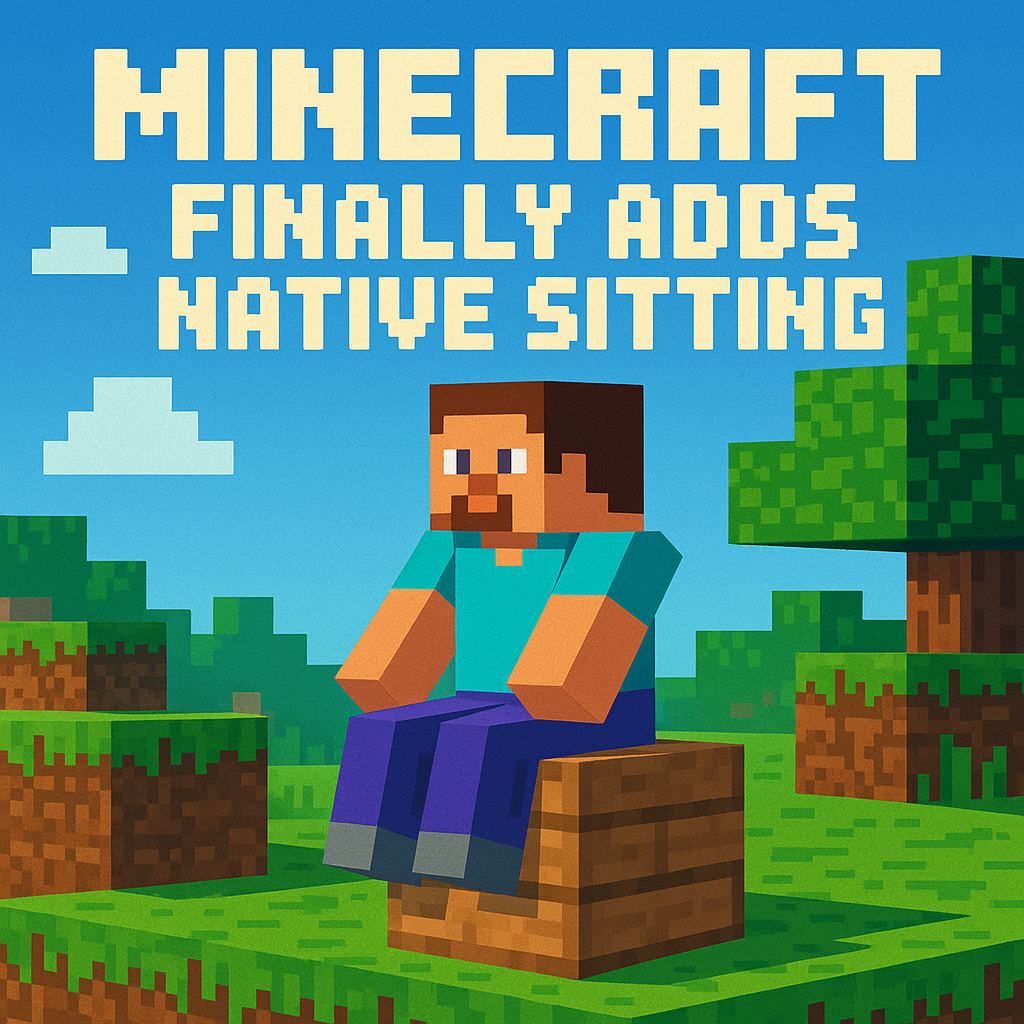
  • Minecraft’s next update adds native sitting via a new Cushion item and a one‑use Straw Bed that lets you sleep without resetting spawn; both are live today in Java Snapshot 26.3‑3 and Bedrock Preview 26.40.30, with a broader fall Drop 3 release planned. [1][2][3]
  • The “sit” mechanic is a social‑presence primitive that role‑play servers, creators, and Realm owners can convert into session length and spending, landing just as Xbox’s new chief Asha Sharma says Mojang will report directly to her after major cuts. [3][4]
  • If even a sliver of Minecraft’s 155 million monthly players tries Realms because “hanging out” looks better with seats, that’s meaningful recurring revenue without building a single boss fight. [5][6]

What the source said

IGN reports Mojang is adding a Cushion item (16 colors) you can place and interact with to sit, plus a Straw Bed for one‑night sleeps that don’t change your spawn; both features are available now in preview builds and slated for a fall Drop 3 release that also includes a new biome. Fans—who’ve asked for sitting for 17 years—cheered the reveal, and the coverage frames it amid Microsoft’s Xbox restructuring that moves Mojang’s reporting line to Xbox CEO Asha Sharma. [1][2][3]

Why it matters

Minecraft is not just a survival sandbox; it’s Microsoft’s biggest always‑on social space since the company acquired Mojang for $2.5 billion in 2014, and small mechanics like “sit” shape screenshots, streams, and role‑play rhythms across Java and Bedrock. That’s oxygen for creators selling furniture packs, for Realm owners inviting friends to “hang out,” and for servers that compete on vibe and presence as much as progression. [2][5][9]

For Xbox, the timing is pointed. On July 6, 2026, Asha Sharma announced a top‑to‑bottom restructure and said Mojang will report directly to her, while AP confirmed 4,800 job cuts across Microsoft, many in gaming; a social‑presence roadmap—seats now, better emotes or gestures next—offers low‑risk, high‑surface‑area wins that lift dwell time and Marketplace conversion without changing the game’s DNA. [3][4]

Original analysis

Contrarian read

  • Consensus: “Adding sitting is cute but trivial.”
  • Here’s the rub: sitting is a platform feature, not just a prop. The Cushion is an entity that overlaps non‑full blocks and has no collision, so you can tuck it onto slabs, shelves, or trapdoors to create real living spaces that look good in thumbnails, TikToks, and server hubs—the media that recruits the next player into your Realm or Discord. Mojang just shipped a low‑friction equivalent to Roblox‑style social emotes, baked into vanilla across Java and Bedrock previews. [2]

Back‑of‑envelope math (assumptions stated)

  • Facts: Minecraft reached 155 million monthly active users (MAU), and Realms list at $3.99 (solo) and $7.99 (Plus) per month in the U.S. [6][5]
  • If an incremental 0.1%–0.3% of MAU spins up a new Realm because sitting makes social builds and hangouts feel worth it:
    • 155,000–465,000 incremental subs.
    • At $3.99: $618,450–$1,855,350 in monthly recurring revenue (MRR).
    • At $7.99: $1,238,450–$3,715,350 MRR.
  • This is not a forecast; it shows the order of magnitude for a presence primitive that nudges conversion by tenths of a point, especially when Marketplace furniture packs piggyback on the Cushion. [5][6]

Named‑stakeholder breakdown

  • Mojang Studios: The Cushion and Straw Bed test cross‑edition choreography—Java Snapshot 26.3‑3 and Bedrock Preview 26.40.30 ship near‑simultaneously—hinting at a tighter parity cadence under Sharma’s direct oversight. [2][3]
  • Xbox leadership (Asha Sharma): With Mojang reporting to her and cuts resetting expectations, small social wins that scale to 155M MAU are the cleanest path to “more engagement, higher attach” without AAA risk. [3][4][6]
  • Marketplace creators: Every seat is a set; expect Cushion‑compatible decor packs and sit‑friendly interiors that monetize screenshots as much as survival utility. [2]
  • Realm owners and server hosts: RP towns, school clubs, and SMPs finally get canonical chairs; call‑to‑action is simple—“Come sit by the campfire at 8 PM”—and average session duration should tick up. [5]
  • Modders: Some fast‑follow utility mods get obsoleted (one modder already called their Sitting Pillows redundant), while high‑concept furniture, animations, and datapack integrations gain a better vanilla base. [2][7]

2×2: presence vs. progression, low vs. high scope

  • Low scope × Presence: Vanilla seats (Cushion) and emotes that make hubs and cafés feel inhabited. [2]
  • High scope × Presence: Worldgen that seeds seating in Abandoned Camps and villages, guiding players into social spots. [2][3]
  • Low scope × Progression: Straw Bed enabling tactical sleep in expeditions without spawn reset. [2]
  • High scope × Progression: Full biome drops that alter routes and resource loops, paired with social props for hubs. [1][2]

Concrete design consequences

  • The Cushion’s rules (entity, no collision, overlapping allowed) enable layered builds but constrain redstone motion; you can’t piston‑push a seat like a block, and early feedback already requests a piston‑friendly Seat/Bench variant for flying machines. That is Mojang receiving signal on where “sit” collides with engineering patterns—and it’s fixable. [2][8]
  • Performance risk lives at scale; community testers report lag when spamming thousands of Cushions on lower‑end servers, which means Mojang will need to tune entity budgets and culling if “seating everywhere” becomes the new SMP aesthetic. [7]

What others are missing

The Cushions are entities, not ordinary blocks, and Mojang explicitly allows them to overlap other objects and lack collision; that’s a deliberate “soft‑furniture” layer that avoids rewriting block rules but adds entity‑count costs and redstone limits. Bedrock’s Preview notes even mention Abandoned Camps seeding these items in the world, with a known generation bug right now, which signals Mojang wants seating seen and used rather than buried in crafting menus. Net effect: seating as worldgen affordance, not merely a craftable gimmick, which changes how villages, hubs, and screenshots look at scale. [2][3]

What to watch next

  1. By November 30, 2026, Mojang ships Drop 3 with Cushion and Straw Bed on both Java and Bedrock, and the final release notes retain “sleep without resetting spawn” as a Straw Bed property. Verification: official 26.3 release changelogs. [2][3]
  2. By March 31, 2027, Mojang introduces at least one additional social‑presence feature beyond sitting/sleeping (for example, new emotes or a Seat/Bench variant that supports piston movement), reflecting early Snapshot feedback. Verification: Mojang.net snapshot/release notes. [2][8]
  3. By Q2 FY27 earnings (reported late Q1 FY27 on Microsoft’s calendar), Microsoft cites a new all‑time‑high Minecraft MAU above 155M or calls out increased Realms/Marketplace engagement tied to 2026 social‑presence updates. Verification: Microsoft investor transcripts. [6]

My take

This is Mojang slipping a platform upgrade into a comfort update. Sitting sounds tiny until you remember Minecraft’s real competitor is wherever kids hang out—Roblox, Fortnite Creative, even Discord—and a chair is permission to linger. Under Asha Sharma, Xbox just put Mojang on the front burner; expect more presence primitives that make worlds feel inhabited: seats now, gestures and diegetic emotes next. If I ran a Realm or a Marketplace studio, I’d build for vibe immediately—campfires, cafés, bleachers—because the next wave of growth in a 155‑million‑MAU sandbox won’t be mobs; it will be moments. [3][5][6]

Sources

  1. A New Minecraft Update Will Finally Let Players Sit Down — IGN (https://www.ign.com/articles/new-minecraft-update-finally-allows-players-to-sit-down) — Baseline report on the Cushion sit feature, Straw Bed, player reaction, and fall timing context.
  2. Minecraft 26.3 Snapshot 3 — Mojang (https://www.minecraft.net/en-us/article/minecraft-26-3-snapshot-3) — Primary source confirming Cushion mechanics (entity, overlap, no collision), 16 colors, and Straw Bed behavior.
  3. Resetting XBOX — Xbox Wire (https://news.xbox.com/en-us/2026/07/06/resetting-xbox/) — Official memo by Asha Sharma announcing the restructure and stating Mojang will report directly to her; situates Minecraft strategy.
  4. Microsoft cuts 4,800 jobs, including many at Xbox, in a “reset” — AP News (https://apnews.com/article/5a8f712c531911089dee008b3bbb33c4) — Independent confirmation of the scale and timing of Microsoft’s gaming layoffs and Sharma’s memo.
  5. Realms Servers for Bedrock & Java — Minecraft (https://www.minecraft.net/en-us/realms) — Official pricing and positioning for Realms and Realms Plus, used in the revenue calculation.
  6. Microsoft Fiscal Year 2026 Q1 Earnings Call — Microsoft Investor Relations (https://www.microsoft.com/en-us/investor/events/fy-2026/earnings-fy-2026-q1) — Transcript citing 155M monthly active users for Minecraft, grounding scale assumptions.
  7. With Minecraft adding cushions in the latest snapshot, my Sitting Pillows mod has become rather redundant — Reddit (https://www.reddit.com/r/Minecraft/comments/1upx8eo/with_minecraft_adding_cushions_in_the_latest/) — Community signal that vanilla seating impacts mod utility and points to creator adaptation.
  8. Cushion and Seat — Minecraft Feedback (https://feedback.minecraft.net/hc/en-us/community/posts/47210956510861-Cushion-and-Seat) — Snapshot‑era discussion requesting a piston‑friendly seat variant; evidence of redstone use‑case pressure.
  9. Microsoft to acquire Mojang — Microsoft (https://news.microsoft.com/2014/09/15/minecraft-to-join-microsoft/) — Confirms the 2014 acquisition of Mojang for $2.5 billion, framing Microsoft’s long‑term stake in Minecraft.


Related update: We recently published an article that expands on this topic: read the latest post.

Minecraft Snapshot 26.3: Better | Analysis by Brian Moineau

TL;DR

  • Minecraft 26.3 Snapshot 2 adds an order-independent transparency (OIT) rendering mode that fixes years of glass/water sorting bugs across stained glass, water, and particles, and points to a broader Java renderer refresh. [1][5]
  • Under-the-hood updates—Data Pack v109.0, Resource Pack v90.0, and a new block_transformer component—expand creator power for servers and mapmakers without Java mods, with concrete hooks for sounds, particles, and loot. [1]
  • Vulkan remains experimental and pink-screens on macOS in this build; Mojang is clearly testing a multi-backend path, but OpenGL stays the practical default in 26.2–26.3-era snapshots. [1][2][4]

What the source said

Minecraft 26.3 Snapshot 2 introduces an “Improved Transparency” option that enables order-independent transparency to resolve long-standing translucency issues like viewing entities through stained glass or water. Mojang flags higher performance cost and lists known issues, including a macOS Vulkan pink screen and incorrect entity lighting. [1]

Gameplay tweaks include throttled wandering AI for distant persistent mobs, shields overriding hoe/shovel use on right-click, and Drowned with Tridents switching to melee within three blocks. Technical changes bump Data Pack to v109.0, Resource Pack to v90.0, add a block_transformer data component, and default the server white-list to true; Mojang also credits community contributors for the OIT work. [1]

Why it matters

For players, OIT cleans up daily visual papercuts around slimes, glass panes, particles, nameplates, and water—pain points visible in every stained-glass build and guardian farm. The “higher performance impact” warning means trade-offs on mid-tier GPUs (think GTX 1650 or RX 580), so this path favors correctness over maximum fps in layered scenes. For creators, the pack bumps and block_transformer enable tool-based block transformations and puzzle mechanics in pure data, removing the need for server-side plugins on private realms. [1]

For Mojang and Microsoft, this advances a modern, multi-backend renderer on Java Edition. Vulkan entered snapshots in 26.2 as experimental, and Mojang restored OpenGL as default in a later 26.2 build to stabilize testing cadence; the macOS pink-screen note in 26.3 shows the work-in-progress nature of that backend. The goal is clear: future-proof Java’s graphics pipeline without regressing gameplay. [1][3][4]

Original analysis

Framing: Why Minecraft 26.3 Snapshot 2 matters beyond pretty glass

Consensus take: “OIT is a nice visual upgrade; wake me when we get a new dimension.”
Contrarian read: OIT is the canary for a multi-year Java renderer refit aligned with Vulkan experiments, replacing fragile depth-sorted hacks with an algorithmic approach that fixes slime occlusion, shulker bullets, wind charges, beacon beams, and boat water fill artifacts seen through glass. That simplification sets up later features like volumetric layers and complex particles by reducing transparency-specific technical debt in the core pipeline. [1][5]

Back-of-envelope performance math

  • Frame budget math: 60 fps equals about 1000 ms / 60 ≈ 16.7 ms per frame.
  • Scenario estimate: if OIT adds 2–4 ms in heavy-translucency scenes (Mojang only says “higher performance impact”), the budget becomes ~18.7–20.7 ms, or roughly 53–48 fps in those moments; correctness improves, and you can still toggle OIT off. [1]

This isn’t a blanket penalty; in typical overworld views without stacked glass/water, timings should stay near pre-OIT paths, while aquariums, mangrove lagoons, and stained-glass megabases will cost more but finally render right. Expect shader and resource pack authors to publish per-scene deltas as they profile v90.0 changes over the next snapshot or two. [1]

Historical analogue: 2018’s “Flattening” (Java 1.13) and what it predicts

In 2018, Java 1.13’s “Flattening” replaced numeric IDs with namespaced data and overhauled commands, resources, and packs, which briefly broke tooling but enabled the data-driven era that followed. Similarly, v109.0 (data) and v90.0 (resources) plus block_transformer in 26.3 Snapshot 2 form new scaffolding: items can transform blocks with rule-based state providers, sounds, particles, and loot strategies—no mixins or Forge/Fabric required. If history rhymes, short-term refactors buy long-term velocity for creators. [1][7]

Named-stakeholder breakdown

  • Mojang Java Team: OIT removes entire classes of “transparent things disappear” bugs and lowers maintenance complexity; Vulkan work continues behind a guarded “experimental” flag. [1][3][4]
  • Community modders (Rubén Osorio López, Jozufozu): Their transparency research now lives in vanilla, tightening the loop between popular mod techniques and first-party rendering constraints. [1]
  • Shader/resource pack authors: Resource Pack v90.0 and shader define shifts imply refactors; Mojang cautions that overriding Core Shaders remains unsupported and may break as OIT evolves. [1]
  • Server operators: The white-list defaults to true, improving safety but adding onboarding friction for public hubs; expect panel vendors to surface a toggle promptly. [1]
  • Apple/macOS players: Vulkan on Mac currently pink-screens in this snapshot; stick with OpenGL until Mojang or MoltenVK updates clear the known issue. [1]

A simple 2×2: Where OIT helps the most

  • High translucency density + Cinematic builders: Maximum benefit in aquariums and stained-glass cathedrals seen in Hermitcraft-scale showcases.
  • High translucency density + PvP/PvE: Medium benefit; correctness helps visibility, but fps headroom is tight on competitive Java servers like Hypixel UHC.
  • Low translucency density + Cinematic builders: Low-to-medium benefit; correctness pays off in ReplayMod timelapses and thumbnails.
  • Low translucency density + Survival casuals: Minimal benefit; consider leaving OIT off on older GPUs such as the GTX 1050 Ti.

Versioning context matters

Mojang switched to calendar versioning for 2026, making 26.3 the third drop of the year rather than a monolithic “1.22-sized” release. That cadence explains why foundational tech like OIT, Vulkan backend toggles, and pack-format revisions can headline a drop without a marquee biome or dimension. It also sets expectations: more frequent, lower-risk platform layers that compound over quarters. [7]

What others are missing

The quiet headline is block_transformer in Data Pack v109.0, which lets items transform blocks using data-defined state providers, sounds, particles, loot, and drop strategies. Think hoe-to-path, axe-to-strip, brush-to-reveal—then extend it to custom adventure mechanics and progression gates that feel native on vanilla servers. For mapmakers and educators, this means shipping puzzle logic to Realms with a zip instead of managing plugins. Coverage focused on OIT’s visuals is skipping the creator workflow win that lands the moment v109.0 hits public servers. [1]

What to watch next

  1. By August 31, 2026, Mojang will either resolve the macOS Vulkan pink-screen or keep Vulkan disabled-by-default on Mac in testing builds; pre-releases will show a fix or a clear fallback. [1][3]
  2. By the 26.3 release candidate window (no later than October 2026), OIT remains opt-in via “Improved Transparency,” not default, with Mojang positioning it as a quality-first toggle for higher-end GPUs. [1]
  3. Within two weeks of 26.3’s stable launch, at least three major shader/resource packs publish OIT-compatible updates or guidance referencing Resource Pack v90.0 or shader define changes. [1]

My take

Minecraft 26.3 Snapshot 2 is the unsexy work that keeps a 300‑million‑copy series vibrant in 2026. OIT fixes everyday eyesores, and the pack-format plus block_transformer upgrades push real power to creators—the engine of Java Edition’s longevity. Vulkan hiccups on macOS are the price of modernization; stick to OpenGL on Macs until the pink-screen note clears. If you build worlds, test OIT; if you run servers, prep panels for the white-list default; if you ship packs, budget shader-define time as you did during 1.13’s 2018 churn. [1][6][7]

Sources

  1. Minecraft 26.3 Snapshot 2 — Minecraft (https://www.minecraft.net/en-us/article/minecraft-26-3-snapshot-2) — Official patch notes: OIT option, performance trade-offs, gameplay tweaks, pack version bumps, Mac Vulkan issue, server white-list default, and credited contributors.

  2. Minecraft 26.3 Snapshot 1 — Minecraft (https://www.minecraft.net/en-us/article/minecraft-26-3-snapshot-1) — Confirms the Dappled Forest biome, Poplar trees, Abandoned Camps, and wool stairs/slabs framing the 26.3 content arc.

  3. Minecraft Java Edition — 26.2 Snapshot 1 — Minecraft Feedback (https://feedback.minecraft.net/hc/en-us/articles/44898619266317-Minecraft-Java-Edition-26-2-Snapshot-1) — Documents Vulkan entering Java snapshots as an experimental backend.

  4. Minecraft 26.2 Snapshot 8 — Minecraft (https://www.minecraft.net/en-us/article/minecraft-26-2-snapshot-8) — Notes OpenGL restored as default with Vulkan remaining experimental, signaling a cautious rollout.

  5. Order-independent transparency — Wikipedia (https://en.wikipedia.org/wiki/Order-independent_transparency) — Technical background on OIT methods and why they avoid per-triangle sorting.

  6. Minecraft is the first videogame ever to sell more than 300 million copies — PC Gamer (https://www.pcgamer.com/minecraft-is-the-first-videogame-ever-to-sell-more-than-300-million-copies/) — Sales milestone context with reporting on Mojang’s scale.

  7. Development of Minecraft: Java Edition — Wikipedia (https://en.wikipedia.org/wiki/Development_of_Minecraft%3A_Java_Edition) — Documents 2011 Java release timing, 2018 1.13 “Flattening,” and Mojang’s switch to calendar versioning for 2026.


Related update: We recently published an article that expands on this topic: read the latest post.

Surface Laptop Ultra: Nvidia‑Powered AI | Analysis by Brian Moineau

TL;DR

  • Microsoft’s Surface Laptop Ultra is the first flagship Windows laptop built around Nvidia’s RTX Spark SoC, advertising up to 1 PFLOP of local AI compute and 128GB unified memory, but a 110W design target signals “desktop-class” throughput will hit battery walls in mobile use [2][3][5].
  • The story is stack control in 2026: Microsoft and Nvidia are bringing CUDA and Blackwell‑class GPU tech to Windows on Arm, a strategic end‑run around Intel and AMD and a direct challenge to Apple’s MacBook Pro line [2][5].
  • If RTX Spark laptops ship in volume and key ISVs optimize Windows‑on‑Arm CUDA paths, 2026–2027 could echo Apple’s 2020 M1 inflection—only with Nvidia setting the cadence for PC “AI laptops” [5][6].

What the source said

ZDNET’s hands‑on from Taipei at Computex 2026 calls Surface Laptop Ultra the standout RTX Spark device, noting a 15‑inch 3:2 PixelSense Ultra mini‑LED panel rated at 2000 nits HDR and 262 ppi, plus creator‑friendly I/O (2×USB‑C, USB‑A, HDMI, SD, 3.5 mm) in a metal chassis [1]. It reports Nvidia’s ARM‑based RTX Spark pairing a 20‑core CPU with GPU performance “roughly equivalent” to a GeForce RTX 5070, and configurations up to 128GB unified memory aimed at local AI [1]. Thermal changes include a dual‑fan, dual‑heat‑pipe layout and a slightly raised base to improve airflow in the 15‑inch form factor [1]. Open items include price tiers, RAM options, measured battery life, and preorder timing signaled as “late summer/early fall” 2026 [1].

Why it matters

For Microsoft in 2026, Surface Laptop Ultra is public proof that Windows on Arm can lead the “AI PC” story with CUDA, fifth‑gen‑class Tensor Cores, and unified memory, rather than trailing x86 laptops on battery life alone [2][5]. The device provides a credible counter to Apple’s MacBook Pro narrative in creative and on‑device inference workloads just as developers decide where to target Stable Diffusion, Llama‑3, and NeRF pipelines for client compute [2][5].

For Nvidia, Spark PCs extend its data‑center CUDA dominance into client devices on Windows, which could bind independent software vendors to CUDA toolchains across 2026–2027 [3][5]. If the bet pays off, Intel and AMD face a squeeze from an Arm+Blackwell package while Apple maintains its integrated stack; studios and consumers win on local LLMs and video tools—if battery life and price don’t dull the pitch [3][6].

Original analysis

Surface Laptop Ultra is a stack play masquerading as a laptop

The spec sheet grabs attention—1 PFLOP AI, 20 Arm CPU cores, and up to 128GB unified memory—but the strategic move is CUDA on Windows on Arm delivered via a Blackwell‑class GPU in a unified‑memory SoC [2][4][5]. That gives Microsoft a first‑party flagship where ISVs can ship the same CUDA kernels across workstation, data center, and laptop without re‑architecting for disparate memory models [2][5].

Consensus take: “Surface Laptop Ultra is a MacBook Pro killer because it matches performance with AI flair” [1]. Contrarian read: this is a CUDA land grab on Windows, not a copy‑paste of Apple’s 16‑inch formula [2][5].

Apple’s edge remains vertically integrated silicon, hardware media engines, and battery efficiency proven since the M1 in 2020; Microsoft’s counter is a developer‑first path where Stable Diffusion XL, Llama‑3 variants, NeRFs, and video upscaling run on familiar CUDA code in 2026 [2][5]. For teams already standardized on CUDA for training and inference, developer gravity favors Spark even if Metal and Core ML perform well in Apple’s ecosystem [2][5].

Back‑of‑envelope: battery reality check

Assume an 84 Wh battery; display at ~350 nits draws ~7 W; platform idle ~5 W; sustained AI/video averages ~55 W on a 110 W‑TDP Spark SoC under creator workloads [3].

  • Total draw ≈ 5 + 7 + 55 = ~67 W.
  • Heavy AI runtime ≈ 84 Wh / 67 W ≈ 1.25 hours.
  • Mixed creator session (35 W average) ≈ 84 / (5 + 7 + 35) ≈ 1.9 hours.
    Takeaway: expect “AI at the desk” performance and short unplugged runs in 2026 unless workloads throttle or displays dim aggressively [3].
2×2: Where Surface Laptop Ultra sits

Axes: Y = AI throughput; X = mobility/endurance.

  • High throughput, low endurance: Surface Laptop Ultra (RTX Spark, 110 W target) and creator rigs like Razer Blade 15 with H‑class CPUs/GPUs [3].
  • High throughput, high endurance: MacBook Pro with M3 Max‑class efficiency and media engines for ProRes/HEVC/AV1 workflows [1].
  • Low throughput, high endurance: Snapdragon X‑class ultrabooks tuned for office tasks and light copilots at <20 W sustained.
  • Low throughput, low endurance: Legacy thin‑and‑lights with small dGPUs that throttle under sustained loads.

The trade: Ultra prioritizes CUDA‑grade throughput on Windows over battery endurance, which fits desk‑bound creator sessions in 2026 [3][6].

Historical analogue: 2020’s M1 reset

In 2020, Apple’s M1 unified CPU+GPU+NPU and memory architecture shifted laptop performance‑per‑watt, but the win crystallized when Final Cut Pro, Logic Pro, and Metal‑optimized Adobe/Blender updates arrived in the same year [2020][1]. Spark laptops echo that pattern in 2026: silicon is newsworthy, yet success hinges on ISVs shipping Windows‑on‑Arm CUDA builds and model toolchains that “just work” [2][5]. Nvidia’s advantage is portability from DGX/GeForce to client via CUDA and Blackwell Tensor Cores, while Microsoft supplies Windows compatibility and Surface industrial design [2][5].

Named‑stakeholder breakdown
  • Microsoft: Gains a flagship to anchor Windows on Arm for creators; must defend pricing and battery optics in 2026 channel reviews [1][2].
  • Nvidia: Extends CUDA from DGX and GeForce into “AI PCs,” setting de facto client inference standards during the 2026–2027 cycle [5].
  • Apple: Retains endurance and media‑engine leadership on MacBook Pro, but faces CUDA gravity nudging cross‑platform studios toward Windows.
  • Intel/AMD: Risk losing high‑margin creator tiers if OEMs adopt Arm+Blackwell; need clear x86 AI acceleration roadmaps before CES 2027.
  • Qualcomm: Remains vital for mainstream Arm laptops, but Spark grabs the performance spotlight at Computex 2026 [6].
  • ISVs (Adobe, Blackmagic, Topaz, Autodesk): Biggest upside is one CUDA pipeline scaling from RTX desktop to Spark laptops; challenge is engineering Windows‑on‑Arm releases on 2026 timelines [2][5].

What others are missing

Unified memory at “up to 128GB” is not a vanity spec; it eliminates costly PCIe host‑to‑device copies for multi‑gigabyte KV caches and tiles in LLM/VLM and 4K–8K video pipelines that blow past VRAM limits on split‑memory designs [2][5]. Diffusion models with long context windows, multi‑stream color‑managed timelines, and 16‑bit float buffers gain when CPU and GPU share a coherent pool in 2026 workflows [2][5]. Nvidia’s messaging highlights a coherent CPU‑GPU memory model with full CUDA on Windows on Arm; Microsoft echoes this in its Surface Ultra post [2][5]. If ISVs expose that coherency in their schedulers, Spark laptops can outperform similar‑TFLOP rivals on memory‑bound tasks even at the same wattage [2][5].

What to watch next

  1. By Q4 2026, independent reviews will record under‑2‑hour battery life for sustained local AI video upscaling on Surface Laptop Ultra at default panel brightness, using repeatable benchmarks [3][6].
  2. By December 31, 2026, at least two top creative ISVs (for example, Adobe or Blackmagic) will ship Windows‑on‑Arm CUDA builds that beat their own x86 Windows versions on identical workloads at matched power settings by a statistically significant margin [2][5].
  3. By CES 2027 (January 2027), three or more major OEMs beyond Microsoft will announce second‑wave RTX Spark laptops with ≤80 W TDP bins aimed at all‑day assistant and light‑creator use cases [6].

My take

Surface Laptop Ultra aims to be the CUDA laptop you can carry to a 2026 shoot, not the longest‑lasting notebook in a 12‑hour flight [2][5]. If I’m editing 6K ProRes, iterating Gen‑2 diffusion shots, and fine‑tuning a 13B LLM locally, identical CUDA code paths on a premium Windows machine beat two extra hours of battery for my workflow [2][5]. Microsoft and Nvidia are betting creators will plug in at the desk and want accelerated local inference at home and studio [3][5]. If ISVs deliver Arm‑CUDA builds this year, the “AI PC” label graduates from marketing to measurable gains in 2026 [2][5].

Sources

  1. ZDNET — Hands‑on with Microsoft Surface Laptop Ultra at Computex 2026 — What this contributes: concrete display specs (2000‑nit HDR, 262 ppi), ports, thermal layout, and open questions on pricing and battery.

  2. Microsoft Devices Blog — Introducing Surface Laptop Ultra (May 2026) — What this contributes: official confirmation of RTX Spark on Windows on Arm, Blackwell‑class GPU, CUDA support, and up to 128GB unified memory.

  3. Tom’s Hardware — Surface Laptop Ultra targets 110W TDP for RTX Spark Superchip (2026) — What this contributes: reported 110 W design target and realistic performance/power trade‑offs for the 15‑inch chassis.

  4. TechSpot — Microsoft unveils Surface Laptop Ultra with Nvidia RTX Spark and up to 128GB RAM (2026) — What this contributes: launch summary including 20‑core Arm CPU and 15‑inch form factor context.

  5. NVIDIA Newsroom — NVIDIA and Microsoft bring RTX Spark PCs with up to 1 PFLOP AI and unified memory (2026) — What this contributes: Nvidia’s framing of CUDA, Blackwell‑class Tensor Cores, and the Windows client stack.

  6. Tom’s Guide — I tested Microsoft Surface Laptop Ultra at Computex 2026 — What this contributes: independent hands‑on and confirmation that multiple Spark laptops debuted at the Taipei show.

Metas Metaverse U‑Turn: Horizon Survives | Analysis by Brian Moineau

A last-minute reprieve for Horizon Worlds — and what it reveals about Meta's metaverse misadventure

Horizon Worlds was once a cornerstone of Meta's plans to build a social metaverse — four years later, the company almost shut it down. That twisty sentence captures the weird lifecycle of a product that began as a bold, public-facing proof of concept and ended up as a product trying to survive inside a shifting corporate strategy. Meta announced it would move Horizon Worlds almost entirely off VR and toward mobile, then—after a wave of headlines and developer concern—decided not to fully pull the VR plug. The back-and-forth tells us as much about the realities of building immersive platforms as it does about Meta’s broader pivot to AI and wearables. (techcrunch.com)

Why this moment matters

  • It’s a marker of failure and salvage at the same time: billions spent on Reality Labs, public layoffs, then a quiet decision to keep Horizon Worlds alive on VR in some form. (techcrunch.com)
  • It signals a strategic shift from “VR-first” to device-agnostic and mobile-first experiences, where reach and scale matter more than immersion alone. (arstechnica.com)
  • For creators and users, it creates uncertainty: will long-term investments in VR content pay off, or will mobile become the only viable path forward?

Let’s walk through the story, the practical implications, and what it might mean for the future of social virtual worlds.

The arc: launch, hype, losses, retrenchment

When Meta publicly doubled down on the metaverse in 2021, Horizon Worlds was the centerpiece—a social, user-created VR environment that embodied Zuckerberg’s vision of the next platform. Early demos and headlines promised that millions would use spatial computing to socialize, work, and play.

Reality hit hard. Reality Labs—the umbrella unit that included Horizon Worlds and Meta’s headset work—racked up enormous losses over several years. Usage and engagement numbers never matched Meta’s most optimistic targets, and Meta began cutting staff and shuttering in-house game studios tied to the VR push. By early 2026 the company had announced cuts that included hundreds (or more) of roles inside Reality Labs and the closure of some VR-focused projects. (forbes.com)

In response, Meta repositioned Horizon Worlds. The company emphasized mobile growth—pointing to a spike in mobile users after a mobile version launched—while saying it would “double down” on VR developers and the Quest store. Then came the announcement that Horizon Worlds would largely leave VR and focus on mobile, which sounded like an admission that the VR-first metaverse experiment hadn’t worked on Meta’s timeline. That announcement produced a strong reaction across press, developer communities, and users. (techcrunch.com)

After the backlash and the noise—both from creators worried about sunk work and from consumers who’d invested in the Meta Quest platform—Meta appears to have stepped back from a hard shutdown of Horizon Worlds on VR. It’s a graceful retreat rather than a total surrender: the company will continue to support certain VR developer pathways while making Horizon Worlds “almost exclusively mobile” at the product level. (techcrunch.com)

Why Meta might keep VR life support for Horizon Worlds

  • Brand and ecosystem risk: Killing Horizon Worlds outright would have sent a clear signal that Meta was giving up on VR, potentially collapsing Quest sales and developer investment.
  • Developer and creator relations: Meta still needs third-party content to make its VR storefront viable, and abruptly pulling its marquee social world would undercut that narrative.
  • Technical and IP continuity: Horizon’s tech—engines, tools, and creators’ assets—still have value and can be repurposed for mobile or future XR experiences.

So, rather than an immediate shutdown, Meta chose the calmer path: separate Horizon Worlds’ future from the Quest storefront narrative and enable a transition that prioritizes scale (mobile reach) while keeping VR options available for now. (dataconomy.com)

What this means for creators, users, and the industry

  • Creators: Expect ambiguity. Building for VR remains risky unless you target cross-platform worlds that work on phones and headsets. Diversifying for mobile-first distribution reduces the chance that your work becomes obsolete.
  • Users: Social VR communities that formed around shared headset experiences will feel the sting. Mobile versions often change interaction patterns and expectations—some communities will migrate; others won’t.
  • Industry: This is a textbook case of technology strategy meeting market realities. Immersive hardware adoption remains modest; AI, not VR, currently drives investor and executive enthusiasm. Companies will likely pursue hybrid approaches—XR where it makes sense, mobile and AI where scale and monetization are clearer.

A closer look at the risk–reward tradeoff

Meta spent heavily to own an end-to-end immersive stack: hardware, software, content, distribution. That requires patient capital and a long runway. But public companies face quarterly scrutiny and shifting priorities—Meta’s move toward AI and wearables shows how quickly strategic attention can shift if financial returns don’t justify continued investment.

The company’s decision not to immediately kill Horizon Worlds in VR suggests leaders want to avoid signaling a full retreat while still trimming losses. It’s a balancing act: keep the core story alive enough to protect other XR efforts, yet reallocate resources to the newer growth engines (AI, wearables). (linkedin.com)

What to watch next

  • Developer tools and monetization updates. If Meta invests in APIs and better monetization for cross-platform creators, that will indicate serious intent to keep Horizon alive in a new form.
  • Headset sales and Quest store positioning. If Quest hardware continues to sell and third-party VR apps thrive, VR could retain a strategic foothold.
  • AI and AR product announcements. Meta’s pivot to AI and smart wearables will shape where Horizon’s tech gets reused or folded into new experiences.

My take

Meta’s near-shutdown and last-minute reprieve for Horizon Worlds is a revealing moment: it doesn’t prove the metaverse was a mistake, but it does show the limits of a VR-first strategy pursued at scale and pace. The smarter takeaway is that social virtual worlds will survive—but likely as device-agnostic, networked experiences that live on phones, laptops, headsets, and whatever glasses come next. For creators and companies, the lesson is clear: build for portability, prioritize audience and monetization, and expect strategy to change rapidly as technologies and business pressures evolve.

Final thoughts

Horizon Worlds’ twisty path—from marquee bet to near-closure to partial rescue—captures the messy middle of innovation. Big bets are messy; some pay off, many require reinvention. Meta’s metaverse experiment has yielded useful tech and lessons even if the original dream didn’t unfold on schedule. The remaining question is whether the company can turn those lessons into a sustainable platform that respects creators, delights users, and fits into a broader AI-first roadmap.

Sources