
Minecraft Finally Adds Native Sitting | Analysis by Brian Moineau

TL;DR

  • Minecraft’s next update adds native sitting via a new Cushion item and a one‑use Straw Bed that lets you sleep without resetting spawn; both are live today in Java Snapshot 26.3‑3 and Bedrock Preview 26.40.30, with a broader fall Drop 3 release planned. [1][2][3]
  • The “sit” mechanic is a social‑presence primitive that role‑play servers, creators, and Realm owners can convert into session length and spending, landing just as Xbox’s new chief Asha Sharma says Mojang will report directly to her after major cuts. [3][4]
  • If even a sliver of Minecraft’s 155 million monthly players tries Realms because “hanging out” looks better with seats, that’s meaningful recurring revenue without building a single boss fight. [5][6]

What the source said

IGN reports Mojang is adding a Cushion item (16 colors) you can place and interact with to sit, plus a Straw Bed for one‑night sleeps that don’t change your spawn; both features are available now in preview builds and slated for a fall Drop 3 release that also includes a new biome. Fans—who’ve asked for sitting for 17 years—cheered the reveal, and the coverage frames it amid Microsoft’s Xbox restructuring that moves Mojang’s reporting line to Xbox CEO Asha Sharma. [1][2][3]

Why it matters

Minecraft is not just a survival sandbox; it’s Microsoft’s biggest always‑on social space since the company acquired Mojang for $2.5 billion in 2014, and small mechanics like “sit” shape screenshots, streams, and role‑play rhythms across Java and Bedrock. That’s oxygen for creators selling furniture packs, for Realm owners inviting friends to “hang out,” and for servers that compete on vibe and presence as much as progression. [2][5][9]

For Xbox, the timing is pointed. On July 6, 2026, Asha Sharma announced a top‑to‑bottom restructure and said Mojang will report directly to her, while AP confirmed 4,800 job cuts across Microsoft, many in gaming; a social‑presence roadmap—seats now, better emotes or gestures next—offers low‑risk, high‑surface‑area wins that lift dwell time and Marketplace conversion without changing the game’s DNA. [3][4]

Original analysis

Contrarian read

  • Consensus: “Adding sitting is cute but trivial.”
  • Here’s the rub: sitting is a platform feature, not just a prop. The Cushion is an entity that overlaps non‑full blocks and has no collision, so you can tuck it onto slabs, shelves, or trapdoors to create real living spaces that look good in thumbnails, TikToks, and server hubs—the media that recruits the next player into your Realm or Discord. Mojang just shipped a low‑friction equivalent to Roblox‑style social emotes, baked into vanilla across Java and Bedrock previews. [2]

Back‑of‑envelope math (assumptions stated)

  • Facts: Minecraft reached 155 million monthly active users (MAU), and Realms list at $3.99 (solo) and $7.99 (Plus) per month in the U.S. [6][5]
  • If an incremental 0.1%–0.3% of MAU spins up a new Realm because sitting makes social builds and hangouts feel worth it:
    • 155,000–465,000 incremental subs.
    • At $3.99: $618,450–$1,855,350 in monthly recurring revenue (MRR).
    • At $7.99: $1,238,450–$3,715,350 MRR.
  • This is not a forecast; it shows the order of magnitude for a presence primitive that nudges conversion by tenths of a point, especially when Marketplace furniture packs piggyback on the Cushion. [5][6]

Named‑stakeholder breakdown

  • Mojang Studios: The Cushion and Straw Bed test cross‑edition choreography—Java Snapshot 26.3‑3 and Bedrock Preview 26.40.30 ship near‑simultaneously—hinting at a tighter parity cadence under Sharma’s direct oversight. [2][3]
  • Xbox leadership (Asha Sharma): With Mojang reporting to her and cuts resetting expectations, small social wins that scale to 155M MAU are the cleanest path to “more engagement, higher attach” without AAA risk. [3][4][6]
  • Marketplace creators: Every seat is a set; expect Cushion‑compatible decor packs and sit‑friendly interiors that monetize screenshots as much as survival utility. [2]
  • Realm owners and server hosts: RP towns, school clubs, and SMPs finally get canonical chairs; call‑to‑action is simple—“Come sit by the campfire at 8 PM”—and average session duration should tick up. [5]
  • Modders: Some fast‑follow utility mods get obsoleted (one modder already called their Sitting Pillows redundant), while high‑concept furniture, animations, and datapack integrations gain a better vanilla base. [2][7]

2×2: presence vs. progression, low vs. high scope

  • Low scope × Presence: Vanilla seats (Cushion) and emotes that make hubs and cafés feel inhabited. [2]
  • High scope × Presence: Worldgen that seeds seating in Abandoned Camps and villages, guiding players into social spots. [2][3]
  • Low scope × Progression: Straw Bed enabling tactical sleep in expeditions without spawn reset. [2]
  • High scope × Progression: Full biome drops that alter routes and resource loops, paired with social props for hubs. [1][2]

Concrete design consequences

  • The Cushion’s rules (entity, no collision, overlapping allowed) enable layered builds but constrain redstone motion; you can’t piston‑push a seat like a block, and early feedback already requests a piston‑friendly Seat/Bench variant for flying machines. That is Mojang receiving signal on where “sit” collides with engineering patterns—and it’s fixable. [2][8]
  • Performance risk lives at scale; community testers report lag when spamming thousands of Cushions on lower‑end servers, which means Mojang will need to tune entity budgets and culling if “seating everywhere” becomes the new SMP aesthetic. [7]

What others are missing

The Cushions are entities, not ordinary blocks, and Mojang explicitly allows them to overlap other objects and lack collision; that’s a deliberate “soft‑furniture” layer that avoids rewriting block rules but adds entity‑count costs and redstone limits. Bedrock’s Preview notes even mention Abandoned Camps seeding these items in the world, with a known generation bug right now, which signals Mojang wants seating seen and used rather than buried in crafting menus. Net effect: seating as worldgen affordance, not merely a craftable gimmick, which changes how villages, hubs, and screenshots look at scale. [2][3]

What to watch next

  1. By November 30, 2026, Mojang ships Drop 3 with Cushion and Straw Bed on both Java and Bedrock, and the final release notes retain “sleep without resetting spawn” as a Straw Bed property. Verification: official 26.3 release changelogs. [2][3]
  2. By March 31, 2027, Mojang introduces at least one additional social‑presence feature beyond sitting/sleeping (for example, new emotes or a Seat/Bench variant that supports piston movement), reflecting early Snapshot feedback. Verification: Mojang.net snapshot/release notes. [2][8]
  3. By Q2 FY27 earnings (reported late Q1 FY27 on Microsoft’s calendar), Microsoft cites a new all‑time‑high Minecraft MAU above 155M or calls out increased Realms/Marketplace engagement tied to 2026 social‑presence updates. Verification: Microsoft investor transcripts. [6]

My take

This is Mojang slipping a platform upgrade into a comfort update. Sitting sounds tiny until you remember Minecraft’s real competitor is wherever kids hang out—Roblox, Fortnite Creative, even Discord—and a chair is permission to linger. Under Asha Sharma, Xbox just put Mojang on the front burner; expect more presence primitives that make worlds feel inhabited: seats now, gestures and diegetic emotes next. If I ran a Realm or a Marketplace studio, I’d build for vibe immediately—campfires, cafés, bleachers—because the next wave of growth in a 155‑million‑MAU sandbox won’t be mobs; it will be moments. [3][5][6]

Sources

  1. A New Minecraft Update Will Finally Let Players Sit Down — IGN (https://www.ign.com/articles/new-minecraft-update-finally-allows-players-to-sit-down) — Baseline report on the Cushion sit feature, Straw Bed, player reaction, and fall timing context.
  2. Minecraft 26.3 Snapshot 3 — Mojang (https://www.minecraft.net/en-us/article/minecraft-26-3-snapshot-3) — Primary source confirming Cushion mechanics (entity, overlap, no collision), 16 colors, and Straw Bed behavior.
  3. Resetting XBOX — Xbox Wire (https://news.xbox.com/en-us/2026/07/06/resetting-xbox/) — Official memo by Asha Sharma announcing the restructure and stating Mojang will report directly to her; situates Minecraft strategy.
  4. Microsoft cuts 4,800 jobs, including many at Xbox, in a “reset” — AP News (https://apnews.com/article/5a8f712c531911089dee008b3bbb33c4) — Independent confirmation of the scale and timing of Microsoft’s gaming layoffs and Sharma’s memo.
  5. Realms Servers for Bedrock & Java — Minecraft (https://www.minecraft.net/en-us/realms) — Official pricing and positioning for Realms and Realms Plus, used in the revenue calculation.
  6. Microsoft Fiscal Year 2026 Q1 Earnings Call — Microsoft Investor Relations (https://www.microsoft.com/en-us/investor/events/fy-2026/earnings-fy-2026-q1) — Transcript citing 155M monthly active users for Minecraft, grounding scale assumptions.
  7. With Minecraft adding cushions in the latest snapshot, my Sitting Pillows mod has become rather redundant — Reddit (https://www.reddit.com/r/Minecraft/comments/1upx8eo/with_minecraft_adding_cushions_in_the_latest/) — Community signal that vanilla seating impacts mod utility and points to creator adaptation.
  8. Cushion and Seat — Minecraft Feedback (https://feedback.minecraft.net/hc/en-us/community/posts/47210956510861-Cushion-and-Seat) — Snapshot‑era discussion requesting a piston‑friendly seat variant; evidence of redstone use‑case pressure.
  9. Microsoft to acquire Mojang — Microsoft (https://news.microsoft.com/2014/09/15/minecraft-to-join-microsoft/) — Confirms the 2014 acquisition of Mojang for $2.5 billion, framing Microsoft’s long‑term stake in Minecraft.


Related update: We recently published an article that expands on this topic: read the latest post.
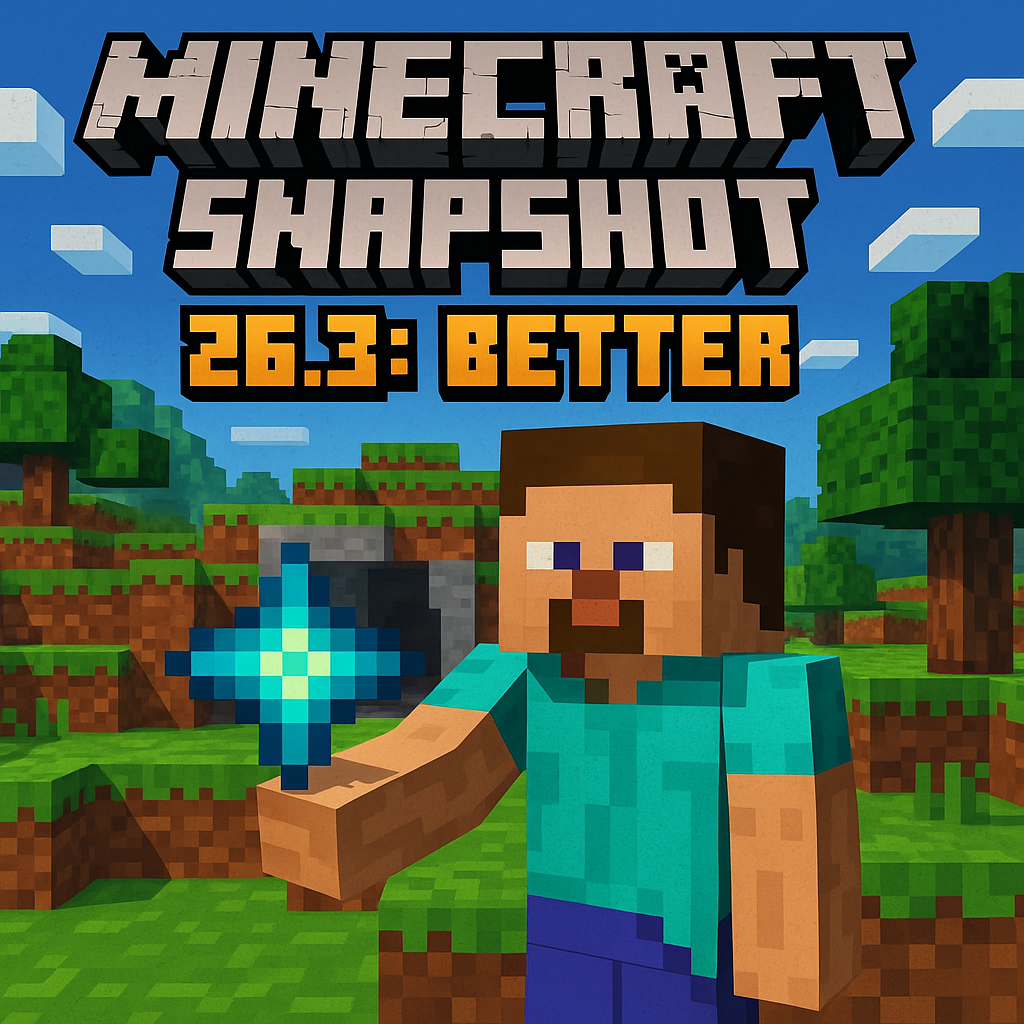
Minecraft Snapshot 26.3: Better | Analysis by Brian Moineau

TL;DR

  • Minecraft 26.3 Snapshot 2 adds an order-independent transparency (OIT) rendering mode that fixes years of glass/water sorting bugs across stained glass, water, and particles, and points to a broader Java renderer refresh. [1][5]
  • Under-the-hood updates—Data Pack v109.0, Resource Pack v90.0, and a new block_transformer component—expand creator power for servers and mapmakers without Java mods, with concrete hooks for sounds, particles, and loot. [1]
  • Vulkan remains experimental and pink-screens on macOS in this build; Mojang is clearly testing a multi-backend path, but OpenGL stays the practical default in 26.2–26.3-era snapshots. [1][2][4]

What the source said

Minecraft 26.3 Snapshot 2 introduces an “Improved Transparency” option that enables order-independent transparency to resolve long-standing translucency issues like viewing entities through stained glass or water. Mojang flags higher performance cost and lists known issues, including a macOS Vulkan pink screen and incorrect entity lighting. [1]

Gameplay tweaks include throttled wandering AI for distant persistent mobs, shields overriding hoe/shovel use on right-click, and Drowned with Tridents switching to melee within three blocks. Technical changes bump Data Pack to v109.0, Resource Pack to v90.0, add a block_transformer data component, and default the server white-list to true; Mojang also credits community contributors for the OIT work. [1]

Why it matters

For players, OIT cleans up daily visual papercuts around slimes, glass panes, particles, nameplates, and water—pain points visible in every stained-glass build and guardian farm. The “higher performance impact” warning means trade-offs on mid-tier GPUs (think GTX 1650 or RX 580), so this path favors correctness over maximum fps in layered scenes. For creators, the pack bumps and block_transformer enable tool-based block transformations and puzzle mechanics in pure data, removing the need for server-side plugins on private realms. [1]

For Mojang and Microsoft, this advances a modern, multi-backend renderer on Java Edition. Vulkan entered snapshots in 26.2 as experimental, and Mojang restored OpenGL as default in a later 26.2 build to stabilize testing cadence; the macOS pink-screen note in 26.3 shows the work-in-progress nature of that backend. The goal is clear: future-proof Java’s graphics pipeline without regressing gameplay. [1][3][4]

Original analysis

Framing: Why Minecraft 26.3 Snapshot 2 matters beyond pretty glass

Consensus take: “OIT is a nice visual upgrade; wake me when we get a new dimension.”
Contrarian read: OIT is the canary for a multi-year Java renderer refit aligned with Vulkan experiments, replacing fragile depth-sorted hacks with an algorithmic approach that fixes slime occlusion, shulker bullets, wind charges, beacon beams, and boat water fill artifacts seen through glass. That simplification sets up later features like volumetric layers and complex particles by reducing transparency-specific technical debt in the core pipeline. [1][5]

Back-of-envelope performance math

  • Frame budget math: 60 fps equals about 1000 ms / 60 ≈ 16.7 ms per frame.
  • Scenario estimate: if OIT adds 2–4 ms in heavy-translucency scenes (Mojang only says “higher performance impact”), the budget becomes ~18.7–20.7 ms, or roughly 53–48 fps in those moments; correctness improves, and you can still toggle OIT off. [1]

This isn’t a blanket penalty; in typical overworld views without stacked glass/water, timings should stay near pre-OIT paths, while aquariums, mangrove lagoons, and stained-glass megabases will cost more but finally render right. Expect shader and resource pack authors to publish per-scene deltas as they profile v90.0 changes over the next snapshot or two. [1]

Historical analogue: 2018’s “Flattening” (Java 1.13) and what it predicts

In 2018, Java 1.13’s “Flattening” replaced numeric IDs with namespaced data and overhauled commands, resources, and packs, which briefly broke tooling but enabled the data-driven era that followed. Similarly, v109.0 (data) and v90.0 (resources) plus block_transformer in 26.3 Snapshot 2 form new scaffolding: items can transform blocks with rule-based state providers, sounds, particles, and loot strategies—no mixins or Forge/Fabric required. If history rhymes, short-term refactors buy long-term velocity for creators. [1][7]

Named-stakeholder breakdown

  • Mojang Java Team: OIT removes entire classes of “transparent things disappear” bugs and lowers maintenance complexity; Vulkan work continues behind a guarded “experimental” flag. [1][3][4]
  • Community modders (Rubén Osorio López, Jozufozu): Their transparency research now lives in vanilla, tightening the loop between popular mod techniques and first-party rendering constraints. [1]
  • Shader/resource pack authors: Resource Pack v90.0 and shader define shifts imply refactors; Mojang cautions that overriding Core Shaders remains unsupported and may break as OIT evolves. [1]
  • Server operators: The white-list defaults to true, improving safety but adding onboarding friction for public hubs; expect panel vendors to surface a toggle promptly. [1]
  • Apple/macOS players: Vulkan on Mac currently pink-screens in this snapshot; stick with OpenGL until Mojang or MoltenVK updates clear the known issue. [1]

A simple 2×2: Where OIT helps the most

  • High translucency density + Cinematic builders: Maximum benefit in aquariums and stained-glass cathedrals seen in Hermitcraft-scale showcases.
  • High translucency density + PvP/PvE: Medium benefit; correctness helps visibility, but fps headroom is tight on competitive Java servers like Hypixel UHC.
  • Low translucency density + Cinematic builders: Low-to-medium benefit; correctness pays off in ReplayMod timelapses and thumbnails.
  • Low translucency density + Survival casuals: Minimal benefit; consider leaving OIT off on older GPUs such as the GTX 1050 Ti.

Versioning context matters

Mojang switched to calendar versioning for 2026, making 26.3 the third drop of the year rather than a monolithic “1.22-sized” release. That cadence explains why foundational tech like OIT, Vulkan backend toggles, and pack-format revisions can headline a drop without a marquee biome or dimension. It also sets expectations: more frequent, lower-risk platform layers that compound over quarters. [7]

What others are missing

The quiet headline is block_transformer in Data Pack v109.0, which lets items transform blocks using data-defined state providers, sounds, particles, loot, and drop strategies. Think hoe-to-path, axe-to-strip, brush-to-reveal—then extend it to custom adventure mechanics and progression gates that feel native on vanilla servers. For mapmakers and educators, this means shipping puzzle logic to Realms with a zip instead of managing plugins. Coverage focused on OIT’s visuals is skipping the creator workflow win that lands the moment v109.0 hits public servers. [1]

What to watch next

  1. By August 31, 2026, Mojang will either resolve the macOS Vulkan pink-screen or keep Vulkan disabled-by-default on Mac in testing builds; pre-releases will show a fix or a clear fallback. [1][3]
  2. By the 26.3 release candidate window (no later than October 2026), OIT remains opt-in via “Improved Transparency,” not default, with Mojang positioning it as a quality-first toggle for higher-end GPUs. [1]
  3. Within two weeks of 26.3’s stable launch, at least three major shader/resource packs publish OIT-compatible updates or guidance referencing Resource Pack v90.0 or shader define changes. [1]

My take

Minecraft 26.3 Snapshot 2 is the unsexy work that keeps a 300‑million‑copy series vibrant in 2026. OIT fixes everyday eyesores, and the pack-format plus block_transformer upgrades push real power to creators—the engine of Java Edition’s longevity. Vulkan hiccups on macOS are the price of modernization; stick to OpenGL on Macs until the pink-screen note clears. If you build worlds, test OIT; if you run servers, prep panels for the white-list default; if you ship packs, budget shader-define time as you did during 1.13’s 2018 churn. [1][6][7]

Sources

  1. Minecraft 26.3 Snapshot 2 — Minecraft (https://www.minecraft.net/en-us/article/minecraft-26-3-snapshot-2) — Official patch notes: OIT option, performance trade-offs, gameplay tweaks, pack version bumps, Mac Vulkan issue, server white-list default, and credited contributors.

  2. Minecraft 26.3 Snapshot 1 — Minecraft (https://www.minecraft.net/en-us/article/minecraft-26-3-snapshot-1) — Confirms the Dappled Forest biome, Poplar trees, Abandoned Camps, and wool stairs/slabs framing the 26.3 content arc.

  3. Minecraft Java Edition — 26.2 Snapshot 1 — Minecraft Feedback (https://feedback.minecraft.net/hc/en-us/articles/44898619266317-Minecraft-Java-Edition-26-2-Snapshot-1) — Documents Vulkan entering Java snapshots as an experimental backend.

  4. Minecraft 26.2 Snapshot 8 — Minecraft (https://www.minecraft.net/en-us/article/minecraft-26-2-snapshot-8) — Notes OpenGL restored as default with Vulkan remaining experimental, signaling a cautious rollout.

  5. Order-independent transparency — Wikipedia (https://en.wikipedia.org/wiki/Order-independent_transparency) — Technical background on OIT methods and why they avoid per-triangle sorting.

  6. Minecraft is the first videogame ever to sell more than 300 million copies — PC Gamer (https://www.pcgamer.com/minecraft-is-the-first-videogame-ever-to-sell-more-than-300-million-copies/) — Sales milestone context with reporting on Mojang’s scale.

  7. Development of Minecraft: Java Edition — Wikipedia (https://en.wikipedia.org/wiki/Development_of_Minecraft%3A_Java_Edition) — Documents 2011 Java release timing, 2018 1.13 “Flattening,” and Mojang’s switch to calendar versioning for 2026.


Related update: We recently published an article that expands on this topic: read the latest post.

When The Last of Us Multiplayer Died | Analysis by Brian Moineau

When a Beloved Franchise Almost Went Live: The Last of Us Multiplayer's Rise and Fall

The Last of Us Multiplayer quietly became one of gaming’s most bittersweet “what if” stories. Fans remember Factions — the tense, soulful multiplayer mode from the 2013 original — and many hoped Naughty Dog would return to that magic. The Last of Us Multiplayer, a standalone live-service project often called Factions or The Last of Us Online, grew into an ambitious effort over several years, only to be dramatically scaled back and reportedly cancelled after being “about 80%” complete. (darkhorizons.com)

Why this mattered

For context, Naughty Dog built its reputation on cinematic, character-driven single-player games. Shifting a studio like that into the world of AAA live service multiplayer is not just a technical challenge — it’s a cultural and business pivot. The Last of Us multiplayer started as an extension of The Last of Us Part II’s ideas, evolved into a full project, and attracted big internal investment and high expectations. Yet, in a development landscape increasingly dominated by persistent online games with huge upkeep costs, the studio faced a trade-off: finish and support a sprawling live service, or refocus on the narrative experiences that define Naughty Dog. (dexerto.com)

  • It reportedly spent years in development — some sources say around seven years — and reached a late stage before being shut down or heavily reassessed. (gamesradar.com)
  • Internal voices and external partners were involved: there were reports of consultations and reviews, including input from other studios. (gamesradar.com)

What “80% done” actually means

Saying a game was “80% done” can be emotionally charged and technically misleading. Developers and studios measure progress differently. Often the visible systems, art, and core loops make up a large portion of early progress, while the remaining 20% can include the hardest parts: balancing, server infrastructure, anti-cheat systems, live ops tooling, monetization frameworks, and long-term support planning.

In other words, 80% might mean the prototype and many fundamentals existed — but not that the game was ready to ship or sustain a live community at scale. Reported quotes from former leads emphasize how close the project felt internally, yet also how daunting the last stretch was. (darkhorizons.com)

The industry tug-of-war

Transitioning from single-player excellence to live service success is difficult for any studio. There are several pressures that informed Naughty Dog’s decision-making:

  • Live services require continuous content updates, community management, and significant post-launch support teams.
  • AAA live games need long-term monetization strategies and technical backbones for servers, matchmaking, and anti-cheat.
  • Prioritizing one major live project can siphon talent and resources away from cinematic single-player titles, which often define a studio’s brand and revenue potential.

Because of these factors, Naughty Dog reportedly chose to reallocate resources toward other single-player projects, like the studio’s secretive Intergalactic: The Heretic Prophet, rather than commit to the long-term demands of an online Last of Us. That choice underscores a broader industry reality: not every beloved IP benefits from becoming a live service. (gamesradar.com)

What fans lost — and what they still have

Fans lost more than a potential new game; they lost a vision of how The Last of Us could translate into persistent, emergent multiplayer storytelling. Many players long for a refined, narrative-aware PvP experience that retains the franchise’s emotional weight.

However, there are silver linings:

  • The original Factions remains a touchstone and a design reference for team-based tension. Re-releases and memories keep its spirit alive.
  • Knowledge and prototypes from the canceled or paused project may inform future Naughty Dog work or inspire smaller-scale multiplayer experiments from former team members. (gamerant.com)

A closer look at the timeline

To clear confusion, here’s a concise timeline of the publicly reported events:

  • Development reportedly began around 2020, initially tied to The Last of Us Part II’s ecosystem. (forbes.com)
  • Over subsequent years, the project expanded into a standalone live-service title with a significant team.
  • Around late 2023 and into 2024, reports suggested the game was being reassessed or scaled back amid internal reviews and company priorities. (gamedeveloper.com)
  • Recently, statements from developers and coverage cited the project being “about 80%” complete at its cancellation or pause, triggering fresh debate about what “complete” means in practice. (darkhorizons.com)

Final thoughts

My take: the story of The Last of Us Multiplayer is a useful reminder that big ideas and beloved IPs don’t automatically equal sustainable live-service games. Quality, long-term support, and alignment with a studio’s identity matter just as much as ambition. While it’s heartbreaking to see a project with apparent momentum shelved, the choice to prioritize what a studio does best — especially when that’s telling powerful single-player stories — can be the braver, more honest path.

That said, the appetite for a well-made, emotionally resonant multiplayer Last of Us remains. If the right team, scope, and business model emerge — perhaps from former Naughty Dog talent or a smaller, more focused studio — fans may still get something that honors Factions without promising the impossible.

What to watch next

  • Anecdotes from former team members and interviews with studio leads will be telling about how much of the canceled work survives internally.
  • Any projects launched by ex-Naughty Dog devs could be fertile ground for The Last of Us-style multiplayer design.
  • Industry shifts in how publishers handle live services (shorter live ops, hybrid monetization, or tighter scopes) may open the door for revisiting similar projects with less risk.

Sources


Related update: We recently published an article that expands on this topic: read the latest post.


Related update: We recently published an article that expands on this topic: read the latest post.