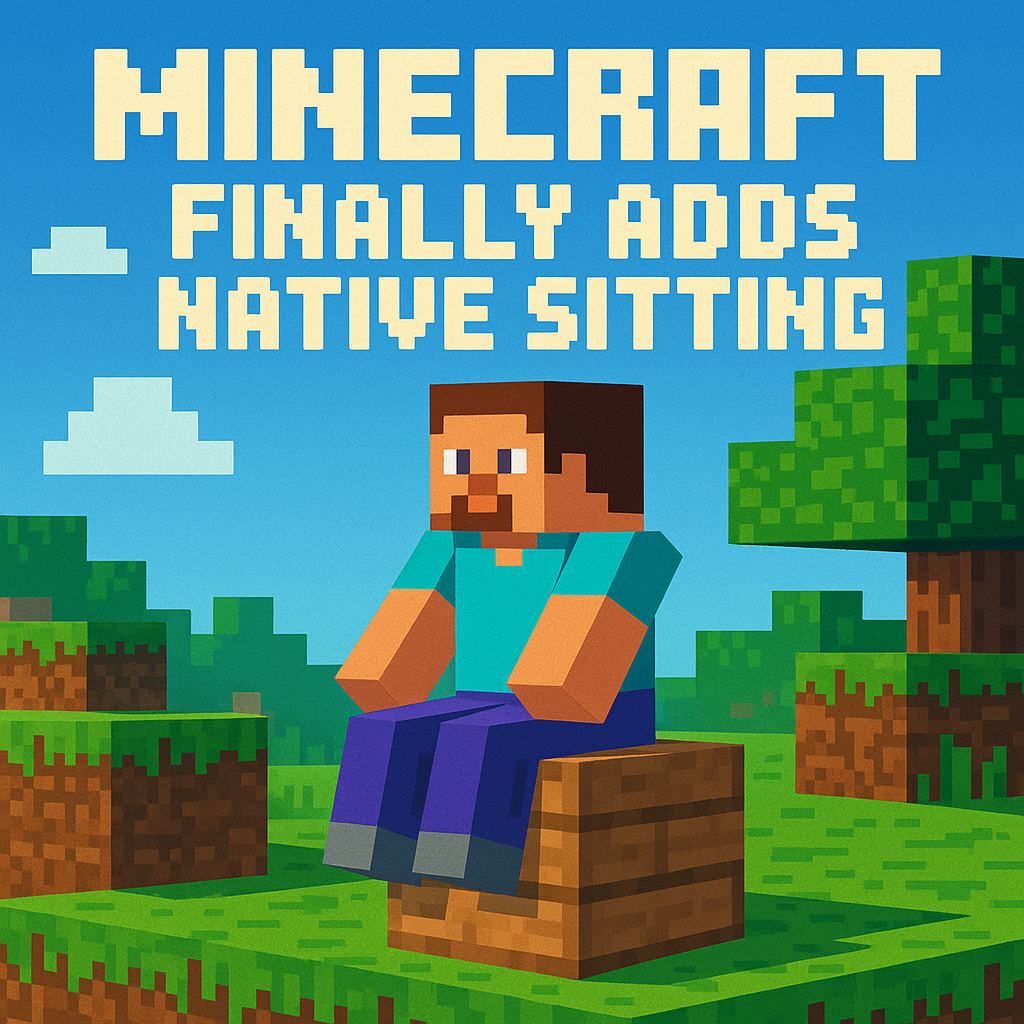
TL;DR
- Minecraft’s next update adds native sitting via a new Cushion item and a one‑use Straw Bed that lets you sleep without resetting spawn; both are live today in Java Snapshot 26.3‑3 and Bedrock Preview 26.40.30, with a broader fall Drop 3 release planned. [1][2][3]
- The “sit” mechanic is a social‑presence primitive that role‑play servers, creators, and Realm owners can convert into session length and spending, landing just as Xbox’s new chief Asha Sharma says Mojang will report directly to her after major cuts. [3][4]
- If even a sliver of Minecraft’s 155 million monthly players tries Realms because “hanging out” looks better with seats, that’s meaningful recurring revenue without building a single boss fight. [5][6]
What the source said
IGN reports Mojang is adding a Cushion item (16 colors) you can place and interact with to sit, plus a Straw Bed for one‑night sleeps that don’t change your spawn; both features are available now in preview builds and slated for a fall Drop 3 release that also includes a new biome. Fans—who’ve asked for sitting for 17 years—cheered the reveal, and the coverage frames it amid Microsoft’s Xbox restructuring that moves Mojang’s reporting line to Xbox CEO Asha Sharma. [1][2][3]
Why it matters
Minecraft is not just a survival sandbox; it’s Microsoft’s biggest always‑on social space since the company acquired Mojang for $2.5 billion in 2014, and small mechanics like “sit” shape screenshots, streams, and role‑play rhythms across Java and Bedrock. That’s oxygen for creators selling furniture packs, for Realm owners inviting friends to “hang out,” and for servers that compete on vibe and presence as much as progression. [2][5][9]
For Xbox, the timing is pointed. On July 6, 2026, Asha Sharma announced a top‑to‑bottom restructure and said Mojang will report directly to her, while AP confirmed 4,800 job cuts across Microsoft, many in gaming; a social‑presence roadmap—seats now, better emotes or gestures next—offers low‑risk, high‑surface‑area wins that lift dwell time and Marketplace conversion without changing the game’s DNA. [3][4]
Original analysis
Contrarian read
- Consensus: “Adding sitting is cute but trivial.”
- Here’s the rub: sitting is a platform feature, not just a prop. The Cushion is an entity that overlaps non‑full blocks and has no collision, so you can tuck it onto slabs, shelves, or trapdoors to create real living spaces that look good in thumbnails, TikToks, and server hubs—the media that recruits the next player into your Realm or Discord. Mojang just shipped a low‑friction equivalent to Roblox‑style social emotes, baked into vanilla across Java and Bedrock previews. [2]
Back‑of‑envelope math (assumptions stated)
- Facts: Minecraft reached 155 million monthly active users (MAU), and Realms list at $3.99 (solo) and $7.99 (Plus) per month in the U.S. [6][5]
- If an incremental 0.1%–0.3% of MAU spins up a new Realm because sitting makes social builds and hangouts feel worth it:
- 155,000–465,000 incremental subs.
- At $3.99: $618,450–$1,855,350 in monthly recurring revenue (MRR).
- At $7.99: $1,238,450–$3,715,350 MRR.
- This is not a forecast; it shows the order of magnitude for a presence primitive that nudges conversion by tenths of a point, especially when Marketplace furniture packs piggyback on the Cushion. [5][6]
Named‑stakeholder breakdown
- Mojang Studios: The Cushion and Straw Bed test cross‑edition choreography—Java Snapshot 26.3‑3 and Bedrock Preview 26.40.30 ship near‑simultaneously—hinting at a tighter parity cadence under Sharma’s direct oversight. [2][3]
- Xbox leadership (Asha Sharma): With Mojang reporting to her and cuts resetting expectations, small social wins that scale to 155M MAU are the cleanest path to “more engagement, higher attach” without AAA risk. [3][4][6]
- Marketplace creators: Every seat is a set; expect Cushion‑compatible decor packs and sit‑friendly interiors that monetize screenshots as much as survival utility. [2]
- Realm owners and server hosts: RP towns, school clubs, and SMPs finally get canonical chairs; call‑to‑action is simple—“Come sit by the campfire at 8 PM”—and average session duration should tick up. [5]
- Modders: Some fast‑follow utility mods get obsoleted (one modder already called their Sitting Pillows redundant), while high‑concept furniture, animations, and datapack integrations gain a better vanilla base. [2][7]
2×2: presence vs. progression, low vs. high scope
- Low scope × Presence: Vanilla seats (Cushion) and emotes that make hubs and cafés feel inhabited. [2]
- High scope × Presence: Worldgen that seeds seating in Abandoned Camps and villages, guiding players into social spots. [2][3]
- Low scope × Progression: Straw Bed enabling tactical sleep in expeditions without spawn reset. [2]
- High scope × Progression: Full biome drops that alter routes and resource loops, paired with social props for hubs. [1][2]
Concrete design consequences
- The Cushion’s rules (entity, no collision, overlapping allowed) enable layered builds but constrain redstone motion; you can’t piston‑push a seat like a block, and early feedback already requests a piston‑friendly Seat/Bench variant for flying machines. That is Mojang receiving signal on where “sit” collides with engineering patterns—and it’s fixable. [2][8]
- Performance risk lives at scale; community testers report lag when spamming thousands of Cushions on lower‑end servers, which means Mojang will need to tune entity budgets and culling if “seating everywhere” becomes the new SMP aesthetic. [7]
What others are missing
The Cushions are entities, not ordinary blocks, and Mojang explicitly allows them to overlap other objects and lack collision; that’s a deliberate “soft‑furniture” layer that avoids rewriting block rules but adds entity‑count costs and redstone limits. Bedrock’s Preview notes even mention Abandoned Camps seeding these items in the world, with a known generation bug right now, which signals Mojang wants seating seen and used rather than buried in crafting menus. Net effect: seating as worldgen affordance, not merely a craftable gimmick, which changes how villages, hubs, and screenshots look at scale. [2][3]
What to watch next
- By November 30, 2026, Mojang ships Drop 3 with Cushion and Straw Bed on both Java and Bedrock, and the final release notes retain “sleep without resetting spawn” as a Straw Bed property. Verification: official 26.3 release changelogs. [2][3]
- By March 31, 2027, Mojang introduces at least one additional social‑presence feature beyond sitting/sleeping (for example, new emotes or a Seat/Bench variant that supports piston movement), reflecting early Snapshot feedback. Verification: Mojang.net snapshot/release notes. [2][8]
- By Q2 FY27 earnings (reported late Q1 FY27 on Microsoft’s calendar), Microsoft cites a new all‑time‑high Minecraft MAU above 155M or calls out increased Realms/Marketplace engagement tied to 2026 social‑presence updates. Verification: Microsoft investor transcripts. [6]
My take
This is Mojang slipping a platform upgrade into a comfort update. Sitting sounds tiny until you remember Minecraft’s real competitor is wherever kids hang out—Roblox, Fortnite Creative, even Discord—and a chair is permission to linger. Under Asha Sharma, Xbox just put Mojang on the front burner; expect more presence primitives that make worlds feel inhabited: seats now, gestures and diegetic emotes next. If I ran a Realm or a Marketplace studio, I’d build for vibe immediately—campfires, cafés, bleachers—because the next wave of growth in a 155‑million‑MAU sandbox won’t be mobs; it will be moments. [3][5][6]
Sources
- A New Minecraft Update Will Finally Let Players Sit Down — IGN (https://www.ign.com/articles/new-minecraft-update-finally-allows-players-to-sit-down) — Baseline report on the Cushion sit feature, Straw Bed, player reaction, and fall timing context.
- Minecraft 26.3 Snapshot 3 — Mojang (https://www.minecraft.net/en-us/article/minecraft-26-3-snapshot-3) — Primary source confirming Cushion mechanics (entity, overlap, no collision), 16 colors, and Straw Bed behavior.
- Resetting XBOX — Xbox Wire (https://news.xbox.com/en-us/2026/07/06/resetting-xbox/) — Official memo by Asha Sharma announcing the restructure and stating Mojang will report directly to her; situates Minecraft strategy.
- Microsoft cuts 4,800 jobs, including many at Xbox, in a “reset” — AP News (https://apnews.com/article/5a8f712c531911089dee008b3bbb33c4) — Independent confirmation of the scale and timing of Microsoft’s gaming layoffs and Sharma’s memo.
- Realms Servers for Bedrock & Java — Minecraft (https://www.minecraft.net/en-us/realms) — Official pricing and positioning for Realms and Realms Plus, used in the revenue calculation.
- Microsoft Fiscal Year 2026 Q1 Earnings Call — Microsoft Investor Relations (https://www.microsoft.com/en-us/investor/events/fy-2026/earnings-fy-2026-q1) — Transcript citing 155M monthly active users for Minecraft, grounding scale assumptions.
- With Minecraft adding cushions in the latest snapshot, my Sitting Pillows mod has become rather redundant — Reddit (https://www.reddit.com/r/Minecraft/comments/1upx8eo/with_minecraft_adding_cushions_in_the_latest/) — Community signal that vanilla seating impacts mod utility and points to creator adaptation.
- Cushion and Seat — Minecraft Feedback (https://feedback.minecraft.net/hc/en-us/community/posts/47210956510861-Cushion-and-Seat) — Snapshot‑era discussion requesting a piston‑friendly seat variant; evidence of redstone use‑case pressure.
- Microsoft to acquire Mojang — Microsoft (https://news.microsoft.com/2014/09/15/minecraft-to-join-microsoft/) — Confirms the 2014 acquisition of Mojang for $2.5 billion, framing Microsoft’s long‑term stake in Minecraft.
Related update: We recently published an article that expands on this topic: read the latest post.