TL;DR
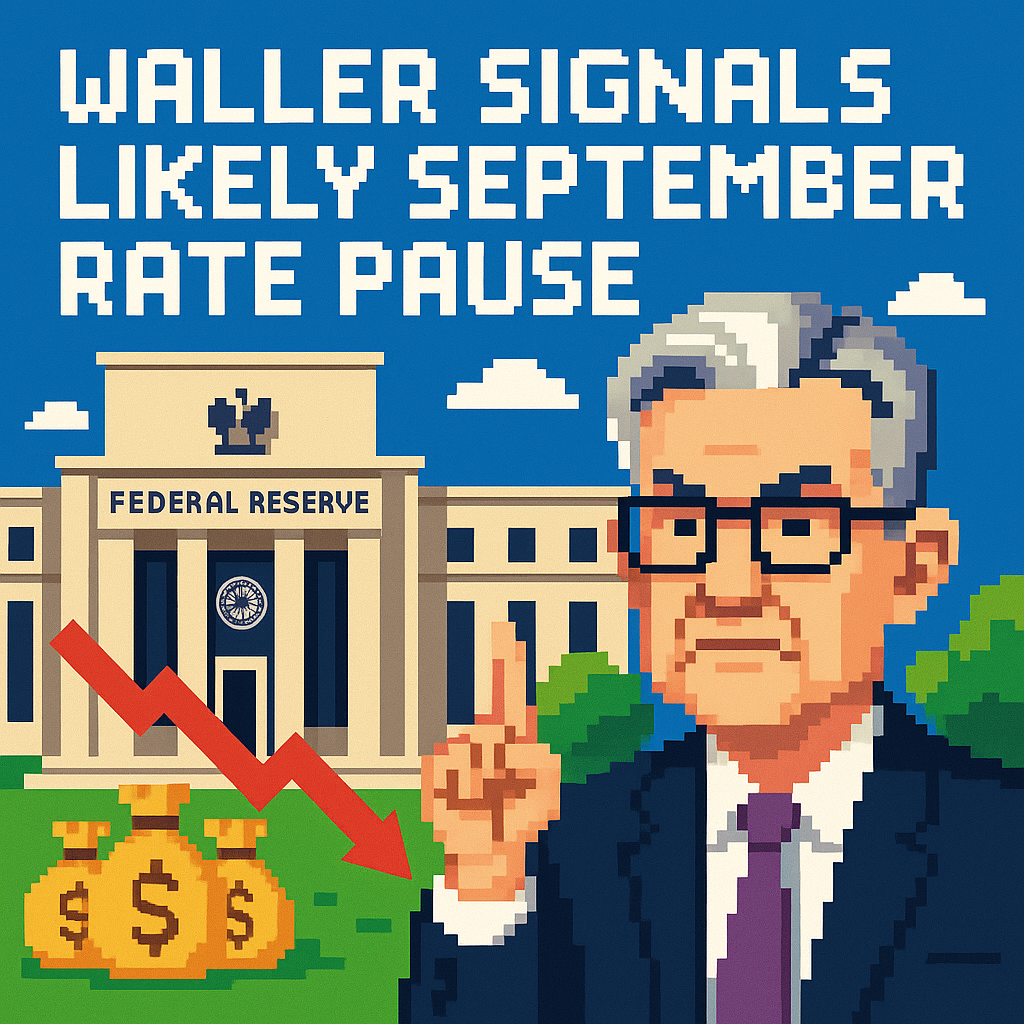
- Federal Reserve Governor Christopher Waller said he was inclined to hold rates at the mid-September 2026 FOMC if August inflation cools, countering Kevin Warsh’s hawkish Jackson Hole tone that pushed markets toward a September hike. [1][3]
- CME-linked odds for a September increase jumped near 58% after Warsh’s Jackson Hole remarks, then drifted back toward roughly 50% after Waller’s comments. [3][2]
- My read: data-dependent voices like Waller will carry the month unless core inflation re-accelerates materially in the next print; markets look a bit rich on hike odds here. [1][2]
What the source said
The Financial Times reported that Governor Waller indicated he was inclined to keep the federal funds rate unchanged in September 2026 if incoming August inflation data confirm cooling, and it contrasted that signal with markets’ post–Jackson Hole shift toward a hike. [1]
Coverage noted that Warsh’s hawkish posture in Jackson Hole, Wyoming, on August 28, 2026, helped push hike odds higher before Waller’s remarks pared them. [3]
Waller explicitly grounded his September stance in the next CPI/PCE readings and acknowledged softer labor data, with July’s U.S. unemployment rate near 4.1%. [2]
Net: the FT framed an active policy debate—Warsh’s toughness nudged probabilities up; Waller’s conditional patience leaned them back toward a hold pending next week’s inflation report. [1]
Why it matters
A 25 basis point hike or hold in September 2026 changes mortgage quotes, corporate funding costs, and bank hedging right now, not in theory. The split between Warsh’s tougher stance and Waller’s data-first posture pulls the Treasury curve, which feeds into housing affordability, small‑business credit, and capex decisions in cities like Dallas and Detroit. [2][3]
Pricing moves of a few basis points affect real money: dealers, asset managers, and regional lenders must adjust risk on the fly when odds swing 8–10 percentage points in a single session. [2][3]
Investors also have to parse a communications shift after Jackson Hole. Warsh downplayed forward guidance and emphasized discipline, which increases the premium on each CPI and PCE print. [3]
That stance amplifies the influence of officials like Waller who translate data into conditional policy, and it heightens whiplash risk as traders chase each speech, tightening financial conditions via volatility even without a formal hike. [1][3]
Original analysis
Contrarian read — the consensus and why I disagree
- Consensus: Warsh’s Jackson Hole hawkishness tipped the odds toward a September hike, with CME-linked probabilities near 57–58% intraday. [3]
- My case: Waller supplied the data-contingent anchor and odds slid back toward even-money after his remarks; if August core CPI runs ~0.20–0.25% m/m, a voting majority will back a hold over a preemptive hike. [1][2]
- Labor adds cover: with July unemployment around 4.1% and signs of easing job openings, a “watchful hold” minimizes regret while keeping optionality. [2]
Back-of-envelope calculation — how much “hike risk” is actually priced
- After Jackson Hole: implied odds of a 25 bp September hike ≈ 58%; expected move = 0.58 × 25 bp ≈ 14.5 bp. [3]
- After Waller’s pushback: pricing cooled to ≈ 50%; expected move = 0.50 × 25 bp = 12.5 bp. [2]
- Delta ≈ 2 bp; with a two‑year Treasury duration ~1.9, price impact ≈ 1.9 × 0.0002 = 0.00038, or 0.038%. On a $250,000,000 position, mark‑to‑market ≈ $95,000 (author’s calculation using duration × yield change).
Back-of-envelope calculation — the household translation
- Assume a $400,000, 30‑year fixed mortgage priced at 7.00% if the Fed holds versus 7.25% if it hikes 25 bp.
- Payment at 7.00%: r = 0.07/12; n = 360 → about $2,663/month.
- Payment at 7.25%: r = 0.0725/12; n = 360 → about $2,729/month.
- Difference ≈ $66/month, or ~$800/year—material for first‑time buyers deciding whether to lock in September 2026 (author’s calculation).
Named‑stakeholder breakdown — what this means right now
- Homebuilders (D.R. Horton, Lennar): A September hold steadies rate locks into the autumn selling season; a hike risks cancellations and heavier incentives. Watch MBA weekly applications and order backlogs in Q3.
- Regional banks (PNC, Fifth Third): A hold stabilizes deposit betas; a hike nudges NIM but worsens AFS/HTM marks, pressuring tangible common equity optics into Q4.
- AI‑buildout supply chain (Nvidia, Broadcom, Eaton): Warsh linked late‑cycle demand risks to frothy investment; a hike cools multiples and debt‑financed data‑center capex, while a hold stretches the runway for 2027–2028 plans. [3]
- Utilities and yield proxies (NextEra, Duke): Even a 2–3 bp shift in expected policy bleeds into equity risk premia; a hold supports defensives that sold off when hike odds spiked. [2][3]
- High‑yield issuers (private credit funds; B‑rated borrowers): A hold preserves refinancing windows into Q4 2026; a hike raises coupons into clustered maturities.
Historical analogue — how guidance risk feeds term premia
- In 2013’s “taper tantrum,” less‑predictable guidance widened term premia even as the expected policy path shifted modestly; the 10‑year yield rose over 100 bp from May to September 2013 while the funds rate stayed pinned.
- In 2017, the Fed’s balance‑sheet normalization plan muted that volatility by pre‑announcing caps; today’s retreat from specificity rhymes more with 2013 than 2017, arguing for a fatter term premium into 2026–2027.
A simple typology for the Fed’s current split
- Pragmatic data‑first (Waller): Votes hinge on the next CPI/PCE; communicates thresholds like “if continued progress, hold.” [1][2]
- Credibility‑first (Warsh): Emphasizes vigilance on inflation and accepts more market volatility as the cost of policy flexibility. [3]
- Markets ping‑pong between these poles, which is why odds lurched to ~58% post–Jackson Hole, then cooled toward ~50% after Waller. Position sizing should reflect that tug‑of‑war rather than a single static reaction function. [3][2]
What others are missing
Most coverage fixates on the September 2026 binary. The bigger story is how Warsh’s retreat from forward guidance changes the entire term structure by design, raising communication uncertainty that feeds the term premium even if the modal path for the funds rate barely shifts. [3]
Waller’s conditional clarity briefly filled that vacuum, but the structural takeaway is fewer breadcrumbs and fatter premia, which matter for 10‑year mortgages, 20‑ to 30‑year project finance, and multi‑decade utility rate cases that discount far‑out cash flows. [1][3]
Even if the FOMC holds on September 16, a higher term premium can keep borrowing costs elevated and price‑to‑earnings multiples subdued into 2027, especially in capital‑intensive sectors.
What to watch next
- By September 13, 2026: Core CPI prints at or below 0.25% m/m SA; if that happens, September hike odds fall below 40% by the September 14 open.
- By September 16, 2026: FOMC holds the target range; the statement adds a data‑contingent “willingness to act” clause without new forward guidance.
- By October 31, 2026: The two‑year Treasury yield stays within ±15 bp of its September 9 close, signaling a narrow realized policy path despite noisier Fed rhetoric.
My take
I side with Waller’s conditional hold. Banking disinflation progress while unemployment hovers near 4.1% reduces overshoot risk and buys time to see whether shelter and non‑market services cool into Q4 2026. [2]
Warsh’s concern about credibility is understandable, but a preemptive hike into moderating core could tighten more than intended, especially with AI‑linked capex muddling relative prices. If August core lands near 0.20–0.25% m/m, expect a steady hand and a statement that keeps the hawkish umbrella open—but furled. [1][2]
Sources
- Financial Times — “Fed’s Chris Waller inclined to hold rates if inflation cools” (September 2026). What this contributes: primary report on Waller’s conditional hold stance and its timing.
- AP News — Coverage of Waller’s remarks and market reaction (September 2026). What this contributes: odds near 50%, July unemployment near 4.1%, and context on shifting expectations.
- Kiplinger — “Stocks turn down as Warsh talks up rates: Stock Market Today” (late August 2026). What this contributes: link between Warsh’s Jackson Hole tone and CME FedWatch odds around 57–58%.
Related update: We recently published an article that expands on this topic: read the latest post.