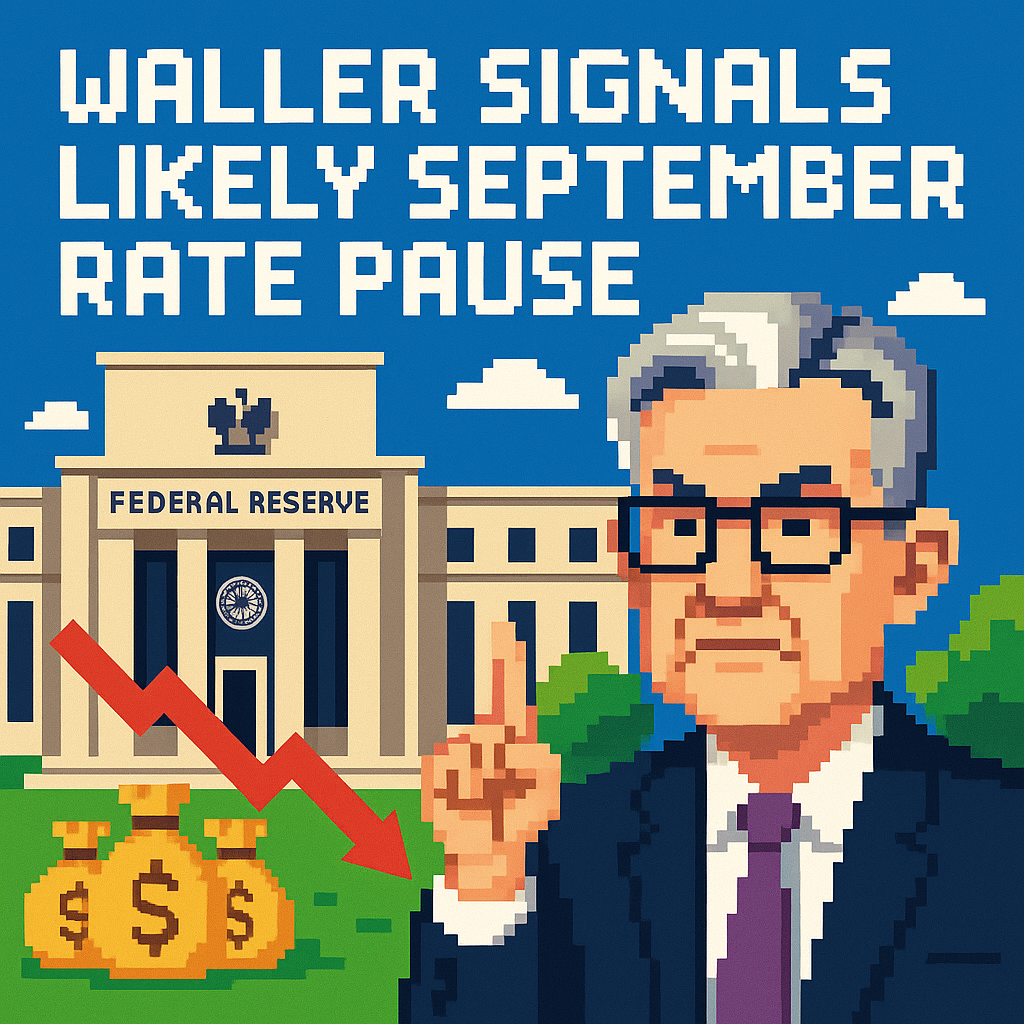
Waller Signals Likely September Rate Pause | Analysis by Brian Moineau

TL;DR

  • Federal Reserve Governor Christopher Waller said he was inclined to hold rates at the mid-September 2026 FOMC if August inflation cools, countering Kevin Warsh’s hawkish Jackson Hole tone that pushed markets toward a September hike. [1][3]
  • CME-linked odds for a September increase jumped near 58% after Warsh’s Jackson Hole remarks, then drifted back toward roughly 50% after Waller’s comments. [3][2]
  • My read: data-dependent voices like Waller will carry the month unless core inflation re-accelerates materially in the next print; markets look a bit rich on hike odds here. [1][2]

What the source said

The Financial Times reported that Governor Waller indicated he was inclined to keep the federal funds rate unchanged in September 2026 if incoming August inflation data confirm cooling, and it contrasted that signal with markets’ post–Jackson Hole shift toward a hike. [1]
Coverage noted that Warsh’s hawkish posture in Jackson Hole, Wyoming, on August 28, 2026, helped push hike odds higher before Waller’s remarks pared them. [3]
Waller explicitly grounded his September stance in the next CPI/PCE readings and acknowledged softer labor data, with July’s U.S. unemployment rate near 4.1%. [2]
Net: the FT framed an active policy debate—Warsh’s toughness nudged probabilities up; Waller’s conditional patience leaned them back toward a hold pending next week’s inflation report. [1]

Why it matters

A 25 basis point hike or hold in September 2026 changes mortgage quotes, corporate funding costs, and bank hedging right now, not in theory. The split between Warsh’s tougher stance and Waller’s data-first posture pulls the Treasury curve, which feeds into housing affordability, small‑business credit, and capex decisions in cities like Dallas and Detroit. [2][3]
Pricing moves of a few basis points affect real money: dealers, asset managers, and regional lenders must adjust risk on the fly when odds swing 8–10 percentage points in a single session. [2][3]

Investors also have to parse a communications shift after Jackson Hole. Warsh downplayed forward guidance and emphasized discipline, which increases the premium on each CPI and PCE print. [3]
That stance amplifies the influence of officials like Waller who translate data into conditional policy, and it heightens whiplash risk as traders chase each speech, tightening financial conditions via volatility even without a formal hike. [1][3]

Original analysis

Contrarian read — the consensus and why I disagree

  • Consensus: Warsh’s Jackson Hole hawkishness tipped the odds toward a September hike, with CME-linked probabilities near 57–58% intraday. [3]
  • My case: Waller supplied the data-contingent anchor and odds slid back toward even-money after his remarks; if August core CPI runs ~0.20–0.25% m/m, a voting majority will back a hold over a preemptive hike. [1][2]
  • Labor adds cover: with July unemployment around 4.1% and signs of easing job openings, a “watchful hold” minimizes regret while keeping optionality. [2]

Back-of-envelope calculation — how much “hike risk” is actually priced

  • After Jackson Hole: implied odds of a 25 bp September hike ≈ 58%; expected move = 0.58 × 25 bp ≈ 14.5 bp. [3]
  • After Waller’s pushback: pricing cooled to ≈ 50%; expected move = 0.50 × 25 bp = 12.5 bp. [2]
  • Delta ≈ 2 bp; with a two‑year Treasury duration ~1.9, price impact ≈ 1.9 × 0.0002 = 0.00038, or 0.038%. On a $250,000,000 position, mark‑to‑market ≈ $95,000 (author’s calculation using duration × yield change).

Back-of-envelope calculation — the household translation

  • Assume a $400,000, 30‑year fixed mortgage priced at 7.00% if the Fed holds versus 7.25% if it hikes 25 bp.
  • Payment at 7.00%: r = 0.07/12; n = 360 → about $2,663/month.
  • Payment at 7.25%: r = 0.0725/12; n = 360 → about $2,729/month.
  • Difference ≈ $66/month, or ~$800/year—material for first‑time buyers deciding whether to lock in September 2026 (author’s calculation).

Named‑stakeholder breakdown — what this means right now

  • Homebuilders (D.R. Horton, Lennar): A September hold steadies rate locks into the autumn selling season; a hike risks cancellations and heavier incentives. Watch MBA weekly applications and order backlogs in Q3.
  • Regional banks (PNC, Fifth Third): A hold stabilizes deposit betas; a hike nudges NIM but worsens AFS/HTM marks, pressuring tangible common equity optics into Q4.
  • AI‑buildout supply chain (Nvidia, Broadcom, Eaton): Warsh linked late‑cycle demand risks to frothy investment; a hike cools multiples and debt‑financed data‑center capex, while a hold stretches the runway for 2027–2028 plans. [3]
  • Utilities and yield proxies (NextEra, Duke): Even a 2–3 bp shift in expected policy bleeds into equity risk premia; a hold supports defensives that sold off when hike odds spiked. [2][3]
  • High‑yield issuers (private credit funds; B‑rated borrowers): A hold preserves refinancing windows into Q4 2026; a hike raises coupons into clustered maturities.

Historical analogue — how guidance risk feeds term premia

  • In 2013’s “taper tantrum,” less‑predictable guidance widened term premia even as the expected policy path shifted modestly; the 10‑year yield rose over 100 bp from May to September 2013 while the funds rate stayed pinned.
  • In 2017, the Fed’s balance‑sheet normalization plan muted that volatility by pre‑announcing caps; today’s retreat from specificity rhymes more with 2013 than 2017, arguing for a fatter term premium into 2026–2027.

A simple typology for the Fed’s current split

  • Pragmatic data‑first (Waller): Votes hinge on the next CPI/PCE; communicates thresholds like “if continued progress, hold.” [1][2]
  • Credibility‑first (Warsh): Emphasizes vigilance on inflation and accepts more market volatility as the cost of policy flexibility. [3]
  • Markets ping‑pong between these poles, which is why odds lurched to ~58% post–Jackson Hole, then cooled toward ~50% after Waller. Position sizing should reflect that tug‑of‑war rather than a single static reaction function. [3][2]

What others are missing

Most coverage fixates on the September 2026 binary. The bigger story is how Warsh’s retreat from forward guidance changes the entire term structure by design, raising communication uncertainty that feeds the term premium even if the modal path for the funds rate barely shifts. [3]
Waller’s conditional clarity briefly filled that vacuum, but the structural takeaway is fewer breadcrumbs and fatter premia, which matter for 10‑year mortgages, 20‑ to 30‑year project finance, and multi‑decade utility rate cases that discount far‑out cash flows. [1][3]
Even if the FOMC holds on September 16, a higher term premium can keep borrowing costs elevated and price‑to‑earnings multiples subdued into 2027, especially in capital‑intensive sectors.

What to watch next

  1. By September 13, 2026: Core CPI prints at or below 0.25% m/m SA; if that happens, September hike odds fall below 40% by the September 14 open.
  2. By September 16, 2026: FOMC holds the target range; the statement adds a data‑contingent “willingness to act” clause without new forward guidance.
  3. By October 31, 2026: The two‑year Treasury yield stays within ±15 bp of its September 9 close, signaling a narrow realized policy path despite noisier Fed rhetoric.

My take

I side with Waller’s conditional hold. Banking disinflation progress while unemployment hovers near 4.1% reduces overshoot risk and buys time to see whether shelter and non‑market services cool into Q4 2026. [2]
Warsh’s concern about credibility is understandable, but a preemptive hike into moderating core could tighten more than intended, especially with AI‑linked capex muddling relative prices. If August core lands near 0.20–0.25% m/m, expect a steady hand and a statement that keeps the hawkish umbrella open—but furled. [1][2]

Sources

  1. Financial Times — “Fed’s Chris Waller inclined to hold rates if inflation cools” (September 2026). What this contributes: primary report on Waller’s conditional hold stance and its timing.
  2. AP News — Coverage of Waller’s remarks and market reaction (September 2026). What this contributes: odds near 50%, July unemployment near 4.1%, and context on shifting expectations.
  3. Kiplinger — “Stocks turn down as Warsh talks up rates: Stock Market Today” (late August 2026). What this contributes: link between Warsh’s Jackson Hole tone and CME FedWatch odds around 57–58%.

Bowman’s 2026 Fed Outlook: Calm Caution | Analysis by Brian Moineau

Reading the Fed’s Signals: Bowman’s January 16, 2026 Outlook on the Economy and Monetary Policy

Good morning at the conference table of the mind: imagine the Federal Reserve’s meeting notes as a weather report for the economy. On January 16, 2026, Vice Chair for Supervision Michelle W. Bowman stepped up in Boston and delivered a forecast that felt less like thunder and more like watching the clouds: inflation easing, but a labor market growing fragile — and policy makers watching both closely. Her remarks at the New England Economic Forum are a practical, plainspoken reminder that the Fed’s job is often about balancing calm and caution.

Why this speech matters

  • The speaker is Michelle W. Bowman, Vice Chair for Supervision of the Federal Reserve Board — a policymaker with a voting role on the FOMC and direct responsibility for bank supervision.
  • The talk comes at a moment of transition: after several rate cuts in late 2025, inflation readings looking better once one-off tariff effects are stripped out, and early signs that hiring is weakening.
  • Bowman’s emphasis: inflation seems to be moving toward the Fed’s 2% goal, but a fragile labor market raises downside risk — and that should shape monetary policy decisions.

Highlights from Bowman’s outlook

  • Recent policy changes: the Fed lowered the federal funds target range by 75 basis points since September 2025 (three 25-basis-point cuts), bringing the range to 3.50–3.75%. Bowman voted for those cuts, viewing policy as moving toward neutral.
  • Inflation narrative: headline and core PCE inflation have fallen, and when estimated tariff impacts are removed, core PCE looks much closer to 2%. Core services inflation has eased in particular; remaining pressure is concentrated in core goods, which Bowman expects to moderate as tariff effects fade.
  • Labor market concern: hiring rates are low and payroll growth has flattened; with layoffs not yet widespread, the labor market could still deteriorate quickly if demand softens. Bowman views the labor-market downside as the larger near-term risk.
  • Policy stance and approach: Bowman favors a forward-looking, data-informed strategy — ready to adjust policy to support employment if labor fragility worsens, while noting policy is not on a preset course.
  • Supervision agenda: as Vice Chair for Supervision, Bowman also highlighted regulatory priorities — rationalizing large-bank ratings, improving M&A review processes, and implementing the GENIUS Act responsibilities on stablecoins.

The investor and business dilemma

  • For businesses: easing inflation can reduce input-cost pressure, but softer hiring and potentially weaker demand mean firms should be cautious about growth plans and workforce commitments.
  • For investors: the combination of lower inflation risk and a fragile labor market suggests the Fed is unlikely to pivot aggressively. Markets should prepare for gradual adjustments rather than dramatic rate swings, with a watchful eye on employment indicators.

What to watch next

  • Monthly payrolls and the unemployment rate — signs of a pickup in layoffs or a sharper rise in unemployment would increase the Fed’s focus on supporting employment.
  • Core PCE inflation excluding tariff adjustments — Bowman explicitly treats tariff effects as one-offs; if core goods inflation doesn’t continue to soften, that would complicate the 2% story.
  • Business hiring intentions and consumer demand measures — weak demand would reinforce Bowman’s caution about labor-market fragility.
  • Fed communications at upcoming FOMC meetings — Bowman emphasized that policy is not on autopilot and that the Committee will weigh new data meeting by meeting.

A few practical takeaways

  • Expect policy to remain “patient but ready”: the Fed’s stance is moderately restrictive but responsive to incoming data.
  • Companies should build flexibility into hiring and capital plans — layering contingent plans (e.g., phased hiring, temporary contracts) reduces risk if demand softens.
  • Bond and equity investors should monitor real-time labor and inflation indicators rather than relying solely on past rate moves.

My take

Bowman’s speech reads as pragmatic: credit the Fed for recognizing progress on inflation while honestly calling out the economy’s weak spots. The emphasis on labor-market fragility is a useful corrective to narratives that celebrate disinflation as a finished project. Policymaking in 2026 looks set to be a juggling act — steadying inflation without worsening employment — and Bowman’s call for forward-looking, data-driven decisions is the kind of steady voice markets and Main Street need right now.

Sources


Related update: We recently published an article that expands on this topic: read the latest post.

Fed Split Drives Sudden Market Rally | Analysis by Brian Moineau

Stocks Rally as Rate-cut Odds Soar: Why a Single Fed Voice Moved Markets

Markets can be moody, and on November 21, 2025 they were downright fickle. One speech from a senior Fed official — New York Fed President John Williams — was enough to flip investor sentiment, send stocks higher and reprice the odds of a rate cut at the Fed’s December meeting. But the story isn’t just about a single quote; it’s about how fragile market expectations have become and why investors now have to navigate a Fed that sounds increasingly divided.

An attention-grabbing moment

  • In prepared remarks delivered at a Central Bank of Chile event on November 21, 2025, John Williams said he “still see[s] room for a further adjustment in the near term” to move policy closer to neutral.
  • Markets reacted fast: major indexes rallied intraday (the Dow, S&P 500 and Nasdaq all jumped), bond yields fell and CME Group’s FedWatch tool sharply increased the probability priced in for a 25-basis-point cut at the December 9–10 Fed meeting. (forbes.com)

That single dovish tilt — from a Fed official who sits permanently on the Federal Open Market Committee — was enough to reverse a recent shift toward pausing further easing. But Williams’ view wasn’t unanimous inside the Fed: other officials publicly backed holding rates steady for now, keeping uncertainty high. (forbes.com)

Why Wall Street cared so much

  • Expectations rule short-term flows. Futures and options markets move quickly when a credible policymaker signals a change. Williams is influential; his willingness to countenance another cut pushed traders to reprice December odds aggressively. (forbes.com)
  • Rate-sensitive sectors react fast. Homebuilders, gold, and consumer discretionary names — equities that benefit when borrowing costs fall — saw notable gains as investors positioned for easier policy. Technology and cyclical names that had previously weathered a hawkish Fed also saw rotations. (investopedia.com)
  • Bond markets set the backdrop. Treasury yields fell on the news, reflecting both the revised odds of policy easing and a quick move toward safer, lower-yield pricing. That in turn supports equity valuations by lowering discount rates for future earnings. (mpamag.com)

The Fed’s internal tension

  • Williams emphasized the labor market softness and said upside inflation risks had “lessened somewhat,” arguing there’s room to nudge policy toward neutral. But other officials and many market analysts remained cautious, pointing to still-elevated inflation readings and patchy labor data as reasons to hold steady. (forbes.com)
  • The result is a split Fed narrative: a powerful, market-moving voice saying “near-term cut possible,” and several colleagues advocating patience. That split creates whipsaw risk — big moves when each new datapoint or comment arrives.

What investors should watch next

  • The December 9–10 FOMC meeting calendar date. Markets have reweighted odds, but a true signal will come from Fed communications and incoming data between now and the meeting. (investopedia.com)
  • Labor-market indicators. Williams flagged downside risks to employment; if payrolls and wage growth weaken, the Fed’s tolerance for cuts grows. Conversely, stronger-than-expected job prints or stubborn inflation would swing the pendulum back. (forbes.com)
  • Fed rhetoric cohesion. Look for whether other Fed officials echo Williams’ tone or double-down on restraint. If the Fed’s public messaging becomes more uniform, the market’s volatility should ease. If the split persists, expect continued intra-day reversals. (finance.yahoo.com)

What this means practically:

  • Portfolio positioning may tilt toward rate-sensitive sectors if cuts look probable, but the risk of being wrong is real — a single stronger data release could flush those positions.
  • Volatility will remain elevated while the Fed’s internal debate plays out and the economic data stream remains mixed.

Quick takeaway points

  • A single influential Fed official can materially shift market expectations; John Williams’ “near-term” comment on Nov 21, 2025 did exactly that. (forbes.com)
  • Markets now price a much higher chance of a December rate cut, but the Fed is not united — several officials have favored maintaining current rates. (reuters.com)
  • Incoming labor and inflation data, plus the Fed’s subsequent communications, will determine whether this rally has legs or is a short-lived repricing.

My take

This episode is a reminder that markets trade not only on data but on narratives. A narrative shift — in this case, that the Fed might ease sooner — can drive swift, meaningful reallocation across assets. For investors, the sensible middle path is to respect the potential for policy easing while protecting against the opposite outcome. In practice, that means balancing exposure to assets that benefit from looser policy with hedges or sizing discipline in case the Fed leans back into restraint.

Sources

(Note: the Forbes story that prompted this piece ran on November 21, 2025; Reuters and Investopedia provide non-paywalled coverage and context cited above.)


Related update: We recently published an article that expands on this topic: read the latest post.


Related update: We recently published an article that expands on this topic: read the latest post.