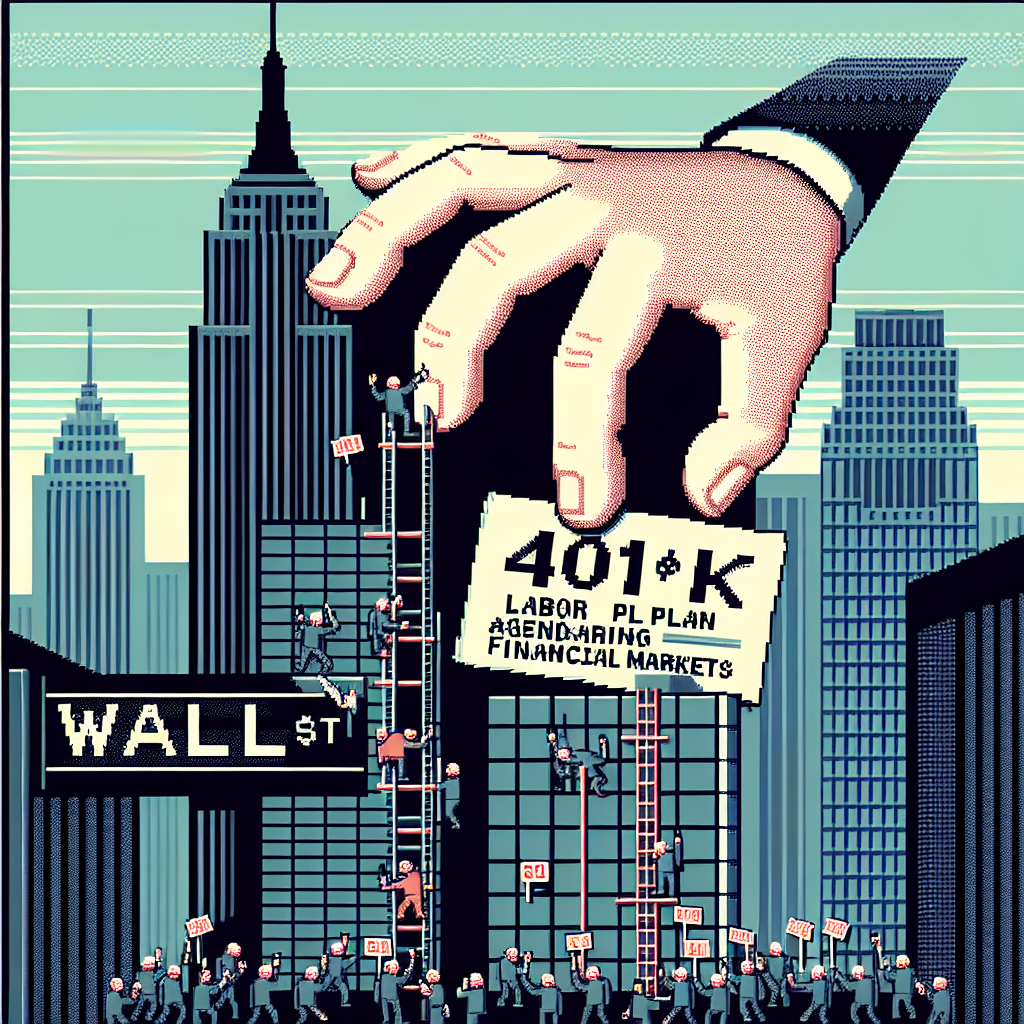
Wall Street Eyes Your 401(k): Risk Shift | Analysis by Brian Moineau

Hook: Why your 401(k) might suddenly look more like a hedge fund

The Labor Department wants to give Wall Street firms greater access to a lucrative market — your 401(k). That sentence sounds alarming because it is: a recent push from the administration and the Department of Labor aims to ease rules so retirement plans can more easily add “alternative” investments (private equity, private credit, cryptocurrencies, structured notes and the like) to workplace retirement menus. The pitch is familiar — more access, more diversification, potentially higher returns — but the delivery may shift risk and fees onto everyday savers who rely on 401(k)s for retirement security.

What’s changing and why it matters

For decades, 401(k) plans have been dominated by mutual funds and index funds that are relatively liquid, transparent, and cheap. The new policy direction encourages plan sponsors and recordkeepers to include alternatives as standard options. Proponents argue alternatives can boost returns and broaden investment choices beyond public equities and bonds.

But alternatives are different beasts: they’re often expensive, hard to value, and illiquid. That matters inside a workplace retirement plan because participants — not just wealthy accredited investors — would be exposed. What looks like added choice on paper can become complexity, conflicts of interest, and higher costs for workers who neither asked for nor understand these products.

The investor dilemma: complexity vs. choice

  • Alternatives may offer high headline returns in certain market cycles, but they come with opaque fee structures (management fees, performance fees, transaction costs).
  • They can be difficult to price daily; many require quarterly or annual valuations, which undermines transparency and can mislead savers about the true state of their accounts.
  • Illiquidity is a real problem. If the plan or participant needs to rebalance or redeem during a market crash, these investments may be impossible or extremely costly to sell.
  • Plan fiduciaries might face pressure (or legal exposure) when they add risky products to broadly offered plan menus, while brokers and Wall Street firms stand to earn substantial new revenue.

Transitioning to these offerings without robust investor protections and plain-language disclosures risks turning retirement savings into a new profit center for asset managers — at workers’ expense.

How we got here: policy moves and political framing

The current push builds on an executive order and subsequent DOL guidance that frame alternatives as “democratizing access” to investment opportunities historically reserved for wealthy investors. Administrations often paint this as leveling the playing field: why should only the rich get private equity’s outsized returns?

But policy details matter. When rules change to reduce hurdles for offering alternatives, the market actors who package and sell these products — investment banks, private equity firms, broker-dealers and large recordkeepers — gain a massive addressable market: the roughly $12 trillion in U.S. retirement assets. Critics warn the change lets Wall Street market sophisticated, high-fee products to a population that may lack the information and resources to evaluate them.

The Washington Post column that spurred this conversation calls the plan “a massive 401(k) greed grab for Wall Street.” That blunt framing captures the core concern: structural incentives may steer savers into costly strategies that enrich intermediaries but don’t meaningfully improve retirement outcomes for most workers.

Real-world risks: fees, conflicts, and lawsuits

  • Higher fees. Alternatives frequently charge higher management fees and performance-based fees that erode long-term compounding. Over a 30-year horizon, even modest extra fees can reduce retirement balances dramatically.
  • Conflicts of interest. Broker-dealers and advisors who receive commissions or trail fees have incentives that may conflict with participant best interests.
  • Legal exposure for plan sponsors. Many plan sponsors historically avoid including complex alternatives precisely because of litigation risk: if participants lose money and sue, fiduciaries can be held accountable. Changing rules may not eliminate that exposure; it could shift liability in unpredictable ways.
  • Disparate impact. Lower-income or less financially literate workers are likelier to be harmed if defaults or target-date funds include poorly understood alternatives.

These are not hypothetical — there are precedents where complex financial products sold to retail or retirement accounts led to outsized losses and investigations. Relaxing guardrails without simultaneous consumer protections is a risky policy cocktail.

What protections would make a difference

If alternatives are going to be offered more widely, policymakers and plan sponsors should demand stronger safeguards:

  • Plain-language fee and liquidity disclosures tailored to non-expert plan participants.
  • Strict valuation rules and third-party custody to reduce conflicts and mark-to-market manipulation.
  • Fee limits and caps on performance-based compensation within default options like target-date funds.
  • Enhanced fiduciary duties and clearer ERISA guidance so plan sponsors understand liabilities and best practices.
  • Limits on which alternatives can be offered as default options for auto-enrolled participants.

Without structural protections like these, the balance of power favors institutions that design and distribute complex products — not the savers in the plan.

What workers should watch for now

  • Review your plan’s default and target-date funds. Watch for language that adds “private” or “alternative” exposure.
  • Check fees on your statements and ask HR or the plan administrator for plain-English explanations of any new options.
  • Be skeptical of marketing that implies “access” equals “better outcomes.” Diversification is useful, but only when paired with transparency and reasonable costs.
  • If offered complex products, ask whether they’re available as an opt-in, not part of an automatic default.

Transition words matter here: more options can be beneficial — but only when they’re genuinely accessible and appropriately regulated.

What this means for the broader retirement system

If policies succeed in making alternatives common in 401(k) menus, we could see a structural shift in how retirement assets are managed. That could mean higher profits for asset managers and more concentrated ownership of private companies by retirement funds. It could also mean greater tail-risk for everyday savers, and rising disparities in retirement outcomes.

Policymakers should ask a central question: do these changes improve the core mission of 401(k)s — steady, reliable retirement income for workers — or do they open a new revenue stream for financial intermediaries under the banner of “choice”?

My take

The idea of broadening investment choices in retirement plans isn’t inherently bad. Innovation can create value. But the devil is in the implementation. Without stronger consumer protections, mandatory disclosures, and fiduciary clarity, this push looks less like expanding opportunity and more like funneling predictable retirement flows into higher-fee, less-transparent vehicles. That’s a recipe for profits at the top and disappointment at the bottom.

Policymakers and plan sponsors should prioritize safeguards that protect savers’ long-term compounding power. Otherwise, the “democratization” of alternatives will read like a polite sales pitch for Wall Street.

Further reading

  • The Washington Post column analyzing the policy and implications.
  • The Guardian’s reporting on risks faced by small investors in expanded retirement options.
  • Analysis from labor and union groups highlighting concerns about fees and fiduciary duty.

Sources


Related update: We recently published an article that expands on this topic: read the latest post.

Meta’s Resilience Cracks After Court | Analysis by Brian Moineau

When a Giant Stumbles: Meta Finally Shows Weakness and What It Means

The phrase Meta Finally Shows Weakness landed in my head the morning markets opened after two consecutive landmark legal losses. For years investors treated Meta’s stock like a rubber band: it could stretch through regulatory storms, advertising slowdowns, and costly bets on the metaverse — and then snap back. But a bad year caught up to that resilience, and now investors, policymakers, and the company itself face a new, less forgiving reality.

The core topic — Meta Finally Shows Weakness — isn’t just a headline. It’s the moment when legal pressure moved from a nagging background risk into a visible, quantifiable drag on the company’s prospects.

Why the recent losses matter

  • Juries in separate, high-profile trials found Meta liable or negligent in cases alleging harm to children and failures to protect users, producing multi-hundred-million dollar awards and renewed regulatory attention.
  • Those rulings arrived after a year of mixed signals: strong ad revenue and user growth on one hand, but rising legal costs, unsettled insurance coverage, and big strategic spending (Reality Labs, AI) on the other.
  • Markets hate uncertainty. When legal outcomes start to look less like one-off setbacks and more like systemic liabilities, investor sentiment can swing hard and fast.

Transitioning from reputation risk to balance-sheet consequences is what turns an operational challenge into a structural one. The recent verdicts pushed that transition.

The court defeats in plain terms

Recent jury decisions — including a New Mexico verdict ordering Meta to pay roughly $375 million and a separate California bellwether finding against Meta and YouTube for negligent design that harmed a plaintiff — have turned up the volume on a long-running wave of litigation alleging that social platforms harmed minors and misled users. These rulings matter not only for the dollar amounts but because they set precedent and embolden other plaintiffs and states.

At the same time, other legal fronts remain active: appeals, a revived advertisers’ class action, and regulatory probes in the U.S. and EU. A loss in a handful of trials doesn’t bankrupt Meta, but it raises the probability of more settlements, higher compliance costs, and stricter rules that could change business choices around product design and advertising.

How investors had been willing to look the other way

For much of the last two years, investors gave Meta the benefit of the doubt. Reasons included:

  • A powerful advertising engine that continued to grow revenue despite macro volatility.
  • Strong user engagement and product improvements tied to AI and Reels-style short video formats.
  • Confidence that management could absorb fines and legal costs while still delivering free cash flow.

That tolerance came with an implicit assumption: legal and regulatory issues were manageable, episodic, and unlikely to materially constrain growth. Recent rulings puncture that assumption.

The investor dilemma

Investors now face three hard questions:

  1. How much of Meta’s future cash flow is at risk from litigation and regulation?
  2. Will rising legal costs and potential design changes erode the ad targeting that underpins revenue?
  3. Is the company’s pivot to AI and hardware enough to justify the current valuation if regulatory headwinds tighten?

Answers differ based on risk appetite. Growth investors might still prize Meta’s monetization engine and discounted long-term AI bet. Value and risk-focused investors will demand higher margins of safety, citing amplified legal exposure and the possibility of regulatory measures that limit targeted ads or force design changes that reduce engagement.

What regulators and lawmakers are watching next

Momentum from jury verdicts breeds attention on Capitol Hill and in statehouses. Legislators who have long pushed for platform accountability now have fresh political cover to pursue laws addressing algorithmic design, child protection, or advertising transparency. For Meta, that means legal risk now comes alongside the real risk of structural, policy-driven changes to the business model.

Regulatory action could take many shapes: fines, design mandates, or restrictions on data-driven advertising. Each carries different financial and operational costs, but together they add a layer of uncertainty investors can’t ignore.

The company’s possible responses

Meta has several levers it can pull:

  • Appeal aggressively and fight precedent-setting rulings to limit contagion.
  • Increase spending on compliance, safety design, and product changes to reduce future liabilities.
  • Shift product and ad strategies to reduce reliance on controversial targeting methods.
  • Lean into new growth engines (AI-driven features, hardware) to diversify revenue.

None of these are cheap. Appeals can be lengthy; product redesigns can depress engagement; new growth initiatives require capital and time. The question for markets is whether Meta can absorb those costs without compromising its core profit engine.

A few practical takeaways for investors

  • Expect volatility. Legal verdicts and related headlines will drive short-term swings.
  • Watch regulatory signals closely — bills, FTC actions, and state attorney general moves can alter risk calculus.
  • Reassess valuation assumptions: factor in higher potential costs for litigation, compliance, and product redesign.
  • Diversify exposures across ad-driven tech names to avoid concentrated betting on a single regulatory outcome.

My take

Meta has shown it can recover from shocks before, but resilience isn’t infinite. When court losses stop being isolated and start looking systemic, the market’s tolerance thins. That’s the crux of why Meta Finally Shows Weakness matters: it signals a potential inflection point where legal and policy risk bite into valuation in a way that past earnings beats did not fully offset.

Meta remains a massive, profitable company with enviable assets. But investors and policymakers are now recalibrating: strong results won’t automatically trump structural risks. For those watching — whether as shareholders, regulators, or users — the coming months will reveal whether these legal defeats are a temporary bruising or the beginning of a longer, costly adjustment.

Final thoughts

Big companies often survive big problems, yet not all recoveries are equal. Meta’s path forward will come down to legal outcomes, regulatory responses, and how effectively the company adapts product and monetization strategies. The market’s verdict — swift and sometimes unforgiving — will reflect not only earnings and growth but how credible Meta’s plan looks for a world increasingly focused on safety, transparency, and regulation.

Sources


Related update: We recently published an article that expands on this topic: read the latest post.


Related update: We recently published an article that expands on this topic: read the latest post.
SpaceX IPO Hype: Investors, Beware | Analysis by Brian Moineau

The SpaceX IPO Is Coming — But Don't Let FOMO Lift You Off Without a Parachute

SpaceX IPO chatter is back in headlines, and this time the conversation feels different: the company that disrupted rocket manufacturing is reportedly preparing to file for an initial public offering, and big private-holders — from Cathie Wood’s ARK Venture Fund to smaller interval funds — look ready to ride the rocket. The idea of owning a sliver of Elon Musk’s aerospace empire is intoxicating, and headlines that suggest valuations in the trillions have retail and institutional investors rethinking how to get exposure.

But before you let excitement drive your allocation, pause. There are real reasons prices for funds holding private SpaceX stakes jumped on the news — and equally real reasons to read the fine print.

What just happened

  • Late 2025 and early 2026 reporting from several outlets said SpaceX is weighing a 2026 IPO and has taken steps such as permitting insider share sales and lining up banks. Reports suggested the offering could be enormous: raising tens of billions and valuing the company at well over $1 trillion. (investing.com)
  • Investors that already had private stakes (for example, interval/venture-style funds that can hold unlisted securities) saw inflows and NAV bumps as the prospect of a public exit became plausible. Cathie Wood’s ARK Venture Fund — which lists SpaceX among its private holdings — was highlighted frequently as a retail-accessible route to SpaceX exposure. (fortune.com)
  • The chatter intensified when Musk and SpaceX actions (including corporate moves like acquiring xAI) added coherence to the narrative that a public listing could be part of a broader strategy. (apnews.com)

Transitioning from rumor to reality, however, is often slippery in the private-company-to-IPO pipeline. SpaceX has long resisted going public; the timing, size, and structure (full company vs. Starlink spun-out, percentage of float, pricing strategy) will materially shape outcomes.

Why funds that own SpaceX stakes surged

  • Liquidity hope: Many closed-end and interval funds that can legally hold private shares (ARK Venture Fund, certain boutique private-shares funds) became a de facto retail-friendly on-ramp. News of an IPO converts theoretical private-value into a near-term liquidity catalyst. (finance.yahoo.com)
  • Revaluation effects: When major outlets report an impending IPO or insider share sale at a higher implied valuation, NAV estimates for funds holding those private securities often jump. That attracts inflows and media attention, which feeds the loop. (investing.com)
  • Narrative momentum: Firms like ARK sell a vision — Starlink, AI integration, and eventual Mars-scale markets — and investors who buy that future will pile into any vehicle that promises access. That narrative inflow can amplify price movements beyond fundamentals. (fortune.com)

The investor dilemma

  • Small float risk: Early indications suggest SpaceX might only sell a modest portion of equity in an IPO. If true, public investors could end up paying sky-high prices for shares that still trade thinly, while large shareholders retain control and most upside. Thin public floats can mean high volatility and poor price discovery at first. (investing.com)
  • Valuation stretches: Trillion-dollar valuations are headline-grabbing but hinge on optimistic revenue scenarios for Starlink, future data-center-in-space projects, and other ventures. Execution risk is real — regulatory hurdles, competition, and capital intensity all matter. (theguardian.com)
  • Fund mechanics differ: Buying an interval fund that holds SpaceX is not the same as buying a stock. Fee structures, redemption windows, NAV-to-market price discrepancies, and concentration limits can make these funds behave very differently from public equities. Investors should read prospectuses closely. (finance.yahoo.com)

How savvy investors should think about this

  • Differentiate access from value. Buying an ARK-like fund gives access to SpaceX as a private asset in a managed vehicle; it doesn’t guarantee easy, immediate liquidity at IPO pricing. Understand how much of the fund is actually exposed and what the fund’s redemption mechanics are. (cnbc.com)
  • Anticipate structure and timing. Watch for details: will SpaceX file confidentially, will it spin out Starlink, how much new equity will it issue, and when will insiders be allowed to sell? These choices determine whether the IPO is a capital-raising event, a liquidity event for insiders, or both. (investing.com)
  • Keep portfolio sizing conservative. Even if you believe in the long-term upside, a sensible allocation caps the downside from valuation shock or early trading volatility. Treat any pre-IPO exposure as a high-conviction but higher-risk sleeve of a portfolio.
  • Expect headline volatility. Media coverage will swing funds and related public names (chip suppliers, launch partners). If you trade on headlines, plan for whipsaw. (heygotrade.com)

SpaceX IPO: short-term winners and longer-term questions

  • Winners in the near term are likely to be funds that already held private stakes and firms providing supply-chain exposure (e.g., satellite components, launch-parter suppliers). Those positions can re-rate quickly when an IPO looks imminent. (observer.com)
  • Longer-term, the critical questions remain: can Starlink scale profitably in a competitive orbital-internet market? Will capital needs for AI-in-space or mega-data-centers justify the lofty price tags? And how much governance and insider control will public investors actually get? These questions determine whether the IPO is a historic market event or a short-lived media spectacle.

My take

An impending SpaceX IPO is a landmark moment for markets and technology investing — if it happens at the reported scale, it will change index composition and investor access to the satellite-and-rocket economy. That excitement is understandable. But the prudent move is not to chase headlines; it’s to study structure, read fund disclosures, and size positions to reflect both the upside and a meaningful chance of early disappointment. For most investors, indirect exposure through diversified vehicles or modest allocations makes more sense than concentrated bets on a single private company during an emotionally charged run-up.

Sources

(Note: the original Barron’s piece you referenced influenced the framing for this post; the reporting above synthesizes multiple open sources that covered the potential SpaceX IPO and the flows into funds holding private stakes.)


Related update: We recently published an article that expands on this topic: read the latest post.


Related update: We recently published an article that expands on this topic: read the latest post.