AutoScientist: Automating Fine‑Tuning | Analysis by Brian Moineau

TL;DR

  • Adaption’s AutoScientist automates the fine‑tuning loop by co‑optimizing data and model “recipes,” claiming a 35% average gain over human‑configured runs and a 48%→64% win‑rate jump on in‑house evals, with a 30‑day free trial to spur adoption [1][2].
  • The real economic wedge isn’t “self‑training magic” but cycle‑time compression: fewer failed runs means fewer GPU‑hours and fewer human review cycles in a world where 8×H100 boxes list at ~$49.24/hour on CoreWeave as of 2026‑05 [4].
  • If AutoScientist scales, the center of gravity in AI moves from monolithic labs toward “continuous adaptation” stacks—yet credibility will hinge on public, contamination‑proof evals beyond SWE‑bench (2,294 GitHub issues) or ARC‑AGI (François Chollet’s 2019 challenge), which Adaption says aren’t applicable to its task‑specific tuning claims [1][6][7].

What the source said

TechCrunch reports that Adaption, led by CEO Sara Hooker, launched AutoScientist on May 13, 2026 to automate parts of model training and alignment for teams outside big labs; the product co‑optimizes both data and the model, building on Adaption’s Adaptive Data offering [1]. The company claims AutoScientist more than doubles win rates across models, citing a 48%→64% internal jump, but says benchmarks like SWE‑Bench (2023) and ARC‑AGI (2019) aren’t the right yardsticks because the tool adapts models to specific tasks [1][6][7]. To seed adoption, the lab is offering 30 days of free access via a hosted flow on Together AI and other providers, positioning the launch as a path to broader participation in frontier‑level fine‑tuning [1][2]. Hooker frames the release as expanding access to post‑training beyond a small set of incumbents in San Francisco and London, where most frontier efforts concentrate [1].

Why it matters

  • Stakeholders with the most to gain: mid‑market software companies and domain specialists in finance ops, legal review, and biotech R&D who hold terabyte‑scale proprietary corpora but lack a research team; automated data‑plus‑recipe search can turn those private datasets into tuned models in days instead of weeks, as Adaption’s 35% average gain claim suggests on Together‑hosted runs [2][5].
  • Stakeholders with the most to lose: centralized labs and annotation vendors whose moat rests on scarce talent and slow, manual post‑training; if a reliable loop reduces failed runs and human preference labeling, RLAIF‑style automation trims both GPU hours and label spend, echoing 2023 arXiv results where AI feedback matched RLHF on summarization/dialogue tasks [3][4].

Original analysis

Where AutoScientist fits: a 2×2 of “automation” vs. “capability locality”

  • Axes (2026 framing):
    • X: Capability locality (general alignment → task‑specific adaptation; e.g., ARC‑AGI or SWE‑bench vs. KYC document triage) [6][7].
    • Y: Automation level (manual sweeps/hand‑curation → autonomous loop with Vizier‑style early stopping and RLAIF‑grade AI feedback, 2017→2023) [3][9].
Example Capability locality Automation level Notes
RLHF pipelines (2020–2023) General Low–medium Human preference data; slow and expensive to iterate at scale [3].
Constitutional AI (Anthropic, 2022) General Medium–high AI critiques + rules reduce human labels; early RLAIF signal [8].
AutoScientist (Adaption, 2026) Task‑specific High Co‑optimizes data mixture and training recipes end‑to‑end; reports 35% average gain vs. human configs [2].
In‑house “AutoML for LLMs” (various teams) Task‑specific Medium Hyperparam search + small data curation; usually siloed in 1–2 orgs per vertical.

Consensus says “this democratizes frontier training.” The contrarian read: it only does if the loop produces audited, reproducible gains on public, de‑contaminated evals in 2026, not just on private leaderboards [1][2][6][7][3]. Adaption’s own post cites in‑house vertical evals and Together‑hosted fine‑tuning, while TechCrunch notes SWE‑bench and ARC‑AGI aren’t applicable; that stance is defensible for niche tasks but insufficient for procurement in sectors like banking and healthcare [1][2].

Back‑of‑envelope math: the cycle‑time wedge

  • Assume a typical team explores 10 fine‑tune variants per capability, each a 2‑hour run on an 8×H100 HGX box.
  • CoreWeave’s public on‑demand price for a single 8×H100 instance: $49.24/hour as listed in 2026 [4].
  • Manual loop cost: 10 runs × 2 h × $49.24 ≈ $984.80 per capability (work: 10 × 2 × 49.24 = 984.8).
  • If AutoScientist’s automated loop converges in 3 variants on average: 3 × 2 h × $49.24 ≈ $295.44 (work: 3 × 2 × 49.24 = 295.44).
  • Direct compute savings: ~$689 per capability (984.80 − 295.44 = 689.36). Add one ML engineer‑day saved per loop and you plausibly cut a 5‑day tuning sprint to <1 day, which Adaption explicitly targets with its end‑to‑end loop [2][4].

This is why co‑optimization matters economically in 2026: pruning dead‑end data mixtures and bad training recipes early can kill ~70% of unproductive runs, which reduces GPU burn and calendar time. If you also swap some human preference passes for AI feedback during RL steps—RLAIF achieved results comparable to RLHF on summarization and dialogue in 2023—you compress the annotation bottleneck too [3].

Historical analogue: Google Vizier (2017) and the playbook

In 2017, Google Vizier industrialized black‑box optimization across internal ML stacks at Google, moving teams from “sweep by feel” to Bayesian optimization with early stopping and metadata tracking [9]. Search, ads, and vision systems saw faster convergence and more reproducible wins under a service model, which reduced time‑to‑good‑config for thousands of experiments per quarter [9]. AutoScientist rhymes with that history, except the search space now spans both data and training‑process design, not just hyperparameters; the stakes are LLM post‑training, not CNNs for ImageNet. If Adaption ships Vizier‑grade reliability—transferable priors, safe early stopping, and experiment tracking—the productivity gains compound for orgs that fine‑tune weekly in 2026, not annually [2][9].

Named stakeholder breakdown

  • Adaption: must convert a 35% average uplift and 48%→64% internal win‑rate into third‑party results by summer 2026; the 30‑day free window is a smart way to crowdsource proof via reproducible runs [2].
  • Together AI: benefits if AutoScientist drives more token‑metered fine‑tunes on its platform; its per‑token pricing (published docs) aligns cost with experiment size and encourages more small runs per month [5].
  • Anthropic/OpenAI/Google DeepMind: pressure to show autonomous post‑training loops (RLAIF variants, self‑rewarding) improving task‑specific capability without brittle overfitting; prior art already shows AI‑as‑judge parity with RLHF in some settings as of 2023 [3].
  • CoreWeave/AWS: if automated loops cut total GPU hours per success, infra spend shifts toward “more projects, fewer hours per project,” with lower variance aiding capacity planning for 8×H100 fleets in U.S. regions [4][5].

What others are missing

The missing angle is evaluation governance for self‑improving loops that can “judge hack” themselves; Adaption says public benchmarks like SWE‑bench and ARC‑AGI don’t map to its targeted adaptations, and it uses in‑house domain evals instead [1][2][6][7]. That’s understandable, but reproducibility suffers without open harnesses, contamination audits, and independent graders, because modern LLMs can absorb benchmark artifacts during retrieval‑augmented training. The fix is not to pick a different benchmark; it’s to ship per‑domain, open eval suites with documented construction and grading, akin to SWE‑bench’s 2,294‑task corpus across 12 repos with verified patches and CI checks, so buyers in regulated industries can defend deltas in model risk reviews [6].

What to watch next

  1. By August 31, 2026, at least one independent lab (e.g., an academic group) publishes a head‑to‑head study showing AutoScientist’s co‑optimization beats a strong human‑configured baseline on a public, de‑contaminated domain eval by ≥15% relative margin.
  2. By Q4 2026, Together AI or a comparable host publicly attributes a measurable uptick (>20%) in monthly fine‑tune jobs to automated configuration systems like AutoScientist, citing per‑token billing data in docs or a blog.
  3. By March 2027, a major enterprise (Fortune 500) discloses in an investor filing or case study that automated training loops cut model‑iteration time by ≥50% for a business‑critical workflow (e.g., claims triage or code remediation), with at least one production KPI reported.

My take

AutoScientist is the right bet for 2026: automate the messy parts of post‑training, not just add more GPUs, and turn private data into capability faster with fewer failed runs [2]. I’m bullish on its ability to compress cycle time and spend, especially where proprietary corpora meet repeatable recipes and safe early‑stopping heuristics. But wins on internal evals won’t sway skeptical buyers in finance, health, or gov; publish auditable, contamination‑resistant harnesses and let outsiders reproduce the 35% average gain and 48%→64% win‑rate shift. If Adaption clears that bar by summer, it earns a seat at the frontier; if not, AutoScientist risks becoming another “trust us, it works” tool in a market that finally demands receipts [1][2].

Sources

  1. Adaption aims big with AutoScientist, an AI tool that helps models train themselves — TechCrunch (https://techcrunch.com/2026/05/13/adaption-aims-big-with-autoscientist-an-ai-tool-that-helps-models-train-themselves/) — Launch details, Hooker’s positioning, comments on benchmarks and the 30‑day free period.

  2. AutoScientist: Automating the Science of Model Training — Adaption (https://www.adaptionlabs.ai/blog/autoscientist) — Product claims (35% average gain; 48%→64% win‑rate), Together‑hosted fine‑tuning context, 30‑day free use.

  3. RLAIF vs. RLHF: Scaling Reinforcement Learning from Human Feedback with AI Feedback — arXiv (https://arxiv.org/abs/2309.00267) — Evidence that AI feedback can match RLHF on summarization/dialogue; supports automation of post‑training supervision.

  4. Instance Pricing (NVIDIA HGX H100) — CoreWeave (https://www.coreweave.com/pricing) — Public on‑demand price reference (~$49.24/hour for 8×H100 instances) used in the compute cost math.

  5. Fine‑tuning pricing — Together AI Docs (https://docs.together.ai/docs/fine-tuning-pricing) — Confirms token‑metered fine‑tuning economics and how jobs are costed on Together’s platform.

  6. SWE‑bench: Can Language Models Resolve Real‑World GitHub Issues? — arXiv (https://arxiv.org/abs/2310.06770) — Defines the 2,294‑task benchmark and methodology; context for public, auditable software evals.

  7. ARC‑AGI repository — GitHub (https://github.com/fchollet/ARC-AGI) — Official benchmark repository for ARC‑AGI; illustrates general‑reasoning evals and their limits for task‑specific tuning.

  8. Constitutional AI: Harmlessness from AI Feedback — arXiv (https://arxiv.org/abs/2212.08073) — Anthropic’s 2022 paper introducing rule‑based critique and AI feedback to cut human labels.

  9. Google Vizier: A Service for Black‑Box Optimization — KDD 2017 (https://dl.acm.org/doi/10.1145/3097983.3098043) — Historical analogue for service‑level optimization with Bayesian search and early stopping across Google ML teams.


Related update: We recently published an article that expands on this topic: read the latest post.
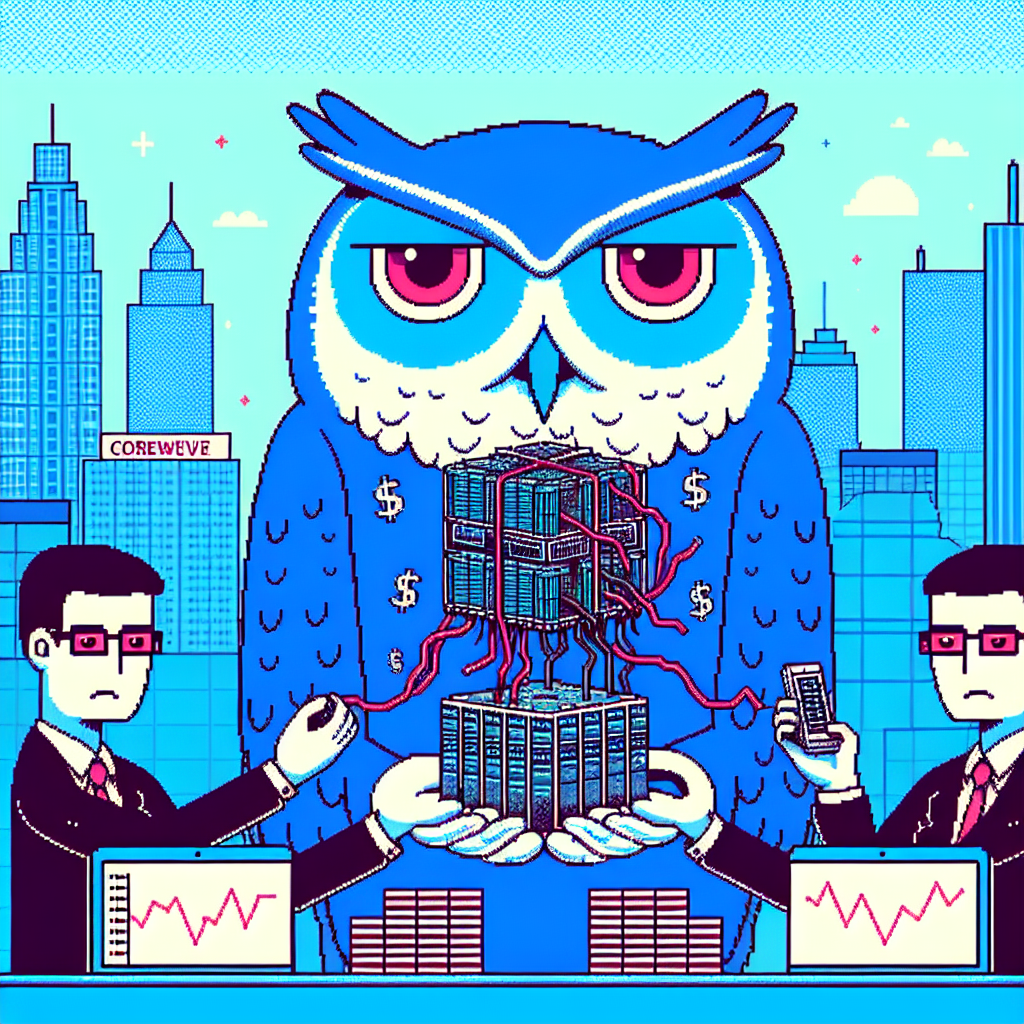

Lenders Balk at AI Data Center Financing | Analysis by Brian Moineau

Lenders said “no” to an AI data center. Why that matters.

When the financial engine behind a flashy AI project can’t convince banks to chip in, it’s not a small hiccup — it’s a flashing warning light. Last week, Blue Owl Capital’s attempt to line up roughly $4 billion of third‑party debt for a new data center in Lancaster, Pennsylvania — a build CoreWeave would occupy — failed to draw lender interest. The reason cited by at least one prospective lender: CoreWeave’s below‑investment‑grade credit profile and the growing unease around underwriting AI‑linked infrastructure with stretched balance sheets. The story isn’t just about one deal — it’s a snapshot of how credit markets are recalibrating around the AI boom.

Quick takeaways for readers scanning headlines

  • Blue Owl shopped approximately $4 billion of debt for a Lancaster, PA data center that CoreWeave is expected to occupy, but lenders largely passed.
  • CoreWeave carries a B+ issuer rating from S&P, which many lenders view as a material hurdle for financing large construction loans.
  • Blue Owl has provided roughly $500 million of bridge financing that runs through March 2026, but longer‑term debt partners remain elusive.
  • The episode highlights a broader tightening in credit appetite for capital‑intensive AI infrastructure that lacks investment‑grade tenant credit or explicit sponsor credit support.

The backstory you need

Over the past 18 months, an explosion of AI compute demand has driven a rush to build specialized data centers loaded with GPUs and networking hardware. Building that capacity is incredibly expensive — and developers have often relied on creative financing structures to spread risk: pre‑leasing to investment‑grade tenants, using big‑tech credit to securitize bonds, or tapping private‑credit syndicates.

Blue Owl made a name for itself by structuring large, bespoke financing deals tied to hyperscale projects — sometimes leaning on the strong credit of marquee partners. In Lancaster, the project was to be occupied by CoreWeave, a fast‑growing AI cloud provider backed commercially by Nvidia and others. But CoreWeave’s S&P issuer rating sits at B+ — below investment grade — and lenders told Business Insider they reviewed the deal and “passed.” Blue Owl says the project is under construction and “fully funded, on time, and on budget,” and disclosed about $500 million of bridge financing through March 2026 to cover near‑term needs. The challenge is finding permanent debt that’s comfortable carrying exposure to a below‑IG tenant and the concentrated, capital‑intensive nature of AI infrastructure.

Why lenders are getting picky

  • Credit ratings matter. For big construction debt, investment‑grade tenant credit or sponsor guarantees make it far easier for banks and institutional lenders to underwrite large exposures. A B+ issuer rating is often treated as “junk” territory for many conservative lenders.
  • AI is capital‑intensive and lumpy. The economics depend on long‑term take‑or‑pay contracts, utilization of expensive GPUs, and steady demand. Any wobble in customer concentration or equipment supply can compress cash flow quickly.
  • Market memory of recent stresses. Earlier struggles — like banks having a hard time placing tranches of other hyperscale financings — have made lenders more circumspect.
  • Private‑credit scrutiny. Blue Owl itself has faced pressure in parts of its business (including reports of halted redemptions in a private credit fund), which can color counterparties’ appetite to join its largest balance‑sheet exposures.

What this means for CoreWeave, Blue Owl, and the AI buildout

  • For CoreWeave: investor patience will hinge on cash‑flow visibility and an ability to diversify tenant concentration and lower leverage. The stock moved lower after the reporting, reflecting market discomfort.
  • For Blue Owl: the firm can still fund projects via sponsor equity or temporary bridge loans, but repeatedly failing to syndicate debt on marquee deals could hurt its reputation as a deal architect and raise questions about balance‑sheet exposure.
  • For the sector: expect more selectivity. Deals that once easily found buyers — because of hype around AI demand — will now require cleaner credit profiles, investment‑grade anchors, or explicit wrap/credit support from an investment‑grade counterparty.

The investor dilemma

Investors and lenders face a tradeoff: back high‑growth, strategically important AI infrastructure (and accept structurally higher credit risk), or demand tighter protections and wait for clearer proof that demand and margins are durable. That tradeoff is reshaping deal structures:

  • More bridge financing and sponsor equity up front.
  • Deals that rely on investment‑grade offtake guarantees (or partial guarantees).
  • Larger covenant packages, shorter tenors, and higher pricing for riskier borrowers.

My take

This episode is less a verdict on AI’s long‑term promise and more a reminder that capital markets separate technological excitement from credit tolerance. Building the AI cloud is still necessary and likely lucrative for some players — but lenders increasingly want either investment‑grade counterparties, explicit credit support, or much better margin of safety. That shift will favor well‑capitalized incumbents and force smaller, highly leveraged specialists to refine their capital plans or find partners willing to accept concentrated risk.

If Blue Owl or CoreWeave can secure an investment‑grade sponsor guarantee, diversify demand, or show stronger operating cash flows, the market will follow. Until then, expect increased creativity in financing — and more deals that stall at the lender pitch desk.

Sources

Final thoughts

The AI infrastructure race will keep building — but the capital that fuels it is asking tougher questions. Projects once sold on future demand will increasingly need present‑day creditworthiness, sponsor strength, or hybrid financing structures that bridge the gap. The lenders’ “pass” in Lancaster is a practical reset: hype isn’t a covenant, and tomorrow’s compute needs don’t pay today’s interest.


Related update: We recently published an article that expands on this topic: read the latest post.


Related update: We recently published an article that expands on this topic: read the latest post.

CoreWeave’s Comeback: Nvidia‑Tied | Analysis by Brian Moineau

The AI Stock That Keeps Bouncing Back: Why CoreWeave Won’t Stay Down

Artificial‑intelligence stories are supposed to be rocket launches: dramatic, fast, and rarely reversing course. Yet some of the most interesting winners have a bumpier ride — pullbacks, doubts, and then surprising rebounds. Enter CoreWeave, the cloud‑GPU specialist that has been fighting gravity and, lately, winning.

A quick hook: the comeback you might’ve missed

CoreWeave (CRWV) shot into public markets in 2025, soared, slid, and then climbed again — all while quietly doing what AI companies need most: giving models the raw GPU horsepower to train and run. Investors worried about debt, scale and whether AI spending would hold up. But a close strategic tie to Nvidia — including a multibillion‑dollar stake and capacity commitments — helped turn skepticism into renewed momentum.

Why this matters right now

  • AI model development needs specialized infrastructure: racks of Nvidia GPUs, power, cooling, and expertise. Not every company wants to build that.
  • That creates an addressable market for GPU‑cloud providers who can scale quickly and sign long‑term deals with big AI customers.
  • Stocks that serve the AI stack (not just chip makers or software vendors) often trade more on growth expectations and capital intensity than near‑term profits — so sentiment swings can be dramatic.

What CoreWeave actually does

  • Provides on‑demand access to large fleets of Nvidia GPUs for customers that run AI training and inference workloads.
  • Sells capacity and management services so companies (including big names like Meta and OpenAI) can avoid building their own costly infrastructure.
  • Is planning aggressive build‑outs — CoreWeave’s stated target includes multi‑gigawatt “AI factory” capacity growth toward 2030.

Those services are plain‑spoken but foundational: models need compute, and CoreWeave packages compute at scale.

The Nvidia connection — more than hype

  • Nvidia invested roughly $2 billion in CoreWeave Class A stock and has held a meaningful equity stake (about 7% as reported). That converts a vendor relationship into a strategic tie.
  • Nvidia also committed to buying unused CoreWeave capacity through April 2032 — a demand backstop that reduces some revenue risk for CoreWeave as it expands.
  • For investors, that kind of endorsement from the dominant GPU supplier matters. It signals product‑level alignment and the potential for preferential access to the most in‑demand accelerators.

Put simply: CoreWeave isn’t just purchasing Nvidia hardware — it has a firm, financial and contractual linkage that changes the risk calculus.

Why the stock fell (and why that doesn’t tell the whole story)

  • The pullback in late 2025 was largely driven by investor concerns around the capital intensity of building massive GPU farms and the potential for an AI spending slowdown.
  • Rapid share gains after the IPO stoked fears of an overshoot — and when expectations cool, high‑growth, high‑debt names often correct sharply.
  • Those concerns are legitimate: scaling GPUs at the pace AI demands requires big debt or equity raises, and execution risk (timelines, power, contracts) is real.

But the rebound shows the other side: compelling demand, marquee customers, and a deep tie to Nvidia can offset those fears — or at least shift expectations about how quickly returns may arrive.

The investor dilemma

  • Bull case: CoreWeave sits at the center of a secular AI compute wave, with strong revenue growth potential and a strategic Nvidia link that helps secure hardware and demand.
  • Bear case: Execution risk, heavy capital needs, and potential macro or AI‑spending slowdowns could pressure margins and require dilution or higher leverage.
  • Time horizon matters: this is not a short‑term dividend play. It’s a growth, capital‑cycle story where patient investors bet on future monopoly‑adjacent utility for AI computing.

A few signals to watch

  • Customer contracts and revenue growth cadence (are enterprise and hyperscaler deals expanding or stabilizing?)
  • Gross margins and utilization rates (higher utilization of deployed GPUs improves unit economics)
  • Capital‑raise activity and debt levels (how much additional financing will be needed to meet gigawatt targets?)
  • Nvidia’s continuing involvement (more purchases or strategic agreements would be a strong positive)

The headline takeaway

CoreWeave illustrates a recurring theme of the AI era: infrastructure businesses can be wildly valuable, but they’re capital‑intensive and sentiment‑sensitive. The company’s strategic relationship with Nvidia both de‑risks and differentiates it — and that combination helps explain why the stock “refuses to stay down” when the broader narrative shifts positive.

My take

I find CoreWeave an emblematic AI bet: powerful, essential, and messy. If you believe AI compute demand will keep compounding and that having preferential GPU access matters, CoreWeave is a natural play — though one that requires a stomach for volatility and clarity about financing risk. For long‑term investors who understand capital cycles, it’s a name worth watching; for short‑term traders, expect swings tied to headlines about deals, funding, or Nvidia’s moves.

Sources


Related update: We recently published an article that expands on this topic: read the latest post.


Related update: We recently published an article that expands on this topic: read the latest post.