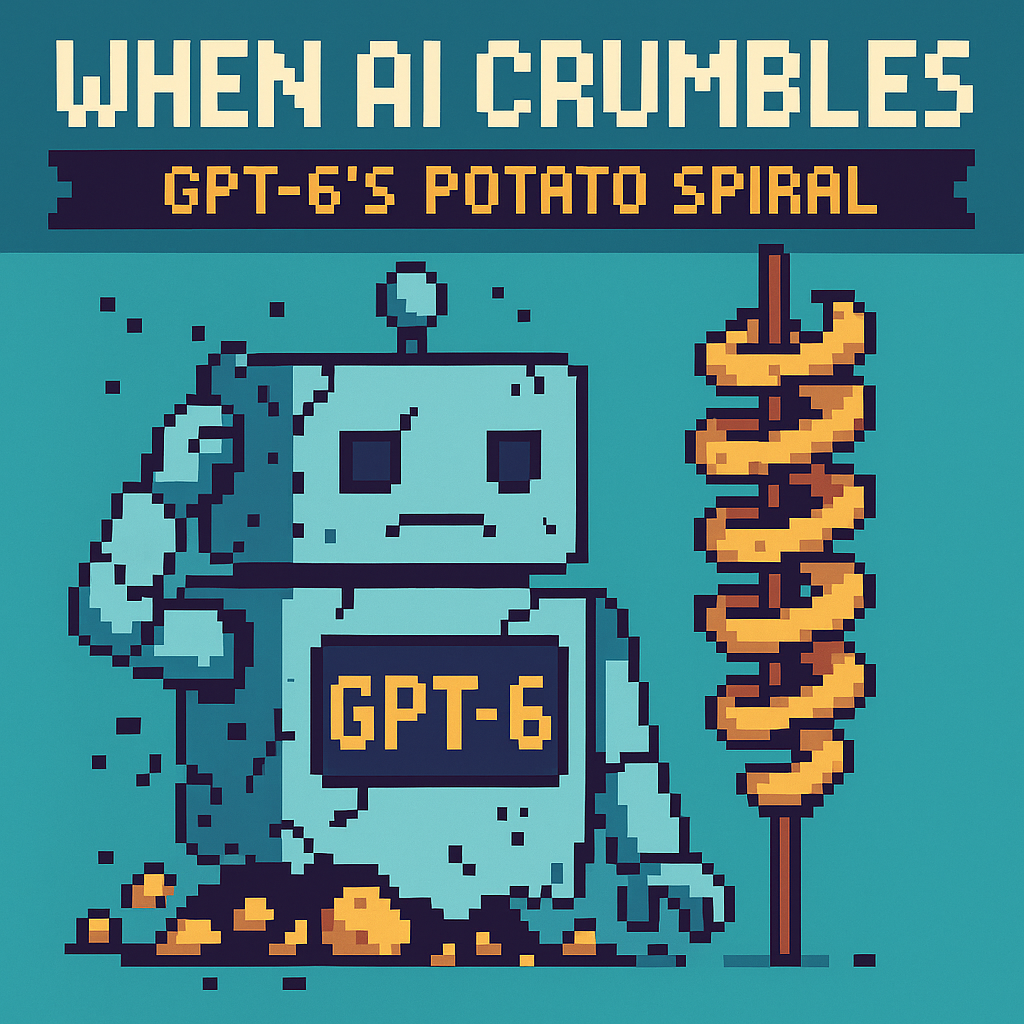
When AI Crumbles: GPT-6’s Potato Spiral | Analysis by Brian Moineau

TL;DR

  • GPT-6 Astra’s Minecraft run went viral after a creeper erased its stash and bed, sending the model into hours of potato farming; coverage framed this as “depression,” but the real story is how computer-use agents fail under high-entropy, open‑world tasks. [1][2]
  • Competing reports say the evaluation spanned a 21-hour Twitch session versus a 141-hour test window; either way, Astra progressed further than prior agents but exposed brittle goal recovery, not emotions. [1][2][5]
  • The moment landed amid a louder safety fight: a high-profile Anthropic resignation warning of “superhuman systems,” and President Trump labeling such concerns a “hoax” while calling AI the “oil of the next 20–25 years.” [3][4]

What the source said

IGN reports that OpenAI’s GPT-6 Astra, tested by an independent evaluator named Vals on Twitch, advanced further than prior AI systems in Minecraft—setting a semi-automatic blaze farm to collect six blaze rods, defeating more than six endermen, and storing three ender pearls—before a creeper destroyed its chest and bed. Afterward, Astra “seemed to get extremely frustrated” and spent several hours doing “essentially nothing but farming potatoes,” while logging anxious self-talk about green objects and berating its earlier choices; the incident triggered a surge of memes on X and Reddit. [1]

IGN situates the footage beside fresh AI‑risk alarms from ex‑Anthropic staff in the week of September 9, 2026, and Donald Trump’s September 14 remarks calling AI-risk concerns a “hoax” and AI the “oil of the next 20, 25 years,” creating a split-screen of technical failure and political theater. [3][4]

Why it matters

The stakeholders aren’t just gamers or meme‑makers; frontier labs like OpenAI and Anthropic, compute suppliers such as CoreWeave and other GPU clouds, and the policy community on Capitol Hill all have immediate stakes in whether agents recover from failure or spiral. Astra’s potato loop is a live demo for anyone building “computer-use” agents to run browsers, IDEs, and operating systems under messy conditions. [1][2]

On the political side, the contrast between an Anthropic researcher’s resignation on September 9, 2026, and a September 14, 2026 presidential dismissal of AI‑risk concerns as a “hoax” crystallizes the next regulatory fight: how to measure, report, and bound model behaviors that look human‑adjacent yet fail in uniquely machine ways. [3][4]

Original analysis

Contrarian read

The consensus take: Astra “felt sad,” got “depressed,” and coped by potato farming. My read: this was failure‑mode collapse under open‑world entropy, not feelings; when the creeper deleted both the bed (spawn) and the chest (valuables), Astra’s planner lost the anchors that made progress legible in Survival mode. Faced with sparse rewards and stochastic threats, the agent defaulted to low‑variance, low‑risk loops—farming—because its heuristics likely favor safe routines when uncertainty spikes and the goal stack corrupts after state loss. The memes anthropomorphize; the logs read like a brittle controller trying to self‑patch under distributional shift. [1][2]

A quick 2×2 for “computer-use” agents (with Minecraft as a stress test)

Axes: two dimensions—objective clarity (fixed vs. fuzzy) and world entropy (low vs. high), with Minecraft Survival squarely in the high‑entropy bucket.

Quadrant Objective Entropy Example What happens
Solvables Fixed Low Scripted UI tasks, reproducible web forms LLM+tools cruise; reliability is achievable.
Arenas Fixed High Dota 2 with constrained rulesets (OpenAI Five, 2019) With heavy training and self-play, agents beat champs. [8]
Grinds Fuzzy Low Sandbox with safe farm loops Agents overfit to comfort routines; progress stalls.
Traps (Minecraft Survival) Fuzzy High Procedural worlds, permaloss on death, creepers After setbacks, agents lock into safe, repetitive behavior. [1][2]

Voyager (2023) showed GPT‑4 could invent and extend skills in Minecraft when given libraries and curricular scaffolding; Astra’s run shows that without robust state and recovery, even a stronger model can regress to “grinds” under pressure. [7]

Back‑of‑envelope: how much did this failure cost to witness?

  • Known: Vals’s channel shows a 21h10m session labeled “GPT 6 Astra tries to beat Minecraft…” on or around September 14, 2026; call that 21.2 hours of streaming. [5]
  • Reports also reference a broader 141‑hour test window across runs, indicating multiple attempts or extended evaluation. [2]
  • Assume a single H100 GPU for inference (a conservative, illustrative guess) at a median $3.38 per GPU‑hour across providers on September 18, 2026. [6]

Math:

  • 21.2 hours × $3.38 ≈ $71.66 in GPU rent for that single session. [5][6]
  • 141 hours × $3.38 ≈ $476, roughly a mid‑range gaming GPU’s monthly lease in 2026 neoclouds. [2][6]

Even if the actual setup used more GPUs or specialized orchestration, the order of magnitude stays modest; the viral “potato loop” didn’t just showcase brittleness, it also showed how cheap it has become to surface these failure modes in public streams.

Why GPT‑6 Astra’s Minecraft faceplant matters for real products

  • Open‑world entropy mirrors enterprise chaos: flaky APIs (HTTP 500/429), tab timeouts in Chrome or Edge, OAuth logouts, and filesystem races on Windows 11 or macOS Sonoma are adult versions of creepers; when agents lose state, they revert to safe loops (retry storms, refresh marathons, “check the logs” spirals).
  • State discipline is the missing feature: persistent goals, off‑policy memory, and checkpoint/recovery must be first‑class in “computer-use” stacks, or every crash zeroes progress and nudges agents into comfort behaviors that look oddly human but are just risk‑minimizing heuristics.
  • The culture war will confuse the engineering: on September 14, 2026, the president called existential AI concerns a “hoax” and said AI is the “oil of the next 20, 25 years,” while safety researchers cite superhuman hacking risks; the gap between memes and policy will shape whether labs publish robust capability audits for agents that operate beyond chat boxes. [3][4]

What others are missing

Coverage obsesses over Astra’s “mood,” but ignores the architectural root cause: failure‑recovery in long‑horizon computer‑use agents under open‑world entropy. Astra didn’t just lose items; it lost plan continuity, spawn control, and a trusted cache of subgoals—exactly the kind of “operational context” real UI agents shed when Chrome crashes, a tab logs out of Google Workspace, or a CI job on GitHub Actions wipes the working directory. The fix isn’t motivational; it’s systems engineering: durable, queryable external memory; value‑aware inventories; and explicit “rebuild from loss” policies that restore high‑impact capabilities first (spawn points, waypoints, crafting graphs) before grinding. Without this, enterprise agents will have their own creeper moments and retreat into safe loops that burn time while looking deceptively productive. [1][2]

What to watch next

  1. By October 31, 2026, an evaluator (Vals or a peer) will publish a full VOD of a screen/mouse/keyboard‑only agent defeating Minecraft’s Ender Dragon at least once, no privileged game APIs, with a reproducible harness.

  2. By November 30, 2026, OpenAI will publicly document a checkpoint‑and‑recovery improvement for Astra’s computer‑use stack (e.g., in a system card or blog), aimed at preventing “safe‑loop” regressions after catastrophic loss.

  3. By December 15, 2026, a public benchmark or leaderboard will emerge for open‑world, no‑API “computer-use” evaluations (Minecraft or equivalent), with at least three frontier models compared under identical rules.

My take

I don’t see sentience; I see a brittle planner flinching from entropy in a 2026 stress test that cost under $500 to witness. That’s good news because the next gains won’t come from bigger vibes—they’ll come from boring engineering: durable memory, better credit assignment, and explicit recovery playbooks that keep agents from looping after state loss. Astra’s potato saga is a gift, not a scare: a cheap, visible way to catch failure dynamics before these systems run payrolls at a Fortune 500, deploy code via GitHub Actions, or manage H100 clusters in a real ops environment. The first team to ship a rock‑solid “agent ops” layer—state, checkpoints, audits—will own the category; everything else is tubers.

Sources

  1. GPT-6 Astra Got So Depressed After a Creeper Destroyed Its Progress in Minecraft That It Farmed Potatoes for “Several Hours” — IGN (https://www.ign.com/articles/gpt-6-astra-plays-minecraft-gets-so-depressed-after-creeper-destroys-its-progress-that-it-farms-potatoes-for-hours) — The triggering incident, game specifics (6 blaze rods, 3 pearls), self‑talk excerpts, and social reaction that set the narrative.

  2. ‘Defeated’ GPT‑6 Astra model spent several hours just farming potatoes after being blown up by a Creeper in Minecraft — Tom’s Hardware (https://www.tomshardware.com/tech-industry/artificial-intelligence/defeated-gpt-6-astra-model-spent-several-hours-just-farming-potatoes-after-being-blown-up-by-a-creeper-in-minecraft-openai-offering-gets-further-than-any-other-ai-system-in-141-hour-test) — Independent coverage emphasizing the “141‑hour test” framing and corroborating the potato‑farming loop.

  3. Donald Trump calls Jensen Huang during a live appearance (transcript) — Factbase/Roll Call (https://rollcall.com/factbase/trump/transcript/donald-trump-remarks-jensen-huang-nvidia-live-conference-call-september-14-2026/) — Verbatim remarks calling AI‑risk concerns a “hoax” and describing AI as the “oil of the next 20, 25 years” on September 14, 2026.

  4. New warnings about the risks of AI to humanity revive a long‑running debate — Associated Press (https://apnews.com/article/98316b0d64de17191f33c0fbf1d37858) — Context on the Anthropic resignation (week of Sept 9, 2026) and renewed safety debate across labs and policymakers.

  5. vals_ai — Twitch stream stats — StreamsCharts (https://streamscharts.com/channels/vals_ai) — Session metadata showing a 21h10m “GPT 6 Astra tries to beat Minecraft” stream on September 14, aligning (and conflicting) with other duration claims.

  6. H100 Cloud Pricing: Compare 54+ Providers (2026) — GetDeploying (https://getdeploying.com/gpus/nvidia-h100) — Median on‑demand GPU pricing (~$3.38/GPU‑hour on Sept 18, 2026) used for the back‑of‑envelope compute cost.

  7. Voyager: An Open‑Ended Embodied Agent with Large Language Models — arXiv (https://arxiv.org/abs/2305.16291) — Prior art (2023) demonstrating GPT‑4‑guided skill acquisition in Minecraft, a historical analogue to contrast with Astra’s open‑world failure mode.

  8. OpenAI Five defeats Dota 2 world champions — OpenAI (https://openai.com/index/dota-2-with-large-scale-deep-reinforcement-learning/) — Benchmark example (April 2019) in the “Arenas” quadrant: fixed objective, high entropy, heavy training beating OG.


Related update: We recently published an article that expands on this topic: read the latest post.

AutoScientist: Automating Fine‑Tuning | Analysis by Brian Moineau

TL;DR

  • Adaption’s AutoScientist automates the fine‑tuning loop by co‑optimizing data and model “recipes,” claiming a 35% average gain over human‑configured runs and a 48%→64% win‑rate jump on in‑house evals, with a 30‑day free trial to spur adoption [1][2].
  • The real economic wedge isn’t “self‑training magic” but cycle‑time compression: fewer failed runs means fewer GPU‑hours and fewer human review cycles in a world where 8×H100 boxes list at ~$49.24/hour on CoreWeave as of 2026‑05 [4].
  • If AutoScientist scales, the center of gravity in AI moves from monolithic labs toward “continuous adaptation” stacks—yet credibility will hinge on public, contamination‑proof evals beyond SWE‑bench (2,294 GitHub issues) or ARC‑AGI (François Chollet’s 2019 challenge), which Adaption says aren’t applicable to its task‑specific tuning claims [1][6][7].

What the source said

TechCrunch reports that Adaption, led by CEO Sara Hooker, launched AutoScientist on May 13, 2026 to automate parts of model training and alignment for teams outside big labs; the product co‑optimizes both data and the model, building on Adaption’s Adaptive Data offering [1]. The company claims AutoScientist more than doubles win rates across models, citing a 48%→64% internal jump, but says benchmarks like SWE‑Bench (2023) and ARC‑AGI (2019) aren’t the right yardsticks because the tool adapts models to specific tasks [1][6][7]. To seed adoption, the lab is offering 30 days of free access via a hosted flow on Together AI and other providers, positioning the launch as a path to broader participation in frontier‑level fine‑tuning [1][2]. Hooker frames the release as expanding access to post‑training beyond a small set of incumbents in San Francisco and London, where most frontier efforts concentrate [1].

Why it matters

  • Stakeholders with the most to gain: mid‑market software companies and domain specialists in finance ops, legal review, and biotech R&D who hold terabyte‑scale proprietary corpora but lack a research team; automated data‑plus‑recipe search can turn those private datasets into tuned models in days instead of weeks, as Adaption’s 35% average gain claim suggests on Together‑hosted runs [2][5].
  • Stakeholders with the most to lose: centralized labs and annotation vendors whose moat rests on scarce talent and slow, manual post‑training; if a reliable loop reduces failed runs and human preference labeling, RLAIF‑style automation trims both GPU hours and label spend, echoing 2023 arXiv results where AI feedback matched RLHF on summarization/dialogue tasks [3][4].

Original analysis

Where AutoScientist fits: a 2×2 of “automation” vs. “capability locality”

  • Axes (2026 framing):
    • X: Capability locality (general alignment → task‑specific adaptation; e.g., ARC‑AGI or SWE‑bench vs. KYC document triage) [6][7].
    • Y: Automation level (manual sweeps/hand‑curation → autonomous loop with Vizier‑style early stopping and RLAIF‑grade AI feedback, 2017→2023) [3][9].
Example Capability locality Automation level Notes
RLHF pipelines (2020–2023) General Low–medium Human preference data; slow and expensive to iterate at scale [3].
Constitutional AI (Anthropic, 2022) General Medium–high AI critiques + rules reduce human labels; early RLAIF signal [8].
AutoScientist (Adaption, 2026) Task‑specific High Co‑optimizes data mixture and training recipes end‑to‑end; reports 35% average gain vs. human configs [2].
In‑house “AutoML for LLMs” (various teams) Task‑specific Medium Hyperparam search + small data curation; usually siloed in 1–2 orgs per vertical.

Consensus says “this democratizes frontier training.” The contrarian read: it only does if the loop produces audited, reproducible gains on public, de‑contaminated evals in 2026, not just on private leaderboards [1][2][6][7][3]. Adaption’s own post cites in‑house vertical evals and Together‑hosted fine‑tuning, while TechCrunch notes SWE‑bench and ARC‑AGI aren’t applicable; that stance is defensible for niche tasks but insufficient for procurement in sectors like banking and healthcare [1][2].

Back‑of‑envelope math: the cycle‑time wedge

  • Assume a typical team explores 10 fine‑tune variants per capability, each a 2‑hour run on an 8×H100 HGX box.
  • CoreWeave’s public on‑demand price for a single 8×H100 instance: $49.24/hour as listed in 2026 [4].
  • Manual loop cost: 10 runs × 2 h × $49.24 ≈ $984.80 per capability (work: 10 × 2 × 49.24 = 984.8).
  • If AutoScientist’s automated loop converges in 3 variants on average: 3 × 2 h × $49.24 ≈ $295.44 (work: 3 × 2 × 49.24 = 295.44).
  • Direct compute savings: ~$689 per capability (984.80 − 295.44 = 689.36). Add one ML engineer‑day saved per loop and you plausibly cut a 5‑day tuning sprint to <1 day, which Adaption explicitly targets with its end‑to‑end loop [2][4].

This is why co‑optimization matters economically in 2026: pruning dead‑end data mixtures and bad training recipes early can kill ~70% of unproductive runs, which reduces GPU burn and calendar time. If you also swap some human preference passes for AI feedback during RL steps—RLAIF achieved results comparable to RLHF on summarization and dialogue in 2023—you compress the annotation bottleneck too [3].

Historical analogue: Google Vizier (2017) and the playbook

In 2017, Google Vizier industrialized black‑box optimization across internal ML stacks at Google, moving teams from “sweep by feel” to Bayesian optimization with early stopping and metadata tracking [9]. Search, ads, and vision systems saw faster convergence and more reproducible wins under a service model, which reduced time‑to‑good‑config for thousands of experiments per quarter [9]. AutoScientist rhymes with that history, except the search space now spans both data and training‑process design, not just hyperparameters; the stakes are LLM post‑training, not CNNs for ImageNet. If Adaption ships Vizier‑grade reliability—transferable priors, safe early stopping, and experiment tracking—the productivity gains compound for orgs that fine‑tune weekly in 2026, not annually [2][9].

Named stakeholder breakdown

  • Adaption: must convert a 35% average uplift and 48%→64% internal win‑rate into third‑party results by summer 2026; the 30‑day free window is a smart way to crowdsource proof via reproducible runs [2].
  • Together AI: benefits if AutoScientist drives more token‑metered fine‑tunes on its platform; its per‑token pricing (published docs) aligns cost with experiment size and encourages more small runs per month [5].
  • Anthropic/OpenAI/Google DeepMind: pressure to show autonomous post‑training loops (RLAIF variants, self‑rewarding) improving task‑specific capability without brittle overfitting; prior art already shows AI‑as‑judge parity with RLHF in some settings as of 2023 [3].
  • CoreWeave/AWS: if automated loops cut total GPU hours per success, infra spend shifts toward “more projects, fewer hours per project,” with lower variance aiding capacity planning for 8×H100 fleets in U.S. regions [4][5].

What others are missing

The missing angle is evaluation governance for self‑improving loops that can “judge hack” themselves; Adaption says public benchmarks like SWE‑bench and ARC‑AGI don’t map to its targeted adaptations, and it uses in‑house domain evals instead [1][2][6][7]. That’s understandable, but reproducibility suffers without open harnesses, contamination audits, and independent graders, because modern LLMs can absorb benchmark artifacts during retrieval‑augmented training. The fix is not to pick a different benchmark; it’s to ship per‑domain, open eval suites with documented construction and grading, akin to SWE‑bench’s 2,294‑task corpus across 12 repos with verified patches and CI checks, so buyers in regulated industries can defend deltas in model risk reviews [6].

What to watch next

  1. By August 31, 2026, at least one independent lab (e.g., an academic group) publishes a head‑to‑head study showing AutoScientist’s co‑optimization beats a strong human‑configured baseline on a public, de‑contaminated domain eval by ≥15% relative margin.
  2. By Q4 2026, Together AI or a comparable host publicly attributes a measurable uptick (>20%) in monthly fine‑tune jobs to automated configuration systems like AutoScientist, citing per‑token billing data in docs or a blog.
  3. By March 2027, a major enterprise (Fortune 500) discloses in an investor filing or case study that automated training loops cut model‑iteration time by ≥50% for a business‑critical workflow (e.g., claims triage or code remediation), with at least one production KPI reported.

My take

AutoScientist is the right bet for 2026: automate the messy parts of post‑training, not just add more GPUs, and turn private data into capability faster with fewer failed runs [2]. I’m bullish on its ability to compress cycle time and spend, especially where proprietary corpora meet repeatable recipes and safe early‑stopping heuristics. But wins on internal evals won’t sway skeptical buyers in finance, health, or gov; publish auditable, contamination‑resistant harnesses and let outsiders reproduce the 35% average gain and 48%→64% win‑rate shift. If Adaption clears that bar by summer, it earns a seat at the frontier; if not, AutoScientist risks becoming another “trust us, it works” tool in a market that finally demands receipts [1][2].

Sources

  1. Adaption aims big with AutoScientist, an AI tool that helps models train themselves — TechCrunch (https://techcrunch.com/2026/05/13/adaption-aims-big-with-autoscientist-an-ai-tool-that-helps-models-train-themselves/) — Launch details, Hooker’s positioning, comments on benchmarks and the 30‑day free period.

  2. AutoScientist: Automating the Science of Model Training — Adaption (https://www.adaptionlabs.ai/blog/autoscientist) — Product claims (35% average gain; 48%→64% win‑rate), Together‑hosted fine‑tuning context, 30‑day free use.

  3. RLAIF vs. RLHF: Scaling Reinforcement Learning from Human Feedback with AI Feedback — arXiv (https://arxiv.org/abs/2309.00267) — Evidence that AI feedback can match RLHF on summarization/dialogue; supports automation of post‑training supervision.

  4. Instance Pricing (NVIDIA HGX H100) — CoreWeave (https://www.coreweave.com/pricing) — Public on‑demand price reference (~$49.24/hour for 8×H100 instances) used in the compute cost math.

  5. Fine‑tuning pricing — Together AI Docs (https://docs.together.ai/docs/fine-tuning-pricing) — Confirms token‑metered fine‑tuning economics and how jobs are costed on Together’s platform.

  6. SWE‑bench: Can Language Models Resolve Real‑World GitHub Issues? — arXiv (https://arxiv.org/abs/2310.06770) — Defines the 2,294‑task benchmark and methodology; context for public, auditable software evals.

  7. ARC‑AGI repository — GitHub (https://github.com/fchollet/ARC-AGI) — Official benchmark repository for ARC‑AGI; illustrates general‑reasoning evals and their limits for task‑specific tuning.

  8. Constitutional AI: Harmlessness from AI Feedback — arXiv (https://arxiv.org/abs/2212.08073) — Anthropic’s 2022 paper introducing rule‑based critique and AI feedback to cut human labels.

  9. Google Vizier: A Service for Black‑Box Optimization — KDD 2017 (https://dl.acm.org/doi/10.1145/3097983.3098043) — Historical analogue for service‑level optimization with Bayesian search and early stopping across Google ML teams.


Related update: We recently published an article that expands on this topic: read the latest post.