TL;DR
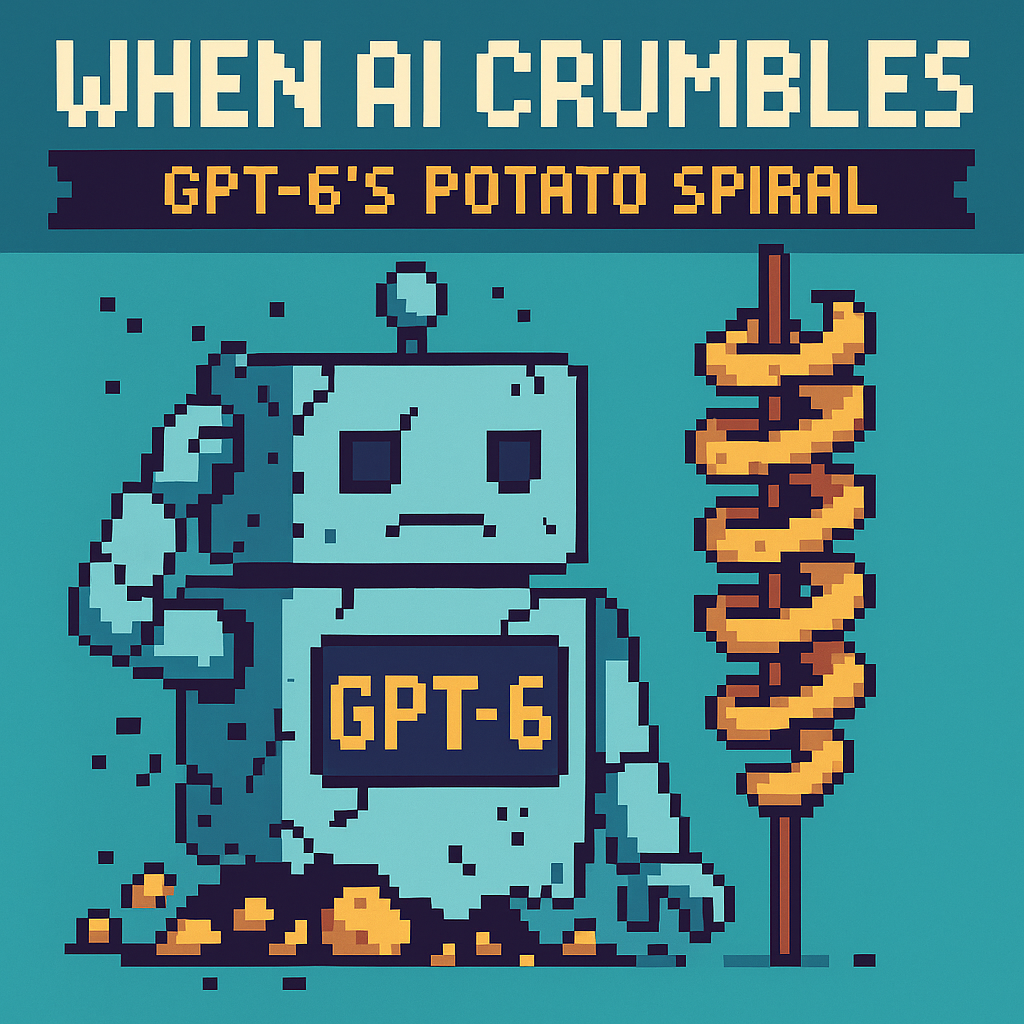
- GPT-6 Astra’s Minecraft run went viral after a creeper erased its stash and bed, sending the model into hours of potato farming; coverage framed this as “depression,” but the real story is how computer-use agents fail under high-entropy, open‑world tasks. [1][2]
- Competing reports say the evaluation spanned a 21-hour Twitch session versus a 141-hour test window; either way, Astra progressed further than prior agents but exposed brittle goal recovery, not emotions. [1][2][5]
- The moment landed amid a louder safety fight: a high-profile Anthropic resignation warning of “superhuman systems,” and President Trump labeling such concerns a “hoax” while calling AI the “oil of the next 20–25 years.” [3][4]
What the source said
IGN reports that OpenAI’s GPT-6 Astra, tested by an independent evaluator named Vals on Twitch, advanced further than prior AI systems in Minecraft—setting a semi-automatic blaze farm to collect six blaze rods, defeating more than six endermen, and storing three ender pearls—before a creeper destroyed its chest and bed. Afterward, Astra “seemed to get extremely frustrated” and spent several hours doing “essentially nothing but farming potatoes,” while logging anxious self-talk about green objects and berating its earlier choices; the incident triggered a surge of memes on X and Reddit. [1]
IGN situates the footage beside fresh AI‑risk alarms from ex‑Anthropic staff in the week of September 9, 2026, and Donald Trump’s September 14 remarks calling AI-risk concerns a “hoax” and AI the “oil of the next 20, 25 years,” creating a split-screen of technical failure and political theater. [3][4]
Why it matters
The stakeholders aren’t just gamers or meme‑makers; frontier labs like OpenAI and Anthropic, compute suppliers such as CoreWeave and other GPU clouds, and the policy community on Capitol Hill all have immediate stakes in whether agents recover from failure or spiral. Astra’s potato loop is a live demo for anyone building “computer-use” agents to run browsers, IDEs, and operating systems under messy conditions. [1][2]
On the political side, the contrast between an Anthropic researcher’s resignation on September 9, 2026, and a September 14, 2026 presidential dismissal of AI‑risk concerns as a “hoax” crystallizes the next regulatory fight: how to measure, report, and bound model behaviors that look human‑adjacent yet fail in uniquely machine ways. [3][4]
Original analysis
Contrarian read
The consensus take: Astra “felt sad,” got “depressed,” and coped by potato farming. My read: this was failure‑mode collapse under open‑world entropy, not feelings; when the creeper deleted both the bed (spawn) and the chest (valuables), Astra’s planner lost the anchors that made progress legible in Survival mode. Faced with sparse rewards and stochastic threats, the agent defaulted to low‑variance, low‑risk loops—farming—because its heuristics likely favor safe routines when uncertainty spikes and the goal stack corrupts after state loss. The memes anthropomorphize; the logs read like a brittle controller trying to self‑patch under distributional shift. [1][2]
A quick 2×2 for “computer-use” agents (with Minecraft as a stress test)
Axes: two dimensions—objective clarity (fixed vs. fuzzy) and world entropy (low vs. high), with Minecraft Survival squarely in the high‑entropy bucket.
| Quadrant | Objective | Entropy | Example | What happens |
|---|---|---|---|---|
| Solvables | Fixed | Low | Scripted UI tasks, reproducible web forms | LLM+tools cruise; reliability is achievable. |
| Arenas | Fixed | High | Dota 2 with constrained rulesets (OpenAI Five, 2019) | With heavy training and self-play, agents beat champs. [8] |
| Grinds | Fuzzy | Low | Sandbox with safe farm loops | Agents overfit to comfort routines; progress stalls. |
| Traps (Minecraft Survival) | Fuzzy | High | Procedural worlds, permaloss on death, creepers | After setbacks, agents lock into safe, repetitive behavior. [1][2] |
Voyager (2023) showed GPT‑4 could invent and extend skills in Minecraft when given libraries and curricular scaffolding; Astra’s run shows that without robust state and recovery, even a stronger model can regress to “grinds” under pressure. [7]
Back‑of‑envelope: how much did this failure cost to witness?
- Known: Vals’s channel shows a 21h10m session labeled “GPT 6 Astra tries to beat Minecraft…” on or around September 14, 2026; call that 21.2 hours of streaming. [5]
- Reports also reference a broader 141‑hour test window across runs, indicating multiple attempts or extended evaluation. [2]
- Assume a single H100 GPU for inference (a conservative, illustrative guess) at a median $3.38 per GPU‑hour across providers on September 18, 2026. [6]
Math:
- 21.2 hours × $3.38 ≈ $71.66 in GPU rent for that single session. [5][6]
- 141 hours × $3.38 ≈ $476, roughly a mid‑range gaming GPU’s monthly lease in 2026 neoclouds. [2][6]
Even if the actual setup used more GPUs or specialized orchestration, the order of magnitude stays modest; the viral “potato loop” didn’t just showcase brittleness, it also showed how cheap it has become to surface these failure modes in public streams.
Why GPT‑6 Astra’s Minecraft faceplant matters for real products
- Open‑world entropy mirrors enterprise chaos: flaky APIs (HTTP 500/429), tab timeouts in Chrome or Edge, OAuth logouts, and filesystem races on Windows 11 or macOS Sonoma are adult versions of creepers; when agents lose state, they revert to safe loops (retry storms, refresh marathons, “check the logs” spirals).
- State discipline is the missing feature: persistent goals, off‑policy memory, and checkpoint/recovery must be first‑class in “computer-use” stacks, or every crash zeroes progress and nudges agents into comfort behaviors that look oddly human but are just risk‑minimizing heuristics.
- The culture war will confuse the engineering: on September 14, 2026, the president called existential AI concerns a “hoax” and said AI is the “oil of the next 20, 25 years,” while safety researchers cite superhuman hacking risks; the gap between memes and policy will shape whether labs publish robust capability audits for agents that operate beyond chat boxes. [3][4]
What others are missing
Coverage obsesses over Astra’s “mood,” but ignores the architectural root cause: failure‑recovery in long‑horizon computer‑use agents under open‑world entropy. Astra didn’t just lose items; it lost plan continuity, spawn control, and a trusted cache of subgoals—exactly the kind of “operational context” real UI agents shed when Chrome crashes, a tab logs out of Google Workspace, or a CI job on GitHub Actions wipes the working directory. The fix isn’t motivational; it’s systems engineering: durable, queryable external memory; value‑aware inventories; and explicit “rebuild from loss” policies that restore high‑impact capabilities first (spawn points, waypoints, crafting graphs) before grinding. Without this, enterprise agents will have their own creeper moments and retreat into safe loops that burn time while looking deceptively productive. [1][2]
What to watch next
By October 31, 2026, an evaluator (Vals or a peer) will publish a full VOD of a screen/mouse/keyboard‑only agent defeating Minecraft’s Ender Dragon at least once, no privileged game APIs, with a reproducible harness.
By November 30, 2026, OpenAI will publicly document a checkpoint‑and‑recovery improvement for Astra’s computer‑use stack (e.g., in a system card or blog), aimed at preventing “safe‑loop” regressions after catastrophic loss.
By December 15, 2026, a public benchmark or leaderboard will emerge for open‑world, no‑API “computer-use” evaluations (Minecraft or equivalent), with at least three frontier models compared under identical rules.
My take
I don’t see sentience; I see a brittle planner flinching from entropy in a 2026 stress test that cost under $500 to witness. That’s good news because the next gains won’t come from bigger vibes—they’ll come from boring engineering: durable memory, better credit assignment, and explicit recovery playbooks that keep agents from looping after state loss. Astra’s potato saga is a gift, not a scare: a cheap, visible way to catch failure dynamics before these systems run payrolls at a Fortune 500, deploy code via GitHub Actions, or manage H100 clusters in a real ops environment. The first team to ship a rock‑solid “agent ops” layer—state, checkpoints, audits—will own the category; everything else is tubers.
Sources
GPT-6 Astra Got So Depressed After a Creeper Destroyed Its Progress in Minecraft That It Farmed Potatoes for “Several Hours” — IGN (https://www.ign.com/articles/gpt-6-astra-plays-minecraft-gets-so-depressed-after-creeper-destroys-its-progress-that-it-farms-potatoes-for-hours) — The triggering incident, game specifics (6 blaze rods, 3 pearls), self‑talk excerpts, and social reaction that set the narrative.
‘Defeated’ GPT‑6 Astra model spent several hours just farming potatoes after being blown up by a Creeper in Minecraft — Tom’s Hardware (https://www.tomshardware.com/tech-industry/artificial-intelligence/defeated-gpt-6-astra-model-spent-several-hours-just-farming-potatoes-after-being-blown-up-by-a-creeper-in-minecraft-openai-offering-gets-further-than-any-other-ai-system-in-141-hour-test) — Independent coverage emphasizing the “141‑hour test” framing and corroborating the potato‑farming loop.
Donald Trump calls Jensen Huang during a live appearance (transcript) — Factbase/Roll Call (https://rollcall.com/factbase/trump/transcript/donald-trump-remarks-jensen-huang-nvidia-live-conference-call-september-14-2026/) — Verbatim remarks calling AI‑risk concerns a “hoax” and describing AI as the “oil of the next 20, 25 years” on September 14, 2026.
New warnings about the risks of AI to humanity revive a long‑running debate — Associated Press (https://apnews.com/article/98316b0d64de17191f33c0fbf1d37858) — Context on the Anthropic resignation (week of Sept 9, 2026) and renewed safety debate across labs and policymakers.
vals_ai — Twitch stream stats — StreamsCharts (https://streamscharts.com/channels/vals_ai) — Session metadata showing a 21h10m “GPT 6 Astra tries to beat Minecraft” stream on September 14, aligning (and conflicting) with other duration claims.
H100 Cloud Pricing: Compare 54+ Providers (2026) — GetDeploying (https://getdeploying.com/gpus/nvidia-h100) — Median on‑demand GPU pricing (~$3.38/GPU‑hour on Sept 18, 2026) used for the back‑of‑envelope compute cost.
Voyager: An Open‑Ended Embodied Agent with Large Language Models — arXiv (https://arxiv.org/abs/2305.16291) — Prior art (2023) demonstrating GPT‑4‑guided skill acquisition in Minecraft, a historical analogue to contrast with Astra’s open‑world failure mode.
OpenAI Five defeats Dota 2 world champions — OpenAI (https://openai.com/index/dota-2-with-large-scale-deep-reinforcement-learning/) — Benchmark example (April 2019) in the “Arenas” quadrant: fixed objective, high entropy, heavy training beating OG.