P/E Compression Is the 2026 Bull Market’s Tell
TL;DR
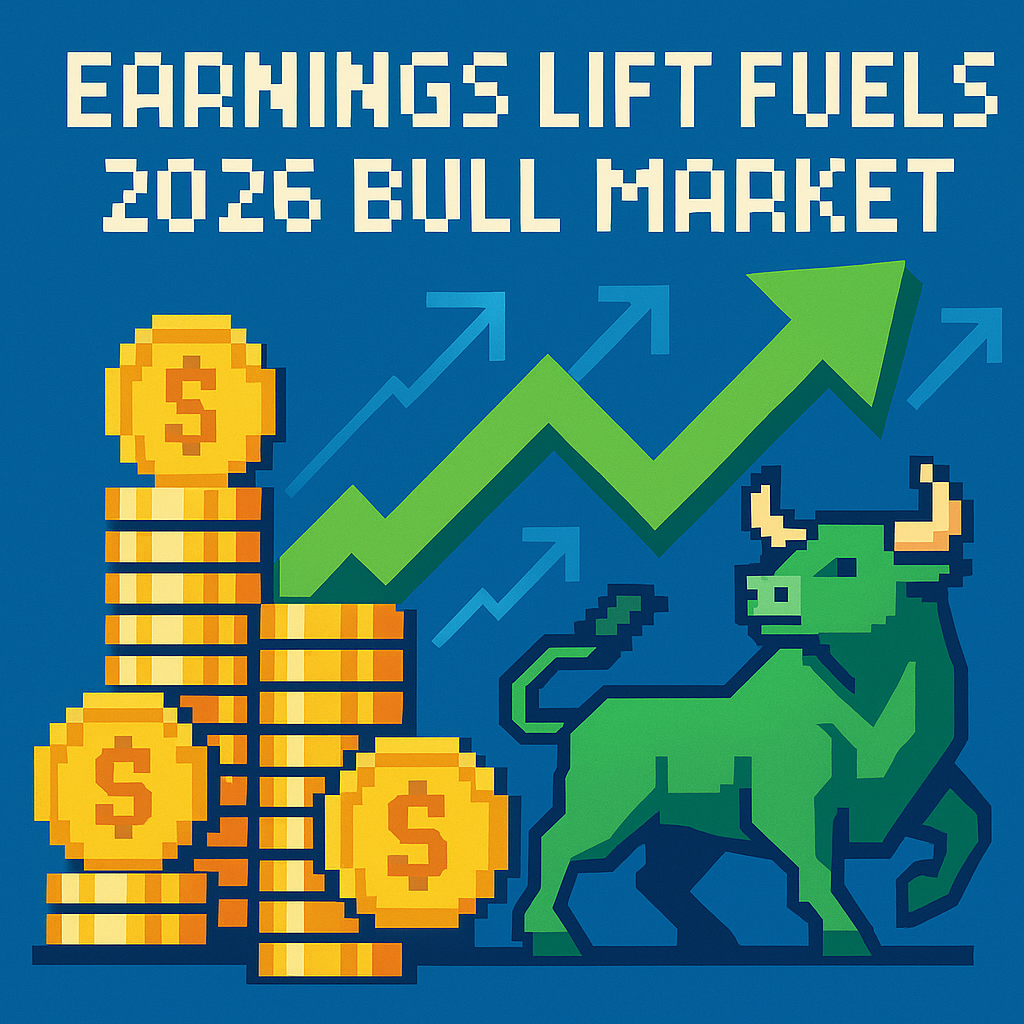
- In the 2026 bull market, the wrinkle is P/E compression: the S&P 500’s forward P/E sits below where it began the year even as prices climbed, because earnings rose faster than prices [1].
- FactSet pegs Q2 2026 S&P 500 earnings growth at 23.3%, with 10 of 11 sectors up, led by Energy, Information Technology, and Materials—fuel for prices without needing multiple expansion [2].
- Math check: with the S&P 500 at 7,499 and a 20.4x forward P/E on June 30, the market discounts roughly $368 in next-12‑month EPS; if forward EPS lifts to $380–$400 by Q4 while the multiple merely holds 20x–21x, you still get 7,600–8,400 [3].
What the source said
Yahoo Finance reported that the 2026 rally left the S&P 500 cheaper on a forward basis than where it started the year, because the “E” outran the “P,” compressing the index’s forward P/E [1]. The article pointed to an “earnings boom,” with back‑to‑back 20%+ EPS growth quarters and a 23.3% estimate for Q2 2026 from FactSet [2]. Ten of eleven GICS sectors should post year‑over‑year profit gains, with Energy, Information Technology, and Materials leading the pack [2]. The takeaway: if Q2 beats again, analysts raise numbers into Q3 2026, while prices can climb even if the multiple stays flat [1][2].
Original analysis
-
Shown work on valuation math using June 30, 2026 inputs: S&P 500 = 7,499; forward P/E = 20.4x [3]. Implied next‑12‑month EPS = 7,499 ÷ 20.4 = $367.6, which rounds to $368 [3]. Scenario A: if forward EPS = $380 and P/E = 20.0x, price = 20.0 × 380 = 7,600 [3]. Scenario B: if forward EPS = $400 and P/E = 21.0x, price = 21.0 × 400 = 8,400 [3]. Risk case: if EPS = $380 and P/E compresses to 19.0x, price = 19.0 × 380 = 7,220, which shows downside even with higher earnings [3].
-
A 2×2 for 2H 2026:
- High earnings growth + Flat/Down P/E (compression): steady grind higher; resembles mid‑cycle periods like 2004 when profit momentum outpaced sentiment.
- High earnings growth + Up P/E: melt‑up risk; think of 2013 as a year when both earnings and multiples helped.
- Low earnings growth + Flat/Up P/E: brittle rally; vulnerable to guidance cuts during October–November 2026 earnings season.
- Low earnings growth + Down P/E: drawdown; typically follows negative revisions clusters across at least 6 of 11 sectors.
-
Contrarian read: leadership concentration in mega‑cap AI names such as Nvidia, Microsoft, and Alphabet could mean broad EPS beats help equal‑weight indices more than the cap‑weighted S&P 500 in 2H 2026, while pockets like Utilities and Real Estate remain rate‑sensitive even if Energy and Tech print strong results [2].
What others are missing
The market underestimates how 2026 AI data‑center buildouts at Microsoft (Quincy, Washington), Amazon (Hilliard, Ohio), and Alphabet (Council Bluffs, Iowa) flow through GAAP EPS via depreciation schedules that stretch 6–8 years, which can lift reported margins even before full cash returns materialize; that accounting timing could fortify EPS in Information Technology and Communication Services while masking capital‑intensity risk that shows up in free cash flow.
What to watch next
- By November 15, 2026, FactSet’s published S&P 500 forward 12‑month EPS will print at or above $390.
- On December 31, 2026, if the S&P 500 forward P/E closes between 19.5x and 21.5x, the index will finish between 7,600 and 8,400.
- By November 30, 2026, at least 8 of 11 GICS sectors will show positive year‑over‑year EPS growth for Q3 2026 in the FactSet scorecard.
Sources
- Yahoo Finance (malaysia.news.yahoo.com) — Summarizes 2026 P/E compression alongside price gains, framing why valuations look less stretched than headlines imply.
- FactSet Insight (insight.factset.com) — Provides the Q2 2026 23.3% S&P 500 EPS growth estimate and notes 10 of 11 sectors with positive YoY earnings, plus sector leadership.
- J.P. Morgan Asset Management, Guide to the Markets (am.jpmorgan.com) — Supplies the June 30, 2026 forward P/E of 20.4x and context for index‑level valuation math.
Related update: We recently published an article that expands on this topic: read the latest post.
When Bond Traders Ignore the Fed: A Dinner-Table Argument for Markets and Democracy
The financial world loves a paradox: the Federal Reserve cuts its policy rate, signaling easier money, yet long-term Treasury yields climb instead of falling. That’s exactly what’s happening now — and it’s touching off a heated debate that’s part market mechanics, part politics, and entirely consequential for anyone who pays a mortgage, runs a business, or watches Washington.
(finance.yahoo.com)
Why this feels like a grab for attention
-
The Fed has been easing from highs set in 2024, cutting the federal funds target by roughly 1.5 percentage points so far. Traders expect more cuts. Yet 10- and 30-year Treasury yields have moved higher, not lower. That mismatch is uncommon outside of certain episodes in the 1990s and has market strategists scratching their heads. (finance.yahoo.com)
-
The timing is politically charged: President Trump will soon be able to nominate Jerome Powell’s replacement, and market participants are already debating what a politically aligned Fed chair could mean for inflation, credibility, and long-term borrowing costs. Fear: a Fed that caves to pressure to ease too far could stoke inflation and push yields even higher. (finance.yahoo.com)
The competing explanations (pick your favorite)
-
A hopeful reading: Rising long-term yields reflect confidence. Investors expect stronger growth and lower recession risk, so they demand less duration protection — higher yields are a payoff for an economy that’s not collapsing. (finance.yahoo.com)
-
A structural adjustment view: Some say this is a return to pre-2008 market norms — less central-bank dominance, markets pricing in real macro variables (growth, fiscal stance, term premium) rather than simply shadowing policy rates. (finance.yahoo.com)
-
The bond vigilante scenario: Creditors are worried about a swelling U.S. debt burden and a politically compromised Fed. If traders think the central bank will prioritize short-term political goals over price stability, they’ll demand higher yields as compensation for future inflation or fiscal risk. That narrative has gained traction as talk of a political appointee to the Fed intensifies. (finance.yahoo.com)
What’s at stake for ordinary people
-
Mortgage rates and car loans are tied to long-term Treasury yields. If 10- and 30-year yields keep rising despite Fed cuts, borrowing costs for consumers may not fall the way policymakers (or politicians) promise. That matters for home affordability, corporate investment, and the pace of the economy. (finance.yahoo.com)
-
Fed credibility is monetary gold. If the public and markets lose faith that the Fed will fight inflation when needed — or that it can resist political pressure — the central bank’s ability to anchor expectations weakens. That can make inflation higher and more volatile over time, which is costlier than short-term stimulus. (reuters.com)
The investor dilemma
-
Short-term returns vs. long-term risks: Traders must choose whether to interpret rising yields as a buying opportunity (if growth stays firm) or a warning sign (if fiscal or political pressures push inflation and rates up). Both choices carry real pain if the signal is wrong. (finance.yahoo.com)
-
Pricing the unknown Fed nominee: Markets are trying to price not only macro data but also political risk — how dovish will the next chair be, and how independent? That uncertainty is adding a term premium to bonds that doesn’t move in lockstep with the Fed’s policy path. (reuters.com)
How policymakers and politicians look from here
-
For the Fed: this is a test of independence. Cuts are a tool; credibility is the asset that makes those tools work predictably. If markets perceive cuts as politically driven rather than data-driven, the policy channel frays. (finance.yahoo.com)
-
For the White House: pushing for lower long-term rates via political influence on the Fed is a high-risk play. Even if the administration succeeds in appointing a friendly chair, markets may still demand a premium for perceived fiscal looseness or higher inflation risk, undermining the intended effects. (finance.yahoo.com)
What to watch next
-
Moves in the 10-year and 30-year Treasury yields relative to Fed fund futures pricing. If yields keep diverging from the expected policy path, risk premia or fiscal concerns are probably doing the heavy lifting. (finance.yahoo.com)
-
Inflation data and the Fed’s language. Concrete signs of sticky inflation together with more politically charged rhetoric around appointments will deepen market uncertainty. (reuters.com)
-
Nomination news. Who the White House nominates and how markets and Treasury investors react will shape the credibility story. Early market pushback — as reported in recent investor outreach to the Treasury — already signals concern. (reuters.com)
Some practical thinking for readers
-
If you have a mortgage or plan to borrow, don’t count on big rate relief simply because the Fed is cutting short-term rates. Long-term yields matter. (finance.yahoo.com)
-
For investors: be mindful of duration risk and the possibility that a rising-term premium could pressure long-duration portfolios even as short-term rates fall. Diversification and scenario planning matter more when political risk enters the monetary policy mix. (finance.yahoo.com)
Final thoughts
We’re watching a classic tug-of-war between central-bank tools and market psychology. When bond traders “defy” the Fed, they’re not staging a conspiracy — they’re signalling uncertainty about growth, inflation, fiscal health, and yes, political influence. If the Fed wants the trust that makes policy moves effective, it needs to prove its independence; if politics tries to bend the central bank into short-term aims, the cost will likely show up where it hurts most: in the price of money for everyday Americans.
(finance.yahoo.com)
Sources
Related update: We recently published an article that expands on this topic: read the latest post.
Related update: We recently published an article that expands on this topic: read the latest post.
Related update: We recently published an article that expands on this topic: read the latest post.