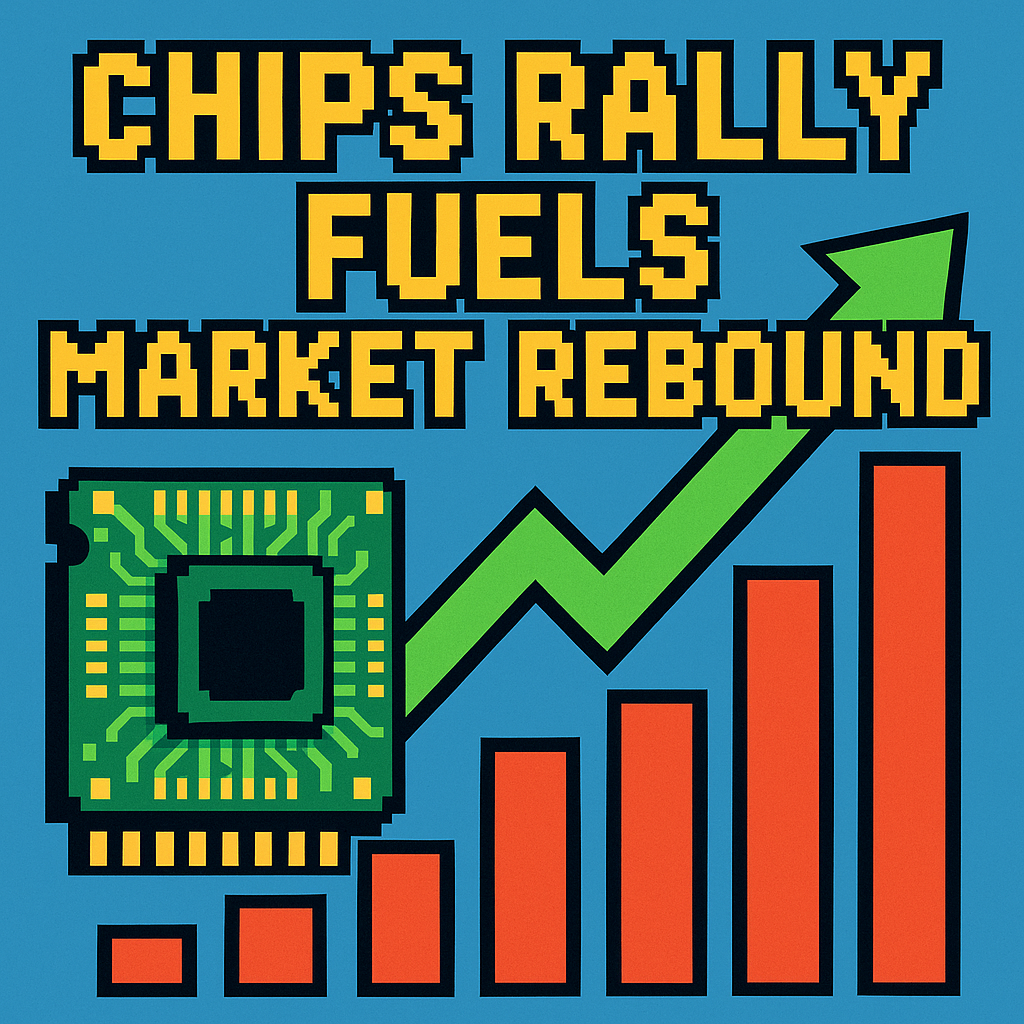
Chips Rally Fuels Market Rebound | Analysis by Brian Moineau

TL;DR

  • Chips led a rebound from the Fed-led sell-off as semiconductors ripped and the Nasdaq rose 1.91%, while the S&P 500 gained 1.08% on June 18, 2026; energy lagged as WTI crude slid to $73.58 on reports of a U.S.–Iran détente. [1][4]
  • Breadth improved under the surface: the Russell 2000 outperformed with nearly a 2% gain, while defensives wobbled—classic risk-on when oil and rate fears cool together in New York trading. [1][2]
  • The tape says “AI back on,” but the investable takeaway is rotation: lower crude compresses energy earnings while easing input and financing costs for power-hungry data center suppliers and small-cap borrowers in the U.S. market. [1][3][4]

What the source said

CNBC’s live blog logged a broad rebound after the Fed-driven slump: the S&P 500 closed up 1.08% to 7,500.58, the Nasdaq rose 1.91% to 26,517.93, and the Dow added 0.14% to 51,564.70 on June 18, 2026. Semiconductors led; Intel drew positive chatter linked to Apple, and AI-adjacent names such as Corning jumped 7%. The Russell 2000 outperformed with nearly +2% on the day, while the S&P energy sector fell almost 2% as WTI dipped to $73.58 on U.S.–Iran agreement headlines. Individual movers included Enphase (+10%), Corning (+7%), and Exxon/Chevron (−2%+), while Kroger slipped after a one‑cent EPS miss despite a revenue beat. [1]

Why it matters

Two policy levers—rates and oil—just loosened their grip on risk assets after a midweek hawkish Fed tone and a Thursday oil slide to the low‑$70s per barrel, as reported by Axios and Reuters from Washington and Tehran angles. If crude holds near $73–$76 through August 2026, gasoline and freight costs ease, trimming the inflation impulse that pressured multiples in Q2. In that setup, equity buyers can re-risk into growth stories (chips/data centers) without fighting duration headwinds. [2][3][4]

Small-cap industrials and services tied to diesel and short-term borrowing—think Russell 2000 constituents in trucking, tools, and regional services—gain operating and financing relief when oil dips and yields stabilize into Q2 2026 quarter‑end. Conversely, energy producers face a valuation headwind as futures reprice supply risk lower on a U.S.–Iran thaw around the Strait of Hormuz. Active managers entering June 2026 month‑end must choose between chasing AI beta or leaning into a breadth turn that favors cyclicals and balance‑sheet repair. [1][2][4]

Original analysis

Contrarian read: June 18, 2026 looked more like rotation than a pure AI melt-up in New York.

  • Consensus: “The AI trade is back—buy chips because the Fed sell-off was a blip.” The CNBC live blog framed the day that way while the Fed’s June messaging lingered. [1][6]
  • My case: Semis ripped, but the simultaneous pop in the Russell 2000 and slump in energy are cleaner breadth tells than another megacap surge. After a chip “bloodbath” earlier in June, next‑day rebounds often fade unless credit and input costs improve together; WTI at $73–$74 plus a Friday Juneteenth holiday that curbs catalysts tilts flows toward cyclicals over narrow AI leaders. [1][2][4][6]

Back‑of‑envelope calculation: Kroger’s miss was optical, not fundamental, in Q1 FY2026.

  • KR printed $1.58 in Q1 EPS vs. $1.59 expected—a $0.01 shortfall, or ~0.63% below consensus (0.01/1.59). Revenue was $46.12B vs. $45.59B, a $0.53B beat—about 1.16% above expectations (0.53/45.59). A 7% intraday drawdown on a one‑cent EPS miss—even as revenue outperformed—implies punishment for guidance quality or margin mix, not headline growth, and sets up mean reversion if fuel and promo costs moderate into H2 2026. [1][5]

Named‑stakeholder breakdown: the week’s winners and losers map to oil and AI.

  • Intel (INTC): Re‑rating risk tilts positive near term. A “brand upgrade” narrative tied to Apple chatter and a broad semi bounce catalyzed gains; sustained upside needs data center share wins, not just headlines. Tactically constructive into June month‑end while SOX momentum runs. [1][3]
  • Apple (AAPL): Bank of America nudged FY26E EPS to $8.63 as pricing offsets memory tightness; a $100 Pro/Pro Max hike is the tell. Risk: elasticity in a stretched replacement cycle for premium iPhones in the U.S. and China. [1]
  • Enphase (ENPH): IQ9S microinverter traction plus a Barclays upgrade produced a 10% jump; if oil stays soft and residential paybacks stabilize in H2 2026, backlog conversion can carry shares. [1]
  • Exxon/Chevron/Occidental: Oil’s downdraft—linked to U.S.–Iran détente talk and Hormuz passage risk easing—compresses near‑term cash yields and de‑rates beta. Discipline on 2026 capex versus buybacks will decide multiple support. [1][3][4]
  • Corning (GLW): A stealth AI beneficiary via glass, optics, and fiber; a 7% pop signals the market’s hunt for second‑order suppliers with real EBITDA tied to data center builds in places like Arizona and Ohio. [1]

Historical analogue: 2013’s mini “taper tantrum” flipped once rates found a level, and small caps plus cyclicals staged a summer catch‑up while energy lagged on supply comfort; 2026’s hawkish Fed tone followed by a breadthy risk‑on day with softer crude rhymes with that script. [2][4][6]

2×2: Who wins if chips lead while WTI stays below $80 into Q3 2026? [4]

  • High energy use + AI adjacency (cooling, power, optics suppliers): Win big—margin tailwinds and top‑line growth.
  • High energy use + no AI tie (airlines, trucking): Win moderate—cost relief without multiple expansion.
  • Low energy use + AI adjacency (software): Mixed—sentiment help, limited operating leverage.
  • Energy producers (upstream, oil‑beta): Lose near term—lower realized prices and weaker narrative carry.

Net: Thursday’s bounce is more than chips; it’s a breadth tell powered by cheaper oil and “good enough” macro into late June 2026. Position sizing should reflect that—add to cyclicals and small caps with operating leverage to sub‑$80 WTI, keep AI but prefer second‑order suppliers over crowded leaders. [1][2][4]

What others are missing

Coverage fixates on index points and AI tickers, but the oil‑tape linkage—with the Strait of Hormuz explicitly in play via a U.S.–Iran ceasefire framework—carries second‑order consequences for June–July CPI prints in the United States. That supply relief pushes WTI toward the mid‑$70s, compresses energy earnings, and boosts P&Ls for energy‑intensive end markets like glass, optics, cooling, and logistics tied to U.S. data centers. If crude sticks near $73–$76 instead of $85, multiples expand more for small caps and capital goods than for an already‑prized AI complex. Watch oil first; it’s the breadth key. [2][3][4]

What to watch next

  1. By August 15, 2026, WTI crude trades below $70 intraday at least once as supply risk premia fade on further clarity around the U.S.–Iran framework. [4]

  2. Between June 24 and September 30, 2026, the Russell 2000 outperforms the S&P 500 by at least 300 bps, reflecting falling fuel costs and improving breadth in U.S. equities. [1][2]

  3. By Q3 2026 earnings season (reported October–November 2026), at least two of Exxon, Chevron, or Occidental guide capex lower or slow buybacks versus H1 2026 cadence, acknowledging weaker realized prices. [1][4]

My take

Chasing semis after a big green day is easy; leaning into energy‑sensitive cyclicals and quality small caps while WTI sits at $73.58 is harder but smarter for Q3 risk. I’ll keep core AI exposure, but I’ll add to second‑order suppliers (glass, optics, cooling) and borrowers with high operating leverage to cheaper fuel. If a credible U.S.–Iran détente holds and crude drifts to the low‑$70s, the next leg won’t be five tickers—it’ll be 500 across the Russell 2000 and U.S. cyclicals. I’m buying the rotation, not the headline, with a 2026 lens on breadth. [1][2][4]

Sources

  1. S&P 500 closes higher, Nasdaq climbs nearly 2% as chips fuel comeback from Fed sell-off: Live updates — CNBC (https://www.cnbc.com/2026/06/17/stock-market-today-live-updates.html) — Primary live blog with index closes, sector moves, and notable stock drivers including energy weakness and small-cap strength.

  2. How major US stock indexes fared Thursday 6/18/2026 — AP News (https://apnews.com/article/411ec68891aa5dc7d7f684e0305e2aa3) — Confirms the broad rebound, notes calendar effects around Juneteenth, and frames weekly context.

  3. Wall St advances as Iran deal optimism offsets hawkish Fed; Intel soars — Reuters via Investing.com (https://au.investing.com/news/economy-news/wall-st-futures-bounce-back-as-usiran-deal-optimism-balances-hawkish-fed-intel-up-4494347) — Corroborates semiconductor leadership and market balancing of Fed messaging with geopolitical tailwinds.

  4. Oil prices sink on announcement of Iran deal — Axios (https://www.axios.com/2026/06/14/oil-prices-us-iran-war-hormuz-strait-peace-deal) — Details on the U.S.–Iran agreement, Strait of Hormuz implications, and the associated drop in WTI.

  5. Kroger (KR) Q1 Earnings Miss Estimates — Zacks (https://www.zacks.com/stock/news/2939171/kroger-kr-q1-earnings-miss-estimates) — Confirms the $1.58 EPS vs. $1.59 consensus and revenue outperformance, enabling the calculation.

  6. June Fed Meeting: Updates and Commentary — Kiplinger (https://www.kiplinger.com/news/live/fed-meeting-updates-and-commentary-june-2026) — Documents the midweek Fed‑led sell‑off and rate tone that set up the rebound dynamic.


Related update: We recently published an article that expands on this topic: read the latest post.


Berkshire’s New CEO Labels Four Forever | Analysis by Brian Moineau

Why Berkshire’s new boss just named four “forever” stocks — and quietly shrugged at two others

When a company built by Warren Buffett hands the reins to Greg Abel, investors listen. In his first shareholder letter as Berkshire Hathaway’s CEO (published in early March 2026), Abel did more than salute the past — he clarified which holdings he views as “forever” and which ones didn’t make that inner circle. The choices are equal parts reassurance and subtle signal about what matters when stewardship changes but the mandate to preserve value doesn’t.

This matters because Berkshire’s portfolio is enormous, concentrated, and iconic. What the company says about its biggest positions matters for markets and for anyone trying to think long term about durable businesses.

What Abel called “forever” — and why it matters

Abel described four holdings as core, long-term positions Berkshire expects to own for decades:

  • Apple
  • American Express
  • Coca-Cola
  • Moody’s

Why those four? The common thread is clarity: strong brand moats, predictable cash flow, management teams Berkshire trusts, and business models that have shown resilience across cycles. Abel’s naming of these companies signals continuity with Buffett’s playbook: identify exceptional businesses, buy sizeable stakes at attractive prices, and hold through time.

A few quick context points:

  • These four companies make up a large portion of Berkshire’s equity portfolio — together they’re a center of gravity for the firm’s public-equity bets.
  • Apple in particular is massive for Berkshire by market value; Coke and AmEx are classic Buffett examples of consumer and financial moats; Moody’s offers a high-margin, durable niche in credit-rating services.

The two notable omissions

Two of Berkshire’s other very large holdings were notably absent from Abel’s “forever” roster:

  • Bank of America
  • Chevron

That doesn’t mean they’re being sold tomorrow. But omission is itself information. In Bank of America’s case, Berkshire has already trimmed its position significantly in recent quarters, and Buffett historically points to stakes he truly intends to “maintain indefinitely” — the omission hints at reduced conviction or simply a pragmatic reweighting. Chevron remains a huge position but is more exposed to commodity cycles and capital allocation debates than the four Abel singled out.

Why this distinction matters for investors

  • Signaling vs. action: Naming a stock as “forever” is not a trade order, but it is a governance signal. It tells shareholders what management views as reliable anchors of capital allocation.
  • Style clarity: The four “forever” names reinforce Buffett-era core principles — brands, margins, predictability — while the omitted names underscore that portfolio composition can shift even at a company famous for buy-and-hold.
  • Succession risk and continuity: Abel’s list reassures those worried that Berkshire might abandon Buffett’s temperament. It also highlights the open question of who will make day-to-day portfolio choices; Abel inherited stewardship responsibilities but doesn’t have the same public track record as Buffett.

How to think about “forever” stocks for your own portfolio

  • “Forever” for Berkshire ≠ forever for every investor. Berkshire’s stake sizes, tax position, and horizon are unique.
  • Look for durable cash flows and pricing power, not just nostalgia. Coca-Cola’s brand vs. Chevron’s commodity exposure illustrates the difference.
  • Be honest about concentration: Berkshire’s approach is concentrated bets. Most individual investors should balance conviction with diversification.
  • Reassess when the business changes, not when the stock price does. Holding forever means monitoring the business — management quality, competitive edge, and capital allocation — not checking charts daily.

A few concrete investor takeaways

  • If you admire Buffett-style investing, study why Apple, AmEx, Coke, and Moody’s fit that mold rather than simply copy the tickers.
  • Treat the omission of Bank of America and Chevron as a reminder that even blue-chip holdings can be downgraded in conviction.
  • For long-term investors, focus on business durability and management incentives; for traders, these signals may matter more for short-term flows than long-term fundamentals.

What this moment reveals about Berkshire itself

  • Continuity with adaptation: Abel’s letter emphasizes sticking to durable businesses while acknowledging an evolving portfolio and new capital-allocation dynamics.
  • Cash pile and patience: Berkshire still holds massive cash reserves — a tactical advantage if valuations wobble and buying opportunities appear.
  • Uncertainty in day-to-day management: With the portfolio’s traditional stewards reshuffled, the market is watching how Berkshire will source new big ideas and allocate capital at scale.

My take

Abel’s naming of four “forever” stocks reads like a careful bridge: it comforts investors who feared a wholesale departure from Buffett’s philosophy, while also hinting that practical decisions — trimming, adding, and pivoting — will continue. For most individual investors, the lesson isn’t to buy these exact names blindly; it’s to adopt Berkshire’s discipline: buy strong businesses with durable advantages and hold them until the story truly changes.

Sources


Related update: We recently published an article that expands on this topic: read the latest post.


Related update: We recently published an article that expands on this topic: read the latest post.

Big Oil Doubles Down as Prices Falter | Analysis by Brian Moineau

A surprising act of confidence: Why Exxon and Chevron kept pumping in Q3

The image of major oil companies throttling back while prices sag feels intuitive — yet in Q3 2025 Exxon Mobil and Chevron did the opposite. Both U.S. giants raised oil-equivalent production even as analysts and agencies warned of a growing global supply surplus and softening oil prices. That choice matters for markets, investors and the energy transition — and it tells us something about how the biggest producers think about the future.

Key takeaways

  • Exxon and Chevron increased third-quarter 2025 output, setting new records in several regions.
  • Their production growth is driven by recent project start-ups, acquisitions (Chevron/Hess) and Permian and Guyana expansions (Exxon).
  • The increases come amid IEA and bank forecasts of a potential supply glut and downward pressure on prices.
  • The companies appear to be prioritizing volume, cash generation and project execution over short-term price signaling.
  • That strategy reduces per-barrel breakevens through scale and cost discipline, but it also risks amplifying a market surplus if too many producers do the same.

The scene: more barrels while the price outlook cools

In Q3 2025 Exxon reported oil-equivalent production of roughly 4.8 million boe/d, reflecting record Permian and Guyana volumes and recent project start‑ups (Yellowtail among them). Chevron posted production north of 4.0 million boe/d, helped materially by the Hess acquisition and ramp-ups across its portfolio. Both companies beat many expectations for operational delivery even as headline crude prices slid from earlier 2024–2025 highs. (corporate.exxonmobil.com)

Meanwhile, the International Energy Agency and several major banks warned that global supply is outpacing demand growth — a dynamic that could leave the market with a multi-million-barrel-per-day surplus into 2026 and keep downward pressure on benchmarks like Brent and WTI. Those forecasts, plus OPEC+ output decisions and slowing demand growth projections, have shaped a decidedly more bearish short‑term outlook for oil. (reuters.com)

Why keep the taps wide open?

Several practical and strategic reasons explain the behavior.

  • Project momentum and economics

    • Large investments and recently started projects (Exxon’s Guyana developments, Chevron’s post-Hess additions) are optimized to run. Once capital is committed, incremental unit costs fall as production scales — so maximizing throughput preserves investment economics and cash flow. (corporate.exxonmobil.com)
  • Cash generation and shareholder returns

    • Even at lower prices, higher volumes translate to meaningful cash flow. Both companies have continued to prioritize returning capital via dividends and buybacks; maintaining or growing production supports that. (investing.com)
  • Competitive and strategic positioning

    • Winning in long-cycle growth areas (Guyana, Permian) cements competitive advantages. Producing now also preserves market share and prevents leaving value on the table that competitors might capture.
  • Operational discipline lowers risk

    • Both firms emphasize cost control and higher-margin barrels (low breakeven wells, advantaged crude streams). Their messaging suggests confidence that many of their new barrels remain profitable even with softer benchmark prices. (corporate.exxonmobil.com)

The market tension: short-term glut vs. long-term demand view

From the IEA’s perspective, 2025–2026 could see several million barrels per day of surplus, driven by faster supply growth (OPEC+ easing cuts and higher non-OPEC output) and modest demand expansion. That’s a recipe for weaker prices near term. Yet Exxon and Chevron publicly lean on a longer-term view: resilient oil demand through the mid- to long-term and value tied to low-cost growth projects. The result is a strategic push to convert investments into volumes and cash today rather than mothballing assets in hopes of higher future prices. (reuters.com)

What investors and policymakers should watch

  • Price sensitivity: If more majors chase volume, the supply/demand imbalance could deepen, pressuring prices and testing the majors’ margin assumptions.
  • Capex discipline: Watch whether future spending remains disciplined or ramps further — more capex means more future supply.
  • OPEC+ moves: Any shift in OPEC+ policy (reinstating cuts or holding production steady) would quickly change the short-term equation.
  • Balance sheets and returns: Continued strong cash flow supports buybacks/dividends, but sustained low prices would force re‑prioritization.
  • Transition signalling: How these firms balance hydrocarbons growth with decarbonization investments will shape their political and social license to operate.

A short reflection

Watching Exxon and Chevron push production higher even with a bearish short-term outlook is a reminder that big oil plays a long game. Their choices reflect a mix of sunk-cost economics, shareholder obligations and confidence in portfolio quality. For markets, that can mean more price volatility in the near term; for the energy transition, it highlights a stubborn supply-side inertia that renewables and efficiency must outpace to shift demand-supply fundamentals.

Sources


Related update: We recently published an article that expands on this topic: read the latest post.

Oil giant Chevron to cut thousands of jobs as it seeks billions in savings – The Washington Post | Analysis by Brian Moineau

Oil giant Chevron to cut thousands of jobs as it seeks billions in savings - The Washington Post | Analysis by Brian Moineau

**Title: Navigating the Waves of Change: Chevron's Workforce Reduction in a Shifting Global Landscape**

In a significant move that has rippled through the oil industry, Chevron recently announced its decision to cut 15 to 20 percent of its global workforce. This strategic maneuver aims to trim billions in annual operating expenses, marking a turning point for one of the world's largest oil companies. As we explore this development, it's essential to understand the broader context and how it ties into global trends.

### A Sea of Change in the Energy Sector

Chevron's decision to reduce its workforce is not an isolated event but part of a larger trend in the energy sector. As the world continues to pivot towards sustainable energy solutions, traditional oil companies are under increasing pressure to adapt. The International Energy Agency's report on renewable energy forecasts that renewables will account for 95% of the increase in global power capacity through 2025. This shift is prompting oil giants to rethink their strategies to remain competitive and relevant in an evolving market.

### Navigating Turbulent Waters

Layoffs, while challenging, are sometimes necessary for organizations to stay afloat amidst economic headwinds. For Chevron, reducing its workforce aligns with its broader goal of enhancing operational efficiency and maintaining profitability. However, this decision will undoubtedly impact thousands of employees worldwide, raising questions about job security in an industry facing a transformative era.

### The Human Element

Behind the numbers and statistics are real people experiencing the impact of these decisions. It's crucial to consider the human element involved in such corporate strategies. Companies like Chevron have a responsibility to support their employees through transitions, whether through severance packages, job placement programs, or upskilling opportunities. After all, investing in people can yield dividends in loyalty and reputation.

### Drawing Parallels Beyond the Oil Industry

Chevron's announcement mirrors a trend seen across various industries grappling with the twin challenges of technological advancement and economic unpredictability. Tech giants like Google and Microsoft have also faced similar decisions, opting to streamline operations and focus on core competencies. These moves highlight the universal need for businesses to remain agile and forward-thinking in an ever-changing world.

### A Lighthearted Reflection

While the topic of job cuts can seem heavy, it's also an opportunity to reflect on the resilience of the workforce and the spirit of adaptability. History shows that industries and individuals have continually reinvented themselves in response to change. Just as the oil industry once revolutionized transportation and global commerce, today's challenges may spark innovation and new opportunities for growth.

### Final Thought: Embracing a New Era

Chevron's workforce reduction is a reminder that change is the only constant in business. As we witness the energy sector's evolution, it's essential to embrace these shifts with an open mind and a proactive approach. As the world moves towards a more sustainable future, companies and individuals alike must navigate these waters with resilience and optimism, ready to seize the opportunities that lie ahead.

In the end, the journey of transformation may be challenging, but it also holds the promise of a brighter future for all.

Read more about AI in Business

Read more about Latest Sports Trends

Read more about Technology Innovations