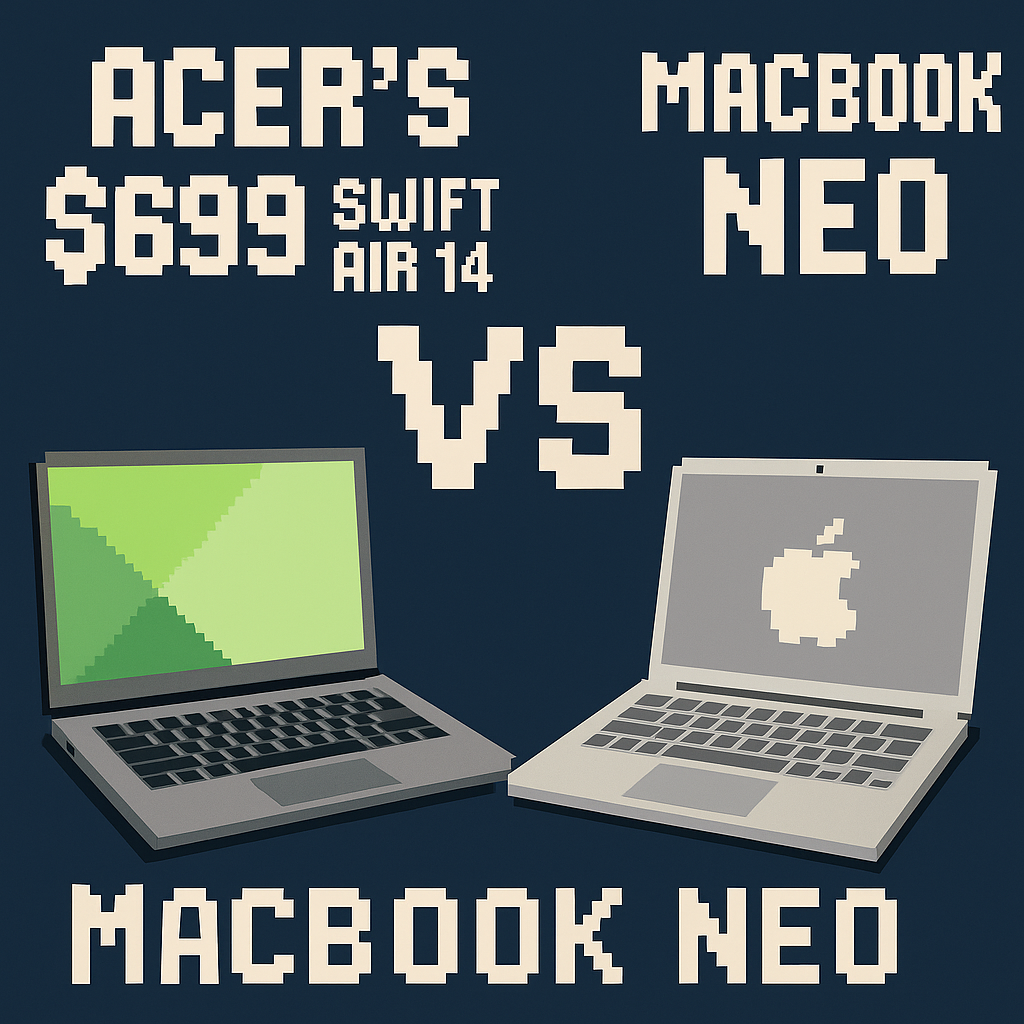
Acer’s $699 Swift Air 14 vs MacBook Neo | Analysis by Brian Moineau

TL;DR

  • Acer’s $699 Swift Air 14 is a colorful 14‑inch Windows laptop positioned against Apple’s $599 MacBook Neo, but it ships with just 8GB RAM and a low‑end Intel Core Series 3 “Wildcat Lake” chip. [1][3][4]
  • On paper it beats the Neo on I/O, refresh rate, and battery capacity (70Wh vs 36.5Wh), yet its NPU peaks at 17 TOPS—well below Microsoft’s 40‑TOPS Copilot+ PC bar—so it won’t ship with flagship Windows AI features. [2][4][7]
  • The real play isn’t Acer vs Apple; it’s Intel seeding an entry tier OEMs can ship at scale in 2026, trading ceilings from a 64‑bit memory interface and 8GB SKUs that will age quickly under Windows 11’s AI stack. [3][5][7]

What the source said

Acer will launch the Swift Air 14 in North America in August 2026 with Intel’s budget‑oriented Core Series 3 “Wildcat Lake,” including 6‑core Core 5 and Core 7 variants, starting at $699. It weighs about 1.19 kg, is slightly thicker than Apple’s MacBook Neo, and offers a 14‑inch 1920×1200 IPS panel at 120Hz and 350 nits. Base memory is 8GB LPDDR5 (configurable to 16GB). Ports include two Thunderbolt 4 (USB‑C) and one USB‑A. Acer also previewed an Aspire 18 AI (up to Intel Core Ultra Series 3, 32GB RAM, 2TB storage) and a Nitro 16 gaming notebook that can be configured with AMD’s Ryzen 9 9955HX3D; pricing for those remains TBD, with ship dates clustered across July–August 2026. [1][2][6]

Why it matters

Acer Swift Air 14 vs MacBook Neo is this season’s entry‑level laptop cage match under $800 in 2026, with Apple’s tighter macOS power management and fixed 8GB RAM facing Acer’s bigger 70Wh battery, 120Hz panel, and extra ports—still with 8GB at the floor. That baseline collides with Microsoft’s Copilot+ PC requirements, which place a 40‑TOPS NPU threshold on key Windows 11 features such as Recall‑class local semantic search and advanced Studio effects that run offline. [2][4][7]

Stakeholders diverge. Intel needs Wildcat Lake to anchor affordable “AI PCs” after 2024–2025 premium chips pushed average selling prices higher; OEMs need something they can ship amid DDR5 price swings reported by TrendForce; Microsoft wants Copilot+ attach rates but set a 40‑TOPS NPU bar; Apple positions the Neo as a “good‑enough” Mac that feeds Services ARPU without discounting the MacBook Air. [3][5][7][8]

Original analysis

Here’s the uncomfortable truth: the Swift Air 14 looks terrific on a spec card, but several “wins” won’t materialize in daily use once you factor in a 17‑TOPS NPU ceiling and 8GB floor. [2][7]

  • Contrarian read

    • Consensus: “Acer’s $699 Swift Air 14 undercuts the $599 MacBook Neo with a bigger battery, faster screen, and more ports—finally, a Windows answer.” [1][4]
    • My take: It’s not a real Neo killer because its AI engine and memory ceiling keep it outside Microsoft’s Copilot+ roadmap. The Swift Air’s NPU tops at 17 TOPS; Copilot+ PCs demand 40 TOPS on the NPU. Without that certification, users will miss Windows 11 features that Microsoft gates behind the Copilot+ badge in 2025–2026. [2][7]
  • Back‑of‑envelope battery math (shown work)

    • MacBook Neo: Apple and press materials peg ~11 hours of wireless web on a 36.5Wh pack. Average platform draw ≈ 36.5Wh ÷ 11h = ~3.3W. [4][8]
    • Swift Air 14: Acer claims up to 16 hours of web on 70Wh. Average draw ≈ 70Wh ÷ 16h = ~4.4W. [2]
    • Interpretation: Despite a larger battery, Acer’s Windows platform draw (even in vendor tests) is roughly 1.1W higher than Apple’s. Add a 120Hz panel and typical Windows background tasks and you’ll likely land below the headline figure in mixed use. The capacity advantage is real; the efficiency gap persists. [2][4][8]
  • 2×2: Where these machines land in 2026 (typology)

    • X‑axis: NPU capability (sub‑40 TOPS vs ≥40 TOPS); Y‑axis: efficiency (web workload <3.8W vs ≥3.8W average draw).
    • High NPU / High efficiency: Premium Copilot+ ARM designs (e.g., Qualcomm X‑Elite class) in 2025–2026. [7]
    • High NPU / Lower efficiency: Early Copilot+ x86 refreshes with ≥40‑TOPS NPUs but heavier draw. [7]
    • Low NPU / High efficiency: Apple MacBook Neo—strong battery behavior but outside the Windows Copilot+ universe by design. [4]
    • Low NPU / Lower efficiency: Acer Swift Air 14—17‑TOPS NPU and ~4.4W implied draw put it here until silicon changes. [2]
  • Comparison table (core shopper questions)

    Dimension Acer Swift Air 14 Apple MacBook Neo
    Price (base) $699 $599
    CPU Intel Core Series 3 “Wildcat Lake,” up to Core 7 350 (6 cores) Apple A‑series SoC class (A18 Pro‑derived)
    RAM 8GB base, up to 16GB LPDDR5 (onboard) 8GB unified (fixed)
    Display 14" 1920×1200, 120Hz, 350 nits, ~100% sRGB 13" 2408×1506, 60Hz
    Battery 70Wh; up to 16h web (vendor claim) 36.5Wh; ~11h web (Apple claim)
    Ports 2× Thunderbolt 4 (Type‑C), 1× USB‑A 2× USB‑C
    Weight 1.19 kg ~1.24 kg

    Sources: Acer press materials for Swift Air 14 specs and battery claims; Apple press materials for Neo specs and capacity; RTINGS methodology informs the web‑draw estimate. [1][2][4][8]

  • Architecture fine print that matters at $699

    • Wildcat Lake is slimmed for cost and thermals: briefings point to a 64‑bit (single‑channel) memory interface and trimmed last‑level cache—choices that help Intel and OEMs hit price targets but constrain sustained bandwidth. On Windows, that punishes iGPU throughput and RAM‑heavy multitasking, especially at 8GB. [3][5]
    • This intersects awkwardly with the 120Hz display. Scrolling is smoother in Office and Edge, yes; but the iGPU and memory path aren’t built for high‑FPS gaming or heavier creative previews. You’ll feel 120Hz in UI smoothness, not in AAA‑title frame rates. [2][3]
  • Historical analogue (year and pattern)

    • Apple’s 12‑inch MacBook (Early 2015) paired a fanless Core M with a single USB‑C and tight thermals; reviewers praised portability but flagged sustained performance and port constraints. The Swift Air 14 echoes that 2015 trade: thin‑first design that limits headroom for the workload mix buyers adopt 12–24 months later. [10][11]
  • Named‑stakeholder breakdown

    • Acer: Gains shelf presence and margin with an aluminum Windows laptop at $699 in Best Buy and Amazon listings, but risks returns if 8GB SKUs stutter under Windows 11 updates and local AI effects. [1][7]
    • Intel: Places Core Series 3 silicon into mass‑market tiers in 2026; it trades peak performance for BOM sanity to counter Apple’s $599 Neo pressure. [3][4]
    • Microsoft: Keeps “AI PC” messaging strict—Copilot+ requires 40 TOPS on the NPU while some OEMs trumpet “platform TOPS 40” that mix CPU/GPU/NPU; shoppers will see conflicting badges in U.S. retail. [2][7]
    • Apple: Keeps the Neo simple—two ports, one RAM option, strong efficiency; configuration stinginess looks less punitive when Windows peers ship 8GB too, reducing perceived downside at $599. [4]
    • AMD (gaming): Wins oxygen at the high end with Acer’s Nitro 16 offering Ryzen 9 9955HX3D with 3D V‑Cache, shifting performance‑per‑dollar chatter toward AMD during back‑to‑school 2026. [6]

What others are missing

The Copilot+ threshold mismatch is the story, not the 120Hz vs 60Hz panel talk. Acer markets “up to 40 platform TOPS,” but the Swift Air 14’s on‑device NPU is rated at 17 TOPS, and Microsoft’s Copilot+ certification demands 40 TOPS on the NPU alone. Platform TOPS (CPU+GPU+NPU) don’t qualify for Copilot+; the NPU’s TOPS gates exclusive Windows features. Expect two $699 Windows laptops on the same Best Buy shelf in November 2026—both with “AI” stickers, but only one with the Copilot+ badge—driving returns, support calls, and negative reviews when Recall‑class features don’t appear. [2][7]

What to watch next

  1. By September 30, 2026 (Q3), Best Buy or Amazon will list the Swift Air 14 base SKU with 16GB RAM at $699–$749, replacing the 8GB base in U.S. stores due to review pressure and returns.
  2. By November 30, 2026 (Q4), Acer will announce a Swift Air 14 variant with an NPU rated at ≥40 TOPS and ship it with the Copilot+ PC logo in the same chassis or a minor refresh.
  3. By December 15, 2026 (holiday), at least two U.S. retailers (Newegg and Micro Center) will advertise Nitro 16 configurations with Ryzen 9 9955HX3D at ≤$1,499 before rebates.

Sources

  1. Acer press materials (June–August 2026) — Launch timing, pricing for Swift Air 14, Aspire 18 AI, and Nitro 16; panel, port, and battery specs.
  2. Acer Swift Air 14 spec sheet (2026) — Claims on 70Wh battery, 120Hz display, port layout, weight, and stated “up to 40 platform TOPS” vs 17‑TOPS NPU.
  3. Intel Core Series 3 “Wildcat Lake” brief (2026) — Positioning, core counts, memory interface notes, and cache trade‑offs for entry‑tier silicon.
  4. Apple MacBook Neo product materials (2026) — Battery capacity (36.5Wh), weight, panel resolution, and Apple’s web battery estimate.
  5. TrendForce DRAM price tracker (2025–2026) — DDR5 price volatility context for OEM BOM decisions at the $599–$799 tier.
  6. AMD Ryzen 9 9955HX3D product page (2026) — 3D V‑Cache positioning and availability in mainstream gaming notebooks like Nitro 16.
  7. Microsoft Copilot+ PC requirements page (2024–2026) — Explicit 40‑TOPS NPU threshold and feature gating for Windows 11 AI experiences.
  8. RTINGS battery test methodology and results (2024–2026) — Web browsing test design informing average draw calculations used for cross‑device comparisons.
  9. The Verge review: Apple MacBook (12‑inch, Early 2015) — Historical thin‑and‑light trade‑offs on thermals, ports, and sustained performance.
  10. AnandTech deep dive: 12‑inch MacBook (2015) — Analysis of design constraints and performance ceilings that mirror 2026 entry‑tier compromises.


Related update: We recently published an article that expands on this topic: read the latest post.
Cyber Monday Extensions: Score Deals Now | Analysis by Brian Moineau

Just when you thought Black Friday was good…now Cyber Monday keeps giving

If your inbox and social feeds felt like a bargain bazaar over the weekend, breathe easy: the best retailers kept the lights on. Cyber Monday may have officially passed, but an army of “extended” deals rolled into Tuesday (and beyond), meaning you can still snag deep discounts on tech, home, fashion and more — without camping in front of a site at midnight.

Retailers treated Cyber Monday like the start of a weeklong shopping sprint. That means if you hesitated, there’s still time to scope out — and score — things you actually want (or gifts you’ll pretend you’d planned on all along).

Why these extensions happen and why you should care

  • Retailers split holiday promotions across several shopping events to keep momentum and capture late buyers.
  • Inventory and algorithmic repricing often let good deals hang on after the official date — especially on big retailers like Amazon, Wayfair, Best Buy and department stores.
  • For shoppers, that translates into second-chance discounts on laptops, TVs, kitchen appliances, sneakers, and beauty bestsellers — sometimes at near-Black-Friday levels.

Put simply: patience and quick comparisons still win. A “still-on” Cyber Monday offer can be your ticket to a high-ticket item with smaller regret.

What categories are still worth checking

  • Tech
    • Laptops, headphones, TVs and smart home gear frequently see extended markdowns.
    • Look for Nike-level markdowns on midrange and premium models (Apple, Samsung, Bose, Sony).
  • Home and furniture
    • Wayfair, Home Depot and mattress brands often keep clearance and doorbuster pricing going for a few extra days.
  • Fashion and beauty
    • Department stores and beauty retailers extend sitewide or category sales; limited-stock items (sizes, shades) go fast.
  • Travel and subscriptions
    • Airlines, cruises and streaming platforms occasionally extend promotional fares and trial pricing through the week.
  • Kitchen and small appliances
    • High-ticket blenders, espresso machines and air fryers are often restocked and repriced for the extended window.

Where to look first (smart shopping order)

  1. Check the retailer’s front page or “Cyber” landing page for explicit end dates.
  2. Search the specific item you want — “extended sale” or “clearance” filters reveal lingering bargains.
  3. Compare the item on two or three sites (price trackers and quick searches help).
  4. Factor shipping, returns and warranty into your total cost — a slightly higher price with free returns can be the safer play.
  5. Use browser coupons, cash-back extensions, and store credit offers to squeeze more value.

Deals worth prioritizing right now

  • Big-screen TVs and OLEDs: retailers commonly hold back some TV inventory with meaningful discounts for late shoppers.
  • Headphones and earbuds from household brands: often deeply discounted as part of bundle deals.
  • Large home purchases (furniture, mattresses): extended sales frequently include floor models and overstock items.
  • Beauty tools (hair stylers, skincare devices): high-ticket items marked down for seasonal promotions and gift sets.
  • Smart home devices and robot vacuums: solid savings, especially on popular models that were doorbusters.

(These are categories where multiple outlets — from mainstream outlets to niche publications — reported continued savings across platforms during the extended Cyber Monday pushes.)

How to avoid buyer’s remorse

  • Set a hard price ceiling before you click “buy.” If a deal doesn’t beat your ceiling, it’s not a deal.
  • Watch for promo expiration language and coupon exclusions — some “extended” prices are only valid while supplies last.
  • Beware of “comps”: a product shown at a higher crossed-out price isn’t always the real benchmark; check past prices on price-tracking sites.
  • Consider warranty/return windows for electronics and large furniture; post-holiday returns and exchanges get busy.

Shopping etiquette for the late-December sprint

  • If you’re purchasing gifts, double-check delivery estimates — extended deals don’t always mean extended shipping speed.
  • Buy from retailers with clear return policies to avoid holiday headaches.
  • Keep digital receipts and order confirmations for easier tracking and price-matching later if needed.

Late-stage winners: real-world examples

Over the latest Cyber Monday wave, outlets such as the New York Post, Forbes and major shopping editors highlighted:

  • Discounts on major-brand electronics and headphones.
  • Furniture and home accessory markdowns from Wayfair and big-box sellers.
  • Beauty gift sets and hair tools holding their price throughout the extended window. These patterns tell a consistent story: retailers want to capture straggler shoppers, and they're willing to keep attractive discounts live for a short extension. (See Sources below for roundups and live updates.)

My take

If you missed the Cyber Monday frenzy, don’t panic. The smart move is to prioritize what you really want (or need), compare quickly, and use any store-level protections to your advantage. Some of the best savings show up in the first couple of days after Cyber Monday — so act deliberately but decisively.

If you’re hunting a high-ticket item (TV, laptop, major appliance), treat the remainder of the week like your last chance: check prices, confirm return policies, and pull the trigger when the total deal beats your price ceiling.

Final thoughts

Retailers kept the sale energy alive for a reason: shoppers kept clicking. For buyers, that means better odds of finding exactly what you wanted without the drama of the holiday weekend. Shop smart, protect yourself with returns and warranties, and enjoy the rare pleasure of getting a real deal…after the crowds have thinned.

Sources

Markets Test Key Levels as AI Chip Race | Analysis by Brian Moineau

A tricky morning for the market: futures wobble while AI drama rattles Nvidia

Wall Street opened with a bit of that stomach-flip feeling investors know too well — futures flirting with a key level as big tech news rearranged the mood. Nvidia slipped after reports that Google (and possibly Meta) are moving more seriously into AI chips, while earnings from companies like Alibaba and Best Buy provided bright spots. The result: cautious optimism, punctuated by a reminder that narratives — and who controls AI compute — still move markets.

What to notice right away

  • S&P 500 and Nasdaq futures were teetering around an important technical level, signaling that the major indexes face a decisive day (or week) ahead.
  • Nvidia shares dropped after news that Google’s AI chips (TPUs) are being pitched more aggressively and that Meta may be in talks to use Google’s chips — a development that raises questions about market share in AI hardware.
  • Retail and cloud-related earnings (Alibaba, Best Buy among them) surprised on the upside, giving pockets of the market fuel even as AI headlines dominated the tape.

Why futures matter this morning

  • Futures act like a pre-market temperature check: small price differences can amplify when regular trading opens.
  • When futures “waver at a key level,” traders interpret that as indecision at an important technical barrier — the line between a resumption of the uptrend or a pullback that could invite volatility.
  • That indecision is particularly potent now because the market’s leadership is concentrated in a handful of mega-cap tech names; any uncertainty there can sway broad indexes.

The Nvidia story (short and relevant)

  • The kerfuffle centers on reports that Google has been moving to offer its tensor processing units (TPUs) more broadly and that Meta may consider buying or renting them for data-center AI workloads.
  • For Nvidia, whose GPUs dominate AI training and inference today, that’s a credible competitive threat if big customers diversify away or rent capacity elsewhere.
  • Markets reacted: Nvidia down; Google/Alphabet gained ground as investors priced the prospect of a stronger cloud/chip offering. But analysts remain split between near-term price pressure and longer-term confidence in Nvidia’s ecosystem and product roadmap.

Earnings winners: Alibaba and Best Buy

  • Alibaba: The company’s AI initiatives (including Qwen and other cloud efforts) and improving execution have investors rewarding the stock. Positive earnings or user/engagement data tends to revive confidence in its growth narrative beyond just Chinese e-commerce.
  • Best Buy: A solid retailer report — especially during a season where tech and appliance demand matters — reminded markets that cyclical earnings can still surprise positively and support discretionary retail names even as tech headlines dominate.

The investor dilemma

  • Focus vs. diversification: Are you trading the headlines (short-term swings tied to AI chip deals) or positioning for structural trends (AI spending continuing to balloon, where Nvidia still has advantages)?
  • Technical risk vs. fundamental conviction: Futures waver at key levels often trigger stop runs and increased volatility. Long-term investors should ask whether a headline-driven drop meaningfully changes the underlying business case.
  • Earnings pockets vs. market leadership: Retail winners and cloud/AIs successes can provide rotation opportunities, but broad indices are heavily weighted to the biggest tech names — which still drive the market’s direction.

Strategic thinking (practical ideas, not advice)

  • If you’re short-term trading, watch the futures level closely: a clear break (with volume) could invite follow-through; a hold and reversal often signals buyers stepping in.
  • For swing or longer-term investors, separate the signal from the noise: a one-off report about chip deals is newsworthy but doesn’t instantly rewrite competitive moats — track customer wins, product compatibility, and supply commitments over several quarters.
  • Consider diversification across AI plays: chips (Nvidia), cloud/service providers (Google, AWS, Microsoft), and select application-layer companies that monetize AI rather than supply raw compute.
  • Earnings surprises in areas like retail (Best Buy) and cloud/AI adoption (Alibaba) show rotation can matter — scanning relative strength and volume after reports helps find durable moves.

Market mood and what to watch next

  • Watch how major indexes behave if/after they clear the “key level” in futures. A decisive breakout could renew the rally; a failure could bring renewed volatility and profit-taking.
  • Keep an eye on follow-up reporting about the Google/Meta/TPU discussions and any official statements from Nvidia or Google — markets often move again when the details (or denials) arrive.
  • Monitor next wave of earnings and guidance: retailers, cloud providers, and chip suppliers will shape whether headlines are transitory or signal a deeper reshuffling.

Quick takeaways

  • Markets are at a crossroads: technical indecision in futures plus headline risk from AI supply competition equals heightened short-term volatility.
  • Nvidia’s pullback reflects legitimate concerns about compute competition, but it doesn’t instantly erase Nvidia’s ecosystem advantages.
  • Earnings from Alibaba and Best Buy show pockets of fundamental strength that can offer rotation opportunities amid headline-driven noise.

My take

This is a classic example of markets balancing two currents: headline-driven rotation (who supplies which chips) and the longer-running structural story of AI adoption. Short-term traders will be reactive — and rightly so — but long-term investors should weigh whether today’s headlines change durable revenue and margin pathways. For now, expect chop: the indexes are being tested, and the winners will be those who can blend quick risk management with a patient view on AI’s multi-year buildout.

Sources


Related update: We recently published an article that expands on this topic: read the latest post.

Best MacBook Deals This November | Analysis by Brian Moineau

Why now might be the best time to buy a MacBook (yes, really)

If you’ve been watching MacBook prices and waiting for the “right” moment, November 2025 is shaping up to be one of those rare windows where timing and product cycles line up. Brand‑new Apple Silicon MacBooks — from older M1 models to the latest M5 14‑inch Pro — are seeing meaningful discounts, and the result is something unusual: genuinely affordable new MacBooks starting as low as $599. For many buyers that changes the question from “Should I upgrade?” to “Which one should I get?”

Quick overview you can scan

  • M1 MacBook Air (13", 8GB/256GB): record low pricing around $599 at major retailers.
  • M4 MacBook Air: solid discounts across 13" and 15" models, with some configurations under $1,000.
  • M4 and M5 MacBook Pro: deals exist on 14" and 16" models — the M5 is new but already seeing modest price cuts.
  • Inventory and manufacturer cycles (new chip generations, rumored A‑series MacBooks) and possible tariff concerns are nudging retailers to clear stock.

Why prices dropped — context that matters

  • Apple’s transition to Apple Silicon (M1 → M2 → M3 → M4 → M5) created a multi‑tier MacBook lineup that covers a wide set of needs and budgets. Older but still capable models (like the M1 Air) remain useful, especially for students and general productivity.
  • Retailers often clear inventory when new chips or form factors arrive. The recent M5 14" MacBook Pro launch and continuing interest in M4 machines have produced discounts across both newer and earlier models.
  • External forces — like rumored tariffs or component shifts — can accelerate discounting as retailers try to move inventory before price structures change.

Who should consider which model

  • Students, writers, everyday users
    • M1 MacBook Air (13", 8GB/256GB) at $599 is the best value if you want a new MacBook for browsing, essays, video calls, and light creative work. It runs macOS and most common apps smoothly and is the cheapest way to get Apple Silicon in a brand‑new machine.
  • Power users who still want portability
    • M4 MacBook Air (13" or 15") gives better memory, battery life, and newer features (Center Stage camera on M4, slimmer bezels on redesigns). Look for 13" or 15" M4 deals if you want the newest Air experience without stepping up to Pro thermals or weight.
  • Creators and professionals who need sustained performance and ports
    • 14" and 16" MacBook Pro lines (M4 Pro/Max and M5) offer bigger screens, faster sustained performance, and more ports. If your workflows include video exports, 3D, or heavy code builds, watch for M4 Pro/Max clearance and early M5 price drops to land the best deal.

Picking a configuration: storage & memory reminders

  • Prioritize RAM if you multitask or use creative apps; Apple’s unified memory matters more than in the Intel era.
  • Storage upgrades at checkout are expensive; consider external SSDs or cloud storage if you can’t justify the cost.
  • If you buy an M1 at $599, remember it’s often 8GB/256GB — great for many users but limiting for large media libraries or heavy virtual machines.

Timing and risk: when to pull the trigger

  • If you need a laptop this month: these deals are real and widespread. The M1 Air at $599 is a hard bargain for new hardware.
  • If you can wait: Apple rumors suggest an entry‑level Mac (A‑series chip) could arrive within a year, and Apple’s product cycles may produce further adjustments. But rumored new models often target different price points or features; today’s deep discounts may not return once inventory tightens.
  • If you care about long‑term OS updates: recent macOS releases (macOS Tahoe in 2025) have tightened Intel support; staying on Apple Silicon ensures longer compatibility with future macOS versions.

Standout deals (examples seen in November 2025)

  • M1 MacBook Air (13", 8GB/256GB) — about $599 at Walmart.
  • M4 MacBook Air — many 13" and 15" SKUs at $100–$200 off; some 15" M4s around $999–$1,199 depending on memory and storage.
  • M4 MacBook Pro 14" and 16" — notable discounts on multiple configurations; M5 14" models showing smaller early discounts of $50–$150.

Practical buying tips

  • Buy from reputable sellers (Amazon, Walmart, Best Buy, B&H) to preserve return windows and warranty clarity.
  • Compare identical configurations across retailers — color and minor specs sometimes change price.
  • Check whether a listed unit is new vs. refurbished; new M1 units at $599 are circulating but may be limited stock.
  • Consider Apple Certified Refurbished if you’re comfortable — you can get like‑new hardware with Apple warranty and often meaningful savings.

My take

The Apple Silicon era matured fast, and that maturity is finally showing up in price diversity. You can now pick a brand‑new MacBook that fits your budget and be confident it will remain useful for years. If you want the cheapest route to Apple Silicon performance, the M1 Air at $599 is a surprising and practical option — especially for students or light users. If you want future‑proofing and a nicer display or camera, the M4 Air and discounted Pro configurations give compelling middle paths. In short: November 2025 is one of those buyer‑friendly moments when compromise doesn’t mean settling.

Sources


Related update: We recently published an article that expands on this topic: read the latest post.


Related update: We recently published an article that expands on this topic: read the latest post.
Best Buy reports modest sales recovery, but says tariffs are complicating its turnaround – CNBC | Analysis by Brian Moineau

Best Buy reports modest sales recovery, but says tariffs are complicating its turnaround - CNBC | Analysis by Brian Moineau

Title: Navigating the Retail Seas: Best Buy's Modest Recovery Amidst Tariff Tides

The retail world is no stranger to the ebbs and flows of economic tides, and Best Buy, the electronics giant, recently reported a modest sales recovery that seems to signal a change in the winds. Surpassing revenue and earnings expectations for its most recent quarter, Best Buy is showcasing a resilience that many other retailers could stand to emulate. But, as the company's leadership wisely notes, the journey is far from over, with the looming specter of tariffs complicating what could otherwise be a smooth turnaround.

The news, originally reported by CNBC, highlights Best Buy's cautious optimism. Despite the positive quarterly results, the company has maintained its full-year forecast, citing tariff uncertainty as a potential storm cloud on the horizon. It's a prudent move, considering the current geopolitical climate where trade tensions can shift as quickly as a wind gust.

Tariffs have been a hot topic globally, with many industries feeling the impact of trade policies, particularly those between the United States and China. Electronics, one of Best Buy's staple offerings, often bear the brunt of these tariffs due to their complex international supply chains. Much like sailors navigating treacherous waters, retailers must be adept at steering their strategies to avoid the rocks of increased costs and reduced consumer spending.

Interestingly, Best Buy's performance can also be seen as a microcosm of the broader retail landscape, which has been experiencing a renaissance of sorts. The pandemic accelerated e-commerce adoption, yet many consumers still value the tactile experience of in-store shopping. This dual demand requires retailers to be agile, offering seamless omnichannel experiences that satisfy both digital and traditional shoppers.

In the wider world of business, parallels can be drawn to companies like Apple and Amazon, who have also had to deftly maneuver through tariff implications. Apple's supply chain, deeply intertwined with Chinese manufacturing, has been particularly vulnerable, driving the company to explore diversification strategies. Meanwhile, Amazon's vast global logistics network gives it some insulation from individual tariff impacts, but it too keeps a watchful eye on trade developments.

Beyond the realm of commerce, tariffs have ripple effects that touch various aspects of society. For instance, educational institutions that rely on imported technology for STEM programs may face budgetary pressures, which in turn affects students' learning experiences. Similarly, small businesses that can't absorb increased costs as easily as larger corporations may pass these on to consumers, leading to broader economic implications.

So, what does this mean for the average consumer? While Best Buy's cautious approach might seem like a corporate strategy discussion far removed from everyday life, it actually serves as a reminder of the interconnectedness of global markets and personal wallets. As tariffs influence product prices, consumers may find themselves making more deliberate purchasing decisions, weighing the value of immediate gratification against potential future costs.

In conclusion, Best Buy's recent performance is a testament to strategic resilience, a quality that is increasingly vital in today's unpredictable economic environment. While tariffs remain a complicating factor, the company's ability to navigate these challenges offers hope not only for its own future but also for the broader retail industry. As we move forward, it will be fascinating to watch how Best Buy and its peers continue to adapt, innovate, and steer through the complexities of global trade. Whether you're a shareholder, a shopper, or simply someone interested in the dynamics of business, there's much to learn from Best Buy's journey. Sail on, Best Buy, sail on.

Read more about AI in Business

Read more about Latest Sports Trends

Read more about Technology Innovations

The Best Buy Memorial Day Sale Is Now Live With Fresh New Tech Deals – IGN | Analysis by Brian Moineau

The Best Buy Memorial Day Sale Is Now Live With Fresh New Tech Deals - IGN | Analysis by Brian Moineau

Embrace the Future: Dive into Best Buy's Memorial Day Tech Extravaganza

Ah, Memorial Day—the unofficial gateway to summer, a time for barbecues, beach excursions, and, for the tech-savvy among us, a golden opportunity to snag the latest gadgets at unbeatable prices! This year, Best Buy is leading the charge with its Memorial Day sale, launching early in 2025 with a smorgasbord of fresh deals that promise to delight tech enthusiasts and casual shoppers alike.

A Tech Wonderland Awaits

From the sleek sophistication of Apple products to the robust reliability of major appliances, Best Buy's sale is a veritable wonderland of tech treasures. Whether you're eyeing a new MacBook for your remote work setup or a state-of-the-art refrigerator to keep your summer drinks chilled, there's something for everyone. And let's not forget the entertainment buffs—Best Buy's selection of discounted TVs is perfect for those looking to upgrade their home theater experience just in time for summer blockbuster season.

Keeping Up with the Tech-Joneses

In today's fast-paced world, staying current with technology feels almost as essential as keeping up with the Kardashians. As AI continues to make headlines with its transformative potential—from revolutionizing industries to sparking ethical debates—having the latest tech is more than just a luxury; it's a way to stay connected and informed. Best Buy's sale offers a chance to explore cutting-edge tech without breaking the bank, aligning perfectly with our ever-growing digital society.

Interestingly, this tech bonanza coincides with a broader trend of sustainability in consumer electronics. As global conversations around climate change intensify, companies are increasingly focusing on creating products that are not only innovative but also environmentally friendly. From energy-efficient appliances to tech designed with recyclability in mind, the Memorial Day sale presents an opportunity for consumers to make choices that are both smart and sustainable.

A Global Perspective

On a global scale, the excitement around tech sales like Best Buy's ties into larger economic narratives. Amidst fluctuating markets and post-pandemic recovery, consumer electronics remain a resilient sector, often serving as a bellwether for broader economic health. As people invest in new devices, it signals optimism and a willingness to embrace the future—qualities that resonate well beyond individual purchases.

Final Thoughts: Seize the Day (and the Deals!)

As you peruse the aisles, whether virtually or in-store, remember that Memorial Day is about more than just sales. It's a moment to honor those who have served and to reflect on the freedoms we enjoy, including the freedom to explore and innovate. So, while you're snagging that discounted Apple Watch or eyeing a shiny new lawnmower, take a moment to appreciate the bigger picture.

In the spirit of Memorial Day, let's celebrate not just the deals but the advancements they represent and the brighter, tech-enhanced future they promise. Happy shopping, and here's to a summer filled with sunshine and stellar tech!

Read more about AI in Business

Read more about Latest Sports Trends

Read more about Technology Innovations

‘Most’ Best Buys will have extra Switch 2s available in-store – The Verge | Analysis by Brian Moineau

‘Most’ Best Buys will have extra Switch 2s available in-store - The Verge | Analysis by Brian Moineau

Nintendo Switch 2: Midnight Madness at Best Buy

Gamers, mark your calendars and set those alarms! Best Buy has announced that “most stores” will have a “limited inventory” of the highly anticipated Nintendo Switch 2 systems available for its midnight launch. Yes, you read that right—there will be additional units in-store! For all of us who have suffered through the nail-biting anxiety of online pre-orders, this news comes as a welcome relief.

Now, let’s take a step back and marvel at the cultural phenomenon that is the Nintendo Switch. Since its launch in 2017, the Switch has become a staple in gaming households around the world, amassing a fan base that includes everyone from casual gamers to hardcore enthusiasts. The hybrid console’s ability to transition seamlessly from a home console to a portable device was a game-changer, and it’s safe to say that we’re all excited to see what the Switch 2 brings to the table.

But it’s not just about the console itself; it’s about the experience. A midnight release adds an extra layer of excitement, turning an ordinary purchase into an event. For those who have never experienced a midnight launch, imagine the energy of a concert line or the camaraderie of a Black Friday crowd, but with a shared love for gaming. It’s an excellent opportunity to meet fellow gamers, swap stories, and maybe even pick up some tips for your favorite games.

This release couldn’t come at a better time, as it taps into the broader zeitgeist of nostalgia and community. In recent months, we’ve seen a resurgence of interest in physical media and in-person events—perhaps a response to the isolation many felt during the pandemic. The Switch 2 midnight launch fits right into this narrative, offering a moment of collective excitement and anticipation.

Elsewhere in the world, we see similar trends of community and nostalgia. Vinyl records have made a significant comeback, with sales hitting record highs in recent years. In sports, events like the Olympics and the World Cup continue to draw global audiences, uniting people in their shared passion and excitement. Even the film industry is seeing a return to theaters, with moviegoers eager to experience the magic of the big screen together.

For Nintendo fans, the Switch 2 midnight launch at Best Buy is not just a chance to snag the latest console; it’s a chance to be part of something bigger—a community of people brought together by their love for gaming. And who knows? Maybe you’ll even make a friend or two while waiting in line.

So, grab your coat, pack a snack, and prepare for an exciting night of anticipation and camaraderie. Whether you’re a seasoned gamer or a newcomer eager to join the ranks, the Switch 2 launch is shaping up to be an unforgettable event.

Final Thought: Technology may be advancing at a rapid pace, but it’s moments like these that remind us of the human connections that make it all worthwhile. Here’s to the Switch 2 and the joy of shared experiences—may the odds be ever in your favor as you hunt for that coveted console. Happy gaming!

Read more about AI in Business

Read more about Latest Sports Trends

Read more about Technology Innovations

Walgreens Goes From $100 Billion Health Giant to Private-Equity Salvage Project – The Wall Street Journal | Analysis by Brian Moineau

Walgreens Goes From $100 Billion Health Giant to Private-Equity Salvage Project - The Wall Street Journal | Analysis by Brian Moineau

**From Pharmacy Powerhouse to Private-Equity Project: The Walgreens Odyssey**

Once upon a time, Walgreens stood tall as a $100 billion behemoth in the health industry, a giant among giants in the world of pharmacy and retail. Fast forward to today, and this titan is finding itself in the arms of Sycamore Partners, a private-equity firm known for taking companies on a journey of transformation—or, more aptly, salvage operations. What's led Walgreens down this winding road from the peak of pharmaceutical prowess to a private-equity project? Let’s explore the narrative of change in the retail pharmacy landscape.

**The E-Commerce Effect**

The decline of Walgreens is not an isolated incident but rather a chapter in the larger story of retail evolution. As the tides of e-commerce have swept across the globe, traditional brick-and-mortar stores have found themselves in increasingly choppy waters. Giants like Amazon have redefined customer expectations, offering convenience and competitive pricing that physical stores struggle to match. Walgreens, despite its storied history, has not been immune to these forces.

In the broader context, it’s worth noting how other traditional retailers have navigated this digital disruption. Take, for instance, Best Buy, which found a way to thrive by revamping its online presence and customer service strategies, proving that adaptation is indeed possible. Meanwhile, Sears, once a retail stalwart, serves as a cautionary tale, having succumbed to the pressures without adequately evolving.

**Health-Industry Shifts**

Beyond the digital revolution, the health industry itself is in flux. The rise of telemedicine, changing patient expectations, and new regulatory landscapes have altered how health services are delivered and consumed. Walgreens, which had long been synonymous with the local pharmacy experience, needed to innovate and expand its healthcare offerings. Competitors like CVS Health have embraced this change more readily, integrating health services and digital solutions to meet the modern consumer's needs.

In a world where healthcare is moving towards more integrated and holistic models, Walgreens' slower pivot has been a significant factor in its decline. The acquisition by Sycamore Partners might be the catalyst needed for a strategic realignment, potentially infusing the company with a fresh perspective on navigating these changing terrains.

**A Broader Economic Lens**

Walgreens’ predicament can be seen as a microcosm of the broader economic climate. As private equity increasingly steps in to rescue or revitalize struggling businesses, we see echoes of this in other sectors. For instance, the restaurant industry has witnessed similar patterns, with private-equity firms stepping in to revitalize brands that have fallen out of favor with shifting consumer tastes.

Furthermore, as we transition into a post-pandemic world, the business landscape is undergoing significant recalibration. Companies are re-evaluating their operational strategies, supply chain mechanisms, and digital footprints to remain competitive and relevant.

**Final Thoughts**

The story of Walgreens serves as a poignant reminder of the necessity for businesses to adapt proactively and innovatively. In an era defined by rapid technological advancements and shifting consumer expectations, standing still is not an option. Whether Sycamore Partners can successfully steer Walgreens back to its former glory remains to be seen, but one thing is certain: the journey will be closely watched by those who understand the importance of evolution in the ever-changing world of business.

As we look to the future, it’s crucial for businesses to embrace change, foster innovation, and, perhaps most importantly, place the customer at the heart of their strategies. After all, the ability to adapt is not just a business strategy; it is an imperative for survival.

Read more about AI in Business

Read more about Latest Sports Trends

Read more about Technology Innovations