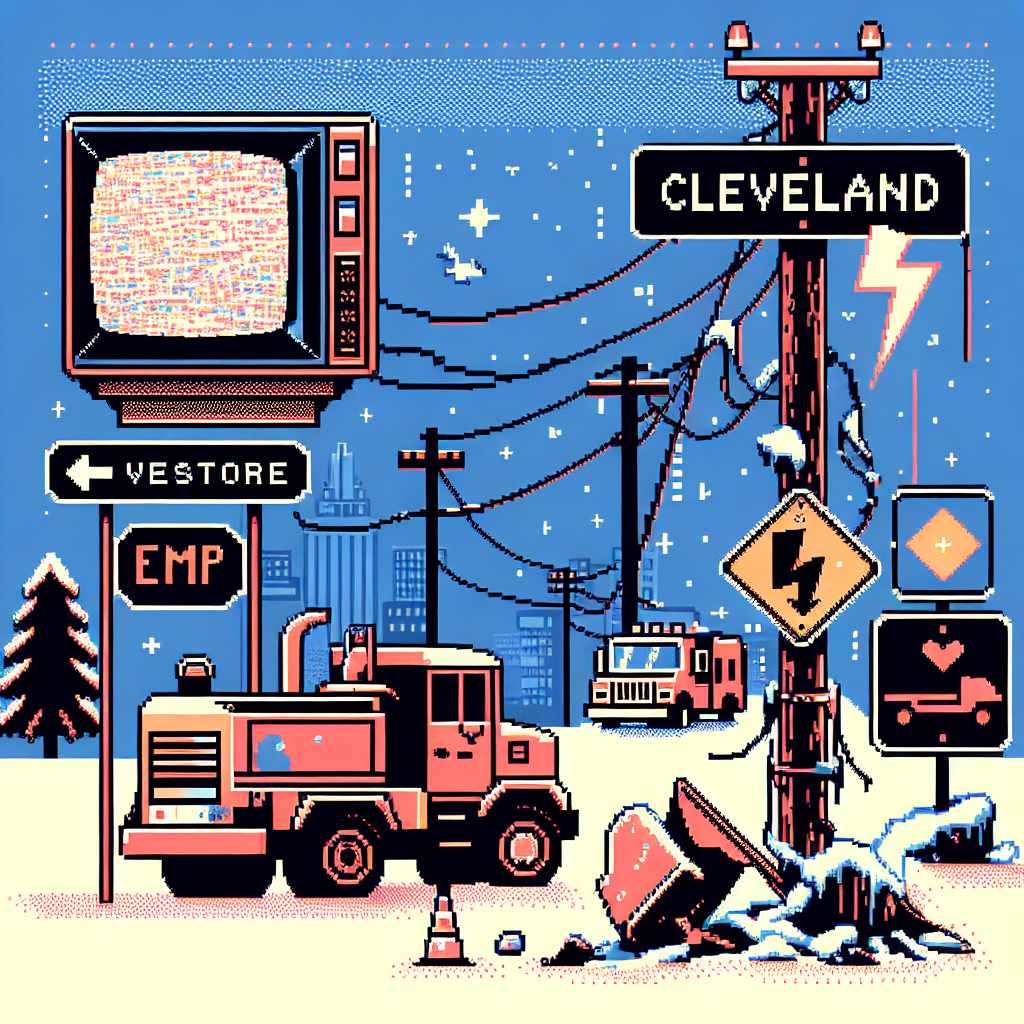
Plow Truck Snaps Pole, N.E. Ohio Offline | Analysis by Brian Moineau

A plow truck, a snapped pole, and a neighborhood offline: what happened in Cleveland Heights

It was one of those small, aggravating disruptions that suddenly remind you how much of modern life runs on invisible lines. On January 2, 2026, a plow or salt truck struck a utility pole in Cleveland Heights and damaged fiber lines that carry internet and phone service for Spectrum customers. The result: pockets of northeast Ohio left without connectivity during a winter afternoon — a sharp inconvenience for remote workers, students, local businesses, and anyone trying to get basic information or call for help.

Why this matters more than a simple “outage” headline

  • Internet and phone outages aren’t just about lost streaming or annoyance. They can interrupt work meetings or deadlines, halt online classes, prevent contact with emergency services, and disrupt businesses that depend on card payments or inventory systems.
  • Fiber lines are often routed on the same poles that carry electricity and other utilities. Physical damage to a pole can therefore cascade into multiple systems going dark.
  • Winter weather makes repairs slower and more dangerous. Crews need safe access, proper equipment, and sometimes coordination with power companies to de-energize lines before they can work.

What we know (the quick facts)

  • Date of incident: January 2, 2026.
  • Location: Cleveland Heights, northeast Ohio.
  • Cause: A plow or salt truck hit a utility pole and damaged fiber lines.
  • Company affected: Spectrum (service disruption to Cleveland-area customers).
  • Response: Spectrum said crews responded immediately and were working to make repairs. Local news reported the developing situation and advised customers to check for updates. (cleveland19.com)

A closer look at the chain reaction

  • A vehicle strikes a pole → pole shifts or breaks → attached fiber and copper lines are pulled or severed → signal loss for downstream customers.
  • Even if the physical fiber is only partially damaged, signal quality can drop or intermittent outages can occur until full repairs are completed.
  • Utilities and ISPs often must coordinate: electrical crews may need to ensure a safe work environment before telecom technicians can access damaged lines.

How outages hit different people

  • Remote workers: missed calls, lost VPN access, inability to join video meetings.
  • Students: interrupted online classes, lost assignments or test access during timed exams.
  • Small businesses: card machines and POS systems may fail, causing revenue loss.
  • Vulnerable households: medical devices that rely on internet/phone service or inability to reach caregivers/emergency responders.
  • Community hubs: libraries and warming centers often provide connectivity — when they’re affected, residents lose fallback options.

Practical steps for residents (short, useful checklist)

  • Check official outage pages and local news for updates. Spectrum posted that crews were working to restore services; official channels are the best source for timelines. (cleveland19.com)
  • Use cellular data as a temporary fallback; if your mobile plan allows, create a hotspot for critical tasks.
  • If power is out, conserve mobile battery: lower screen brightness, close unused apps, use low-power mode.
  • For prolonged outages, seek local warming centers, libraries, or businesses that still have power and connectivity.
  • Report your outage to your provider so they have accurate counts and locations — aggregated customer reports help prioritize repairs.

What this says about infrastructure resilience

This incident is a reminder that our communications infrastructure is vulnerable to everyday accidents — not just cyberattacks or massive storms. As communities and utilities upgrade networks, there’s growing emphasis on:

  • Hardening critical poles and rerouting fiber underground where feasible (costly but reduces weather and accident risk).
  • Better coordination and mutual-aid agreements between utilities and ISPs to speed safe access for repairs.
  • Local contingency planning so residents without backups aren’t left stranded during transient events.

Spectrum and other providers often open public Wi‑Fi access points and issue advisories during wide outages; those measures help, but they’re stopgaps until physical repairs are finished. (spectrumlocalnews.com)

Neighborhood voices

On community forums and local social feeds, residents reported varying outage durations: some saw service restored within hours, others were offline longer. Those firsthand accounts show two things: (1) outage boundaries are often patchy and unpredictable, and (2) people rely on neighborhood networks — checking with neighbors, sharing battery packs, or pooling resources when needed. (reddit.com)

My take

Small incidents like a plow hitting a pole make for big-picture questions. How quickly can essential services be restored when the unexpected happens? Are there better ways to shield critical communications from routine roadway accidents? And how can communities plan so outages don’t become emergencies for vulnerable residents?

Practical investments — from targeted undergrounding in critical corridors to faster inter-agency coordination and community-level backup plans — won’t eliminate risk, but they make neighborhoods more resilient. In the meantime, keep a simple preparedness kit: phone charger, portable battery, and a plan for where to go if connectivity or power goes out.

Sources


Related update: We recently published an article that expands on this topic: read the latest post.


T‑Mobile Tacks $3 Monthly for Apple TV | Analysis by Brian Moineau

Don’t forget: T‑Mobile’s “Apple TV On Us” will cost $3 a month starting January 1, 2026

You might have assumed your carrier perk would quietly stay free forever. If you’re on certain T‑Mobile postpaid plans and have been enjoying Apple TV “On Us,” don’t be surprised to see a new line on your bill next year: the benefit will no longer be entirely free — it becomes a $3/month charge on January 1, 2026.

Here’s what’s changing, why it matters, and what you can do about it.

What’s happening (quick snapshot)

  • T‑Mobile is ending the fully free Apple TV “On Us” benefit for most eligible plans. Effective January 1, 2026, customers who previously received Apple TV at no charge will see a $3/month fee.
  • T‑Mobile will continue to apply a $9.99/month discount toward Apple TV for qualifying plans; after Apple raised Apple TV+ to $12.99/month, subscribers will pay the remaining $3.
  • The change affects customers on plans such as Experience More, Experience Beyond, Go5G Plus / Next, Magenta MAX, Magenta Plus, ONE Plus, and similar tiers.
  • T‑Mobile still appears to offer a six‑month trial for some customers, and subscribers can manage or cancel the add‑on in T‑Life or via their T‑Mobile account. (t-mobile.com)

Why T‑Mobile is doing this

  • Apple increased Apple TV+’s price from $9.99 to $12.99 (U.S.) in 2025. That $3 hike is the direct reason the “On Us” perk can’t remain truly free unless T‑Mobile absorbs the full increase. (reuters.com)
  • Carriers regularly reassess bundled perks to protect margins as third‑party services raise prices or as promotional windows end. T‑Mobile is keeping a substantial discount — it’s just passing some of the recent Apple price increase through to customers. (appleinsider.com)

Who this affects

  • Current T‑Mobile postpaid customers on qualifying plans who redeemed Apple TV “On Us” or receive it as a plan benefit.
  • Customers billed for Apple TV through T‑Mobile (not via Apple directly): their bill will reflect the $12.99 price or the $9.99 discount plus the $3 customer share starting Jan 1, 2026.
  • People who have the Apple TV subscription through Apple directly aren’t managed by T‑Mobile’s billing unless they choose to redeem the carrier offer. If you redeem T‑Mobile’s $3 offer, your Apple‑billed subscription may be paused and T‑Mobile’s billing will take over. (t-mobile.com)

Practical steps to avoid surprises

  • Check your T‑Mobile messages and the T‑Life app for account notices that mention “Apple TV just $3/month” or a price‑change notification. T‑Mobile has been sending texts to affected customers. (androidauthority.com)
  • If you don’t want to pay $3/month, cancel the T‑Mobile–managed Apple TV subscription before January 1, 2026. Manage it in T‑Life or via your T‑Mobile ID. (t-mobile.com)
  • Compare alternatives: Apple still offers free trials (often three months for device purchases), Apple One bundles may make sense if you use multiple Apple services, and Apple’s new Apple TV + Peacock bundle (or other streaming bundles) can be more economical depending on which services you use. (tomsguide.com)

The bigger picture for carrier perks

  • This is part of a wider pattern: carriers trim or restructure perks when content partners raise prices or change promotional strategies. What felt like a permanent “freebie” can be temporary. (mactrast.com)
  • For customers, it’s a reminder to treat carrier‑bundled streaming perks like subscriptions: set a calendar reminder before the trial or promotional period ends, and review whether the perk still delivers value.

My take

T‑Mobile’s move is pragmatic — it preserves a meaningful discount ($9.99 off the new $12.99 price) while shifting a small portion of the cost to customers. For users who casually watch Apple TV originals, $3/month is a modest fee to keep the service. But for budget‑minded subscribers who only used the perk because it was free, that three dollars is an inflection point: keep it, switch to a trial, or cancel and reallocate that money to another streaming option.

If you’ve forgotten you had the perk, treat this as a friendly billing nudge: check your account, decide whether you want Apple TV after January 1, 2026, and act before the charge appears.

Sources


Related update: We recently published an article that expands on this topic: read the latest post.


Related update: We recently published an article that expands on this topic: read the latest post.

Inside the Lucrative World of Smishing | Analysis by Brian Moineau

Sim farms to Gucci shoes: the hidden economy powering smishing gangs

They don’t stash cryptocurrency in cold wallets — they stack Gucci boxes on warehouse shelves. A recent investigation into smishing (SMS phishing) operations lifts the lid on an industrial-scale fraud economy: mass-texting infrastructure, pre-built phishing kits, stolen card farms and a fast-turnover spending spree that turns victims’ misery into luxury handbags and high-end sneakers.

This post walks through how smishing works today, why it’s so profitable, the infrastructure behind it (hello, “SIM farms”), how law enforcement and regulators are responding, and most importantly — what you can do to avoid being a target.

Why this story matters

  • Smishing has evolved from opportunistic text scams into a coordinated, profitable ecosystem that resembles a shadow supply chain.
  • Criminal groups reinvest quickly: stolen payment details are loaded into mobile wallets or used to buy consumer electronics and designer goods almost instantly.
  • The tools are low-cost and highly scalable, meaning attackers can reach millions of people with small messages and big returns.

How smishing actually works (the scammer’s playbook)

  • Attack vector: A short, urgent-looking SMS (“missed parcel”, “suspicious charge”, “toll fee”) contains a link or phone number. The message is crafted to bypass initial skepticism.
  • Data capture: Victims who click are taken to convincing fake sites that harvest card details, OTPs, and login credentials. Some campaigns also coax victims into installing malicious apps that harvest SMS or device data.
  • Monetization: Stolen cards are used immediately — loaded into Apple/Google Wallets, purchased as gift cards, or used to buy high-value goods that can be resold. In some reported cases, criminals load stolen cards onto pre-positioned devices for rapid checkout.
  • Amplification: Compromised accounts (social or contact lists) and SIM swapping let attackers expand reach and evade some checks.

The infrastructure: SIM farms, phishing kits and a fraud economy

  • SIM farms: Banks of SIM cards and devices used to send huge volumes of SMS without going through normal carrier channels. They make smishing campaigns cheap, fast and harder to trace.
  • Smishing kits: Off-the-shelf fraud software sold on messaging apps and underground forums that package fake landing pages, campaign dashboards, and support — turning novices into effective operators.
  • Reinvestment loop: Proceeds fund lifestyle spending (designer goods, phones, travel), which also serves as evidence for police raids — a visible sign of scale that investigators have seized en masse.

Reports from industry watchers and law-enforcement summaries describe the operation as “industrialized” — not lone opportunists, but syndicates with roles, tooling, and logistics. (mobileecosystemforum.com)

The spoils: why luxury items keep appearing in evidence rooms

  • Quick conversion: Rather than launder cash slowly, many gangs spend stolen funds immediately on tangible goods (train-and-flip model). Luxury items are a fast way to convert card data into resaleable assets or instant status.
  • Visibility: Luxury purchases are literally visible in evidence rooms after raids — a compelling narrative for media coverage and a real-world indicator of the proceeds’ size. Police uncover thousands of shoes, bags and electronics in some seizures. (thehackernews.com)

The scale and human cost

  • Massive reach: Some campaigns send hundreds of thousands of malicious SMS in a single day. Estimates and government briefings point to millions of compromised cards and billions in losses globally over recent years. (thehackernews.com)
  • Victim impact: Beyond financial loss, victims face account takeover, credit damage, time spent recovering funds and a psychological hit from being exploited by a seemingly small text.

What regulators and telcos are doing

  • Bans and rules: Governments (notably the UK) have moved to restrict or ban SIM farms and strengthen the regulatory toolkit to prevent their commercial supply and misuse. Carrier-level filtering, more stringent SIM-issuance checks, and voluntary codes for app stores are also part of the response. (gov.uk)
  • Industry action: Banks and payment networks are improving fraud detection, moving away from SMS-based OTP where possible, and offering faster dispute resolution — but the attack surface has shifted into mobile wallets and merchant transactions, which complicates defense.

Practical advice for staying safe

  • Treat unexpected SMS with skepticism. Don’t click links in texts about urgent bank problems or delivery issues — open the bank or courier’s app/website yourself.
  • Use app-based or hardware MFA where possible instead of SMS-based two-factor authentication.
  • Check mobile account security: register a PIN/passcode with your carrier and be cautious about unsolicited calls that ask to “port” your number.
  • Keep device software up to date and avoid installing apps from unknown sources.
  • If you’re targeted: contact your bank immediately, freeze cards, report the SMS to your carrier and report the fraud to local law enforcement or consumer protection agencies.

For consumers, the single most effective habit is a pause: don’t rush to click — log in to the service directly using a bookmark or official app and verify.

What this means for businesses and policymakers

  • Businesses need layered fraud detection that looks beyond simple velocity rules (many messages, many clicks) and into account-behavior analytics and device profiling.
  • Policymakers must balance legitimate uses of bulk-SMS tools with tighter controls on SIM farm hardware and app-store distribution of malicious “SIM-farming” apps.
  • Cross-border enforcement is essential because many operations orchestrate infrastructure and cash-out chains across jurisdictions.

My take

This isn’t just a phishing problem — it’s an emergent criminal business model that exploits our dependence on mobile messaging and legacy authentication methods. The image of Gucci boxes in evidence rooms is a vivid, almost cinematic shorthand, but beneath it is a systemic imbalance: cheap, scalable attack tooling versus fragmented, slow-moving defenses. Consumers can and should act — but meaningful, sustainable disruption will need coordinated tech, telecom and law-enforcement changes, paired with smarter payment authentication that doesn’t rely on SMS.

A quick checklist to reduce your risk

  • Never click suspicious SMS links.
  • Prefer authentication apps or hardware keys.
  • Add a carrier account PIN and monitor your mobile number.
  • Regularly review bank/credit statements and set alerts.
  • Report suspicious messages to your carrier and bank.

Sources

Optus Outage Sparks Crisis in Telecom | Analysis by Brian Moineau

Title: The Optus Outage: A Wake-Up Call for Australia’s Telecom Infrastructure

In an age where connectivity is more than just a convenience—it’s a lifeline—the recent Optus telecom outage in Australia has raised serious concerns about the reliability of our communication networks. The incident not only left hundreds without service but has also been tragically linked to multiple fatalities. How did we get here, and what does this mean for the future of telecommunications in Australia?

Understanding the Incident: What Happened?

On a seemingly ordinary day, Australia’s telecommunications giant, Optus, experienced a significant outage that lasted several hours. This disruption impacted countless users who were unable to access not just social media or entertainment, but crucial services like emergency calls. As the dust settled, reports emerged linking the outage to several tragic deaths, highlighting a devastating consequence of our growing dependence on digital communication.

The Bigger Picture: Context of the Outage

Telecommunications have become the backbone of modern society, essential for everything from personal communication to emergency services. In Australia, Optus is one of the key players in the market, providing services to millions. When a service as vital as emergency communication fails, the ramifications can be severe.

This incident has sparked outrage among the public, prompting urgent questions about the reliability of telecommunications infrastructure. How can we ensure that such a critical service remains uninterrupted? What measures are in place to prevent future outages? As citizens turn their frustration towards Optus, policymakers and industry leaders are also under pressure to address these vulnerabilities.

Key Takeaways

Critical Importance of Connectivity: The Optus outage showcased how crucial telecom services are for emergency situations, emphasizing that connectivity is not just a luxury but a necessity.

Public Outcry: The incident has led to widespread anger in Australia, with calls for accountability and improved infrastructure to prevent future outages.

Link to Fatalities: Investigations revealed that the outage was connected to multiple deaths, underlining the serious consequences of telecom failures.

Need for Robust Infrastructure: This incident serves as a dire reminder that telecommunications infrastructure needs to be resilient and reliable, especially for emergency services.

Policy Implications: The fallout from this outage may prompt policymakers to re-evaluate regulations and standards governing telecommunications providers in Australia.

Concluding Reflection

As we navigate an increasingly digital world, the Optus outage serves as a sobering reminder of the fragility of our communication systems. It’s not just about staying in touch with friends or streaming our favorite shows; it’s about ensuring that in times of crisis, help is only a call away. Moving forward, it’s imperative that both telecom companies and policymakers prioritize the reliability of these essential services. After all, in a connected world, we cannot afford to be disconnected—especially when lives are on the line.

Sources

– “Optus: Anger in Australia after telecom outage linked to deaths” – BBC News – “Telecommunications Reliability in Crisis Situations” – Australian Communications and Media Authority

By fostering a dialogue around these issues, we can work towards a more secure and dependable telecommunications future for all Australians.


Related update: We recently published an article that expands on this topic: read the latest post.


Related update: We recently published an article that expands on this topic: read the latest post.

Apple is giving iPhone 14 and 15 users another free year of satellite features – The Verge | Analysis by Brian Moineau

Apple is giving iPhone 14 and 15 users another free year of satellite features – The Verge | Analysis by Brian Moineau

Title: Apple Extends Satellite Features for iPhone 14 and 15: A Glimpse into Our Connected Future

In an exciting announcement that feels straight out of a sci-fi novel, Apple is gifting iPhone 14 and 15 users with another year of free satellite connectivity. This extension, revealed in Apple’s iPhone 17 press releases, underscores a rapidly evolving world where staying connected is not just a luxury but a necessity.

Connecting the Dots: Technology and Beyond

Imagine this: you’re hiking through the stunning yet isolated Sierra Nevada mountains. Suddenly, you find yourself lost, or worse, in need of help. In the past, you’d have to rely on traditional methods of communication or hope for a passing hiker. But with Apple’s satellite features, your iPhone becomes a lifeline, connecting you to the world even in the most remote locations. It’s not just about convenience; it’s about safety and peace of mind.

This move by Apple isn’t just a technical upgrade—it’s a societal shift. Consider the implications in disaster-stricken areas where traditional communication infrastructures fail. Satellite connectivity can be a game-changer, ensuring vital communication lines remain open when they’re needed most.

Satellite Connectivity: A New Frontier

Apple’s foray into satellite connectivity isn’t happening in a vacuum. It mirrors a broader trend in tech, where companies are racing to provide internet connectivity in the remotest corners of the globe. Elon Musk’s Starlink, for instance, aims to deliver high-speed internet across the planet using a constellation of low Earth orbit satellites.

Furthermore, this extension aligns with global initiatives to bridge the digital divide. According to the International Telecommunication Union, nearly half of the world’s population still lacks internet access. Apple’s commitment could be seen as a step toward universal connectivity, a vision that aligns with global efforts to ensure everyone, everywhere, can access the digital world.

Implications for the Future

As we embrace this satellite-enabled future, it raises intriguing possibilities. Could our smartphones become even more integral to our everyday lives? Will we witness a surge in adventure tourism, knowing that help is just a satellite signal away? It’s an exhilarating thought for tech enthusiasts and adventurers alike.

Moreover, as climate change continues to challenge our planet, satellite connectivity could play a crucial role in monitoring environmental changes and aiding in disaster response. It’s a reminder that technology, when used responsibly, can be a powerful force for good.

Final Thoughts

Apple’s decision to extend free satellite features for iPhone 14 and 15 users is more than a generous offer; it’s a visionary step towards a future where connectivity knows no bounds. As we stand on the precipice of this new era, it’s thrilling to imagine the possibilities that lie ahead.

Whether you’re an avid traveler, a tech enthusiast, or someone who simply appreciates the peace of mind that comes with knowing you’re always connected, this announcement is a testament to the remarkable age of technology we live in. So, here’s to staying connected, no matter where we are on this beautiful planet. Cheers to the future!

Read more about AI in Business

Read more about Latest Sports Trends

Read more about Technology Innovations


Related update: We recently published an article that expands on this topic: read the latest post.

Apple Already Testing a C2 Modem for iPhones, According to Leaker – MacRumors | Analysis by Brian Moineau

Apple Already Testing a C2 Modem for iPhones, According to Leaker – MacRumors | Analysis by Brian Moineau

**Title: Apple’s Second-Gen C2 Modem: A Peek Into the Future of iPhone Connectivity**

Ah, the thrill of a new iPhone feature! It’s akin to unwrapping a gift you never knew you needed, yet somehow, once it’s in your hands, you can’t imagine life without it. Apple, the maestro of tech innovation, is reportedly testing its second-generation C2 modem for future iPhone models, according to a trustworthy leaker. This news comes as a whisper of excitement in the tech community, hinting at the potential leap forward in connectivity for Apple’s flagship product.

**The C2 Modem: A Sneak Peek**

Imagine your iPhone working even faster, with improved connectivity and less battery drain. That’s the promise of the C2 modem. While details remain somewhat under wraps, this second-generation modem is expected to enhance the speed and reliability of data transmission, a crucial aspect as we increasingly rely on our devices for everything from streaming to gaming.

The significance of this development extends beyond just Apple. As the world pivots towards 5G and beyond, having a proprietary modem positions Apple to not only optimize performance but also to better integrate hardware and software. This seamless integration is a hallmark of Apple’s design philosophy, reminiscent of their move to custom silicon with the M1 chip.

**Apple’s Track Record: A Symphony of Innovation**

This isn’t Apple’s first foray into developing its hardware. The company’s transition to its silicon for Macs was a bold move that paid off handsomely, with the M1 chip delivering remarkable performance and efficiency. The C2 modem could signify a similar shift in the realm of mobile connectivity, potentially setting a new standard for competitors.

Globally, the push towards more efficient and powerful mobile networks is relentless. For example, South Korea and China are racing ahead with 5G deployments, while Europe is making significant investments in infrastructure. Apple’s C2 modem could be a key player in this global tech race, providing users with the tools to harness the full potential of advanced networks.

**The Leaker’s Credibility**

When it comes to leaks, credibility is key. The source of this information has a solid track record, lending weight to the speculation. In the world of tech leaks, where rumors are as common as coffee spills in Silicon Valley, a reliable source is worth its weight in gold.

**Final Thoughts: The Future Beckons**

As Apple moves forward with testing the C2 modem, the tech world watches with bated breath. The evolution of iPhone connectivity is not just about faster download speeds or clearer calls; it’s about paving the way for new innovations that will shape our digital lives.

In essence, the C2 modem represents more than just a technical upgrade. It’s a promise of innovation that keeps us on the edge of our seats, wondering what the next iPhone will bring. As we await official announcements, one thing is certain: Apple’s commitment to pushing the envelope ensures that the future of mobile technology is as bright as the shiny new iPhone in your pocket.

Read more about AI in Business

Read more about Latest Sports Trends

Read more about Technology Innovations


Related update: We recently published an article that expands on this topic: read the latest post.