TL;DR
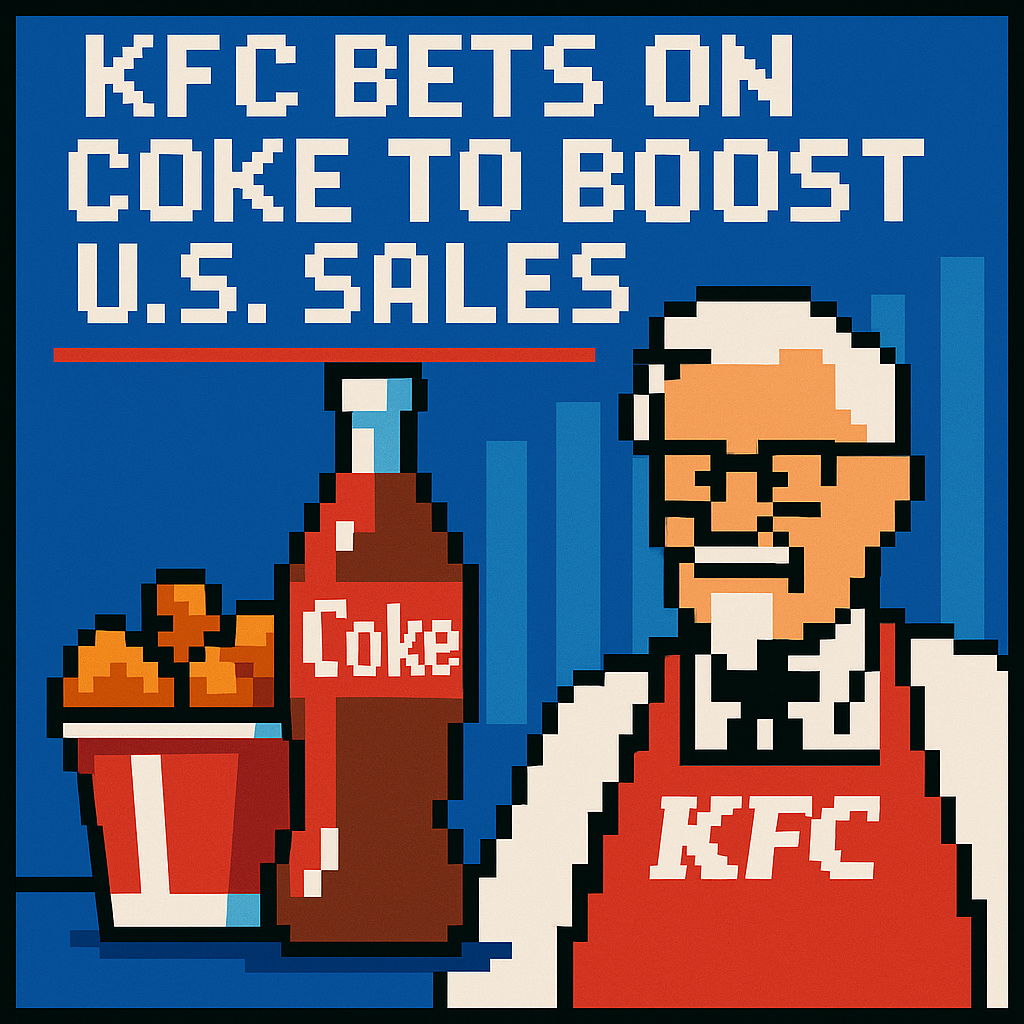
- KFC replacing Pepsi with Coca-Cola at roughly 3,700 U.S. restaurants is a contract story with margin math underneath: Coke brings a broader beverage toolkit and system support KFC needs for its “comeback” in the U.S. [1][2][3].
- If beverages are ~10–15% of KFC U.S. sales, even a 1-point attach-rate lift plus modest trading-up to “crafted” drinks could add tens of millions in franchisee gross profit by spring 2027; back-of-envelope says ~$25M systemwide at conservative margins. [5][6][7][8]
- Pepsi loses a marquee U.S. fountain account but keeps Taco Bell and KFC International; Coke gains fresh visibility in chicken QSR just as Costco and others have swung back to Coke—suggesting pouring-rights churn, not a one-off. [4][9][10]
What the source said
Fox Business reports that KFC will replace Pepsi products with Coca-Cola across about 3,700 U.S. restaurants, ending a nearly four-decade beverage partnership. The rollout starts in January 2027 and is expected to be complete by spring 2027. The switch marks a high-profile win for The Coca‑Cola Company in QSR fountain accounts. [1]
Fox also notes the legacy ties between PepsiCo and KFC dating to PepsiCo’s 1986 acquisition of the chain, and the later Yum! Brands spin-off in 1997, making the change symbolic as well as operationally complex for franchisees. Financial terms weren’t disclosed in the report. [1]
Why it matters
For KFC U.S. (part of Yum! Brands), beverages reliably lift average check with high incremental margins, and Coca-Cola’s foodservice machine—portfolio breadth (Coke, Sprite, Fanta, Gold Peak, fairlife, BODYARMOR), R&D, and activation—gives KFC more “levers” than a standard cola swap. Trade sources peg cold-dispensed gross margins around ~52%, which is why beverage mix matters so much to franchisee P&Ls. [11][2]
For the cola duopoly, fountain contracts are beachheads that shape multi-year consumer defaults. Coca-Cola adds a national chicken chain to a roster that already includes McDonald’s and Wendy’s; PepsiCo forfeits a visible U.S. account but keeps Taco Bell and KFC outside the U.S., plus a 10‑year Subway deal starting 2025. Expect both players to redeploy incentives and innovation to defend or pry open other chains’ contracts in 2026–2027. [2][3][4][9]
Original analysis
This isn’t just “cola wars”; it’s a beverage P&L move
Consensus read: “KFC switched because customers prefer Coke.”
Contrarian read: KFC switched because Coca-Cola gives it a faster path to higher-margin beverage mix and more dayparts, supported by system capabilities (equipment, marketing, data) and a deeper bench of non-cola SKUs that pair with chicken—iced teas, lemonades, “refreshers,” and zero-sugar options. [2][3][8]
Two facts frame the math:
- KFC’s 2024 U.S. system sales were about $4.907B, across ~3,669 units (AUV ~$1.336M). [5][6]
- Beverages contribute roughly 10–15% of QSR sales (midpoint 12%), and beverage attach rates historically hover near or above half of orders in limited service (a 2007 NYC study found 54.1% of multi-item receipts included a beverage). [8][7]
Back-of-envelope calculation (conservative)
- Baseline beverage sales (12% of U.S. system sales): 0.12 × $4.907B ≈ $589M. [5][8]
- Suppose Coca-Cola’s program lifts beverage mix +1 percentage point via new SKUs/combos (to 13%): incremental sales ≈ $4.907B × 0.01 ≈ $49M. [5]
- What drops to the bottom line for franchisees? Use ~52% gross margin as a cautious proxy from cold-dispensed benchmarks. [11]
- Incremental gross profit ≈ $49M × 0.52 ≈ $25.5M.
- Upsell potential: “crafted” fountain or refresher-style drinks often carry ~$2.50+ price points with ~$2.15 gross profit—far richer than standard cola pours. A few share points of mix-shift into these items would compound the profit lift. [12]
Is +1 point realistic? The switch coincides with KFC’s U.S. “comeback” plan and a McKinney, Texas “Open House” innovation restaurant pushing iced coffees, shakes, and boba-style items—formats Coca-Cola can scale across 3,600–3,700 stores with equipment and supply muscle. [3][15]
Historical analogue: 1986 déjà vu—contracts cascade after a headline move
In 1986, PepsiCo bought KFC for $850M and used ownership to drive Pepsi fountain placement, while competitors like Wendy’s bolted to Coke to avoid buying from a rival—an early reminder that pouring rights are strategic, not just taste-based. [13][14] Fast-forward: Costco’s food court swung from Coke to Pepsi in 2013 to protect the $1.50 combo, then confirmed a return to Coke in 2025—another data point that large accounts can and do flip on strategic grounds. [10]
KFC’s 2027 U.S. flip fits that pattern: big-brand moves trigger portfolio recalibration by peers (and suppliers) because economics, innovation roadmaps, and optics shift faster than stated “taste” preferences.
Named-stakeholder breakdown
- Coca-Cola North America Foodservice (Dagmar Boggs): Gains a national chicken QSR to showcase pairing platforms (fried chicken + Sprite/iced tea/lemonade/zero-sugar). Expect menu LTOs and bundle experiments by summer 2027. [2]
- KFC U.S. (Catherine Tan-Gillespie): Buys optionality—more drink SKUs, richer marketing support, and a bridge to new dayparts (snacks, sweets, afternoon beverages) that the “Open House” lab is already testing in Texas. [3][15]
- PepsiCo: Loses U.S. KFC but retains Taco Bell (10-year renewal) and KFC International; also won Subway for a decade starting January 2025. Will redeploy incentives to defend those pillars and to find substitute volume. [4][9]
- Franchisees: Benefit most if Coke helps raise attach rate/trade-up without slowing speed-of-service; fountain margins are among the fattest in-store by gross percentage. [11][12]
- Consumers: Mountain Dew Sweet Lightning (KFC-exclusive since 2019) becomes an open question; Coke systems won’t pour it, and Pepsi historically bottled Baja Blast for retail LTOs after Taco Bell exclusivity. Watch for a 2027 retail LTO. [16][17][18]
What others are missing
Operationally, multibrand “combo” boxes matter. Yum! still runs KFC–Taco Bell co-branded units in the U.S., and Reuters reports Pepsi renewed Taco Bell for 10 years and KFC International—meaning many two-in-one sites will live with split beverage allegiances starting January 2027. [4][19]
That creates floor-plan, equipment, syrup, and POS-coordination puzzles (two towers, backroom storage, supplier service routes) that impact capex, speed, and training. Yum’s filings confirm it operates multibrand units; translating one brand to Coke while the other remains Pepsi is non-trivial and could slow the rollout cadence or drive site-by-site compromises (e.g., dual towers or SKU rationalization). Analysts focused on “cola wars” taste debates are missing this ops-and-contracts choke point where margin is won or lost. [3][4][19]
What to watch next
By June 30, 2027, KFC launches at least one nationally marketed Coca-Cola-based “crafted” beverage (e.g., lemonade/tea/refresher) positioned as a pairing with tenders or buckets, with availability at 3,000+ U.S. stores. [2][3]
By September 30, 2027, PepsiCo announces a U.S. retail or alternative-channel release (seasonal or LTO) of Mountain Dew Sweet Lightning, following the Baja Blast playbook. [16][17]
By March 31, 2027, at least 25% of KFC–Taco Bell co-branded U.S. locations operate with both suppliers’ fountains or a documented workaround (e.g., dual towers, segmented beverage menus), cited in trade or local coverage. [4][19]
My take
Coke isn’t just “better cola”; it’s a beverage system that can raise attach and check while KFC fixes chicken, staffing, and drive-thru. The conservative math already points to ~$25M in extra gross profit for the system if attach nudges up one point, before crafted drinks and daypart wins kick in. Pepsi’s defense will be fierce with Subway and Taco Bell locked through long-term agreements. On balance, I’d make the same bet as KFC: in 2027–2028, beverages will carry more of the U.S. turnaround than nuggets, and Coca-Cola is the stronger chassis for that job. [5][8][11][12]
Sources
[1] KFC replacing Pepsi with Coca-Cola at 3,700 US restaurants after nearly four decades — Fox Business (https://www.foxbusiness.com/retail/kfc-replacing-pepsi-coca-cola-3700-us-restaurants-after-nearly-four-decades.amp) — Straight report of the switch, scale (~3,700 U.S. stores), and spring 2027 completion timeline.
[2] The Coca-Cola Company and KFC Announce New U.S. Beverage Partnership — The Coca‑Cola Company (https://www.coca-colacompany.com/media-center/coca-cola-kfc-us-beverage-partnership) — Official announcement: January 2027 start, spring 2027 completion; Coca‑Cola’s system support and brand quotes.
[3] Two Secret Recipes, One Iconic Partnership: KFC U.S. Announces New Beverage Partnership with The Coca‑Cola Company — PR Newswire (https://www.prnewswire.com/news-releases/two-secret-recipes-one-iconic-partnership-kfc-us-announces-new-beverage-partnership-with-the-coca-cola-company-302910560.html) — KFC’s framing of the move as part of a broader U.S. “comeback,” plus innovation testbed (Open House in McKinney, TX).
[4] KFC picks Coca-Cola as U.S. soda supplier, ditches longtime partner PepsiCo — KSL.com (Reuters) (https://www.ksl.com/article/news/business/kfc-picks-coca-cola-as-us-soda-supplier-ditches-longtime-partner-pepsico/51636951) — Confirms four-decade Pepsi relationship, 3,718 U.S. locations, spring 2027 timing, and Pepsi renewals with Taco Bell and KFC International.
[5] QSR 50 2025: Top Fast-Food Chicken Chains, Ranked by Sales — QSR Magazine (https://www.qsrmagazine.com/story/qsr-50-2025-top-fast-food-chicken-chains-ranked-by-sales/) — U.S. KFC data point: 2024 AUV ~$1.336M, total units ~3,669.
[6] Chick-fil-A sales slowed in 2024, franchise disclosure documents reveal — Nation’s Restaurant News (https://www.nrn.com/quick-service/chick-fil-a-sales-slowed-2024-franchise-disclosure-documents-reveal) — Places KFC’s 2024 U.S. system sales at ~$4.907B for context in chicken QSR.
[7] What People Buy From Fast-Food Restaurants: NYC 2007 — Obesity (Dumanovsky et al., 2009) (https://onlinelibrary.wiley.com/doi/full/10.1038/oby.2009.90) — Receipt study: more than half of multi-item QSR orders include a beverage; useful historical attach-rate anchor.
[8] How to Turn Drinks Into a Growth Engine — QSR Magazine (https://www.qsrmagazine.com/sponsored_content/how-to-turn-drinks-into-a-growth-engine/) — Trade data point: beverages ~10–15% of QSR sales; rationale for average-check and attach-rate focus.
[9] Subway selects PepsiCo as its U.S. beverage partner (10-year agreement beginning Jan 1, 2025) — Subway Newsroom (https://newsroom.subway.com/2024-03-19-Subway-R-Selects-PepsiCo-as-its-Beverage-Partner-in-the-U-S) — Balances narrative: Pepsi wins elsewhere even as it loses KFC U.S.
[10] Costco confirms food courts switched from Pepsi back to Coca‑Cola in 2025 — AOL/USA Today (https://www.aol.com/finance/costco-bids-goodbye-pepsi-stores-200212489.html) — Illustrates recent, high-profile fountain churn toward Coke.
[11] Finding New Opportunities for Fountain Drinks — NACS Magazine (https://www.nacsmagazine.com/issues/march-2025/finding-new-opportunities-for-fountain-drinks) — Benchmarks cold-dispensed margins (~52%) as a conservative proxy for high beverage gross margins.
[12] The New Economics of Fountain Soda — Modern Restaurant Management (https://modernrestaurantmanagement.com/the-new-economics-of-fountain-soda/) — Example pricing/margin: ~$2.50 fountain yielding ~$2.15 gross profit; supports mix-upside thesis.
[13] PepsiCo to Acquire Kentucky Fried Chicken for ~$850M (1986) — Los Angeles Times (https://www.latimes.com/archives/la-xpm-1986-07-24-mn-31648-story.html) — Establishes original Pepsi–KFC tie and era context.
[14] Wendy’s to make $1.6B Pepsi-to-Coke switch (1986) — UPI Archives (https://www.upi.com/Archives/1986/10/15/Wendys-to-make-16-billion-Pepsi-to-Coke-switch/8730529732800/) — Shows how cola contracts cascade when ownership/alliances shift.
[15] KFC opens a Texas “Open House” innovation restaurant — AP News (https://apnews.com/article/6bb34d1783a17f7a651c929306e6752c) — Independent confirmation of KFC’s U.S. innovation platform and testbed.
[16] MTN DEW Sweet Lightning announced as KFC‑exclusive (2019) — KFC Press (https://global.kfc.com/press-releases/mtn-dew-introduces-sweet-lightning-available-exclusively-at-kfc-us-a-bold-new-beverage-to-pair-perfectly-with-the-colonels-11-herbs-and-spices) — Establishes exclusivity baseline affected by the switch.
[17] Mountain Dew bottles Baja Blast for retail (2014) — PR Newswire (https://www.prnewswire.com/news-releases/mountain-dew-bottles-taco-bell-blockbuster-mtn-dew-baja-blast-for-limited-time-only-256503661.html) — Precedent: Pepsi later retails a QSR‑exclusive flavor.
[18] Baja Blast — Wikipedia (https://en.wikipedia.org/wiki/Baja_Blast) — Summarizes repeated Baja Blast retail LTOs after Taco Bell exclusivity, suggesting a likely Sweet Lightning playbook.
[19] Yum! Brands 2025 Form 10‑K (multibrand units) — SEC/PublicNow (https://www.publicnow.com/view/E116F1F4B6977A1A078BD37980EAADAC415968AD) — Confirms Yum! operates multibrand units, relevant to KFC–Taco Bell combo ops under split beverage suppliers.