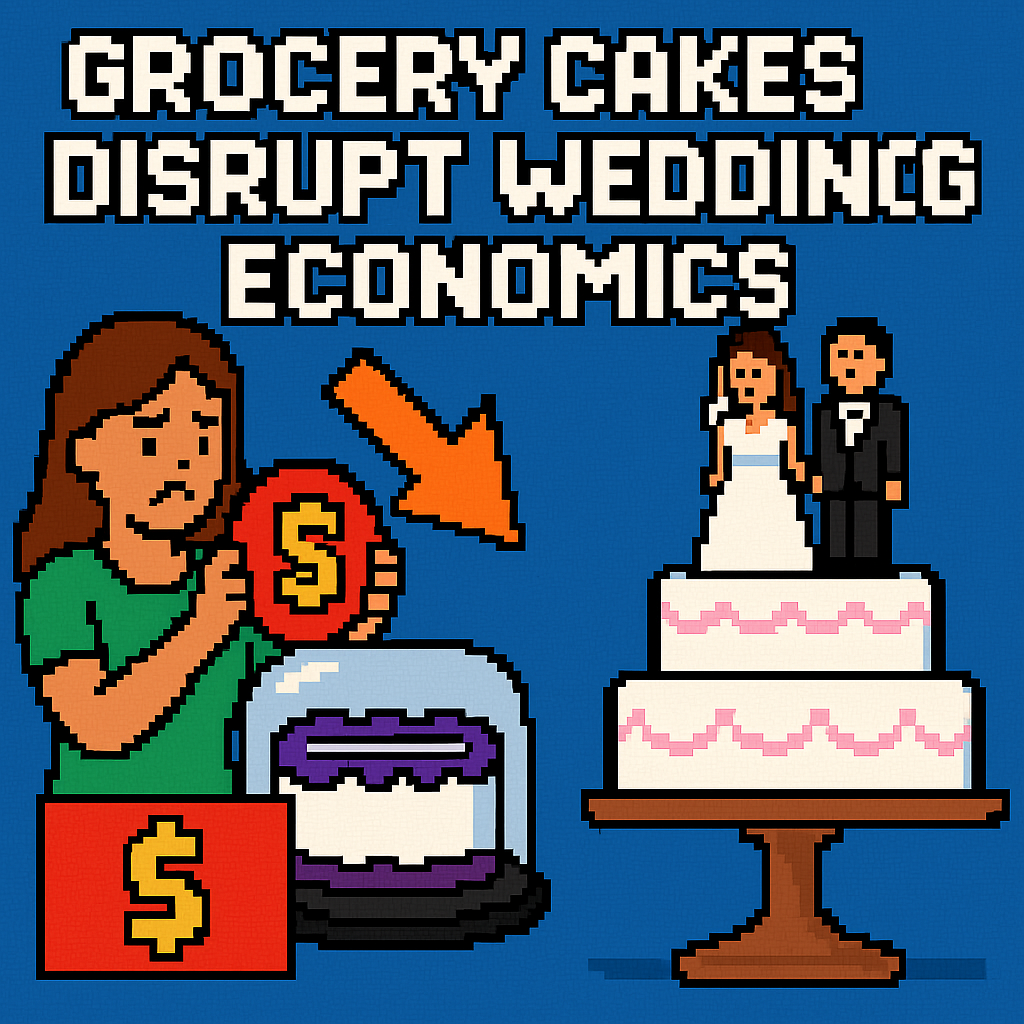
Grocery Cakes Disrupt Wedding Economics | Analysis by Brian Moineau

TL;DR

  • Grocery store wedding cakes are moving from a TikTok hack to a line item, as NPR profiles couples swapping $1,000+ bespoke bakes for Publix tiers and Costco half-sheets “about $30 each” to blunt $36,000 wedding budgets. [1][2]
  • The savings are concrete: half-sheet cakes at $24.99–$27.99 (48 servings) equal roughly $0.50–$0.70 per slice versus boutique bakery pricing of $3–$8 per slice. [2][6]
  • This isn’t a death knell for artisans; cake is ~2% of budgets, so mass retailers siphon value shoppers while boutique bakers double down on design, flavors, and service-led premiums. [2][3]

What the source said

NPR reports a visible shift in 2026: more couples are choosing grocery store wedding cakes to rein in costs amid pricier venues, catering, and imported flowers and gowns. Using Zola’s $36,000 average wedding spend as context for 2026, NPR highlights consumers who opt for Publix tiers or Costco sheet cakes “about $30 each,” trading customization for big savings. [1][2] NPR also cites Zola’s finding that roughly one-third of couples are willing to spend less on cake and dessert to hit their targets. [2][1] Publix says its Birmingham, Alabama area stores sell ~50% more wedding cakes than before 2020, with one fondant design serving 94 priced at $388, while Costco’s per-slice math lands near $0.70. [1][6]

Why it matters

  • Stakeholders aren’t just brides and bakers. Regional grocers (Publix), national club stores (Costco), mass retailers (Walmart), and independents all feel the ripple. In a year when Bank of America Institute’s card data shows wedding-related spending up 8.5% year over year through May 2026, families still need relief valves inside a larger “spend more overall, save on the non-essentials” dynamic. [5]
  • The fight isn’t for cake revenue; it’s for the occasion. Weddings generate high-visibility word-of-mouth and gateway baskets (sheet cakes → deli platters → floral). Fresh departments already account for ~41% of food retail sales in 2026, and deli/prepared foods are pulling more trips; wedding desserts extend that flywheel for grocers. [8]

Original analysis

The grocery store wedding cakes calculus (with math)

Back-of-envelope: compare a typical 150-guest reception.

  • Boutique baseline: Zola pegs common bakery pricing at $3–$8 per slice; take the mid-point at $5.50, total ≈ 150 × $5.50 = $825. [2]
  • Costco scenario: one half-sheet (48 servings) runs about $24.99–$27.99. For 150 guests you’d buy 4 cakes (192 servings) = $99.96–$111.96. Effective per-slice ≈ $0.52–$0.58; total savings ≈ $713–$725. [6][2]
  • Publix scenario: NPR notes a three-tier “real wedding cake look” at a lower per-slice than average, and cites a Birmingham-area fondant cake serving 94 for $388 (~$4.13 per slice). For 150 guests, two such cakes ≈ $776 (188 servings), close to boutique totals but with tiered aesthetics and a free tasting. [1][7]

What this says about demand elasticity: when a category’s share of wallet is ~2%, it becomes a surgical place to economize without “ruining the day.” Dessert is a variable cost that scales with headcount, so it’s a rational target when guest lists creep upward. [2]

A 2×2: Cake-as-Signal vs. Cake-as-Food

  • High signaling priority × High budget: Commissioned showpieces dominate. Flavor flights, sugar flowers, intricate fondant. Independent studios (and luxury grocers) win.
  • High signaling × Low budget: Grocer tiered cakes + minimal decor; add a small “display cake” for photos and backfill with sheet cakes in the kitchen. Publix/Whole Foods sweet spot. [1][7]
  • Low signaling × High budget: Upscale menus steal the spotlight; couples might serve plated desserts and skip a premium cake entirely. Zola’s data show splurges cluster on catering, not cake. [2]
  • Low signaling × Low budget: Pure sheet-cake economics. Costco/Sam’s/Walmart command on price, convenience, and known taste profiles. [6][3]

Contrarian read

Consensus: cheap grocery cakes will “disrupt” boutique bakers.
Counter: they won’t—because cake rarely decides the deal. The knotty constraints—venue minimums, per-head catering costs, band/DJ fees—drive budgets; cake’s 2% share is too small to upend an artisan’s pipeline unless their mix already skews budget-tier. Meanwhile, premium bakers monetize complexity and service that grocers won’t mimic at scale: custom flavors, structural artistry, on-site support, and brand storytelling. Zola’s own range ($3–$8 per slice) signals segmentation, not collapse; couples still buy uniqueness where it photographs and tastes premium. [2][3]

Named-stakeholder breakdown

  • Publix: Rising wedding volume (+~50% vs. pre-2020 around Birmingham) validates a replicable regional playbook—catalog tiers, free tastings, dependable fulfillment. Expect more in-bakery consults and cross-sell into floral/catering in Florida and Georgia. [1][7]
  • Costco: Stays “unbranded” for weddings yet quietly owns the unit-economics crown (48 servings at ~$24.99–$27.99). The lever is throughput and app ordering, not customization. [6][1]
  • Walmart: National reach and aggressive price perception make it the mass-customization contender if it tightens online design tools and pickup logistics. [3]
  • Kroger/Albertsons: If the merger mates deli/bakery scale with regional wedding catalogs, they can challenge Publix in non-Southeast metros; prepared-foods strengths are an edge for bundles. [8]
  • Independent bakers: Margin moves up-market. Sell scarcity (booked-out weekends), design IP, and concierge service. Partner with venues that curate “heritage pastry” aesthetics and charge for tastings, delivery, and touch-ups. [2][3]

What others are missing

Coverage fixates on the cake and misses the trip engine. Weddings are an entry point to a profitable flywheel: a cake consult brings a couple into the bakery, then to floral mockups, deli grazing tables, champagne, and day-of pickup logistics. Fresh already accounts for ~41% of food retail sales in 2026, and deli-prepared foods are pulling more trips; a wedding dessert program quietly adds occasions without restaurant-style labor intensity. If a grocer captures the cake, it often captures the rest of the week’s basket—and possibly a loyalty member for years. [8]

What to watch next

  1. By June 30, 2027, at least one of the five largest U.S. grocers by sales will launch in-app wedding cake consultations or tasting-box reservations (observable via a public landing page or app release notes).
  2. By December 31, 2027, Bank of America Institute will publish a follow-up showing wedding-related card spend still outpacing total services growth, even if unit counts soften (confirmable via a dated Institute post). [5]
  3. By September 30, 2028, Zola or The Knot will report a ≥5 percentage-point increase from 2026 in couples sourcing dessert from non-boutique channels (grocers, clubs, or big-box), reflected in an annual trend report. [2][3]

My take

I’d bet on a barbell. Grocery store wedding cakes will keep winning the pragmatic middle—especially outside Los Angeles and New York—while the top of the market doubles down on design and spectacle with boutique studios. If I’m a grocer like Publix, Costco, or Walmart, I productize the “wedding weekend”: cake consults, a modest tiered catalog, sheet-cake backfill, floral packages, and grazing boards—all bookable online with precise pickup windows. If I’m a boutique baker, I raise minimums, publish per-slice bands, and upsell on artistry and on-site service. The couples haven’t changed; the math has. Build for the math.

Sources

[1] Weddings are expensive. How about a grocery store cake? — NPR (https://www.npr.org/2026/10/17/nx-s1-5976921/grocery-store-wedding-cakes) — News peg; cites Zola’s $36,000 average, “about a third” willing to save on dessert, Publix’s Birmingham growth and pricing, and Costco’s per-slice math.

[2] Wedding Cake Cost Guide: Average Price and Budget Tips — Zola (https://www.zola.com/expert-advice/a-guide-to-wedding-cake-costs) — National cake averages ($700–$1,100), typical per-slice pricing ($3–$8), and cake’s small share of total budget.

[3] Weddings in 2024: A Look Back at Industry Statistics — The Knot (https://www.theknot.com/content/wedding-data-insights/weddings-in-2024) — Benchmark that average wedding cost was $33,000 in 2024, offering contrast to Zola’s 2026 figure.

[4] Consumer Price Index News Release (mid-2026) — U.S. Bureau of Labor Statistics (https://www.bls.gov/news.release/cpi.htm) — Category data indicate “cakes, cupcakes, and cookies” index rising roughly 3% year over year in mid-2026, framing dessert input inflation.

[5] Weddings: Putting a price on love — Bank of America Institute (https://institute.bankofamerica.com/economic-insights/wedding-spending.html) — Shows wedding-related spending up 8.5% YoY through May 2026, reinforcing the “save here, splurge there” environment.

[6] How to Order a Cake at Costco (Tips, Pros, Cons & Prices) — The Kitchn (https://www.thekitchn.com/ordering-costco-cakes-guide-23678755) — Documents half-sheet cakes at $24.99 for 48 servings and ordering norms.

[7] Wedding & Special Occasion Cakes — Publix Super Markets (https://www.publix.com/products-services/bakery/wedding-special-occasions) — Confirms free tastings, flavor/filling options, and the standardized planning flow within the bakery program.

[8] Fresh Foods Still Win: Three Signals Shaping the Future of Grocery — FMI (https://www.fmi.org/blog/view/fmi-blog/2026/09/09/fresh-still-wins–three-signals-shaping-the-future-of-grocery) — Industry context: fresh departments’ share of sales (~41%) and deli/prepared foods’ role in driving trips, crucial to the wedding-weekend cross-sell thesis.


Related update: We recently published an article that expands on this topic: read the latest post.
KFC Bets on Coke to Boost U.S. Sales | Analysis by Brian Moineau

TL;DR

  • KFC replacing Pepsi with Coca-Cola at roughly 3,700 U.S. restaurants is a contract story with margin math underneath: Coke brings a broader beverage toolkit and system support KFC needs for its “comeback” in the U.S. [1][2][3].
  • If beverages are ~10–15% of KFC U.S. sales, even a 1-point attach-rate lift plus modest trading-up to “crafted” drinks could add tens of millions in franchisee gross profit by spring 2027; back-of-envelope says ~$25M systemwide at conservative margins. [5][6][7][8]
  • Pepsi loses a marquee U.S. fountain account but keeps Taco Bell and KFC International; Coke gains fresh visibility in chicken QSR just as Costco and others have swung back to Coke—suggesting pouring-rights churn, not a one-off. [4][9][10]

What the source said

Fox Business reports that KFC will replace Pepsi products with Coca-Cola across about 3,700 U.S. restaurants, ending a nearly four-decade beverage partnership. The rollout starts in January 2027 and is expected to be complete by spring 2027. The switch marks a high-profile win for The Coca‑Cola Company in QSR fountain accounts. [1]

Fox also notes the legacy ties between PepsiCo and KFC dating to PepsiCo’s 1986 acquisition of the chain, and the later Yum! Brands spin-off in 1997, making the change symbolic as well as operationally complex for franchisees. Financial terms weren’t disclosed in the report. [1]

Why it matters

For KFC U.S. (part of Yum! Brands), beverages reliably lift average check with high incremental margins, and Coca-Cola’s foodservice machine—portfolio breadth (Coke, Sprite, Fanta, Gold Peak, fairlife, BODYARMOR), R&D, and activation—gives KFC more “levers” than a standard cola swap. Trade sources peg cold-dispensed gross margins around ~52%, which is why beverage mix matters so much to franchisee P&Ls. [11][2]

For the cola duopoly, fountain contracts are beachheads that shape multi-year consumer defaults. Coca-Cola adds a national chicken chain to a roster that already includes McDonald’s and Wendy’s; PepsiCo forfeits a visible U.S. account but keeps Taco Bell and KFC outside the U.S., plus a 10‑year Subway deal starting 2025. Expect both players to redeploy incentives and innovation to defend or pry open other chains’ contracts in 2026–2027. [2][3][4][9]

Original analysis

This isn’t just “cola wars”; it’s a beverage P&L move

Consensus read: “KFC switched because customers prefer Coke.”
Contrarian read: KFC switched because Coca-Cola gives it a faster path to higher-margin beverage mix and more dayparts, supported by system capabilities (equipment, marketing, data) and a deeper bench of non-cola SKUs that pair with chicken—iced teas, lemonades, “refreshers,” and zero-sugar options. [2][3][8]

Two facts frame the math:

  • KFC’s 2024 U.S. system sales were about $4.907B, across ~3,669 units (AUV ~$1.336M). [5][6]
  • Beverages contribute roughly 10–15% of QSR sales (midpoint 12%), and beverage attach rates historically hover near or above half of orders in limited service (a 2007 NYC study found 54.1% of multi-item receipts included a beverage). [8][7]
Back-of-envelope calculation (conservative)
  • Baseline beverage sales (12% of U.S. system sales): 0.12 × $4.907B ≈ $589M. [5][8]
  • Suppose Coca-Cola’s program lifts beverage mix +1 percentage point via new SKUs/combos (to 13%): incremental sales ≈ $4.907B × 0.01 ≈ $49M. [5]
  • What drops to the bottom line for franchisees? Use ~52% gross margin as a cautious proxy from cold-dispensed benchmarks. [11]
    • Incremental gross profit ≈ $49M × 0.52 ≈ $25.5M.
  • Upsell potential: “crafted” fountain or refresher-style drinks often carry ~$2.50+ price points with ~$2.15 gross profit—far richer than standard cola pours. A few share points of mix-shift into these items would compound the profit lift. [12]

Is +1 point realistic? The switch coincides with KFC’s U.S. “comeback” plan and a McKinney, Texas “Open House” innovation restaurant pushing iced coffees, shakes, and boba-style items—formats Coca-Cola can scale across 3,600–3,700 stores with equipment and supply muscle. [3][15]

Historical analogue: 1986 déjà vu—contracts cascade after a headline move

In 1986, PepsiCo bought KFC for $850M and used ownership to drive Pepsi fountain placement, while competitors like Wendy’s bolted to Coke to avoid buying from a rival—an early reminder that pouring rights are strategic, not just taste-based. [13][14] Fast-forward: Costco’s food court swung from Coke to Pepsi in 2013 to protect the $1.50 combo, then confirmed a return to Coke in 2025—another data point that large accounts can and do flip on strategic grounds. [10]

KFC’s 2027 U.S. flip fits that pattern: big-brand moves trigger portfolio recalibration by peers (and suppliers) because economics, innovation roadmaps, and optics shift faster than stated “taste” preferences.

Named-stakeholder breakdown

  • Coca-Cola North America Foodservice (Dagmar Boggs): Gains a national chicken QSR to showcase pairing platforms (fried chicken + Sprite/iced tea/lemonade/zero-sugar). Expect menu LTOs and bundle experiments by summer 2027. [2]
  • KFC U.S. (Catherine Tan-Gillespie): Buys optionality—more drink SKUs, richer marketing support, and a bridge to new dayparts (snacks, sweets, afternoon beverages) that the “Open House” lab is already testing in Texas. [3][15]
  • PepsiCo: Loses U.S. KFC but retains Taco Bell (10-year renewal) and KFC International; also won Subway for a decade starting January 2025. Will redeploy incentives to defend those pillars and to find substitute volume. [4][9]
  • Franchisees: Benefit most if Coke helps raise attach rate/trade-up without slowing speed-of-service; fountain margins are among the fattest in-store by gross percentage. [11][12]
  • Consumers: Mountain Dew Sweet Lightning (KFC-exclusive since 2019) becomes an open question; Coke systems won’t pour it, and Pepsi historically bottled Baja Blast for retail LTOs after Taco Bell exclusivity. Watch for a 2027 retail LTO. [16][17][18]

What others are missing

Operationally, multibrand “combo” boxes matter. Yum! still runs KFC–Taco Bell co-branded units in the U.S., and Reuters reports Pepsi renewed Taco Bell for 10 years and KFC International—meaning many two-in-one sites will live with split beverage allegiances starting January 2027. [4][19]

That creates floor-plan, equipment, syrup, and POS-coordination puzzles (two towers, backroom storage, supplier service routes) that impact capex, speed, and training. Yum’s filings confirm it operates multibrand units; translating one brand to Coke while the other remains Pepsi is non-trivial and could slow the rollout cadence or drive site-by-site compromises (e.g., dual towers or SKU rationalization). Analysts focused on “cola wars” taste debates are missing this ops-and-contracts choke point where margin is won or lost. [3][4][19]

What to watch next

  1. By June 30, 2027, KFC launches at least one nationally marketed Coca-Cola-based “crafted” beverage (e.g., lemonade/tea/refresher) positioned as a pairing with tenders or buckets, with availability at 3,000+ U.S. stores. [2][3]

  2. By September 30, 2027, PepsiCo announces a U.S. retail or alternative-channel release (seasonal or LTO) of Mountain Dew Sweet Lightning, following the Baja Blast playbook. [16][17]

  3. By March 31, 2027, at least 25% of KFC–Taco Bell co-branded U.S. locations operate with both suppliers’ fountains or a documented workaround (e.g., dual towers, segmented beverage menus), cited in trade or local coverage. [4][19]

My take

Coke isn’t just “better cola”; it’s a beverage system that can raise attach and check while KFC fixes chicken, staffing, and drive-thru. The conservative math already points to ~$25M in extra gross profit for the system if attach nudges up one point, before crafted drinks and daypart wins kick in. Pepsi’s defense will be fierce with Subway and Taco Bell locked through long-term agreements. On balance, I’d make the same bet as KFC: in 2027–2028, beverages will carry more of the U.S. turnaround than nuggets, and Coca-Cola is the stronger chassis for that job. [5][8][11][12]

Sources

[1] KFC replacing Pepsi with Coca-Cola at 3,700 US restaurants after nearly four decades — Fox Business (https://www.foxbusiness.com/retail/kfc-replacing-pepsi-coca-cola-3700-us-restaurants-after-nearly-four-decades.amp) — Straight report of the switch, scale (~3,700 U.S. stores), and spring 2027 completion timeline.

[2] The Coca-Cola Company and KFC Announce New U.S. Beverage Partnership — The Coca‑Cola Company (https://www.coca-colacompany.com/media-center/coca-cola-kfc-us-beverage-partnership) — Official announcement: January 2027 start, spring 2027 completion; Coca‑Cola’s system support and brand quotes.

[3] Two Secret Recipes, One Iconic Partnership: KFC U.S. Announces New Beverage Partnership with The Coca‑Cola Company — PR Newswire (https://www.prnewswire.com/news-releases/two-secret-recipes-one-iconic-partnership-kfc-us-announces-new-beverage-partnership-with-the-coca-cola-company-302910560.html) — KFC’s framing of the move as part of a broader U.S. “comeback,” plus innovation testbed (Open House in McKinney, TX).

[4] KFC picks Coca-Cola as U.S. soda supplier, ditches longtime partner PepsiCo — KSL.com (Reuters) (https://www.ksl.com/article/news/business/kfc-picks-coca-cola-as-us-soda-supplier-ditches-longtime-partner-pepsico/51636951) — Confirms four-decade Pepsi relationship, 3,718 U.S. locations, spring 2027 timing, and Pepsi renewals with Taco Bell and KFC International.

[5] QSR 50 2025: Top Fast-Food Chicken Chains, Ranked by Sales — QSR Magazine (https://www.qsrmagazine.com/story/qsr-50-2025-top-fast-food-chicken-chains-ranked-by-sales/) — U.S. KFC data point: 2024 AUV ~$1.336M, total units ~3,669.

[6] Chick-fil-A sales slowed in 2024, franchise disclosure documents reveal — Nation’s Restaurant News (https://www.nrn.com/quick-service/chick-fil-a-sales-slowed-2024-franchise-disclosure-documents-reveal) — Places KFC’s 2024 U.S. system sales at ~$4.907B for context in chicken QSR.

[7] What People Buy From Fast-Food Restaurants: NYC 2007 — Obesity (Dumanovsky et al., 2009) (https://onlinelibrary.wiley.com/doi/full/10.1038/oby.2009.90) — Receipt study: more than half of multi-item QSR orders include a beverage; useful historical attach-rate anchor.

[8] How to Turn Drinks Into a Growth Engine — QSR Magazine (https://www.qsrmagazine.com/sponsored_content/how-to-turn-drinks-into-a-growth-engine/) — Trade data point: beverages ~10–15% of QSR sales; rationale for average-check and attach-rate focus.

[9] Subway selects PepsiCo as its U.S. beverage partner (10-year agreement beginning Jan 1, 2025) — Subway Newsroom (https://newsroom.subway.com/2024-03-19-Subway-R-Selects-PepsiCo-as-its-Beverage-Partner-in-the-U-S) — Balances narrative: Pepsi wins elsewhere even as it loses KFC U.S.

[10] Costco confirms food courts switched from Pepsi back to Coca‑Cola in 2025 — AOL/USA Today (https://www.aol.com/finance/costco-bids-goodbye-pepsi-stores-200212489.html) — Illustrates recent, high-profile fountain churn toward Coke.

[11] Finding New Opportunities for Fountain Drinks — NACS Magazine (https://www.nacsmagazine.com/issues/march-2025/finding-new-opportunities-for-fountain-drinks) — Benchmarks cold-dispensed margins (~52%) as a conservative proxy for high beverage gross margins.

[12] The New Economics of Fountain Soda — Modern Restaurant Management (https://modernrestaurantmanagement.com/the-new-economics-of-fountain-soda/) — Example pricing/margin: ~$2.50 fountain yielding ~$2.15 gross profit; supports mix-upside thesis.

[13] PepsiCo to Acquire Kentucky Fried Chicken for ~$850M (1986) — Los Angeles Times (https://www.latimes.com/archives/la-xpm-1986-07-24-mn-31648-story.html) — Establishes original Pepsi–KFC tie and era context.

[14] Wendy’s to make $1.6B Pepsi-to-Coke switch (1986) — UPI Archives (https://www.upi.com/Archives/1986/10/15/Wendys-to-make-16-billion-Pepsi-to-Coke-switch/8730529732800/) — Shows how cola contracts cascade when ownership/alliances shift.

[15] KFC opens a Texas “Open House” innovation restaurant — AP News (https://apnews.com/article/6bb34d1783a17f7a651c929306e6752c) — Independent confirmation of KFC’s U.S. innovation platform and testbed.

[16] MTN DEW Sweet Lightning announced as KFC‑exclusive (2019) — KFC Press (https://global.kfc.com/press-releases/mtn-dew-introduces-sweet-lightning-available-exclusively-at-kfc-us-a-bold-new-beverage-to-pair-perfectly-with-the-colonels-11-herbs-and-spices) — Establishes exclusivity baseline affected by the switch.

[17] Mountain Dew bottles Baja Blast for retail (2014) — PR Newswire (https://www.prnewswire.com/news-releases/mountain-dew-bottles-taco-bell-blockbuster-mtn-dew-baja-blast-for-limited-time-only-256503661.html) — Precedent: Pepsi later retails a QSR‑exclusive flavor.

[18] Baja Blast — Wikipedia (https://en.wikipedia.org/wiki/Baja_Blast) — Summarizes repeated Baja Blast retail LTOs after Taco Bell exclusivity, suggesting a likely Sweet Lightning playbook.

[19] Yum! Brands 2025 Form 10‑K (multibrand units) — SEC/PublicNow (https://www.publicnow.com/view/E116F1F4B6977A1A078BD37980EAADAC415968AD) — Confirms Yum! operates multibrand units, relevant to KFC–Taco Bell combo ops under split beverage suppliers.


Related update: We recently published an article that expands on this topic: read the latest post.



Related update: We recently published an article that expands on this topic: read the latest post.
Carry This $85 Michelin Car Lifesaver | Analysis by Brian Moineau

Keep this $85 gadget in your car — because nothing ruins a day like a dead battery

You’re running late, it’s raining, and the engine won’t turn over. Cue the dread. For the cost of a couple of takeout meals, Costco right now is selling a compact solution that turns a ruined morning into a five-minute problem: the Michelin Portable Jump Starter and 10,000 mAh LiFePO4 Power Bank — commonly listed at $84.99.

This isn’t just another flashy battery pack. It’s a pragmatic emergency tool that doubles as a power bank, flashlight, and — most importantly — a jump starter. If you spend any time on the road, it’s worth carving out a corner of the trunk for.

Why this one deserves a spot in your car

  • It’s a true two-in-one: a 10,000 mAh LiFePO4 battery that functions as a power bank for phones and a 12V jump starter for common passenger vehicles.
  • LiFePO4 chemistry is safer and longer-lived than typical lithium-ion cells, so the device is less likely to swell, overheat, or degrade quickly.
  • Costco listing shows strong user sentiment: about a 4.5-star rating from 200+ reviews (availability and ratings can vary by region).
  • It ships with jumper cables, a USB-C charge cable, a 12V car charger, and a storage bag — everything you’d need to stash it and forget it until needed.
  • Built-in emergency lighting (including strobe and SOS modes) makes it helpful for roadside visibility at night.

What it can and can’t do

  • What it can do:

    • Jump most small-to-mid-size passenger cars or deliver enough cranking current for typical sedans.
    • Charge phones, tablets, and small USB devices when you’re away from an outlet.
    • Provide emergency illumination and a visible SOS/strobe if you’re stranded at night.
  • What it might struggle with:

    • Very large engines (big V8s, diesel trucks) or batteries in extreme cold may require a higher-capacity pack rated for higher peak amps.
    • Some users report effectiveness drops in extreme subzero conditions, which isn’t unusual for portable battery tech.
    • If a vehicle’s battery is completely failed (not just discharged), a jump pack might not help — it can only provide a boost, not replace a bad battery.

Practical tips for storing and using a jump starter

  • Keep it charged: LiFePO4 holds charge well, but the unit should still be checked every few months. If you store it in an attached garage or trunk, a quick top-up every 3 months is reasonable.
  • Learn the clamp etiquette: red to positive (+), black to negative (–) or vehicle chassis ground per the manual. Incorrect connections can damage electronics or safety systems.
  • Read the manual before you need it: know the LED indicators, safety interlocks, and the recommended cranking procedure for your car.
  • Keep it accessible: trunk or cargo area is fine — but put it somewhere you can get to in rain or snow without unpacking the entire trunk.
  • Consider specs if you have a big vehicle: look for higher peak-amp ratings if you regularly need to service trucks, large SUVs, or diesel engines.

Practical value vs. price

At $84.99, this Michelin unit sits in the mid-range for consumer jump starters. It competes favorably because of the LiFePO4 cell chemistry and Costco’s broad return policy, plus the bundled accessories. If you compare to higher-end units with massive peak amps and air compressors, those cost more — but for everyday drivers who want a compact, reliable emergency tool, this is a sensible compromise.

Lessons from real users

  • Many owners praise its reliability and long battery life for charging phones and for the occasional jump.
  • Online threads show occasional reports of failure when used in extreme cold or when trying to jump very large vehicles; that’s a reminder to match the tool to your vehicle’s needs.
  • Buying through Costco provides the safety net of returns and broad availability in many areas, which matters when you want to test the device risk-free.

Quick points to scan

  • Product: Michelin Portable Jump Starter and 10,000 mAh LiFePO4 Power Bank.
  • Price at Costco (as listed recently): $84.99.
  • Battery: 10,000 mAh LiFePO4.
  • Extras: jumper cables, USB-C cable, 12V car charger, storage bag, emergency lighting.
  • Rating snapshot: roughly 4.5 stars from ~200+ reviews on Costco’s site (subject to change).

My take

This is the kind of practical purchase that quietly repays itself the first time it saves you from waiting for a tow or borrowing cables in a parking lot. It won’t replace a professional roadside kit for heavy-duty work, but for most daily drivers it’s the best kind of insurance: inexpensive, easy to store, and genuinely useful. If you value peace of mind on the road, it’s an easy add to your car essentials.

Sources


Related update: We recently published an article that expands on this topic: read the latest post.

Uncover Costco’s Must-Have Fall Finds: Tre | Analysis by Brian Moineau

Discovering Fall Finds at Costco: Your Seasonal Shopping Guide

As the leaves begin to change and the air turns crisp, there’s an unmistakable buzz that signals the arrival of fall. For many of us, this means cozy sweaters, pumpkin spice everything, and—if you’re a Costco member—an exciting trip to your local warehouse to uncover the latest seasonal goodies. This fall, Costco is rolling out its much-anticipated lineup, and trust me, you won’t want to miss it.

The Exciting Lineup of Fall Finds

According to *Food & Wine*, Costco is welcoming the season with open arms, boasting a selection of fall favorites that have customers buzzing with excitement. From the rich flavors of pumpkin pie to the delightful aroma of a brand-new bakery treat, the warehouse is stocked with everything you need to embrace the fall season. Let’s dive into some highlights of what you can expect this year at Costco.

1. Pumpkin Pie Reigns Supreme

It wouldn’t be fall without the classic Costco pumpkin pie. This fan-favorite dessert is back, and it’s just as delicious as you remember. Made with a buttery crust and a rich, spiced filling, it’s perfect for Thanksgiving gatherings or cozy nights at home.

2. Pumpkin Cheesecake Delight

For those looking to elevate their dessert game, the pumpkin cheesecake is another seasonal staple making its return. Creamy and decadent, this cheesecake offers a twist on the traditional pumpkin pie that’s sure to impress your guests.

3. A Brand-New Bakery Treat

This season, Costco is also introducing a brand-new bakery treat that has shoppers talking. While specific details may still be under wraps, the excitement surrounding this fresh addition suggests it’s going to be a must-try for bakery lovers.

4. Bulk Halloween Candy

As Halloween approaches, Costco’s aisles are filled with bulk candy options, perfect for stocking up for trick-or-treaters or hosting spooky gatherings. Whether you prefer chocolate or fruity treats, there’s something for everyone.

5. Seasonal Decor and More

Beyond food, Costco has also brought in an array of fall-themed home decor items. From cozy blankets to festive pumpkin decorations, you’ll find everything you need to create a warm, inviting atmosphere in your home.

Key Takeaways

– Pumpkin Favorites: Costco’s pumpkin pie and cheesecake are back for fall, offering classic flavors that celebrate the season. – New Bakery Treat: A brand-new bakery item is being introduced, adding excitement to this year’s selection. – Halloween Candy: Bulk candy options are available for Halloween, making it easy to stock up for the festivities. – Seasonal Decor: Home decor items are also in stock, helping you to embrace the fall spirit in your living space.

A Final Reflection

As we welcome the fall season, there’s something comforting about indulging in seasonal treats and decorating our homes. Costco has made it easier than ever to celebrate this time of year with its array of offerings. So, gather your friends and family, hit up your local Costco, and get ready to enjoy everything that fall has to offer. Happy shopping, and may your fall be filled with delicious treats and cozy moments!

—

Sources

– “7 Fall Finds at Costco — Including a Brand-New Bakery Treat.” Food & Wine. [Food & Wine](https://www.foodandwine.com/news/costco-fall-finds)

Feel free to check back for more seasonal updates and tips!


Related update: We recently published an article that expands on this topic: read the latest post.

Broadcom, Nvidia, HPE, Gap, Walgreens, Costco, Intuitive Machines, and More Movers – Barron’s | Analysis by Brian Moineau

Broadcom, Nvidia, HPE, Gap, Walgreens, Costco, Intuitive Machines, and More Movers – Barron’s | Analysis by Brian Moineau

**Title: Market Movers and Shakers: A Lighthearted Look at the Business World**

Picture this: It’s a crisp autumn morning, the leaves are starting to turn, and somewhere in a bustling boardroom, the key players of Broadcom, Nvidia, HPE, Gap, Walgreens, Costco, and Intuitive Machines are making moves that ripple through the stock market like a perfectly skipped stone across a serene lake. In the latest Barron’s roundup of market movers, these companies have taken center stage, and while the stock market might seem like a high-stakes poker game, let’s dive into the world of business with a bit of levity.

**Tech Titans: Broadcom and Nvidia**

First up, let’s talk tech. Broadcom and Nvidia are two companies that have become household names in the tech industry—Broadcom with its wide range of semiconductor products and Nvidia with its groundbreaking graphics processing units (GPUs). Both companies are riding the wave of technological advancement, but they’re not just surfing; they’re doing the business equivalent of a triple axel.

Nvidia, for instance, has been making headlines not just for its GPUs that power gaming and AI applications, but also for its foray into the automotive industry, with ambitions to redefine the future of autonomous vehicles. Meanwhile, Broadcom is expanding its horizons with strategic acquisitions, aiming to solidify its position in the semiconductor market. In a world where technology evolves faster than a toddler’s attention span, these companies are setting a brisk pace.

**Retail and Healthcare: A Tale of Two Industries**

Switching gears, we move to the retail and healthcare sectors. Gap, Walgreens, and Costco are navigating the labyrinth of consumer behavior, each with its unique strategy. Gap is in the throes of a brand transformation, trying to rekindle its glory days with a fresh take on fashion. Walgreens, on the other hand, is expanding its healthcare services, looking to become not just a pharmacy, but a community health hub—a move that aligns with the increasing global focus on accessible healthcare.

Costco, the beloved membership-only warehouse club, continues to thrive with its no-nonsense approach to retail. It’s a place where buying a year’s supply of toilet paper in one go is not just accepted but encouraged. As global supply chains face unprecedented challenges, Costco’s bulk-buying model seems more appealing than ever.

**To the Moon and Beyond: Intuitive Machines**

Now, let’s set our sights a little higher—literally. Intuitive Machines is making waves in the aerospace industry. With ambitions to support lunar exploration, this company is part of a new era of space exploration that feels straight out of a sci-fi novel. As NASA and private companies like SpaceX rekindle the space race, Intuitive Machines is poised to play a crucial role in humanity’s return to the Moon. It’s a reminder that the sky is not the limit; it’s just the beginning.

**Connecting the Dots: A Global Perspective**

In a world where everything is interconnected, these market movements are more than isolated events. They reflect broader trends in technology, retail, healthcare, and even space exploration. As companies like Nvidia push the boundaries of AI, we see echoes in other industries, from autonomous driving to smart healthcare solutions. Walgreens’ expansion into health services mirrors a global trend towards integrated healthcare systems, while Intuitive Machines’ lunar ambitions highlight humanity’s enduring fascination with space.

**Final Thoughts**

As we watch these corporate titans make their moves, it’s essential to remember that business, at its core, is about people—innovators, consumers, and dreamers alike. Whether it’s Nvidia redefining technology, Gap reinventing its brand, or Intuitive Machines reaching for the stars, each company is a testament to human ambition and resilience. So, as we follow these market movers, let’s do so with a sense of curiosity and perhaps a lighthearted acknowledgment that, in the grand scheme of things, we’re all just trying to figure it out, one quarter at a time.

Read more about AI in Business

Read more about Latest Sports Trends

Read more about Technology Innovations


Related update: We recently published an article that expands on this topic: read the latest post.