TL;DR
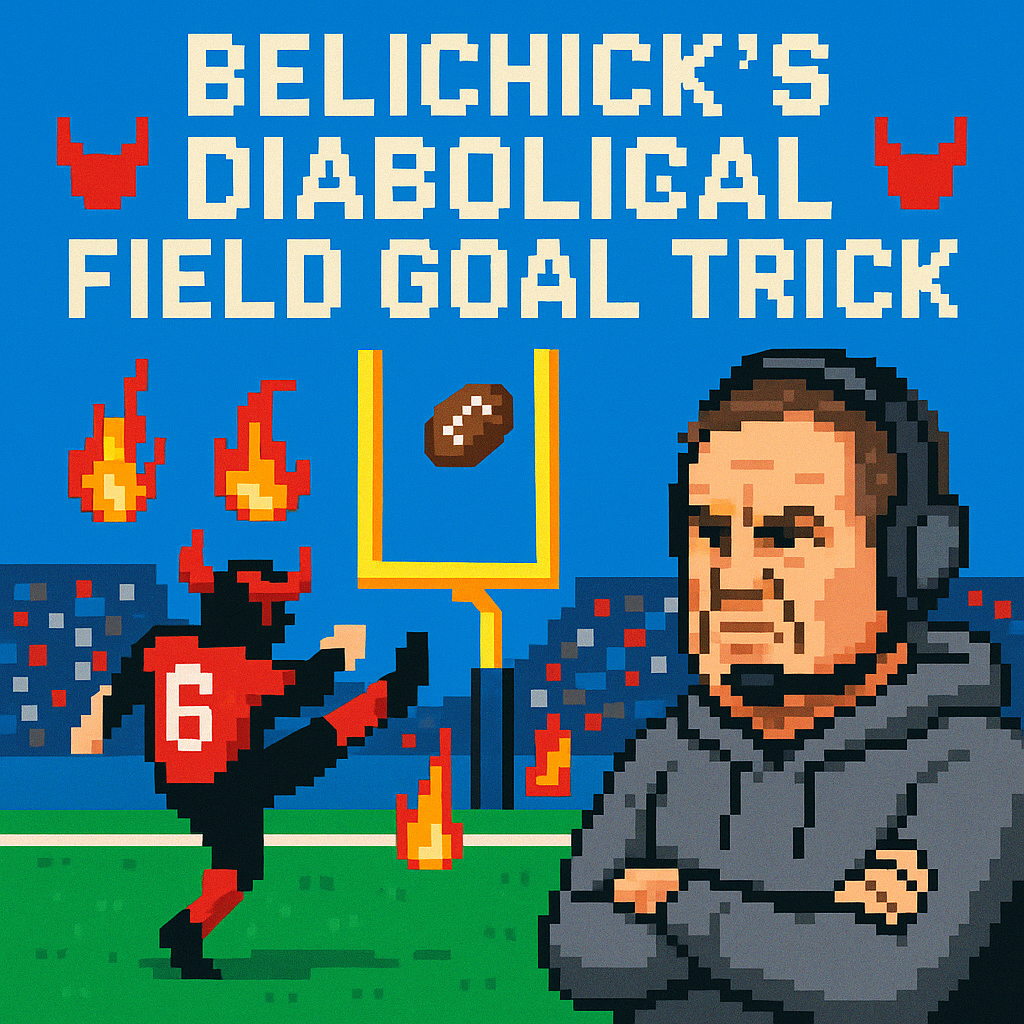
- Bill Belichick’s “field goal trick” at Gillette Stadium in Foxborough, Massachusetts used the north‑end video board to show a reverse end‑zone view that created a second, offset set of yellow uprights for visiting kickers, while Patriots kicks did not feature that view. [1]
- The tactic aligns with the NFL’s 2022–2023 Game Operations Manual, which permits either a static image or an All‑22 camera angle on in‑stadium boards during kicks—exactly the feed that produces the illusion when a board sits behind the posts. [2][3]
- In a venue known for weather volatility, even a 2–3 percentage‑point dip in opponents’ make rate translates to roughly 1–2 expected points over a multi‑year window at home; that swing stems from a 2019 league baseline of 30.7 attempts per team and 81.6% accuracy. [5][7]
What the source said
The New York Post reported on September 2, 2026 that former NFL analytics staffer Ryan Paganetti reviewed broadcasts from roughly 2012–2020 and saw “dozens” of visiting attempts where Gillette’s board showed a reverse end‑zone angle, creating “double uprights,” while Patriots attempts did not show the same view; he cited the 2012 AFC Championship miss by Billy Cundiff as an example. [1][6] Paganetti also said the effect was strongest on one end of the field because of the board’s fixed placement at Gillette, which opened in 2002 on Route 1 in Foxborough. [1] Co‑host Nick Underhill added that several college programs run similar board tactics more routinely, citing SEC stadium practices. [1]
Why it matters
The key stakeholders are NFL Football Operations (which writes stadium display rules), club operators like the Kraft Group who control in‑stadium content, and special‑teams coordinators trying to protect expected points on 3‑point plays; the current All‑22/static rule in the 2022–2023 manual unintentionally allows an optical conflict at venues where boards sit behind the posts. [2][3] When policy prescribes “neutralized hype” but doesn’t address geometry, teams with certain sightlines get a legal nudge.
Visiting kickers already face Foxborough winds and winter cold; mid‑range 40–49‑yard tries convert around 83% in NFL data, and even a small perceptual conflict can tilt marginal attempts. [9] Those marginal decisions—go versus kick from the 36‑ to 32‑yard lines—stack across eight home dates per season and can decide one‑score outcomes over 2012–2020 windows. [5][1]
Original analysis
The Bill Belichick field goal trick, quantified
-
Back‑of‑envelope math
- Opponents attempt ~31 field goals per 16‑game season (2019: 30.7); that’s ~1.9 per game. In one home stadium, expect roughly half that—about 15 attempts across eight home games. [5]
- Leaguewide make rate was 81.6% in 2019. If the board‑induced illusion trimmed visiting accuracy at Gillette by a conservative 3 percentage points (from 82% to 79%), the expected points swing per home season ≈ attempts × delta make% × 3 points = 15 × 0.03 × 3 ≈ 1.35 points. [5]
- Across nine seasons (2012–2020), that sums to roughly 12 points—enough to flip one or two coin‑flip outcomes, which fits Belichick’s marginal‑gains ethos and the Patriots’ 2010s record of close wins. [1][5]
-
Contrarian read
- Conventional reaction: “This feels like rule‑bending.”
- Counter: It matches policy as written. The Game Operations Manual specifies a static image or All‑22 angle for kicks “from when the kicking team reaches the line of scrimmage” through the officials’ signal; an end‑zone All‑22 framed behind real posts inherently paints a second set in the kicker’s view. ProFootballTalk reported the approach remains legal under current guidance, which is why the effect persisted in the 2010s. [2][3]
-
Named‑stakeholder breakdown
- New England Patriots (Robert Kraft, Bill Belichick through 2019): Legal, repeatable, venue‑specific edge that compounds over years; a clarified memo would retire a small advantage without retroactive penalties. [2][3]
- NFL Football Operations: The Equity Rule promises fairness across 30 venues; expect a clarification specifying “neutral background behind uprights” to remove architecture‑driven asymmetry before the 2026 playoffs. [4]
- Visiting special‑teams coordinators (Baltimore Ravens, Buffalo Bills, Miami Dolphins): Add a Friday walk‑through item at Gillette—verify board content on both ends, brief kickers to anchor mid‑upright, and cue holders to adjust tilt if a reverse image appears; the 2012 Billy Cundiff case shows how stadium information can intrude on timing. [6]
- Broadcast partners (CBS, Fox, NBC): TV trucks often feed in‑stadium boards; standardizing a neutral template for kicks requires a single production note and lowers the risk of an officiating complaint in a Week 15 game. [2][3]
- Stadium vendors (Daktronics): RFPs will start asking for “kick templates” that gray out uprights or lock a team wordmark during live attempts to comply with an anticipated memo without redesigning the board.
-
Historical analogue
- Compare 2014 “Deflategate,” where alleged PSI manipulation violated rules, with this 2012–2020 optics case: here the parameter is visual, the behavior is overt, and the tactic sits inside policy. The closer analogue is the 2012 AFC title game, when Cundiff said the scoreboard showed third down and rushed his process—an information‑design issue affecting a 32‑yard attempt at 0:15 of Q4. [6]
-
Simple 2×2: geometry × policy (hypotheses)
- Board aligned behind uprights × All‑22 feed: Highest conflict; expect 2–4 percentage‑point make‑rate drag in marginal winds given 81.6% baseline. [5][10][11][12]
- Board aligned × Static image (blank/wordmark): Minimal conflict; expect 0–1 pp effect. [3][5]
- Board offset (north/south corner) × All‑22: Low conflict; expect 0–1 pp effect due to parallax. [3][5]
- Board offset × Static: Negligible; effectively baseline. [3][5]
-
Why the illusion can matter at all
- Lab findings show illusions like Ebbinghaus (2004) and related paradigms (2005; sports analogues in 2008 golf putting) bias movement planning under time pressure; a kicker’s saccade from snap to spot limits online correction, so a second set of yellow bars can pull aim. [10][11][12] Add Foxborough wind gusts and cold in November–January, and small planning errors widen dispersion on 45–53‑yard tries. [9]
What others are missing
The specific blind spot is governance‑by‑template: the “Video During Kicks” clause was built to stop hype clips and strobe effects, not to model how an All‑22 feed interacts with a board physically behind the posts at Gillette’s north end in Foxborough. [3] In Philadelphia, Lincoln Financial Field’s boards don’t sit directly behind the uprights, so the same All‑22 choice doesn’t paint “virtual posts,” which is why a one‑line policy tweak—“no uprights or end‑zone shots on boards during live kicks”—solves the asymmetry without banning All‑22 elsewhere. [8][3]
What to watch next
-
By Week 6 of the 2026 season (October 14, 2026), the NFL issues a Game Operations memo requiring a static, non‑upright background (team wordmark or blank) on end‑zone boards during field‑goal and try attempts. [3]
-
By December 31, 2026, at least five clubs publicly confirm updated in‑stadium kick templates (static or de‑saturated backgrounds) in game‑notes, team sites, or beat reports.
-
In 2026 regular‑season data, visiting opponents at Gillette attempt at least 14 field goals but post a make rate within ±1.0 percentage point of their combined away‑game average, indicating the illusion edge shrinks after the memo.
My take
This is peak Belichick: marginal gains through venue control at Gillette in Massachusetts, executed within written policy, and effective only in tight bands. Small edges, repeated from 2012 through 2020, add up on the scoreboard. Keep the All‑22 allowance for fairness to fans and film, but mandate a neutral, non‑upright background once the kicking unit is set. Let wind, snap, and swing—not a second set of painted posts—decide 3‑point plays. [2][3][6]
Sources
[1] Bill Belichick used ‘diabolically clever’ field goal trick to gain Patriots edge — New York Post (https://nypost.com/2026/09/02/sports/bill-belichick-used-diabolically-clever-field-goal-trick-to-gain-patriots-edge-in-shocking-reveal/) — Reports Paganetti’s claim, 2012–2020 review, and the “double uprights” description with examples.
[2] Patriots’ video tactic for field goals was, and still is, legal — NBC Sports/ProFootballTalk (https://www.nbcsports.com/nfl/profootballtalk/rumor-mill/news/patriots-video-tactic-for-field-goals-was-and-still-is-legal) — Explains why current policy permits the tactic and summarizes league posture.
[3] NFL Operations Manual (excerpted): “Video During Kicks — static image or All‑22” — FlipHTML5 mirror (https://fliphtml5.com/uryp/sdbq/NFL_Operations_Manual_2022-2023/) — Provides the board‑content rule that enables the illusion when a board sits behind the uprights.
[4] Equity Rule — NFL Football Operations (https://nfl-ops-prod-umbraco-author.azurewebsites.net/game-operations-logistics/preparation-safety/equity-rule/) — States the league’s competitive‑equity philosophy guiding technology and access.
[5] 2020 NFL Record & Fact Book (2019 data): League average FG attempts and make rate — NFL (https://edge-operations.nfl.com/media/4414/2020-nfl-record-and-fact-book-1.pdf) — Documents 2019 averages: 30.7 attempts per team and 81.6% FG%.
[6] Cundiff: Scoreboard showed third down — FOX Sports (https://www.foxsports.com/stories/nfl/cundiff-scoreboard-showed-third-down) — Contemporary report on Billy Cundiff’s 32‑yard miss in the 2012 AFC title game and scoreboard confusion.
[7] The impact of visual illusions on perception, action planning, and motor performance — PubMed (https://pubmed.ncbi.nlm.nih.gov/23757046/) — Reviews evidence that illusions can bias aiming performance under time constraints.
[8] Yahoo Sports video on Patriots’ scoreboard tactic — Yahoo Sports (https://sports.yahoo.com/videos/patriots-leverage-stadium-video-screen-191541772.html) — Explainer summarizing Paganetti’s account and why board placement matters, with stadium‑specific notes.
[9] NFL might experiment with making extra‑points longer — NFL.com (https://www.nfl.com/news/nfl-might-experiment-with-making-extra-point-attempts-longer-0ap2000000330411) — Cites ~83% success for 40–49‑yard field goals, framing mid‑range difficulty.
[10] Ebbinghaus illusion affects on‑line movement control (2004) — PubMed (https://pubmed.ncbi.nlm.nih.gov/15288440/) — Shows classic illusion effects on action in time‑pressured aiming.
[11] Visual illusions affect both movement planning and on‑line control (2005) — ScienceDirect (https://www.sciencedirect.com/science/article/abs/pii/S0167945705000679) — Details mechanisms by which illusions perturb goal‑directed actions.
[12] Putting to a bigger hole: Golf performance relates to perceived size (2008) — Colorado State University (https://amplab.colostate.edu/reprints/Witt_etal_Golf_2008.pdf) — Sports‑specific evidence linking perceived target size and accuracy.
Related update: We recently published an article that expands on this topic: read the latest post.
Related update: We recently published an article that expands on this topic: read the latest post.