Belichick’s Diabolical Field Goal Trick | Analysis by Brian Moineau

TL;DR

  • Bill Belichick’s “field goal trick” at Gillette Stadium in Foxborough, Massachusetts used the north‑end video board to show a reverse end‑zone view that created a second, offset set of yellow uprights for visiting kickers, while Patriots kicks did not feature that view. [1]
  • The tactic aligns with the NFL’s 2022–2023 Game Operations Manual, which permits either a static image or an All‑22 camera angle on in‑stadium boards during kicks—exactly the feed that produces the illusion when a board sits behind the posts. [2][3]
  • In a venue known for weather volatility, even a 2–3 percentage‑point dip in opponents’ make rate translates to roughly 1–2 expected points over a multi‑year window at home; that swing stems from a 2019 league baseline of 30.7 attempts per team and 81.6% accuracy. [5][7]

What the source said

The New York Post reported on September 2, 2026 that former NFL analytics staffer Ryan Paganetti reviewed broadcasts from roughly 2012–2020 and saw “dozens” of visiting attempts where Gillette’s board showed a reverse end‑zone angle, creating “double uprights,” while Patriots attempts did not show the same view; he cited the 2012 AFC Championship miss by Billy Cundiff as an example. [1][6] Paganetti also said the effect was strongest on one end of the field because of the board’s fixed placement at Gillette, which opened in 2002 on Route 1 in Foxborough. [1] Co‑host Nick Underhill added that several college programs run similar board tactics more routinely, citing SEC stadium practices. [1]

Why it matters

The key stakeholders are NFL Football Operations (which writes stadium display rules), club operators like the Kraft Group who control in‑stadium content, and special‑teams coordinators trying to protect expected points on 3‑point plays; the current All‑22/static rule in the 2022–2023 manual unintentionally allows an optical conflict at venues where boards sit behind the posts. [2][3] When policy prescribes “neutralized hype” but doesn’t address geometry, teams with certain sightlines get a legal nudge.

Visiting kickers already face Foxborough winds and winter cold; mid‑range 40–49‑yard tries convert around 83% in NFL data, and even a small perceptual conflict can tilt marginal attempts. [9] Those marginal decisions—go versus kick from the 36‑ to 32‑yard lines—stack across eight home dates per season and can decide one‑score outcomes over 2012–2020 windows. [5][1]

Original analysis

The Bill Belichick field goal trick, quantified

  • Back‑of‑envelope math

    • Opponents attempt ~31 field goals per 16‑game season (2019: 30.7); that’s ~1.9 per game. In one home stadium, expect roughly half that—about 15 attempts across eight home games. [5]
    • Leaguewide make rate was 81.6% in 2019. If the board‑induced illusion trimmed visiting accuracy at Gillette by a conservative 3 percentage points (from 82% to 79%), the expected points swing per home season ≈ attempts × delta make% × 3 points = 15 × 0.03 × 3 ≈ 1.35 points. [5]
    • Across nine seasons (2012–2020), that sums to roughly 12 points—enough to flip one or two coin‑flip outcomes, which fits Belichick’s marginal‑gains ethos and the Patriots’ 2010s record of close wins. [1][5]
  • Contrarian read

    • Conventional reaction: “This feels like rule‑bending.”
    • Counter: It matches policy as written. The Game Operations Manual specifies a static image or All‑22 angle for kicks “from when the kicking team reaches the line of scrimmage” through the officials’ signal; an end‑zone All‑22 framed behind real posts inherently paints a second set in the kicker’s view. ProFootballTalk reported the approach remains legal under current guidance, which is why the effect persisted in the 2010s. [2][3]
  • Named‑stakeholder breakdown

    • New England Patriots (Robert Kraft, Bill Belichick through 2019): Legal, repeatable, venue‑specific edge that compounds over years; a clarified memo would retire a small advantage without retroactive penalties. [2][3]
    • NFL Football Operations: The Equity Rule promises fairness across 30 venues; expect a clarification specifying “neutral background behind uprights” to remove architecture‑driven asymmetry before the 2026 playoffs. [4]
    • Visiting special‑teams coordinators (Baltimore Ravens, Buffalo Bills, Miami Dolphins): Add a Friday walk‑through item at Gillette—verify board content on both ends, brief kickers to anchor mid‑upright, and cue holders to adjust tilt if a reverse image appears; the 2012 Billy Cundiff case shows how stadium information can intrude on timing. [6]
    • Broadcast partners (CBS, Fox, NBC): TV trucks often feed in‑stadium boards; standardizing a neutral template for kicks requires a single production note and lowers the risk of an officiating complaint in a Week 15 game. [2][3]
    • Stadium vendors (Daktronics): RFPs will start asking for “kick templates” that gray out uprights or lock a team wordmark during live attempts to comply with an anticipated memo without redesigning the board.
  • Historical analogue

    • Compare 2014 “Deflategate,” where alleged PSI manipulation violated rules, with this 2012–2020 optics case: here the parameter is visual, the behavior is overt, and the tactic sits inside policy. The closer analogue is the 2012 AFC title game, when Cundiff said the scoreboard showed third down and rushed his process—an information‑design issue affecting a 32‑yard attempt at 0:15 of Q4. [6]
  • Simple 2×2: geometry × policy (hypotheses)

    • Board aligned behind uprights × All‑22 feed: Highest conflict; expect 2–4 percentage‑point make‑rate drag in marginal winds given 81.6% baseline. [5][10][11][12]
    • Board aligned × Static image (blank/wordmark): Minimal conflict; expect 0–1 pp effect. [3][5]
    • Board offset (north/south corner) × All‑22: Low conflict; expect 0–1 pp effect due to parallax. [3][5]
    • Board offset × Static: Negligible; effectively baseline. [3][5]
  • Why the illusion can matter at all

    • Lab findings show illusions like Ebbinghaus (2004) and related paradigms (2005; sports analogues in 2008 golf putting) bias movement planning under time pressure; a kicker’s saccade from snap to spot limits online correction, so a second set of yellow bars can pull aim. [10][11][12] Add Foxborough wind gusts and cold in November–January, and small planning errors widen dispersion on 45–53‑yard tries. [9]

What others are missing

The specific blind spot is governance‑by‑template: the “Video During Kicks” clause was built to stop hype clips and strobe effects, not to model how an All‑22 feed interacts with a board physically behind the posts at Gillette’s north end in Foxborough. [3] In Philadelphia, Lincoln Financial Field’s boards don’t sit directly behind the uprights, so the same All‑22 choice doesn’t paint “virtual posts,” which is why a one‑line policy tweak—“no uprights or end‑zone shots on boards during live kicks”—solves the asymmetry without banning All‑22 elsewhere. [8][3]

What to watch next

  1. By Week 6 of the 2026 season (October 14, 2026), the NFL issues a Game Operations memo requiring a static, non‑upright background (team wordmark or blank) on end‑zone boards during field‑goal and try attempts. [3]

  2. By December 31, 2026, at least five clubs publicly confirm updated in‑stadium kick templates (static or de‑saturated backgrounds) in game‑notes, team sites, or beat reports.

  3. In 2026 regular‑season data, visiting opponents at Gillette attempt at least 14 field goals but post a make rate within ±1.0 percentage point of their combined away‑game average, indicating the illusion edge shrinks after the memo.

My take

This is peak Belichick: marginal gains through venue control at Gillette in Massachusetts, executed within written policy, and effective only in tight bands. Small edges, repeated from 2012 through 2020, add up on the scoreboard. Keep the All‑22 allowance for fairness to fans and film, but mandate a neutral, non‑upright background once the kicking unit is set. Let wind, snap, and swing—not a second set of painted posts—decide 3‑point plays. [2][3][6]

Sources

[1] Bill Belichick used ‘diabolically clever’ field goal trick to gain Patriots edge — New York Post (https://nypost.com/2026/09/02/sports/bill-belichick-used-diabolically-clever-field-goal-trick-to-gain-patriots-edge-in-shocking-reveal/) — Reports Paganetti’s claim, 2012–2020 review, and the “double uprights” description with examples.

[2] Patriots’ video tactic for field goals was, and still is, legal — NBC Sports/ProFootballTalk (https://www.nbcsports.com/nfl/profootballtalk/rumor-mill/news/patriots-video-tactic-for-field-goals-was-and-still-is-legal) — Explains why current policy permits the tactic and summarizes league posture.

[3] NFL Operations Manual (excerpted): “Video During Kicks — static image or All‑22” — FlipHTML5 mirror (https://fliphtml5.com/uryp/sdbq/NFL_Operations_Manual_2022-2023/) — Provides the board‑content rule that enables the illusion when a board sits behind the uprights.

[4] Equity Rule — NFL Football Operations (https://nfl-ops-prod-umbraco-author.azurewebsites.net/game-operations-logistics/preparation-safety/equity-rule/) — States the league’s competitive‑equity philosophy guiding technology and access.

[5] 2020 NFL Record & Fact Book (2019 data): League average FG attempts and make rate — NFL (https://edge-operations.nfl.com/media/4414/2020-nfl-record-and-fact-book-1.pdf) — Documents 2019 averages: 30.7 attempts per team and 81.6% FG%.

[6] Cundiff: Scoreboard showed third down — FOX Sports (https://www.foxsports.com/stories/nfl/cundiff-scoreboard-showed-third-down) — Contemporary report on Billy Cundiff’s 32‑yard miss in the 2012 AFC title game and scoreboard confusion.

[7] The impact of visual illusions on perception, action planning, and motor performance — PubMed (https://pubmed.ncbi.nlm.nih.gov/23757046/) — Reviews evidence that illusions can bias aiming performance under time constraints.

[8] Yahoo Sports video on Patriots’ scoreboard tactic — Yahoo Sports (https://sports.yahoo.com/videos/patriots-leverage-stadium-video-screen-191541772.html) — Explainer summarizing Paganetti’s account and why board placement matters, with stadium‑specific notes.

[9] NFL might experiment with making extra‑points longer — NFL.com (https://www.nfl.com/news/nfl-might-experiment-with-making-extra-point-attempts-longer-0ap2000000330411) — Cites ~83% success for 40–49‑yard field goals, framing mid‑range difficulty.

[10] Ebbinghaus illusion affects on‑line movement control (2004) — PubMed (https://pubmed.ncbi.nlm.nih.gov/15288440/) — Shows classic illusion effects on action in time‑pressured aiming.

[11] Visual illusions affect both movement planning and on‑line control (2005) — ScienceDirect (https://www.sciencedirect.com/science/article/abs/pii/S0167945705000679) — Details mechanisms by which illusions perturb goal‑directed actions.

[12] Putting to a bigger hole: Golf performance relates to perceived size (2008) — Colorado State University (https://amplab.colostate.edu/reprints/Witt_etal_Golf_2008.pdf) — Sports‑specific evidence linking perceived target size and accuracy.


Related update: We recently published an article that expands on this topic: read the latest post.
Related update: We recently published an article that expands on this topic: read the latest post.
Falcons’ Bold Four‑QB Roster Gambit | Analysis by Brian Moineau

TL;DR

  • The Falcons’ initial 53-man roster for 2026 kept four quarterbacks (Tua Tagovailoa, Michael Penix Jr., Cooper Rush, Jack Strand) and only two running backs (Bijan Robinson, Brian Robinson Jr.), a rare build that squeezes special teams and edge depth while buying time to sort the QB pecking order. [2][3][4]
  • Atlanta traded CB Clark Phillips III and a 2027 fifth-round pick to the Bears for DT Gervon Dexter Sr., and carried injured DB Billy Bowman Jr. on the 53—classic “roster sequencing” that signals short-term IR moves and more churn before Week 1 against Pittsburgh at Mercedes-Benz Stadium in Atlanta, Georgia. [1][2][6][7]
  • My read: the four-QB gambit is a rational response to 2026 emergency QB mechanics and trade dynamics, not indecision; expect Atlanta to flip one QB and backfill RB/EDGE via the IR/waiver dance within 72 hours of cutdown. [3][5][8]

What the source said

The Falcoholic’s initial roster rundown highlights three headline choices: Atlanta carried four quarterbacks through the 53-man cutdown, reduced the running back room to two, and made several surprising moves at the margins. Those included releasing special-teams contributor Tyler Goodson and passing on veteran edge help (Azeez Ojulari, Bralen Trice) while adding Gervon Dexter Sr. on the interior. The piece frames Billy Bowman Jr.’s inclusion as a positive recovery signal, with Da’Shawn Hand in a similar spot heading into the September 2026 opener against the Pittsburgh Steelers. It also underscores that “initial” is the operative word—more moves are expected before Week 1—while questioning a few priorities (e.g., LB JD Bertrand, QB Cooper Rush) in a roster that’s likely to keep moving. [1]

Why it matters

This isn’t just about the Falcons; it’s about how 2026 roster mechanics and quarterback injury risk push teams toward hoarding passers and punting on back-end depth across 53 and 48 active slots on game day. The real stakeholders are general manager Ian Cunningham and head coach Kevin Stefanski, who must balance immediate competitive needs (edge pressure, special teams) with asset preservation (QB trade value) under NFL roster rules that reward sequencing acumen. [2][3][5][8]

Players feel it most. Four quarterbacks and 13 defensive backs crowd out roles for back-end runners and rotational edge rushers—jobs often earned on kick coverage at Heinz Field–style slugfests the Steelers prefer. If Atlanta can’t replace those hidden-yardage snaps with disciplined personnel usage, the cost shows up in field position in Week 1 on September 6–7, not on a transaction log. [1][2][4]

Original analysis

Contrarian read — The consensus: carrying four quarterbacks is wasteful and screams indecision. My take: it’s rational roster arbitrage in 2026. The NFLPA’s veto of the league’s proposed unlimited emergency QB elevations forces the true “QB3” to live on the 53 or consume one of a finite number of weekly elevations, which erodes flexibility. Four clubs kept four QBs on initial 53s this week, so Atlanta’s not an outlier; they’re playing the market. [3][5]

Back-of-the-envelope roster math — edge and RB:

  • Defensive snap math: assume 65 defensive snaps and two-edge fronts on 80% of plays. That’s 0.8 × 65 × 2 ≈ 104 edge snaps to allocate. With only three true edges (Za’Darius Smith, Samson Ebukam, Cameron Thomas), the average load is ~35 snaps each if perfectly balanced; in real usage, the top two push toward 50+, leaving fatigue and injury exposure and minimal sub-package variability. A fourth edge would drop average load toward the high-20s and add third-down variants without taxing Smith/Ebukam. [2][4]
  • Offensive run math: assume ~62 offensive snaps and a 42% rush rate ≈ 26 RB carries. Bijan Robinson and Brian Robinson Jr. can absorb that on paper, but one in-game ankle tweak leaves pass-pro and two-minute offense in the hands of a practice-squad elevation or an out-of-position WR. The opportunity cost of QB4 is probably 10–12 special-teams snaps and the emergency RB3 role on September game days. [2][4][8]

Named-stakeholder breakdown:

  • Tua Tagovailoa, QB: Retains leverage as presumed QB1; four-QB build gives Atlanta time to test-market the room without cutting bait in late August 2026. [2][3][4]
  • Michael Penix Jr., QB: Protected development runway; not forced into QB2 by timing. A trade of Rush or a Strand stash becomes the pressure valve before Week 2. [2][3]
  • Cooper Rush, QB: Classic “inventory” quarterback—valuable to teams thin on game-ready backups; most tradable piece if Atlanta wants to reclaim a roster slot by September 14. [2][3][4]
  • Jack Strand, QB: UDFA with preseason juice; hard to sneak to the practice squad without exposing him to claims—hence the initial 53 spot and the likely PS shuffle. [3][4]
  • Gervon Dexter Sr., DT: Interior pass-rush infusion via a costed asset (Clark Phillips III + 2027 5th); signals confidence in perimeter pressure packages built around Smith/Ebukam/Thomas until James Pearce Jr. returns from suspension. [2][6]
  • Billy Bowman Jr., DB: Inclusion on 53 signals a near-term practice return under IR rules (minimum four games if he were stashed), preserving earlier availability; roster sequencing, not sentiment. [2][4][7]

A 2×2 to decode the Falcons’ initial 53-man roster

  • Axis 1 (X): Immediate game-day utility for Week 1 at Mercedes-Benz Stadium in Atlanta. [1][2]
  • Axis 2 (Y): Retainable market value on the 53 across September 2026 trade calls. [3][5]
    • High utility / high value: Bijan Robinson, Za’Darius Smith — scarce snaps that change outcomes on third-and-medium. [2][4]
    • High utility / low value: Core special-teamers (Malcolm DeWalt IV), swing OL — replaceable leaguewide but essential every Sunday. [2][4]
    • Low utility / high value: QB4 (Rush or Strand) — minimal game-day need, high trade/roster-protection value under current QB rules. [3][5]
    • Low utility / low value: Developmental TE3 or RB3 — the very spots squeezed to carry a fourth QB. [2][4]

What the numbers and rules foreshadow: The Falcons will almost certainly execute the classic post-53 shuffle—short-term IR for one or two injured players (eligible to return after four games), followed by re-signs or claims at RB and EDGE before September 3, 2026. That’s how you square a four-QB ledger with Week 1 reality without losing assets to waivers under 16-man practice-squad and elevation limits. The team site’s transaction language and the Bowman/Hand handling already point that direction. [2][6][7][8]

What others are missing

Angle: the deliberate “roster sequencing” behind Bowman and Dexter. Billy Bowman Jr. on the initial 53 isn’t a sentimental victory lap; it’s a clock play tied to the four-game IR return rule that preserves earlier practice activation in September. Dexter’s arrival on August cutdown week pairs with that timing—interior depth lets Atlanta tolerate going light at edge for a few days while it maneuvers IR and waiver claims. That combination—timing plus positional redundancy—explains the four-QB and two-RB oddity better than “they can’t decide at quarterback.” [2][4][6][7]

What to watch next

  1. By September 3, 2026, Atlanta will place at least one of Bowman or Hand on short-term IR and add an RB3 to the 53 via re-sign or waiver claim. [2][4][7]
  2. By Week 2 (September 13–14, 2026), the Falcons will pare the active QB room to three (via trade of Rush or a Strand move to the practice squad). [2][3][4][5]
  3. By October 11, 2026 (through Week 5), Gervon Dexter Sr. will log 40%+ defensive snap share in at least two games as Atlanta leans interior pressure to offset light edge depth. [2][6]

My take

I’m fine with the Falcons burning an initial 53 spot on QB4. The 2026 rules incentivize hoarding passers, and Atlanta’s room has both uncertainty and trade value in a market where four teams carried four QBs on cutdown day. I’m not fine with living short at edge beyond this week, because Za’Darius Smith and Samson Ebukam shouldn’t play 85% of snaps in September if you want them healthy in December. If Cunningham executes the IR/waiver two-step and spins off one quarterback for a day-three pick while adding an RB3 and a rotational edge, this roster build stops looking weird and starts looking savvy. [2][3][5][6][7][8]

Sources

[1] Top storylines following the Falcons initial 53-man roster — The Falcoholic (https://www.thefalcoholic.com/atlanta-falcons-depth-chart/95615/top-storylines-following-the-falcons-initial-53-man-roster-billy-bowman-tyler-goodson) — The starting point: four QBs, two RBs, surprise edge cuts, Bowman/Hand status, and the expectation of churn.

[2] Atlanta Falcons release initial 2026 roster — AtlantaFalcons.com (https://www.atlantafalcons.com/news/atlanta-falcons-2026-roster) — Official 53 with position counts and transaction buckets (released/waived), including QB4, RB2, Bowman on the 53, and Goodson/Ojulari/Trice moves.

[3] Four NFL teams keep four QBs on initial 53-man rosters — NFL.com (https://amp.nfl.com/news/four-nfl-teams-keep-four-qbs-on-initial-53-man-rosters) — League-wide context that Atlanta isn’t alone; lists the Falcons’ quartet and explains why teams are doing it.

[4] Falcons announce initial 53-man roster: 3 takeaways as team carries 4 QBs — Atlanta Journal-Constitution (https://images.ajc.com/sports/2026/08/falcons-announce-initial-53-man-roster-3-takeaways-as-atlanta-carries-4-qbs/) — Independent confirmation of the position counts and notable inclusions/exclusions, plus Bowman’s status.

[5] NFLPA vetoes emergency third QB rule change — NFL.com (https://www.nfl.com/news/nflpa-vetoes-emergency-third-qb-rule-change) — Explains why teams can’t stash a “bona fide” emergency QB via unlimited elevations, pushing clubs toward carrying more QBs.

[6] Falcons trade CB Clark Phillips III, 5th-round pick to Chicago Bears for DT Gervon Dexter Sr. — AtlantaFalcons.com (https://www.atlantafalcons.com/news/falcons-trade-clark-phillips-iii-5th-round-pick-chicago-bears-gervon-dexter-sr) — Confirms the Dexter acquisition that shapes trench depth and buys time for edge-room triage.

[7] Players now eligible to return from injured reserve after four games — NFL.com (https://www.nfl.com/news/players-now-eligible-to-return-from-injured-reserve-after-four-games) — Details the modern short-term IR framework (four-game minimum, designated to return), critical to understanding Bowman/IR timing.

[8] Contract Language & Roster Mechanics (Practice Squad and Standard Elevation Addendum) — NFL Football Operations (https://operations.nfl.com/calendar-events/nfl-free-agency/contract-language) — Codifies 16-man practice squads and the 54/55-man elevations that interact with the Falcons’ initial 53 calculus.


Related update: We recently published an article that expands on this topic: read the latest post.


Related update: We recently published an article that expands on this topic: read the latest post.
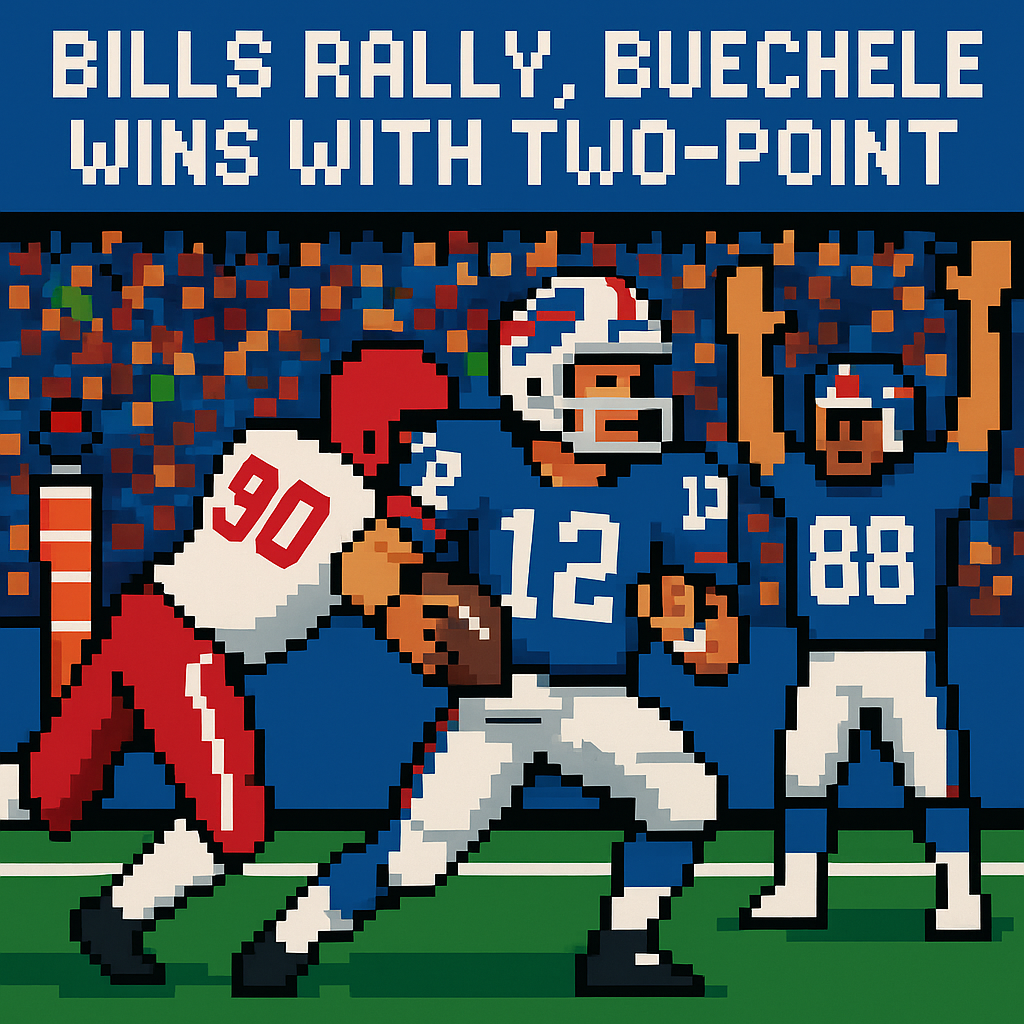
Bills Rally, Buechele Wins With Two-Point | Analysis by Brian Moineau

TL;DR

  • Buffalo beat Pittsburgh 28–27 on August 27, 2026 at Highmark Stadium in Orchard Park to finish a 3–0 preseason, capped by RB Ian Wheeler’s 2-yard TD at 1:06 and QB Shane Buechele’s dart to WR Dante Pettis for the go-ahead two-point conversion. [2][3][9]
  • The play-call says more than the record: first-year head coach Joe Brady chose a live-fire, gotta-have-it rep over a tie, stress-testing his situational menu and his QB2 in a real clock. [3][5]
  • The real stakes now are roster economics: a bubble player like Wheeler faces a ~$637,500 swing between a 53-man spot and the practice squad; Pettis’ swing is even bigger given his service time and WR6/PR profile. [6]

What the source said

WIVB relays the Associated Press game story: Buffalo rallied to beat the Steelers 28–27 in Orchard Park, New York, closing the preseason with a perfect 3–0 record. Ian Wheeler punched in a 2‑yard touchdown with 1:06 remaining, and a Buechele-to-Pettis two-point conversion sealed it. The piece frames the win as a rebound after early errors. [1]

It also credits “Steve Buechele” on the two-point throw, mirroring AP’s wire copy carried by affiliates. The recap emphasizes the late swing from a fourth-quarter deficit to a one-point win in the 2026 preseason finale for both clubs. [1]

Why it matters

The scoreboard won’t travel to September 2026, but the tape will. For the Bills, this was Joe Brady’s first August as head coach; compressing a last-minute drive into a successful two-pointer gives him hard evidence on Shane Buechele’s poise, Pettis’ utility as a WR6/returner, and Wheeler’s contact balance in short yardage. That trio maps directly to Sunday’s cutdown decisions at wide receiver, running back, and quarterback on the 53-man. [3][5][7]

For bubble players, the delta isn’t abstract. A spot on the 53 means a full Paragraph 5 salary for 18 weeks; a practice squad slot means weekly paychecks that can vanish with a single transaction. One late drive on August 27 just moved real compensation bands for two veterans on the margins. [6]

Original analysis

Consensus says “perfect preseasons don’t predict anything.” That’s broadly true at the team level—see the 2008 Detroit Lions, who went 4–0 in August and then 0–16 by December—but this particular 28–27 finish matters for two reasons: the decisions it exposed and the dollars it moved. [10]

Contrarian read

  • Consensus: August records are noise.
  • My case: This win carried signal for Brady’s program because he manufactured a high-leverage rep on purpose. With 1:06 left on August 27, he declined the tie and put the outcome on a sprint-out throw to Pettis. That’s banked practice in a situation coordinators can’t simulate, and it centered Shane Buechele—correctly identified by the team as the trigger man, despite wire stories misnaming him “Steve”—as the functional QB2 before a Sunday 6 p.m. ET deadline. [3][4][8]

Back-of-envelope calculation: the roster-money swing

  • Practice squad salaries in 2026: $13,750/week for standard players; $18,350/week for veterans; max $22,850/week. Over an 18‑week regular season, that’s $247,500 (standard) or $330,300 (veteran). [6]
  • League-minimum Paragraph 5 salaries in 2026: rookie $885,000; 7+ credited seasons $1,215,000. [6]

Math:

  • Ian Wheeler (2 credited seasons): 53-man at $885,000 vs. standard PS at $247,500 ⇒ swing ≈ $885,000 − $247,500 = $637,500. One drive just swung more than a half-million dollars of career capital. [6]
  • Dante Pettis (8th season): 53-man at $1,215,000 vs. PS at a veteran rate $330,300 ⇒ swing ≈ $1,215,000 − $330,300 = $884,700. Special-teams snaps plus that two-point toe-tap are not just “feel-good”—they’re compensation levers. [6][7]

A simple 2×2 of preseason performances (Who produced x How they produced)

  • Axes:
    • Personnel: Starters vs. Depth
    • Traits: Repeatable (process-driven) vs. Volatile (broken plays/flags)
Repeatable traits (route craft, leverage, vision) Volatile traits (busted coverages, tip drills)
Starters N/A here (Josh Allen, many starters rested). [4] N/A
Depth Pettis (release/landmark discipline on 2-pt), Wheeler (short-yardage decisiveness, ball security on goal line); Buechele (footwork under duress). [2][3][7] A couple PI swings and scramble explosives earlier in August—useful, but not bankable. [2]

Why it predicts something actionable: the Bills need WR6 to be a field-position asset and an on-script route runner, not a camp hero. Pettis’ usage—July 30, 2026 signing plus situational trust on a game-deciding rep—maps to a defined role with Brady: punt return insurance, motion/Z depth, and two-minute competence. Wheeler’s path is as RB3/teams coverage back, where vision and contact balance translate week to week in the AFC East. [1][3][7]

Finally, correct the record: multiple AP-affiliate recaps credited “Steve” Buechele on the conversion. The Bills’ own clips, roster, and game notes all identify Shane, and the highlight is unambiguous on team video. That discrepancy is trivial for standings, but nontrivial for a quarterback fighting to be named QB2. Narrative scaffolding matters when you’re not a household name in Western New York. [2][8][9]

What others are missing

The key angle isn’t the 3–0 line—it’s Brady’s risk calculus. He didn’t just “go for two”; he selected a sideline-tight, timing-dependent concept that tests ball placement, body control, and toe discipline, then ran it through a new veteran (Pettis) and a backup quarterback (Buechele). That’s a culture tell in Orchard Park: Buffalo will emphasize precision in gotta-have-it football, not just Josh Allen’s improvisation. If Brady’s 2026 Bills win close games, trace it back to reps like August 27—where the staff chose data over vibes and built live confidence into their situational call sheet. [3][5]

What to watch next

  1. By Sunday, August 30, 2026, 6:00 p.m. ET, Buffalo carries two quarterbacks on the initial 53—Josh Allen and Shane Buechele—with Kyle Allen waived and a strong candidate for the practice squad. [3][4]
  2. By Sunday, August 30, 2026, Dante Pettis makes the Bills’ initial 53 as WR6/PR, after his July 30, 2026 signing and late-game usage cement a defined role. [1][7]
  3. By Week 4 (through September 2026), Ian Wheeler logs at least 25 combined rushes plus targets for Buffalo—including special teams active status in at least three games—reflecting RB3 trust. [2][6]

My take

Keep the playmakers who closed it in Orchard Park. I’d name Shane Buechele the QB2, keep Dante Pettis as WR6/primary punt return hedge, and award Ian Wheeler the RB3 job at league minimum to start. The way Buffalo won on August 27, 2026—scripted, precise, and gutsy—signals how Joe Brady plans to manage leverage downs. Trim to those traits on Sunday at 6 p.m. ET and bank EV in one-score games. [2][3][6]

Sources

  1. Bills rally to close out preseason with perfect record, beating Steelers 28-27 after early errors — WIVB/AP (https://www.wivb.com/sports/buffalo-bills/bills-rally-to-close-out-preseason-with-perfect-record-beating-steelers-28-27-after-early-errors/) — Original report with the late Wheeler TD and Buechele-to-Pettis two-point to finish a perfect preseason.

  2. Bills 28, Steelers 27 — Recap + highlights — BuffaloBills.com (https://www.buffalobills.com/news/bills-28-steelers-27-final-score-recap-highlights) — Official game recap confirming the 28–27 result, the 3–0 preseason, and drive details.

  3. ‘It was just execution’ — Bills reflect on the comeback — BuffaloBills.com (https://www.buffalobills.com/news/it-was-just-execution-the-bills-reflect-on-an-impressive-fourth-quarter-comeback-to-close-out-the-preseason) — Describes the decision to go for two, Pettis’ catch, and context around late-game choices.

  4. Steelers edged by Bills, 28–27, in preseason finale — Steelers.com (https://www.steelers.com/news/steelers-edged-by-bills-28-27-in-preseason-finale) — Opponent’s game story with timing and sequence of the go-ahead TD and conversion.

  5. 2026 NFL Preseason, Week 3: What We Learned — NFL.com (https://mobile-www.nfl.com/news/2026-nfl-preseason-week-3-what-we-learned-from-thursday-s-games) — League roundup listing Bills 28, Steelers 27 and broader context for Thursday’s games.

  6. Minimum and practice-squad salaries, 2026 — Over The Cap (https://overthecap.com/minimum-salaries) — Authoritative CBA-driven table for 2026 roster minimums and practice-squad weekly/yearly pay used in the back-of-envelope math.

  7. Bills sign WR Dante Pettis to one-year deal — BuffaloBills.com (https://www.buffalobills.com/news/bills-sign-wide-receiver-dante-pettis-to-one-year-deal) — Confirms Pettis’ July 30, 2026 signing and offers role context heading into August.

  8. Bills close preseason with 28–27 win over Steelers on Buechele’s late 2-point conversion — ABC News (AP) (https://abcnews.com/amp/Sports/wireStory/bills-close-preseason-28-27-win-steelers-buecheles-136020469) — AP wire version that misidentifies “Steve” Buechele, illustrating the reporting discrepancy.

  9. QB Shane Buechele and WR Dante Pettis connect on two-point conversion (video) — BuffaloBills.com (https://www.buffalobills.com/video/bills-comeback-preseason-win-vs-steelers-nfl-highlights) — Team video confirming the players involved on the decisive play.

  10. 2008 Detroit Lions season summary — Pro-Football-Reference (https://www.pro-football-reference.com/teams/det/2008.htm) — Historical analogue showing a 4–0 preseason followed by an 0–16 regular season, underscoring why August records can mislead.


Related update: We recently published an article that expands on this topic: read the latest post.

Related update: We recently published an article that expands on this topic: read the latest post.
Smack’s perfect night reshapes Packers | Analysis by Brian Moineau

TL;DR

  • In the Aug. 2026 Packers–Broncos preseason game at Lambeau Field, Green Bay’s 33–13 win doubled as a referendum on rookie kicker Trey Smack: a perfect night capped by a 59-yarder and a 7-for-7 preseason, which changes the 53-man calculus under new special teams boss Cam Achord. [1], [3]
  • Will Sheppard’s 6-for-6 outing for 47 yards and a toe-tap TD, plus depth-defense flashes (Anthony Campbell sack; Kamal Hadden two tackles for loss), addressed roster-bubble roles Matt LaFleur must define before Week 1 in September 2026. [1]
  • The quiet story is operation and policy, not just leg talent: Achord’s FACTs mantra and an Aug. 30 league cutdown deadline push Green Bay to lock the three-man kick battery (snapper Cal Adomitis, holder/punter Daniel Whelan, kicker Smack) and reallocate practice reps to protection and returns this week. [3], [5]

What the source said

Milwaukee Journal Sentinel’s live recap logged a one-sided Packers win over Denver: Jordan Love opened 5-of-7 for 56 yards and a TD; Bo Nix answered 6-of-9 for 76 yards and a score. Rookie Trey Smack drilled four field goals, including 59 yards before halftime, finishing the night 7-for-7 this preseason. Will Sheppard led Green Bay with six catches on six targets for 47 yards and a toe-tap TD; safety Mark Perry added a first-half interception. Third-teamer Anthony Campbell recorded a sack, Kamal Hadden made two tackles for loss, and Jaden Nixon—Keisean Nixon’s younger brother—punched in a late short TD to close the 33–13 result. [1]

Why it matters

The real stakeholders after a mid-August blowout aren’t headliners; they’re the decision-makers juggling back-end roles that swing one-score games in October and November 2026. For Brian Gutekunst and Matt LaFleur, the cost–benefit on a rookie with verified 59-yard range intersects with Achord’s process mandate after Green Bay sat at 82.4% on field goals in 2025, a bottom-10 finish that cost hidden points. [3]

For bubble players—Trey Smack, Will Sheppard, Anthony Campbell, Kamal Hadden—one clean performance matters only if it maps to stable roles tied to names and jobs: Smack’s timing with Cal Adomitis and Daniel Whelan; Sheppard’s red-zone footwork on boundary fades; Campbell’s pressure from the C-gap; Hadden’s nickel run fits and perimeter tackling. Those roles translate at Lambeau Field when wind chills arrive and December averages sit near 29°F in Green Bay, Wisconsin. [8], [1]

Original analysis

What actually moved the needle

This game hinged on asymmetries the 2026 regular season will magnify in Green Bay: a kicker with verified outer range, a first-year coordinator with a process creed, and role players who clean up 2025 inefficiencies. Smack’s 59-yarder “hit the net,” and he closed 7-for-7 through two preseason games; those numbers expand LaFleur’s fourth-down map between the +42 and +37, where a punt feels meek and a miss yields survivable field position. [1]

Achord’s arrival reframes the unit. His FACTs mantra—Focus, Attitude, Compete, Together—anchors a consistency mandate after last year’s 82.4% FG rate (23rd) and draggy return game. The actionable plan is simple: settle the battery, compress operation errors, and reclaim 6–10 hidden points by December 2026. [3]

Smack wasn’t a luxury pick. Green Bay moved for him at No. 216 in the April 2026 draft, a Day 3 resource signal that they intended to end the kicker carousel that shadowed 2024–2025. The summer depth chart also showed intent: by late July 28, the club pared competition and repped Smack with Adomitis and Whelan, pointing to a consolidation ahead of final cuts. [2], [7]

Back-of-envelope math: how many points is “a real leg” worth?

  • Known facts: Packers’ FG% in 2025 = 82.4% (23rd). League-wide 50+ yard make rate hovers near ~60% across recent seasons. Green Bay’s December average high sits near 29°F, which historically suppresses kick distance. [3], [4], [8]

Assumptions for one 17-game season:

  • Attempts: 30 total field goals; 6 from 50+ (modern mix).
  • Replacement kicker baseline = 82.4% overall; 60% from 50+.
  • Smack stabilizes at 90% overall; 65% from 50+ after a preseason with a verified 59-yarder. [1], [4]

Compute (shown work):

  • Non-long attempts: 24 kicks at +7.6 percentage points = 24 × 0.076 = 1.82 additional makes ≈ 5.46 points.
  • Long attempts: 6 kicks at +5 percentage points = 6 × 0.05 = 0.30 additional makes ≈ 0.90 points.
  • Combined ≈ 6.36 points over 17 games—about one touchdown of expected margin added.

The win-probability punch is lumpier: two extra long makes in close games can flip a result, especially when late-season winds at Lambeau Field push coaches toward conservative calls unless they trust the battery. [4], [8]

Historical analogue (year-specific)

Cincinnati’s 2021 run with Evan McPherson is the template: Zac Taylor’s Bengals drafted him on Day 3 and rode 14-for-14 postseason kicking, including multiple 50+ makes, to tilt field-position and fourth-down math in January wins at Tennessee and Kansas City. That single personnel bet changed late-game strategy for an entire playoff run. [4]

2×2: Leg range vs. operation quality

  • High leg range + High operation (snap/hold 1.25–1.30s; clean tilt) → Expand attempt range to 59+; harvest 3–7 hidden points across 2026.
  • High leg range + Low operation (wobbly laces/tilt) → Volatile misses; burned field position; staff reverts to punts at the +40.
  • Low leg range + High operation → Reliable from ≤48; compresses LaFleur’s fourth-down map; forces more fourth-and-medium attempts.
  • Low leg range + Low operation → Special teams drags offense; roster churn by October amid preventable losses. [6]

Contrarian read

  • Consensus: “It’s preseason; kicker stats don’t mean much.”
  • Counter: For specialists, August is the only live lab with NFL hashes, pro snap-to-kick timing, and a full operation. Smack’s makes came with Cal Adomitis snapping and Daniel Whelan holding, including a 59-yarder and multiple 50+ attempts across two weeks; that’s replicable process, not grainy college tape. Pittsburgh practice familiarity notes from his June work further tied comfort to snapper–holder rhythm, which is what travels to September. [1], [6]

Named-stakeholder breakdown

  • Trey Smack (rookie K): Day 3 pick at No. 216 in April 2026; 7-for-7 this preseason with a 59-yarder; widened Green Bay’s attempt band by at least 7–10 yards on neutral wind nights. [1], [2]
  • Cam Achord (ST coordinator): Introduced FACTs mantra in May 2026; targeted consistency after a 23rd-ranked 82.4% FG rate in 2025; prioritizes settling the battery before Aug. 30 cuts. [3], [5]
  • Daniel Whelan (P/holder): Returned after 2023–2025 duty in Green Bay; holder on Smack’s 59; controls tilt/laces that determine ball flight on 50+ kicks. [1], [3]
  • Cal Adomitis (LS): First-team long snapper on Smack’s attempts; operation time within the 1.25–1.30s window; secures the cadence that separates good from great NFL attempts. [1], [6]
  • Will Sheppard (WR): 6 targets, 6 catches, 47 yards, 1 TD vs. Denver; profiles as WR4/WR5 with red-zone boundary craft learned at Vanderbilt; core-four special teams candidate. [1]
  • Anthony Campbell (DB): Logged a sack as a third-teamer; projects to punt team gunner or kickoff squeeze with length and a 2026 camp motor. [1]
  • Kamal Hadden (DB): Two TFLs in nickel fits; fights for CB5/CB6 while contributing on kick coverage; his leverage discipline showed on two second-quarter snaps. [1]
  • Brian Gutekunst and Matt LaFleur (GM/HC): Must trim to 53 by Aug. 30, 2026; choices at K/WR5/CB6 re-shape late-game math and special-teams risk budget for Weeks 1–4. [5]

What others are missing

Most recaps graded Smack’s “leg” but skipped the battery decision Green Bay must finalize by Tuesday: snap-to-kick standardization with Adomitis–Whelan and a protection unit that surrendered too many edge pressures in 2025, which directly impacts 50+ accuracy in cold air at Lambeau Field in November and December. [3], [6], [8]

What to watch next

  1. By Aug. 31, 2026, Green Bay lists Trey Smack as the only kicker on the Week 1 depth chart with Cal Adomitis and Daniel Whelan as the snap–hold battery, confirmed on the team’s official release. [3], [5]
  2. Through Weeks 1–4 of 2026, the Packers attempt at least three field goals of 50+ yards and convert two or more, as logged in the weekly gamebooks. [4]
  3. By Week 3 of 2026, Will Sheppard earns 20+ offensive snaps in a single game and logs at least two red-zone targets, per participation and target reports. [1]

Sources

[1] Milwaukee Journal Sentinel — “Live recap: Packers 33, Broncos 13 (Preseason, Aug. 2026)” — contributes box score details, drive notes, and player-specific stats cited above.

[2] NFL.com Draft Tracker — “2026 NFL Draft: Day 3 selections” — confirms Trey Smack’s selection at No. 216 and Green Bay’s draft-day intent.

[3] Packers.com — May–Aug. 2026 pressers with Cam Achord and Matt LaFleur — provides Achord’s FACTs mantra, special-teams priorities, and references to 2025 FG% context.

[4] Pro Football Reference and ESPN Stats & Info — league FG distance splits and historical notes — supports ~60% 50+ make rate and Evan McPherson’s 14-for-14 2021 postseason.

[5] NFL Operations — 2026 roster management calendar — establishes the Aug. 30 cutdown deadline to 53 players and timing for practice-squad formation.

[6] The Athletic (Special Teams features, 2019–2024) — snap-to-kick timing norms (≈1.25–1.30s), laces/tilt impacts, and operation best practices that translate to NFL game conditions.

[7] Green Bay Press-Gazette/PackersNews.com — July 2026 transaction/training camp logs — documents late-July roster trims at kicker and shifts in rep distribution with the first-team battery.

[8] NOAA Climate Normals (1991–2020) for Green Bay, WI — quantifies late-season temperature context (e.g., ~29°F average December high) relevant to kick distance and ball flight.


Related update: We recently published an article that expands on this topic: read the latest post.


Related update: We recently published an article that expands on this topic: read the latest post.
Caleb Downs Debuts in Cowboys No. 18 | Analysis by Brian Moineau

Caleb Downs receives Cowboys jersey number alongside 2026 rookie class — first steps in a new chapter

The moment every rookie remembers is when they put on their first NFL jersey. Caleb Downs receives Cowboys jersey number 18 as the Dallas Cowboys’ 2026 rookie class reported to rookie minicamp, and that single detail already feels like a small, public christening of a career that began as a headline at Ohio State and now carries the weight of Cowboys expectations. The number is more than fabric — it’s identity, merchandise, and a first handshake with the fanbase.

Rookie minicamp at The Star in Frisco is where paperwork meets pads, and where assignments like equipment, playbooks, and yes, initial jersey numbers, make the draft picks look and act like professionals. For Downs — the Cowboys’ first-round pick at No. 11 overall — getting number 18 was one of the early, visible signs that the transition from college standout to Dallas Cowboy has officially begun. The team also assigned numbers to the rest of the class, including Malachi Lawrence (57) and several others who will vie for roles in training camp. (dallascowboys.com)

What the jersey number moment means

  • A jersey number is a snapshot: it tells you position group, immediate availability of preferred digits, and sometimes hints at future branding.
  • For rookies, the number assignment is ceremonial and practical — it shows they’re cleared, signed, and on the field with coaches and veterans.
  • For fans, it starts the speculation: will Caleb keep 18 or negotiate for another number (reporting shows he’s been linked to No. 2 but currently wears 18 during minicamp)? (star-telegram.com)

Transition: beyond the symbolism, this moment also ties directly into the practical flow of NFL life.

Caleb Downs, the rookie minicamp, and fitting into the Cowboys

Downs arrived in Dallas with a reputation: a physical, instinctive safety who excelled at Ohio State and was one of the most talked-about defensive prospects in the 2026 class. The Cowboys made him their top defensive priority, and his immediate integration into minicamp drills — including work with coaches and veterans — suggests the staff wants him steeped in their defensive language right away. Photos from The Star showed him in No. 18 while learning the “very multiple” Cowboys defense that defensive staff emphasize. (dallascowboys.com)

The rookie minicamp is short but intense. It’s where playbooks get heavy, positional battles begin, and where coaches start to map rookies into the long season ahead. For Downs, wearing that assigned jersey while working one-on-one with established players and coaches does two things: it puts him on the daily radar of staff and it gives fans the first durable image of him in Cowboys blue.

Why fans care about numbers (and why they shouldn’t overreact)

  • Numbers sell jerseys. A first-round safety with star potential will generate preorders and social chatter; fans love to buy into the moment. Those sales matter to the franchise and create early brand momentum for the player. (reddit.com)
  • Numbers can change. Veteran players already in the room might claim or negotiate numbers. Media coverage has noted that Downs has shown interest in No. 2 — currently held by a veteran — but until the regular season roster finalizes and NFL merchandising updates, minicamp numbers are often provisional. That’s normal. (star-telegram.com)
  • The real metric isn’t the digit. How quickly Downs adapts to the scheme, his special teams impact early on, and whether he can translate college instincts into NFL reads are what will ultimately define his rookie season.

Transition: looking outward, the number assignment also frames how Dallas organized its 2026 class.

The rookie class snapshot

The Cowboys used a defensive-first approach in the draft, and their initial number assignments reflect the mix of positions they brought in: from edge rushers to linebackers to defensive backs. Alongside Downs, other picks received numbers that place them into positional groups to immediately join meetings and drills. That early organization helps coaches run focused sessions and gives each rookie a place in the rotation from day one. (dallascowboys.com)

This matters because Dallas isn’t rebuilding from scratch — they’re retooling a defense that expects contributions from youth and vets alike. Assigning numbers, handing out playbooks, and getting rookies on the field speeds up evaluation and helps identify who might be ready to push for snaps come August.

Early signals and what to watch next

  • Will Downs remain at No. 18? Keep an eye on roster moves and veteran negotiations as training camp progresses.
  • Special teams are often the first proving ground for rookies. How much Downs participates there could determine early roster security.
  • Practice reps against starters: how does he match up in coverage and run support against established Cowboys? Those reps will be telling.

Transition: before wrapping up, a brief takeaways section.

Quick takeaways

  • The jersey moment is symbolic: Caleb Downs wears No. 18 in rookie minicamp and is officially integrated into the Cowboys’ practice environment. (dallascowboys.com)
  • Numbers can be temporary; performance and roster negotiations will determine the permanent assignments. (star-telegram.com)
  • More important than the digit is the speed of adaptation — Downs’ learning curve in Dallas’ “very multiple” defense will set the tone for his rookie year. (dallascowboys.com)

My take

There’s a reason fans obsess over jersey numbers: they’re tangible, collectible, and emotionally loaded. But for Caleb Downs, the important story isn’t 18 or 2 — it’s opportunity. Having been drafted to fill a clear need in Dallas’ defense, his true rookie uniform will be defined by snaps, assignments, and how often coaches call his name in critical moments. The jersey is the opening line; the season will write the rest.

Sources


Related update: We recently published an article that expands on this topic: read the latest post.


Related update: We recently published an article that expands on this topic: read the latest post.

Kings Face Must-Win Game 4 to Extend | Analysis by Brian Moineau

Los Angeles Kings vs. Colorado Avalanche — Round 1, Game 4 preview

Sunday’s Game 4 between the Los Angeles Kings and the Colorado Avalanche carries more than the usual playoff hum — it’s a crossroads. The Los Angeles Kings vs. Colorado Avalanche matchup in the 2026 Stanley Cup Playoffs — Round 1, Game 4 puts the Kings down 0-3 and facing elimination on April 26, 2026 at Crypto.com Arena. The urgency is obvious: change the tone, renew the energy, and find a way to extend the series.

This preview pulls together locker-room signals, expected lineup moves, and what stylistic adjustments might matter most if the Kings want to avoid a sweep.

The immediate context

  • Colorado leads the series 3-0 and has controlled large stretches with speed, structure, and a steady special teams performance.
  • The Kings have shown flashes — moments of push and individual effort — but they haven’t sustained pressure or match Colorado’s transition game for 60 minutes.
  • LAKingsInsider reported the Kings expect two lineup changes for Game 4, aimed at injecting speed and energy into the middle-six and creating a new look in the third-line mix. (lakingsinsider.com)

What the two expected changes mean

The tweaks aren’t dramatic on paper, but they’re meaningful in intent.

  • The Kings are adding more skating and pace to their bottom-six, moving Scott Laughton into the middle of a different trio. That’s a clear signal: they want a line that can close gaps quickly, pressure puck carriers, and create simpler entries — even at the cost of some established special-teams chemistry. (nhl.com)
  • The second change is another forward shuffle that aims to balance energy and possession. The goal is straightforward — get more pucks to the net and cycle faster so Colorado can’t play their easy, high-octane transition hockey as often.

These moves read as an attempt to change the series narrative. Rather than overcomplicate tactics, the Kings are choosing a practical lever: speed.

Style battle: why the Kings must simplify

Colorado’s strengths are obvious: elite transition speed, disciplined puck retrievals, and a top-tier penalty kill. Against that, the Kings have sometimes tried to outthink the game rather than outskate it.

  • Simplification helps. Quick, north-south plays, tighter support for puck carriers, and relentless net-front presence will force Colorado into half-ice battles more often.
  • You don’t need to completely reinvent the system. Incremental adjustments — quicker line changes, cleaner breakouts, and prioritizing the slot on zone entries — can blunt Colorado’s odd-man attacks.

Anže Kopitar’s comments about the team’s stylistic approach hint at a willingness to adapt, while keeping the captain’s legacy and minutes in mind. Kopitar remains the emotional spine of the group, and his deployment will likely tilt toward stabilizing minutes and high-leverage situations. (lakingsinsider.com)

Scott Laughton and chemistry with new linemates

Moving Laughton into the center of a new third line is a clear gamble that could pay off in two ways:

  • First, Laughton brings competitive two-way instincts and better-than-expected skating metrics. That should allow the line to pressure on forechecks and win board battles. (nhl.com)
  • Second, if that trio can sustain puck possession and relieve pressure from the top two lines, the Kings will limit Colorado’s prime chances and buy some breathing room for their defensive pairs and goaltending.

However, chemistry matters. New linemates need time to read each other’s tendencies. In a playoff series with no margin for error, the risk is that short-term miscommunication invites odd-man rushes — exactly the situations Colorado prefers.

Special teams and game-state management

Special teams will decide moments in tight playoff contests, and this series is no different.

  • Colorado’s penalty kill has been elite. The Kings can’t rely on drawing penalties; instead they must focus on power-play zone time and shot quality.
  • When leading, the Kings have to resist passive clock-killing tactics that cede neutral-zone control. Colorado punishes hesitation with speed and structure.

In short: attack on offense, be decisive on the defensive breakouts, and don’t invite transition chances late in the game.

What a realistic LA comeback looks like

If the Kings are to extend the series, a successful Game 4 scenario would include:

  1. Fast starts — stake a lead within the first period and force Colorado to chase.
  2. A top-line that wins possession battles in the offensive zone and generates high-danger looks around the net.
  3. The new middle-six providing bite — wins on pucks behind the net and cleaner entries.
  4. Disciplined line changes and a goaltending performance that keeps the score close through the middle periods.

Those components won’t guarantee a win, but they give the Kings the best shot at flipping momentum.

What this means for Kopitar’s career arc

Anže Kopitar’s role in this series has felt heavy with context. This season carried talk of endings and legacies. Whether Game 4 is a last stand or another chapter, Kopitar’s deployment and effort remain central.

  • He can still influence the game through positioning, puck management, and faceoff control.
  • More importantly, his presence stabilizes minutes and decision-making for younger pieces who need to find their playoff identity.

Kopitar won’t erase the systemic gaps alone, but his approach can set the tone.

A few quick things to watch

  • How quickly the new third line gels in 5-on-5 and in defensive-zone coverage.
  • Whether LA’s breakout decisions become more direct and less fanciful under forecheck pressure.
  • Colorado’s response: will they adjust to counter increased bottom-six speed, or double down on sheltering their gap control?

Final thoughts

Game 4 is a pivot point. The Kings’ two lineup changes signal intent: get faster, press harder, and avoid giving Colorado easy transition hockey. It’s a pragmatic response — not a philosophical makeover — but pragmatism can win games. If the Kings can combine Kopitar’s steadying influence with a bitey middle-six and cleaner decisions, they have a chance to force at least one more fight in the series. Otherwise, this week may mark the end of a chapter and the start of hard offseason questions.

Sources


Related update: We recently published an article that expands on this topic: read the latest post.

Related update: We recently published an article that expands on this topic: read the latest post.
Did the Packers Win the 2026 Draft? | Analysis by Brian Moineau

Did the Packers Win the 2026 Draft? A look at “Packers draft grades Reacts survey: Grading the full 2026 class — Acme Packing Company”

You could feel the split-second hum across message boards and living rooms the minute the draft ended: relief, skepticism, excitement, and the predictable pile-on. Acme Packing Company’s piece, “Packers draft grades Reacts survey: Grading the full 2026 class,” captured that immediate aftershock — readers and analysts handing out anything from an A- to a D. Let’s walk through what those grades mean, why they’re so different, and whether Green Bay actually improved its roster this spring.

What the headline tells us

  • The Packers entered the 2026 draft without a first-round pick (a consequence of past trades), and that context shapes every reaction.
  • Acme’s Reacts survey aggregates voices — fans, local writers, and a few national takes — so the resulting grade is a blend of emotion and analysis.
  • Immediate draft grades tend to reflect expectations and need more than long-term value. That’s why you’ll see lots of variance.

Why that matters: drafting is probabilistic. Short-term grades measure perceived fit and value on draft night; long-term success hinges on development, injuries, and scheme fit.

Quick snapshot of the class

  • Green Bay used a relatively small number of picks compared to some teams and prioritized players they believed could compete quickly.
  • The most criticized point: no first-rounder to grab a difference-maker — a sticking point for media and fans alike.
  • Supporters of the class argue the front office graded their board and took best player/fit at value on the clock.

Transitioning from feeling to facts, let’s parse the specific strengths and weaknesses people cited.

Strengths that earned higher marks

  • Drafting for need in the middle rounds: Several picks reportedly addressed depth concerns — particularly along the offensive line and in the defensive front — areas that can make an immediate difference in year one.
  • Value finds: When teams hit on later-round picks, those picks can become roster cornerstones without costing premium capital.
  • Coaching fit: Packers coaches have a decent track record developing certain types of players, which increases the perceived upside of this class.

Weaknesses that drew the low scores

  • No top-end swing: Critics faulted the lack of a first-round pick and the team’s inability to land a clear “ceiling” player who can change games.
  • Risky/unknown profiles: Some selections were seen as upside shots with limited tape or injury histories, which fuels skepticism from analytic types and impatient fans.
  • Depth vs. star power: The class looked like roster filling rather than a transformational haul — perfectly valid strategy, but less glamorous.

What the grades are actually grading

When you see an A or a D attached to a draft, understand that graders are mixing several things:

  • Immediate roster impact.
  • Perceived value relative to pick position.
  • Long-term upside and fit with the team’s scheme.
  • Narrative bias (teams that traded up or down get judged for the move as much as the player.)

Acme’s Reacts survey shows how subjective this moment is: some respondents penalized the team for lacking a first-rounder, while others judged strictly on the players Green Bay actually selected.

The real benchmark: development

Draft-night grades are loud. But the only objective test is time and development. A few points to keep in mind:

  • Many franchises (and fans) misjudge value when they grade immediately; a third of successful NFL starters were mid- to late-round picks.
  • Success depends on coaching stability, health, and whether new players get a clear path to meaningful snaps.
  • For Green Bay specifically, look at how the front office has developed similar profiles in prior drafts — that pattern predicts a lot.

Moving from analysis to practical expectations: don’t expect instant stars from all picks, but watch snap counts and special teams involvement as the real first-year signals.

How fans should react to the grades

  • Balanced perspective works best: be optimistic about upside, skeptical of immediate proclamations, and patient.
  • Watch training camp reports and early-season usage — those two indicators usually separate “project” from “prospect.”
  • Remember that roster construction is cumulative: one draft rarely fixes deep roster holes, but a steady stream of mid-round wins builds a contender.

What to watch next

  • Preseason snaps and position battles. Early usage tells us the coaches’ true view.
  • Special teams contributions. Rookie snap counts there can predict roster survival and future roles.
  • Injury reports and whether any rookie faces a redshirt-type year. Availability is a primary driver of draft ROI.

A few quick takeaways

  • The draft was practical rather than flashy.
  • Grading immediately will always split opinion; Acme’s Reacts survey reflects that gap.
  • The Packers’ 2026 class looks like depth-building with a couple of upside plays — not a home-run draft, but not a disaster either.

My take

I lean toward cautious optimism. With no first-rounder, the front office played the hand it had: filling weaknesses and taking a couple of reasonable swings. That approach can work — if the development pipeline functions and the coaching staff integrates newcomers into real roles. Expect this class to matter in Year 2 more than Year 1. If one or two guys emerge as clear-day starters, this will read much better in retrospect.

Sources

Share your view: did the Packers get their money’s worth in the 2026 draft, or will this class go down as a missed opportunity?


Related update: We recently published an article that expands on this topic: read the latest post.

Related update: We recently published an article that expands on this topic: read the latest post.
Thompson’s 4.26 Dash: Speed vs. Substance | Analysis by Brian Moineau

Speed steals the spotlight: Brenen Thompson’s 4.26 40-yard dash and what it really means

You don’t have to be a stats nerd to feel the hair-rise moment when a player explodes out of the blocks at the NFL Combine. Brenen Thompson did exactly that on February 28, 2026 — a blistering 4.26-second 40-yard dash that instantly became the headline of the day. It’s the kind of number that lives forever in highlight reels and draft-room spreadsheets alike. (nbcsports.com)

Why one sprint can sting — and why it often doesn’t

  • For receivers, straight-line speed matters more than for most positions. Deep routes, separation on fly patterns, and the ability to turn a short catch into a long one are all magnified by elite speed. Thompson’s run put him in rarefied air among combine performers. (espn.com)
  • That said, the 40-yard dash has limits. Most football plays aren’t 40 yards of full-speed, isolated running down a lane. Change-of-direction, route nuance, hands, body control, and football IQ are equal — if not greater — determinants of NFL success. The history of fast-but-not-elite careers (and slower players who became stars) reminds scouts to balance metrics with tape. (nbcsports.com)

A quick snapshot of the run and its context

  • Where and when: The performance came at the 2026 NFL Scouting Combine in Indianapolis on February 28, 2026. (espn.com)
  • The number: 4.26 seconds — the fastest at the 2026 Combine, and among the fastest in Indianapolis history, sitting very close to the combine record (4.21). (nbcsports.com)
  • The player: Brenen Thompson, listed at about 5-foot-9 and 164 pounds on combine measurement, who set school receiving marks at Mississippi State and posted a 1,000-yard season in 2025. (espn.com)

How scouts — and fantasy players — will read this

  • Immediate upside: A 4.26 legitimizes Thompson’s role as a vertical threat. It flags him as someone who can stretch defenses, win contested timing routes if paired with the right release technique, and flip field position on a moment’s notice. Teams that prioritize speed in their scheme will take notice. (sportingnews.com)
  • Nuance matters: Speed alone won’t mask heavy route-running flaws, small hands, or issues with separation against press coverage. Expect teams to rewatch his college tape for technique on in-breaking routes, contested-catch ability, and how often he converts speed into separation on game-speed routes. (espn.com)
  • Draft impact: A top-40 workout like this typically improves a player’s stock — especially for receivers who were already on the board. But where Thompson lands will depend on positional needs, interviews, medical checks, and his full collection of drills (shuttle, three-cone, catching drills). (cbssports.com)

What the 40 doesn’t tell you — and why that’s important

  • Route-running and nuance: A receiver’s ability to create separation at five and ten yards — using footwork, timing, and deception — is more predictive of consistent production than raw top speed.
  • Play strength and durability: Thompson’s weight (164 pounds at the combine) raises legitimate questions about how he’ll handle physical NFL defensive backs and press coverage, and whether he’ll maintain his health across a pro season. Game tape and medical evaluations will weigh heavily. (espn.com)
  • Special teams and versatility: For some players, elite speed becomes a roster-saving asset on kick returns and punt coverage. Teams value multi-role contributors, especially later-round picks.

Speed snapshot

  • 4.26 seconds at the 2026 Combine puts Thompson in elite company — a headline-making sprint that can and will move evaluators to reexamine him. (nbcsports.com)
  • Historical note: Combine-era leaders like Xavier Worthy (4.21) and John Ross (4.22) show the spectrum of outcomes — blazing time doesn’t guarantee stardom, but it opens doors. (nbcsports.com)

My take

Numbers like Thompson’s 4.26 are a sports lover’s candy: visceral, quantifiable, and instantly memorable. But the real craftsmanship for teams is in converting that pure athleticism into repeatable football plays. If Thompson pairs that speed with improved route nuance, a little added strength, and reliable hands, he could be a matchup nightmare on day one of camps. If he’s purely a straight-line threat, his role will likely trend toward situational downfield plays and special teams. Either way, the run was a statement — one that demands a closer look beyond the stopwatch.

Sources


Related update: We recently published an article that expands on this topic: read the latest post.

Related update: We recently published an article that expands on this topic: read the latest post.
Gutekunst’s Indy Takeaway for Packers | Analysis by Brian Moineau

What Gutekunst Said in Indy — and What It Means for the Packers' Next Move

The NFL Scouting Combine is where drills meet diplomacy: prospects earn headlines with 40-yard dash times, and front-office leaders trade candid soundbites into a media frenzy. When Packers GM Brian Gutekunst took the podium in Indianapolis, he did what he usually does — guarded optimism with a clear blueprint. His comments touched on receivers, pass rush, special teams and the salary-cap landscape. For fans trying to read the tea leaves, Gutekunst’s tone in Indy felt like part reassurance, part challenge: the roster is close, but key upgrades remain necessary.

Quick hits from the podium

  • Gutekunst shrugged off clubhouse friction from Josh Jacobs’ public comments, emphasizing private conversations and Jacobs’ team-first mentality. (packers.com)
  • The GM still prefers developing in-house receivers rather than making a splash external addition — but he’s not blind to the need for a proven No. 1. (packers.com)
  • Health updates: Christian Watson’s ACL rehab is progressing; Romeo Doubs’ concussion history doesn’t appear to be a long-term red flag. (packers.com)
  • Pass-rush production and kicker reliability are explicit offseason priorities. Gutekunst said the pass rush “has to get better” and confirmed competition at kicker. (packers.com)
  • The higher-than-expected salary cap gives flexibility, but Gutekunst framed it as breathing room rather than a license to overspend. (packers.com)

Why the receiver conversation matters (and why Gutekunst sounded measured)

The optics were interesting: running back Josh Jacobs openly said the Packers need a “proven, No. 1” receiver, and that line quickly became the storyline out of Super Bowl week. Gutekunst’s response in Indy defused the drama without dismissing the issue. He reiterated that he’s had private conversations with Jacobs and believes the RB’s comments were rooted in a desire to win, not discord. At the same time, Gutekunst made his evaluation priorities clear: the front office would prefer one or more players on the current roster to step up rather than immediately flipping resources for an established star. That signals two things:

  • Gutekunst trusts the development pipeline and values internal continuity (drafted players getting opportunities). (packers.com)
  • The door remains open for external moves if the right high-value option appears — but not at the cost of destabilizing long-term roster construction. The GM’s posture is pragmatic, not reactionary. (packers.com)

From an SEO perspective: fans searching “Packers receiver need 2025”, “Gutekunst Combine receivers” or “Josh Jacobs comments” will find that Indy didn’t change Green Bay’s strategy — it clarified it.

Pass rush, the hidden keystone

If receivers are the high-profile ask, pass rush is the structural one. Gutekunst explicitly said producing more pressure is crucial if the Packers want to meet their stated championship aims. The Combine is the early-stage marketplace for edge talent, and Gutekunst’s remarks suggest he’s prepared to use draft capital or trades to upgrade that front. Expect the Packers to weigh:

  • Drafting edge help (possibly trading up if a premier rusher is available). (packers.com)
  • Prioritizing players with both size and versatility, fitting the defensive vision Jeff Hafley wants. (packers.com)

For fans, the implication is clear: look for moves that boost pressure generation next to improving coverage. A better pass rush feeds the secondary, masks rough patches at corner, and gives Jordan Love more clean pockets.

Roster depth, contracts, and the salary-cap reality

A surprise jump in the salary cap created headlines around the league. Gutekunst described the windfall as helpful breathing room but didn’t suggest Green Bay will suddenly behave differently in free agency. Key notes:

  • Jordan Love’s contract talks were expected to begin around combine-time, but formal extension rules limit when teams can complete deals. Gutekunst said initial conversations are part of the combine rhythm. (packers.com)
  • Several impending free-agent decisions — from offensive line starters to rotational players — will shape draft and signing priorities. Gutekunst framed the cap boost as flexibility, not a wholesale change in philosophy. (packers.com)

This is smart conservative management: keep flexible while targeting high-impact upgrades rather than overpaying for short-term fixes.

Special teams and other nitty-gritty areas Gutekunst flagged

Two specific small-market but high-leverage items rose in his talk:

  • Kicker Anders Carlson will face competition after a shaky rookie year; Gutekunst expects improvement but also competition. Kicking matters in close games — the Packers are addressing it. (packers.com)
  • Running back depth and role definition: Gutekunst wants a “bigger back” behind Aaron Jones for short-yardage and late-game scenarios, especially if AJ Dillon departs. That’s a targeted roster need that can influence mid-round draft choices or free-agent looks. (packers.com)

These are the kinds of small decisions that swing tight games; Gutekunst’s comments show he’s not ignoring them.

What to expect next — a short roadmap

  • Draft: Look for an emphasis on pass rush and depth — possibly a late-round developmental QB and an OL insurance piece. (packers.com)
  • Free agency/trades: Gutekunst will use the extra cap room judiciously. Big splashes are possible but not guaranteed; priority will be on fit and value. (packers.com)
  • Development: The staff will continue to create opportunities for younger receivers and defensive backs to earn roles — Gutekunst repeatedly credited opportunity as a driver of recent draft ROI. (packers.com)

Midseason checklist for skeptics and optimists

  • Skeptics: Watch for whether Green Bay actually adds a true No. 1 receiver or simply leans on roster development; whether pass-rush production measurably improves; and if kicking issues are resolved. (packers.com)
  • Optimists: Lean into the fact that the cap boost and internal depth give Gutekunst options; a few well-timed moves (edge rusher + reliable kicker) could convert a very good roster into a championship one. (packers.com)

My take

Gutekunst’s Combine appearance felt less like a reveal and more like a status report from a GM who believes the roster is close but incomplete. He balanced faith in homegrown talent with an honest acceptance that targeted upgrades matter — especially in pass rush and at the receiver position. If Green Bay can pair smart additions with the growth already visible on the roster, this offseason could be the bridge between contention and genuine title expectation.

Sources


Related update: We recently published an article that expands on this topic: read the latest post.


Related update: We recently published an article that expands on this topic: read the latest post.

Capitals Rally to Topple Islanders 4-1 | Analysis by Brian Moineau

Capitals 4, Islanders 1 — When “biggest game of the season” actually feels that big

There’s something delicious about a team answering the noise. On Monday night at Capital One Arena the Washington Capitals faced the New York Islanders in what every local outlet and fan chat had already labeled “the biggest game of the season.” The hype felt earned: two Metro Division rivals separated by four points in the standings, both jockeying for position before the Olympic break. The final score — Capitals 4, Islanders 1 — tells a tidy story, but the way Washington manufactured it says more about identity, depth and momentum than a box score ever could.

Why this mattered more than one scoreboard

  • Both clubs were tight in the Metropolitan Division standings; a home win meant Washington cut the gap and put real pressure on an Islander club that had been playing well.
  • The Caps did it without their top two goalies available, relying on Clay Stevenson — in only his third NHL appearance — to steady the ship.
  • It wasn’t pretty for 60 minutes, but the result was the kind you accept when the playoff picture is on the line: two points and a nudge toward relevance.

What happened, in plain terms

  • Mathew Barzal punished a Tom Wilson turnover late in the first to give the Islanders a 1-0 lead.
  • Early in the second the Caps flipped the script: Martin Fehérváry scored on a give-and-go with Wilson, and 31 seconds later Anthony Beauvillier jammed one home to put Washington up.
  • Nic Dowd added a fortunate — but timely — third in the third period when his pass intended for Alex Ovechkin deflected in, and John Carlson iced it with an empty-netter.
  • Clay Stevenson made 29 saves and looked composed. David Rittich stopped 20 for the Isles.
  • Nic Dowd’s goal came in his 500th game with the franchise, and Ovechkin recorded an assist that moved a franchise-only points metric into rare territory.

(Recaps and box scores from NHL.com and ESPN confirm the sequence and outcomes.) (nhl.com)

Three reasons this win matters beyond the scoreboard

  • Momentum before the Olympics: NHL teams often treat the pre-Olympic stretch as a sprint; winning a divisional “measuring stick” game gives Washington psychological lift and tangible ground in the Metro race. RMNB framed it exactly that way — a huge intra-division victory that reshapes the short-term landscape. (russianmachineneverbreaks.com)
  • Depth showing up: With Logan Thompson and Charlie Lindgren sidelined, Stevenson’s calm performance removed a major worry. When a team can absorb injuries to prime goalies and still get two points, it bodes well as the grind intensifies. Multiple outlets noted Stevenson’s poise and the team’s ability to protect him. (espn.com)
  • Special teams and small margins still matter: Washington’s power play remains a sore point — commentators and analysts keep pointing out how many potential points that unit has cost the Caps this season. But even with a sputtering man advantage, Washington found ways to manufacture offense at even strength and get timely bounces. RMNB’s postgame bluntly called out the Caps’ power-play woes while celebrating the win’s impact. (russianmachineneverbreaks.com)

Standout moments and human color

  • Fehérváry’s goal had an emotional subtext: he scored just days after becoming a father, and the “dad-strength” narrative leapt straight from the crowd to social timelines. RMNB leaned into the storytelling element — newly minted fatherhood and a goal to match. (russianmachineneverbreaks.com)
  • Nic Dowd’s 500th-game bounce: sometimes hockey gives you moments you can’t script. Dowd’s goal — courtesy of an Islanders’ own-unlucky deflection — doubled as a feel-good marker in a veteran’s milestone night. ESPN and the AP noted the milestone alongside the goal. (espn.com)
  • Clay Stevenson’s calmness under pressure: thrust into the spotlight with two goalies out, Stevenson didn’t melt. Multiple recaps highlighted how his steady 29-save night turned a potentially nervy situation into a confidence-building performance. (nhl.com)

What this game doesn’t fix

  • The power play still needs help. Washington’s special teams slowness is a recurring theme; wins like this paper over the weakness briefly, but the math of standings over a full season eventually punishes those inefficiencies.
  • Aesthetic consistency. RMNB and others called the game “not the prettiest win.” That’s a fair description: sloppy zone exits, neutral-zone turnovers (a costly Wilson turnover started the Isles’ only goal), and defensive pinch timing that could have opened bigger holes if not for Stevenson’s saves. (russianmachineneverbreaks.com)

The bigger picture for both clubs

  • Capitals: This feels like a get-right stretch. A three-game winning streak and a resilient performance without top netminders suggests Washington can keep chipping at the Metro cluster. If they can fix special teams and maintain consistency, the team can quietly climb into a meaningful playoff position after the Olympic break. (espn.com)
  • Islanders: Losing two straight after a little winning streak is a reminder that momentum is fragile. They still sit ahead in the standings, but goaltending rotation choices (Rittich getting starts over Ilya Sorokin in some spots) and an inability to prevent quick concession moments (two goals in 31 seconds) are issues to iron out. (nhl.com)

My take

This was the kind of win that feels essential even when it isn’t pretty. Washington didn’t dazzle; they answered. That’s a hallmark of teams that turn close seasons into meaningful ones. The Caps showed depth (Stevenson), veteran grit (Dowd, Carlson), and the kind of timely bounces that define NHL runs. If they can pair nights like this with improved special-teams play and fewer sloppy turnovers, they’ll be more than a feel-good story — they’ll be a force in a crowded division.

Sources


Related update: We recently published an article that expands on this topic: read the latest post.


Related update: We recently published an article that expands on this topic: read the latest post.

Seahawks’ Offense Steals NFC Title | Analysis by Brian Moineau

When the Script Flipped: Seahawks’ Offense Steals the Spotlight in NFC Title Win

The NFC title game felt like a movie where the twist isn’t telegraphed — and then everything changes. Seattle’s offense showed up not as a supporting actor but as the lead, delivering the sort of performance that turns “maybe” into “we’re going to the Super Bowl.” Meanwhile, the defense did enough drama to keep viewers on edge. Here’s a readable breakdown of how the game swung, what mattered most, and how the units graded out after a 31-27 victory over the Rams on January 25, 2026.

Quick snapshot

  • Final score: Seahawks 31, Rams 27 (NFC Championship, Jan 25, 2026).
  • Seattle’s offense posted a statement: Sam Darnold finished with 346 yards and 3 TDs; Jaxon Smith‑Njigba had 153 yards and a score.
  • The defense made a game-defining fourth‑down stop near the end to seal the victory.

The important bits — what tilted the game

  • Sam Darnold’s efficiency and poise: A turnover-free day with big yardage (346) and three touchdowns. He managed the clock and converted late third downs on the final possession — precisely the job of a championship QB.
  • Jaxon Smith‑Njigba’s route-running and consistent separation: When the offense needed chunk plays, Smith‑Njigba delivered. That kind of weapon changes how the defense must allocate resources.
  • Defensive stop when it mattered most: Despite some wobbles in coverage earlier, the “Dark Side” made the critical fourth‑down defensive play in the red zone late in the game — the kind of sequence that defines playoff runs.
  • Mistakes and recoveries: The Rams had turnovers and special-teams miscues that swung field position; Seattle’s defense also had some shaky coverage moments that made the game nervy until the final whistle.

How the units graded out

  • Offense — Top marks

    • Quarterback play: Calm, decisive and productive. He didn’t force throws and engineered the late possession. Grade: strong.
    • Receiving group: Big-game contributions from Smith‑Njigba and key catches on the final drive. The offense looked designed to create high-value plays. Grade: excellent.
    • Offensive line and running game: Mixed moments, but the line gave Darnold enough time and the run game did enough to keep the Rams honest. Grade: good.
  • Defense — Good but nervy

    • Run defense and pass rush: Made big plays when needed (notably the late sacks and the fourth‑down stop), but overall the back end gave up some explosive plays. Grade: solid with caveats.
    • Secondary: A rollercoaster — game‑saving plays mixed with coverage lapses that allowed the Rams to stay in it. Individual performances were uneven. Grade: inconsistent.
  • Special teams: A play here or there mattered (positive and negative), but the game hinged mostly on offense vs. defense. Grade: mixed.

Why this felt different for Seattle

Traditionally, narratives about the Seahawks have leaned on defensive identity — the days of the “Legion of Boom” cast a long shadow. This game felt like a handoff: Seattle’s offense carrying the team to the big stage while the defense supplied timely, clutch moments rather than complete dominance. It’s a healthy evolution; a championship roster needs both a reliable offense and a defense that can close.

Three strategic takeaways for the postseason

  • Keep feeding the matchup winners. When Smith‑Njigba is separating, the offense must keep targeting him to sustain drives and flip field position.
  • Tighten the back-end communication. The defense made the headline play, but the coverage lapses are blueprint fodder for playoff opponents — cleanup work is required.
  • Balance clock management with aggression. Darnold’s late-possession decisions were textbook: move the chains, use time, and finish. That is playoff football.

My take

This was more than a win; it was a statement of identity. Seattle’s offense proved it can be the engine of a title run, and the defense reminded everyone it still has the muscle to make game-clinching plays. If the Seahawks carry this blend — offensive firepower plus opportunistic defense — into the Super Bowl, they’ll be a lot harder to stop. That said, the coverage inconsistencies are the clearest place opponents will test them next — and how Seattle responds will tell us whether this was a one-off script flip or the start of a new chapter.

Sources


Related update: We recently published an article that expands on this topic: read the latest post.


Related update: We recently published an article that expands on this topic: read the latest post.

January Playoff, September Sky Drama | Analysis by Brian Moineau

When the calendar says January but the sky says September

The sky over Bank of America Stadium looked like it had missed the memo. On a Saturday that should have felt like the crisp business of playoff football, Charlotte baked and brooded under a midwinter atmosphere more suited to late summer thunderheads. The Rams and Panthers didn’t just play each other — they played the weather, too, with thunderstorms and gusts hovering over kickoff and the NFL’s carefully timed broadcast windows.

Why the weather mattered more than a weather report

  • The Rams-Panthers wild-card kickoff was scheduled for 4:30 p.m. ET, with Packers-Bears set to stream at 8:00 p.m. ET. A lightning delay in the early game could push the later streamable game into overlapping territory — something the league can only partially manage (it can shift a kickoff by 10 minutes, per league guidance). (nbcsports.com)
  • Forecast models and local meteorologists flagged a solid chance of thunderstorms, gusty winds and sustained precipitation during kickoff and into the second half. That wasn’t just uncomfortable for fans; it changes punt dynamics, the passing game, field footing and coaching calculus in real time. (wral.com)
  • Weather narratives aren’t new in football, but they take on outsized importance in the playoffs: a sudden thunder delay can complicate broadcasters’ schedules, strain team routines and turn momentum on its head. NBC Sports flagged the structural issue — two playoff games possibly running at once — as an NFL logistics headache. (nbcsports.com)

Setting the scene: the context that matters

  • Playoff stakes: This was Wild Card Weekend — the margin for error is thin and every win, timeout and coaching choice magnifies. Teams plan for wind and rain during the season, but postseason weather can still be a curveball. (nbcsports.com)
  • Local forecast consensus: Multiple outlets and meteorologists warned of thunderstorms and gusts up to the mid-30s (mph) with a high probability of precipitation during the afternoon into evening — effectively a recipe for slippery balls and improvised clock management. (wral.com)
  • The game’s outcome: Despite the weather tangles and drama, the Rams won a tight one, 34–31, with a last-minute touchdown that ultimately decided the contest. The elements added texture to an already dramatic finish. (reuters.com)

What the weather actually changed on the field

  • Quarterback play and play-calling: Rain and wind nudge offenses toward shorter throws, quicker releases and more emphasis on the run game. For teams that rely on timing routes, even slight precipitation can disrupt rhythm — and force mid-drive adjustments. (sports.yahoo.com)
  • Special teams volatility: Punting and kicking become lotteries when gusts gust across the stadium. Field position swings and blocked-kick opportunities gain weight in the win probability model. Local forecasts and game-day notes warned fans to watch the punting game. (wral.com)
  • Broadcast and scheduling headaches: The NFL’s limited flexibilities — a 10-minute slide for a later kickoff, contingency plans for delays — are blunt instruments when lightning’s involved. If the early game stalls, networks, streaming services and in-stadium operations must improvise, while viewers juggling multiple platforms can miss decisive stretches. (nbcsports.com)

Lessons for fans, teams and broadcasters

  • Fans: Pack an umbrella and temper expectations for perfect football weather — and expect possible broadcast delays or overlap. If you’re streaming another game later, be ready for timing shifts. (foxsports.com)
  • Teams: Build weather drills into playoff prep. The ability to pivot quickly — shift to quick-game passing, protect against gusts, adjust punt formation — becomes a competitive advantage. (sports.yahoo.com)
  • Broadcasters and leagues: This is a reminder that modern scheduling — with linear and streaming rights layered — needs more nimble contingency plans for weather disruptions, especially as extreme-weather patterns become less predictable. The NFL’s 10-minute leeway is useful but limited. (nbcsports.com)

A few memorable in-game moments shaped by the conditions

  • Tight finishes feel tighter when a slippery ball makes a contested catch harder, or when a gust sends a kickoff farther than expected. The Rams’ last-minute drive that clinched a 34–31 victory carried extra drama against a backdrop of overcast, wind-swept stands. (reuters.com)

My take

Weather has a way of reminding us that football — even in January’s playoff theater — is played outdoors, subject to the same temperament as any other natural event. The Rams-Panthers game was a small case study in adaptability: teams adjust play-calling, special teams get riskier, and broadcasters juggle time slots. As fans we romanticize the “pure” postseason atmosphere; reality is more interesting. Storms, delays and gusts don’t just change outcomes — they give playoff games their cinematic texture.

Final thoughts

The calendar may say January, but the sky doesn’t check schedules. That mismatch is part of what keeps playoff football compelling. Weather can be an antagonist, an equalizer, and sometimes a plot twist — and this Rams-Panthers wild-card contest had all three. Whether you remember the game for the final drive or the thunderstorms rumbling above, it’s a reminder that in football the elements are always in play.

Sources


Related update: We recently published an article that expands on this topic: read the latest post.


Related update: We recently published an article that expands on this topic: read the latest post.

Chargers’ Injury Watch: Hampton and 7 | Analysis by Brian Moineau

Chargers vs. Patriots: Who’s banged up and what it means for Wild Card Sunday

The Chargers opened Wild Card week with a splashy — and a little alarming — injury report. Eight players didn’t practice on Wednesday, including running back Omarion Hampton, and a handful of starters took either veteran rest or limited reps as Los Angeles prepares for a tense trip to New England. That nugget matters: in playoff matchups, small availability swings turn into tactical advantages (or headaches) overnight. (chargers.com)

Quick snapshot

  • The Chargers listed eight players as DNP (did not participate) on Wednesday: Omarion Hampton (ankle), Bud Dupree (hamstring), KeAndre Lambert-Smith (hamstring), Kendall Williamson (ankle), Austin Deculus (oblique), plus veteran-rest DNPs for Keenan Allen and Khalil Mack. Jamaree Salyer, Elijah Molden and Donte Jackson were limited. Justin Herbert practiced fully. (chargers.com)
  • The Patriots’ report included a few notable absences and limited players (Thayer Munford Jr., Garrett Bradbury, Vederian Lowe among DNPs), but their key defenders have been trending toward participation. The Patriots posted their own update on Thursday that fleshed out those details. (patriots.com)

Why Omarion Hampton’s DNP matters

  • Depth at running back is suddenly a storyline. Hampton has been a part of the Chargers’ rotation after returning from a fractured ankle earlier in the season. His absence in practice — particularly with an ankle designation — raises questions about how involved he’ll be on game day, and whether special-teams duties or short-yardage snaps shift to others like Kimani Vidal or Hassan Haskins. (chargers.com)
  • In a matchup where the Patriots have shown strength against the run this season, any reduction in the Chargers’ ground-game availability could push the Bolts to rely more on Justin Herbert’s arm and Greg Roman’s passing concepts. Herbert practiced fully, which is an encouraging counterpoint for Los Angeles’ offense. (patriots.com)

Other Chargers to watch

  • Bud Dupree (hamstring) — Edge rush depth is critical against a Patriots offensive line that can lean on power runs and play-action. Dupree’s absence would affect pass-rush packages and rotational stamina. (chargers.com)
  • KeAndre Lambert-Smith (hamstring) — A younger receiver whose snaps matter in third-down and special-teams packages; a DNP here tightens Keenan Allen/other targets’ workload. (chargers.com)
  • Jamaree Salyer & Donte Jackson (limited) — Even limited practice for a left tackle or a cornerback matters: protection and coverage reps are the heartbeat of a game plan. Their statuses over the next couple of days will guide matchups and blocking calls. (patriots.com)

Patriots’ side: stability and nagging issues

  • New England’s Wednesday/Thursday reports show several players sidelined by illness and lingering injuries (including Khyiris Tonga still out with a foot issue). But several defensive leaders like Harold Landry and Robert Spillane logged limited work, which hints at a higher likelihood they’ll be close to game-ready. Home-field advantage and healthier participation days give the Pats some margin for error. (patriots.com)

Tactical ripple effects to expect

  • Offensive game-planning: If Hampton’s role is reduced, expect more two- and three-receiver sets, as well as early tempo to try to get the Patriots’ linebackers moving sideline-to-sideline. Chargers might lean on quick passes and Herbert’s mobility to create chunks. (patriots.com)
  • Special teams: Hampton’s value includes return and coverage snaps; his limited availability could shift responsibilities and slightly alter field-position battles in a game where every yard counts. (nbcsports.com)
  • Defensive rotations: Bud Dupree’s absence would change who rushes on obvious passing downs and could mean more snaps for rotational rushers — which affects how the Chargers rush four vs. bring extra blitzers. That shapes how the Patriots’ offensive line chooses protections. (chargers.com)

Things to watch between now and kickoff

  • Friday’s and Saturday’s practice reports — coaches will use the remaining days to make final injury designations and game-day decisions. Small changes (limited → full, or DNP → limited) can flip plan priorities. (patriots.com)
  • Special-teams depth chart announcements — these usually come late but are especially telling in playoff games when depth is tested. (nbcsports.com)
  • Matchup adjustments: If the Chargers are notably shorthanded on the edge or at running back, look for increased usage of quick passes, screens and pre-snap motion to create favorable matchups.

A few practical takeaways

  • Expect a Chargers offense that will try to protect Herbert’s left hand by emphasizing timing throws, quick reads and schemed run looks if Hampton’s role shrinks. (patriots.com)
  • The Patriots will try to exploit any wear in the Chargers’ front seven and could push tempo if they sense limited depth at edge rush or in the backfield. (patspulpit.com)
  • Final rosters and active lists on game day will tell the real story; reports now are useful but fluid. (patriots.com)

My take

This injury report is less about panic and more about contingency planning. The Chargers still have the superstar pieces they need — Justin Herbert practiced fully — but playoff football punishes thinness. If Hampton is limited on Sunday, the Chargers’ coaching staff will need to be creative and protect their offensive rhythm while keeping defenses guessing. On the Patriots’ end, incremental health wins for linebackers and key linemen tilt the edge toward New England’s game-control style at Gillette. Bottom line: availability is itself a tactical advantage in the postseason, and both teams are jockeying for that edge right now. (chargers.com)

Sources


Related update: We recently published an article that expands on this topic: read the latest post.


Related update: We recently published an article that expands on this topic: read the latest post.

Sweden Dominates; Canada Clinches Top Spot | Analysis by Brian Moineau

A night of high drama at the World Juniors: Sweden rolls, Canada clears the way

The puck barely left the ice Wednesday night as two of the tournament favorites—Sweden and Canada—put on clinical offensive displays that reshaped group play at the 2026 IIHF World Junior Championship. Sweden’s balanced attack handed the United States a 6-3 loss and finished Group A unbeaten, while Canada leaned on timing and a red-hot Cole Beaudoin to outscore Finland 7-4 and claim first in Group B. If you like speed, finishing and a little junior-level chaos, this was hockey served hot.

Why this matters now

  • These games weren’t just group-stage box scores — they set seeding and momentum for the knockout rounds. Sweden’s statement win hands them real control in Group A; Canada’s late goals and depth scoring show a team built for the push toward a medal.
  • The World Juniors is where top prospects test themselves under bright lights. Performances here can lift a player’s draft stock and reveal which teams have systems tough enough to survive a seven-game tournament.

What stood out

  • Sweden’s two-headed scoring attack: Lucas Pettersson and Eddie Genborg each netted a pair of goals, giving Sweden reliable finishers at key moments. That kind of finishing from the top end makes a team hard to slow down.
  • Special teams and short-handed impact: Sweden converted on the power play and even struck short-handed—small margins that widened the gap and exposed lapses in U.S. discipline.
  • Canada’s depth production: Cole Beaudoin finished with three points and the Beaudoin–O’Reilly–Desnoyers line provided momentum swings. Multiple contributors (Brady Martin scored twice, Zayne Parekh and Sam O’Reilly each had multi-point nights) underline Canada’s offensive depth.
  • Goaltending and timing: Love Harenstram made 28 saves for Sweden in a game where timely saves didn’t steal the outcome but kept the gap manageable. Conversely, netminding inconsistencies and a few defensive miscues cost the U.S. chances to stay close.

Game snapshots

  • Sweden 6, United States 3

    • Sweden controlled the tempo after an early deflection gave them a 1-0 lead. Genborg struck twice on the power play and Pettersson added a short-handed dagger — a momentum killer that turned the game in Sweden’s favor. Jack Berglund’s three assists and some young draft-eligible names setting up plays showed Sweden’s mix of experience and emerging talent. The U.S. battled but could not sustain a full 60-minute effort. (NHL.com recap)
  • Canada 7, Finland 4

    • A wild first period gave way to Canada settling into effective chance creation and finished opportunities. Beaudoin scored twice and assisted once, and Brady Martin added a two-goal night. Finland kept pace at times — Roope Vesterinen and Lasse Boelius chipped in offensively — but Canada’s finishing and a clutch third-period goal margin carried them to top spot in Group B. (NHL.com recap)

Bigger-picture implications

  • Sweden looks like a legitimate gold-medal threat. Unbeaten in group play and with finishers who can convert special-team chances, they’ve staked a claim as a team to fear in the quarters and beyond.
  • Canada’s balance matters. Tournament hockey rewards teams that can roll multiple lines and still produce. Their depth scoring reduces the pressure on any single star and helps when matchups get tighter in elimination rounds.
  • The U.S. and Finland both have tools to correct course, but the margin for error shrinks in knockout hockey. Discipline and consistency — especially on special teams and defensive-zone coverage — will be critical if either wants to climb the bracket.

Headlines players to watch next

  • Lucas Pettersson (Sweden) — timely scoring and a knack for finishing from dangerous areas.
  • Eddie Genborg (Sweden) — power-play presence; two-goal nights change games.
  • Cole Beaudoin (Canada) — multi-point performances and a reliable scorer on the more physical Canadian forecheck.
  • Jack Berglund (Sweden) — playmaking that fuels the top line’s momentum.

My take

The World Juniors keeps delivering the best mix of raw talent and meaningful hockey. Sweden’s 6-3 win over the U.S. felt like more than a group-stage result — it was a reminder that tournament depth and special-teams execution beat sporadic heroics. Canada’s 7-4 victory showed that when a team spreads offense across lines, it becomes very hard to shut down. This tournament still has twists ahead, but after these results, teams that marry discipline with finishing will be the ones lifting trophies.

Sources


Related update: We recently published an article that expands on this topic: read the latest post.


Related update: We recently published an article that expands on this topic: read the latest post.

Packers’ Week 18: Rest or Play to Prep | Analysis by Brian Moineau

Banged up and bracing for the playoffs: what the Packers should do in Week 18

Introduction

The last game of the regular season usually carries either celebration or heartbreak. For the 2025 Green Bay Packers, Week 18 is instead a logistical puzzle: their playoff fate is set (No. 7 seed), but the roster looks like it’s been through a war. Do you rest stars and prioritize health, or play enough to fix glaring problems before a hostile playoff road trip? That tension — between protection and preparation — will shape the next seven days in Green Bay.

Where we are and why it matters

  • The Packers clinched a playoff berth but will enter as the NFC’s No. 7 seed, which means an immediate road game in the wild-card round.
  • A string of recent injuries and a three-game slide have left the roster thin: season-ending injuries (including Achilles and ankle losses), concussions, and multiple players exiting the most recent game. That makes the Week 18 decision more complicated than a simple “rest everyone” approach.
  • Coach Matt LaFleur and staff have signaled discussions are ongoing; nothing is decided. The memory of last season’s finale — when starters suffered injuries that affected postseason availability — is very much on the staff’s mind.

What the practical choices look like

  • Rest the primary starters who are healthy enough to sit.

    • Pros: Reduces risk of new injuries to top contributors (QB, key defenders, lead RB), gives time to recover nagging issues.
    • Cons: With a 53-man roster and many hurt players already, resting too many starters could force inexperienced backups into key roles and upset team rhythm heading into a hostile playoff matchup.
  • Play to correct schematic and assignment issues.

    • Pros: Fixes mental mistakes and alignment problems that showed up recently — especially on run defense — and helps build game-time sharpness before a road playoff game.
    • Cons: Increased injury risk; may not be worth it for players with obvious long-term value.
  • A hybrid approach: rest the most injury-prone or fragile starters, play others to keep timing intact.

    • Pros: Balances health management with necessary prep; allows coaches to evaluate depth and tweak assignments.
    • Cons: Hard to pull off cleanly on a shorthanded roster; some “rested” players may still need limited reps to stay in rhythm.

Key factors the Packers must weigh

  • Medical clearance and concussion protocol timelines for Jordan Love and other injured starters.
  • The severity and timing of season-ending injuries already sustained — those change what the team can realistically rest.
  • Depth chart reality: the Packers are not a 90-man roster in Week 18; they have limited active bodies. If backups would be thrown into critical snaps, the risk shifts.
  • The opponent and matchup context: Minnesota’s tendencies and whether Week 18 looks like a realistic dress rehearsal for the likely playoff matchup.
  • Psychological and momentum considerations: a team that plays crisp, confident football can carry that energy. Conversely, resting everyone can leave players cold or disrupt continuity.

What I’d expect the Packers to do

  • Protect the most critical long-term assets (e.g., starters with lingering injuries or concussion concerns) — let them rest if medical staff advises.
  • Keep enough veterans on the field to work out schematic breakdowns and get the defense’s fundamentals — especially to shore up run defense and assignment discipline.
  • Use targeted reps for players who need timing (quarterback-room backups practicing with starters in situ, special-teams drills for core units).
  • Lean on the depth chart to give younger players meaningful snaps, but avoid risking premium players for vanity reps.

A few smart management moves

  • Turn Week 18 into a prioritized rehearsal: run the basic, high-frequency plays the team will rely on in the playoffs rather than trying to invent or fix everything at once.
  • Emphasize communication and assignment fundamentals in walkthroughs and practice — many of the recent problems were mental errors, not lack of effort.
  • Schedule minute-by-minute medical evaluations and clear communication with players so decisions are transparent going into gameday.
  • Prepare contingency plans for short yardage, red zone and special teams scenarios so backups aren’t surprised if thrust into the game.

Things to watch during Week 18

  • Official injury reports and any updates to Jordan Love’s concussion status.
  • Who actually gets a game-day rest designation and who plays limited snaps.
  • Whether the coaching staff simplifies play-calls to protect players from overthinking and reduce the chance of mistakes.
  • How the run defense responds if starters play — that was an acute problem recently and could decide whether the unit feels playoff-ready.

What this means for playoff outlook

  • Resting judiciously could preserve the roster’s top talents for the wild-card game, but doing too much may leave the team ill-prepared for an aggressive, physical playoff opponent.
  • Conversely, playing too many starters in a bid to “fix” problems risks new injuries that would be much costlier in a single-elimination setting.
  • The ideal result is a middle path: maintain health while fixing the most glaring, fixable issues and giving key backups a chance to prove they can handle emergency roles.

A few quick takeaways

  • The Packers are stuck between risk and reward: protecting star players versus maintaining competitive sharpness.
  • Medical clearance — especially for the quarterback — will drive much of the Week 18 plan.
  • Given a thin roster, expect a blended strategy: rest where necessary, but play enough veterans to clean up assignment mistakes and stabilize the team’s identity heading into the playoffs.

Final thoughts

This is one of those coaching dilemmas that reveals organizational priorities. Do you prioritize long-term availability over short-term readiness? The smart move is rarely binary. With memories of last season’s finale still fresh and key players banged up, Green Bay’s staff should optimize for availability of their top contributors while using Week 18 as a focused rehearsal: address the defensive misalignments, shore up the run defense principles, and give select backups meaningful reps. If they can find that balance, the Packers will have increased their odds of surviving the first road hurdle — and that’s what matters when you’re the No. 7 seed.

Sources


Related update: We recently published an article that expands on this topic: read the latest post.


Related update: We recently published an article that expands on this topic: read the latest post.

Bears’ Defense Shaky Ahead of 49ers Night | Analysis by Brian Moineau

Bears enter Sunday night in San Francisco with question marks on defense

The Bears are headed to Levi's Stadium under a cloud of uncertainty. With playoff seeding on the line and a primetime national audience watching, Chicago’s defensive corps — normally one of the unit’s strengths this season — looks shakier than you’d like the week before the postseason push. Injuries and an illness bug have left multiple starters listed as questionable or out, forcing the Bears to lean on depth and coaching ingenuity against a 49ers offense that can punish hesitation.

What’s going on (short version)

  • Multiple defensive contributors are either ruled out or questionable because of injuries and illness.
  • Key concerns include cornerback availability, the status of veteran playmakers in the secondary, and whether linebackers can play at full strength.
  • The timing — late December, with seeding implications — makes these absences feel more urgent than they might earlier in the year.

Snapshot of the injury picture

  • Nick McCloud: ruled out due to illness.
  • Nahshon Wright: hamstring/illness and did not practice late in the week; questionable.
  • Josh Blackwell: missed late practices; questionable.
  • C.J. Gardner-Johnson: knee but practiced full; questionable.
  • T.J. Edwards: dealing with a glute issue; limited in practice and listed as questionable.
  • Rome Odunze (offense): ruled out (foot) — not a defensive player, but his absence affects game flow and offensive matchups.

(These notes reflect the team injury report and local media coverage released in the days leading into the Bears–49ers Sunday night game.)

Why this matters — more than just names on a sheet

  • Cornerback instability against a pass-heavy 49ers offense is a matchup problem: San Francisco’s route concepts and tight-end usage create high-demand coverage assignments. When your nickel and boundary corners are banged up or sick, you can expect the opponent to attack the seams and force the defense into matchup-based substitutions that invite communication errors.
  • Linebacker questions change fit and run-defense responsibilities: If T.J. Edwards is limited or unavailable, the Bears must shuffle reps and responsibility for middle-of-field coverage and run-gap integrity. That can open lanes for playmakers like Christian McCaffrey and force safeties into awkward run-support vs. coverage choices.
  • Depth and special teams get tested: Late-week illnesses frequently force elevation of practice-squad players and increased snaps for rotational guys. That’s not inherently bad, but it compresses the margin for error in a game where every possession matters.

How the Bears can cope (practical angles)

  • Lean on communication and simplify assignments: When bodies are limited, fewer moving parts helps reduce blown coverages. Expect play calls designed to keep the defense on its heels without relying on complex rotations.
  • Prioritize situational football: Limit third-and-long exposure and make the offense earn points. Winning field position and converting turnovers become even more valuable when personnel is stressed.
  • Trust experienced depth and scout-prep replacements: The Bears will look to backup corners and special teams standouts who already know the system. Coaching that prepares specific matchups for those replacements can blunt an opposing offense’s best plans.
  • Offense must stay on the field: Time of possession becomes a weapon when your defense is undermanned. A ball-control, methodical approach reduces the number of times the defense is forced to make game-altering plays.

Moments to watch on Sunday night

  • Early third-down plays: If the Bears struggle to get off the field, that will expose the thin spots in the secondary right away.
  • Matchups versus tight ends and slot receivers: How the Bears handle intermediate routes and seams will indicate whether Gardner-Johnson (if active) and the nickel package can hold up.
  • Substitution and communication penalties: Pre-snap confusion or repeated personnel errors often reflect last-minute lineup changes due to illness/injury.

A tempered optimism

This team has weathered stretches of adversity before. Coaching adjustments, veteran leadership, and a strong offensive identity can mitigate losses on the other side of the ball — at least to a degree. The 49ers present a stiff test, but football is still decided one play at a time; the Bears’ ability to slog through the ugly sequences and capitalize on turnovers will be decisive.

My take

Injuries and illnesses are part of NFL life, but timing is everything. Facing an elite offense in a primetime setting with multiple defensive starters uncertain elevates the stakes. I expect the Bears to simplify and play disciplined football — they don’t have the luxury of improvisation on defense. If the backups can hold the seams and the offense controls the clock, Chicago can make this a competitive game. If not, the 49ers will likely exploit matchup advantages and put the Bears on their heels.

Sources


Related update: We recently published an article that expands on this topic: read the latest post.


Related update: We recently published an article that expands on this topic: read the latest post.

Pesce Returns: Devils vs. Golden Knights | Analysis by Brian Moineau

Devils vs. Golden Knights: Pesce’s Return and a Week of Ripples Across the NHL

A game-changing lineup note can feel small on paper — a defenseman sketching his name back onto the roster sheet — but it can also tilt momentum, chemistry and confidence. That’s the vibe coming out of the NHL’s latest status report: Brett Pesce is back with the New Jersey Devils for their showdown with the Vegas Golden Knights, while elsewhere the league is navigating absences that matter — Darcy Kuemper to injured reserve for the Los Angeles Kings and Jack Eichel and Shea Theodore sidelined for Vegas.

Why this matters beyond one game

  • The Devils get a reliable, puck-moving right-shot defenseman back in their top-four pairing; that’s not just defensive depth, it’s a strategic reset for breakout plays and power-play support.
  • For Vegas, missing Eichel and Theodore in the same night forces lineup shifts and tests the depth that has been their identity since the club’s first run.
  • The Kings’ placing Darcy Kuemper on IR is a reminder of how fragile goaltending depth can be — and how quickly team plans pivot when a veteran netminder hits the shelf.

These pieces interact league-wide: a returned defenseman affects matchups; a star out changes the opponent’s scouting report; a goalie on IR forces AHL call-ups and can reshape division standings over a month.

The immediate headlines

  • Brett Pesce returned from a hand injury and was in the Devils’ lineup for their game against Vegas after practicing earlier in the week. He hadn’t played since October 26 and had been paired with Luke Hughes when active. (NHL.com) (nhl.com)
  • The Golden Knights were missing Jack Eichel (illness) and Shea Theodore (upper-body injury) for that matchup, a significant dent given Eichel’s role as the team’s driving offensive center and Theodore’s importance on the right side of the Vegas blue line. Coach Bruce Cassidy labeled both as day-to-day. (Reuters / The Hockey News) (reuters.com)
  • Darcy Kuemper of the Kings was placed on injured reserve after taking a blow to the head in a game vs. Dallas; the IR designation sidelines him for at least seven days and prompted the Kings to recall depth goaltenders. (Reuters) (reuters.com)

How Pesce’s return changes the Devils

  • Stabilizes a top-four role: Pesce brings a steady right-side presence who can log heavy minutes against opponents’ top lines.
  • Improves transition play: Pesce’s mobility and outlet passing help New Jersey move the puck quickly out of danger — important against teams that pressure high and force turnovers.
  • Short-term boost to confidence and matchup flexibility: even a single healthy defenseman returning lets the coach stagger minutes differently, shelter younger d-men and create fresher matchups late in games.

If Pesce can pick up where he left off — averaging close to 20 minutes a night this season before injury — the Devils get a measurable upgrade in both five-on-five defense and special teams options.

What Vegas loses (and how they cope)

  • Losing Jack Eichel for a game or two creates an immediate offensive vacuum. He’s not only a point producer but a center who controls tempo and draws opponents’ top defenders.
  • Shea Theodore’s absence undermines Vegas’ transitional game and their power-play quarterbacking from the right point.
  • Coach Bruce Cassidy’s “shuffle the lines” approach (moving veterans into different roles, sliding other blueliners up) is sensible short-term, but sustained absences would force long-term lineup changes and increased minutes for depth pieces like Braeden Bowman or retooled forward lines.

Depth is the Golden Knights’ historical strength, but stars like Eichel and Theodore are the difference-makers in tight games and playoff scenarios.

The Kings and the ripple effects of goaltender injuries

  • Kuemper’s IR placement after a head blow leaves Los Angeles relying on backups who haven’t carried the same workload or statistical consistency this season.
  • Goaltending injuries create immediate roster churn: recalls, emergency starts, and, at worst, a stretch where defensive systems must compensate for a less consistent netminder.
  • The Kings’ short-term objectives become preserving points while protecting their starter’s recovery timeline — and that can influence in-game risk tolerance (less aggressive pinch play, more conservative breakouts).

Even when the skater landscape feels noisy, the goaltender’s health often determines whether a team can stay competitive through a streaky month.

A few practical reading points for fans and bettors

  • Watch first-period matchups: With Pesce back, Devils’ defensive zone pairings and matchup decisions will change. That affects puck possession and early shot suppression metrics.
  • Track Vegas’ special teams: Without Theodore and Eichel, see how the Golden Knights reassign power-play duties and who quarterbacking from the point — that will indicate whether they can maintain their penalty efficiency.
  • Monitor Kings’ netminder starts: Kuemper’s return-to-play date is not fixed; short-term results under the backup can swing LA’s place in the standings quickly.

Quick takeaways

  • Pesce’s return gives the Devils an upgrade on the right side of their defense and immediate matchup flexibility. (nhl.com)
  • Vegas missing Eichel and Theodore in the same game is significant; their day-to-day status could affect short-term results and lineup chemistry. (reuters.com)
  • Kuemper on IR forces the Kings to rely on depth goalies, which can expose defensive vulnerabilities until he’s cleared to return. (reuters.com)

My take

This is the kind of week that separates team depth from team identity. The Devils get a measured upgrade with Pesce back — it won’t single-handedly change their season, but it makes life easier for Luke Hughes and the forwards relying on steady exits. Vegas’ versatility will be tested without Eichel and Theodore, and how they respond will tell us whether their depth remains as formidable as advertised. As for the Kings, protecting Kuemper’s recovery is priority one; riding a backup through December can be survivable, but the calendar doesn’t pause for goaltender injuries.

Sources


Related update: We recently published an article that expands on this topic: read the latest post.

Penguins’ Collapse: One Second Again | Analysis by Brian Moineau

One second, one collapse: How the Penguins handed away a win and another headache

The puck sits in the neutral zone. The clock flashes 0:01. The arena breathes a collective sigh of relief — this one is effectively over. Then chaos. A shorthanded dagger. A scramble in front. A puck that should never have crossed the line, and suddenly the scoreboard reads a tie. For the Pittsburgh Penguins, that slice of time — fractions of a second, really — has become maddeningly familiar.

On December 9, 2025, the Penguins watched a 4-3 lead evaporate with 0.1 seconds left as the Anaheim Ducks forced overtime and eventually won in the shootout. It wasn’t just a bad bounce or an unlucky tip. It was a failure of situational defense, personnel choices, and the recurring theme of “so close, yet not.” Players and coaches left the ice visibly disgusted — and with reason. This wasn’t an isolated heartbreak; it fits into a pattern that’s dogged the team since last season.

What happened in the final second

  • The Penguins led late and were on a power play. Conventional thinking: a team with possession and the man advantage should be able to protect a one-goal lead for the final seconds.
  • Instead, a shorthanded rush off a Penguins turnover culminated in Beckett Sennecke scoring with 0.1 seconds remaining to force overtime. The goal exposed defensive breakdowns — notably from Kris Letang and Erik Karlsson — who ended up out of position and was involved in the defensive collapse that preceded the finish. (pittsburghhockeynow.com)
  • The game proceeded to overtime and then a shootout, where the Ducks needed only one conversion to take the extra point.

Why this stings beyond a single loss

  • Frequency. This was the 11th time since last season the Penguins surrendered a late lead or loss in a shootout/OT situation — a pattern, not a fluke. Repetition reveals process problems. (pittsburghhockeynow.com)
  • Defensive configuration. Head coach Dan Muse trusted his top offensive defensemen in a late, delicate sequence. Letang and Karlsson are elite puck movers and play critical minutes in all situations — but when the scoreboard and clock demand conservative clearing and body-on-body coverage, their offensive instincts can leave seams exposed. Muse later acknowledged the tradeoff: on paper it’s defensible, in practice it proved costly. (pittsburghhockeynow.com)
  • Execution under pressure. The Penguins dominated play — a season-high 48 shots and lopsided expected-goal numbers — yet failed to bury enough of their chances and, crucially, failed to protect a lead in the final laps. High-quality play for long stretches doesn’t absolve mistakes at game-defining moments. (pittsburghhockeynow.com)

The bigger context: trending headaches for Pittsburgh

  • This outcome isn’t unique to one game. Media coverage and advanced stats have repeatedly flagged Pittsburgh’s difficulty closing games and their tendency to lose leads — a narrative that stretches back through the 2024–25 season and beyond. The trend appears both tactical and personnel-driven: defensive structure late in games, certain defensive pairings on the ice, and inconsistent finishing by the forward corps. (thehockeynews.com)
  • The coaching transition and lineup evolution complicate matters. Dan Muse is new-ish, bringing different habits and line preferences. Early evidence shows him empowering players and leaning on his top defenders — a modern approach — but one that requires precise execution and risk management in the waning seconds. When a coach is still building trust and identity, these late-game decisions carry an outsized effect. (pittsburghhockeynow.com)

Where the Penguins should look for fixes

  • Re-think who’s on the ice in the final 15–20 seconds. Possession plus a one-goal lead should prioritize stick-on-stick, body-on-body defending, and clearing lanes over offensive creativity. That probably means at least one more defensive-minded presence alongside whichever puck-handler is tasked with time-killing. (pittsburghhockeynow.com)
  • Drill the two-minute/closing sequences until they’re muscle memory. Cleaning up turnovers, location discipline, and small-stick plays near the net are teachable. They’re also repeatable under pressure if rehearsed. Players like Kris Letang and Erik Karlsson can still be used — but with explicit, simplified roles in those moments. (pittsburghhockeynow.com)
  • Clarify personnel matchups on special teams and late situations. If a defense pairing has shown “creative risk” tendencies, give them fewer matchups where a blown play immediately costs a game. Trust is earned; situational restraint can be temporary and tactical. (pittsburghhockeynow.com)
  • Convert more high-quality chances into goals. The Penguins out-chanced Anaheim 43–19 and created far more dangerous opportunities — but didn’t produce the necessary finishing. That’s a complementary problem: create the pressure and then finish it off so late-game slips are less impactful. (pittsburghhockeynow.com)

A few player grades (snap impressions from the game)

  • Arturs Silovs: Solid but unremarkable. Stopped what he needed to, but the team’s end-of-game collapse overshadowed his work. (pittsburghhockeynow.com)
  • Tommy Novak: One of his best games in a Penguins uniform — active, driving to the net, good shot totals. (pittsburghhockeynow.com)
  • Kris Letang / Erik Karlsson: Both gifted, both culpable in the final sequence. The moment exposed the risk of pairing two offensively minded defenders in the most dangerous seconds of a game. (pittsburghhockeynow.com)

My take

You can build teams a dozen ways, and modern NHL coaching often prizes versatility: offensive defensemen logging key minutes, forwards who can carry both zone starts, and hypothesized lineup continuity. But the scoreboard is the final arbiter. When a club repeatedly coughs up leads in the closing moments, it reveals where philosophical ideals bump into the reality of execution.

Dan Muse has earned latitude — he’s changing culture and getting results in many stretches — but trusting the same high-event defenders in every late-game scenario has shown a tangible downside. This is fixable. It’s not a roster meltdown or existential crisis; it’s attention to detail, coaching clarity, and a few shifts in end-game personnel and habits. The next time the clock hits :15 and the puck is in the Penguins’ hands, the margin between a win and a deflating “what-if” will be determined by choices that can be coached and practiced.

Final thoughts

Losing one like this is infuriating, especially when the team dominated most of the game. The good news: the underlying process — puck control, zone entries, shot volumes — often looked very good. The bad news: bad habits at the end of games have a way of eroding momentum and morale faster than an opponent’s comeback. If Pittsburgh addresses its late-game structure with urgency and practical adjustments, they’ll keep reaping the benefits of their strong play without handing away the final moments.

Sources


Related update: We recently published an article that expands on this topic: read the latest post.


Related update: We recently published an article that expands on this topic: read the latest post.

Hampton Returns: Chargers Backfield | Analysis by Brian Moineau

Omarion Hampton is back: what his return means for the Chargers on Monday Night Football

You could feel the pulse in SoFi Stadium even before kickoff: the Chargers activated rookie running back Omarion Hampton for Monday night, and suddenly the backfield — already a talking point this season — looked a little less fragile and a lot more dangerous.

Hampton’s activation from injured reserve, along with Hassan Haskins and Otito Ogbonnia, isn’t just a roster update. It’s a storyline: a first-round rookie who flashed as a three-down back, a group of depth pieces returning at a pivotal point in the playoff race, and a Chargers offense trying to stitch together consistency down the stretch.

Quick snapshot

  • Player returning: Omarion Hampton (RB) — activated from injured reserve for Monday night’s game vs. the Eagles.
  • Other activations: Hassan Haskins (RB) and Otito Ogbonnia (DL).
  • Roster moves: Chargers placed TE Tucker Fisk on IR and made other corresponding moves to open roster spots.
  • Hampton’s 2025 numbers before injury: 66 carries, 314 rushing yards, 2 rushing TDs; 20 receptions for 136 yards. (Started first five games before Week 5 ankle fracture.) (nbcsports.com)

Why this matters — the practical angle

  • Instant workload relief: Kimani Vidal and the other backups did admirable work while Hampton was sidelined, but getting your early-down, receiving-capable rookie back changes play-call balance and reduces wear on the rest of the committee. That matters especially late in games and over a playoff push. (nbcsports.com)

  • Passing-game versatility: Hampton wasn’t just a rusher at North Carolina or in his brief NFL action — his 20 catches before the injury showed he can be targeted out of the backfield. That’s valuable with Justin Herbert’s offense, where backs functioning as reliable short-yardage receivers open up play-action and intermediate passing windows. (chargers.com)

  • Depth and scheming: Haskins’ return adds short-yardage and special-teams depth, while Ogbonnia bolsters the defensive line rotation. Together, these activations let Jim Harbaugh and offensive coordinator re-explore personnel packages they relied on earlier in the year. (chargers.com)

The narrative context

Hampton’s rookie arc this year was promising before the ankle fracture. Drafted in the first round, he earned early snaps and a 100-yard game in Week 4 that showcased speed, burst, and receiving feel. Then came injuries — the NFL’s most inevitable antagonist — and a stretch where Los Angeles leaned on late-round and veteran options to keep the ground game moving.

Activating Hampton now is a calculated gamble: he’s had time to heal, the Chargers have cleared a roster spot, and the timing coincides with a crucial part of the season when every win shifts playoff math. It’s both a vote of confidence in the player’s recovery and an admission that the team needs more of what he brings. (chargers.com)

What to watch in his first game back

  • Snap share in early downs versus obvious passing situations. If Hampton sees immediate first- and second-down work, the staff trusts him physically and schematically.
  • Targeting out of the backfield. Hampton’s receiving snaps will indicate whether the coaching staff plans to reinsert him into three-down packages or keep him more limited.
  • Rushing explosiveness and cutting. The ankle injury is the story; how he plants and changes direction will be the eye test that tells whether he’s truly back to form.
  • How the Chargers balance carries with Vidal and Haskins. A committee can be effective, but usage balance will affect Hampton’s productivity and the offense’s rhythm.

A roster chess move — bigger-picture implications

  • Playoff impact: This isn’t a blockbuster trade or a free-agent splash, but adding a first-round talent back into the rotation can swing a game or two. In a tight AFC window, that swing could be the difference between home-field hopes and an uphill seed. (nfl.com)

  • Long-term development: For Hampton personally, returning late in the season presents a balance between winning now and developing a body that lasts. The Chargers will need to manage snaps carefully to protect his long-term upside.

What this says about Chargers’ front office and coaching

Bringing Hampton back now signals urgency: Los Angeles is clearly trying to maximize its current roster for a playoff push rather than relying solely on depth or waiting for the offseason. It also reflects the medical staff’s confidence in his rehab and the coaching staff’s appetite to integrate him quickly into game plans. Activating two running backs and a defensive lineman at once is a coordinated answer to roster wear-and-tear — and an implicit bet that these players give the team a better chance to win right now. (chargers.com)

What the numbers suggest

Pre-injury Hampton averaged 4.8 yards per carry and showed an ability to break long runs (including a 54-yard TD in college and early big-play runs as a rookie). Getting even a subset of that explosiveness back helps an offense that thrives on chunk plays and vertical passing — the run game can set up easier throws and fewer third-and-longs. The Chargers’ offense should be more balanced with Hampton available, which helps protect Herbert and the passing game’s rhythm. (chargers.com)

My take

There’s momentum in reunions like this — of promising rookies returning from injury at a pivotal moment. Hampton’s return is both a practical upgrade and an emotional jolt for Chargers fans who watched him flash early in the season. If the medical staff and coaches manage him prudently, he could be the jolt this offense needs to stay competitive in a crowded AFC. Don’t expect him to carry the team single-handedly; expect a strategic reintroduction that aims to amplify what already works while minimizing risk.

Sources


Related update: We recently published an article that expands on this topic: read the latest post.

Melton’s Swiss‑Army Day Powers Packers | Analysis by Brian Moineau

When versatility wins: Bo Melton’s Swiss Army act and Christian Watson’s comeback day

Green Bay served up a classic NFC North slugfest on December 7, 2025 — a game with momentum swings, a few emotional returns, and one of those small, beautiful stories that makes football feel like theater. The headline moments: Bo Melton lining up everywhere and delivering a 45-yard touchdown, and Christian Watson scoring twice in his long-awaited return against the Bears. What followed was a 28-21 Packers victory sealed by Keisean Nixon’s end‑zone interception, but the underlying narrative was about roster flexibility and players answering the moment.

Why this game mattered beyond the score

  • Division implications were real — rivalry games carry extra weight in December.
  • The Packers are juggling injuries and roster shifts; seeing depth players contribute matters for January hopes.
  • Christian Watson’s two-touchdown day in a rematch against the team he suffered a major knee injury against in 2024 added emotional resonance.
  • Bo Melton’s play exemplified modern roster value: a core special-teamer who can actually impact offense and (occasionally) defense.

The plays that stole the show

  • Bo Melton’s 45-yard touchdown: Lined up in the slot, practically uncovered, Melton tracked Jordan Love’s deep ball and outraced a late recovery by Jaquan Brisker. It was a pure example of schematic misdirection (using a position-change guy to create matchup confusion) and execution. That score opened a window for Green Bay’s offense to breathe. (Source: Packers.com)
  • Christian Watson’s two third-down TDs: Watson ripped off a 23-yard third‑and‑10 strike in the second quarter and then a 41-yard third‑and‑3 conversion in the third — both plays when the offense needed a sudden flip of field position and momentum. His performance underscored both his deep speed and his ability to win contested spots after returning from an ACL tear. (Source: Packers.com)
  • Josh Jacobs late drive: A decisive 21-yard run set up Jacobs’ 2-yard touchdown that put Green Bay ahead with 3:32 left — a reminder the run game still provides the most reliable late‑game clock management and hole‑making. (Source: Packers.com)
  • Keisean Nixon’s game‑ending interception: The defensive bookend — timely pressure and a red‑zone pick to close the door — turned a tight game into a W. (Game recap)

What Bo Melton’s usage tells us about the Packers

  • Versatility is not just a roster luxury; it’s a strategic weapon. Melton started camp as a converted cornerback and has been sprinkled into offensive snaps after injuries thinned the wide receiver room. Using him as a change‑of‑pace receiver created a matchup the Bears hadn’t prepared for.
  • Special teams and hybrid players expand play-calling options. Melton’s background makes him harder to scout pre-snap: is he a receiver, a nickel corner, or a gadget snap? That uncertainty can free up timing and create one-on-one opportunities.
  • Developmentally, Melton’s path is a modern blueprint: carve out a role on special teams, learn multiple positions, and be ready when the offense calls your number. His touchdown — his first regular-season TD since the breakout vs. Minnesota nearly two years ago — was validation of that journey. (Source: Packers.com)

Christian Watson’s comeback arc, by the numbers

  • Since returning in late October, Watson has been explosive: he recorded 25 receptions for 452 yards and five touchdowns over six starts leading up to this game, and the Bears matchup gave him another statement performance. The two touchdowns against Chicago were both on third downs — high-leverage plays that swung the pendulum for Green Bay. (Source: Packers.com)
  • The third‑down wrinkle: Watson’s touchdowns highlight Jordan Love’s comfort throwing in pressure windows and the Packers’ willingness to target their fastest vertical threat on critical downs.

Matchup lessons and what to watch next

  • Opponents defending Love must respect the vertical game. When Green Bay gets one-on-one coverage, Love and his receivers are willing to attack and convert on big downs.
  • Depth matters late in the season. With injuries across the league, teams that can rotate in competent, multi-role players (Melton, returning receivers like Jayden Reed, etc.) will fare better in January’s attrition.
  • The Bears’ late rally nearly changed the narrative. The ability to stop a fourth‑quarter run and then force a high-pressure end‑zone throw — resulting in Nixon’s interception — showed that complementary football (offense, run game, red‑zone defense) wins tense rivalry games.

Highlights for quick SEO-friendly scanning:

  • Bo Melton touchdown: 45 yards.
  • Christian Watson: 2 TDs, 89 yards on 4 targets.
  • Jordan Love: 3 TD passes, key chemistry with deep targets.
  • Josh Jacobs: 86 rushing yards, game-winning TD.
  • Final score: Packers 28, Bears 21; game‑sealing INT by Keisean Nixon.

A closer look at momentum and morale

This win felt like more than three points in the standings — it was a validation of culture. Players returning from injury produced, a utility man stepped up when asked to wear many hats, and the defense made the play it needed to at the end. Those intangible outcomes ripple in a locker room: confidence in backups, trust in the coaching staff’s creativity, and reinforced belief in Jordan Love’s decision-making with the deep ball.

My take

Football seasons are often decided by the little things that compound: a converted third‑down, a timely blitz, a creative personnel usage. Bo Melton’s touchdown was one of those small-but-loud moments that can tilt a roster’s identity toward versatility. Christian Watson’s two scores reminded everyone that elite speed + regained confidence is a dangerous combination. Put them together with a steady running game and a clutch defensive play, and you get a win that feels like progress.

Sources


Related update: We recently published an article that expands on this topic: read the latest post.