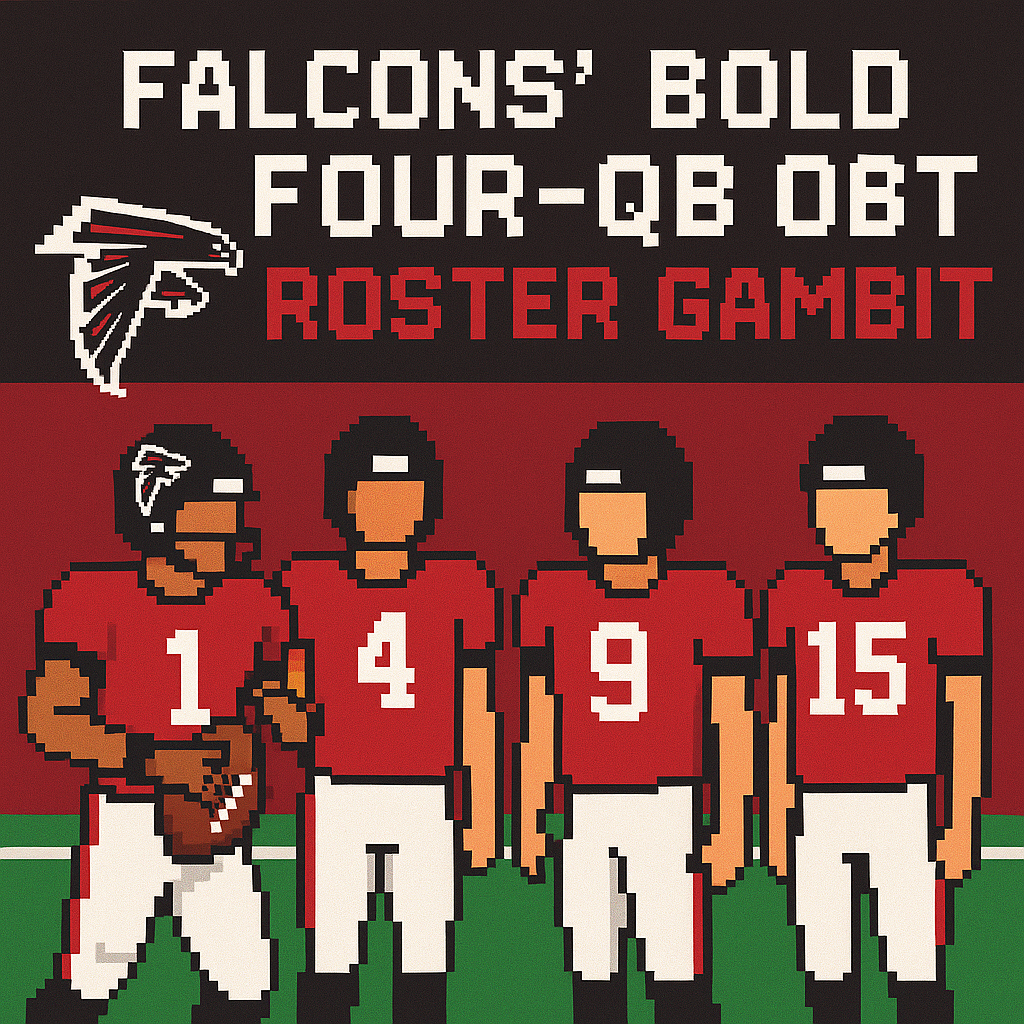
Falcons’ Bold Four‑QB Roster Gambit | Analysis by Brian Moineau

TL;DR

  • The Falcons’ initial 53-man roster for 2026 kept four quarterbacks (Tua Tagovailoa, Michael Penix Jr., Cooper Rush, Jack Strand) and only two running backs (Bijan Robinson, Brian Robinson Jr.), a rare build that squeezes special teams and edge depth while buying time to sort the QB pecking order. [2][3][4]
  • Atlanta traded CB Clark Phillips III and a 2027 fifth-round pick to the Bears for DT Gervon Dexter Sr., and carried injured DB Billy Bowman Jr. on the 53—classic “roster sequencing” that signals short-term IR moves and more churn before Week 1 against Pittsburgh at Mercedes-Benz Stadium in Atlanta, Georgia. [1][2][6][7]
  • My read: the four-QB gambit is a rational response to 2026 emergency QB mechanics and trade dynamics, not indecision; expect Atlanta to flip one QB and backfill RB/EDGE via the IR/waiver dance within 72 hours of cutdown. [3][5][8]

What the source said

The Falcoholic’s initial roster rundown highlights three headline choices: Atlanta carried four quarterbacks through the 53-man cutdown, reduced the running back room to two, and made several surprising moves at the margins. Those included releasing special-teams contributor Tyler Goodson and passing on veteran edge help (Azeez Ojulari, Bralen Trice) while adding Gervon Dexter Sr. on the interior. The piece frames Billy Bowman Jr.’s inclusion as a positive recovery signal, with Da’Shawn Hand in a similar spot heading into the September 2026 opener against the Pittsburgh Steelers. It also underscores that “initial” is the operative word—more moves are expected before Week 1—while questioning a few priorities (e.g., LB JD Bertrand, QB Cooper Rush) in a roster that’s likely to keep moving. [1]

Why it matters

This isn’t just about the Falcons; it’s about how 2026 roster mechanics and quarterback injury risk push teams toward hoarding passers and punting on back-end depth across 53 and 48 active slots on game day. The real stakeholders are general manager Ian Cunningham and head coach Kevin Stefanski, who must balance immediate competitive needs (edge pressure, special teams) with asset preservation (QB trade value) under NFL roster rules that reward sequencing acumen. [2][3][5][8]

Players feel it most. Four quarterbacks and 13 defensive backs crowd out roles for back-end runners and rotational edge rushers—jobs often earned on kick coverage at Heinz Field–style slugfests the Steelers prefer. If Atlanta can’t replace those hidden-yardage snaps with disciplined personnel usage, the cost shows up in field position in Week 1 on September 6–7, not on a transaction log. [1][2][4]

Original analysis

Contrarian read — The consensus: carrying four quarterbacks is wasteful and screams indecision. My take: it’s rational roster arbitrage in 2026. The NFLPA’s veto of the league’s proposed unlimited emergency QB elevations forces the true “QB3” to live on the 53 or consume one of a finite number of weekly elevations, which erodes flexibility. Four clubs kept four QBs on initial 53s this week, so Atlanta’s not an outlier; they’re playing the market. [3][5]

Back-of-the-envelope roster math — edge and RB:

  • Defensive snap math: assume 65 defensive snaps and two-edge fronts on 80% of plays. That’s 0.8 × 65 × 2 ≈ 104 edge snaps to allocate. With only three true edges (Za’Darius Smith, Samson Ebukam, Cameron Thomas), the average load is ~35 snaps each if perfectly balanced; in real usage, the top two push toward 50+, leaving fatigue and injury exposure and minimal sub-package variability. A fourth edge would drop average load toward the high-20s and add third-down variants without taxing Smith/Ebukam. [2][4]
  • Offensive run math: assume ~62 offensive snaps and a 42% rush rate ≈ 26 RB carries. Bijan Robinson and Brian Robinson Jr. can absorb that on paper, but one in-game ankle tweak leaves pass-pro and two-minute offense in the hands of a practice-squad elevation or an out-of-position WR. The opportunity cost of QB4 is probably 10–12 special-teams snaps and the emergency RB3 role on September game days. [2][4][8]

Named-stakeholder breakdown:

  • Tua Tagovailoa, QB: Retains leverage as presumed QB1; four-QB build gives Atlanta time to test-market the room without cutting bait in late August 2026. [2][3][4]
  • Michael Penix Jr., QB: Protected development runway; not forced into QB2 by timing. A trade of Rush or a Strand stash becomes the pressure valve before Week 2. [2][3]
  • Cooper Rush, QB: Classic “inventory” quarterback—valuable to teams thin on game-ready backups; most tradable piece if Atlanta wants to reclaim a roster slot by September 14. [2][3][4]
  • Jack Strand, QB: UDFA with preseason juice; hard to sneak to the practice squad without exposing him to claims—hence the initial 53 spot and the likely PS shuffle. [3][4]
  • Gervon Dexter Sr., DT: Interior pass-rush infusion via a costed asset (Clark Phillips III + 2027 5th); signals confidence in perimeter pressure packages built around Smith/Ebukam/Thomas until James Pearce Jr. returns from suspension. [2][6]
  • Billy Bowman Jr., DB: Inclusion on 53 signals a near-term practice return under IR rules (minimum four games if he were stashed), preserving earlier availability; roster sequencing, not sentiment. [2][4][7]

A 2×2 to decode the Falcons’ initial 53-man roster

  • Axis 1 (X): Immediate game-day utility for Week 1 at Mercedes-Benz Stadium in Atlanta. [1][2]
  • Axis 2 (Y): Retainable market value on the 53 across September 2026 trade calls. [3][5]
    • High utility / high value: Bijan Robinson, Za’Darius Smith — scarce snaps that change outcomes on third-and-medium. [2][4]
    • High utility / low value: Core special-teamers (Malcolm DeWalt IV), swing OL — replaceable leaguewide but essential every Sunday. [2][4]
    • Low utility / high value: QB4 (Rush or Strand) — minimal game-day need, high trade/roster-protection value under current QB rules. [3][5]
    • Low utility / low value: Developmental TE3 or RB3 — the very spots squeezed to carry a fourth QB. [2][4]

What the numbers and rules foreshadow: The Falcons will almost certainly execute the classic post-53 shuffle—short-term IR for one or two injured players (eligible to return after four games), followed by re-signs or claims at RB and EDGE before September 3, 2026. That’s how you square a four-QB ledger with Week 1 reality without losing assets to waivers under 16-man practice-squad and elevation limits. The team site’s transaction language and the Bowman/Hand handling already point that direction. [2][6][7][8]

What others are missing

Angle: the deliberate “roster sequencing” behind Bowman and Dexter. Billy Bowman Jr. on the initial 53 isn’t a sentimental victory lap; it’s a clock play tied to the four-game IR return rule that preserves earlier practice activation in September. Dexter’s arrival on August cutdown week pairs with that timing—interior depth lets Atlanta tolerate going light at edge for a few days while it maneuvers IR and waiver claims. That combination—timing plus positional redundancy—explains the four-QB and two-RB oddity better than “they can’t decide at quarterback.” [2][4][6][7]

What to watch next

  1. By September 3, 2026, Atlanta will place at least one of Bowman or Hand on short-term IR and add an RB3 to the 53 via re-sign or waiver claim. [2][4][7]
  2. By Week 2 (September 13–14, 2026), the Falcons will pare the active QB room to three (via trade of Rush or a Strand move to the practice squad). [2][3][4][5]
  3. By October 11, 2026 (through Week 5), Gervon Dexter Sr. will log 40%+ defensive snap share in at least two games as Atlanta leans interior pressure to offset light edge depth. [2][6]

My take

I’m fine with the Falcons burning an initial 53 spot on QB4. The 2026 rules incentivize hoarding passers, and Atlanta’s room has both uncertainty and trade value in a market where four teams carried four QBs on cutdown day. I’m not fine with living short at edge beyond this week, because Za’Darius Smith and Samson Ebukam shouldn’t play 85% of snaps in September if you want them healthy in December. If Cunningham executes the IR/waiver two-step and spins off one quarterback for a day-three pick while adding an RB3 and a rotational edge, this roster build stops looking weird and starts looking savvy. [2][3][5][6][7][8]

Sources

[1] Top storylines following the Falcons initial 53-man roster — The Falcoholic (https://www.thefalcoholic.com/atlanta-falcons-depth-chart/95615/top-storylines-following-the-falcons-initial-53-man-roster-billy-bowman-tyler-goodson) — The starting point: four QBs, two RBs, surprise edge cuts, Bowman/Hand status, and the expectation of churn.

[2] Atlanta Falcons release initial 2026 roster — AtlantaFalcons.com (https://www.atlantafalcons.com/news/atlanta-falcons-2026-roster) — Official 53 with position counts and transaction buckets (released/waived), including QB4, RB2, Bowman on the 53, and Goodson/Ojulari/Trice moves.

[3] Four NFL teams keep four QBs on initial 53-man rosters — NFL.com (https://amp.nfl.com/news/four-nfl-teams-keep-four-qbs-on-initial-53-man-rosters) — League-wide context that Atlanta isn’t alone; lists the Falcons’ quartet and explains why teams are doing it.

[4] Falcons announce initial 53-man roster: 3 takeaways as team carries 4 QBs — Atlanta Journal-Constitution (https://images.ajc.com/sports/2026/08/falcons-announce-initial-53-man-roster-3-takeaways-as-atlanta-carries-4-qbs/) — Independent confirmation of the position counts and notable inclusions/exclusions, plus Bowman’s status.

[5] NFLPA vetoes emergency third QB rule change — NFL.com (https://www.nfl.com/news/nflpa-vetoes-emergency-third-qb-rule-change) — Explains why teams can’t stash a “bona fide” emergency QB via unlimited elevations, pushing clubs toward carrying more QBs.

[6] Falcons trade CB Clark Phillips III, 5th-round pick to Chicago Bears for DT Gervon Dexter Sr. — AtlantaFalcons.com (https://www.atlantafalcons.com/news/falcons-trade-clark-phillips-iii-5th-round-pick-chicago-bears-gervon-dexter-sr) — Confirms the Dexter acquisition that shapes trench depth and buys time for edge-room triage.

[7] Players now eligible to return from injured reserve after four games — NFL.com (https://www.nfl.com/news/players-now-eligible-to-return-from-injured-reserve-after-four-games) — Details the modern short-term IR framework (four-game minimum, designated to return), critical to understanding Bowman/IR timing.

[8] Contract Language & Roster Mechanics (Practice Squad and Standard Elevation Addendum) — NFL Football Operations (https://operations.nfl.com/calendar-events/nfl-free-agency/contract-language) — Codifies 16-man practice squads and the 54/55-man elevations that interact with the Falcons’ initial 53 calculus.


Related update: We recently published an article that expands on this topic: read the latest post.

Related update: We recently published an article that expands on this topic: read the latest post.

Falcons Quiet GM Search: Long Game Plan | Analysis by Brian Moineau

The Falcons’ GM Search: A Quiet Shuffle with Big Stakes

Hook: The Atlanta Falcons are playing the long game — and the latest from NFL insider Tom Pelissero suggests that what looks like a whisper of interviews today could be the blueprint for the franchise’s next decade.

The short version: the Falcons are methodically interviewing GM candidates while Matt Ryan’s new role atop football operations helps shape the process. Tom Pelissero’s recent update confirms interviews are underway and underscores that Atlanta is being deliberate about pairing a general manager with the new leadership structure.

Where we are and why it matters

  • The Falcons parted ways with Terry Fontenot after the 2025 season, creating one of the NFL’s most consequential front-office openings.
  • Matt Ryan — the former franchise quarterback — is expected to be installed as president of football operations (or head of football operations), which shifts the power dynamic and makes the GM hire as much about chemistry as it is about résumé.
  • The team is interviewing candidates publicly reported (and confirmed by team communications) as part of a process led by Ryan and aided by executive search firms.

Why this matters:

  • A GM hires coaches, builds the roster and controls the draft strategy; with Ryan overseeing football operations, the GM will need to complement Ryan’s vision rather than clash with it.
  • The Falcons already made a headline coaching hire (Kevin Stefanski), so the GM decision is the next major lever that will determine roster construction and the team’s trajectory.

What Pelissero reported

  • Tom Pelissero provided a concise update on NFL Network’s “The Insiders”: the Falcons’ interview process for GM candidates is active and moving forward. The coverage emphasized process and fit over a quick hire. (nfl.com)

  • Local reporting from the Falcons confirmed interviews with at least one candidate (Josh Williams) and framed the search as being guided by Matt Ryan and supported by external search partners. That article highlights the organization’s stated focus on working relationships and alignment as priorities. (atlantafalcons.com)

  • Outside coverage has linked names into the process (reports noting interviews or interest in experienced executives such as Joe Douglas in the broader media cycle), indicating Atlanta is considering both established front-office figures and newer executives. (nypost.com)

The real question: fit over flash

  • The Falcons don’t need a headline-grabbing hire as much as a complementary partner for Ryan and Stefanski.

  • With Stefanski already in place as head coach, the GM must:

    1. Build synergy with Stefanski’s schematic needs (e.g., offensive priorities, roster flexibility).
    2. Share or be adaptable to Ryan’s strategic vision for the roster and organizational culture.
    3. Execute drafts and free-agent strategy that can accelerate competitiveness without destabilizing the cap or long-term plan.
  • That’s why Pelissero’s emphasis on process — interviews, vetting, and fit — is worth noting. The team appears to prefer a careful selection that reduces friction at the top of the organization.

Candidates and context to watch

  • Expect the Falcons to consider:

    • Veterans who’ve previously run or assisted in running a roster (they bring proven processes).
    • Talent evaluators who can identify immediate contributors and long-term building blocks in the draft.
    • Executives who are comfortable in a shared-power structure with a president of football operations (that’s a key filter now).
  • Publicly named interviewees (like Josh Williams) and reported names in the media signal Atlanta is casting a wide net — from league-tested GMs to sharp evaluators who can execute a Stefanski-friendly roster plan. (atlantafalcons.com)

What to expect next

  • More interviews and vetting steps announced in short order (weeks, not months).
  • A hire that will be framed publicly around “fit” — expect statements about alignment with Matt Ryan and Kevin Stefanski.
  • Immediate focus post-hire on roster evaluation, draft board alignment, and free-agent strategy for the coming offseason.

Key points to watch:

  • How closely the GM’s public philosophy matches Stefanski’s scheme.
  • Whether the Falcons clearly define the president/GM boundaries in public communications.
  • Any quick staff moves that hint at the new GM’s priorities (personnel staff hires, scouting structure changes).

My take

Atlanta seems to be learning the lesson many franchises have learned the hard way: putting personalities in compatible seats matters as much as pedigree. Tom Pelissero’s update — short and process-driven — is a signal the Falcons want this right rather than fast. With Matt Ryan now in a leadership role and Stefanski coaching, the GM will likely be judged on how well they knit those pieces together into a coherent, sustainable plan.

If Atlanta lands someone who can both evaluate talent and collaborate at the executive level, this search could be the subtle turning point the franchise needs. If not, tensions at the top could blunt the potential Stefanski brings on the field.

Sources


Related update: We recently published an article that expands on this topic: read the latest post.


Related update: We recently published an article that expands on this topic: read the latest post.


Related update: We recently published an article that expands on this topic: read the latest post.

Stefanski Keeps Ulbrich for Defense Plan | Analysis by Brian Moineau

When continuity meets change: Why the Falcons kept Jeff Ulbrich after hiring Kevin Stefanski

A crisp weekend in Atlanta brought big headlines: Kevin Stefanski was introduced as the Falcons’ new head coach on January 17, 2026 — and two days later the franchise quietly made another important decision. Jeff Ulbrich, the architect behind Atlanta’s sudden pass-rush renaissance, will stay on as defensive coordinator under Stefanski on a new three‑year deal. The pairing is one part bold reset and one part deliberate continuity — and that mix could define the next chapter for the Falcons. (atlantafalcons.com)

Why this matters right now

  • The Falcons hired Kevin Stefanski as head coach on January 17, 2026, handing him the keys to a roster with clear weapons but lingering questions at quarterback and continuity questions on staff. (atlantafalcons.com)
  • Ulbrich’s defense produced a franchise‑record 57 sacks in 2025 and improved Atlanta’s pass rush from a chronic weakness into a clear strength — a turnaround that owner Arthur Blank and new leadership wanted to preserve. Keeping Ulbrich preserves momentum on that side of the ball. (espn.com)
  • Stefanski comes from an offensive, run‑centric background; retaining Ulbrich signals a two‑pronged approach: refresh the offense while keeping the defensive foundation intact. (atlantafalcons.com)

The narrative at play

Think of the Falcons’ offseason so far as a chess move followed by a safety blanket. Atlanta hired a coach known for play‑calling discipline, offensive structure and quarterback management. Stefanski’s résumé includes two AP Coach of the Year awards and sustained emphasis on a physical rushing attack. That’s the chess move — a clear directional choice for the offense and culture. (atlantafalcons.com)

Keeping Jeff Ulbrich is the safety blanket. Ulbrich’s 2025 defense flipped a stubborn team weakness into a real asset: younger edge rushers like James Pearce Jr. and Jalon Walker broke out, and the unit posted numbers that made opponents respect Atlanta’s ability to pressure quarterbacks. Owner and new president-level leadership preferred not to hit the reset button on a defense that finally looked like it had identity and upward trajectory. (espn.com)

What this could mean on the field

  • Defensive identity stays: With Ulbrich in place, expect the Falcons to keep aggressive pass-rush concepts and continue prioritizing edge development. That helps simplify defensive planning while Stefanski installs his offensive concepts. (espn.com)
  • Offense refresh under Stefanski: Stefanski will likely bring trusted assistants and an emphasis on a strong rushing foundation and clean QB mechanics; how he meshes with Atlanta’s quarterback situation (Kirk Cousins vs. Michael Penix Jr. recovery timeline) will be a key storyline. (atlantafalcons.com)
  • Balance of power in the building: Retaining Ulbrich — with a new three‑year contract reported — suggests owner and president want collaboration, not wholesale staff purge. That can speed up roster construction and offseason program planning. (nbcsports.com)

Things to watch this offseason

  • Which Stefanski assistants follow him to Atlanta, and how their offensive philosophy integrates with the existing roster and Bijan Robinson’s skill set. (atlantafalcons.com)
  • How the Falcons manage the QB timeline for Michael Penix Jr.’s recovery versus a potential veteran plan — Stefanski’s past experience with rotating quarterbacks is relevant context. (theguardian.com)
  • Whether Ulbrich’s defensive scheme remains the same or is adapted to better complement Stefanski’s offensive tempo and personnel demands. (espn.com)

Notes on fit and risk

  • The upside: Continuity on defense buys Stefanski breathing room to implement offensive systems without sacrificing recent defensive gains. Young pass-rushers already on the roster give Ulbrich real tools to build with. (espn.com)
  • The risk: If Stefanski and Ulbrich’s philosophies clash in practice planning, game planning, or personnel priorities — especially in how draft/FA resources are allocated between offense and defense — the “best of both worlds” approach could devolve into mixed messaging. Alignment up front will be essential. (atlantafalcons.com)

My take

This move reads as savvy and pragmatic. The Falcons could have made a clean sweep and risked losing the defensive momentum that finally emerged in 2025. Instead, they paired a proven offensive-minded head coach with the defensive architect who gave them a sudden identity. Success won’t be automatic — quarterback clarity and staff alignment are the heavy lifts — but the franchise has at least given itself a real shot at stabilizing both sides of the ball. If Stefanski and Ulbrich can coordinate a coherent plan that values complementary strengths, the Falcons might be building toward consistency instead of another reboot.

Final thoughts

Coaching changes are often loud and disruptive. The quiet, deliberate retention of Jeff Ulbrich after hiring Kevin Stefanski suggests Atlanta’s leadership prefers a hybrid approach: change where they need it most (offense/head coach) and continuity where it actually worked (defense). That’s a promising formula — provided everyone is rowing the same way.

Sources


Related update: We recently published an article that expands on this topic: read the latest post.


Related update: We recently published an article that expands on this topic: read the latest post.


Related update: We recently published an article that expands on this topic: read the latest post.