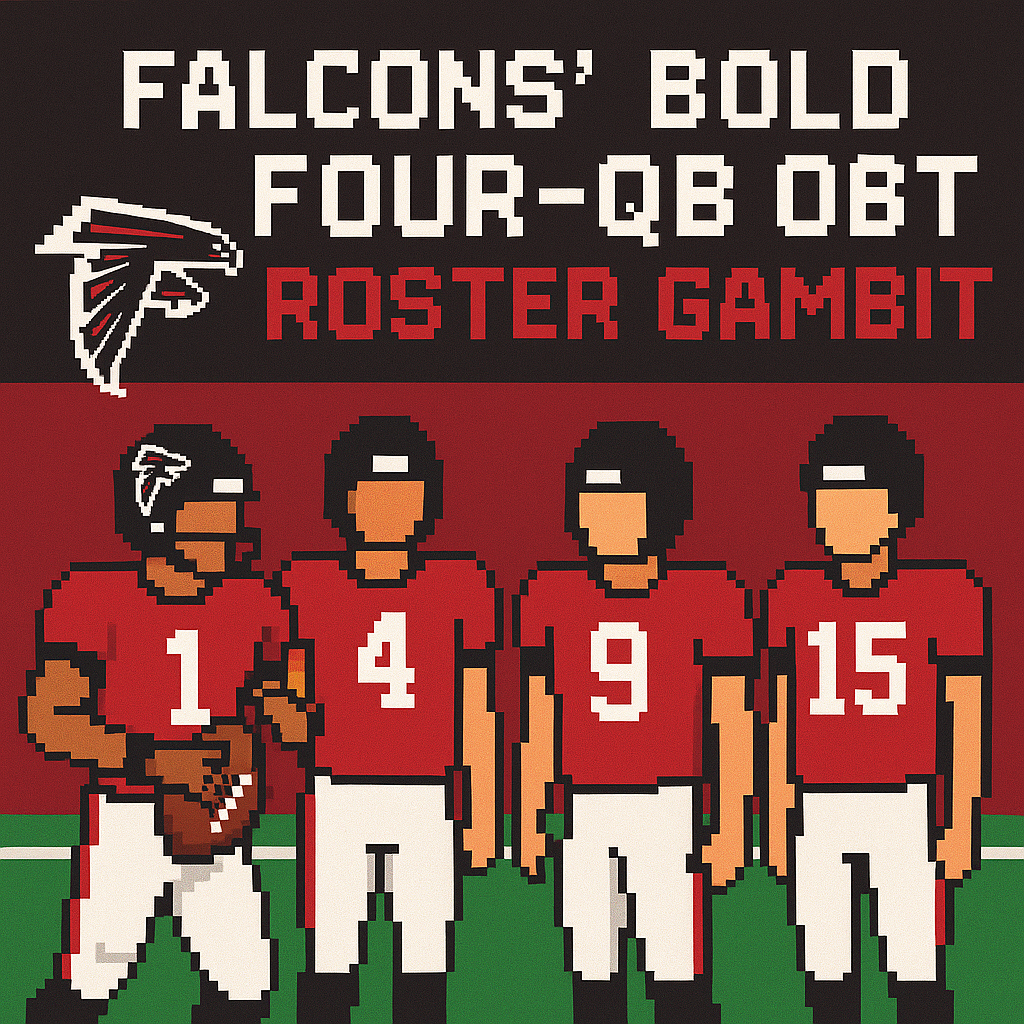
Falcons’ Bold Four‑QB Roster Gambit | Analysis by Brian Moineau

TL;DR

  • The Falcons’ initial 53-man roster for 2026 kept four quarterbacks (Tua Tagovailoa, Michael Penix Jr., Cooper Rush, Jack Strand) and only two running backs (Bijan Robinson, Brian Robinson Jr.), a rare build that squeezes special teams and edge depth while buying time to sort the QB pecking order. [2][3][4]
  • Atlanta traded CB Clark Phillips III and a 2027 fifth-round pick to the Bears for DT Gervon Dexter Sr., and carried injured DB Billy Bowman Jr. on the 53—classic “roster sequencing” that signals short-term IR moves and more churn before Week 1 against Pittsburgh at Mercedes-Benz Stadium in Atlanta, Georgia. [1][2][6][7]
  • My read: the four-QB gambit is a rational response to 2026 emergency QB mechanics and trade dynamics, not indecision; expect Atlanta to flip one QB and backfill RB/EDGE via the IR/waiver dance within 72 hours of cutdown. [3][5][8]

What the source said

The Falcoholic’s initial roster rundown highlights three headline choices: Atlanta carried four quarterbacks through the 53-man cutdown, reduced the running back room to two, and made several surprising moves at the margins. Those included releasing special-teams contributor Tyler Goodson and passing on veteran edge help (Azeez Ojulari, Bralen Trice) while adding Gervon Dexter Sr. on the interior. The piece frames Billy Bowman Jr.’s inclusion as a positive recovery signal, with Da’Shawn Hand in a similar spot heading into the September 2026 opener against the Pittsburgh Steelers. It also underscores that “initial” is the operative word—more moves are expected before Week 1—while questioning a few priorities (e.g., LB JD Bertrand, QB Cooper Rush) in a roster that’s likely to keep moving. [1]

Why it matters

This isn’t just about the Falcons; it’s about how 2026 roster mechanics and quarterback injury risk push teams toward hoarding passers and punting on back-end depth across 53 and 48 active slots on game day. The real stakeholders are general manager Ian Cunningham and head coach Kevin Stefanski, who must balance immediate competitive needs (edge pressure, special teams) with asset preservation (QB trade value) under NFL roster rules that reward sequencing acumen. [2][3][5][8]

Players feel it most. Four quarterbacks and 13 defensive backs crowd out roles for back-end runners and rotational edge rushers—jobs often earned on kick coverage at Heinz Field–style slugfests the Steelers prefer. If Atlanta can’t replace those hidden-yardage snaps with disciplined personnel usage, the cost shows up in field position in Week 1 on September 6–7, not on a transaction log. [1][2][4]

Original analysis

Contrarian read — The consensus: carrying four quarterbacks is wasteful and screams indecision. My take: it’s rational roster arbitrage in 2026. The NFLPA’s veto of the league’s proposed unlimited emergency QB elevations forces the true “QB3” to live on the 53 or consume one of a finite number of weekly elevations, which erodes flexibility. Four clubs kept four QBs on initial 53s this week, so Atlanta’s not an outlier; they’re playing the market. [3][5]

Back-of-the-envelope roster math — edge and RB:

  • Defensive snap math: assume 65 defensive snaps and two-edge fronts on 80% of plays. That’s 0.8 × 65 × 2 ≈ 104 edge snaps to allocate. With only three true edges (Za’Darius Smith, Samson Ebukam, Cameron Thomas), the average load is ~35 snaps each if perfectly balanced; in real usage, the top two push toward 50+, leaving fatigue and injury exposure and minimal sub-package variability. A fourth edge would drop average load toward the high-20s and add third-down variants without taxing Smith/Ebukam. [2][4]
  • Offensive run math: assume ~62 offensive snaps and a 42% rush rate ≈ 26 RB carries. Bijan Robinson and Brian Robinson Jr. can absorb that on paper, but one in-game ankle tweak leaves pass-pro and two-minute offense in the hands of a practice-squad elevation or an out-of-position WR. The opportunity cost of QB4 is probably 10–12 special-teams snaps and the emergency RB3 role on September game days. [2][4][8]

Named-stakeholder breakdown:

  • Tua Tagovailoa, QB: Retains leverage as presumed QB1; four-QB build gives Atlanta time to test-market the room without cutting bait in late August 2026. [2][3][4]
  • Michael Penix Jr., QB: Protected development runway; not forced into QB2 by timing. A trade of Rush or a Strand stash becomes the pressure valve before Week 2. [2][3]
  • Cooper Rush, QB: Classic “inventory” quarterback—valuable to teams thin on game-ready backups; most tradable piece if Atlanta wants to reclaim a roster slot by September 14. [2][3][4]
  • Jack Strand, QB: UDFA with preseason juice; hard to sneak to the practice squad without exposing him to claims—hence the initial 53 spot and the likely PS shuffle. [3][4]
  • Gervon Dexter Sr., DT: Interior pass-rush infusion via a costed asset (Clark Phillips III + 2027 5th); signals confidence in perimeter pressure packages built around Smith/Ebukam/Thomas until James Pearce Jr. returns from suspension. [2][6]
  • Billy Bowman Jr., DB: Inclusion on 53 signals a near-term practice return under IR rules (minimum four games if he were stashed), preserving earlier availability; roster sequencing, not sentiment. [2][4][7]

A 2×2 to decode the Falcons’ initial 53-man roster

  • Axis 1 (X): Immediate game-day utility for Week 1 at Mercedes-Benz Stadium in Atlanta. [1][2]
  • Axis 2 (Y): Retainable market value on the 53 across September 2026 trade calls. [3][5]
    • High utility / high value: Bijan Robinson, Za’Darius Smith — scarce snaps that change outcomes on third-and-medium. [2][4]
    • High utility / low value: Core special-teamers (Malcolm DeWalt IV), swing OL — replaceable leaguewide but essential every Sunday. [2][4]
    • Low utility / high value: QB4 (Rush or Strand) — minimal game-day need, high trade/roster-protection value under current QB rules. [3][5]
    • Low utility / low value: Developmental TE3 or RB3 — the very spots squeezed to carry a fourth QB. [2][4]

What the numbers and rules foreshadow: The Falcons will almost certainly execute the classic post-53 shuffle—short-term IR for one or two injured players (eligible to return after four games), followed by re-signs or claims at RB and EDGE before September 3, 2026. That’s how you square a four-QB ledger with Week 1 reality without losing assets to waivers under 16-man practice-squad and elevation limits. The team site’s transaction language and the Bowman/Hand handling already point that direction. [2][6][7][8]

What others are missing

Angle: the deliberate “roster sequencing” behind Bowman and Dexter. Billy Bowman Jr. on the initial 53 isn’t a sentimental victory lap; it’s a clock play tied to the four-game IR return rule that preserves earlier practice activation in September. Dexter’s arrival on August cutdown week pairs with that timing—interior depth lets Atlanta tolerate going light at edge for a few days while it maneuvers IR and waiver claims. That combination—timing plus positional redundancy—explains the four-QB and two-RB oddity better than “they can’t decide at quarterback.” [2][4][6][7]

What to watch next

  1. By September 3, 2026, Atlanta will place at least one of Bowman or Hand on short-term IR and add an RB3 to the 53 via re-sign or waiver claim. [2][4][7]
  2. By Week 2 (September 13–14, 2026), the Falcons will pare the active QB room to three (via trade of Rush or a Strand move to the practice squad). [2][3][4][5]
  3. By October 11, 2026 (through Week 5), Gervon Dexter Sr. will log 40%+ defensive snap share in at least two games as Atlanta leans interior pressure to offset light edge depth. [2][6]

My take

I’m fine with the Falcons burning an initial 53 spot on QB4. The 2026 rules incentivize hoarding passers, and Atlanta’s room has both uncertainty and trade value in a market where four teams carried four QBs on cutdown day. I’m not fine with living short at edge beyond this week, because Za’Darius Smith and Samson Ebukam shouldn’t play 85% of snaps in September if you want them healthy in December. If Cunningham executes the IR/waiver two-step and spins off one quarterback for a day-three pick while adding an RB3 and a rotational edge, this roster build stops looking weird and starts looking savvy. [2][3][5][6][7][8]

Sources

[1] Top storylines following the Falcons initial 53-man roster — The Falcoholic (https://www.thefalcoholic.com/atlanta-falcons-depth-chart/95615/top-storylines-following-the-falcons-initial-53-man-roster-billy-bowman-tyler-goodson) — The starting point: four QBs, two RBs, surprise edge cuts, Bowman/Hand status, and the expectation of churn.

[2] Atlanta Falcons release initial 2026 roster — AtlantaFalcons.com (https://www.atlantafalcons.com/news/atlanta-falcons-2026-roster) — Official 53 with position counts and transaction buckets (released/waived), including QB4, RB2, Bowman on the 53, and Goodson/Ojulari/Trice moves.

[3] Four NFL teams keep four QBs on initial 53-man rosters — NFL.com (https://amp.nfl.com/news/four-nfl-teams-keep-four-qbs-on-initial-53-man-rosters) — League-wide context that Atlanta isn’t alone; lists the Falcons’ quartet and explains why teams are doing it.

[4] Falcons announce initial 53-man roster: 3 takeaways as team carries 4 QBs — Atlanta Journal-Constitution (https://images.ajc.com/sports/2026/08/falcons-announce-initial-53-man-roster-3-takeaways-as-atlanta-carries-4-qbs/) — Independent confirmation of the position counts and notable inclusions/exclusions, plus Bowman’s status.

[5] NFLPA vetoes emergency third QB rule change — NFL.com (https://www.nfl.com/news/nflpa-vetoes-emergency-third-qb-rule-change) — Explains why teams can’t stash a “bona fide” emergency QB via unlimited elevations, pushing clubs toward carrying more QBs.

[6] Falcons trade CB Clark Phillips III, 5th-round pick to Chicago Bears for DT Gervon Dexter Sr. — AtlantaFalcons.com (https://www.atlantafalcons.com/news/falcons-trade-clark-phillips-iii-5th-round-pick-chicago-bears-gervon-dexter-sr) — Confirms the Dexter acquisition that shapes trench depth and buys time for edge-room triage.

[7] Players now eligible to return from injured reserve after four games — NFL.com (https://www.nfl.com/news/players-now-eligible-to-return-from-injured-reserve-after-four-games) — Details the modern short-term IR framework (four-game minimum, designated to return), critical to understanding Bowman/IR timing.

[8] Contract Language & Roster Mechanics (Practice Squad and Standard Elevation Addendum) — NFL Football Operations (https://operations.nfl.com/calendar-events/nfl-free-agency/contract-language) — Codifies 16-man practice squads and the 54/55-man elevations that interact with the Falcons’ initial 53 calculus.


Related update: We recently published an article that expands on this topic: read the latest post.
Related update: We recently published an article that expands on this topic: read the latest post.
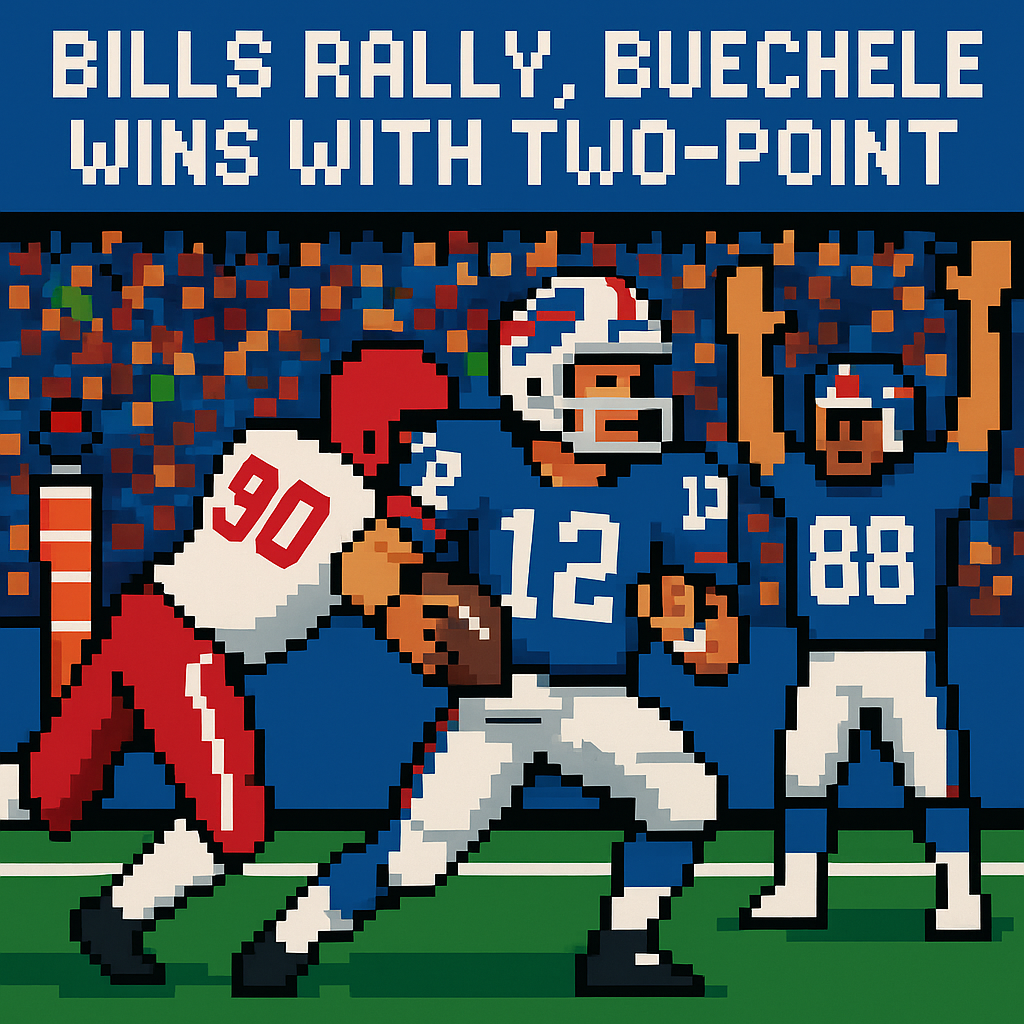
Bills Rally, Buechele Wins With Two-Point | Analysis by Brian Moineau

TL;DR

  • Buffalo beat Pittsburgh 28–27 on August 27, 2026 at Highmark Stadium in Orchard Park to finish a 3–0 preseason, capped by RB Ian Wheeler’s 2-yard TD at 1:06 and QB Shane Buechele’s dart to WR Dante Pettis for the go-ahead two-point conversion. [2][3][9]
  • The play-call says more than the record: first-year head coach Joe Brady chose a live-fire, gotta-have-it rep over a tie, stress-testing his situational menu and his QB2 in a real clock. [3][5]
  • The real stakes now are roster economics: a bubble player like Wheeler faces a ~$637,500 swing between a 53-man spot and the practice squad; Pettis’ swing is even bigger given his service time and WR6/PR profile. [6]

What the source said

WIVB relays the Associated Press game story: Buffalo rallied to beat the Steelers 28–27 in Orchard Park, New York, closing the preseason with a perfect 3–0 record. Ian Wheeler punched in a 2‑yard touchdown with 1:06 remaining, and a Buechele-to-Pettis two-point conversion sealed it. The piece frames the win as a rebound after early errors. [1]

It also credits “Steve Buechele” on the two-point throw, mirroring AP’s wire copy carried by affiliates. The recap emphasizes the late swing from a fourth-quarter deficit to a one-point win in the 2026 preseason finale for both clubs. [1]

Why it matters

The scoreboard won’t travel to September 2026, but the tape will. For the Bills, this was Joe Brady’s first August as head coach; compressing a last-minute drive into a successful two-pointer gives him hard evidence on Shane Buechele’s poise, Pettis’ utility as a WR6/returner, and Wheeler’s contact balance in short yardage. That trio maps directly to Sunday’s cutdown decisions at wide receiver, running back, and quarterback on the 53-man. [3][5][7]

For bubble players, the delta isn’t abstract. A spot on the 53 means a full Paragraph 5 salary for 18 weeks; a practice squad slot means weekly paychecks that can vanish with a single transaction. One late drive on August 27 just moved real compensation bands for two veterans on the margins. [6]

Original analysis

Consensus says “perfect preseasons don’t predict anything.” That’s broadly true at the team level—see the 2008 Detroit Lions, who went 4–0 in August and then 0–16 by December—but this particular 28–27 finish matters for two reasons: the decisions it exposed and the dollars it moved. [10]

Contrarian read

  • Consensus: August records are noise.
  • My case: This win carried signal for Brady’s program because he manufactured a high-leverage rep on purpose. With 1:06 left on August 27, he declined the tie and put the outcome on a sprint-out throw to Pettis. That’s banked practice in a situation coordinators can’t simulate, and it centered Shane Buechele—correctly identified by the team as the trigger man, despite wire stories misnaming him “Steve”—as the functional QB2 before a Sunday 6 p.m. ET deadline. [3][4][8]

Back-of-envelope calculation: the roster-money swing

  • Practice squad salaries in 2026: $13,750/week for standard players; $18,350/week for veterans; max $22,850/week. Over an 18‑week regular season, that’s $247,500 (standard) or $330,300 (veteran). [6]
  • League-minimum Paragraph 5 salaries in 2026: rookie $885,000; 7+ credited seasons $1,215,000. [6]

Math:

  • Ian Wheeler (2 credited seasons): 53-man at $885,000 vs. standard PS at $247,500 ⇒ swing ≈ $885,000 − $247,500 = $637,500. One drive just swung more than a half-million dollars of career capital. [6]
  • Dante Pettis (8th season): 53-man at $1,215,000 vs. PS at a veteran rate $330,300 ⇒ swing ≈ $1,215,000 − $330,300 = $884,700. Special-teams snaps plus that two-point toe-tap are not just “feel-good”—they’re compensation levers. [6][7]

A simple 2×2 of preseason performances (Who produced x How they produced)

  • Axes:
    • Personnel: Starters vs. Depth
    • Traits: Repeatable (process-driven) vs. Volatile (broken plays/flags)
Repeatable traits (route craft, leverage, vision) Volatile traits (busted coverages, tip drills)
Starters N/A here (Josh Allen, many starters rested). [4] N/A
Depth Pettis (release/landmark discipline on 2-pt), Wheeler (short-yardage decisiveness, ball security on goal line); Buechele (footwork under duress). [2][3][7] A couple PI swings and scramble explosives earlier in August—useful, but not bankable. [2]

Why it predicts something actionable: the Bills need WR6 to be a field-position asset and an on-script route runner, not a camp hero. Pettis’ usage—July 30, 2026 signing plus situational trust on a game-deciding rep—maps to a defined role with Brady: punt return insurance, motion/Z depth, and two-minute competence. Wheeler’s path is as RB3/teams coverage back, where vision and contact balance translate week to week in the AFC East. [1][3][7]

Finally, correct the record: multiple AP-affiliate recaps credited “Steve” Buechele on the conversion. The Bills’ own clips, roster, and game notes all identify Shane, and the highlight is unambiguous on team video. That discrepancy is trivial for standings, but nontrivial for a quarterback fighting to be named QB2. Narrative scaffolding matters when you’re not a household name in Western New York. [2][8][9]

What others are missing

The key angle isn’t the 3–0 line—it’s Brady’s risk calculus. He didn’t just “go for two”; he selected a sideline-tight, timing-dependent concept that tests ball placement, body control, and toe discipline, then ran it through a new veteran (Pettis) and a backup quarterback (Buechele). That’s a culture tell in Orchard Park: Buffalo will emphasize precision in gotta-have-it football, not just Josh Allen’s improvisation. If Brady’s 2026 Bills win close games, trace it back to reps like August 27—where the staff chose data over vibes and built live confidence into their situational call sheet. [3][5]

What to watch next

  1. By Sunday, August 30, 2026, 6:00 p.m. ET, Buffalo carries two quarterbacks on the initial 53—Josh Allen and Shane Buechele—with Kyle Allen waived and a strong candidate for the practice squad. [3][4]
  2. By Sunday, August 30, 2026, Dante Pettis makes the Bills’ initial 53 as WR6/PR, after his July 30, 2026 signing and late-game usage cement a defined role. [1][7]
  3. By Week 4 (through September 2026), Ian Wheeler logs at least 25 combined rushes plus targets for Buffalo—including special teams active status in at least three games—reflecting RB3 trust. [2][6]

My take

Keep the playmakers who closed it in Orchard Park. I’d name Shane Buechele the QB2, keep Dante Pettis as WR6/primary punt return hedge, and award Ian Wheeler the RB3 job at league minimum to start. The way Buffalo won on August 27, 2026—scripted, precise, and gutsy—signals how Joe Brady plans to manage leverage downs. Trim to those traits on Sunday at 6 p.m. ET and bank EV in one-score games. [2][3][6]

Sources

  1. Bills rally to close out preseason with perfect record, beating Steelers 28-27 after early errors — WIVB/AP (https://www.wivb.com/sports/buffalo-bills/bills-rally-to-close-out-preseason-with-perfect-record-beating-steelers-28-27-after-early-errors/) — Original report with the late Wheeler TD and Buechele-to-Pettis two-point to finish a perfect preseason.

  2. Bills 28, Steelers 27 — Recap + highlights — BuffaloBills.com (https://www.buffalobills.com/news/bills-28-steelers-27-final-score-recap-highlights) — Official game recap confirming the 28–27 result, the 3–0 preseason, and drive details.

  3. ‘It was just execution’ — Bills reflect on the comeback — BuffaloBills.com (https://www.buffalobills.com/news/it-was-just-execution-the-bills-reflect-on-an-impressive-fourth-quarter-comeback-to-close-out-the-preseason) — Describes the decision to go for two, Pettis’ catch, and context around late-game choices.

  4. Steelers edged by Bills, 28–27, in preseason finale — Steelers.com (https://www.steelers.com/news/steelers-edged-by-bills-28-27-in-preseason-finale) — Opponent’s game story with timing and sequence of the go-ahead TD and conversion.

  5. 2026 NFL Preseason, Week 3: What We Learned — NFL.com (https://mobile-www.nfl.com/news/2026-nfl-preseason-week-3-what-we-learned-from-thursday-s-games) — League roundup listing Bills 28, Steelers 27 and broader context for Thursday’s games.

  6. Minimum and practice-squad salaries, 2026 — Over The Cap (https://overthecap.com/minimum-salaries) — Authoritative CBA-driven table for 2026 roster minimums and practice-squad weekly/yearly pay used in the back-of-envelope math.

  7. Bills sign WR Dante Pettis to one-year deal — BuffaloBills.com (https://www.buffalobills.com/news/bills-sign-wide-receiver-dante-pettis-to-one-year-deal) — Confirms Pettis’ July 30, 2026 signing and offers role context heading into August.

  8. Bills close preseason with 28–27 win over Steelers on Buechele’s late 2-point conversion — ABC News (AP) (https://abcnews.com/amp/Sports/wireStory/bills-close-preseason-28-27-win-steelers-buecheles-136020469) — AP wire version that misidentifies “Steve” Buechele, illustrating the reporting discrepancy.

  9. QB Shane Buechele and WR Dante Pettis connect on two-point conversion (video) — BuffaloBills.com (https://www.buffalobills.com/video/bills-comeback-preseason-win-vs-steelers-nfl-highlights) — Team video confirming the players involved on the decisive play.

  10. 2008 Detroit Lions season summary — Pro-Football-Reference (https://www.pro-football-reference.com/teams/det/2008.htm) — Historical analogue showing a 4–0 preseason followed by an 0–16 regular season, underscoring why August records can mislead.


Related update: We recently published an article that expands on this topic: read the latest post.


Related update: We recently published an article that expands on this topic: read the latest post.

Bland’s Foot Injury Threatens Cowboys Run | Analysis by Brian Moineau

When a Season Tilts: DaRon Bland, the Cowboys’ Corner, and the Fragility of Momentum

A gut-punch moment for Cowboys fans: DaRon Bland — the All-Pro corner who altered games with his ball-hawking instincts — is now a realistic injured‑reserve candidate because of a foot issue that surfaced during preparations for the Week 16 matchup against the Los Angeles Chargers. That single sentence carries ripple effects for Dallas’s defense, roster decisions and the feel of the locker room the rest of the way.

Quick hits you should know

  • DaRon Bland was added to the Cowboys’ practice/injury reports Dec. 18, 2025, after a foot problem that sidelined him during midweek practice and made him unlikely to play Sunday versus the Chargers. (dallascowboys.com)
  • The team signaled the injury could be serious enough to require placing Bland on season‑ending injured reserve, which would end his 2025 campaign with three games remaining. (dallascowboys.com)
  • Bland’s availability has been a recurring storyline since 2024, when a foot stress fracture forced him to miss significant time; durability is becoming a concern for a player on a big contract and with All‑Pro pedigree. (dallasnews.com)

The context: why this matters beyond one roster move

Bland is not just “a corner” for the Cowboys — he’s a playmaker with a history of flipping field position and generating turnovers. In 2023 he exploded onto the national radar, leading the league with nine interceptions and returning an unprecedented five for touchdowns. The Cowboys leaned on that playmaking ability as a cornerstone of their secondary identity.

When a player like Bland becomes unavailable late in the season, several things happen at once:

  • Opposing offenses adjust, targeting the side away from the team’s most disruptive defender. That can force the Cowboys to rotate coverages more or rely on less‑proven teammates.
  • The coaching staff suddenly faces pressure to retool matchups and potentially increase Trevon Diggs’ snaps (if/when he’s available), or to accelerate the development of younger corners. Reports indicate the Cowboys were already juggling Diggs’ status and other cornerback windows. (dallascowboys.com)
  • The front office and medical staff must balance short‑term competitiveness against long‑term health. Putting Bland on IR could protect his recovery and the team’s future investment, but it also concedes immediate defensive continuity.

What the roster implications look like

  • If Bland lands on injured reserve: Dallas must hollow out a starting-caliber role across the secondary for the remaining three games, or shuffle Diggs and backups into heavier duty. The team has options — returning players from the practice squad window, flipping nickel personnel, or leaning on coverage schematics that mask inexperience — but none are perfect substitutes for an All‑Pro. (dallascowboys.com)
  • If Bland avoids IR and misses only a few games: the Cowboys preserve a matchup advantage for the playoffs (in a healthy scenario), but risk aggravating the injury and possible surgery/longer absence later. Given Bland’s recent foot history, conservative management is a rational path. (dallasnews.com)

What this means for the Chargers game — and the rest of the month

Even if Bland is inactive Sunday, the Cowboys can still defend well on schematic strength and pass rush. Still, his absence compresses margin for error: coverages that rely on tight single‑coverage outside could be more vulnerable, and Dallas may have to trust inexperienced alignments in crucial moments.

For the Chargers game specifically, expect the Cowboys to:

  • Mix zone and help over the top to keep receivers away from the sideline where young corners can get isolated.
  • Increase safety rotation and safety‑to‑slot matchups to account for mismatches.
  • Consider elevating practice‑squad or depth corners to provide fresh legs and special‑teams value.

My take

It’s disappointing on a human level — no player wants to see a season end in a quiet medical room rather than the bright lights of a game. For the Cowboys, this moment reveals two hard truths: elite playmakers are also fragile, and a good roster is built not only with stars but with dependable depth plans. I’d rather see the team make the prudent medical call even if it costs the next three games. Protecting Bland’s long‑term health preserves the investment and gives Dallas a chance to start 2026 with one of its best defenders healthy.

Final thoughts

Injuries are the cruel equalizer of the NFL. The way Dallas responds — schematically and in roster moves — will show whether the organization learned from past seasons about building sustainable depth. Fans should brace for a few imperfect weeks, but also remember that smart, measured decisions now could be the difference between a recovered All‑Pro next fall and a chronic problem that lingers beyond one campaign.

Sources


Related update: We recently published an article that expands on this topic: read the latest post.


Related update: We recently published an article that expands on this topic: read the latest post.

Saints Choose Cade York Over Justin Tucker | Analysis by Brian Moineau

When a Kickoff Workout Became a Story: Saints Try Justin Tucker, Sign Cade York Instead

Justin Tucker got a workout with the New Orleans Saints — but the club ultimately signed Cade York to replace Blake Grupe. What looked like a dramatic midseason audition for the best kicker of the last decade instead turned into a reminder that talent, timing, and off-field context all matter as much as the swing of a leg.

Why the moment mattered

  • The Saints were reeling from a shaky kicking performance: Blake Grupe missed two field goals in a recent loss, and New Orleans decided to explore alternatives.
  • Justin Tucker is the marquee name — one of the most accurate kickers in NFL history, a record-holder and routine game-winner — but he arrived with baggage. In 2025 he served a 10-game suspension under the NFL’s personal conduct policy and had been released by the Baltimore Ravens earlier in the year.
  • Cade York, a former LSU kicker who’s bounced around the league, earned the immediate opportunity: the team signed him to the practice squad and will have him compete for the job.

Quick snapshot of the situation

  • Saints’ change: Blake Grupe will be released; Cade York was signed to the practice squad on November 25, 2025. (nbcsports.com)
  • Justin Tucker worked out for the Saints but was not signed. His first workout since a 10-game suspension did not overcome the off-field concerns the team weighed. (reuters.com)
  • Cade York’s résumé: a 2022 college pedigree (LSU) and multiple short stints with NFL teams; his career pro FG percentage and experience make him an experienced journeyman choice to bridge the gap. (nbcsports.com)

What the Saints likely weighed

  • Performance vs. reputation
    • Tucker’s on-field résumé is elite, but teams now factor in public perception, locker-room dynamics, and league discipline when making signings.
  • Short-term stability
    • The Saints needed a quick, low-friction fix while evaluating options; a younger, less controversial kicker who can be coached and slotted into a competition is attractive.
  • Media and fan reaction
    • Bringing Tucker aboard would have been headline-grabbing and polarizing. Signing York keeps the focus on on-field competition rather than off-field headlines.

Why Cade York makes pragmatic sense

  • Familiarity with high-pressure environments: He kicked at LSU and has remained in NFL orbit, which matters when you need someone who can step in quickly.
  • Low immediate risk: York on the practice squad gives the Saints time to evaluate him against Charlie Smyth and avoid the optics and complications of signing a high-profile player with recent suspension history.
  • Roster flexibility: The Saints can still reassess later in the season — if performance or circumstances change, the team can pivot.

What this says about the NFL today

  • Talent alone isn’t always enough. Teams are balancing winning now with organizational values, PR risks, and league discipline.
  • High-profile players returning from suspension face an uphill climb to find landing spots, regardless of past excellence.
  • The kicker market remains volatile — one missed kick can change a job, and teams are willing to cycle through options rather than commit immediately to headline-grabbing names.

Takeaways for fans and casual observers

  • Signing York is a low-drag, short-term move; it keeps the Saints focused on play and competition rather than off-field headlines. (nbcsports.com)
  • Tucker’s workout showed he’s still sought after for his talent, but broader considerations influenced the Saints’ decision. (reuters.com)
  • The episode highlights how teams manage risk and optics in real time during a season that already stretches rosters thin.

My take

There’s something bittersweet about this one. On pure kicking merit, Justin Tucker would make a lot of teams better overnight. But the NFL isn’t a vacuum: reputational issues, league discipline, and timing change the calculus. For the Saints, signing Cade York feels like the sensible, cautious move — it buys time, limits distractions, and puts the job back into a competition rather than a headline. For Tucker, the audition with New Orleans signals he’s still in the conversation; whether he finds a home likely depends on timing, team willingness to accept the baggage, and how the rest of the season unfolds.

Sources


Related update: We recently published an article that expands on this topic: read the latest post.


Related update: We recently published an article that expands on this topic: read the latest post.

Buffalo Bills shakeup practice squad roster early in 2025 NFL season – Buffalo Rumblings | Analysis by Brian Moineau

Buffalo Bills shakeup practice squad roster early in 2025 NFL season - Buffalo Rumblings | Analysis by Brian Moineau

Buffalo Bills' Practice Squad Shuffle: A Reflection on Change and Opportunity in Sports and Beyond

In an unexpected twist early in the 2025 NFL season, the Buffalo Bills have been busy reconfiguring their practice squad roster, according to the recent report from Buffalo Rumblings. This "two in, one out" maneuver is akin to a strategic game of chess, a sport where every move counts and the ability to adapt is key to success. But what does this mean for the players involved and the broader sports landscape?

The Players: New Faces and Departures

Let's dive into the shuffle. The Bills have brought in two fresh faces while parting ways with another. This kind of roster churn is not uncommon in the NFL, where practice squads serve as a revolving door for talent, providing teams with flexibility and depth. For the new entrants, this is a golden opportunity to prove their mettle and potentially secure a spot on the main roster. For the player leaving, it's a chance to reflect, regroup, and perhaps find new opportunities elsewhere.

This situation is reminiscent of the saying, "When one door closes, another opens." In professional sports, as in life, change is the only constant. Players must be ready to seize opportunities when they arise, and teams must be agile enough to adapt to the ever-shifting landscape of the league.

A Broader Perspective: Change in the World

The Bills' practice squad shakeup reflects a wider theme that resonates beyond sports—embracing change. Whether it's a sports team restructuring its roster, a tech company pivoting its strategy, or individuals navigating personal and professional crossroads, the ability to adapt is crucial.

Take, for instance, the recent surge in remote work. Just as the Bills are adapting to optimize their squad, companies worldwide are rethinking how to best structure their teams in a post-pandemic world. Flexibility and innovation have become the cornerstones of success across industries.

Looking Ahead: The Bills and Beyond

For the Buffalo Bills, this roster adjustment is a proactive step in their quest for NFL glory. As they continue to navigate the 2025 season, these changes could be pivotal in their journey. The Bills have been a team on the rise in recent years, with strong performances and a dedicated fan base. This practice squad shuffle could be another strategic move to keep their upward momentum.

In the world of sports and beyond, embracing change and seizing opportunities are essential for growth and success. The Buffalo Bills' practice squad moves serve as a timely reminder of this universal truth.

Final Thought: Embrace the Shuffle

As we watch the Bills and their new practice squad additions take on the challenges of the 2025 season, let us remember that change, while often daunting, can also be a catalyst for growth and opportunity. Whether you're an athlete, a business professional, or anyone facing change, take a page from the Buffalo Bills' playbook: stay agile, stay focused, and embrace the shuffle.

Read more about AI in Business

Read more about Latest Sports Trends

Read more about Technology Innovations

Titans Add Three to the Team’s Practice Squad, and the Group Includes Center Corey Levin – Tennessee Titans | Analysis by Brian Moineau

Titans Add Three to the Team’s Practice Squad, and the Group Includes Center Corey Levin - Tennessee Titans | Analysis by Brian Moineau

Title: Titans' Practice Squad Shuffle: Corey Levin's Return and the Art of Second Chances

Ah, the ever-evolving dance of the NFL roster. It's a world where dreams are made, dashed, and, if you're lucky, resurrected. The Tennessee Titans have recently made some noteworthy moves by adding three players to their practice squad, including a familiar face: center Corey Levin. Levin, who was waived by the team on Wednesday, now finds himself back in the fold, reminding us all that in the world of professional sports, the door never truly closes—it just revolves.

Corey Levin: The Journeyman Center

Corey Levin is no stranger to the ups and downs of the NFL. Drafted by the Titans in the sixth round of the 2017 NFL Draft, he has since become the quintessential journeyman, with stints at various teams, including the Chicago Bears and the Denver Broncos. Levin's journey is one of resilience—a quality that resonates beyond the football field. Much like the phoenix rising from the ashes, Levin's return to the Titans' practice squad is a testament to tenacity and the belief that skill paired with persistence can reignite opportunities.

Practice Squads: The Unsung Heroes

Practice squads in the NFL are the unsung heroes of the league. They are the benchwarmers, the understudies, the safety nets. These squads allow teams to develop players, keep talent close, and have a ready pool of athletes to call upon in moments of need. With injuries and unexpected challenges ever-present, practice squad players like Levin become crucial to a team's depth and adaptability.

Just as the business world values adaptability and growth, NFL teams understand that investing in their practice squads today can lead to a stronger, more flexible roster tomorrow. It's akin to modern companies investing in their talent pool, training, and nurturing potential future stars.

A Wider Lens: Second Chances in Life

Corey Levin's story is not just about football; it's a narrative that mirrors many second-chance stories we see in other areas of life. Consider the tech industry, where a failed start-up today can become tomorrow's unicorn. Entrepreneurs like Steve Jobs, who once found himself ousted from Apple, only to return and lead the company to unprecedented heights, are prime examples of how setbacks can be stepping stones to success.

Similarly, in the world of entertainment, actors and musicians often face periods of obscurity before returning to the spotlight. Robert Downey Jr.'s comeback story, from personal struggles to becoming Iron Man and a linchpin of the Marvel Cinematic Universe, shows us that the narrative of redemption and resilience is universal.

Final Thoughts: Embracing the Journey

As Titans fans, and sports enthusiasts in general, we can appreciate the dynamic and often unpredictable nature of the NFL. Corey Levin's return to the Titans' practice squad is a reminder of the power of perseverance and the importance of never counting someone out. Whether on the gridiron, in the boardroom, or in our personal lives, second chances can lead to the most inspiring chapters of our stories.

So here's to the practice squads, the journeymen, and everyone who dares to dream again. May we all find the strength to embrace the journey, wherever it may lead.

Read more about AI in Business

Read more about Latest Sports Trends

Read more about Technology Innovations