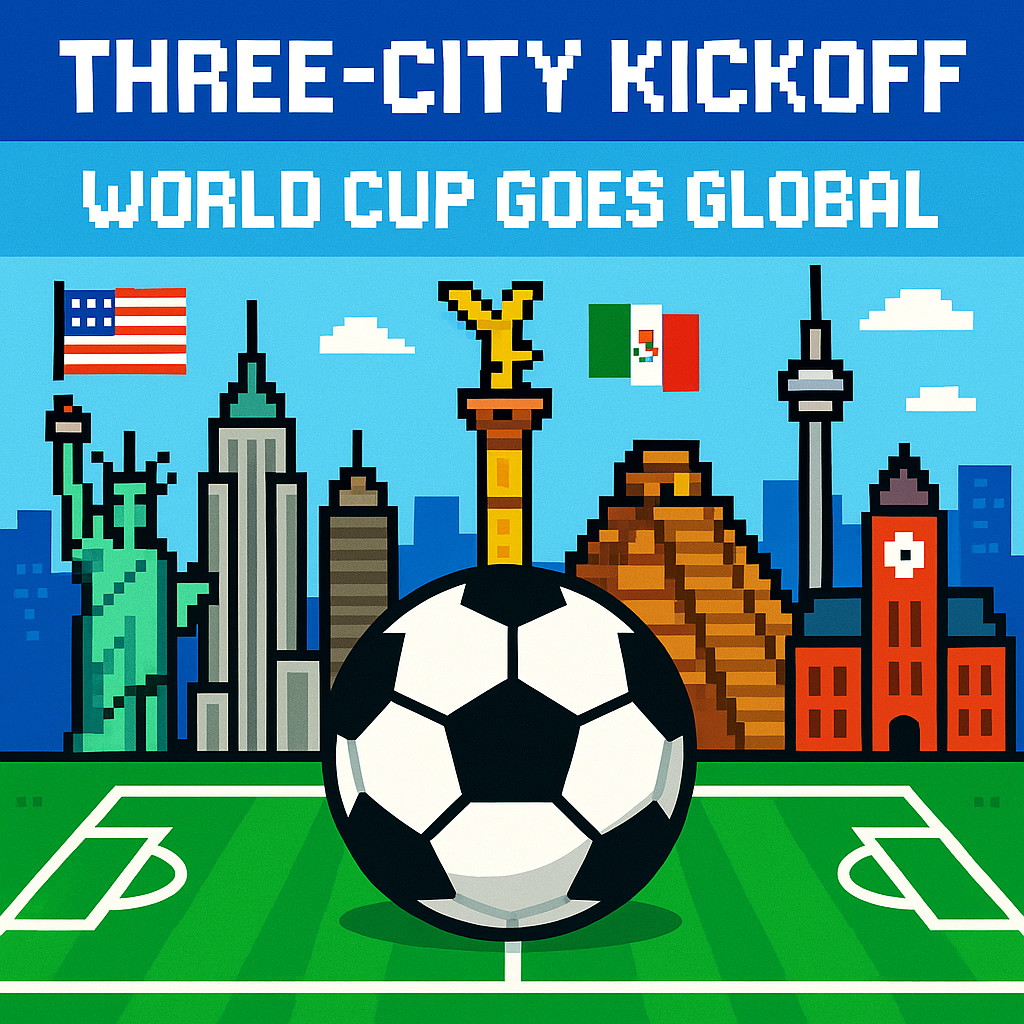
Three-City Kickoff: World Cup Goes Global | Analysis by Brian Moineau

TL;DR

  • The 2026 FIFA World Cup opening ceremonies are a three-city flex: Mexico City launched on June 11 with Shakira, Burna Boy, and the anthem “Dai Dai,” while Toronto and Los Angeles follow on June 12 with big-name slates—staking a claim that the tournament is as much culture as football. [2][3][4][5]
  • The expanded 48‑team, 104‑match format sets an attendance record path; even a conservative 45,000 average would top USA ’94’s 3.59 million, while 60,000–70,000 averages imply roughly 6.2–7.3 million tickets used. [7][8][9]
  • The staggered ceremonies are schedule and monetization architecture: they stretch prime viewing windows across time zones, create more sellable tentpoles for FOX/FS1 and Telemundo/Peacock, and smooth urban operations across three host nations. [4][6]

What the source said

CBS News reports that the largest FIFA Men’s World Cup ever has begun across the U.S., Mexico, and Canada—with three opening ceremonies instead of one. Mexico City’s Azteca show featured Shakira before Mexico beat South Africa 2–0, while Toronto and Los Angeles host their ceremonies on June 12 ahead of Canada–Bosnia and the U.S.–Paraguay. The piece lists artist lineups (Shakira, Burna Boy, Michael Bublé, Alanis Morissette, Katy Perry, LISA, and more), gives kickoff times in ET/PT, notes the 48‑team expansion to 104 matches, and describes stepped‑up U.S. security in host metros. It also flags Toronto’s BMO Field temporary expansion and points fans to live coverage. [1]

Why it matters

Three opening ceremonies signal a new tournament logic for a 48‑team, 104‑match event spread across 16 host cities in the U.S., Mexico, and Canada in 2026. FIFA is multiplying cultural touchpoints that sell ad spots, sponsor activations, and social clips while easing pressure on single venues like SoFi Stadium (Inglewood) and BMO Field (Toronto). The commercial upside concentrates with rights‑holders FOX/FS1 and Telemundo/Peacock and with FIFA’s 2023‑approved format change. [6][7][12]

The downside risk sits with city operations chiefs and transit systems—LA Metro, the Toronto Transit Commission (TTC), and Mexico City’s STC Metro—plus artists tied to production glitches and federations facing a supersized spotlight. U.S. security agencies already elevated their posture around host metros per CBS News, and Toronto’s organizers must sync ceremony timing to a 3:00 p.m. ET kickoff window. In 2026, optics ride alongside outcomes. [1][5]

Original analysis

  • Back‑of‑envelope: the attendance ceiling

    • Total matches: 104. If average in‑stadium attendance hits only 45,000, the tournament draws ≈4.68 million (104 × 45,000), already beating USA ’94’s 3.59 million (3,587,538). If it averages 60,000, that’s ≈6.24 million; at 70,000, ≈7.28 million. Even without universal sellouts, the record falls. [7][8][9]
    • Reference points: USA ’94 totaled 3.587 million across 52 matches; Qatar 2022 drew about 3.4 million across 64 matches. [8][9]
  • Named‑stakeholder breakdown (what this means for them)

    • FIFA: A three‑ceremony format creates three distinct inventory peaks (Mexico City June 11; Toronto and Los Angeles June 12), each with sponsorable “moments.” That spreads risk and magnifies social engagement spikes around official assets like the anthem. [3][4][5]
    • FOX/FS1 and Telemundo/Peacock: A primetime USMNT vs. Paraguay at SoFi (9:00 p.m. ET) sets up a ratings test against 2022’s USA–England Black Friday benchmark near 20 million combined viewers in the U.S. [6][10][11]
    • BMO Field (Toronto): Temporary capacity to ≈45,000 turns Canada’s opener into a full‑stadium TV picture, narrowing the optics gap with NFL‑scale U.S. venues and stress‑testing modular seating at international scale. [12]
    • Mexico City (Azteca): Opening match plus opening ceremony equals global first impression; a 2–0 win over South Africa gives the host’s narrative momentum on day one. [2]
    • Artists/labels: “Dai Dai” as the official anthem debuts live to cross‑market audiences; Shakira and Burna Boy span Latin America, Africa, and U.S. diaspora fandoms, a positioning built for Global 200 lift next chart week. [3][2]
  • A 2×2: What the three opening ceremonies optimize

    • Axis 1: Nation‑branding vs. Global‑pop spectacle.
    • Axis 2: Fan atmosphere vs. Broadcast‑first staging.
    • Mexico City (Nation‑branding × Fan atmosphere): Azteca’s history and a Latin‑leaning lineup (Shakira, Maná, J Balvin) deliver heritage and terrace color on camera. [2][3]
    • Toronto (Nation‑branding × Broadcast‑first): Canadian icons (Alanis Morissette, Michael Bublé) and a tight pre‑kickoff window match domestic pride with TV pacing inside BMO Field. [5][12]
    • Los Angeles (Global‑pop spectacle × Broadcast‑first): Katy Perry, LISA, Future, Anitta, Rema, and Tyla anchor a clip‑engineered show in a U.S. primetime slot from SoFi’s stage. [4][6]
  • Contrarian read

    • Consensus: “Three ceremonies are pure sizzle.”
    • Counter: They are scheduling infrastructure. FIFA and broadcasters are distributing tentpoles across time zones—Mexico City midday local on June 11; Toronto afternoon ET; USA primetime PT/ET on June 12—to widen contiguous viewing blocks for a 39‑day, 104‑match product. That is revenue design, not ornament. [4][6][7]

What others are missing

The three‑ceremony design is an operations‑and‑monetization hack, not just a highlight reel. Staggered start times build a rolling “live” window—Mexico City spectacle feeds Toronto’s afternoon slot, which hands off to L.A. primetime—keeping FOX/FS1 and Telemundo/Peacock in near wall‑to‑wall event mode for two calendar days. That yields more makegoods capacity, more local sponsor activations per host committee, and thinner peaks for security and transit versus one mega‑ceremony. With SoFi’s USMNT kickoff at 9:00 p.m. ET and Toronto’s at 3:00 p.m. ET anchoring different dayparts, this is inventory and incident‑risk management by design. [6][5][4]

What to watch next

  1. By June 27, 2026 (end of the group stage), FIFA’s cumulative attendance tally surpasses 3.6 million, eclipsing USA ’94 before the knockouts begin. [7][8][9]
  2. By June 15, 2026 (first ratings day after the U.S. opener), USA–Paraguay delivers at least 21 million combined U.S. viewers across English and Spanish platforms, topping the ~20 million from USA–England in 2022. [6][10]
  3. By June 12, 2026 (post‑game Toronto), BMO Field’s announced attendance for Canada–Bosnia is ≥44,000, showing the ≈45,000 temporary build‑out can run at scale. [12][5]

My take

I’m bullish on the three‑ceremony model because it converts a 39‑day, 16‑stadium, three‑federation puzzle (USSF, FMF, Canada Soccer) into serialized appointment TV that flatters each country’s identity while hardening FIFA’s commercial spine. The football will write its own stories, but the stagecraft is already earning its keep with primetime U.S. placement at 9:00 p.m. ET and a format approved in March 2023 that expands total inventory to 104 matches. If the U.S. opener clears 21 million combined viewers, brands will treat the rest of the USMNT slate like NFL‑adjacent tentpoles. [6][7][10]

Sources

[1] CBS News — Report on triple opening ceremonies across U.S., Mexico, and Canada; includes artist lineups, kickoff times, venue notes, and U.S. security posture.
[2] Reuters — Match report from June 11, 2026: Mexico 2–0 South Africa at Estadio Azteca and coverage of the Mexico City opening ceremony.
[3] FIFA Media Release (June 2026) — Announcement of the official 2026 anthem “Dai Dai” and participating artists including Shakira and Burna Boy; frames global music strategy.
[4] Los Angeles 2026 Host Committee / SoFi Stadium advisory — LA opening ceremony lineup and timing; confirms primetime window and production scale.
[5] City of Toronto / Host City Toronto briefing — Toronto ceremony slate (Alanis Morissette, Michael Bublé) and same‑day timing ahead of Canada–Bosnia at BMO Field.
[6] FOX Sports and Telemundo Deportes programming advisories — U.S.–Paraguay kickoff at 9:00 p.m. ET and distribution across FOX/FS1 and Telemundo/Peacock; primetime positioning.
[7] FIFA Council decision (March 2023) — 2026 format approval: 48 teams and 104 matches; provides the structural basis for schedule and inventory.
[8] FIFA World Cup USA 1994 statistics — Total attendance of 3,587,538 across 52 matches; historical benchmark.
[9] FIFA / BBC Sport summaries for Qatar 2022 — Approximate total attendance around 3.4 million across 64 matches; recent comparator.
[10] Sports Business Journal (Nov 2022) — USA–England combined U.S. audience near 20 million across English and Spanish; benchmark for 2026 ratings expectations.
[11] Telemundo Deportes (Nov 2022) — Spanish‑language audience records for USA–England, including broadcast and streaming totals; supports combined‑viewership math.
[12] Maple Leaf Sports & Entertainment (MLSE) / BMO Field construction brief — Temporary expansion plan to roughly 45,000 capacity for 2026; operational implications for Toronto matches.


Related update: We recently published an article that expands on this topic: read the latest post.
Related update: We recently published an article that expands on this topic: read the latest post.

Purdy’s Five-TD Night Puts Niners Near 1 | Analysis by Brian Moineau

Night of the Purdy Party: How Brock Put the 49ers One Win From the 1-Seed

There are nights when a quarterback doesn’t just play — he takes over the script. On Sunday Night Football, Brock Purdy did exactly that. After a shaky first throw, he rallied to account for five touchdowns (three passing, two rushing) and guided the San Francisco 49ers to a 42-38 win over the Chicago Bears, setting up a winner-take-all Week 18 clash with the Seattle Seahawks for the NFC’s top seed.

This wasn’t tidy. It wasn’t pretty. It was electric, messy, and magnificent — the kind of primetime game that reminds you why football is an emotional sport. Purdy’s performance didn’t just win a game; it extended momentum, ratcheted expectations, and made the 49ers’ late-season narrative impossible to ignore.

Why this game matters beyond the scoreboard

  • The 49ers improved to 12-4 and now control the path to the NFC’s No. 1 seed — beat Seattle in Week 18 and they finish with home-field advantage and a first-round bye.
  • Purdy’s five-touchdown output marked his second straight game with that many TDs, a rare streak that puts him in historical company.
  • The game showcased both San Francisco’s offensive fireworks and defensive vulnerabilities — a reminder that the 49ers’ ceiling is sky-high but not without risk.

What Purdy showed under pressure

Early in the game Purdy’s first pass went the wrong way — a pick-six — and it felt like a potential saboteur for the night. Instead, he flipped the script.

  • Poise: Purdy repeatedly converted third downs and escaped from pressure to keep drives alive. Those off-schedule plays defined the late-game push.
  • Dual-threat explosiveness: He finished with 303 passing yards and two rushing TDs, becoming the first 49ers QB to have 300+ yards, three pass TDs and two rushing TDs in a single game (team research highlighted after the win). That versatility turns play-calling from a plan into a problem for defenses.
  • Clutch: The decisive 38-yard touchdown to Jauan Jennings with 2:15 left was a clean, aggressive strike — the kind of throw that separates good games from signature wins.

Head coach Kyle Shanahan’s postgame praise calling Purdy an “assassin” and saying he was “playing as good as it gets” wasn’t hyperbole. The game mattered in context: it followed a stretch where Purdy had elevated his play and now heads into a season-deciding showdown carrying real momentum.

The big-picture 49ers: offense humming, defense raising questions

This was a team win, but it wasn’t without blemishes.

  • Offense: Christian McCaffrey returned with a huge night (140 rushing yards and a TD), the receiving corps made key plays, and even backup tight end Jake Tonges stepped up in George Kittle’s absence. The attack looked balanced and explosive.
  • Defense: Allowing 38 points to a Bears team led by rookie quarterback Caleb Williams spotlighted persistent coverage and pressure issues. San Francisco’s defense made enough key plays late, but this unit will need steadier work against Seattle’s attack next week.
  • Health and toughness: The 49ers took hits in the trenches and showed resilience; Purdy escaped a few dangerous moments that could have swung the game had things gone differently.

In short: an offense capable of torching any defense, paired with a defense that can be flaky in stretches. That combination makes them thrilling but also fragile.

Moments that mattered

  • The pick-six early could have derailed the Niners; instead Purdy’s response set the tone for the rest of the night.
  • Purdy’s 3rd-and-long completions and late scramble to keep the final drive alive were game-defining.
  • The 38-yard TD to Jennings with 2:15 left — the dagger that ultimately separated the two clubs.

A look ahead: what the Week 18 showdown will decide

  • If the 49ers beat the Seahawks in Week 18 (Saturday night), they clinch the NFC West, snag the No. 1 seed, secure a first-round bye, and earn home-field advantage — potentially all the way to the Super Bowl if they keep winning.
  • The margin for error is razor-thin: Purdy’s recent run gives San Francisco offensive confidence, but the defense must clean up mismatches against Seattle’s weapons.

A few quick stat nuggets

  • Purdy: 24-of-33, 303 passing yards, 3 passing TDs, 1 INT, plus 6 rushes for 28 yards and 2 rushing TDs (game totals as reported after the matchup).
  • The 49ers reached 12-4 and have the opportunity to clinch the NFC’s top seed with a win next week.
  • Purdy became one of the few quarterbacks in the Super Bowl era to record five offensive TDs in back-to-back games, a feat last done by Russell Wilson in 2020.

My take

This was a defining primetime moment for Brock Purdy and the 49ers’ offense. Purdy’s growth from mid-round prospect to an elite manager-of-chaos has been rapid and intoxicating to watch. The offense is dialed in; the defense is worrisome but still capable of clutch plays. If San Francisco can patch the defensive holes and Purdy keeps producing at this level, they won’t be a one-week wonder — they’ll be the team everyone has to beat in January.

If you’re a 49ers fan, savor the Purdy magic but don’t get complacent. If you’re watching the NFC playoff picture, keep an eye on Levi’s Stadium — the 49ers controlling the 1-seed would completely reshape postseason paths.

Sources


Related update: We recently published an article that expands on this topic: read the latest post.


Related update: We recently published an article that expands on this topic: read the latest post.

Bears’ Defense Shaky Ahead of 49ers Night | Analysis by Brian Moineau

Bears enter Sunday night in San Francisco with question marks on defense

The Bears are headed to Levi's Stadium under a cloud of uncertainty. With playoff seeding on the line and a primetime national audience watching, Chicago’s defensive corps — normally one of the unit’s strengths this season — looks shakier than you’d like the week before the postseason push. Injuries and an illness bug have left multiple starters listed as questionable or out, forcing the Bears to lean on depth and coaching ingenuity against a 49ers offense that can punish hesitation.

What’s going on (short version)

  • Multiple defensive contributors are either ruled out or questionable because of injuries and illness.
  • Key concerns include cornerback availability, the status of veteran playmakers in the secondary, and whether linebackers can play at full strength.
  • The timing — late December, with seeding implications — makes these absences feel more urgent than they might earlier in the year.

Snapshot of the injury picture

  • Nick McCloud: ruled out due to illness.
  • Nahshon Wright: hamstring/illness and did not practice late in the week; questionable.
  • Josh Blackwell: missed late practices; questionable.
  • C.J. Gardner-Johnson: knee but practiced full; questionable.
  • T.J. Edwards: dealing with a glute issue; limited in practice and listed as questionable.
  • Rome Odunze (offense): ruled out (foot) — not a defensive player, but his absence affects game flow and offensive matchups.

(These notes reflect the team injury report and local media coverage released in the days leading into the Bears–49ers Sunday night game.)

Why this matters — more than just names on a sheet

  • Cornerback instability against a pass-heavy 49ers offense is a matchup problem: San Francisco’s route concepts and tight-end usage create high-demand coverage assignments. When your nickel and boundary corners are banged up or sick, you can expect the opponent to attack the seams and force the defense into matchup-based substitutions that invite communication errors.
  • Linebacker questions change fit and run-defense responsibilities: If T.J. Edwards is limited or unavailable, the Bears must shuffle reps and responsibility for middle-of-field coverage and run-gap integrity. That can open lanes for playmakers like Christian McCaffrey and force safeties into awkward run-support vs. coverage choices.
  • Depth and special teams get tested: Late-week illnesses frequently force elevation of practice-squad players and increased snaps for rotational guys. That’s not inherently bad, but it compresses the margin for error in a game where every possession matters.

How the Bears can cope (practical angles)

  • Lean on communication and simplify assignments: When bodies are limited, fewer moving parts helps reduce blown coverages. Expect play calls designed to keep the defense on its heels without relying on complex rotations.
  • Prioritize situational football: Limit third-and-long exposure and make the offense earn points. Winning field position and converting turnovers become even more valuable when personnel is stressed.
  • Trust experienced depth and scout-prep replacements: The Bears will look to backup corners and special teams standouts who already know the system. Coaching that prepares specific matchups for those replacements can blunt an opposing offense’s best plans.
  • Offense must stay on the field: Time of possession becomes a weapon when your defense is undermanned. A ball-control, methodical approach reduces the number of times the defense is forced to make game-altering plays.

Moments to watch on Sunday night

  • Early third-down plays: If the Bears struggle to get off the field, that will expose the thin spots in the secondary right away.
  • Matchups versus tight ends and slot receivers: How the Bears handle intermediate routes and seams will indicate whether Gardner-Johnson (if active) and the nickel package can hold up.
  • Substitution and communication penalties: Pre-snap confusion or repeated personnel errors often reflect last-minute lineup changes due to illness/injury.

A tempered optimism

This team has weathered stretches of adversity before. Coaching adjustments, veteran leadership, and a strong offensive identity can mitigate losses on the other side of the ball — at least to a degree. The 49ers present a stiff test, but football is still decided one play at a time; the Bears’ ability to slog through the ugly sequences and capitalize on turnovers will be decisive.

My take

Injuries and illnesses are part of NFL life, but timing is everything. Facing an elite offense in a primetime setting with multiple defensive starters uncertain elevates the stakes. I expect the Bears to simplify and play disciplined football — they don’t have the luxury of improvisation on defense. If the backups can hold the seams and the offense controls the clock, Chicago can make this a competitive game. If not, the 49ers will likely exploit matchup advantages and put the Bears on their heels.

Sources


Related update: We recently published an article that expands on this topic: read the latest post.


Related update: We recently published an article that expands on this topic: read the latest post.