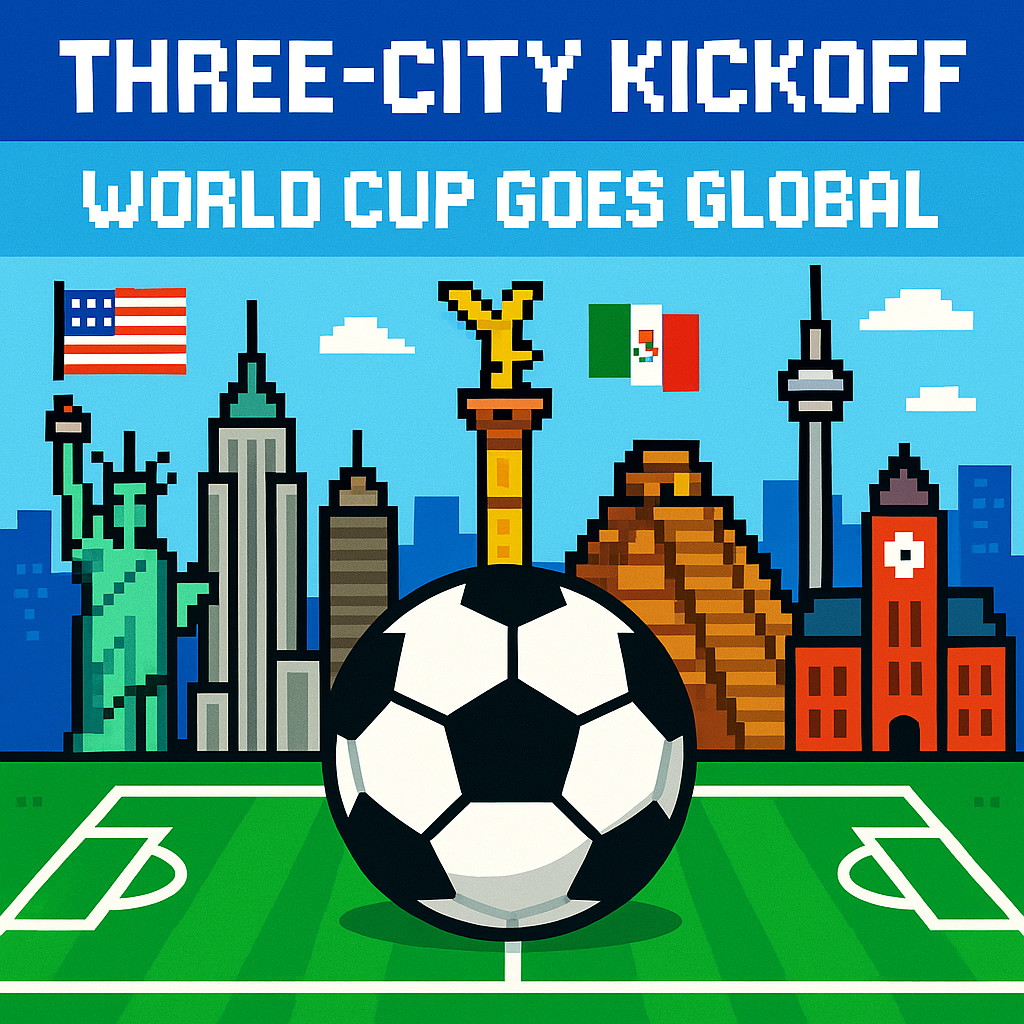
Three-City Kickoff: World Cup Goes Global | Analysis by Brian Moineau

TL;DR

  • The 2026 FIFA World Cup opening ceremonies are a three-city flex: Mexico City launched on June 11 with Shakira, Burna Boy, and the anthem “Dai Dai,” while Toronto and Los Angeles follow on June 12 with big-name slates—staking a claim that the tournament is as much culture as football. [2][3][4][5]
  • The expanded 48‑team, 104‑match format sets an attendance record path; even a conservative 45,000 average would top USA ’94’s 3.59 million, while 60,000–70,000 averages imply roughly 6.2–7.3 million tickets used. [7][8][9]
  • The staggered ceremonies are schedule and monetization architecture: they stretch prime viewing windows across time zones, create more sellable tentpoles for FOX/FS1 and Telemundo/Peacock, and smooth urban operations across three host nations. [4][6]

What the source said

CBS News reports that the largest FIFA Men’s World Cup ever has begun across the U.S., Mexico, and Canada—with three opening ceremonies instead of one. Mexico City’s Azteca show featured Shakira before Mexico beat South Africa 2–0, while Toronto and Los Angeles host their ceremonies on June 12 ahead of Canada–Bosnia and the U.S.–Paraguay. The piece lists artist lineups (Shakira, Burna Boy, Michael Bublé, Alanis Morissette, Katy Perry, LISA, and more), gives kickoff times in ET/PT, notes the 48‑team expansion to 104 matches, and describes stepped‑up U.S. security in host metros. It also flags Toronto’s BMO Field temporary expansion and points fans to live coverage. [1]

Why it matters

Three opening ceremonies signal a new tournament logic for a 48‑team, 104‑match event spread across 16 host cities in the U.S., Mexico, and Canada in 2026. FIFA is multiplying cultural touchpoints that sell ad spots, sponsor activations, and social clips while easing pressure on single venues like SoFi Stadium (Inglewood) and BMO Field (Toronto). The commercial upside concentrates with rights‑holders FOX/FS1 and Telemundo/Peacock and with FIFA’s 2023‑approved format change. [6][7][12]

The downside risk sits with city operations chiefs and transit systems—LA Metro, the Toronto Transit Commission (TTC), and Mexico City’s STC Metro—plus artists tied to production glitches and federations facing a supersized spotlight. U.S. security agencies already elevated their posture around host metros per CBS News, and Toronto’s organizers must sync ceremony timing to a 3:00 p.m. ET kickoff window. In 2026, optics ride alongside outcomes. [1][5]

Original analysis

  • Back‑of‑envelope: the attendance ceiling

    • Total matches: 104. If average in‑stadium attendance hits only 45,000, the tournament draws ≈4.68 million (104 × 45,000), already beating USA ’94’s 3.59 million (3,587,538). If it averages 60,000, that’s ≈6.24 million; at 70,000, ≈7.28 million. Even without universal sellouts, the record falls. [7][8][9]
    • Reference points: USA ’94 totaled 3.587 million across 52 matches; Qatar 2022 drew about 3.4 million across 64 matches. [8][9]
  • Named‑stakeholder breakdown (what this means for them)

    • FIFA: A three‑ceremony format creates three distinct inventory peaks (Mexico City June 11; Toronto and Los Angeles June 12), each with sponsorable “moments.” That spreads risk and magnifies social engagement spikes around official assets like the anthem. [3][4][5]
    • FOX/FS1 and Telemundo/Peacock: A primetime USMNT vs. Paraguay at SoFi (9:00 p.m. ET) sets up a ratings test against 2022’s USA–England Black Friday benchmark near 20 million combined viewers in the U.S. [6][10][11]
    • BMO Field (Toronto): Temporary capacity to ≈45,000 turns Canada’s opener into a full‑stadium TV picture, narrowing the optics gap with NFL‑scale U.S. venues and stress‑testing modular seating at international scale. [12]
    • Mexico City (Azteca): Opening match plus opening ceremony equals global first impression; a 2–0 win over South Africa gives the host’s narrative momentum on day one. [2]
    • Artists/labels: “Dai Dai” as the official anthem debuts live to cross‑market audiences; Shakira and Burna Boy span Latin America, Africa, and U.S. diaspora fandoms, a positioning built for Global 200 lift next chart week. [3][2]
  • A 2×2: What the three opening ceremonies optimize

    • Axis 1: Nation‑branding vs. Global‑pop spectacle.
    • Axis 2: Fan atmosphere vs. Broadcast‑first staging.
    • Mexico City (Nation‑branding × Fan atmosphere): Azteca’s history and a Latin‑leaning lineup (Shakira, Maná, J Balvin) deliver heritage and terrace color on camera. [2][3]
    • Toronto (Nation‑branding × Broadcast‑first): Canadian icons (Alanis Morissette, Michael Bublé) and a tight pre‑kickoff window match domestic pride with TV pacing inside BMO Field. [5][12]
    • Los Angeles (Global‑pop spectacle × Broadcast‑first): Katy Perry, LISA, Future, Anitta, Rema, and Tyla anchor a clip‑engineered show in a U.S. primetime slot from SoFi’s stage. [4][6]
  • Contrarian read

    • Consensus: “Three ceremonies are pure sizzle.”
    • Counter: They are scheduling infrastructure. FIFA and broadcasters are distributing tentpoles across time zones—Mexico City midday local on June 11; Toronto afternoon ET; USA primetime PT/ET on June 12—to widen contiguous viewing blocks for a 39‑day, 104‑match product. That is revenue design, not ornament. [4][6][7]

What others are missing

The three‑ceremony design is an operations‑and‑monetization hack, not just a highlight reel. Staggered start times build a rolling “live” window—Mexico City spectacle feeds Toronto’s afternoon slot, which hands off to L.A. primetime—keeping FOX/FS1 and Telemundo/Peacock in near wall‑to‑wall event mode for two calendar days. That yields more makegoods capacity, more local sponsor activations per host committee, and thinner peaks for security and transit versus one mega‑ceremony. With SoFi’s USMNT kickoff at 9:00 p.m. ET and Toronto’s at 3:00 p.m. ET anchoring different dayparts, this is inventory and incident‑risk management by design. [6][5][4]

What to watch next

  1. By June 27, 2026 (end of the group stage), FIFA’s cumulative attendance tally surpasses 3.6 million, eclipsing USA ’94 before the knockouts begin. [7][8][9]
  2. By June 15, 2026 (first ratings day after the U.S. opener), USA–Paraguay delivers at least 21 million combined U.S. viewers across English and Spanish platforms, topping the ~20 million from USA–England in 2022. [6][10]
  3. By June 12, 2026 (post‑game Toronto), BMO Field’s announced attendance for Canada–Bosnia is ≥44,000, showing the ≈45,000 temporary build‑out can run at scale. [12][5]

My take

I’m bullish on the three‑ceremony model because it converts a 39‑day, 16‑stadium, three‑federation puzzle (USSF, FMF, Canada Soccer) into serialized appointment TV that flatters each country’s identity while hardening FIFA’s commercial spine. The football will write its own stories, but the stagecraft is already earning its keep with primetime U.S. placement at 9:00 p.m. ET and a format approved in March 2023 that expands total inventory to 104 matches. If the U.S. opener clears 21 million combined viewers, brands will treat the rest of the USMNT slate like NFL‑adjacent tentpoles. [6][7][10]

Sources

[1] CBS News — Report on triple opening ceremonies across U.S., Mexico, and Canada; includes artist lineups, kickoff times, venue notes, and U.S. security posture.
[2] Reuters — Match report from June 11, 2026: Mexico 2–0 South Africa at Estadio Azteca and coverage of the Mexico City opening ceremony.
[3] FIFA Media Release (June 2026) — Announcement of the official 2026 anthem “Dai Dai” and participating artists including Shakira and Burna Boy; frames global music strategy.
[4] Los Angeles 2026 Host Committee / SoFi Stadium advisory — LA opening ceremony lineup and timing; confirms primetime window and production scale.
[5] City of Toronto / Host City Toronto briefing — Toronto ceremony slate (Alanis Morissette, Michael Bublé) and same‑day timing ahead of Canada–Bosnia at BMO Field.
[6] FOX Sports and Telemundo Deportes programming advisories — U.S.–Paraguay kickoff at 9:00 p.m. ET and distribution across FOX/FS1 and Telemundo/Peacock; primetime positioning.
[7] FIFA Council decision (March 2023) — 2026 format approval: 48 teams and 104 matches; provides the structural basis for schedule and inventory.
[8] FIFA World Cup USA 1994 statistics — Total attendance of 3,587,538 across 52 matches; historical benchmark.
[9] FIFA / BBC Sport summaries for Qatar 2022 — Approximate total attendance around 3.4 million across 64 matches; recent comparator.
[10] Sports Business Journal (Nov 2022) — USA–England combined U.S. audience near 20 million across English and Spanish; benchmark for 2026 ratings expectations.
[11] Telemundo Deportes (Nov 2022) — Spanish‑language audience records for USA–England, including broadcast and streaming totals; supports combined‑viewership math.
[12] Maple Leaf Sports & Entertainment (MLSE) / BMO Field construction brief — Temporary expansion plan to roughly 45,000 capacity for 2026; operational implications for Toronto matches.


Related update: We recently published an article that expands on this topic: read the latest post.


Related update: We recently published an article that expands on this topic: read the latest post.

Porsche Penske’s Nasr Completes Threepeat | Analysis by Brian Moineau

Sunrise, fog and a three-peat: Daytona’s 64th Rolex 24 delivered everything

If you were up through the night or woke to a flood of dramatic finish-line photos and confetti, you weren’t the only one. The 64th Rolex 24 at Daytona served up a textbook endurance thriller — long caution periods, strategic chess matches in the pits, a late-race duel that had the crowd on its feet, and a historic result that will be remembered in IMSA lore.

How the story ended (the short version)

  • The No. 7 Porsche 963 from Porsche Penske Motorsport — piloted by Felipe Nasr, Julien Andlauer and Laurin Heinrich — took the overall victory after 24 hours and 705 laps. (imsa.com)
  • Nasr’s win completed a personal and team “three-peat”: three straight Rolex 24 overall wins for Nasr and for Porsche Penske. (imsa.com)
  • The finish was tight — Nasr beat Jack Aitken’s Cadillac by 1.569 seconds after a stirring final-20-minute battle. (imsa.com)

What made this running of the Rolex 24 feel different

  • A record crowd brought the energy. Daytona confirmed the largest attendance in the event’s history, which turned the grandstands and infield into a proper festival for endurance racing. (nbcsports.com)
  • Nature played a role: a record-long six-and-a-half-hour full-course yellow for dense fog shuffled strategy and compressed the drama into the closing hours. (racing.porsche.com)
  • Porsche Penske’s dominance was both tactical and resilient — leading a majority of laps but still having to defend fiercely at the end, a reminder that endurance wins are never automatic. (imsa.com)

The race as a narrative — hour by hour highlights

  • Greed and patience in the opening laps: an early multi-car LMP2 incident and a few spins scattered the field, but the race settled into alternating waves of pace and caution. Porsche Penske’s 963s capitalized on consistency early and often. (nbcsports.com)
  • Night into morning: when Daytona goes dark, the race becomes a test of concentration. Hybrid prototypes filled the top-10 early on, and Porsche and Acura traded speed while teams managed traffic, tires and fuel. (nbcsports.com)
  • Fog and the long yellow: the unusually long full-course yellow limited on-track opportunities for many hours, turning pit stops and tire strategy into the prime battlegrounds. That long pause reintroduced tension when the race resumed and compressed the final strategic window. (racing.porsche.com)
  • The last hour: with the race back to green and strategy still unfolding, Felipe Nasr held off a charging Jack Aitken, weaving through GT traffic and defending a gap that swung down to inches — pure, wheel-to-wheel endurance drama. (nbcsports.com)

Cars and classes that mattered

  • GTP (overall): Porsche Penske Motorsport’s No. 7 (winner) and strong showings from hybrid prototypes (BMW M Hybrid V8, Cadillac V-Series.R, Acura ARX-06) made the top of the order a four-manufacturer tussle. (nbcsports.com)
  • LMP2: CrowdStrike Racing by APR’s No. 04 took the class win, a neat counterpoint to the GTP storylines. (nbcsports.com)
  • GTD Pro and GTD: Paul Miller Racing’s BMW M4 GT3 EVO won GTD Pro, while Winward Racing’s Mercedes took GTD — class battles were close and delivered plenty of late-race spice. (nbcsports.com)

Why the three-peat matters

  • Historical weight: three consecutive overall wins at Daytona are rare and put Nasr and Porsche Penske alongside names like Helio Castroneves and Peter Gregg in the record books. That kind of sustained success at a marquee endurance event cements a legacy beyond a single season. (imsa.com)
  • Team depth and execution: endurance racing is a whole-organization sport. The result reflects driver talent, pit crew discipline, engineering choices, and the ability to manage mechanical sympathy over 2,500+ miles. Porsche Penske showed all of those elements. (imsa.com)

Lessons for teams and fans

  • Durability beats raw pace: when fog or long yellows neutralize on-track passes, reliability and smart strategy pay huge dividends.
  • Never count out traffic as a deciding factor: multi-class racing makes lapping slower cars a recurring risk/reward moment late in the race.
  • Crowd and spectacle matter: strong attendance shows endurance racing’s continued appeal and helps make the finish-line moments even more meaningful.

What I noticed that numbers don’t show

Watching the final stint, you could feel the human element — drivers nursing tired bodies, spotters and engineers reading split seconds and making split-second calls, and crews working like a single organism during pit windows. That intimacy between machine and team is why Daytona still fascinates after 64 editions: it’s mechanical ballet under stress, scored to the clock.

My take

This Rolex 24 felt like both a milestone and a statement. Porsche Penske’s three-peat sends a clear message about program stability and execution in GTP, but the spice around the edges — Cadillac’s late charge, BMW’s newcomer performance, the long fog pause — shows the field is hungry and capable of producing shocks. If anything, Daytona 2026 reminded us that endurance racing’s greatest strength is uncertainty: no matter how tidy the statistics look, 24 hours always gives you a fresh story.

Sources


Related update: We recently published an article that expands on this topic: read the latest post.


Related update: We recently published an article that expands on this topic: read the latest post.


Related update: We recently published an article that expands on this topic: read the latest post.

John Harbaugh: I’m measuring Lamar Jackson’s performance, not his attendance – NBC Sports | Analysis by Brian Moineau

John Harbaugh: I’m measuring Lamar Jackson’s performance, not his attendance - NBC Sports | Analysis by Brian Moineau

Lamar Jackson's Offseason Approach: A Modern Take on Performance Over Presence

In the world of professional sports, particularly in the NFL, the offseason is a time for reflection, strategy, and preparation. However, for Baltimore Ravens quarterback Lamar Jackson, this period has sparked a conversation about the balance between attendance and performance. According to an NBC Sports article titled "John Harbaugh: I’m measuring Lamar Jackson’s performance, not his attendance," the Ravens are currently in the Organized Team Activities (OTA) phase of their offseason, which is voluntary. As such, Jackson has chosen to forgo most of these workouts.

This decision might have raised eyebrows among some traditionalists who view physical presence at training camps as a non-negotiable aspect of team commitment. Yet, Ravens head coach John Harbaugh has taken a refreshingly modern stance, emphasizing that he is more concerned with Jackson's performance metrics rather than his mere attendance at these voluntary sessions. This perspective reflects a broader shift in how we evaluate contributions in various fields, from corporate environments to creative industries, where results often speak louder than physical presence.

Lamar Jackson: A Unique Talent

Lamar Jackson isn't just any quarterback; he was the NFL MVP in 2019, known for his electrifying playing style and ability to redefine the QB position. His dual-threat capability—excelling in both passing and rushing—has set him apart as a once-in-a-generation talent. In this context, Harbaugh's focus on performance over presence becomes even more relevant. Jackson's track record suggests that he knows what it takes to keep himself in top form, and his previous performances have already earned him a level of trust from both the coaching staff and fans.

Connecting the Dots: Performance Over Presence

This situation mirrors other sectors where remote work and flexible schedules have become the norm. The pandemic accelerated this trend, showing us that productivity and effectiveness are not always linked to being physically present in a particular location. Just as businesses have learned to adapt, so too must sports teams. It’s about finding the right balance and trusting individuals to manage their responsibilities, whether that involves a strategic offseason training regimen or a business project being handled from a home office.

A Broader Perspective

Jackson's decision also highlights broader issues within professional sports, such as player autonomy and the importance of mental and physical health. By choosing to manage his offseason in a way that works best for him, Jackson is exercising his autonomy—an evolving concept in a league that historically demanded conformity. This is akin to the empowerment we're witnessing in other arenas, such as the tech industry, where employees often have a say in their work environments and schedules.

Final Thoughts

Lamar Jackson's approach to the offseason is a testament to the evolving nature of sports, where mental acuity, strategic thinking, and self-awareness are just as crucial as physical prowess. As we move forward, it will be interesting to see how these shifts in perspective continue to shape the game. For now, though, the focus remains on performance, not presence—a principle that could benefit us all, whether we're on the field, in the office, or anywhere in between.

In a world that increasingly values outcomes over optics, perhaps it's time we all take a page from Lamar's playbook.

Read more about AI in Business

Read more about Latest Sports Trends

Read more about Technology Innovations