TL;DR
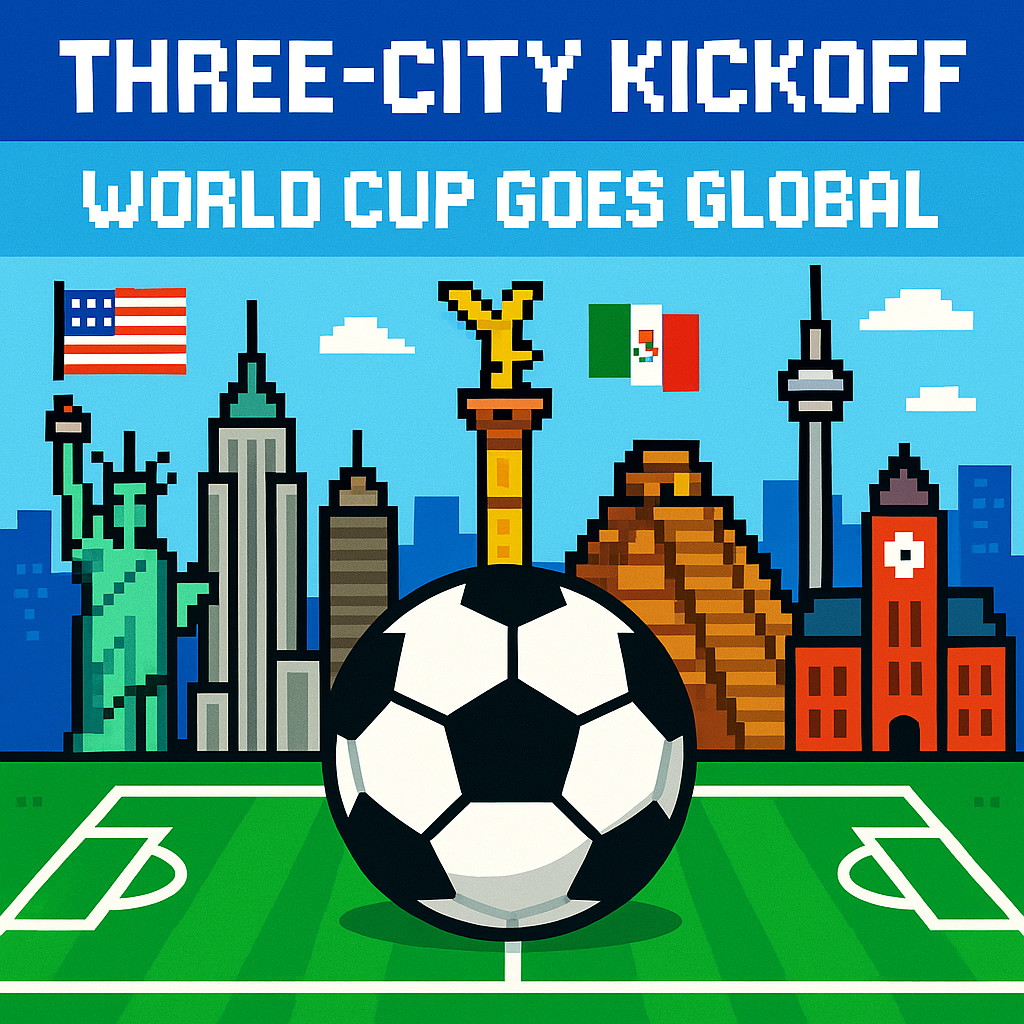
- The 2026 FIFA World Cup opening ceremonies are a three-city flex: Mexico City launched on June 11 with Shakira, Burna Boy, and the anthem “Dai Dai,” while Toronto and Los Angeles follow on June 12 with big-name slates—staking a claim that the tournament is as much culture as football. [2][3][4][5]
- The expanded 48‑team, 104‑match format sets an attendance record path; even a conservative 45,000 average would top USA ’94’s 3.59 million, while 60,000–70,000 averages imply roughly 6.2–7.3 million tickets used. [7][8][9]
- The staggered ceremonies are schedule and monetization architecture: they stretch prime viewing windows across time zones, create more sellable tentpoles for FOX/FS1 and Telemundo/Peacock, and smooth urban operations across three host nations. [4][6]
What the source said
CBS News reports that the largest FIFA Men’s World Cup ever has begun across the U.S., Mexico, and Canada—with three opening ceremonies instead of one. Mexico City’s Azteca show featured Shakira before Mexico beat South Africa 2–0, while Toronto and Los Angeles host their ceremonies on June 12 ahead of Canada–Bosnia and the U.S.–Paraguay. The piece lists artist lineups (Shakira, Burna Boy, Michael Bublé, Alanis Morissette, Katy Perry, LISA, and more), gives kickoff times in ET/PT, notes the 48‑team expansion to 104 matches, and describes stepped‑up U.S. security in host metros. It also flags Toronto’s BMO Field temporary expansion and points fans to live coverage. [1]
Why it matters
Three opening ceremonies signal a new tournament logic for a 48‑team, 104‑match event spread across 16 host cities in the U.S., Mexico, and Canada in 2026. FIFA is multiplying cultural touchpoints that sell ad spots, sponsor activations, and social clips while easing pressure on single venues like SoFi Stadium (Inglewood) and BMO Field (Toronto). The commercial upside concentrates with rights‑holders FOX/FS1 and Telemundo/Peacock and with FIFA’s 2023‑approved format change. [6][7][12]
The downside risk sits with city operations chiefs and transit systems—LA Metro, the Toronto Transit Commission (TTC), and Mexico City’s STC Metro—plus artists tied to production glitches and federations facing a supersized spotlight. U.S. security agencies already elevated their posture around host metros per CBS News, and Toronto’s organizers must sync ceremony timing to a 3:00 p.m. ET kickoff window. In 2026, optics ride alongside outcomes. [1][5]
Original analysis
-
Back‑of‑envelope: the attendance ceiling
- Total matches: 104. If average in‑stadium attendance hits only 45,000, the tournament draws ≈4.68 million (104 × 45,000), already beating USA ’94’s 3.59 million (3,587,538). If it averages 60,000, that’s ≈6.24 million; at 70,000, ≈7.28 million. Even without universal sellouts, the record falls. [7][8][9]
- Reference points: USA ’94 totaled 3.587 million across 52 matches; Qatar 2022 drew about 3.4 million across 64 matches. [8][9]
-
Named‑stakeholder breakdown (what this means for them)
- FIFA: A three‑ceremony format creates three distinct inventory peaks (Mexico City June 11; Toronto and Los Angeles June 12), each with sponsorable “moments.” That spreads risk and magnifies social engagement spikes around official assets like the anthem. [3][4][5]
- FOX/FS1 and Telemundo/Peacock: A primetime USMNT vs. Paraguay at SoFi (9:00 p.m. ET) sets up a ratings test against 2022’s USA–England Black Friday benchmark near 20 million combined viewers in the U.S. [6][10][11]
- BMO Field (Toronto): Temporary capacity to ≈45,000 turns Canada’s opener into a full‑stadium TV picture, narrowing the optics gap with NFL‑scale U.S. venues and stress‑testing modular seating at international scale. [12]
- Mexico City (Azteca): Opening match plus opening ceremony equals global first impression; a 2–0 win over South Africa gives the host’s narrative momentum on day one. [2]
- Artists/labels: “Dai Dai” as the official anthem debuts live to cross‑market audiences; Shakira and Burna Boy span Latin America, Africa, and U.S. diaspora fandoms, a positioning built for Global 200 lift next chart week. [3][2]
-
A 2×2: What the three opening ceremonies optimize
- Axis 1: Nation‑branding vs. Global‑pop spectacle.
- Axis 2: Fan atmosphere vs. Broadcast‑first staging.
- Mexico City (Nation‑branding × Fan atmosphere): Azteca’s history and a Latin‑leaning lineup (Shakira, Maná, J Balvin) deliver heritage and terrace color on camera. [2][3]
- Toronto (Nation‑branding × Broadcast‑first): Canadian icons (Alanis Morissette, Michael Bublé) and a tight pre‑kickoff window match domestic pride with TV pacing inside BMO Field. [5][12]
- Los Angeles (Global‑pop spectacle × Broadcast‑first): Katy Perry, LISA, Future, Anitta, Rema, and Tyla anchor a clip‑engineered show in a U.S. primetime slot from SoFi’s stage. [4][6]
-
Contrarian read
- Consensus: “Three ceremonies are pure sizzle.”
- Counter: They are scheduling infrastructure. FIFA and broadcasters are distributing tentpoles across time zones—Mexico City midday local on June 11; Toronto afternoon ET; USA primetime PT/ET on June 12—to widen contiguous viewing blocks for a 39‑day, 104‑match product. That is revenue design, not ornament. [4][6][7]
What others are missing
The three‑ceremony design is an operations‑and‑monetization hack, not just a highlight reel. Staggered start times build a rolling “live” window—Mexico City spectacle feeds Toronto’s afternoon slot, which hands off to L.A. primetime—keeping FOX/FS1 and Telemundo/Peacock in near wall‑to‑wall event mode for two calendar days. That yields more makegoods capacity, more local sponsor activations per host committee, and thinner peaks for security and transit versus one mega‑ceremony. With SoFi’s USMNT kickoff at 9:00 p.m. ET and Toronto’s at 3:00 p.m. ET anchoring different dayparts, this is inventory and incident‑risk management by design. [6][5][4]
What to watch next
- By June 27, 2026 (end of the group stage), FIFA’s cumulative attendance tally surpasses 3.6 million, eclipsing USA ’94 before the knockouts begin. [7][8][9]
- By June 15, 2026 (first ratings day after the U.S. opener), USA–Paraguay delivers at least 21 million combined U.S. viewers across English and Spanish platforms, topping the ~20 million from USA–England in 2022. [6][10]
- By June 12, 2026 (post‑game Toronto), BMO Field’s announced attendance for Canada–Bosnia is ≥44,000, showing the ≈45,000 temporary build‑out can run at scale. [12][5]
My take
I’m bullish on the three‑ceremony model because it converts a 39‑day, 16‑stadium, three‑federation puzzle (USSF, FMF, Canada Soccer) into serialized appointment TV that flatters each country’s identity while hardening FIFA’s commercial spine. The football will write its own stories, but the stagecraft is already earning its keep with primetime U.S. placement at 9:00 p.m. ET and a format approved in March 2023 that expands total inventory to 104 matches. If the U.S. opener clears 21 million combined viewers, brands will treat the rest of the USMNT slate like NFL‑adjacent tentpoles. [6][7][10]
Sources
[1] CBS News — Report on triple opening ceremonies across U.S., Mexico, and Canada; includes artist lineups, kickoff times, venue notes, and U.S. security posture.
[2] Reuters — Match report from June 11, 2026: Mexico 2–0 South Africa at Estadio Azteca and coverage of the Mexico City opening ceremony.
[3] FIFA Media Release (June 2026) — Announcement of the official 2026 anthem “Dai Dai” and participating artists including Shakira and Burna Boy; frames global music strategy.
[4] Los Angeles 2026 Host Committee / SoFi Stadium advisory — LA opening ceremony lineup and timing; confirms primetime window and production scale.
[5] City of Toronto / Host City Toronto briefing — Toronto ceremony slate (Alanis Morissette, Michael Bublé) and same‑day timing ahead of Canada–Bosnia at BMO Field.
[6] FOX Sports and Telemundo Deportes programming advisories — U.S.–Paraguay kickoff at 9:00 p.m. ET and distribution across FOX/FS1 and Telemundo/Peacock; primetime positioning.
[7] FIFA Council decision (March 2023) — 2026 format approval: 48 teams and 104 matches; provides the structural basis for schedule and inventory.
[8] FIFA World Cup USA 1994 statistics — Total attendance of 3,587,538 across 52 matches; historical benchmark.
[9] FIFA / BBC Sport summaries for Qatar 2022 — Approximate total attendance around 3.4 million across 64 matches; recent comparator.
[10] Sports Business Journal (Nov 2022) — USA–England combined U.S. audience near 20 million across English and Spanish; benchmark for 2026 ratings expectations.
[11] Telemundo Deportes (Nov 2022) — Spanish‑language audience records for USA–England, including broadcast and streaming totals; supports combined‑viewership math.
[12] Maple Leaf Sports & Entertainment (MLSE) / BMO Field construction brief — Temporary expansion plan to roughly 45,000 capacity for 2026; operational implications for Toronto matches.
Related update: We recently published an article that expands on this topic: read the latest post.
Related update: We recently published an article that expands on this topic: read the latest post.