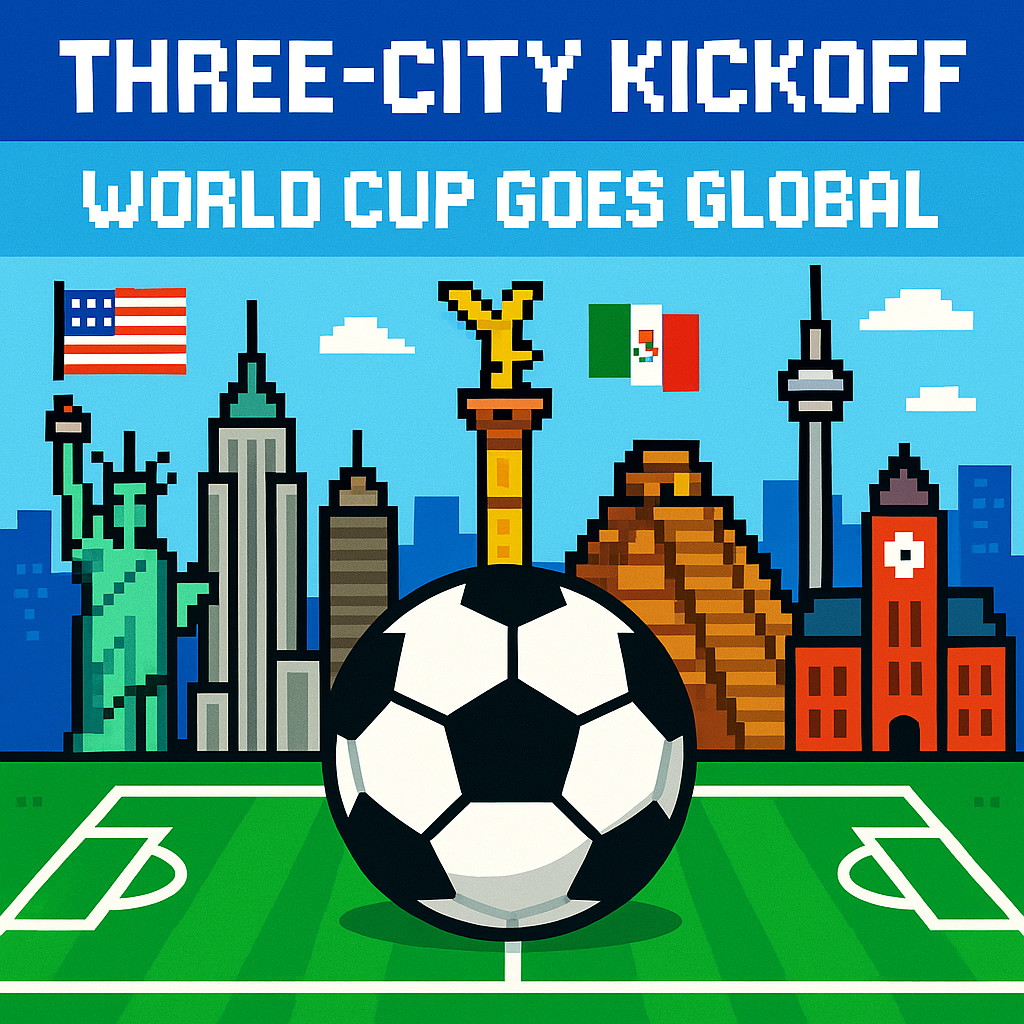
Three-City Kickoff: World Cup Goes Global | Analysis by Brian Moineau

TL;DR

  • The 2026 FIFA World Cup opening ceremonies are a three-city flex: Mexico City launched on June 11 with Shakira, Burna Boy, and the anthem “Dai Dai,” while Toronto and Los Angeles follow on June 12 with big-name slates—staking a claim that the tournament is as much culture as football. [2][3][4][5]
  • The expanded 48‑team, 104‑match format sets an attendance record path; even a conservative 45,000 average would top USA ’94’s 3.59 million, while 60,000–70,000 averages imply roughly 6.2–7.3 million tickets used. [7][8][9]
  • The staggered ceremonies are schedule and monetization architecture: they stretch prime viewing windows across time zones, create more sellable tentpoles for FOX/FS1 and Telemundo/Peacock, and smooth urban operations across three host nations. [4][6]

What the source said

CBS News reports that the largest FIFA Men’s World Cup ever has begun across the U.S., Mexico, and Canada—with three opening ceremonies instead of one. Mexico City’s Azteca show featured Shakira before Mexico beat South Africa 2–0, while Toronto and Los Angeles host their ceremonies on June 12 ahead of Canada–Bosnia and the U.S.–Paraguay. The piece lists artist lineups (Shakira, Burna Boy, Michael Bublé, Alanis Morissette, Katy Perry, LISA, and more), gives kickoff times in ET/PT, notes the 48‑team expansion to 104 matches, and describes stepped‑up U.S. security in host metros. It also flags Toronto’s BMO Field temporary expansion and points fans to live coverage. [1]

Why it matters

Three opening ceremonies signal a new tournament logic for a 48‑team, 104‑match event spread across 16 host cities in the U.S., Mexico, and Canada in 2026. FIFA is multiplying cultural touchpoints that sell ad spots, sponsor activations, and social clips while easing pressure on single venues like SoFi Stadium (Inglewood) and BMO Field (Toronto). The commercial upside concentrates with rights‑holders FOX/FS1 and Telemundo/Peacock and with FIFA’s 2023‑approved format change. [6][7][12]

The downside risk sits with city operations chiefs and transit systems—LA Metro, the Toronto Transit Commission (TTC), and Mexico City’s STC Metro—plus artists tied to production glitches and federations facing a supersized spotlight. U.S. security agencies already elevated their posture around host metros per CBS News, and Toronto’s organizers must sync ceremony timing to a 3:00 p.m. ET kickoff window. In 2026, optics ride alongside outcomes. [1][5]

Original analysis

  • Back‑of‑envelope: the attendance ceiling

    • Total matches: 104. If average in‑stadium attendance hits only 45,000, the tournament draws ≈4.68 million (104 × 45,000), already beating USA ’94’s 3.59 million (3,587,538). If it averages 60,000, that’s ≈6.24 million; at 70,000, ≈7.28 million. Even without universal sellouts, the record falls. [7][8][9]
    • Reference points: USA ’94 totaled 3.587 million across 52 matches; Qatar 2022 drew about 3.4 million across 64 matches. [8][9]
  • Named‑stakeholder breakdown (what this means for them)

    • FIFA: A three‑ceremony format creates three distinct inventory peaks (Mexico City June 11; Toronto and Los Angeles June 12), each with sponsorable “moments.” That spreads risk and magnifies social engagement spikes around official assets like the anthem. [3][4][5]
    • FOX/FS1 and Telemundo/Peacock: A primetime USMNT vs. Paraguay at SoFi (9:00 p.m. ET) sets up a ratings test against 2022’s USA–England Black Friday benchmark near 20 million combined viewers in the U.S. [6][10][11]
    • BMO Field (Toronto): Temporary capacity to ≈45,000 turns Canada’s opener into a full‑stadium TV picture, narrowing the optics gap with NFL‑scale U.S. venues and stress‑testing modular seating at international scale. [12]
    • Mexico City (Azteca): Opening match plus opening ceremony equals global first impression; a 2–0 win over South Africa gives the host’s narrative momentum on day one. [2]
    • Artists/labels: “Dai Dai” as the official anthem debuts live to cross‑market audiences; Shakira and Burna Boy span Latin America, Africa, and U.S. diaspora fandoms, a positioning built for Global 200 lift next chart week. [3][2]
  • A 2×2: What the three opening ceremonies optimize

    • Axis 1: Nation‑branding vs. Global‑pop spectacle.
    • Axis 2: Fan atmosphere vs. Broadcast‑first staging.
    • Mexico City (Nation‑branding × Fan atmosphere): Azteca’s history and a Latin‑leaning lineup (Shakira, Maná, J Balvin) deliver heritage and terrace color on camera. [2][3]
    • Toronto (Nation‑branding × Broadcast‑first): Canadian icons (Alanis Morissette, Michael Bublé) and a tight pre‑kickoff window match domestic pride with TV pacing inside BMO Field. [5][12]
    • Los Angeles (Global‑pop spectacle × Broadcast‑first): Katy Perry, LISA, Future, Anitta, Rema, and Tyla anchor a clip‑engineered show in a U.S. primetime slot from SoFi’s stage. [4][6]
  • Contrarian read

    • Consensus: “Three ceremonies are pure sizzle.”
    • Counter: They are scheduling infrastructure. FIFA and broadcasters are distributing tentpoles across time zones—Mexico City midday local on June 11; Toronto afternoon ET; USA primetime PT/ET on June 12—to widen contiguous viewing blocks for a 39‑day, 104‑match product. That is revenue design, not ornament. [4][6][7]

What others are missing

The three‑ceremony design is an operations‑and‑monetization hack, not just a highlight reel. Staggered start times build a rolling “live” window—Mexico City spectacle feeds Toronto’s afternoon slot, which hands off to L.A. primetime—keeping FOX/FS1 and Telemundo/Peacock in near wall‑to‑wall event mode for two calendar days. That yields more makegoods capacity, more local sponsor activations per host committee, and thinner peaks for security and transit versus one mega‑ceremony. With SoFi’s USMNT kickoff at 9:00 p.m. ET and Toronto’s at 3:00 p.m. ET anchoring different dayparts, this is inventory and incident‑risk management by design. [6][5][4]

What to watch next

  1. By June 27, 2026 (end of the group stage), FIFA’s cumulative attendance tally surpasses 3.6 million, eclipsing USA ’94 before the knockouts begin. [7][8][9]
  2. By June 15, 2026 (first ratings day after the U.S. opener), USA–Paraguay delivers at least 21 million combined U.S. viewers across English and Spanish platforms, topping the ~20 million from USA–England in 2022. [6][10]
  3. By June 12, 2026 (post‑game Toronto), BMO Field’s announced attendance for Canada–Bosnia is ≥44,000, showing the ≈45,000 temporary build‑out can run at scale. [12][5]

My take

I’m bullish on the three‑ceremony model because it converts a 39‑day, 16‑stadium, three‑federation puzzle (USSF, FMF, Canada Soccer) into serialized appointment TV that flatters each country’s identity while hardening FIFA’s commercial spine. The football will write its own stories, but the stagecraft is already earning its keep with primetime U.S. placement at 9:00 p.m. ET and a format approved in March 2023 that expands total inventory to 104 matches. If the U.S. opener clears 21 million combined viewers, brands will treat the rest of the USMNT slate like NFL‑adjacent tentpoles. [6][7][10]

Sources

[1] CBS News — Report on triple opening ceremonies across U.S., Mexico, and Canada; includes artist lineups, kickoff times, venue notes, and U.S. security posture.
[2] Reuters — Match report from June 11, 2026: Mexico 2–0 South Africa at Estadio Azteca and coverage of the Mexico City opening ceremony.
[3] FIFA Media Release (June 2026) — Announcement of the official 2026 anthem “Dai Dai” and participating artists including Shakira and Burna Boy; frames global music strategy.
[4] Los Angeles 2026 Host Committee / SoFi Stadium advisory — LA opening ceremony lineup and timing; confirms primetime window and production scale.
[5] City of Toronto / Host City Toronto briefing — Toronto ceremony slate (Alanis Morissette, Michael Bublé) and same‑day timing ahead of Canada–Bosnia at BMO Field.
[6] FOX Sports and Telemundo Deportes programming advisories — U.S.–Paraguay kickoff at 9:00 p.m. ET and distribution across FOX/FS1 and Telemundo/Peacock; primetime positioning.
[7] FIFA Council decision (March 2023) — 2026 format approval: 48 teams and 104 matches; provides the structural basis for schedule and inventory.
[8] FIFA World Cup USA 1994 statistics — Total attendance of 3,587,538 across 52 matches; historical benchmark.
[9] FIFA / BBC Sport summaries for Qatar 2022 — Approximate total attendance around 3.4 million across 64 matches; recent comparator.
[10] Sports Business Journal (Nov 2022) — USA–England combined U.S. audience near 20 million across English and Spanish; benchmark for 2026 ratings expectations.
[11] Telemundo Deportes (Nov 2022) — Spanish‑language audience records for USA–England, including broadcast and streaming totals; supports combined‑viewership math.
[12] Maple Leaf Sports & Entertainment (MLSE) / BMO Field construction brief — Temporary expansion plan to roughly 45,000 capacity for 2026; operational implications for Toronto matches.


Related update: We recently published an article that expands on this topic: read the latest post.

Related update: We recently published an article that expands on this topic: read the latest post.

LIV Golf CEO Vows Tour Will Continue | Analysis by Brian Moineau

When the rumors roar: LIV Golf operations "continue as scheduled," CEO reaffirms commitment to tour

The headline — LIV Golf operations "continue as scheduled," CEO reaffirms commitment to tour — landed like a splash of cold water across the golf world. Rumors about funding and the tour’s future have multiplied this week, yet the league’s CEO, Scott O’Neil, pushed back with a clear internal message intended to steady players, staff and partners. For anyone watching professional golf’s shifting landscape, the moment felt less like an end and more like a test of confidence.

What prompted the reassurances

Tension has been building around LIV Golf for months, driven by the tour’s massive early spending, its complex relationship with the Public Investment Fund (PIF) of Saudi Arabia, and the seismic 2023 agreement that folded commercial operations among golf’s major players. That background made the latest reports — suggesting PIF might reduce or reconsider support — especially combustible.

In response, sources close to the league told reporters that “LIV Golf funding and operations continue as scheduled,” and an internal email from O’Neil was shared with staff to reinforce that message. The CEO’s tone: operational continuity and a commitment to the 2026 schedule. The goal was clear — stop the whisper campaign and keep the season on track.

Why the timing matters

  • The 2026 calendar is a crucial one: LIV has been positioning itself to win legitimacy — including steps toward Official World Golf Ranking points and expanded global reach.
  • Investors and sovereign funds don’t broadcast strategy lightly. Even a hint of a shift can rattle players’ contracts, broadcast partners and tournament logistics.
  • Golf is built on continuity. Players plan travel, practice schedules, sponsorship activations and roster choices months in advance. Uncertainty can cascade into withdrawals, fractured relationships and a drop in commercial value.

Given those stakes, an internal memo and a public-source confirmation were meant to do more than calm nerves — they were intended to protect the business.

LIV Golf operations "continue as scheduled," CEO reaffirms commitment to tour — unpacking that phrase

That line does the heavy lifting: it affirms three things at once.

  • Funding: Sources said PIF support and existing financing remain in place for the immediate slate of events.
  • Operations: The staff, events and logistics will proceed with the planned calendar, at least for now.
  • Leadership intent: O’Neil’s message signals an organizational decision to carry forward rather than pause or pivot publicly.

Words matter here. “Continue as scheduled” is forward-looking but limited — it doesn’t guarantee long-term funding or rule out future strategic shifts. It buys the tour time and keeps internal and external stakeholders focused on execution.

The broader context: past reconciliation and current friction

Remember the landscape change in 2024–2025: commercial operations among the PGA Tour, DP World Tour and PIF-aligned interests underwent consolidation talks, bringing parties to the same table after years of public division. That détente promised consolidation of sponsorships, broadcast rights and a clearer competitive map.

But peace on paper doesn’t eliminate political, commercial or reputational friction. Changes in global macroeconomics, shifting priorities at sovereign funds, or recalibrations in sport strategy can all alter course. Reports of emergency meetings and internal unease suggest LIV is navigating that tension now — even while insisting the game will go on.

How players and partners are likely reading this

  • Players: They want certainty. The CEO’s message is aimed squarely at them — keep practicing, traveling and competing as planned.
  • Staff: Operational continuity keeps payrolls, vendor contracts and event planning moving. An internal memo reduces immediate staff attrition risk.
  • Sponsors and broadcasters: They watch for signs of stability. Reassurances help preserve activation plans and media scheduling.
  • Fans: The spectacle matters. A confident narrative helps ticket sales and viewership; whispers of instability can throttle momentum.

Still, savvy observers will read between the lines. Short-term continuation is not equal to long-term strategy. Many will treat the memo as a bridge — not a destination.

The investor dilemma

At the center sits a delicate investor calculus. The PIF poured billions into LIV’s rapid rise, and those funds underpinned standout player contracts and ambitious event rollouts. But even large sovereign funds reassess allocations as political landscapes and return expectations shift.

If funding were to contract, the tour would confront difficult choices: slim the schedule, renegotiate contracts, or seek alternate revenue through deeper broadcast deals and sponsorship growth. For now, the messaging thread is focused on deflecting that immediate pressure and protecting the commercial rhythm.

What to watch next

  • Official tournament confirmations and any changes to published fields or schedules.
  • Statements from key players about commitments to upcoming events.
  • Sponsorship and broadcast confirmations for remaining 2026 dates.
  • Any follow-up reporting about PIF’s long-term funding plans.

Transitioning from rumor to clarity will take concrete actions — new contracts, confirmed broadcast windows, and visible presence at events.

A few realistic outcomes

  • The optimistic path: PIF remains committed, LIV continues its 2026 plan, and negotiations with broader golf operators yield creative partnerships.
  • The consolidation path: Strategic scaling and new partnerships fold some LIV elements into a larger global structure while preserving team concepts and marquee events.
  • The retrenchment path: Funding changes force operational cuts and a more measured, survival-oriented LIV.

None of these are certainties. The CEO’s memo is a signal: for now, LIV intends to play the hand it has been dealt.

Final thoughts

Sporting enterprises live and die by narratives as much as by balance sheets. Right now, LIV’s narrative is defensive and pragmatic — reassure, stabilize, execute. That’s a sensible playbook when whispers threaten to disrupt months of planning.

Whether that steadiness translates into long-term viability depends on negotiations, partner faith and the league’s ability to monetize spectacle without sacrificing credibility. For players and fans caught in the middle, the immediate ask is simple: keep an eye on the tees, not the rumor mills. The next few weeks of confirmed events and public statements will tell us whether this was a pause-for-breath or the start of a different chapter for golf.

Sources


Related update: We recently published an article that expands on this topic: read the latest post.


Related update: We recently published an article that expands on this topic: read the latest post.

Alcaraz vs Sinner: Monte‑Carlo Final | Analysis by Brian Moineau

Mouthwatering clash in Monte-Carlo: How to watch Alcaraz vs Sinner for FREE: TV Channels for Monte-Carlo Masters Final

Carlos Alcaraz versus Jannik Sinner is the kind of headline that stops casual scrolls and makes tennis fans rearrange their Sunday plans. How to watch Alcaraz vs Sinner for FREE: TV Channels for Monte-Carlo Masters Final — that’s the exact question TechRadar answered leading into the April 12, 2026 final, and it’s worth revisiting both as a viewing guide and a snapshot of how premium tennis reaches different corners of the globe.

Both players arrived in Monte-Carlo carrying form, swagger and stakes: the title and the world No. 1 ranking were hovering over the match. If you were chasing a free or low-cost way to watch this blockbuster, here’s a readable guide to the main options, why broadcasters differ by territory, and what it means for fans going forward.

Quick preview of the matchup

  • Carlos Alcaraz: explosive, creative and relentless from the baseline; thrives on momentum shifts and athleticism.
  • Jannik Sinner: composed, powerful and blunter in pace; he mixes precision with a rising strategic maturity.

This was billed as “the world’s top two” — and the reality lived up to the billing. The final was played on April 12, 2026 in Monte-Carlo’s iconic setting. For those who missed it live, highlights and recaps are now widely available. (atptour.com)

Where to watch: core options and free routes

For fans asking “how to watch Alcaraz vs Sinner for FREE,” the answer depended on where you were. Broadcasters for Masters 1000 events vary by country, which opens and closes different free options.

  • United States

    • Primary rights holder: Tennis Channel. Access often comes through cable or subscription streaming bundles that carry Tennis Channel.
    • Free-ish routes: short free trials for services that include Tennis Channel (for example, Fubo or YouTube TV promotions at the time) were commonly highlighted as ways to watch without an extra long-term subscription. Note that trials are time-limited and availability changes. (techradar.com)
  • United Kingdom and Ireland

    • Sky Sports Tennis carried the match live, with streaming available on Sky’s NOW platform or the Sky Sports app for subscribers.
    • Occasionally matches are shown on free-to-air partners in special circumstances, but Sky was the main live home. (skysports.com)
  • Continental Europe

    • Local broadcasters varied: Rai in Italy, and a mix of national sports networks across Spain and other territories. Some networks offered short free streams or highlights on their websites and apps. (atptour.com)
  • Global stream

    • TennisTV and ATP digital platforms provided live streaming in many countries that lacked local TV rights — a direct paid option for fans who live outside key broadcast territories. (tennistv.com)

Transitioning from broadcaster lists to practical tips, here are the best tactics fans used to watch for free or near-free.

Tips that actually worked (and why)

  • Try official free trials — but check start/end dates.

    • Many streaming services offer limited-time trials. If a trial covers the match time, it’s a perfectly legal way to watch without an added ongoing subscription. However, always verify trial length and regional availability. (techradar.com)
  • Use local broadcaster catch-ups and highlights.

    • Even if live access isn’t free, national broadcasters often post extended highlights and condensed replays shortly after the match. These don’t substitute the live thrill, but they’re useful when you miss the game. (atptour.com)
  • Consider short-term subscriptions for big matches.

    • If you’re a casual viewer, a one-month subscription to a sports streaming service that carries Tennis Channel or Sky Sports can be cheaper than missing a major final.
  • Don’t rely on unofficial streams.

    • Unofficial streams are often low quality, illegal and risky for malware. Stick with official rights-holders or trial offers for safety and reliability.

Why broadcast rights feel complicated

Rights for ATP Masters 1000 events are parceled regionally. That fragmentation creates both opportunity and frustration: opportunity because fans in some territories enjoy free-to-air access; frustration because major matches can be behind paywalls in other places.

Moreover, streaming has shifted the landscape. Traditional cable bundles still dominate some markets, but direct-to-consumer streaming and the ATP’s own platforms add alternatives — and short-term trials give fans tactical, short-lived ways to watch marquee matches without a long-term commitment. (atptour.com)

Result snapshot and immediate aftermath

Jannik Sinner defeated Carlos Alcaraz 7–6(7–5), 6–3 to win the Monte-Carlo title and reclaim the ATP world No. 1 ranking on April 12, 2026. The match added another memorable chapter to their rivalry and produced highlights that circulated quickly across official ATP channels and broadcasters. (en.wikipedia.org)

What this means for fans going forward

  • Expect more tactical use of trials and short-term subscriptions around big events.
  • Keep an eye on ATP and local broadcasters for highlight packages if live is missed.
  • The rivalry between Alcaraz and Sinner will keep driving broadcast interest; rights-holders know marquee clashes sell viewership and will likely pursue wide distribution.

My take

This matchup reminded me why tennis still thrives on marquee rivalries: it’s less about the medium and more about the drama. Whether you watched via a trial, a paid stream, or caught the highlights later, the core experience — two contrasting styles colliding under pressure — was the draw. Broadcasters will keep shifting, but great tennis remains the constant.

Sources


Related update: We recently published an article that expands on this topic: read the latest post.


Related update: We recently published an article that expands on this topic: read the latest post.