TL;DR
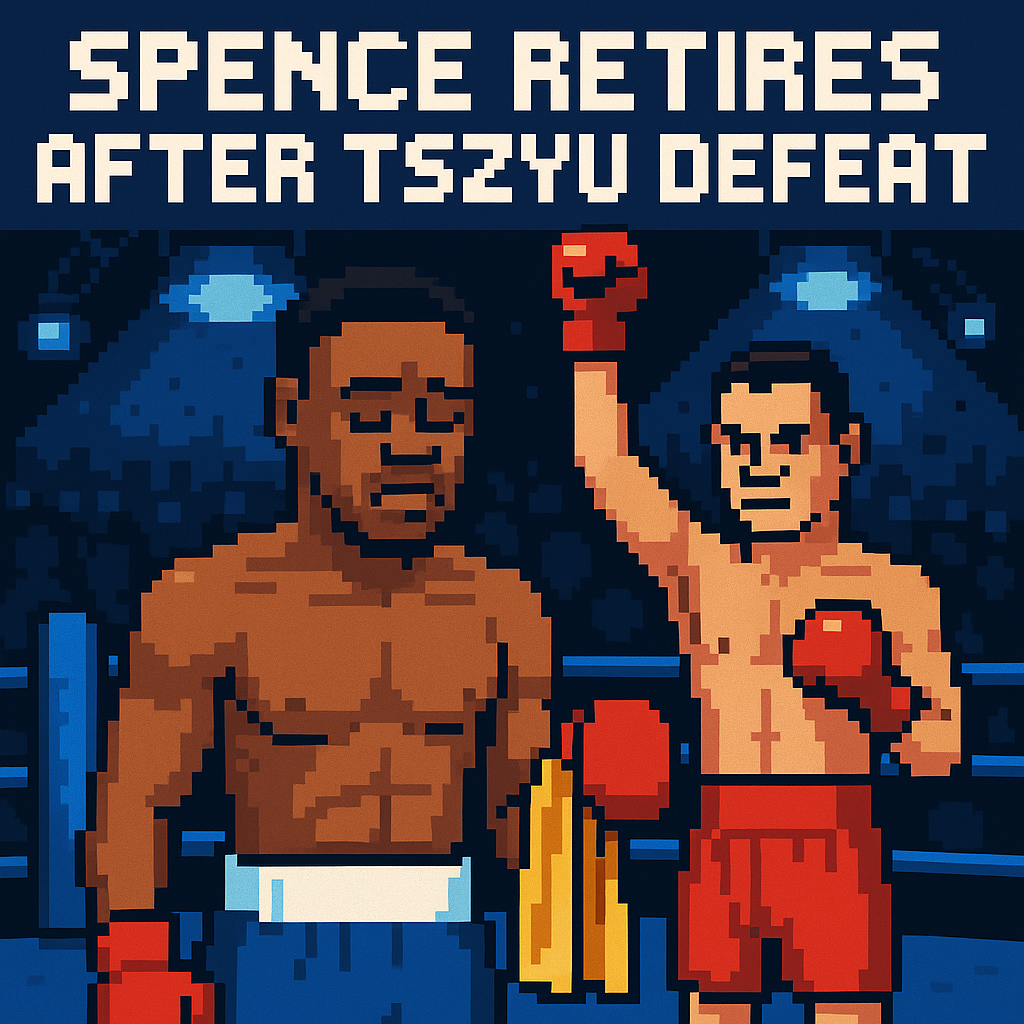
- Errol Spence Jr. retired in the ring after Tim Tszyu outpointed him 118-110, 117-111, 117-111 at Qudos Bank Arena in Sydney; it caps a 14-year pro run shaped by a 2019 Dallas car crash, a 2021 retina tear, and the 2023 Crawford TKO9 loss [1][5][6].
- Tszyu’s relaunch at 160 pounds is less about dominance and more about brand repair and matchmaking bargaining power in a division with aging titlists and accessible mandatories, including the WBA route via Erislandy Lara [2][3][9].
- The business told its own story: a Sydney card packaged for a 9 p.m. ET start and priced at $79.99 on Prime Video (with DAZN carriage noted) signals PBC’s PPV pipeline now prioritizes U.S. primetime even from Australia [3][8][4].
What the source said
Bad Left Hook reported that Tim Tszyu (31) beat Errol Spence Jr. (36) by unanimous decision in Sydney after Spence returned from a three-year layoff and jumped two divisions from 147 to 160 pounds; the judges’ cards were 117-111, 117-111, and 118-110 [1]. Tszyu said 160 is now his home and that beating Spence “tops any world title,” while Spence praised Tszyu and said it was “time to go home… and start a new life,” confirming retirement with an emphasis on health and finances being intact [1]. The piece framed the result as clear and dignified rather than brutal and argued there was no responsible case to urge Spence to continue [1].
Why it matters
The stakeholders extend beyond Spence and Tszyu to rights-holders who need credible PPV main events and to Australia’s No Limit ecosystem that can stage arena shows locally while feeding a U.S. 9 p.m. ET primetime window on Prime Video/DAZN [4][8][3]. Spence’s exit removes a proven U.S. PPV A-side from rotation, creating room—and pressure—to elevate Tszyu as a middleweight draw capable of cross-market events between Sydney and U.S. buyers [4][8].
For fighters in their mid-30s weighing comebacks, Spence’s retirement is a rare health-first precedent in a sport that often pushes “one more payday”; his 2019 Ferrari crash in Dallas, 2021 detached retina, and 2023 TKO9 to Terence Crawford make a 2026 exit both pragmatic and humane [5][6][1].
Original analysis
What Errol Spence’s retirement signals for boxing’s risk-reward math
The consensus read says, “Spence stayed too long and Tszyu retired him.” My contrarian view: Spence timed his exit correctly, and Tszyu’s win is more about narrative repair than an elite 160-pound breakthrough.
-
Spence’s arc—near-fatal car crash in 2019, a retina injury in 2021, and a ninth-round TKO to Crawford in 2023—put him on a narrow ledge where diminishing returns met escalating risk; stepping away at 36 with a 28-2 (22 KOs) ledger and clear speech on camera is the rare smart choice in modern boxing, especially for a former three-belt welterweight unified champion who already headlined a 2023 super fight [5][6][1][2].
-
Tszyu needed a clean, professional win to reset at 160; he got it with wide cards (118-110, 117-111, 117-111) against a smaller opponent moving up two divisions on return from a three-year layoff, which is strong brand maintenance but not proof he rules a division that still includes active beltholders like WBA’s Erislandy Lara in his 40s [1][9][2].
Named-stakeholder breakdown (what this means for them):
- PBC/Prime Video: Proof-of-concept for international PPV slotted to U.S. primetime (9 p.m. ET) at $79.99, a replicable template for Australia-based shows that feel like U.S. Saturday nights without U.S. venue costs [8][4].
- No Limit Boxing (Australia): With Tszyu’s local drawing power and Qudos Bank Arena (Sydney SuperDome) capacity around 18,000 for sport (up to ~21,000 for concerts), their events can “travel” via PPV while preserving the Australian gate and sponsorship upside [7][2].
- WBA/Erislandy Lara: A Tszyu shot at 160 pounds is suddenly marketable; Lara remains an active titlist, and a “name vs. name” title fight is the most makeable near-term play for Tszyu’s 160 campaign [9][2].
- Terence Crawford: Spence’s retirement further burnishes the finality of Crawford’s 2023 TKO9; as Spence exits, that result reads as decisive prime-vs-prime separation on a Nevada commission ledger [6].
Back-of-envelope calculation:
- If Tszyu vs. Lara lands on U.S. Prime PPV at $79.99 and does a conservative 200,000 U.S. buys, top-line PPV revenue is about $16.0 million (200,000 x $79.99 ≈ $15,998,000) before splits, fees, foreign rights, and gate; that level greenlights older-name matchmaking at 160 even without a U.S. arena sellout [8].
- Arena + time-zone arbitrage: Qudos Bank Arena’s sports capacity is ~18,000 (concert max ~21,000); a healthy Sydney gate layered on top of a 9 p.m. ET PPV can outperform a lukewarm U.S. gate at a smaller venue while keeping production anchored to Australia’s cost base [7][8].
2×2 risk-mileage typology (age vs. accumulated damage):
- Younger/Lower mileage: Tim Tszyu (31) at 160 after an active 2024–2026 run; commercial upside with measured opposition [2][3].
- Younger/Higher mileage: N/A among named principals here; this quadrant usually houses pressure fighters with recent wars.
- Older/Lower mileage: Erislandy Lara (in his 40s) with a controlled, economical style that has aged better than most at 160 [9].
- Older/Higher mileage: Errol Spence Jr. (36) given the 2019 crash, 2021 retina, and 2023 TKO9, which heighten risk beyond typical mid-30s decline [5][6].
Historical analogue:
- Sugar Ray Leonard’s late-era returns—Terry Norris in 1991 and Hector Camacho in 1997—show how legends get lured back, then battered into retirement, again; Spence’s immediate “for sure” retirement in Sydney in 2026 tracks closer to Andre Ward’s 2017 exit at age 33 than to Leonard’s yo-yo comebacks at 34 and 40 [1][10][11].
What others are missing
The specific, under-discussed angle is PPV time-zone engineering: this Sydney show was built to start at 9 p.m. ET and retail at $79.99 on Prime in the U.S. (with DAZN carriage noted), which means daytime Australia production was calibrated for U.S. nighttime monetization; Australia supplies the gate, local broadcast partners, and scenic staging, while the U.S. gets a prime-time PPV SKU without paying U.S. arena rent—cost discipline masquerading as global reach [8][3][4].
What to watch next
- By March 2027, Tszyu fights for a middleweight world title—most likely the WBA belt versus Erislandy Lara—rather than pursuing the toughest unified path at 160.
- Through July 2027, Spence remains retired with no licensed pro bout announced and appears in on-camera or advisory roles instead of entering a training camp.
- By mid-2027, PBC/Prime schedules at least one more Australia-based PPV calibrated to a 9 p.m. ET start, featuring Tszyu or another Oceania headliner.
My take
Spence chose dignity over delusion in 2026, and that reads as the right call after Crawford’s TKO9 in 2023 under the Nevada commission’s record [6]. Sydney did not “retire” him; life and timing did, and he listened on the first try [1]. Tszyu proved he can headline a 160-pound PPV business plan built on smart matchmaking, time-zone math, and a capable brand, but true validation means chasing a live belt that talks back—Lara’s WBA version at 160 pounds [9][8]. The ledger is simple: Tszyu repaired his commercial value, and Spence preserved his health; that outcome is rare in boxing’s 2020s incentive structure [2][4].
Sources
- ‘Time to go home’: Errol Spence announces retirement after loss to Tim Tszyu — Bad Left Hook (https://www.badlefthook.com/boxing-results/117511/time-go-home-errol-spence-announces-retirement-after-loss-tim-tszyu-boxing-news-2026) — Ringside report with scorecards, ages, quotes, and immediate retirement confirmation.
- Errol Spence Jr announces retirement after Tim Tszyu claims biggest career win in Sydney — Sky Sports (https://www.skysports.com/boxing/news/12183/13567040/errol-spence-jr-announces-retirement-after-tim-tszyu-claims-biggest-career-win-in-sydney) — Confirms scores, venue, and Tszyu’s stated move to 160 as his new home.
- Tim Tszyu wins a battle of broken soldiers, and Errol Spence Jr heads into the sunset — The Guardian (https://www.theguardian.com/sport/2026/jul/26/tim-tszyu-errol-spence-fight-retirement) — Analytical recap noting PPV pricing/platforms and post-prime context.
- Prime Video and Premier Boxing Champions announce new multiyear rights agreement beginning in 2024 — PBC Press Center (https://www.presscenter.premierboxingchampions.com/press-releases/prime-video-and-premier-boxing-champions-announce-new-multiyear-rights-agreement) — Establishes Prime Video’s PPV distribution role for PBC in the U.S. rights stack.
- Errol Spence Jr. seriously injured in Dallas car crash — ESPN (https://www.espn.com/boxing/story/_/id/27812496/errol-spence-jr-seriously-injured-dallas-car-crash) — Documents Spence’s 2019 Ferrari crash and hospitalization in Texas.
- Boxing show results, July 29, 2023 (Crawford TKO9 Spence) — Nevada State Athletic Commission (https://boxing.nv.gov/uploadedFiles/boxingnvgov/content/results/2023_Results/07-29-23_Redacted.pdf) — Official bout result underpinning the Crawford–Spence outcome in Las Vegas.
- Sydney SuperDome (Qudos Bank Arena) capacity profile — Austadiums (https://www.austadiums.com/stadiums/sydney-superdome) — Provides the ~18,000 sports capacity and ~21,000 concert maximum for venue economics.
- Prime Video PPV listing: Spence Jr. vs. Tszyu — Amazon (https://www.primevideo.com/detail/0QCQ2WIJDYKSCHZGUIQ4I8FPGT) — Confirms 9 p.m. ET timing and $79.99 PPV pricing for the U.S. SKU.
- Lara retains WBA middleweight title vs. Johan González — World Boxing Association (https://www.wbaboxing.com/boxing-news/erislandy-lara-set-to-defend-his-wba-middleweight-title-against-johan-gonzalez-2) — Verifies Lara’s current status and continued activity at 160 pounds.
- Andre Ward announces retirement at 33 — The Guardian (https://www.theguardian.com/sport/2017/sep/21/andre-ward-retirement) — Historical analogue for a top fighter exiting on his own terms in 2017.
- “Leonard… definitely over” after Camacho TKO — The Washington Post (https://www.washingtonpost.com/archive/sports/1997/03/03/leonard-for-sure-my-career-is-definitely-over/c2c24c31-6d94-4e35-864c-ae8550ff4e15/) — Cautionary precedent on late-career comebacks ending badly in 1997.
Related update: We recently published an article that expands on this topic: read the latest post.
Related update: We recently published an article that expands on this topic: read the latest post.
Related update: We recently published an article that expands on this topic: read the latest post.
