TL;DR
- Donald Trump hosted the back-to-back World Series champion Los Angeles Dodgers at the White House for the second straight year, praising the franchise as “one of the great brands anywhere in the world.” [1][2]
- The optics pair a global baseball roster—Shohei Ohtani, Freddie Freeman, and Yoshinobu Yamamoto—with a media-savvy White House, giving both sides reach, legitimacy, and content on the Rose Garden stage. [2][3]
- The commercial engine hums underneath: Forbes values the Dodgers at $7.8B with 2025 revenue near $850M, while an $8.35B local TV pact and new streaming tiers convert cultural spikes into subscription and merchandise lifts. [4][6][8]
What the source said
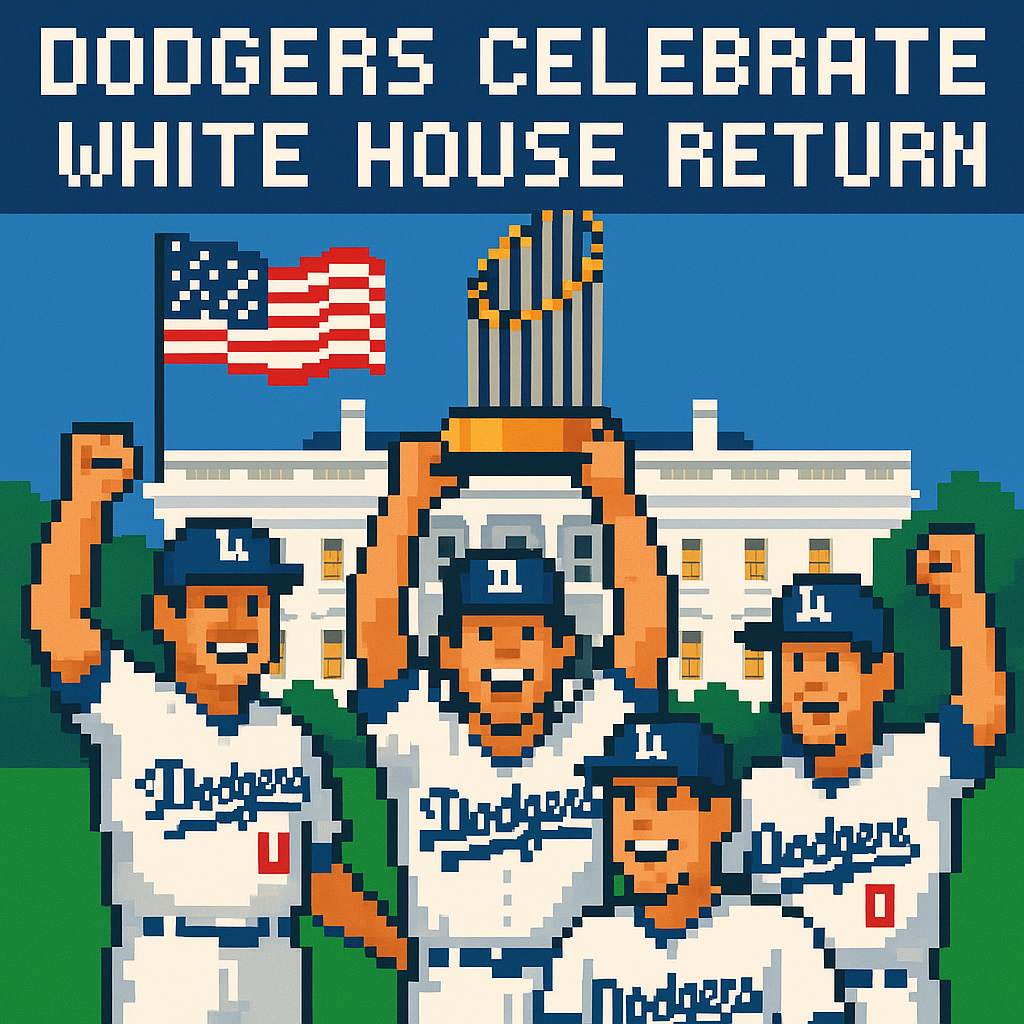
ABC News says President Donald Trump welcomed Shohei Ohtani, Freddie Freeman, and the Los Angeles Dodgers to a Rose Garden ceremony in Washington, D.C., calling them “one of the great brands anywhere in the world.” The report references a 2025 East Room event for the 2024 title over the Yankees and corrects the month of the 2025 Game 7 clincher to November. The White House event displayed two World Series trophies, a “Trump 47” jersey, and a replica ring, and Manager Dave Roberts joked about a “three-peat.” [1][2]
Why it matters
Two U.S. institutions—the White House at 1600 Pennsylvania Avenue and the Dodgers at Chavez Ravine—cross-promoted before national cameras in 2026, attaching the presidency to Ohtani’s global fandom and a bicoastal base stretching from Los Angeles to New York. For the franchise, the shot list—South Lawn podium, twin trophies, Roberts’ “three‑peat” line, and the president’s “great brand” quote—feeds highlight packages, sponsor reels, and social cuts within hours. [2][3]
Stakeholders have dollars on the line. Forbes puts the Dodgers at $7.8B with about $850M in 2025 revenue, while MLB.com’s jersey rankings show Ohtani at No. 1 with teammates close behind. Tie that to SportsNet LA’s $8.35B rights deal and 2025’s SNLA+ streaming option, and the Rose Garden turns from photo op into top‑of‑funnel for merchandise, tickets, and subs. [4][7][6][8]
Original analysis
Trump and the Dodgers staged a mutually beneficial media hit in the Rose Garden: the president linked his office to baseball’s current juggernaut, and the club captured broadcast‑quality footage that plays in Southern California, Japan, and any U.S. market where visiting fans wear blue. This is transactional civics with a revenue model attached, not a culture‑war rerun. [2][3]
Labelled analyses:
- Back-of-the-envelope math
-
Revenue lift: Starting from Forbes’ $850M 2025 revenue, assume a conservative +6% “championship afterglow” for 2026, which many teams see via merch and ticketing. 0.06 × $850M = $51M; $850M + $51M = ~$901M. If MLB’s average valuation gain runs ~12% into 2027, the $7.8B mark grows to $7.8B × 1.12 ≈ $8.74B. A true three‑peat could support a 10–15% premium on top of trend, implying roughly $780M–$1.17B of incremental enterprise value. [4]
-
Media kicker: Spectrum SportsNet LA’s agreement totals $8.35B over 25 years, with SNLA+ launching in 2025 to address cord‑cutters. A White House clip that ricochets through AP, ABC, and MLB channels functions as acquisition creative for those subs and for Fanatics carts, contributing directly to the top line. [6][8][2][3]
- Contrarian read
- Consensus: White House visits carry political downside and limited upside for teams.
- Counter: For the Dodgers, upside is measurable. The 2025 World Series ended 5–4 in 11 innings on Nov. 1, with an 18‑inning Game 3 earlier in the set—catnip for casuals and die‑hards. Trump’s “one of the great brands anywhere in the world” line supplies a portable tagline, while Ohtani’s No. 1 jersey status keeps the register ringing. This ceremony extends the emotional half‑life of those wins, which is how repeat champions monetize narrative. [3][2][7]
- Named-stakeholder breakdown
- Guggenheim/Mark Walter: Another blue‑chip validation of a decade‑long talent and media thesis that supports the next valuation step. [4]
- Charter/Spectrum (SportsNet LA): National mentions of Dodgers content sharpen the consumer case for SNLA carriage and SNLA+ in an RSN shakeout. [6][8]
- MLB/Fanatics/Nike: Ohtani in the Rose Garden after consecutive titles refreshes jersey cycles and stokes international demand across Japan and North America. [7]
- The White House: A feel‑good baseball ceremony yields friendly footage and low‑risk, cross‑partisan earned media in Washington. [2]
- 2×2: Optics vs. Monetization
- High optics / High monetization: Dodgers (brand footage + subs/merch), White House (unifying visuals + audience reach).
- High optics / Low monetization: Casual fans who watch clips but don’t buy—valuable as awareness.
- Low optics / High monetization: Local die‑hards converting to SNLA+ at $x/month after highlight exposure. [6]
- Low optics / Low monetization: Non‑sports voters unlikely to engage—acceptable collateral.
Note: The on‑field spine is real. The Dodgers beat the Yankees 4–1 in the 2024 World Series, then edged the Blue Jays 5–4 in 11 innings on Nov. 1, 2025, with an 18‑inning Game 3 remembered across broadcasts. The brand story sits on those outcomes, not the other way around. [5][3]
What others are missing
The RSN and direct‑to‑consumer math. SportsNet LA’s $8.35B, 25‑year foundation sets the floor, and 2025’s SNLA+ plus MLB app integrations add a metered upsell that turns one Rose Garden clip into sequential retargeting: wire photos on AP, a segment on ABC, and highlight reels on MLB.com within 24 hours. That sequence justifies carriage asks, premium tiers under $25/month, and ARPU gains when lapsed cable homes re‑enter the funnel before October. Most political writeups stop at optics; the Dodgers’ media unit will run this like a paid acquisition loop. [2][6][8]
What to watch next
- By November 30, 2026, MLB and Fanatics publish jersey rankings with Shohei Ohtani at No. 1 and at least two other Dodgers in the top five. [7]
- By April 1, 2027, Spectrum expands SNLA+ availability or bundles it with MLB platforms beyond current footprints, at a stated monthly price under $25. [6][8]
- By March 31, 2027, Forbes lists the Dodgers above $8.5B in valuation, attributing gains to multi‑year titles and direct‑to‑consumer media growth. [4]
My take
Treat the White House ceremony like a Q3 launch. Stitch the “great brand” quote into sponsor decks, run a 72‑hour “Back‑to‑Back” SNLA+ promo in Los Angeles and Orange County, and drop a limited Ohtani/DC jersey on Fanatics before Sunday night baseball. The Yankees didn’t turn dynasties into cash by accident; they systematized it. The Dodgers now have the content, the channels, and the global star to do it at 2026 scale. [2][4][6][7]
Sources
-
Trump will welcome the World Series champion Dodgers to the White House — ABC News (https://abcnews.com/Politics/wireStory/trump-world-series-champion-dodgers-white-house-135023469) — The base report: Rose Garden venue, the “great brands” quote, attendee names, and timeline.
-
Trump fetes Dodgers at the White House again, saying the team is “one of the great brands” — Associated Press (https://apnews.com/article/0daaeadffe276338e5d45ad77663fcb0) — Independent confirmation of ceremony details, quotes, and the repeat‑visit context.
-
Dodgers win 2025 World Series; Game 7 facts and figures — MLB.com (https://www.mlb.com/news/dodgers-win-2025-world-series) and (https://www.mlb.com/news/dodgers-blue-jays-world-series-game-7-facts-and-figures) — Official recaps: Nov. 1, 2025, 11‑inning clincher and the 18‑inning Game 3.
-
Los Angeles Dodgers — Forbes (https://www.forbes.com/teams/los-angeles-dodgers/) and MLB Valuations List (https://www.forbes.com/mlb-valuations/list/) — Valuation ($7.8B, March 2026), revenue (~$850M for 2025), and league growth comps.
-
2024 World Series: Dodgers over Yankees (4–1) — Baseball‑Reference (https://www.baseball-reference.com/postseason/2024_WS.shtml) — Box‑level confirmation of the five‑game 2024 result.
-
Spectrum offering a streaming‑only subscription for Dodgers; SNLA+ details — Los Angeles Times (https://www.latimes.com/sports/dodgers/story/2025-03-17/spectrum-dodgers-streaming-2025-season-games) — How SportsNet LA moved into DTC in 2025, with product and pricing context.
-
Most popular MLB jerseys for 2025 — MLB.com (https://www.mlb.com/dodgers/news/most-popular-mlb-jerseys-for-2025) — Ohtani’s No. 1 jersey ranking and teammate placement substantiate merchandise demand.
-
Spectrum SportsNet LA — ESPN explainer on the $8.35B, 25‑year deal (https://www.espn.com/mlb/story/_/id/44250840/mlb-2025-los-angeles-dodgers-villains-heroes-ohtani-freeman-betts) — Contract scale and RSN context that tie national moments to local media economics.
Related update: We recently published an article that expands on this topic: read the latest post.
Related update: We recently published an article that expands on this topic: read the latest post.