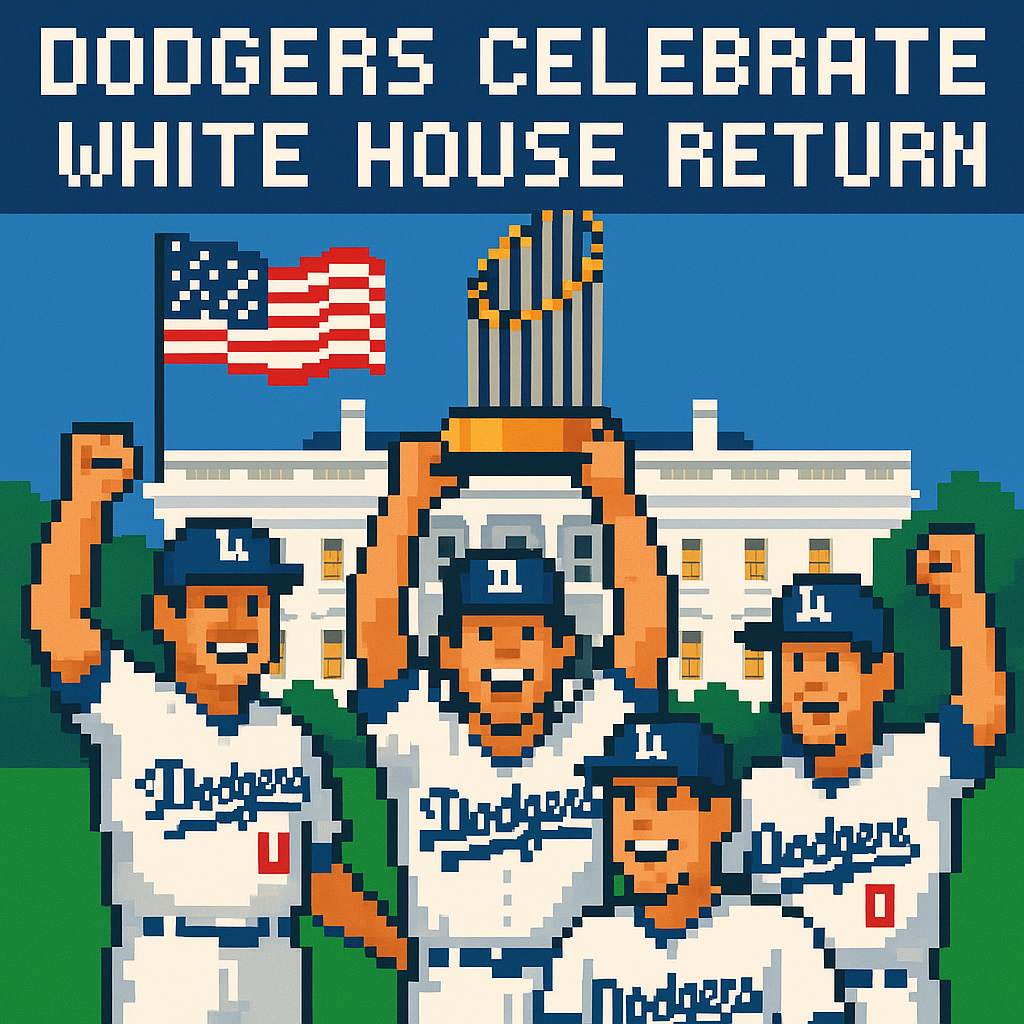
Dodgers Celebrate White House Return | Analysis by Brian Moineau

TL;DR

  • Donald Trump hosted the back-to-back World Series champion Los Angeles Dodgers at the White House for the second straight year, praising the franchise as “one of the great brands anywhere in the world.” [1][2]
  • The optics pair a global baseball roster—Shohei Ohtani, Freddie Freeman, and Yoshinobu Yamamoto—with a media-savvy White House, giving both sides reach, legitimacy, and content on the Rose Garden stage. [2][3]
  • The commercial engine hums underneath: Forbes values the Dodgers at $7.8B with 2025 revenue near $850M, while an $8.35B local TV pact and new streaming tiers convert cultural spikes into subscription and merchandise lifts. [4][6][8]

What the source said

ABC News says President Donald Trump welcomed Shohei Ohtani, Freddie Freeman, and the Los Angeles Dodgers to a Rose Garden ceremony in Washington, D.C., calling them “one of the great brands anywhere in the world.” The report references a 2025 East Room event for the 2024 title over the Yankees and corrects the month of the 2025 Game 7 clincher to November. The White House event displayed two World Series trophies, a “Trump 47” jersey, and a replica ring, and Manager Dave Roberts joked about a “three-peat.” [1][2]

Why it matters

Two U.S. institutions—the White House at 1600 Pennsylvania Avenue and the Dodgers at Chavez Ravine—cross-promoted before national cameras in 2026, attaching the presidency to Ohtani’s global fandom and a bicoastal base stretching from Los Angeles to New York. For the franchise, the shot list—South Lawn podium, twin trophies, Roberts’ “three‑peat” line, and the president’s “great brand” quote—feeds highlight packages, sponsor reels, and social cuts within hours. [2][3]

Stakeholders have dollars on the line. Forbes puts the Dodgers at $7.8B with about $850M in 2025 revenue, while MLB.com’s jersey rankings show Ohtani at No. 1 with teammates close behind. Tie that to SportsNet LA’s $8.35B rights deal and 2025’s SNLA+ streaming option, and the Rose Garden turns from photo op into top‑of‑funnel for merchandise, tickets, and subs. [4][7][6][8]

Original analysis

Trump and the Dodgers staged a mutually beneficial media hit in the Rose Garden: the president linked his office to baseball’s current juggernaut, and the club captured broadcast‑quality footage that plays in Southern California, Japan, and any U.S. market where visiting fans wear blue. This is transactional civics with a revenue model attached, not a culture‑war rerun. [2][3]

Labelled analyses:

  1. Back-of-the-envelope math
  • Revenue lift: Starting from Forbes’ $850M 2025 revenue, assume a conservative +6% “championship afterglow” for 2026, which many teams see via merch and ticketing. 0.06 × $850M = $51M; $850M + $51M = ~$901M. If MLB’s average valuation gain runs ~12% into 2027, the $7.8B mark grows to $7.8B × 1.12 ≈ $8.74B. A true three‑peat could support a 10–15% premium on top of trend, implying roughly $780M–$1.17B of incremental enterprise value. [4]

  • Media kicker: Spectrum SportsNet LA’s agreement totals $8.35B over 25 years, with SNLA+ launching in 2025 to address cord‑cutters. A White House clip that ricochets through AP, ABC, and MLB channels functions as acquisition creative for those subs and for Fanatics carts, contributing directly to the top line. [6][8][2][3]

  1. Contrarian read
  • Consensus: White House visits carry political downside and limited upside for teams.
  • Counter: For the Dodgers, upside is measurable. The 2025 World Series ended 5–4 in 11 innings on Nov. 1, with an 18‑inning Game 3 earlier in the set—catnip for casuals and die‑hards. Trump’s “one of the great brands anywhere in the world” line supplies a portable tagline, while Ohtani’s No. 1 jersey status keeps the register ringing. This ceremony extends the emotional half‑life of those wins, which is how repeat champions monetize narrative. [3][2][7]
  1. Named-stakeholder breakdown
  • Guggenheim/Mark Walter: Another blue‑chip validation of a decade‑long talent and media thesis that supports the next valuation step. [4]
  • Charter/Spectrum (SportsNet LA): National mentions of Dodgers content sharpen the consumer case for SNLA carriage and SNLA+ in an RSN shakeout. [6][8]
  • MLB/Fanatics/Nike: Ohtani in the Rose Garden after consecutive titles refreshes jersey cycles and stokes international demand across Japan and North America. [7]
  • The White House: A feel‑good baseball ceremony yields friendly footage and low‑risk, cross‑partisan earned media in Washington. [2]
  1. 2×2: Optics vs. Monetization
  • High optics / High monetization: Dodgers (brand footage + subs/merch), White House (unifying visuals + audience reach).
  • High optics / Low monetization: Casual fans who watch clips but don’t buy—valuable as awareness.
  • Low optics / High monetization: Local die‑hards converting to SNLA+ at $x/month after highlight exposure. [6]
  • Low optics / Low monetization: Non‑sports voters unlikely to engage—acceptable collateral.

Note: The on‑field spine is real. The Dodgers beat the Yankees 4–1 in the 2024 World Series, then edged the Blue Jays 5–4 in 11 innings on Nov. 1, 2025, with an 18‑inning Game 3 remembered across broadcasts. The brand story sits on those outcomes, not the other way around. [5][3]

What others are missing

The RSN and direct‑to‑consumer math. SportsNet LA’s $8.35B, 25‑year foundation sets the floor, and 2025’s SNLA+ plus MLB app integrations add a metered upsell that turns one Rose Garden clip into sequential retargeting: wire photos on AP, a segment on ABC, and highlight reels on MLB.com within 24 hours. That sequence justifies carriage asks, premium tiers under $25/month, and ARPU gains when lapsed cable homes re‑enter the funnel before October. Most political writeups stop at optics; the Dodgers’ media unit will run this like a paid acquisition loop. [2][6][8]

What to watch next

  1. By November 30, 2026, MLB and Fanatics publish jersey rankings with Shohei Ohtani at No. 1 and at least two other Dodgers in the top five. [7]
  2. By April 1, 2027, Spectrum expands SNLA+ availability or bundles it with MLB platforms beyond current footprints, at a stated monthly price under $25. [6][8]
  3. By March 31, 2027, Forbes lists the Dodgers above $8.5B in valuation, attributing gains to multi‑year titles and direct‑to‑consumer media growth. [4]

My take

Treat the White House ceremony like a Q3 launch. Stitch the “great brand” quote into sponsor decks, run a 72‑hour “Back‑to‑Back” SNLA+ promo in Los Angeles and Orange County, and drop a limited Ohtani/DC jersey on Fanatics before Sunday night baseball. The Yankees didn’t turn dynasties into cash by accident; they systematized it. The Dodgers now have the content, the channels, and the global star to do it at 2026 scale. [2][4][6][7]

Sources

  1. Trump will welcome the World Series champion Dodgers to the White House — ABC News (https://abcnews.com/Politics/wireStory/trump-world-series-champion-dodgers-white-house-135023469) — The base report: Rose Garden venue, the “great brands” quote, attendee names, and timeline.

  2. Trump fetes Dodgers at the White House again, saying the team is “one of the great brands” — Associated Press (https://apnews.com/article/0daaeadffe276338e5d45ad77663fcb0) — Independent confirmation of ceremony details, quotes, and the repeat‑visit context.

  3. Dodgers win 2025 World Series; Game 7 facts and figures — MLB.com (https://www.mlb.com/news/dodgers-win-2025-world-series) and (https://www.mlb.com/news/dodgers-blue-jays-world-series-game-7-facts-and-figures) — Official recaps: Nov. 1, 2025, 11‑inning clincher and the 18‑inning Game 3.

  4. Los Angeles Dodgers — Forbes (https://www.forbes.com/teams/los-angeles-dodgers/) and MLB Valuations List (https://www.forbes.com/mlb-valuations/list/) — Valuation ($7.8B, March 2026), revenue (~$850M for 2025), and league growth comps.

  5. 2024 World Series: Dodgers over Yankees (4–1) — Baseball‑Reference (https://www.baseball-reference.com/postseason/2024_WS.shtml) — Box‑level confirmation of the five‑game 2024 result.

  6. Spectrum offering a streaming‑only subscription for Dodgers; SNLA+ details — Los Angeles Times (https://www.latimes.com/sports/dodgers/story/2025-03-17/spectrum-dodgers-streaming-2025-season-games) — How SportsNet LA moved into DTC in 2025, with product and pricing context.

  7. Most popular MLB jerseys for 2025 — MLB.com (https://www.mlb.com/dodgers/news/most-popular-mlb-jerseys-for-2025) — Ohtani’s No. 1 jersey ranking and teammate placement substantiate merchandise demand.

  8. Spectrum SportsNet LA — ESPN explainer on the $8.35B, 25‑year deal (https://www.espn.com/mlb/story/_/id/44250840/mlb-2025-los-angeles-dodgers-villains-heroes-ohtani-freeman-betts) — Contract scale and RSN context that tie national moments to local media economics.


Related update: We recently published an article that expands on this topic: read the latest post.
CFTC vs States: Battle for Prediction | Analysis by Brian Moineau

TL;DR

  • The CFTC just proposed a rule to codify what prediction markets can list, carving out a path for sports contracts while drawing a hard line against wagers tied to war, terrorism, assassination, and other “enumerated activities” under Section 5c(c)(5)(C) of the Commodity Exchange Act. [1][2]
  • If even 5% of 2025’s $166.94B U.S. sportsbook handle migrates to CFTC‑regulated venues, that’s an ~$8.35B swing in notional volume and a meaningful new revenue stream for exchanges like Kalshi; state sportsbooks will fight to keep it. [2][4][8]
  • The real battle is jurisdiction: a one‑commissioner CFTC under President Trump is asserting exclusive federal authority over prediction markets, setting up court fights with state gaming regulators that will shape who gets the economics—and the rules. [2][3][6][7]

What the source said

In June 2026, the Wall Street Journal reported that a Trump‑led CFTC plans to clarify what prediction markets may legally offer via a new rule that defines a review process and the “public interest” standard. The Journal said sports contracts would largely be permissible, whereas wagers tied to sensitive topics—wars, terrorism, assassinations—would be restricted as “enumerated activities.” The move targets ambiguity that has fueled lawsuits and uneven enforcement across platforms like Kalshi and Polymarket since at least 2012. The proposal opens a formal public comment period and tees up federal–state clashes over whether event contracts sit under the Commodity Exchange Act or state gambling codes. [1]

Why it matters

Two ecosystems collide: federally regulated derivatives exchanges such as Kalshi (a DCM under the CEA) and state‑regulated sportsbooks like DraftKings, FanDuel, and Fanatics. The American Gaming Association reported $166.94B in 2025 U.S. sports betting handle and $16.96B in revenue, so even small share shifts matter to P&Ls and tax receipts. If CFTC‑supervised “sports trading” offers lower friction than parlay‑heavy sportsbooks, time and dollars will migrate. [4]

Regulatory turf is equally material. The CFTC’s NPRM claims these markets fall under the CEA and outlines a 90‑day contract‑by‑contract review with “public interest” factors, pitting Washington against state gaming commissions in jurisdictions like New York and Nevada. The outcome will define whether event contracts scale like futures or remain a boutique product fenced by 50 state regimes. [2][3][7]

Original analysis

Consensus read: “The CFTC is effectively legalizing prediction markets, so volumes will explode and sportsbooks will be sidelined.” My take: not so fast. The proposal mostly clarifies what’s out—the “enumerated activities” in Section 5c(c)(5)(C): terrorism, assassination, war, gaming, and illegality—and how the CFTC will decide if a contract is contrary to the public interest. It nods to many sports outcomes in principle but keeps a 90‑day federal review per listing, which tempers speed and breadth. That’s a green light, not the Autobahn. [2]

  • Back‑of‑envelope math

    • 2025 U.S. sportsbook handle: $166.94B; revenue: $16.96B. If 5% of that handle pivots to CFTC‑regulated sports event contracts by 2027, notional equals 0.05 × $166.94B = ~$8.35B. [4]
    • Exchange economics: Kalshi’s fee schedule charges cents per contract; near $0.50 mid‑prices, that maps to roughly 30–60 bps all‑in per round‑trip. On $8.35B, 0.30%–0.60% implies ~$25M–$50M in annualized fees for one venue; at 10% migration, double the range. [8][4]
    • State impact: With a typical 9%–10% sportsbook hold, $8.35B of diverted handle equates to ~$750M in lost gross gaming revenue; at 10%–20% tax rates, states forgo ~$75M–$150M per year across major markets like New Jersey and Pennsylvania. Expect hardened opposition. [4]
  • A 2×2 to read the rule’s effect (my typology)

    • Axes: Manipulability/insider risk (low↔high) vs. real‑economy/hedging utility (low↔high).
    • Low risk / high utility (Green): “NBA Finals winner,” “season‑long batting average,” “Olympic medal counts.” Expect smoother approvals: outcomes are televised, settled by third‑party stats providers, and leagues like the NBA run integrity programs. [2][3]
    • High risk / high utility (Amber): “Fed cuts by X bps next meeting,” “U.S. CPI above Y% next month.” Useful hedges but sensitive to leaks; April 2026 self‑betting by a U.S. House candidate on Kalshi underscores insider exposure that surveillance must catch. [2][9]
    • Low risk / low utility (Gray): “Celebrity pregnancy by Q4,” “new album release date.” Thin societal utility; the public‑interest test will likely deprioritize or deny. [2]
    • High risk / low utility (Red): “Assassination,” “terror incidents,” “active theater‑of‑war outcomes.” The NPRM aims to exclude these systematically under Rule 40.11. [2]
  • Historical analogue that actually predicts behavior

    • In 2012, the CFTC used a 90‑day review to block Nadex political event contracts under Rule 40.11, citing the public‑interest standard. The 2026 NPRM revives that scaffold but expressly tolerates many sports outcomes, signaling a cleaner, more durable process and fewer ad‑hoc staff letters. Expect formal dockets and repeatable screening criteria. [5][2]
  • Named‑stakeholder implications

    • Kalshi (DCM): Clearer path to list U.S. sports and macro contracts, subject to 90‑day reviews and surveillance proofs; slower than a sportsbook’s daily menu. [2]
    • Polymarket: Positive sports signaling, but U.S. scale still hinges on registration and whether federal preemption over states holds in court; bans on war/terror curtail viral tail events. [2][3]
    • DraftKings/FanDuel/Fanatics: Face a federally supervised substitute with lower take rates and different unit economics; expect lobbying and litigation to classify event contracts as “gaming.” [3][4]
    • State gaming regulators/AGA: Tax base at the margin is at risk; anticipate coordinated challenges to federal preemption and integrity claims in venues like the Second and D.C. Circuits. [3][7]
    • Leagues and data vendors (NFL/NBA, Sportradar/Stats Perform): As CFTC markets grow, official data deals and integrity MOUs may mirror futures‑market surveillance models, with per‑event fees and T+0 settlement feeds. [2][3]

Two underestimated constraints loom. First, the Commission is a one‑member shop under Chair Michael S. Selig, which invites process challenges to any final rule and to exclusive‑jurisdiction assertions. Second, the NPRM’s 90‑day, multi‑factor, contract‑by‑contract screen will throttle the “long tail” listings that drive cult engagement, unless the CFTC standardizes families of sports contracts. Expect early volume to cluster in a few high‑liquidity markets with robust surveillance. [6][2][7]

What others are missing

Coverage has fixated on “pro‑sports, anti‑war,” but the commercial hinge is federal preemption paired with standardization. If exclusive jurisdiction survives in court, a DCM can offer a national sports product insulated from 50 state codes, while a Rule 40.11‑driven taxonomy lets brokerages such as Robinhood or Coinbase embed cash‑settled markets via APIs under federal KYC/AML. That combination enables distribution at scale and forces futures‑style surveillance across venues, rather than state patchworks. The NPRM’s 90‑day process and factor test become a template for comparable disclosures, error‑handling, and settlement sources across exchanges. [2][3][7]

What to watch next

  1. By Q4 2026, at least one top‑five U.S. sportsbook publicly partners with a CFTC‑regulated exchange or files to list a sports event contract through a DCM affiliate, seeking federal cover for nationwide distribution. [2][3]

  2. By March 2027, a federal court issues a merits ruling in a state–federal dispute that affirms or rejects the CFTC’s exclusive jurisdiction over prediction markets, materially changing venue operations in at least three states. [7]

  3. Within 12 months of the rule’s finalization in 2026, the CFTC publishes at least one determination rejecting a proposed geopolitical/violence‑adjacent contract under amended Rule 40.11, setting a binding precedent on “involve” and “public interest.” [2]

My take

This 2026 NPRM is a pragmatic swing: fence out the toxic stuff, normalize the rest under Rule 40.11 and a 90‑day review. If the CFTC finalizes cleanly and wins the preemption fight, prediction markets will look like low‑fee, high‑liquidity retail derivatives that Wall Street can distribute without state silos. I’d bet medium‑term winners are regulated exchanges that operate like brokerages and the leagues that sell them data rights. The losers are anyone betting that state‑by‑state de‑platforming can halt a national market. [2]

Sources

[1] Trump Regulator Proposes New Rules on What’s Allowed on Prediction Markets — Wall Street Journal (https://www.wsj.com/finance/regulation/trump-cftc-prediction-markets-betting-rules-1aea5c9d) — Original report that a Trump‑era CFTC is proposing formal boundaries for prediction markets, including likely bans on war/terror contracts.

[2] CFTC Seeks Public Comment on Notice of Proposed Rulemaking Concerning Event Contracts Involving Enumerated Activities — CFTC (https://www.cftc.gov/PressRoom/PressReleases/9249-26) — The official NPRM: 90‑day review, “public interest” factors, and the terrorism/assassination/war/gaming/illegality screen; references sports contracts.

[3] Feds move to formally allow sports “trading” on prediction markets — Axios (https://www.axios.com/2026/06/10/cftc-prediction-markets-sports-event-contract-rules) — Independent confirmation that the proposal opens a lane for sports event contracts and includes industry reaction.

[4] Commercial Gaming Revenue Hits $78.7 Billion in 2025, Driving Record $18.1 Billion in Gaming Taxes Nationwide — American Gaming Association (https://www.americangaming.org/commercial-gaming-revenue-hits-78-7-billion-in-2025-driving-record-18-1-billion-in-gaming-taxes-nationwide/) — Baseline sports betting economics: $166.94B handle and $16.96B revenue in 2025.

[5] CFTC Issues Order Prohibiting North American Derivatives Exchange’s Political Event Derivatives Contracts — CFTC (https://www.cftc.gov/PressRoom/PressReleases/6224-12) — The 2012 precedent: 90‑day review and prohibition of political event contracts under Rule 40.11.

[6] Exclusive: Prediction markets and sports betting are “two separate things,” regulator says — Axios (https://www.axios.com/2026/05/12/prediction-markets-cftc-selig-regulation) — Chair Michael S. Selig’s stance on separating prediction markets from sportsbooks; context on the one‑commissioner CFTC.

[7] CFTC Reaffirms Exclusive Jurisdiction over Prediction Markets in U.S. Circuit Court Filing — CFTC (https://www.cftc.gov/PressRoom/PressReleases/9183-26) — The agency’s legal brief asserting federal preemption over prediction markets, foreshadowing court fights with states.

[8] Fee Schedule (Feb. 2026 update) — Kalshi (https://kalshi.com/docs/kalshi-fee-schedule.pdf) — Primary documentation of cents‑per‑contract trading fees used to approximate exchange‑level economics.

[9] Kalshi suspends Democratic U.S. House candidate for bet on own primary race — Axios Local (Twin Cities) (https://www.axios.com/local/twin-cities/2026/04/22/kalshi-suspends-democratic-us-house-candidate-matt-klein-primary-race-bet) — Concrete example of insider‑trading risk the rule aims to contain.


Related update: We recently published an article that expands on this topic: read the latest post.