
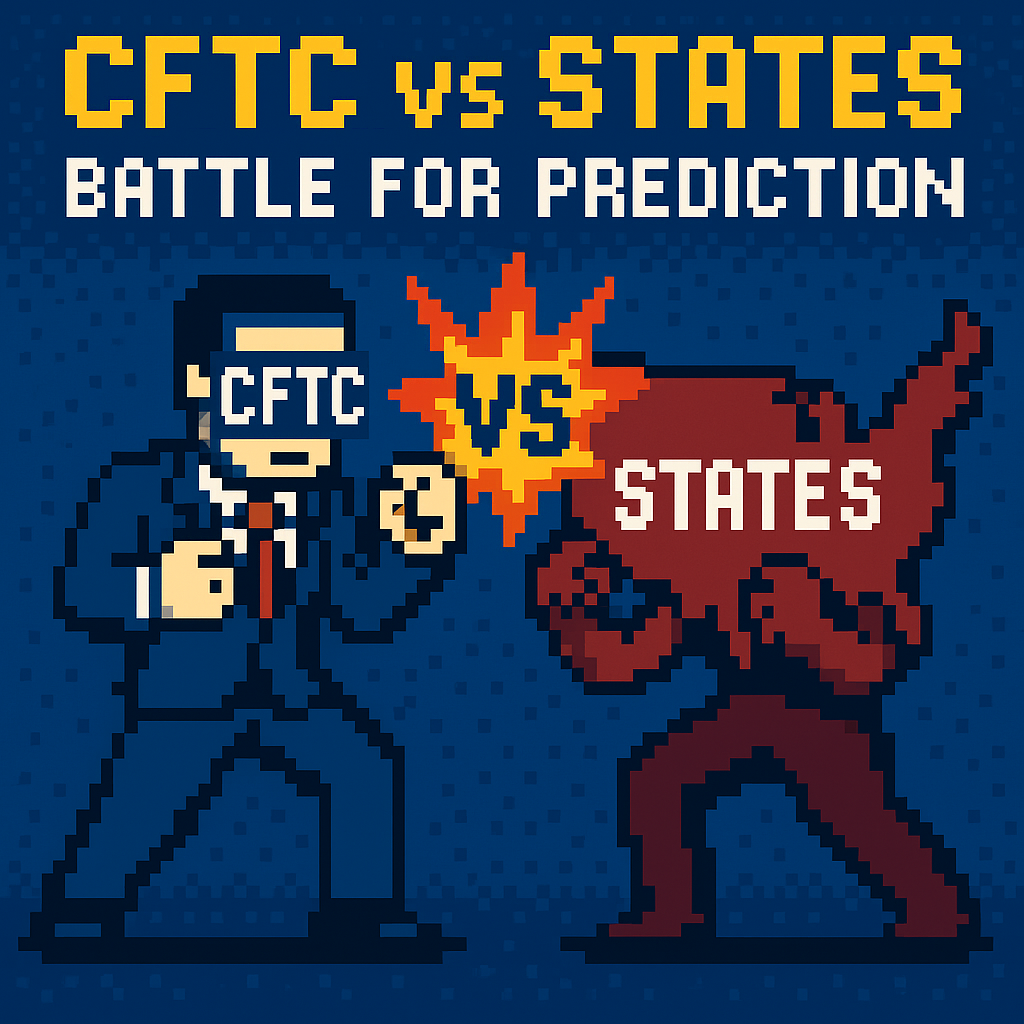
CFTC vs States: Battle for Prediction | Analysis by Brian Moineau

TL;DR

  • The CFTC just proposed a rule to codify what prediction markets can list, carving out a path for sports contracts while drawing a hard line against wagers tied to war, terrorism, assassination, and other “enumerated activities” under Section 5c(c)(5)(C) of the Commodity Exchange Act. [1][2]
  • If even 5% of 2025’s $166.94B U.S. sportsbook handle migrates to CFTC‑regulated venues, that’s an ~$8.35B swing in notional volume and a meaningful new revenue stream for exchanges like Kalshi; state sportsbooks will fight to keep it. [2][4][8]
  • The real battle is jurisdiction: a one‑commissioner CFTC under President Trump is asserting exclusive federal authority over prediction markets, setting up court fights with state gaming regulators that will shape who gets the economics—and the rules. [2][3][6][7]

What the source said

In June 2026, the Wall Street Journal reported that a Trump‑led CFTC plans to clarify what prediction markets may legally offer via a new rule that defines a review process and the “public interest” standard. The Journal said sports contracts would largely be permissible, whereas wagers tied to sensitive topics—wars, terrorism, assassinations—would be restricted as “enumerated activities.” The move targets ambiguity that has fueled lawsuits and uneven enforcement across platforms like Kalshi and Polymarket since at least 2012. The proposal opens a formal public comment period and tees up federal–state clashes over whether event contracts sit under the Commodity Exchange Act or state gambling codes. [1]

Why it matters

Two ecosystems collide: federally regulated derivatives exchanges such as Kalshi (a DCM under the CEA) and state‑regulated sportsbooks like DraftKings, FanDuel, and Fanatics. The American Gaming Association reported $166.94B in 2025 U.S. sports betting handle and $16.96B in revenue, so even small share shifts matter to P&Ls and tax receipts. If CFTC‑supervised “sports trading” offers lower friction than parlay‑heavy sportsbooks, time and dollars will migrate. [4]

Regulatory turf is equally material. The CFTC’s NPRM claims these markets fall under the CEA and outlines a 90‑day contract‑by‑contract review with “public interest” factors, pitting Washington against state gaming commissions in jurisdictions like New York and Nevada. The outcome will define whether event contracts scale like futures or remain a boutique product fenced by 50 state regimes. [2][3][7]

Original analysis

Consensus read: “The CFTC is effectively legalizing prediction markets, so volumes will explode and sportsbooks will be sidelined.” My take: not so fast. The proposal mostly clarifies what’s out—the “enumerated activities” in Section 5c(c)(5)(C): terrorism, assassination, war, gaming, and illegality—and how the CFTC will decide if a contract is contrary to the public interest. It nods to many sports outcomes in principle but keeps a 90‑day federal review per listing, which tempers speed and breadth. That’s a green light, not the Autobahn. [2]

  • Back‑of‑envelope math

    • 2025 U.S. sportsbook handle: $166.94B; revenue: $16.96B. If 5% of that handle pivots to CFTC‑regulated sports event contracts by 2027, notional equals 0.05 × $166.94B = ~$8.35B. [4]
    • Exchange economics: Kalshi’s fee schedule charges cents per contract; near $0.50 mid‑prices, that maps to roughly 30–60 bps all‑in per round‑trip. On $8.35B, 0.30%–0.60% implies ~$25M–$50M in annualized fees for one venue; at 10% migration, double the range. [8][4]
    • State impact: With a typical 9%–10% sportsbook hold, $8.35B of diverted handle equates to ~$750M in lost gross gaming revenue; at 10%–20% tax rates, states forgo ~$75M–$150M per year across major markets like New Jersey and Pennsylvania. Expect hardened opposition. [4]
  • A 2×2 to read the rule’s effect (my typology)

    • Axes: Manipulability/insider risk (low↔high) vs. real‑economy/hedging utility (low↔high).
    • Low risk / high utility (Green): “NBA Finals winner,” “season‑long batting average,” “Olympic medal counts.” Expect smoother approvals: outcomes are televised, settled by third‑party stats providers, and leagues like the NBA run integrity programs. [2][3]
    • High risk / high utility (Amber): “Fed cuts by X bps next meeting,” “U.S. CPI above Y% next month.” Useful hedges but sensitive to leaks; April 2026 self‑betting by a U.S. House candidate on Kalshi underscores insider exposure that surveillance must catch. [2][9]
    • Low risk / low utility (Gray): “Celebrity pregnancy by Q4,” “new album release date.” Thin societal utility; the public‑interest test will likely deprioritize or deny. [2]
    • High risk / low utility (Red): “Assassination,” “terror incidents,” “active theater‑of‑war outcomes.” The NPRM aims to exclude these systematically under Rule 40.11. [2]
  • Historical analogue that actually predicts behavior

    • In 2012, the CFTC used a 90‑day review to block Nadex political event contracts under Rule 40.11, citing the public‑interest standard. The 2026 NPRM revives that scaffold but expressly tolerates many sports outcomes, signaling a cleaner, more durable process and fewer ad‑hoc staff letters. Expect formal dockets and repeatable screening criteria. [5][2]
  • Named‑stakeholder implications

    • Kalshi (DCM): Clearer path to list U.S. sports and macro contracts, subject to 90‑day reviews and surveillance proofs; slower than a sportsbook’s daily menu. [2]
    • Polymarket: Positive sports signaling, but U.S. scale still hinges on registration and whether federal preemption over states holds in court; bans on war/terror curtail viral tail events. [2][3]
    • DraftKings/FanDuel/Fanatics: Face a federally supervised substitute with lower take rates and different unit economics; expect lobbying and litigation to classify event contracts as “gaming.” [3][4]
    • State gaming regulators/AGA: Tax base at the margin is at risk; anticipate coordinated challenges to federal preemption and integrity claims in venues like the Second and D.C. Circuits. [3][7]
    • Leagues and data vendors (NFL/NBA, Sportradar/Stats Perform): As CFTC markets grow, official data deals and integrity MOUs may mirror futures‑market surveillance models, with per‑event fees and T+0 settlement feeds. [2][3]

Two underestimated constraints loom. First, the Commission is a one‑member shop under Chair Michael S. Selig, which invites process challenges to any final rule and to exclusive‑jurisdiction assertions. Second, the NPRM’s 90‑day, multi‑factor, contract‑by‑contract screen will throttle the “long tail” listings that drive cult engagement, unless the CFTC standardizes families of sports contracts. Expect early volume to cluster in a few high‑liquidity markets with robust surveillance. [6][2][7]

What others are missing

Coverage has fixated on “pro‑sports, anti‑war,” but the commercial hinge is federal preemption paired with standardization. If exclusive jurisdiction survives in court, a DCM can offer a national sports product insulated from 50 state codes, while a Rule 40.11‑driven taxonomy lets brokerages such as Robinhood or Coinbase embed cash‑settled markets via APIs under federal KYC/AML. That combination enables distribution at scale and forces futures‑style surveillance across venues, rather than state patchworks. The NPRM’s 90‑day process and factor test become a template for comparable disclosures, error‑handling, and settlement sources across exchanges. [2][3][7]

What to watch next

  1. By Q4 2026, at least one top‑five U.S. sportsbook publicly partners with a CFTC‑regulated exchange or files to list a sports event contract through a DCM affiliate, seeking federal cover for nationwide distribution. [2][3]

  2. By March 2027, a federal court issues a merits ruling in a state–federal dispute that affirms or rejects the CFTC’s exclusive jurisdiction over prediction markets, materially changing venue operations in at least three states. [7]

  3. Within 12 months of the rule’s finalization in 2026, the CFTC publishes at least one determination rejecting a proposed geopolitical/violence‑adjacent contract under amended Rule 40.11, setting a binding precedent on “involve” and “public interest.” [2]

My take

This 2026 NPRM is a pragmatic swing: fence out the toxic stuff, normalize the rest under Rule 40.11 and a 90‑day review. If the CFTC finalizes cleanly and wins the preemption fight, prediction markets will look like low‑fee, high‑liquidity retail derivatives that Wall Street can distribute without state silos. I’d bet medium‑term winners are regulated exchanges that operate like brokerages and the leagues that sell them data rights. The losers are anyone betting that state‑by‑state de‑platforming can halt a national market. [2]

Sources

[1] Trump Regulator Proposes New Rules on What’s Allowed on Prediction Markets — Wall Street Journal (https://www.wsj.com/finance/regulation/trump-cftc-prediction-markets-betting-rules-1aea5c9d) — Original report that a Trump‑era CFTC is proposing formal boundaries for prediction markets, including likely bans on war/terror contracts.

[2] CFTC Seeks Public Comment on Notice of Proposed Rulemaking Concerning Event Contracts Involving Enumerated Activities — CFTC (https://www.cftc.gov/PressRoom/PressReleases/9249-26) — The official NPRM: 90‑day review, “public interest” factors, and the terrorism/assassination/war/gaming/illegality screen; references sports contracts.

[3] Feds move to formally allow sports “trading” on prediction markets — Axios (https://www.axios.com/2026/06/10/cftc-prediction-markets-sports-event-contract-rules) — Independent confirmation that the proposal opens a lane for sports event contracts and includes industry reaction.

[4] Commercial Gaming Revenue Hits $78.7 Billion in 2025, Driving Record $18.1 Billion in Gaming Taxes Nationwide — American Gaming Association (https://www.americangaming.org/commercial-gaming-revenue-hits-78-7-billion-in-2025-driving-record-18-1-billion-in-gaming-taxes-nationwide/) — Baseline sports betting economics: $166.94B handle and $16.96B revenue in 2025.

[5] CFTC Issues Order Prohibiting North American Derivatives Exchange’s Political Event Derivatives Contracts — CFTC (https://www.cftc.gov/PressRoom/PressReleases/6224-12) — The 2012 precedent: 90‑day review and prohibition of political event contracts under Rule 40.11.

[6] Exclusive: Prediction markets and sports betting are “two separate things,” regulator says — Axios (https://www.axios.com/2026/05/12/prediction-markets-cftc-selig-regulation) — Chair Michael S. Selig’s stance on separating prediction markets from sportsbooks; context on the one‑commissioner CFTC.

[7] CFTC Reaffirms Exclusive Jurisdiction over Prediction Markets in U.S. Circuit Court Filing — CFTC (https://www.cftc.gov/PressRoom/PressReleases/9183-26) — The agency’s legal brief asserting federal preemption over prediction markets, foreshadowing court fights with states.

[8] Fee Schedule (Feb. 2026 update) — Kalshi (https://kalshi.com/docs/kalshi-fee-schedule.pdf) — Primary documentation of cents‑per‑contract trading fees used to approximate exchange‑level economics.

[9] Kalshi suspends Democratic U.S. House candidate for bet on own primary race — Axios Local (Twin Cities) (https://www.axios.com/local/twin-cities/2026/04/22/kalshi-suspends-democratic-us-house-candidate-matt-klein-primary-race-bet) — Concrete example of insider‑trading risk the rule aims to contain.


Related update: We recently published an article that expands on this topic: read the latest post.
China Frenzy Sparks Silver Market Meltdown | Analysis by Brian Moineau

When silver forgot the rules: how a China-fueled frenzy blew the top off precious metals

The screens went white. For weeks, traders had been riding one of the most aggressive precious‑metals rallies in decades — then in less than twenty hours silver gave back roughly $40 an ounce and plunged in a way few had seen before. That violent reversal exposed how a cocktail of Chinese retail speculation, strained physical markets and technical safeguards (margins, algorithms, exchange rules) can turn a smoke‑and‑mirrors rally into a sudden market unwind.

Below I unpack what happened, why it got so extreme, and what investors should keep in mind going forward.

How the rally got out of hand

  • Parabolic move first. Silver staged an extraordinary rally through 2025 and into January 2026, propelled by a mix of industrial demand, geopolitical fears and speculative momentum. What starts as rational buying (industry, ETFs, central‑bank flows) can become self‑reinforcing when retail and leveraged players pile in. (Think: more buyers, less paper required per contract, and an expectation that prices only go up.) (m.economictimes.com)

  • A big Chinese footprint. Chinese traders and retail platforms played an outsized role in the surge. Heavy retail participation in China — often through leveraged products and exchange‑linked accounts — amplified volatility and expanded the “paper” exposure to silver beyond what physical supply could cover. When that speculative flow begins to reverse, the effect is amplified. (businessinsider.com)

  • Physical vs. paper stress. Tight physical inventories and frictions in cross‑border flows made the market fragile. When buyers started demanding physical delivery or when exporters tightened exports, the disconnect between the futures (paper) market and actual bullion intensified. That mismatch can sustain rallies — but it also primes the market for violent corrections if leveraged holders are forced to liquidate. (thestreet.com)

  • Margin hikes and forced selling. Exchanges (notably CME) raised margin requirements as volatility surged. Higher margins squeezed leveraged traders and funds, forcing rapid sell orders into already thin markets — a mechanical feedback loop that turned a correction into a crash. (thestreet.com)

  • Macro news as the spark. A shift in macro expectations — for example, a hawkish signal on U.S. monetary policy — strengthened the U.S. dollar and reduced the appeal of non‑yielding assets like gold and silver. That change in sentiment provided the trigger that turned fragile positioning into mass liquidation. (ft.com)

Why this felt different from past pullbacks

  • Speed and leverage. The crash happened faster than many historic drops because leverage today is higher and execution is electronic. Automated systems, program trading and margin‑sensitive accounts can force outsized flows in minutes rather than days.

  • China’s policy layer. Recent Chinese moves affecting metals exports and trading channels added a nation‑level source of uncertainty. That made liquidity in global physical markets more brittle and increased the chance that local Chinese flows would have outsized global effects. (astreka.com)

  • Cross‑market contagion. Silver’s drop didn’t happen in isolation — other industrial metals and gold were affected too. Where previously commodities could absorb shocks, the breadth of positioning (and the prevalence of leveraged retail exposure) made the systemwide reaction sharper. (ft.com)

Lessons for investors and traders

  • What matters more than you think: market plumbing. Supply and demand fundamentals matter — but so do margin rules, exchange interventions, delivery mechanics and who holds the risk. In leveraged, thinly‑liquid markets these mechanics can dominate fundamentals for a while.

  • Know your counterparty risk and leverage exposure. Retail platforms that offer cheap leverage can create asymmetric risks for clients. When you’re long with high leverage, even a small policy or macro surprise becomes dangerous.

  • Distinguish physical from paper exposure. Owning a bar in a vault and owning a futures contract are different bets. When the paper‑to‑physical ratio becomes extreme, prices can diverge quickly and painfully.

  • Expect whipsaw conditions around policy news. Monetary and geopolitical headlines can flip the narrative quickly. Position sizing and stop‑loss discipline aren’t optional in these markets.

What to remember

  • The January 2026 crash was a structural warning: rapid, leveraged flows from China plus strained physical markets and margin hikes equal the recipe for explosive reversals. (businessinsider.com)

  • Margin rules and exchange interventions can be the market’s circuit breakers — and sometimes the accelerants. (thestreet.com)

  • Ownership matters: physical metal, ETFs, futures and leveraged retail products behave differently in stress. (thestreet.com)

My take

We’ve been through narrative cycles before — short squeezes, retail mania, and commodity panics — but the 2025–2026 episode highlights how globalization and digitization of trading magnify those dynamics. Speculation in one major market (China) can now ripple through exchanges and vaults worldwide in a single trading session. For disciplined investors, that means re‑anchoring strategies to fundamentals, minding leverage, and treating liquidity risk as a first‑class concern.

For traders who thrive on volatility, this environment offers opportunity — but only if you respect the mechanics that turned a rally into a rout. For institutions and regulators, it’s a reminder that market structure evolves and that safeguards (margins, position limits, clearer delivery rules) must keep pace.

Sources


Related update: We recently published an article that expands on this topic: read the latest post.



Related update: We recently published an article that expands on this topic: read the latest post.

GOP-Only Crypto Draft Tests Bipartisan | Analysis by Brian Moineau

A GOP-only crypto draft lands on the Hill — and the bipartisan dream frays

The Senate’s crypto drama just entered a new act. One week after bipartisan talks produced hope for a market-structure bill that would give clearer oversight to digital assets, Senate Agriculture Chair John Boozman’s office circulated a GOP-only draft ahead of a committee markup. The move has industry lobbyists, Democratic negotiators and investors watching closely — because it changes the political math for how (and whether) the U.S. writes rules for crypto markets.

Why this matters now

  • The Senate Agriculture, Nutrition, and Forestry Committee has been the focal point for sweeping crypto market-structure legislation that would, among other things, clarify which regulator oversees which digital assets and set rules for exchanges, custodians and decentralized finance.
  • Lawmakers spent months negotiating a bipartisan discussion draft. That draft left several hot-button areas bracketed, signaling ongoing compromise. But tensions over core policy choices — jurisdictional lines between the Commodity Futures Trading Commission and the SEC, treatment of decentralized finance, and ethics provisions around lawmakers and stablecoins — kept a final agreement out of reach.
  • Facing those unresolved issues, Committee Chair Boozman (R-Ark.) released a Republican-only draft to be considered in an upcoming markup. Boozman’s camp framed the move as necessary to keep the process moving; Democrats portrayed it as a retreat from bipartisan compromise.

Early reactions and the politics beneath the headlines

  • A Senate Agriculture spokesperson told reporters there are “a handful of policy differences” but “many areas of agreement,” and that Boozman “appreciates the good-faith effort to reach a bipartisan compromise.” That phrasing signals two things: Republicans want to show openness to negotiation while also defending a decision to advance their own text. (mexc.com)
  • Democrats — led in these talks by Sen. Cory Booker (D‑N.J.) on the Ag panel — have described continued conversations but remain reluctant to back the GOP-only package if core protections and balance-of-power provisions are missing. Industry players and some bipartisan supporters worry that a partisan markup could produce a bill that’s easier to block in the Senate or that would trigger a messy reconciliation with banking committee efforts. (archive.ph)
  • For crypto businesses, the stakes are practical: clarity and safe harbor. Too much delay or partisan infighting risks leaving unclear custody, listing and compliance rules that keep legitimate firms from offering products and leave consumers exposed.

What’s at stake in the policy fight

  • Regulator jurisdiction: Who gets primary authority over which types of tokens — the CFTC, the SEC, or a newly delineated regime — is the biggest technical and political dispute. This determines enforcement posture, registration requirements and litigation risk.
  • DeFi and developer liability: Whether noncustodial protocols and their developers get exemptions or face new liabilities will shape innovation incentives in decentralized finance.
  • Stablecoin rules and yields: Rules around issuer reserves, permitted activities and how yield-on-stablecoin products are treated could reshape the on‑ramps between traditional finance and crypto.
  • Ethics and quorum issues: Proposals to limit officials’ ability to profit from digital assets, and changes to agency quorum rules, have caused friction because they touch lawmakers’ personal interests and how independent agencies operate.

What this GOP-only draft means practically

  • Moving forward without bipartisan signoff increases the odds the Senate Agriculture Committee will vote on a Republican text that Democrats don’t support. That can expedite a timetable but risks another legislative stalemate on the floor — or a competing bill from the Senate Banking Committee.
  • The GOP draft may signal priorities Republicans think are nonnegotiable — e.g., clearer roles for the CFTC, tougher rules on stablecoin operations, or narrower protections for DeFi developers. For industry players, that’s a cue to mobilize for amendments or for outreach to Democratic offices to restore bipartisan language.
  • For markets, uncertainty often beats clarity short-term. The prospect of competing texts or protracted floor fights could keep firms cautious about product launches or migrations that depend on statutory safe harbors.

Practical timeline notes

  • The Agriculture Committee has postponed and rescheduled markups in recent weeks as talks moved back and forth. At the time this draft circulated, committee leadership signaled a markup was scheduled later in January (committee calendars have shifted during the negotiations). Watch the committee’s public calendar and press statements for firm markup dates. (agriculture.senate.gov)

Key takeaways for readers watching crypto policy

    • The release of a GOP-only draft does not end bipartisan talks, but it does raise the political temperature and shortens the runway for compromise.
    • Regulatory jurisdiction and treatment of DeFi remain the most consequential sticking points for both lawmakers and industry.
    • A partisan committee vote could speed a bill through committee but makes final passage harder unless leaders from both parties find an off-ramp or trading ground elsewhere in the Senate.

My take

This episode is classic Congress: momentum from earnest, cross‑party drafting collides with raw politics. Boozman’s GOP draft is both a procedural nudge and a negotiating move — it forces issues into the open rather than letting them linger in bracketed text. That can be healthy if it clarifies choices and prompts serious amendment work. But if the result is two competing, partisan bills (Agriculture vs. Banking), we could be stuck with months of legal ambiguity instead of clear rules that businesses and consumers need.

For the crypto industry, the best outcome remains a durable, bipartisan statute that clearly assigns jurisdiction, protects consumers, and leaves room for innovation. If lawmakers want to claim wins on both consumer protection and responsible innovation, they’ll need to make meaningful concessions — and fast.

Final thoughts

Lawmakers are juggling technical complexity, industry pressure, and electoral politics. The path to effective crypto law will be messy, but insisting on clarity and enforceability should stay front and center. Watch for amendments during markup and any outreach from mixed House–Senate working groups — those will tell you whether this draft is a negotiating step or the start of partisan trench warfare.

Sources


Related update: We recently published an article that expands on this topic: read the latest post.


Related update: We recently published an article that expands on this topic: read the latest post.


Related update: We recently published an article that expands on this topic: read the latest post.


Related update: We recently published an article that expands on this topic: read the latest post.