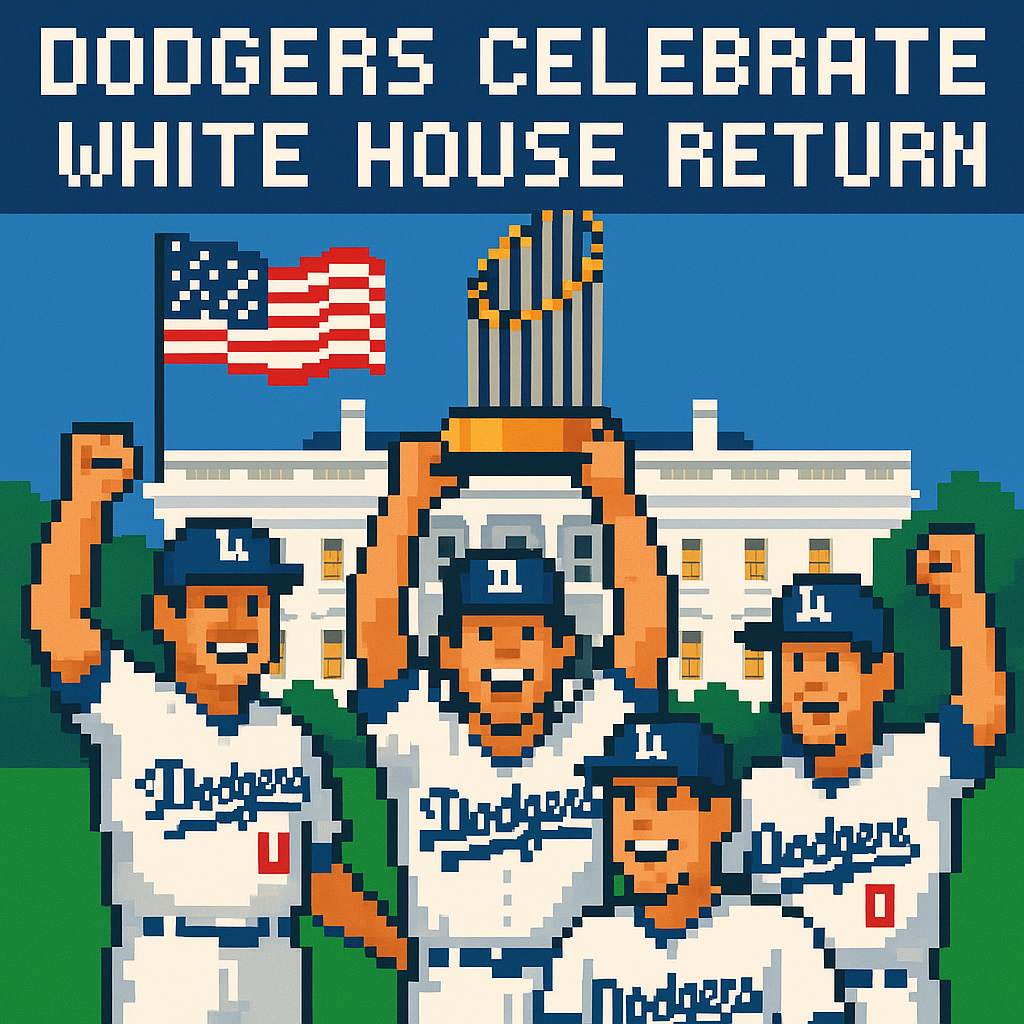
Dodgers Celebrate White House Return | Analysis by Brian Moineau

TL;DR

  • Donald Trump hosted the back-to-back World Series champion Los Angeles Dodgers at the White House for the second straight year, praising the franchise as “one of the great brands anywhere in the world.” [1][2]
  • The optics pair a global baseball roster—Shohei Ohtani, Freddie Freeman, and Yoshinobu Yamamoto—with a media-savvy White House, giving both sides reach, legitimacy, and content on the Rose Garden stage. [2][3]
  • The commercial engine hums underneath: Forbes values the Dodgers at $7.8B with 2025 revenue near $850M, while an $8.35B local TV pact and new streaming tiers convert cultural spikes into subscription and merchandise lifts. [4][6][8]

What the source said

ABC News says President Donald Trump welcomed Shohei Ohtani, Freddie Freeman, and the Los Angeles Dodgers to a Rose Garden ceremony in Washington, D.C., calling them “one of the great brands anywhere in the world.” The report references a 2025 East Room event for the 2024 title over the Yankees and corrects the month of the 2025 Game 7 clincher to November. The White House event displayed two World Series trophies, a “Trump 47” jersey, and a replica ring, and Manager Dave Roberts joked about a “three-peat.” [1][2]

Why it matters

Two U.S. institutions—the White House at 1600 Pennsylvania Avenue and the Dodgers at Chavez Ravine—cross-promoted before national cameras in 2026, attaching the presidency to Ohtani’s global fandom and a bicoastal base stretching from Los Angeles to New York. For the franchise, the shot list—South Lawn podium, twin trophies, Roberts’ “three‑peat” line, and the president’s “great brand” quote—feeds highlight packages, sponsor reels, and social cuts within hours. [2][3]

Stakeholders have dollars on the line. Forbes puts the Dodgers at $7.8B with about $850M in 2025 revenue, while MLB.com’s jersey rankings show Ohtani at No. 1 with teammates close behind. Tie that to SportsNet LA’s $8.35B rights deal and 2025’s SNLA+ streaming option, and the Rose Garden turns from photo op into top‑of‑funnel for merchandise, tickets, and subs. [4][7][6][8]

Original analysis

Trump and the Dodgers staged a mutually beneficial media hit in the Rose Garden: the president linked his office to baseball’s current juggernaut, and the club captured broadcast‑quality footage that plays in Southern California, Japan, and any U.S. market where visiting fans wear blue. This is transactional civics with a revenue model attached, not a culture‑war rerun. [2][3]

Labelled analyses:

  1. Back-of-the-envelope math
  • Revenue lift: Starting from Forbes’ $850M 2025 revenue, assume a conservative +6% “championship afterglow” for 2026, which many teams see via merch and ticketing. 0.06 × $850M = $51M; $850M + $51M = ~$901M. If MLB’s average valuation gain runs ~12% into 2027, the $7.8B mark grows to $7.8B × 1.12 ≈ $8.74B. A true three‑peat could support a 10–15% premium on top of trend, implying roughly $780M–$1.17B of incremental enterprise value. [4]

  • Media kicker: Spectrum SportsNet LA’s agreement totals $8.35B over 25 years, with SNLA+ launching in 2025 to address cord‑cutters. A White House clip that ricochets through AP, ABC, and MLB channels functions as acquisition creative for those subs and for Fanatics carts, contributing directly to the top line. [6][8][2][3]

  1. Contrarian read
  • Consensus: White House visits carry political downside and limited upside for teams.
  • Counter: For the Dodgers, upside is measurable. The 2025 World Series ended 5–4 in 11 innings on Nov. 1, with an 18‑inning Game 3 earlier in the set—catnip for casuals and die‑hards. Trump’s “one of the great brands anywhere in the world” line supplies a portable tagline, while Ohtani’s No. 1 jersey status keeps the register ringing. This ceremony extends the emotional half‑life of those wins, which is how repeat champions monetize narrative. [3][2][7]
  1. Named-stakeholder breakdown
  • Guggenheim/Mark Walter: Another blue‑chip validation of a decade‑long talent and media thesis that supports the next valuation step. [4]
  • Charter/Spectrum (SportsNet LA): National mentions of Dodgers content sharpen the consumer case for SNLA carriage and SNLA+ in an RSN shakeout. [6][8]
  • MLB/Fanatics/Nike: Ohtani in the Rose Garden after consecutive titles refreshes jersey cycles and stokes international demand across Japan and North America. [7]
  • The White House: A feel‑good baseball ceremony yields friendly footage and low‑risk, cross‑partisan earned media in Washington. [2]
  1. 2×2: Optics vs. Monetization
  • High optics / High monetization: Dodgers (brand footage + subs/merch), White House (unifying visuals + audience reach).
  • High optics / Low monetization: Casual fans who watch clips but don’t buy—valuable as awareness.
  • Low optics / High monetization: Local die‑hards converting to SNLA+ at $x/month after highlight exposure. [6]
  • Low optics / Low monetization: Non‑sports voters unlikely to engage—acceptable collateral.

Note: The on‑field spine is real. The Dodgers beat the Yankees 4–1 in the 2024 World Series, then edged the Blue Jays 5–4 in 11 innings on Nov. 1, 2025, with an 18‑inning Game 3 remembered across broadcasts. The brand story sits on those outcomes, not the other way around. [5][3]

What others are missing

The RSN and direct‑to‑consumer math. SportsNet LA’s $8.35B, 25‑year foundation sets the floor, and 2025’s SNLA+ plus MLB app integrations add a metered upsell that turns one Rose Garden clip into sequential retargeting: wire photos on AP, a segment on ABC, and highlight reels on MLB.com within 24 hours. That sequence justifies carriage asks, premium tiers under $25/month, and ARPU gains when lapsed cable homes re‑enter the funnel before October. Most political writeups stop at optics; the Dodgers’ media unit will run this like a paid acquisition loop. [2][6][8]

What to watch next

  1. By November 30, 2026, MLB and Fanatics publish jersey rankings with Shohei Ohtani at No. 1 and at least two other Dodgers in the top five. [7]
  2. By April 1, 2027, Spectrum expands SNLA+ availability or bundles it with MLB platforms beyond current footprints, at a stated monthly price under $25. [6][8]
  3. By March 31, 2027, Forbes lists the Dodgers above $8.5B in valuation, attributing gains to multi‑year titles and direct‑to‑consumer media growth. [4]

My take

Treat the White House ceremony like a Q3 launch. Stitch the “great brand” quote into sponsor decks, run a 72‑hour “Back‑to‑Back” SNLA+ promo in Los Angeles and Orange County, and drop a limited Ohtani/DC jersey on Fanatics before Sunday night baseball. The Yankees didn’t turn dynasties into cash by accident; they systematized it. The Dodgers now have the content, the channels, and the global star to do it at 2026 scale. [2][4][6][7]

Sources

  1. Trump will welcome the World Series champion Dodgers to the White House — ABC News (https://abcnews.com/Politics/wireStory/trump-world-series-champion-dodgers-white-house-135023469) — The base report: Rose Garden venue, the “great brands” quote, attendee names, and timeline.

  2. Trump fetes Dodgers at the White House again, saying the team is “one of the great brands” — Associated Press (https://apnews.com/article/0daaeadffe276338e5d45ad77663fcb0) — Independent confirmation of ceremony details, quotes, and the repeat‑visit context.

  3. Dodgers win 2025 World Series; Game 7 facts and figures — MLB.com (https://www.mlb.com/news/dodgers-win-2025-world-series) and (https://www.mlb.com/news/dodgers-blue-jays-world-series-game-7-facts-and-figures) — Official recaps: Nov. 1, 2025, 11‑inning clincher and the 18‑inning Game 3.

  4. Los Angeles Dodgers — Forbes (https://www.forbes.com/teams/los-angeles-dodgers/) and MLB Valuations List (https://www.forbes.com/mlb-valuations/list/) — Valuation ($7.8B, March 2026), revenue (~$850M for 2025), and league growth comps.

  5. 2024 World Series: Dodgers over Yankees (4–1) — Baseball‑Reference (https://www.baseball-reference.com/postseason/2024_WS.shtml) — Box‑level confirmation of the five‑game 2024 result.

  6. Spectrum offering a streaming‑only subscription for Dodgers; SNLA+ details — Los Angeles Times (https://www.latimes.com/sports/dodgers/story/2025-03-17/spectrum-dodgers-streaming-2025-season-games) — How SportsNet LA moved into DTC in 2025, with product and pricing context.

  7. Most popular MLB jerseys for 2025 — MLB.com (https://www.mlb.com/dodgers/news/most-popular-mlb-jerseys-for-2025) — Ohtani’s No. 1 jersey ranking and teammate placement substantiate merchandise demand.

  8. Spectrum SportsNet LA — ESPN explainer on the $8.35B, 25‑year deal (https://www.espn.com/mlb/story/_/id/44250840/mlb-2025-los-angeles-dodgers-villains-heroes-ohtani-freeman-betts) — Contract scale and RSN context that tie national moments to local media economics.


Related update: We recently published an article that expands on this topic: read the latest post.

Related update: We recently published an article that expands on this topic: read the latest post.

Make Jalopnik Your Google Preferred Source | Analysis by Brian Moineau

Please sir, I want some more: Make Jalopnik your go-to on Google Search

You know that feeling when you want more of a specific flavor — be it extra gravy with your fry-up or another Jalopnik teardown of the latest electric crossover? Google’s new “preferred sources” feature lets you feed that appetite directly into Search so your favorite outlets show up more often in Top Stories. If Jalopnik is your jam, here’s how to make it show up more when you hunt for car news, reviews, or the latest automotive chaos.

Why this matters right now

  • Google recently rolled out a Preferred Sources option in Search’s Top Stories, letting users prioritize outlets they trust. This isn’t about blocking other voices — it’s about nudging the algorithm toward the sites you love. (blog.google)
  • Publishers (including Jalopnik) are encouraging readers to add them as preferred sources because it helps visibility and keeps traffic flowing in a world where discovery has fragmented across platforms. (jalopnik.com)
  • For readers, it’s a small personalization that yields a more relevant stream of reporting when searching breaking topics — especially useful for fast-moving beats like cars, tech, and motorsports. (tomsguide.com)

Quick takeaways

  • The feature appears in Google Search’s Top Stories and can be accessed from the star/card icon or from a central preferences page.
  • You can add as many preferred sources as you like; changes sync to your Google account.
  • Adding Jalopnik helps surface more of its articles in searches where Top Stories appear — but you’ll still see other outlets too.

How to add Jalopnik as a preferred source (two easy ways)

  1. Via a direct Jalopnik link (fastest)
  • Click the link Jalopnik provides in their article or site post (they often include a direct link to the Google “Set your preferred sources” tool). Once on Google’s preferences page, type “Jalopnik,” tick the checkbox, and save. Jalopnik’s article highlights this shortcut for readers who want a one-click route. (jalopnik.com)
  1. From a Google Search results page (discover-as-you-go)
  • Search Google for a current car-related topic (for example: “2024 Kia Sorento review” or “EV recalls”). When Top Stories appears, look for the small stacked-card/star icon to the right of the Top Stories header. (tomsguide.com)
  • Click that icon to open the “Choose your preferred sources” dialog. Type “Jalopnik” into the search box, check the box next to the publication, then tap “Reload results” to see Top Stories refreshed with your selections. (blog.google)

Tips for getting the best results

  • Make sure you’re signed into your Google account — preferences tie to your account and sync across devices.
  • Use high-news queries (current events, trending car models, recalls, racing results) to trigger Top Stories and the star icon if you don’t see it for everyday searches.
  • Add several sources you trust, not just one; users often pick multiple outlets to keep perspective while prioritizing favorites. Google’s early testers typically added four or more. (blog.google)
  • If you change your mind, you can always remove or edit preferred sources from the same dialog or via Google Search personalization settings.

What this means for readers and publishers

  • For readers: more of what you like. If Jalopnik’s voice — cranky, irreverent, detail-hungry car coverage — is what you want, Preferred Sources nudges Search to serve it up more often.
  • For publishers: a way to court loyal readers directly inside the platform that still sends huge referral traffic. It’s also a reminder that discovery is a two-way street: publishers must keep producing content that readers want to prioritize. (theverge.com)

A couple of caveats

  • Preferred sources don’t mean exclusive results. Google will still show other outlets; the feature simply increases the prominence of your chosen sources when relevant.
  • Rollout and availability have been region-limited as Google expands the feature; if you don’t see the star icon yet, try updating the Google app or checking your account settings. (theverge.com)

My take

There’s a small, almost comforting delight in tailoring the internet to your tastes — like asking for an extra helping at a diner and being handed exactly what you wanted. Google’s Preferred Sources is that small favor writ large: it doesn’t rewrite the menu, but it nudges the kitchen to plate more of your favorite dish. If Jalopnik’s the publication that makes you laugh, think, and occasionally spit-take coffee when reading about automotive absurdity, this is an easy move to make your searches feel a little more like home.

Sources


Related update: We recently published an article that expands on this topic: read the latest post.

Paramount Cuts After Skydance Merger | Analysis by Brian Moineau

Paramount Layoffs After Skydance Merger: What Happened and Why It Matters

Introduction — a quick hook
Paramount has begun a sweeping round of layoffs that reach across CBS Entertainment, Paramount+, MTV and other properties — a major consolidation move that follows its recent merger with Skydance. For employees, viewers and creators, the cuts signal a new era of cost-focused consolidation at one of Hollywood’s biggest media houses.

What’s going on (context and background)
In August 2025 Skydance and Paramount completed a high-profile merger that combined Skydance’s production muscle with Paramount’s legacy TV and streaming businesses. Within weeks, new leadership set out a plan to reduce overlap, streamline operations and cut costs — a process that culminated in layoffs that began in late October 2025.

The first wave eliminated roughly 1,000 roles across multiple divisions, with company statements and reporting indicating the total reduction will be about 2,000 jobs (around 10% of the combined workforce) once subsequent rounds are complete. A memo from CEO David Ellison framed the cuts as part of restructuring after the merger; outside reporting has also described a broader target of substantial cost savings as Paramount refocuses priorities under the Skydance-led management team.

Why this matters

  • It affects major content and distribution units: staff reductions touch broadcast (CBS), streaming (Paramount+), youth and music networks (MTV) and other cable and studio operations — meaning decisions about programming, development and day-to-day operations could change.
  • Industry ripple effects: large-scale layoffs immediately alter project staffing, timelines and freelance opportunities and can influence what kinds of shows and formats get greenlit.
  • Strategic repositioning: the move signals that the new leadership is prioritizing efficiency and margin improvement, which may change long-term creative strategy (fewer, higher-budget tentpoles vs. broader slates; more franchise-focused content; emphasis on profitable streaming models).

Key takeaways

  • Paramount Skydance has begun mass layoffs following the August 2025 merger; about 1,000 jobs were cut in the first wave and roughly 2,000 jobs in total are expected. (October 2025 reporting.)
  • Cuts span CBS Entertainment, Paramount+, MTV and other divisions — not limited to a single business unit.
  • The layoffs are part of a broader cost-cutting and restructuring plan under new CEO David Ellison aimed at eliminating overlap and realigning the combined company.
  • Industry consequences include potential delays or cancellations of projects, shifts in commissioning strategy, and reduced staffing for news, production and development teams.
  • This is consistent with typical post-merger consolidation, but the scale and timing mean the effects will be widely felt across creative and corporate ranks.

Scannable snapshot: who’s affected and what to watch

  • Affected groups: corporate staff, production and development teams, cable network personnel, and some news and streaming operations.
  • Near-term risks: halted projects, fewer development deals, hiring freezes, and an increase in freelance competition.
  • What to watch next: official company disclosures (quarterly earnings and SEC filings), statements from division leaders (CBS, Paramount+), and follow-up reporting on which teams and shows are most impacted.

Short concluding reflection
Mergers promise scale and new capabilities, but they also bring hard choices. The Paramount–Skydance layoffs are a stark reminder that corporate consolidation often translates into sharper editorial and staffing decisions on the ground. For viewers, the biggest question will be whether these cuts narrow the range of original voices and experimentation on air and on streaming — and for the industry, whether the refocused Paramount produces a smaller slate of more concentrated hits or a leaner, but less diverse offering.

Sources


Related update: We recently published an article that expands on this topic: read the latest post.

Local TV interview of Bill Belichick comes with key condition: No Jordon Hudson questions – NBC Sports | Analysis by Brian Moineau

Local TV interview of Bill Belichick comes with key condition: No Jordon Hudson questions - NBC Sports | Analysis by Brian Moineau

The Art of Silence: Bill Belichick’s Media Masterclass


In the delicate dance between sports personalities and the media, few have mastered the art as subtly as New England Patriots head coach Bill Belichick. Known for his stoic demeanor and no-nonsense approach, Belichick has long been a figure of fascination both on and off the field. The recent NBC Sports article highlighting Belichick’s insistence on avoiding questions about Jordon Hudson during a local TV interview serves as yet another chapter in the intriguing saga of this football mastermind.

The Belichick Playbook: Silence Speaks Volumes

For those unfamiliar with the backstory, Jordon Hudson is a name that has become somewhat of a ghost in the Belichick narrative. The specifics of their initial meeting seem to carry a weight that Belichick would rather not discuss publicly. This decision to steer clear of Hudson-centric queries is not just a tactic; it's a testament to Belichick’s disciplined approach to media interactions.

Much like his strategy on the football field, Belichick's communication style is calculated, prioritizing control and precision. His famous press conferences, often characterized by brief, guarded responses, have become part of his mystique. This latest move to sidestep Hudson questions is a continuation of his methodical media management.

In the Arena of Public Figures: A Common Thread

Belichick isn’t alone in his quest for privacy amidst the public maelstrom. Across various domains, notable figures have adopted similar strategies. Consider how artists like Beyoncé and Taylor Swift manage their public personas. By controlling the narrative and choosing when to engage, they maintain an air of mystery and preserve their personal lives—from cryptic lyrics to sudden album drops, they keep the audience guessing.

Similarly, in the world of politics, leaders like former President Barack Obama have been adept at balancing transparency with discretion, sharing personal stories when strategic while keeping certain aspects of their lives shielded from public scrutiny.

The Patriots’ Legacy: A Team Built on Focus

Under Belichick’s leadership, the New England Patriots have soared to remarkable heights, securing six Super Bowl titles and becoming a staple of NFL excellence. This success isn’t just about talent on the field; it’s a testament to a culture of focus and discipline—qualities that Belichick embodies and enforces.

Players like Tom Brady and Julian Edelman have flourished under his guidance, crediting his rigorous approach as pivotal to their development. The emphasis on "doing your job" and minimizing distractions is a core tenet of the Patriots’ ethos, reflecting Belichick’s personal philosophy.

Final Thoughts: The Power of Controlled Narrative

In an era where the lines between public and private are increasingly blurred, Belichick’s handling of the Jordon Hudson narrative—or lack thereof—serves as a reminder of the power inherent in controlling one’s own story. By setting boundaries with the media, he not only protects his personal life but also reinforces the culture of focus that defines his team.

As fans and observers, we may always yearn for more insights, more drama, more storylines. Yet, perhaps the real lesson from Belichick’s media strategy is that sometimes, what’s left unsaid can be as powerful as what’s spoken. In the end, the art of silence may be one of the most potent plays in Belichick’s extensive playbook.

Read more about AI in Business

Read more about Latest Sports Trends

Read more about Technology Innovations