TL;DR
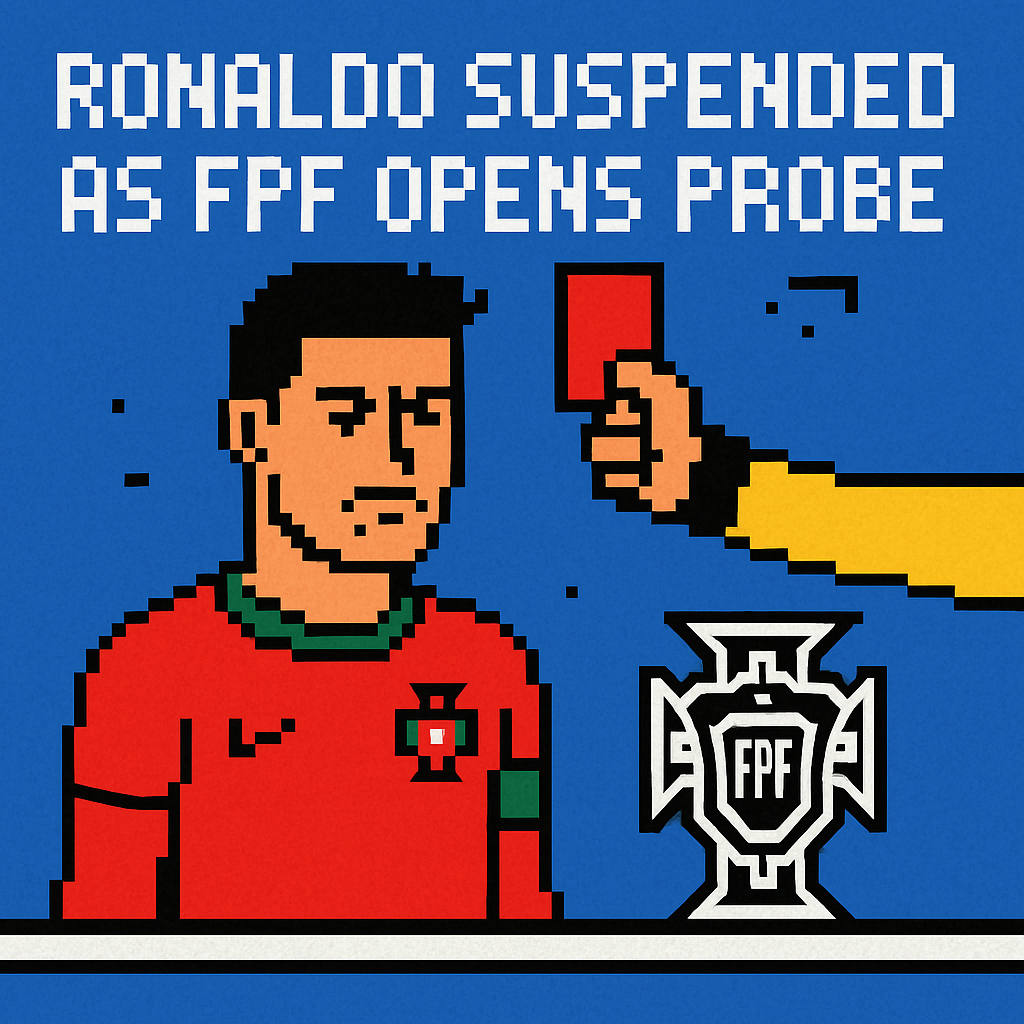
- The Portuguese Football Federation (FPF) provisionally suspended Cristiano Ronaldo and opened urgent disciplinary proceedings after he left Portugal’s camp in Copenhagen roughly 24 hours before the Denmark match on the October 2026 window; the rulebook allows a 1–6 month ban plus a €510–€1,020 fine. [1][3][6]
- This isn’t just about a 41-year-old icon versus a new coach; it’s the FPF reasserting authority while keeping a path to return before the March 2027 Nations League knockouts, as signaled by president Pedro Proença and coach Jorge Jesus. [2][5][7][9]
- Expect a face-saving suspension sized to cover some or all of November 2026 rather than exile; federation posture and Ronaldo’s public apology point to reconciliation on a timetable. [5][9]
What the source said
Goal.com reports the FPF’s Disciplinary Council opened proceedings against Cristiano Ronaldo for leaving the national-team camp in Copenhagen about a day before Portugal’s Nations League game against Denmark, tagged with “urgent” status and a precautionary suspension. Under the FPF regulation, unjustified departure from national duty carries a 1–6 month suspension and a fine of 5–10 accounting units, with each unit set at €102 (total €510–€1,020). The file moved to the investigative committee with confidentiality attached, and the provisional suspension remains in place while the case proceeds. Euronews independently notes the Copenhagen departure and the formal opening of proceedings by the Portuguese FA in October 2026. [1][3][6]
Why it matters
The stakeholders extend beyond Ronaldo and Jorge Jesus to the FPF as an institution, broadcasters like RTP/SIC, sponsors on match signage, and stadium operators filling 50,033 seats at Estádio do Dragão in Porto or 64,642 at Estádio da Luz in Lisbon when Portugal hosts. A slap on the wrist risks future brinkmanship from stars; an overly harsh penalty risks alienating supporters who still buy tickets and jerseys for a 41-year-old national record scorer. [2][10][11]
A calibrated sanction sets precedent without sinking results before the next window in mid-November 2026 and the Nations League quarterfinals scheduled for March 2027. Leaders who miss that balance pay twice—in the A League table and at the gate. [7]
Original analysis
Portuguese Football Federation suspends Ronaldo: what the timeline really means
The rulebook bite is real. Article 160 of the FPF disciplinary regulation specifies a 1–6 month suspension for unjustified abandonment and a 5–10 accounting unit fine; with €102 per unit, the fine computes to €510–€1,020. [6]
The process architecture is telling. The Disciplinary Council issued its deliberation on 9 October 2026 and referred the case on 10 October 2026 to the investigative committee with “urgent” status, keeping a precautionary suspension active; that sequence reads as institutional choreography, not a coach’s vendetta. [2][4]
Public posture points to reconciliation. Within a 48-hour cycle, Ronaldo apologized, Jesus described the rift as solvable, and FPF president Pedro Proença said “todos, sem exceção, querem Ronaldo de volta,” a triad that in federation politics means managed reintegration. [5][9]
2x2: sanction severity vs. public optics
- Light/Conciliatory: 1–2 month ban plus €510–€1,020 fine, joint statements, return in March 2027; precedent set without rupture.
- Light/Punitive: 1–2 month ban with public rebuke, minimal bridge-building; risk of lingering resentment.
- Heavy/Conciliatory: 4–6 month ban framed as procedural necessity; reconciliation deferred, competitive cost rises.
- Heavy/Punitive: 4–6 month ban plus ostracism; echoes France 2010 Anelka, invites factional fallout. The observed signals point to Light/Conciliatory. [6][8][9]
Contrarian read
- The chatter in Portuguese and global media frames this as the end—he walked out, got suspended, case closed.
- Counterpoint: the FPF is codifying a boundary, not burning a bridge; when the president says “todos, sem exceção, querem Ronaldo de volta” on the day urgency is declared, the outcome signaled has teeth but avoids exile, unlike France’s 18-match Anelka ban in 2010. [8][9]
Back-of-envelope calculation
- Dates: precautionary decision on 9 October 2026; referral on 10 October 2026. A one-month final ban starting 10 October ends ~10 November; two months ends ~10 December.
- November 2026 window: UEFA’s schedule shows League A fixtures between 12–17 November, including a Portugal match on 17 November 2026.
- 1-month ban (~to 10 Nov): eligible for the 17 Nov match.
- 2-month ban (~to 10 Dec): misses November fully; returns before March 2027 knockouts. [7]
- November 2026 window: UEFA’s schedule shows League A fixtures between 12–17 November, including a Portugal match on 17 November 2026.
- Fine math: 5–10 UC × €102 = €510–€1,020; symbolic versus lost caps. [6]
Named-stakeholder breakdown
- FPF (Pedro Proença): Reaffirm duty over discretion; a time-bound suspension proves authority without undermining Q1 2027 aims. [2][9]
- Jorge Jesus: Coach with clarity; a measured ban plus “we move on” preserves dressing-room control and public legitimacy. [5]
- Cristiano Ronaldo: An apology and acceptance of punishment protect legacy and keep a March 2027 return plausible if form at Al-Nassr holds. [5]
- Portugal squad (Bruno Fernandes, Gonçalo Ramos, Rafael Leão): Certainty before mid-November fixtures limits media churn and tactical disruption. [7]
- Broadcasters/sponsors: November ratings dip without Ronaldo; a March arc restores narrative juice for quarterfinals. [7]
Historical analogue
- Nicolas Anelka, France 2010: expulsion after a revolt, then an 18-match FFF ban that cemented a split; Portugal’s 2026 posture—legal formality plus conciliatory rhetoric—signals a finite sanction, not a purge. [8]
Kicker detail
- The FPF’s documents explicitly use “urgente” status and route the case to the investigative committee (“instrução”) within 24 hours of the 9 October 2026 deliberation, a tempo that aligns with concluding before the 12–17 November window opens. [2][4][7]
What others are missing
Coverage spotlights the walkout and Jesus’s pressers, but the hinge is procedural: the Disciplinary Council’s 9 October 2026 deliberation, the shift from automatic to non-automatic provisional suspension, and the “natureza urgente” stamp that accelerated referral to instruction on 10 October. That cadence—paired with Article 160’s defined band of 1–6 months and 5–10 UC—points to a decision before mid-November and narrows appeal risk by anchoring everything to the text. The overlooked angle is timing-by-design: the FPF is engineering a pre-window resolution to stabilize squad planning and broadcast inventory. [2][4][6]
What to watch next
- By November 8, 2026, the FPF will announce a fixed-term suspension of 1–2 months, not exceeding 3 months, closing the case before the mid-November fixtures. [2][4]
- By November 17, 2026, Portugal will have secured a Nations League quarterfinal berth without Ronaldo, keeping a “return in March 2027” pathway politically easy. [7]
- By March 2027, if healthy and scoring for Al-Nassr, Ronaldo will be named in Portugal’s League A quarterfinal squad, ending the suspension saga. [5][7]
My take
The FPF just drew a bright red line without slamming the door, and the incentives line up for a two-month ban that wipes November 2026, a token €510–€1,020 fine, and a quiet March 2027 re-entry. Jesus retains selection autonomy; the FPF proves the badge outranks the brand; Ronaldo pays a price he publicly accepted and competes for his place. Portugal avoids a 2010-style rupture and keeps its all-time scorer available when stakes spike. This is institutional hygiene with a marketing plan. [2][5][6][7][9]
Sources
Officially: the Portuguese Football Federation suspends Ronaldo and opens a disciplinary investigation against him — Goal.com (https://www.goal.com/en/news/breaking-the-portuguese-federation-suspends-ronaldo-and-opens-a-disciplinary-investigation-against-him/blt1b520ab576c91386) — Confirms urgent disciplinary proceedings, provisional suspension, and outlines the sanction range.
Cristiano Ronaldo suspenso preventivamente após abertura de processo disciplinar — Diário de Notícias (https://www.dn.pt/desporto/cristiano-ronaldo-suspenso-preventivamente-aps-abertura-de-processo-disciplinar) — Details the 9 Oct 2026 deliberation, 10 Oct referral, and “urgent” status.
Cristiano Ronaldo suspended by Portuguese FA for leaving training camp — Euronews (https://www.euronews.com/2026/10/10/cristiano-ronaldo-suspended-by-portuguese-fa-for-leaving-training-camp) — Independent confirmation of the suspension and Copenhagen departure context.
Conselho de Disciplina abre processo a Cristiano Ronaldo — A Bola (https://www.abola.pt/noticias/conselho-de-disciplina-abre-processo-a-cristiano-ronaldo-2026101011411122493) — Publishes official FPF wording on the process opening and urgency.
Ronaldo apologizes for Portugal walkout; says Jesus broke promise — Al Jazeera (https://www.aljazeera.com/sports/2026/10/6/ronaldo-apologizes-for-portugal-walkout-says-jesus-broke-promise) — Provides Ronaldo’s statement, apology, and Jesus’s conciliatory stance about a potential return.
Regulamento Disciplinar 2025–26 (Art. 160.º; unidades de conta = €102) — AF Beja/FPF (https://afbeja.fpf.pt/Portals/12/Documentos/Regulamentos/REGULAMENTO%20DISCIPLINAR%202025-2026.pdf) — Primary rule text for 1–6 month suspension and 5–10 UC fine; confirms €102 per accounting unit.
UEFA Nations League 2026/27 — League phase fixture list per matchday (PDF) — UEFA (https://editorial.uefa.com/resources/02a4-207fdf4b084e-a8a8727f0805-1000/unl_2627_-_league_phase_fixture_list_per_matchday_28_april_2026.pdf) — Sets November 12–17, 2026 matchdays and frames suspension timing versus March 2027 knockouts.
Nicolas Anelka suspended for 18 matches by France over World Cup revolt — The Guardian (https://www.theguardian.com/football/2010/aug/17/nicolas-anelka-banned-for-18-matches-france) — Historical analogue of rupture over reintegration.
Pedro Proença: «Todos, sem exceção, querem Ronaldo de volta» — A Bola (https://www.abola.pt/noticias/pedro-proenca-todos-sem-excecao-querem-ronaldo-de-volta-2026101015063074618) — Federation president frames the endgame as bringing Ronaldo back.
Estádio do Dragão — Wikipedia (https://en.wikipedia.org/wiki/Est%C3%A1dio_do_Drag%C3%A3o) — Confirms 50,033 capacity used for Portugal home fixtures in Porto.
Estádio da Luz — Wikipedia (https://en.wikipedia.org/wiki/Est%C3%A1dio_da_Luz) — Confirms 64,642 capacity for major Portugal home matches in Lisbon.