
Penguins Kuzmenko Returns After Tragedy | Analysis by Brian Moineau

TL;DR

  • Pittsburgh Penguins winger Andrei Kuzmenko left camp and flew to Moscow after reports that his father, Alexander Kuzmenko, was killed by a bear during a fishing trip in Tuva, Siberia; the Krasnaya River location and four-hour downstream transport detail originate with Russian outlet REN TV and were relayed by Western media. [1][4]
  • Pittsburgh opens the 2026–27 NHL season on Wednesday, September 30 at Philadelphia and faces six games by Saturday, October 10, compressing roster decisions into an 11‑day window that stresses chemistry and special teams. [6][8][14]
  • The Penguins and NHL.com have issued concise confirmations and condolences, while granular field details come via Russian media—a sourcing split that will steer updates and on-air framing across September 30 broadcasts. [9][10]

What the source said

BBC Sport reported that Andrei Kuzmenko, a 30-year-old forward for the Pittsburgh Penguins, departed the team to return to Russia after his father, Alexander—described as an ice hockey coach—was killed by a bear near the Krasnaya River in southern Siberia’s Tuva Republic; the group reportedly moved him downstream for hours before an airlift to a hospital, where he was pronounced dead. [1] The Penguins, via president and general manager Kyle Dubas, issued condolences and confirmed Kuzmenko had practiced with teammates before leaving the club. [9] BBC’s piece also noted Kuzmenko’s one-year deal and that the NHL season begins next week on a late-September slate. [1]

Why it matters

Three stakeholder groups intersect here: Kuzmenko and his family; the Penguins’ hockey operations group managing opening-night roles; and national broadcasters programming a high-visibility launch week in Philadelphia. [6][8] For Pittsburgh’s cap and roster math, Kyle Dubas committed a one-year, $5 million contract to Kuzmenko on July 1, 2026 to backfill scoring after Anthony Mantha’s exit—making his Week 1 availability a live lever on lineup balance. [2][13] ESPN and TNT are marketing an early-season slate across the final week of September and first week of October in a league calendar set for 84 games, so a sudden top-nine absence becomes part of the opening storylines. [6][8]

There’s also a sourcing split: the most vivid incident details—Krasnaya River naming and multi-hour transport—trace to REN TV and are re-aggregated by Western outlets, while Penguins.com and NHL.com stick to verified essentials and attribute the rest to Russian media; that asymmetry will shape how beat writers, fans, and TV trucks update the narrative day by day. [4][9][10]

Original analysis

How the “Andrei Kuzmenko father killed by bear” news reshapes Pittsburgh’s opening week

Kuzmenko skated with Pittsburgh on Thursday, September 24, then left without a set return date after the team publicly committed to supporting his decision to be with family. [9][10] The calendar offers no soft landing: the NHL opens Tuesday, September 29; Pittsburgh opens at the Flyers on Wednesday, September 30 and then plays MTL (Oct 3), WPG (Oct 5), at WSH (Oct 7), at CBJ (Oct 9), and DAL (Oct 10)—six games in 11 days. [6][8][14] Week 1 is when coaches cement pairings and special-teams jobs, not when they expect to rewire them. [14]

Dubas did not add Kuzmenko as a spare part. NHL.com’s team reset framed him as a Mantha replacement for finishing punch; the projection slotted him on a third line with Ben Kindel and Nicholas Robertson to stabilize secondary scoring and PP2 looks. [13] In 2025–26 with Los Angeles, Kuzmenko posted 25 points in 52 games (0.48 P/GP) before a February meniscus repair, signaling a bet on finishing efficiency rather than primary-driving usage in Pittsburgh. [10][13]

  • Back-of-envelope calculation (opening-week points delta):

    • Expected Kuzmenko scoring over four games (Sep 30–Oct 7) at his 2025–26 rate: 0.48 P/GP × 4 = 1.92 ≈ 1.9 points. [10][14]
    • Nicholas Robertson candidate fill-in: 32 points in 78 games last season → 0.41 P/GP × 4 = 1.64 ≈ 1.6 points. Delta ≈ 0.3 points. [13]
    • Box-score delta is small, but PP2 finishing and controlled-entry balance can swing a single goal; one goal in a one-goal game can move win probability by double digits, magnified across an 11‑day gauntlet. [13][14]
  • A 2×2 for sudden absences before the season starts

    • Timing axis: Preseason/Opening week vs. Midseason.
    • Role axis: Core driver vs. Finishing/Support.
    • Quadrants:
      • Preseason × Core driver: Identity shock; systems scramble (e.g., a top-line center loss).
      • Preseason × Finishing/Support: Chemistry risk; PP2 tweaks; early-standings tax—Kuzmenko’s box. [13][14]
      • Midseason × Core driver: Trade-market pressure; cap gymnastics.
      • Midseason × Finishing/Support: AHL call-ups can patch; minimal systems churn.
    • Takeaway: Week‑1 loss of a finisher rarely dents xGF% in aggregate, but it bends coin-flip games when special teams and matchups are still unsettled. [14]
  • Named-stakeholder breakdown

    • Kyle Dubas (President/GM): Balances room culture and launch-week plans; his public stance prioritized player support over timelines, buying trust at the cost of short-term certainty. [9]
    • Dan Muse (Head Coach): Manages line continuity and PP2 roles; watch for Robertson absorbing Kuzmenko’s shooting reps while PP1 stays intact to avoid cascading disruption. [10][13]
    • Nicholas Robertson and Ben Kindel: Inherit offensive-zone starts and retrieval duties; one must shoulder more controlled entries to maintain finishing-quality looks. [13]
    • ESPN/TNT: The Sep 30 PHI–PIT window invites an empathy-forward segment, then shifts to who earns Kuzmenko’s minutes and whether PP2 changes generate a goal swing by October 10. [6][8]
  • A contrarian read

    • Consensus frames the hockey impact as minimal because it’s primarily a human story.
    • Counterpoint: Pittsburgh signed Kuzmenko to plug a finishing gap, and the first 11 days include two divisional road games; a two-goal special-teams swing across this span could decide a tiebreak in April in an 84‑game season. [6][14]

Sourcing context matters for reliability: REN TV supplies the Krasnaya River and four-hour transport claims later echoed by The Guardian and Yahoo, while Penguins.com and NHL.com attribute those details to Russian media and avoid embellishment, a standard risk-mitigation move when cross-border facts are still forming. [4][9][10]

What others are missing

The under-covered angle is roster-rule mechanics under the NHL–NHLPA CBA: if Kuzmenko is placed on the Non-Roster list, his $5 million cap hit still counts, but Pittsburgh can seek emergency recalls if it would otherwise dress fewer than 12 forwards and 6 defensemen; that pathway shapes Wilkes‑Barre/Scranton call-up timing more than any sentimental factors. [2][11] Broadcast windows also pressure clarity—TNT’s Sep 30 slot and ESPN’s early-week shoulder programming incentivize the team to issue status updates before puck drop in Philadelphia to preempt speculation. [6][8] Finally, the chain-of-custody on incident facts flows from REN TV to English-language outlets and then to team sites with attribution, so expect editors to wait for either a Russian police note or a family statement before adding any new field specifics. [4][9][10]

What to watch next

  1. By Friday, October 2, 2026, the Penguins either list Kuzmenko as Non-Roster on the NHL media notes or he appears on the game roster for at least one of the first two games (Sep 30 vs. PHI; Oct 3 vs. MTL). [11][14]
  2. Across Pittsburgh’s first three games (Sep 30–Oct 5), Nicholas Robertson averages at least 15:00 TOI per game and records at least one PP shot on goal, reflecting a Kuzmenko-role substitution. [13][14]
  3. The Sep 30 national broadcast (TNT) includes an on-air update segment naming REN TV as the origin of the field details or cites a team/NHL confirmation that limits specifics to time, place, and family status. [4][8]

Sources

[1] BBC Sport — Initial report on Andrei Kuzmenko leaving the Penguins to return to Russia after his father’s death in Tuva; age, location, practice-before-departure details.
[2] PuckPedia — Contract specifics for Kuzmenko’s one-year, $5 million 2026–27 SPC with Pittsburgh; cap and term context for roster decisions.
[4] REN TV (Russia) — Origin for Krasnaya River location and four-hour downstream transport; most granular incident narrative.
[6] ESPN — 2026–27 NHL opening-week schedule context, including late-September start and national windows.
[8] TNT/Warner Bros. Discovery Sports — PHI–PIT broadcast slot on Wednesday, September 30, 2026; production context for story framing.
[9] Penguins.com — Official team statement from President/GM Kyle Dubas confirming departure and organizational support.
[10] NHL.com — News note confirming Kuzmenko practiced before leaving and summarizing team messaging; timeline anchor.
[11] NHL–NHLPA CBA (Article 16 and roster/emergency-recall provisions) — Non-Roster status rules, emergency recall thresholds, and cap treatment.
[13] NHL.com (Team Reset/Depth Chart: Pittsburgh Penguins, 2026) — Kuzmenko’s projected role with Ben Kindel and Nicholas Robertson; Mantha exit framing and PP2 usage.
[14] NHL.com (2026–27 Penguins schedule page) — Opponent list and dates confirming six games between Sep 30 and Oct 10; compressed-window verification.


Related update: We recently published an article that expands on this topic: read the latest post.

Related update: We recently published an article that expands on this topic: read the latest post.

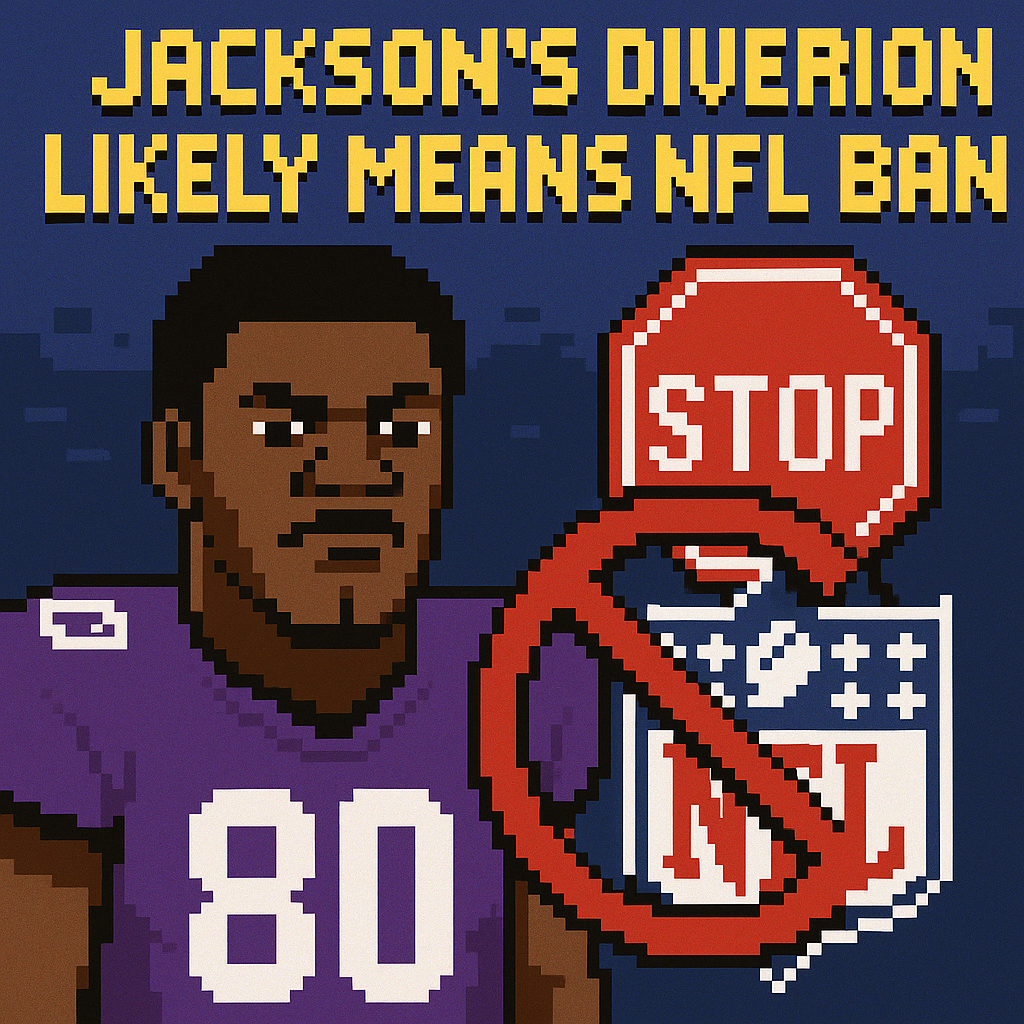
Jackson’s Diversion Likely Means NFL Ban | Analysis by Brian Moineau

TL;DR

  • The diversion program for Alaric Jackson all but guarantees an NFL Personal Conduct Policy violation, triggering discipline even without a conviction, because “disposition” explicitly includes diversion programs. [1], [3]
  • Given a prior two-game ban in 2024, Jackson faces more than the domestic-violence baseline of six games; repeat-offender language allows “enhanced” discipline up to banishment with the right to reapply. [3], [4]
  • For the Rams, a six-to-eight game absence from their $25.375 million-cap-hit left tackle in 2026 is a math problem and a protection problem; the cap-per-game burn rate without him is roughly $1.49 million. [5]

What the source said

ProFootballTalk reported that the Los Angeles City Attorney assigned Rams left tackle Alaric Jackson’s June 9, 2026 domestic battery arrest to a pre-trial diversion program, an alternative to misdemeanor prosecution in Los Angeles County. Under the NFL’s Personal Conduct Policy, entering a diversion counts as a “disposition of a criminal proceeding,” which by itself is a policy violation. Because the allegation involves domestic violence, the baseline suspension is six games, and Jackson’s prior two-game suspension under the same policy raises the risk of an enhanced penalty, even up to banishment with a chance to reapply. The league’s disciplinary officer/appeal process still leaves the Commissioner with final say on the penalty length under the 2022 policy. [1], [3]

Why it matters

Two constituencies have the most at stake. First: the Rams’ offense around Matthew Stafford in 2026. Sean McVay must protect a quarterback carrying a $48.3 million cap charge, which gets harder if the starting left tackle misses six or more games. [9] Second: the locker room and front office. This case tests whether Los Angeles treats left tackle as interchangeable or pays the hidden tax of reshuffling protections, tight end usage, and play-action depth for two months.

There’s also a league precedent angle. Diversion is not exoneration under the policy. The union and league agreed that diversion equals a violation; prior discipline opens the door to more than six games. That procedural fact will drive the outcome here, not whether the City Attorney files charges in Los Angeles. [2], [3]

Original analysis

The diversion program for Alaric Jackson isn’t a legal footnote — it’s the trigger

“Disposition of a criminal proceeding” in the Personal Conduct Policy specifically includes “diversionary program[s]” and similar arrangements, which constitute a violation on their own. That frames the disciplinary question as sanction length, not guilt or innocence under a criminal standard. With domestic violence allegations, the baseline is six games for a first offense; prior misconduct allows enhanced penalties and even banishment with the right to reapply. Jackson already served a two-game suspension in 2024. [3], [4]

What we know, on the record:

  • Arrest date: June 9, 2026, on suspicion of felony domestic violence; felony charges were not filed. The Los Angeles City Attorney assigned the matter to pre-filing diversion, an alternative to misdemeanor prosecution. [2]
  • NFL policy posture: Diversion equals a policy violation; domestic-violence cases start at six games; repeat offenders can get more. [3]

That combination points to “six-plus” as the live over/under, not “will there be discipline?”

Back-of-the-envelope: the Rams’ cost per missed game

Anchoring to 2026 numbers:

  • Jackson’s 2026 cap hit: $25,375,000. [5]
  • Season structure: 17 games across 18 pay weeks. [8]
  • Cap burn rate per game: $25,375,000 ÷ 17 ≈ $1.49 million.

If he’s suspended six games, LA effectively ties up ≈ $8.96 million of cap across games he can’t play (25.375 ÷ 17 × 6 ≈ $8.96 million). On cash, NFL discipline forfeits pay at 1/18th of base salary per week; Jackson’s 2026 base is $18,925,000, so each missed week docks ≈ $1.051 million, and six weeks would cost him ≈ $6.31 million (18.925 ÷ 18 × 6). The team saves those forfeitures against cash and may realize limited in-season cap relief under CBA mechanics, but it still faces an availability hole at its most expensive line spot for roughly a third of the season. [5], [8]

A simple 2×2 to frame the range of outcomes

  • Legal track: Diversion vs. Conviction.
  • NFL discipline track: Baseline (6 games) vs. Enhanced (8+ games/banishment/reapply).

Where Jackson likely lands:

  • Legal: Diversion (already assigned). [2]
  • NFL discipline: Enhanced (prior two-game suspension is an aggravator). [3], [4]

Historical analogues show the league acts without waiting for convictions: Ezekiel Elliott’s 2017 ban was six games despite no criminal conviction. [10]

Historical analogue and what it predicts

Consider 2017 Ezekiel Elliott: no charge, six games, because the policy allows findings “regardless of criminal conviction.” That case reset expectations on the NFL’s independence from prosecutors and previewed today’s process: an independent disciplinary officer makes findings; the Commissioner can appeal the sanction. In Deshaun Watson’s 2022 case, Judge Sue L. Robinson issued six games; the league appealed and drove the penalty higher via settlement. Expect a similar dynamic if the initial sanction on Jackson lands near the floor. [10], [7], [3]

Named-stakeholder breakdown

  • Los Angeles Rams front office: Decide whether the fix is internal (chips, slides, and help) or external (a veteran tackle). Over The Cap’s contract data indicates Jackson’s 2026 structure is movable, which matters if trust erodes. [6]
  • Matthew Stafford: A $48.3 million 2026 cap figure without a stable blind side invites more quick-game and six-man protections, which crimps explosives on third-and-long. [9]
  • Sean McVay: He can win with line duct tape, but a long Jackson absence forces heavier 12-personnel and less five-out route distribution — a measurable personality shift on offense.
  • NFL Management Council/Commissioner: With diversion in hand, the league needn’t prove facts to a criminal standard; the “disposition” definition bridges that gap. The fight is over length, with prior misconduct as the lever. [3]
  • NFLPA: The union bargained to an independent officer with binding factual findings; on appeal, the Commissioner still controls the penalty range. [3], [7]

What others are missing

Coverage is underweighting roster sequencing risk tied to OC Mike LaFleur’s protection rules. The pass-pro choreography — slide calls, back scan assignments, and route depths — is tuned to the left tackle’s floor; remove it for six-to-eight weeks and the knock-ons stack: chips steal routes from tight ends, backs release later, and Stafford’s time-to-throw compresses. Those compounding costs don’t show up in “next man up” clichés or even in cap math. The Rams also face August calendar pressure: veteran tackles with 40+ starts rarely linger after cutdown weekend, and prices spike once Week 1 injuries hit.

What to watch next

  1. By August 31, 2026, the NFL announces a suspension of at least eight games for Jackson, citing his 2024 Personal Conduct Policy violation as an aggravating factor. [3], [4]
  2. By September 10, 2026, if the suspension is eight games or longer, the Rams add a veteran offensive tackle with 40+ career starts to the 53-man roster via signing or trade.
  3. By October 15, 2026, Los Angeles starts at least two different players at left tackle in games Jackson misses.

My take

I’d set the over/under at eight games and take the over. The policy’s text gives the league a clean runway: diversion equals violation; prior discipline invites escalation. The Rams will talk resilience, but the tape on third-and-7 will reveal stress on protections for a $48.3 million-cap quarterback. If Los Angeles wants to protect Stafford’s health and ceiling, it should pay the August premium for a real tackle and accept a production hit elsewhere. [2], [3], [4], [5], [9]

Sources

  1. NBC Sports/ProFootballTalk — Diversion program for Alaric Jackson likely results in another suspension — Adds that diversion is treated as an automatic Personal Conduct Policy violation and flags prior-discipline enhancement.

  2. Associated Press — Rams LT Jackson assigned to pre-filing diversion after June 9, 2026 arrest — Confirms arrest date and City Attorney assignment to diversion in Los Angeles.

  3. NFLPA — NFL Personal Conduct Policy (2022) — Provides definitions: diversion equals “disposition,” six-game baseline, enhanced penalties, banishment/reinstatement, and the disciplinary-officer/appeal framework.

  4. NFL.com — Rams LT Alaric Jackson suspended two games in 2024 for violating the Personal Conduct Policy — Establishes Jackson’s prior two-game suspension.

  5. Spotrac — Alaric Jackson contract page — Details 2026 base salary and cap hit used in the calculations.

  6. Over The Cap — Alaric Jackson contract page — Shows 2026 structure and potential tradeability that shapes Rams options.

  7. NFL.com — Deshaun Watson disciplinary process and six-game ruling by Judge Sue L. Robinson in 2022 — Illustrates the officer/appeal process and how penalties can increase.

  8. NFL Football Operations — Contract language on game checks in a 17-game, 18-week season — Confirms pay is 1/18th of base salary per week.

  9. Spotrac — Matthew Stafford contract/cap figures — Confirms the $48.3 million 2026 cap charge.

  10. NFL.com — Ezekiel Elliott suspended six games in 2017 under the Personal Conduct Policy — Demonstrates that discipline can occur without a criminal conviction.


Related update: We recently published an article that expands on this topic: read the latest post.


Related update: We recently published an article that expands on this topic: read the latest post.