TL;DR
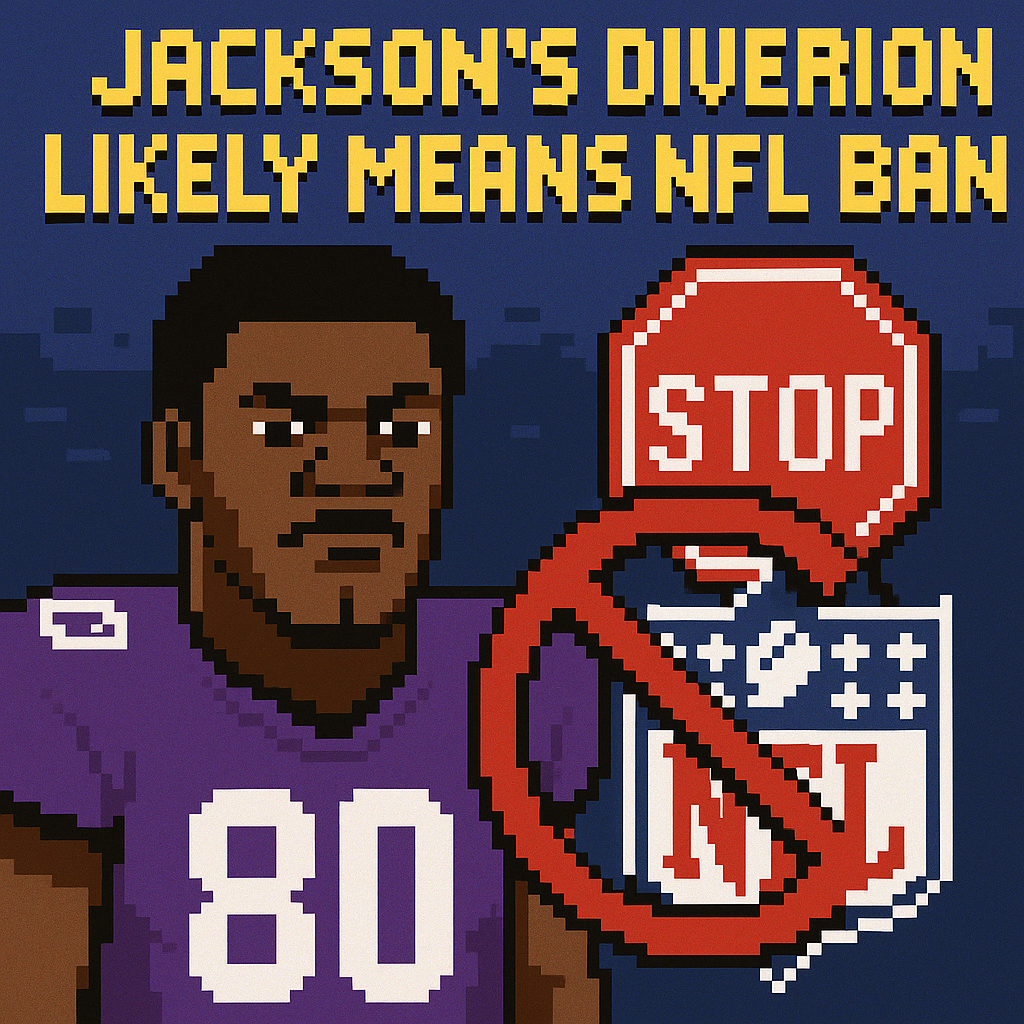
- The diversion program for Alaric Jackson all but guarantees an NFL Personal Conduct Policy violation, triggering discipline even without a conviction, because “disposition” explicitly includes diversion programs. [1], [3]
- Given a prior two-game ban in 2024, Jackson faces more than the domestic-violence baseline of six games; repeat-offender language allows “enhanced” discipline up to banishment with the right to reapply. [3], [4]
- For the Rams, a six-to-eight game absence from their $25.375 million-cap-hit left tackle in 2026 is a math problem and a protection problem; the cap-per-game burn rate without him is roughly $1.49 million. [5]
What the source said
ProFootballTalk reported that the Los Angeles City Attorney assigned Rams left tackle Alaric Jackson’s June 9, 2026 domestic battery arrest to a pre-trial diversion program, an alternative to misdemeanor prosecution in Los Angeles County. Under the NFL’s Personal Conduct Policy, entering a diversion counts as a “disposition of a criminal proceeding,” which by itself is a policy violation. Because the allegation involves domestic violence, the baseline suspension is six games, and Jackson’s prior two-game suspension under the same policy raises the risk of an enhanced penalty, even up to banishment with a chance to reapply. The league’s disciplinary officer/appeal process still leaves the Commissioner with final say on the penalty length under the 2022 policy. [1], [3]
Why it matters
Two constituencies have the most at stake. First: the Rams’ offense around Matthew Stafford in 2026. Sean McVay must protect a quarterback carrying a $48.3 million cap charge, which gets harder if the starting left tackle misses six or more games. [9] Second: the locker room and front office. This case tests whether Los Angeles treats left tackle as interchangeable or pays the hidden tax of reshuffling protections, tight end usage, and play-action depth for two months.
There’s also a league precedent angle. Diversion is not exoneration under the policy. The union and league agreed that diversion equals a violation; prior discipline opens the door to more than six games. That procedural fact will drive the outcome here, not whether the City Attorney files charges in Los Angeles. [2], [3]
Original analysis
The diversion program for Alaric Jackson isn’t a legal footnote — it’s the trigger
“Disposition of a criminal proceeding” in the Personal Conduct Policy specifically includes “diversionary program[s]” and similar arrangements, which constitute a violation on their own. That frames the disciplinary question as sanction length, not guilt or innocence under a criminal standard. With domestic violence allegations, the baseline is six games for a first offense; prior misconduct allows enhanced penalties and even banishment with the right to reapply. Jackson already served a two-game suspension in 2024. [3], [4]
What we know, on the record:
- Arrest date: June 9, 2026, on suspicion of felony domestic violence; felony charges were not filed. The Los Angeles City Attorney assigned the matter to pre-filing diversion, an alternative to misdemeanor prosecution. [2]
- NFL policy posture: Diversion equals a policy violation; domestic-violence cases start at six games; repeat offenders can get more. [3]
That combination points to “six-plus” as the live over/under, not “will there be discipline?”
Back-of-the-envelope: the Rams’ cost per missed game
Anchoring to 2026 numbers:
- Jackson’s 2026 cap hit: $25,375,000. [5]
- Season structure: 17 games across 18 pay weeks. [8]
- Cap burn rate per game: $25,375,000 ÷ 17 ≈ $1.49 million.
If he’s suspended six games, LA effectively ties up ≈ $8.96 million of cap across games he can’t play (25.375 ÷ 17 × 6 ≈ $8.96 million). On cash, NFL discipline forfeits pay at 1/18th of base salary per week; Jackson’s 2026 base is $18,925,000, so each missed week docks ≈ $1.051 million, and six weeks would cost him ≈ $6.31 million (18.925 ÷ 18 × 6). The team saves those forfeitures against cash and may realize limited in-season cap relief under CBA mechanics, but it still faces an availability hole at its most expensive line spot for roughly a third of the season. [5], [8]
A simple 2×2 to frame the range of outcomes
- Legal track: Diversion vs. Conviction.
- NFL discipline track: Baseline (6 games) vs. Enhanced (8+ games/banishment/reapply).
Where Jackson likely lands:
- Legal: Diversion (already assigned). [2]
- NFL discipline: Enhanced (prior two-game suspension is an aggravator). [3], [4]
Historical analogues show the league acts without waiting for convictions: Ezekiel Elliott’s 2017 ban was six games despite no criminal conviction. [10]
Historical analogue and what it predicts
Consider 2017 Ezekiel Elliott: no charge, six games, because the policy allows findings “regardless of criminal conviction.” That case reset expectations on the NFL’s independence from prosecutors and previewed today’s process: an independent disciplinary officer makes findings; the Commissioner can appeal the sanction. In Deshaun Watson’s 2022 case, Judge Sue L. Robinson issued six games; the league appealed and drove the penalty higher via settlement. Expect a similar dynamic if the initial sanction on Jackson lands near the floor. [10], [7], [3]
Named-stakeholder breakdown
- Los Angeles Rams front office: Decide whether the fix is internal (chips, slides, and help) or external (a veteran tackle). Over The Cap’s contract data indicates Jackson’s 2026 structure is movable, which matters if trust erodes. [6]
- Matthew Stafford: A $48.3 million 2026 cap figure without a stable blind side invites more quick-game and six-man protections, which crimps explosives on third-and-long. [9]
- Sean McVay: He can win with line duct tape, but a long Jackson absence forces heavier 12-personnel and less five-out route distribution — a measurable personality shift on offense.
- NFL Management Council/Commissioner: With diversion in hand, the league needn’t prove facts to a criminal standard; the “disposition” definition bridges that gap. The fight is over length, with prior misconduct as the lever. [3]
- NFLPA: The union bargained to an independent officer with binding factual findings; on appeal, the Commissioner still controls the penalty range. [3], [7]
What others are missing
Coverage is underweighting roster sequencing risk tied to OC Mike LaFleur’s protection rules. The pass-pro choreography — slide calls, back scan assignments, and route depths — is tuned to the left tackle’s floor; remove it for six-to-eight weeks and the knock-ons stack: chips steal routes from tight ends, backs release later, and Stafford’s time-to-throw compresses. Those compounding costs don’t show up in “next man up” clichés or even in cap math. The Rams also face August calendar pressure: veteran tackles with 40+ starts rarely linger after cutdown weekend, and prices spike once Week 1 injuries hit.
What to watch next
- By August 31, 2026, the NFL announces a suspension of at least eight games for Jackson, citing his 2024 Personal Conduct Policy violation as an aggravating factor. [3], [4]
- By September 10, 2026, if the suspension is eight games or longer, the Rams add a veteran offensive tackle with 40+ career starts to the 53-man roster via signing or trade.
- By October 15, 2026, Los Angeles starts at least two different players at left tackle in games Jackson misses.
My take
I’d set the over/under at eight games and take the over. The policy’s text gives the league a clean runway: diversion equals violation; prior discipline invites escalation. The Rams will talk resilience, but the tape on third-and-7 will reveal stress on protections for a $48.3 million-cap quarterback. If Los Angeles wants to protect Stafford’s health and ceiling, it should pay the August premium for a real tackle and accept a production hit elsewhere. [2], [3], [4], [5], [9]
Sources
-
NBC Sports/ProFootballTalk — Diversion program for Alaric Jackson likely results in another suspension — Adds that diversion is treated as an automatic Personal Conduct Policy violation and flags prior-discipline enhancement.
-
Associated Press — Rams LT Jackson assigned to pre-filing diversion after June 9, 2026 arrest — Confirms arrest date and City Attorney assignment to diversion in Los Angeles.
-
NFLPA — NFL Personal Conduct Policy (2022) — Provides definitions: diversion equals “disposition,” six-game baseline, enhanced penalties, banishment/reinstatement, and the disciplinary-officer/appeal framework.
-
NFL.com — Rams LT Alaric Jackson suspended two games in 2024 for violating the Personal Conduct Policy — Establishes Jackson’s prior two-game suspension.
-
Spotrac — Alaric Jackson contract page — Details 2026 base salary and cap hit used in the calculations.
-
Over The Cap — Alaric Jackson contract page — Shows 2026 structure and potential tradeability that shapes Rams options.
-
NFL.com — Deshaun Watson disciplinary process and six-game ruling by Judge Sue L. Robinson in 2022 — Illustrates the officer/appeal process and how penalties can increase.
-
NFL Football Operations — Contract language on game checks in a 17-game, 18-week season — Confirms pay is 1/18th of base salary per week.
-
Spotrac — Matthew Stafford contract/cap figures — Confirms the $48.3 million 2026 cap charge.
-
NFL.com — Ezekiel Elliott suspended six games in 2017 under the Personal Conduct Policy — Demonstrates that discipline can occur without a criminal conviction.
Related update: We recently published an article that expands on this topic: read the latest post.
Related update: We recently published an article that expands on this topic: read the latest post.