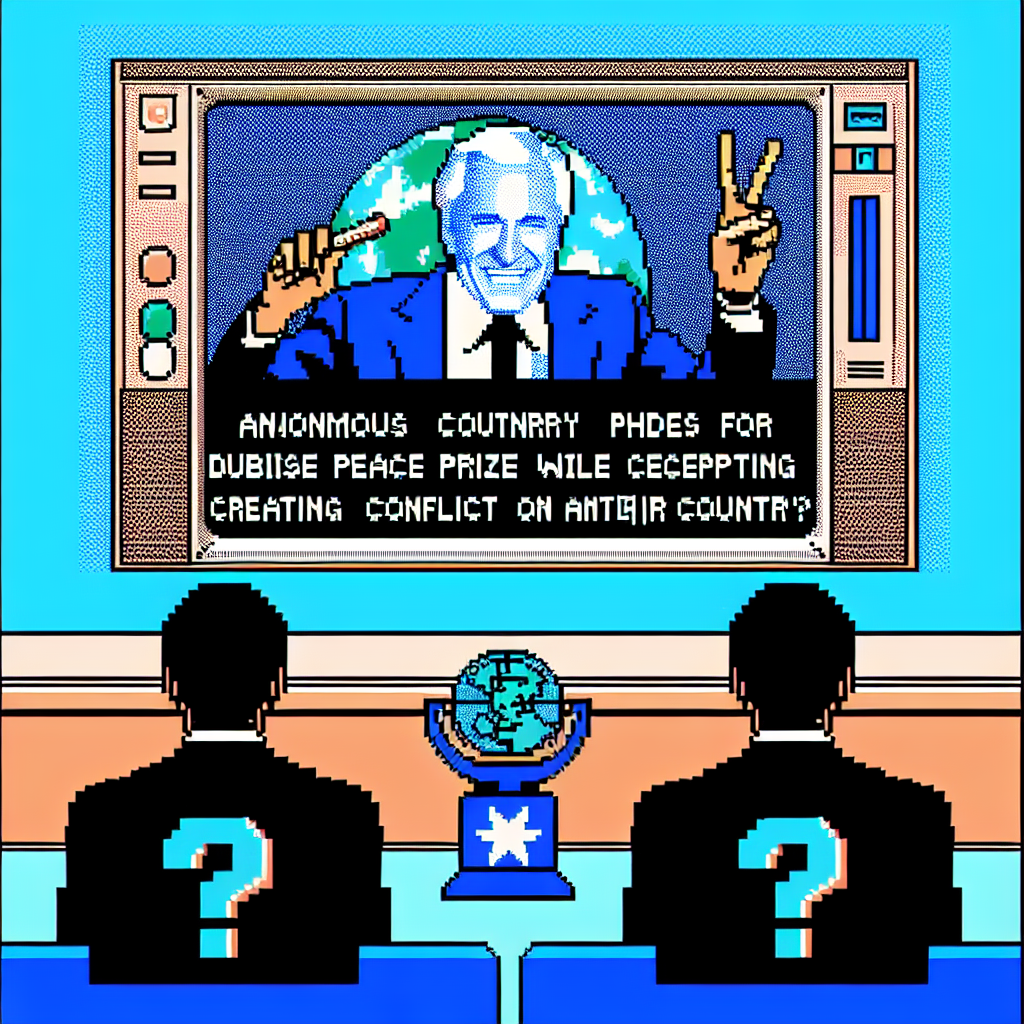
Stewart Mocks Trump’s Peace Prize | Analysis by Brian Moineau

When a “Peace Prize” Meets a Buildup of Battleships: Jon Stewart Calls Out the Contradiction

Opening with a laugh, Jon Stewart didn’t just roast a spectacle — he pointed to an uncomfortable contradiction. On The Daily Show, Stewart mocked FIFA’s newly minted Peace Prize going to President Donald Trump, then flipped the channel to images of an escalating U.S. military posture around Venezuela. The joke landed like a pin on a balloon: if you’re wearing a “peace” medal while sending warships to a neighbor, what exactly does the award mean?

Why the moment feels so surreal

  • The headline-grabbing image: Donald Trump accepting FIFA’s inaugural Peace Prize at the World Cup draw in Washington, D.C.
  • The punchline: Stewart’s line calling the prize “entirely fictitious” — a comic shorthand for how hollow awards look when policy contradicts the symbolism.
  • The context: Simultaneous reporting that the U.S. was ramping up military pressure on Venezuela, prompting commentators to question the sincerity of any “peace” honor.

This isn’t just late-night glee at a president’s expense. It’s the collision of spectacle, soft power and real-world consequences — an episode that exposes how awards, institutions and PR can be weaponized or rendered meaningless when actions don’t match words.

What actually happened

  • FIFA unveiled a new Peace Prize at the 2026 World Cup draw and presented the inaugural award to President Trump. Coverage noted limited transparency about the prize’s nomination or selection process. (See Al Jazeera for reporting on the award and Human Rights Watch requests for details.)
  • Around the same time, multiple outlets reported an increased U.S. military presence near Venezuela and heightened rhetoric toward Nicolás Maduro’s government, prompting concerns about potential confrontation.
  • Independent groups and rights organizations criticized FIFA’s move and raised questions about the organization’s political neutrality; formal complaints were filed over the award and the apparent support shown by FIFA leadership. (The Associated Press reported on complaints to FIFA’s ethics investigators.)

What Jon Stewart was really pointing to

  • Cognitive dissonance: Symbolic honors like a “Peace Prize” carry a moral meaning. When policy actions — troop movements, military build-ups, threats of strikes — look contrary, the symbolism rings hollow.
  • The optics of appeasement: Stewart framed the prize as an “appease-prize,” implying the honor may have been created to flatter or legitimize a political leader rather than to recognize genuine peacemaking.
  • Institutional credibility: When major institutions (sports bodies, media, governments) mix celebration and geopolitics without clear, consistent principles, they risk undermining their own claims to neutrality or moral authority.

Broader implications

  • Awards and legitimacy: Prizes can amplify reputations. But when a prize appears instrumental — given for convenience or influence — it can backfire and erode trust in the awarding institution.
  • Sport and politics: FIFA has long been criticized for uneven governance and ethical lapses. A politically fraught prize handed to an incumbent U.S. president in a high-profile event intensifies scrutiny about sports bodies entering partisan terrain.
  • Messaging vs. policy: The episode underscores how leaders’ image-making (trophy cases, photo ops) can be at odds with the hard calculus of foreign policy — and how comedians and journalists act as translators of that contradiction for the public.

Key takeaways

  • Symbolic honors lose power when they conflict with simultaneous actions; the “peace” label invites scrutiny if policies suggest otherwise.
  • FIFA’s new prize and the ceremony raised questions about transparency and neutrality, prompting formal complaints and concern from rights groups.
  • Stewart’s critique is less about theatrical insult and more about accountability: symbolism should align with substance, or it becomes propaganda.

My take

Comedy has always been an X-ray for civic life: it reveals the cracks by pointing and laughing. Stewart’s monologue did that work here — he turned a glitzy moment into a question: are institutions awarding virtue, or are they renting it out? When a global sports body hands a peace award during a ceremony soaked in celebrity and politics, while a government moves forces into the Caribbean, the public is right to ask whether any of it is sincere. Laughter is the entry point; the follow-up — scrutiny, transparency, and accountability — is what matters.

Sources


Related update: We recently published an article that expands on this topic: read the latest post.


Related update: We recently published an article that expands on this topic: read the latest post.


Related update: We recently published an article that expands on this topic: read the latest post.

When Halo Becomes a Weapon of Politics | Analysis by Brian Moineau

When a Sci‑Fi Icon Gets Drafted Into Real‑World Violence: Halo, AI and the Cost of Dehumanizing Rhetoric

There’s something gut‑level unnerving about seeing your favorite fictional world repurposed as a weapon. Imagine turning a beloved sci‑fi shooter — a series that millions grew up with — into a rallying cry to “destroy” people in the real world. That’s exactly what happened late October 2025 when U.S. government social posts used AI‑generated images of Halo to promote immigration enforcement, prompting sharp condemnation from the franchise’s original creators.

This post untangles why that matters beyond fandom: the mix of cultural icons, generative AI, and political messaging isn’t just tone‑deaf — it risks normalizing language and imagery that have historically enabled dehumanization.

Key takeaways

    • The Department of Homeland Security and related accounts posted AI‑generated Halo imagery with slogans like “Destroy the Flood,” a clear analogy that equated migrants with the Flood, Halo’s parasitic antagonist.
    • Halo veterans including Marcus Lehto and Jaime Griesemer publicly condemned the posts as “absolutely abhorrent” and “despicable,” arguing the Flood were never intended as an allegory for immigrant populations.
    • The incident spotlights two bigger issues: how generative AI makes it trivially easy to weaponize copyrighted cultural IP for political messaging, and how dehumanizing metaphors (comparing groups to parasites) have dangerous historical resonance.
    • Microsoft — owner of the Halo IP — remained publicly noncommittal at the time, raising questions about corporate responsibility when IP is co‑opted for political ends.

The image, the reaction, and why it hurt

Late October 2025, an X (formerly Twitter) post tied to Homeland Security shared imagery of Spartans — Halo’s armored super‑soldiers — driving a Warthog beneath the Halo ring world with the words “Destroy the Flood” and a recruitment angle for ICE. The Flood, within the Halo lore, are a parasitic scourge: an enemy that strips away identity and consumes worlds.

On the surface it reads like a meme. But the implication was unmistakable: equate migrants with parasitic invaders and you’ve reduced human beings to a threat to be annihilated. That’s why key figures behind Halo were enraged. Marcus Lehto said the co‑option “really makes me sick,” while Jaime Griesemer called the ICE post “despicable” and warned it should offend every Halo fan, regardless of politics. Their responses highlight a core point: creators don’t control every context in which their work appears, but many feel a responsibility to object when their art is used to promote harm.

Why copyrighted IP and generative AI are a combustible mix

    • Generative AI tools can produce plausible, polished imagery quickly, making it easy for actors — state or private — to fabricate visuals that look “official.”
    • Cultural IP carries built‑in emotional and persuasive power. A Master Chief figure is shorthand for heroism, conflict and legitimacy for millions of players; recontextualized, it lends those feelings to the message being pushed.
    • Copyright and trademark law offer some remedies, but enforcement is slow and messy — and companies may choose not to act for political or business reasons. At the time of the incident, Microsoft’s public response was limited, leaving creators and fans to push back in public forums.

Generative AI amplifies asymmetries: anyone with basic tools can create imagery that looks like a brand’s or franchise’s official output, then weaponize it online. That’s why the debate isn’t just about one meme — it’s about how we govern visual truth and the ethical limits of deploying cultural capital in politics.

The deeper danger of dehumanizing metaphors

Describing a human group as “parasites,” “insects,” or “the flood” isn’t new; it’s an old rhetorical device that historically precedes violence. Comparing people to sub‑human entities strips moral complexity and makes extreme measures seem plausible or even righteous. Many commentators pointed out that equating migrants with the Flood echoes dangerous dehumanizing language that has been used before to justify abuses.

This is why creators’ outrage matters beyond fandom: it’s a cultural guardrail. When original storytellers push back, they’re not just protecting brand image; they’re resisting a narrative that turns complex social issues into a binary, extermination‑style frame.

Corporate silence and responsibility

Microsoft — current owner of Halo — reportedly declined to comment beyond minimal statements at the time. That silence fuels frustration. If brand IP is repurposed for political messaging that many view as harmful, stakeholders expect clearer action: takedown requests, public distancing, or at least moral clarity from those who own the rights.

But corporate responses are complicated by legal, political and business calculations. The episode exposes tension between platform enforcement, IP owners, and the public interest — a debate that will only intensify as AI image‑making becomes routine.

A short reflection

We live in a moment when imagery moves fast and the line between fiction and political persuasion blurs easily. Cultural icons are powerful because they belong to communities of fans whose shared meanings are shaped, defended and debated. When those icons get hijacked in ways that dehumanize real people, creators’ and communities’ voices matter — not just for brand protection, but for the health of public discourse.

If you care about the soul of the stuff you love, it’s worth paying attention to how it’s used, and calling out when popular culture is enlisted to justify harm. The Halo incident isn’t only a controversy about a videogame — it’s a warning about how tools and symbols can be misused unless we set clearer norms and faster remedies.

Sources


Related update: We recently published an article that expands on this topic: read the latest post.


Related update: We recently published an article that expands on this topic: read the latest post.


Related update: We recently published an article that expands on this topic: read the latest post.


Related update: We recently published an article that expands on this topic: read the latest post.