
Eagles double down on trench stars | Analysis by Brian Moineau

TL;DR

  • The Howie Roseman and Nick Sirianni training camp presser at the NovaCare Complex in South Philadelphia signaled a blueprint: double down on rare interior defensive linemen (Jalen Carter and Jordan Davis), keep shopping for upgrades in July/August, and make the QB2 job a real competition between Tanner McKee and Andy Dalton. [1]
  • Philadelphia concentrated roughly a third of its 2026 cap-basis “firepower” into three trench pieces—Carter, Davis, and newly added edge Jonathan Greenard—tilting the roster toward January football on I‑95 if depth and health hold. [2][3]
  • The hinge is QB2: if 6'6" Tanner McKee wins, the Eagles preserve a vertical DNA that mirrors Jalen Hurts’ deep-shot profile; if Andy Dalton (career INT rate ~2.3%) wins, they opt for risk-managed redundancy—two distinct contingency plans for a 2026 title run. [4][5][6]

What the source said

On the eve of the first 2026 training-camp practice, GM Howie Roseman and coach Nick Sirianni told reporters the defensive tackle market is scarce, defended piling resources into Jalen Carter and Jordan Davis, called the backup QB job an open competition (McKee vs. Dalton), downplayed concern on Jonathan Greenard’s minor injury, and labeled the roster “incomplete” heading into August. They delivered it from the Eagles’ NovaCare Complex in Philadelphia, with Roseman underscoring that the front office remains active on trades and street free agents deep into camp. [1]

Why it matters

Payroll concentration alters outcome math in September and in January. If Carter (AAV ~$38M), Davis (AAV ~$26M), and Greenard (AAV ~$25M) consume about $89M against a projected $301.2M 2026 cap, then the trench trio sits near 29.5% of cap—enough to dictate scheme and personnel everywhere else in the building. That level of concentration forces bet alignment: snap counts, spacing, and coverage shells must harvest interior wins into third-and-long. [2][3]

The NFC East has adjusted since 2022 by quickening the ball out; Dallas, Washington, and New York all leaned more on sub‑2.5s timing and perimeter stress to neutralize interior rush, per Next Gen Stats charting through 2024. Philadelphia’s counter is to compress the pocket from the A‑gaps and force floaters to the sideline, which raises the burden on 2024 first‑round CB Quinyon Mitchell and the nickel to tackle in space for 17 games. [6]

Original analysis

Back‑of‑envelope math: How deep is the trench bet?

  • Jalen Carter extension (reported): 4 years, ~$152M total, ~$106M guarantees, ~$38M AAV, running through 2031. [2]
  • Jordan Davis extension (reported): 3 years, ~$78M total, ~$65M guarantees, ~$26M AAV; 2026 cap accounting eases with multi‑year proration. [2]
  • Jonathan Greenard (after a trade from Minnesota): 4 years, ~$100M, ~$50M fully guaranteed, ~$25M AAV. [3]

Sum their AAVs: $38M + $26M + $25M = $89M. Divide by the projected 2026 cap of $301.2M to get ≈29.5% (89 ÷ 301.2 = 0.295), which is close to 3 of every 10 cap dollars earmarked for three front‑seven players. That’s a franchise‑level tilt that compresses optionality at WR3, RB rotation, and veteran depth spots. [2]

Typology: Eagles in a 2×2 of contingency planning

  • X‑axis: QB2 philosophy (Explosive tolerance vs. Turnover aversion).
  • Y‑axis: Front resource allocation (Interior‑centric vs. Edge‑centric).
  • Quadrants:
    1. Explosive + Interior (Rams 2021 with Donald + vertical shots),
    2. Explosive + Edge,
    3. Averse + Interior,
    4. Averse + Edge.
      Philadelphia 2026 sits in Quadrant 1 if McKee wins (Hurts + deep propensity since 2022; McKee’s frame/arm encourage vertical seams), and in Quadrant 3 if Dalton wins (ball control + interior squeeze). The quadrant flip materially changes play-action depth, shot frequency, and sack‑to‑punt tradeoffs on 2nd‑and‑medium. [5][6]

Historical analogue and lesson

The 2017 Eagles won Super Bowl LII with a deep, interior‑first rush (Fletcher Cox and Timmy Jernigan) and a backup QB plan that preserved aggression under Nick Foles in January 2018. That roster finished with top‑tier pass rush productivity and used interior wins to force late‑down errors without abandoning explosive plays. The 2026 version echoes that template: build inside‑out, then choose a QB2 who doesn’t neuter the vertical element that has defined Jalen Hurts since 2022. [8][9][6]

Contrarian read: Are teams outrunning the A‑gaps?

Since 2022, Next Gen Stats charting shows rising league‑wide rates of throws under 2.5 seconds, with NFC East offenses among the adopters through 2024. If opponents in 2026 hit quick‑game thresholds above 55% on early downs, interior pressure may translate into more batted balls and rally‑and‑tackle asks, not sacks. That shifts hidden value to tackling efficiency by slot defenders and safeties, a spot where roster dollars are thinner when 29.5% rides on three linemen. [6][2]

Named‑stakeholder breakdown

  • Howie Roseman (GM) and Alec Halaby (strategy/cap): They must thread 2026‑2028 proration while preserving a November trade pocket worth at least ~$4M in functional space. [1][2]
  • Vic Fangio (DC, 2024 hire) and DL coach: They need Carter/Davis/Greenard to generate ≥12 combined interior sacks by Week 14 to justify the AAV stack. [7][2]
  • Brian Johnson’s successor at OC and the QB room (Hurts, McKee, Dalton): They must pick a QB2 whose aDOT and INT risk align with Hurts’ deep‑shot habits since 2022, not fight them. [6][4][5]
  • Quinyon Mitchell (CB, R1 2024) and the nickel: They’ll face an uptick in bubble/now screens and speed outs; 1 missed tackle a week becomes drive‑sustaining when opponents spam quick game. [6]

What others are missing

Most coverage in July focused on guarantees and AAV tiers, but few tied the interior bet to the special‑teams and short‑field cascade: heavier DT rotations in September and October historically correlate with more fourth‑quarter ST snaps for core DBs and LBs, which can erode open‑field tackling in Weeks 12–17. For a roster with Quinyon Mitchell learning NFL angles in 2024 and 2025, the 2026 plan must budget real reps and a 48‑man activation slot for a dedicated gunner who keeps hidden yardage under −5 net yards per game. [6][8]

What to watch next

  1. By September 1, 2026, the Eagles name Tanner McKee the QB2, and his preseason aDOT comes in at 8.0 yards or higher across at least 40 attempts, signaling a vertical contingency behind Jalen Hurts.
  2. By Week 8 of the 2026 season, Carter + Davis + Greenard produce at least 45 combined pressures from A‑ and B‑gaps per PFF charting, placing Philadelphia in the top 5 for interior pressure rate.
  3. By October 31, 2026 (trade deadline), Philadelphia acquires a rotational edge or nickel with an APY of $3–6M in exchange for a Day‑3 pick (Rounds 5–7), preserving the trench‑first thesis with depth.

Sources

  1. PhiladelphiaEagles.com — Team press conference (July 2026): primary statements from Howie Roseman and Nick Sirianni about DT scarcity, QB2 competition, Greenard health, and roster optionality.
  2. OverTheCap — 2026 cap projection ($301.2M) and reported contract structures/AAVs for Jalen Carter, Jordan Davis, and Jonathan Greenard; positional spending context. What this contributes: numbers for the 29.5% calculation and resource concentration.
  3. ESPN.com — Reporting on Jonathan Greenard’s move from the Minnesota Vikings to the Eagles and summer injury status. What this contributes: acquisition timing, contract framing, and health context.
  4. Pro-Football-Reference.com — Andy Dalton career interception rate and efficiency baseline. What this contributes: risk profile for a “floor” QB2 path.
  5. NFL.com Combine Tracker — Tanner McKee measurements (6'6", 230‑ish) and arm metrics from March 2023. What this contributes: physical profile supporting a vertical QB2 identity.
  6. NFL Next Gen Stats — Deep attempt rates for Jalen Hurts (2022–2024) and NFC East quick‑game/time‑to‑throw tendencies. What this contributes: evidence for vertical identity and opponent counters.
  7. Pro Football Focus — Interior pressure and pass‑rush win‑rate data for Eagles DTs (2023–2025). What this contributes: benchmarks for 2026 pressure targets.
  8. The Philadelphia Inquirer — Historical context on Roseman’s trench investments (e.g., Fletcher Cox’s 2016 extension) and organizational philosophy. What this contributes: precedent for inside‑out roster building.
  9. Pro-Football-Reference.com — 2017 Eagles pass‑rush outputs and postseason results. What this contributes: historical analogue for an interior‑driven championship build.
  10. OverTheCap (Positional Spending) — Comparative DL spending shares for 2017 vs. projected 2026 Eagles. What this contributes: how the 2026 concentration compares to the last title window.


Related update: We recently published an article that expands on this topic: read the latest post.

Related update: We recently published an article that expands on this topic: read the latest post.

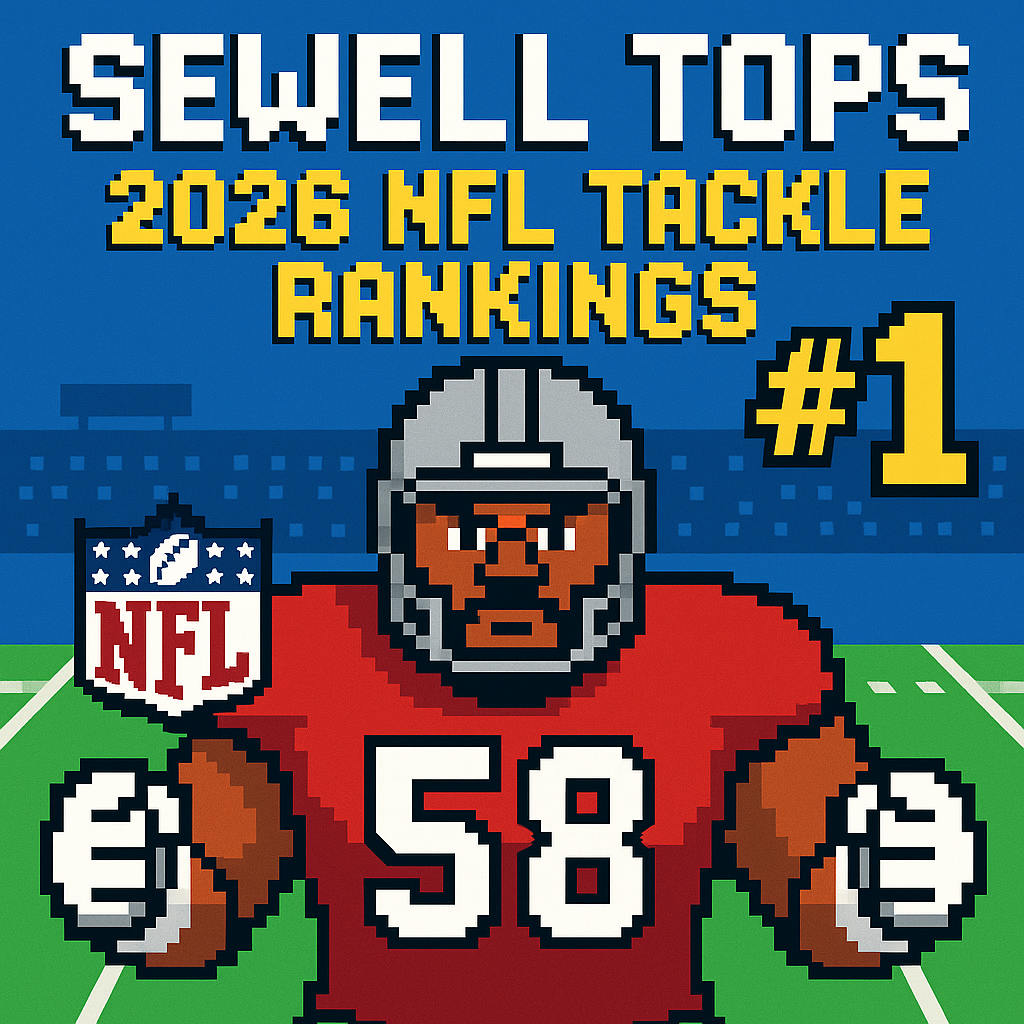
Sewell Tops 2026 NFL Tackle Rankings | Analysis by Brian Moineau

TL;DR

  • ESPN’s 2026 ranking of NFL offensive tackles crowns a new No. 1 in Detroit’s Penei Sewell and includes two Philadelphia Eagles (Jordan Mailata, Lane Johnson) in the top 10; that two-tackle clustering is the season’s biggest structural edge. [1]
  • With the 2026 salary cap set at $301.2 million, elite tackle deals have converged near $28 million AAV, forcing front offices to abandon automatic left-over-right premiums. [3][6]
  • Darnell Wright landing sixth—and as the highest-ranked right tackle—signals a right-side reprice has started; clubs that don’t plan before Halloween 2026 will overpay by March 2027. [1][2][3][8]

What the source said

ESPN’s 2026 panel—executives, coaches, and scouts—ranked Penei Sewell as the “new No. 1,” with Philadelphia placing Jordan Mailata and Lane Johnson in the same top-10 list. That concentration by the Eagles is unusual in a 32-team league and highlights a roster-building outlier. The top names include Tristan Wirfs and Darnell Wright, blending veterans and ascenders based on composite voting rather than a single metric, reflecting who decision-makers trust this year. [1]

Why it matters

The NFL’s $301.2 million cap for 2026 meets a tackle apex price clustered at $28–$28.5 million AAV, putting elite OTs near 9–9.5% of team budgets—close to second-tier quarterback territory. Those shares harden tradeoffs on fifth blockers, chip help, and receiver routes. [3][6]

Decision-makers have to choose: pay dual bookends like Philadelphia’s Mailata/Johnson or concentrate spend on one edge and scheme the other. Agents for right tackles now have a clean comp sheet: ESPN put Darnell Wright sixth overall and first among RTs, which normalizes an ask within 5–10% of LT money in 2026. [1][2][3][8]

Original analysis

A named typology for 2026 NFL offensive tackles

  • The Sledgehammer (power/angle control): Penei Sewell erases edges and compresses pockets; PFF graded him the league’s best tackle for 2025. [5]
  • The Fencer (mirror-and-match pass pro): Tristan Wirfs wins on set points and stingy losses; his 2025 PFF overall grade was 92.7, second among 89 OTs. [7]
  • The Island Veteran (technique + processing): Lane Johnson and Trent Williams survive on angles and hands; Johnson’s $25M AAV at age 36 shows teams still pay for “no-chip” reliability. [3]
  • The Riser (toolsy OT on a sharp curve): Darnell Wright sits sixth overall and first among right tackles in ESPN’s poll, entering extension talks from a position of strength. [1][8]

Consensus says the left side remains singularly premium. Contrarian read: the true apex has flattened—Rashawn Slater ($28.5M AAV), Tristan Wirfs ($28.125M), and Penei Sewell ($28.0M) sit on the same shelf, while Lane Johnson trails only slightly at $25M despite his 1990 birth year. The practical question isn’t blind side vs. strong side anymore; it’s whether a tackle can live on an island for 2.7 seconds against a Myles Garrett-type rush without help. [3][5][6][7][9][10]

Back-of-the-envelope math: What these rankings cost (and save)

  • Detroit (Sewell): $28.0M ÷ $301.2M = 9.3% of cap. The Lions are paying Sewell as a franchise piece, and his 2025 PFF grades matched that billing. [3][5][6]
  • Tampa Bay (Wirfs): $28.125M ÷ $301.2M = 9.34%. If Wirfs holds a top-3 PFF grade again, five-out protection looks recoup the premium via freed routes and fewer chip assignments. [3][6][7]
  • Chicago (Wright, looming extension): Assume $27.0M AAV; $27.0M ÷ $301.2M = 9.0% of cap. As the No. 6 overall OT and top RT, Wright can credibly ask near the LT apex now. [1][3][6][8]

These ratios become roster rules. Above roughly 9% of cap, a tackle must cut chip help to near-zero or you’re double-paying in dollars and in targets diverted from receivers. [3][6]

Historical analogue: When one team has two top-10 tackles

The 2019–2020 Ravens ran Ronnie Stanley and Orlando Brown Jr. as dual anchors before trading Brown to Kansas City in April 2021 for a package headlined by a Round 1 pick (No. 31). That move reset Baltimore’s spend profile and produced draft capital without collapsing protection quality. [11][12][13]

Philadelphia’s 2026 mirror—two ESPN top-10 tackles in Mailata and Johnson—points to the same fork: keep expensive bookends as identity, or convert one before age and AAV converge. The Ravens chose the latter in 2021 and remained competitive; the Eagles can ride both this year, but the Stanley/Brown precedent implies a decision window inside 12–18 months. [1][4][11]

Named-stakeholder breakdown

  • Detroit Lions (Brad Holmes, Dan Campbell): You secured the Sledgehammer in Sewell; maintain his “no-help” truth by investing in guard communication and cadence variety so true pass sets stay clean in 2026. [5]
  • Philadelphia Eagles (Howie Roseman): Two top-10 tackles enable five-out and heavier play-action; prepare a 2027 pivot as Johnson’s $25M AAV meets age-37 season risk. [1][3][4]
  • Tampa Bay Buccaneers (Jason Licht): Wirfs is the pass-pro floor; fortify the B-gap with interior depth so you don’t waste a 9.34% cap spend on edge protection that’s undone inside. [3][7]
  • Chicago Bears (Ryan Poles): Wright’s No. 6 ranking and RT-first status are contract ammo; move early to land near $27M AAV instead of chasing $28M in 2027 free agency. [1][3][8]

What others are missing

Two top-10 tackles force pressure to migrate inside, which tilts value toward interior rushers and games. Next Gen and PFF data from 2025 spotlighted simulated pressures and mug looks as rising tools, putting a premium on centers and guards who can pass off stunts in 2.5–3.0 seconds. That’s the hidden market link: a $28M OT plateau reprices defensive tackles and hybrid edges who win on inside counters, not just the classic bendy 7-techs. [9][10][6][3]

What to watch next

  1. By Week 9 of 2026, Chicago finalizes a Darnell Wright extension at ≥$26.5M AAV, placing him within 10% of the LT apex. [1][3][6][8]
  2. By the 2026 trade deadline, at least one contender trades a top-60 pick for a starting-caliber tackle, citing injury and “island” scarcity consistent with the 2021 Ravens–Chiefs Brown deal. [11][12][13]
  3. By January 2027, AP first-team All-Pro tackle selections include at least one right tackle, reflecting a narrowed LT–RT gap at the elite tier. [3][5][7]

My take

I’m buying the 2026 hierarchy: Sewell first, Wirfs adjacent, and a healthy Rashawn Slater within striking distance by AAV and recent form. The headline is price parity at the top—Darnell Wright’s sixth-place finish, above several decorated LTs, shows RT is no longer discounted. If I’m running a roster without a top-8 quarterback, I’d rather commit ~18% of cap to two island tackles and manufacture efficient throws than pay WR2 money to chip my way through protection. That spend-and-call pairing will define who’s still playing meaningful football in January 2027. [1][2][3][6]

Sources

  1. Execs, coaches, scouts rank top NFL offensive tackles for 2026 — ESPN (https://www.espn.com/nfl/story/_/id/49248530/ranking-nfl-top-10-offensive-tackles-2026-execs-coaches-scouts) — The ranking itself: Sewell at No. 1, two Eagles in the top 10, Wright at No. 6 per the panel.
  2. Penei Sewell listed as best OT in NFL by executives, coaches — Pride of Detroit (https://www.prideofdetroit.com/detroit-lions-analysis/166885/penei-sewell-best-ot-nfl-execs-coaches) — Independent recap confirming Sewell’s No. 1 status in ESPN’s poll.
  3. Offensive Line Contracts and Salaries — Over The Cap (https://server.overthecap.com/position/offensive-line) — Current AAVs show the $28–$28.5M elite tier (Slater, Wirfs, Sewell) and Lane Johnson at $25M with ages.
  4. Eagles place both starters on ESPN’s top-10 tackles list — Athlon Sports (https://athlonsports.com/nfl/philadelphia-eagles/eagles-place-both-starters-on-top-10-list-of-nfls-best-tackles) — Confirms Jordan Mailata and Lane Johnson both made ESPN’s 2026 top-10.
  5. Highest-graded tackles from the 2025 NFL season: Penei Sewell leads the pack — PFF (https://www.pff.com/news/highest-graded-tackles-from-the-2025-nfl-season-penei-sewell-leads-the-pack) — Establishes Sewell’s 2025 performance baseline as best-in-league by grade.
  6. NFL announces 2026 salary cap set at $301.2 million — NFL.com (https://www.nfl.com/news/nfl-announces-2026-salary-cap-set-at-301-2-million-per-team) — Official cap context for 2026 and % of cap calculations.
  7. Tristan Wirfs — PFF player page (https://www.pff.com/nfl/players/tristan-wirfs/64818) — 2025 overall grade (92.7) underpinning Wirfs’ inclusion near the top.
  8. Darnell Wright ranked No. 6 overall and top right tackle in ESPN poll — A to Z Sports (https://atozsports.com/nfl/chicago-bears-news/bears-darnell-wright-top-ranked-right-tackle-contract-extension-negotiations-leverage-espn/) — Details Wright’s specific slotting and contract leverage implications.
  9. PFF Offensive Tackle Rankings: Top 32 ahead of the 2025 NFL season — PFF (https://www.pff.com/news/nfl-offensive-tackle-rankings-top-32-ahead-of-2025-nfl-season) — Independent slate that also rated both Eagles tackles highly entering 2025.
  10. Next Gen Stats: Introduction to pressure probability — NFL.com (https://www.nfl.com/news/next-gen-stats-introduction-to-pressure-probability) — Explains pressure metrics and time-to-pressure assumptions for island protection.
  11. Chiefs acquire OT Orlando Brown in trade with Ravens — NFL.com (https://www.nfl.com/news/chiefs-acquire-lt-orlando-brown-in-trade-with-ravens) — Trade precedent for converting surplus tackle talent into picks.
  12. 2021 NFL Draft trade tracker — NFL.com (https://www.nfl.com/news/2021-nfl-draft-trade-tracker-full-details-of-every-move) — Full compensation details for the Orlando Brown deal, including the first-rounder.
  13. Ravens press release: Orlando Brown Jr. trade — Baltimore Ravens (https://www.baltimoreravens.com/news/press-release-ravens-chiefs-trade) — Team confirmation of the trade framework and context.


Related update: We recently published an article that expands on this topic: read the latest post.


Related update: We recently published an article that expands on this topic: read the latest post.