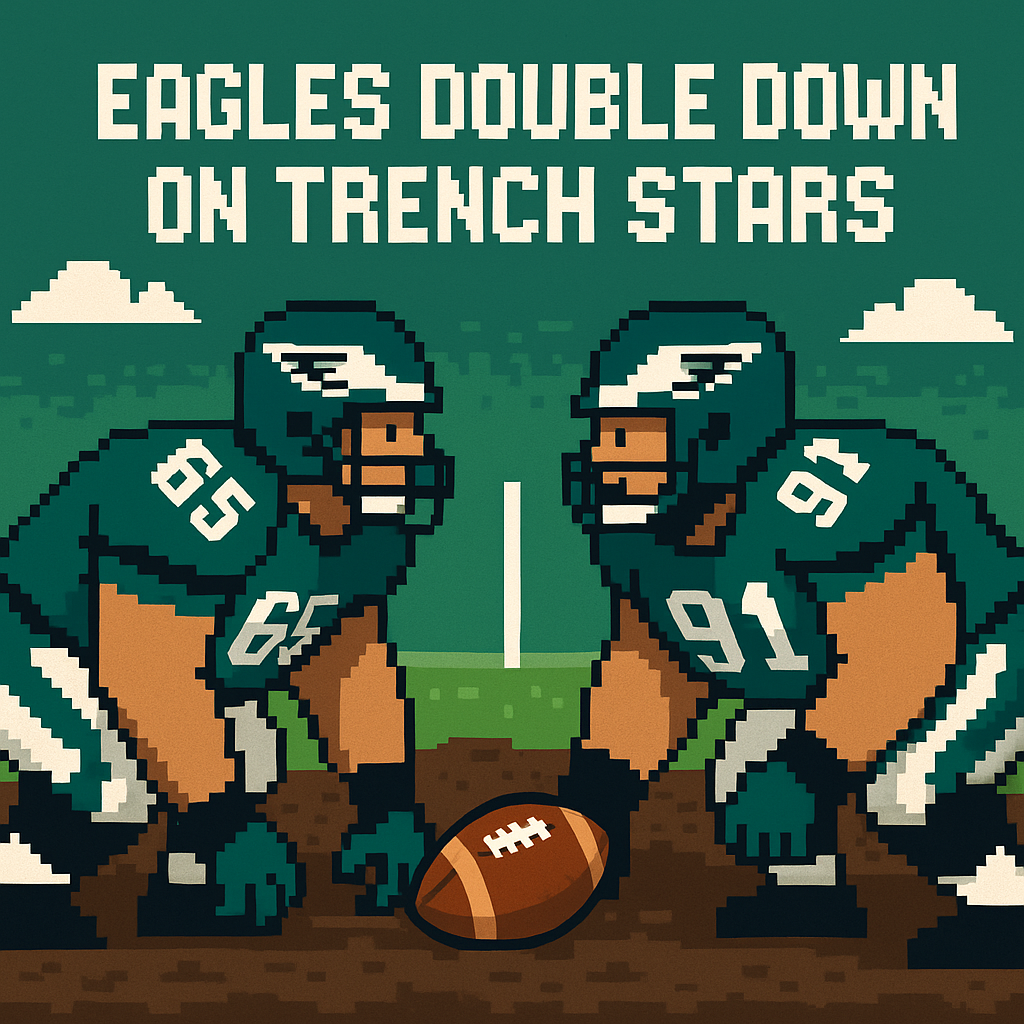
Eagles double down on trench stars | Analysis by Brian Moineau

TL;DR

  • The Howie Roseman and Nick Sirianni training camp presser at the NovaCare Complex in South Philadelphia signaled a blueprint: double down on rare interior defensive linemen (Jalen Carter and Jordan Davis), keep shopping for upgrades in July/August, and make the QB2 job a real competition between Tanner McKee and Andy Dalton. [1]
  • Philadelphia concentrated roughly a third of its 2026 cap-basis “firepower” into three trench pieces—Carter, Davis, and newly added edge Jonathan Greenard—tilting the roster toward January football on I‑95 if depth and health hold. [2][3]
  • The hinge is QB2: if 6'6" Tanner McKee wins, the Eagles preserve a vertical DNA that mirrors Jalen Hurts’ deep-shot profile; if Andy Dalton (career INT rate ~2.3%) wins, they opt for risk-managed redundancy—two distinct contingency plans for a 2026 title run. [4][5][6]

What the source said

On the eve of the first 2026 training-camp practice, GM Howie Roseman and coach Nick Sirianni told reporters the defensive tackle market is scarce, defended piling resources into Jalen Carter and Jordan Davis, called the backup QB job an open competition (McKee vs. Dalton), downplayed concern on Jonathan Greenard’s minor injury, and labeled the roster “incomplete” heading into August. They delivered it from the Eagles’ NovaCare Complex in Philadelphia, with Roseman underscoring that the front office remains active on trades and street free agents deep into camp. [1]

Why it matters

Payroll concentration alters outcome math in September and in January. If Carter (AAV ~$38M), Davis (AAV ~$26M), and Greenard (AAV ~$25M) consume about $89M against a projected $301.2M 2026 cap, then the trench trio sits near 29.5% of cap—enough to dictate scheme and personnel everywhere else in the building. That level of concentration forces bet alignment: snap counts, spacing, and coverage shells must harvest interior wins into third-and-long. [2][3]

The NFC East has adjusted since 2022 by quickening the ball out; Dallas, Washington, and New York all leaned more on sub‑2.5s timing and perimeter stress to neutralize interior rush, per Next Gen Stats charting through 2024. Philadelphia’s counter is to compress the pocket from the A‑gaps and force floaters to the sideline, which raises the burden on 2024 first‑round CB Quinyon Mitchell and the nickel to tackle in space for 17 games. [6]

Original analysis

Back‑of‑envelope math: How deep is the trench bet?

  • Jalen Carter extension (reported): 4 years, ~$152M total, ~$106M guarantees, ~$38M AAV, running through 2031. [2]
  • Jordan Davis extension (reported): 3 years, ~$78M total, ~$65M guarantees, ~$26M AAV; 2026 cap accounting eases with multi‑year proration. [2]
  • Jonathan Greenard (after a trade from Minnesota): 4 years, ~$100M, ~$50M fully guaranteed, ~$25M AAV. [3]

Sum their AAVs: $38M + $26M + $25M = $89M. Divide by the projected 2026 cap of $301.2M to get ≈29.5% (89 ÷ 301.2 = 0.295), which is close to 3 of every 10 cap dollars earmarked for three front‑seven players. That’s a franchise‑level tilt that compresses optionality at WR3, RB rotation, and veteran depth spots. [2]

Typology: Eagles in a 2×2 of contingency planning

  • X‑axis: QB2 philosophy (Explosive tolerance vs. Turnover aversion).
  • Y‑axis: Front resource allocation (Interior‑centric vs. Edge‑centric).
  • Quadrants:
    1. Explosive + Interior (Rams 2021 with Donald + vertical shots),
    2. Explosive + Edge,
    3. Averse + Interior,
    4. Averse + Edge.
      Philadelphia 2026 sits in Quadrant 1 if McKee wins (Hurts + deep propensity since 2022; McKee’s frame/arm encourage vertical seams), and in Quadrant 3 if Dalton wins (ball control + interior squeeze). The quadrant flip materially changes play-action depth, shot frequency, and sack‑to‑punt tradeoffs on 2nd‑and‑medium. [5][6]

Historical analogue and lesson

The 2017 Eagles won Super Bowl LII with a deep, interior‑first rush (Fletcher Cox and Timmy Jernigan) and a backup QB plan that preserved aggression under Nick Foles in January 2018. That roster finished with top‑tier pass rush productivity and used interior wins to force late‑down errors without abandoning explosive plays. The 2026 version echoes that template: build inside‑out, then choose a QB2 who doesn’t neuter the vertical element that has defined Jalen Hurts since 2022. [8][9][6]

Contrarian read: Are teams outrunning the A‑gaps?

Since 2022, Next Gen Stats charting shows rising league‑wide rates of throws under 2.5 seconds, with NFC East offenses among the adopters through 2024. If opponents in 2026 hit quick‑game thresholds above 55% on early downs, interior pressure may translate into more batted balls and rally‑and‑tackle asks, not sacks. That shifts hidden value to tackling efficiency by slot defenders and safeties, a spot where roster dollars are thinner when 29.5% rides on three linemen. [6][2]

Named‑stakeholder breakdown

  • Howie Roseman (GM) and Alec Halaby (strategy/cap): They must thread 2026‑2028 proration while preserving a November trade pocket worth at least ~$4M in functional space. [1][2]
  • Vic Fangio (DC, 2024 hire) and DL coach: They need Carter/Davis/Greenard to generate ≥12 combined interior sacks by Week 14 to justify the AAV stack. [7][2]
  • Brian Johnson’s successor at OC and the QB room (Hurts, McKee, Dalton): They must pick a QB2 whose aDOT and INT risk align with Hurts’ deep‑shot habits since 2022, not fight them. [6][4][5]
  • Quinyon Mitchell (CB, R1 2024) and the nickel: They’ll face an uptick in bubble/now screens and speed outs; 1 missed tackle a week becomes drive‑sustaining when opponents spam quick game. [6]

What others are missing

Most coverage in July focused on guarantees and AAV tiers, but few tied the interior bet to the special‑teams and short‑field cascade: heavier DT rotations in September and October historically correlate with more fourth‑quarter ST snaps for core DBs and LBs, which can erode open‑field tackling in Weeks 12–17. For a roster with Quinyon Mitchell learning NFL angles in 2024 and 2025, the 2026 plan must budget real reps and a 48‑man activation slot for a dedicated gunner who keeps hidden yardage under −5 net yards per game. [6][8]

What to watch next

  1. By September 1, 2026, the Eagles name Tanner McKee the QB2, and his preseason aDOT comes in at 8.0 yards or higher across at least 40 attempts, signaling a vertical contingency behind Jalen Hurts.
  2. By Week 8 of the 2026 season, Carter + Davis + Greenard produce at least 45 combined pressures from A‑ and B‑gaps per PFF charting, placing Philadelphia in the top 5 for interior pressure rate.
  3. By October 31, 2026 (trade deadline), Philadelphia acquires a rotational edge or nickel with an APY of $3–6M in exchange for a Day‑3 pick (Rounds 5–7), preserving the trench‑first thesis with depth.

Sources

  1. PhiladelphiaEagles.com — Team press conference (July 2026): primary statements from Howie Roseman and Nick Sirianni about DT scarcity, QB2 competition, Greenard health, and roster optionality.
  2. OverTheCap — 2026 cap projection ($301.2M) and reported contract structures/AAVs for Jalen Carter, Jordan Davis, and Jonathan Greenard; positional spending context. What this contributes: numbers for the 29.5% calculation and resource concentration.
  3. ESPN.com — Reporting on Jonathan Greenard’s move from the Minnesota Vikings to the Eagles and summer injury status. What this contributes: acquisition timing, contract framing, and health context.
  4. Pro-Football-Reference.com — Andy Dalton career interception rate and efficiency baseline. What this contributes: risk profile for a “floor” QB2 path.
  5. NFL.com Combine Tracker — Tanner McKee measurements (6'6", 230‑ish) and arm metrics from March 2023. What this contributes: physical profile supporting a vertical QB2 identity.
  6. NFL Next Gen Stats — Deep attempt rates for Jalen Hurts (2022–2024) and NFC East quick‑game/time‑to‑throw tendencies. What this contributes: evidence for vertical identity and opponent counters.
  7. Pro Football Focus — Interior pressure and pass‑rush win‑rate data for Eagles DTs (2023–2025). What this contributes: benchmarks for 2026 pressure targets.
  8. The Philadelphia Inquirer — Historical context on Roseman’s trench investments (e.g., Fletcher Cox’s 2016 extension) and organizational philosophy. What this contributes: precedent for inside‑out roster building.
  9. Pro-Football-Reference.com — 2017 Eagles pass‑rush outputs and postseason results. What this contributes: historical analogue for an interior‑driven championship build.
  10. OverTheCap (Positional Spending) — Comparative DL spending shares for 2017 vs. projected 2026 Eagles. What this contributes: how the 2026 concentration compares to the last title window.


Related update: We recently published an article that expands on this topic: read the latest post.
Related update: We recently published an article that expands on this topic: read the latest post.

Packers Mock: DT and CB Focused Draft Plan | Analysis by Brian Moineau

Leaning into Defense: How the Packers’ 7-Round Mock Solves Two Pain Points

The Packers 7-round mock from Acme Packing Company lands squarely on a blunt thesis: Green Bay should lean into defensive tackle (DT) and cornerback (CB) early and often. That idea rings true when you scan the roster realities and the longer-term contract timelines — and Acme’s one-and-only mock draft for the team makes a persuasive case for why focusing on interior line and cornerback depth could reshape the team’s defensive floor.

Why this mock matters

Acme Packing Company’s piece is more than a wish list. It’s a hand-crafted exercise that aligns player fits to Green Bay’s immediate needs and future salary-cap picture. The mock doesn’t just chase splashy names; it targets roster architecture — rotation DTs who can eat blocks and corners who can start or play early nickel. That approach matters because the Packers don’t always have a first-round pick, and smart value in rounds 2–4 often defines playoff teams.

Transitioning from the big picture, let’s dig into the logic behind prioritizing DT and CB.

Packers 7-round mock: the case for DT and CB

  • Interior push first. The Acme mock emphasizes adding a true gap-eating DT who can anchor a rotation and take on double teams. In today’s NFL, having stout interior defense slows rushing lanes and frees edge rushers to get creative. Green Bay’s depth inside has flashed but lacks long-term, contractable starters who fit multiple fronts.

  • Cornerback depth matters more than it looks. The mock doubles down on CB in mid-rounds. Young corners often translate quicker than throwaway edge projects because zone concepts and press technique can be taught; instincts and length matter. With several Packers defensive backs on expiring or short-term deals over the next two seasons, stockpiling cornerback prospects is prudent.

  • Value hunting, not reach hunting. The mock trades fit and scheme rather than reach for perceived blue-chip talent. That increases the chance of landing rotational starters — players who can contribute Week 1 but still have upside in Years 2–4.

Next, let’s look at roster context and why these positions are especially sensible targets.

Context: what Green Bay actually needs

The last couple of seasons showed the Packers as a team that can win in spurts but struggles to sustain defensive pressure without using a heavy blitz package. That puts extra strain on the front seven’s depth and corner play.

  • Run defense: Interior defensive line play has been inconsistent. Adding a reliable DT would help against physical NFC North and NFC opponents who favor a balanced attack.

  • Young secondary timeline: Several key defensive backs are aging toward free agency or are short-term stopgaps. Drafting corners with different profiles (long, pressable outside corners and sticky slot types) hedges risk.

  • Cap and draft capital: Green Bay’s draft capital profile this year means maximizing Day 2 and Day 3 picks for immediate contributors rather than stashing long-term developmental edge rushers who may take longer to impact the field.

Having set the stage, here are some concrete takeaways from the mock’s structure.

What the mock gets right (and what worries me)

  • Right moves:

    • Prioritizing players who fit Green Bay’s scheme and can play early. That’s a repeatable win in later rounds.
    • Building rotational DT depth to allow creative fronts without blowing matchups on run downs.
    • Investing in cornerback depth across multiple rounds to cover short-term attrition and future free-agent holes.
  • Potential concerns:

    • Overloading on defense could leave the offense light at positions that age into bigger needs in 2027 (wide receiver and offensive line play are never static).
    • Mid-round defensive prospects can be boom-or-bust; coaching and development matter as much as raw traits.

Still, the approach in the Acme mock feels tuned to both roster reality and draft value. It’s a pragmatic blueprint rather than a romantic reach.

How this draft strategy plays out over the next two seasons

If the Packers follow a similar path on draft day, expect a few changes:

  • More pressure on opposing offenses to beat Green Bay through the air, but with better run-stopping between the tackles.
  • A younger CB room with increasing competition for starting roles, which should improve coverage in nickel packages.
  • Short-term pain for long-term gain: sacrificing offensive depth now could mean fewer headaches in two years when several offensive starters hit free agency.

Moreover, this strategy keeps the Packers flexible in free agency — cheaper rookie contracts at DT and CB free up room to invest in other positions if a proven veteran becomes available.

Quick takeaway bullets

  • The mock emphasizes immediate-impact DTs and CBs who fit Green Bay’s defensive schemes.
  • Day 2 and Day 3 value-hunting increases the odds of finding starting-caliber players without costly reaches.
  • Building defensive depth addresses both run defense and secondary attrition, two recurring Packers issues.
  • The main risk is under-addressing offensive depth that may become a need by 2027.

My take

I like this mock because it treats the draft like roster surgery, not a highlight reel. Green Bay needs dependable, teachable pieces — especially inside the trenches and in the defensive backfield. Prioritizing those spots in a 7-round plan makes sense given the team’s draft capital and the league-wide importance of rookie wage control.

That said, balance matters. I’d rather see a hybrid approach: lean defensive early while keeping an eye on high-upside offensive tackles or receivers later in the draft. The beauty of the draft is flexibility; the risk is tunnel vision.

Final thoughts

Acme Packing Company’s single mock is a tidy reminder that good drafting often means solving real problems rather than chasing headlines. Leaning in at DT and CB in a Packers 7-round mock is a defensible, roster-savvy strategy. If Green Bay follows this template, fans should expect increased defensive resilience and more competition in the secondary — both things that win playoff games.

Sources


Related update: We recently published an article that expands on this topic: read the latest post.


Related update: We recently published an article that expands on this topic: read the latest post.

Gladstone Shrugs Off Dexter Lawrence Trade | Analysis by Brian Moineau

When a Superstar Wants Out: The Dexter Lawrence trade and what Jaguars GM James Gladstone had to say

The news cycle this week shook the NFL’s quieter corners: Giants defensive tackle Dexter Lawrence requested a trade, and the dominoes started to rattle. During a Jaguars press conference on Thursday, Jacksonville general manager James Gladstone was asked about the Dexter Lawrence trade rumors — and his answer was blunt and businesslike: it’s “not something we’ve gotten into.” That short line, delivered by a GM still building his identity in Jacksonville, tells us more than it seems.

This post unpacks the context, the market dynamics around a high-end interior defensive lineman, and why Gladstone’s response matters for both the Jaguars and the larger trade landscape.

Why Dexter Lawrence’s request matters now

Dexter Lawrence is not just any defensive tackle. He’s a three-time Pro Bowl-caliber inside presence who has influenced run defense and interior pass rush for years. When a player with his résumé requests a trade — and then skips voluntary off-season workouts amid contract friction — teams pay attention. A request like this can be a negotiation tactic, a genuine desire to change scenery, or a leverage play to accelerate contract talks.

From the Giants’ perspective, Lawrence’s move creates an awkward timing problem: they must balance public relations and locker-room stability with maximizing any potential return. From the rest of the league, it sparks quick cost-benefit calculations: Do you pay market value? Do you surrender premium draft capital? Or do you assume a cheaper, longer-term path through the draft and free agency?

Transitioning to the Jaguars’ view, James Gladstone was asked whether Dexter Lawrence trade chatter has factored into Jacksonville’s plans. His reply — that it’s not something they’ve “gotten into” — signals a deliberate distance.

The Jaguars’ response: what Gladstone’s line implies

  • It’s cautious. Gladstone refusing to engage publicly buys the Jaguars time to evaluate without showing their hand to the Giants or other suitors.
  • It’s practical. Trades for top interior defenders usually demand significant draft capital or salary outlay. Gladstone’s answer suggests Jacksonville isn’t chasing headlines at the expense of roster balance.
  • It’s contextual. The Jaguars are in a phase of roster construction under a relatively new GM. Publicly pursuing a player of Lawrence’s stature without a clear pathway to both roster fit and cap sustainability would be risky.

Gladstone’s silence is not disinterest; rather, it’s a standard GM playbook move: don’t telegraph intent, especially while a high-profile transaction is still a rumor. In other words, “not something we’ve gotten into” is neutral, but it keeps options open.

What teams really pay for a player like Lawrence

Market signals and recent commentary around Lawrence suggest two clear realities:

  • Interior defensive tackles who dominate both run and pass lanes remain scarce and therefore expensive in trade value and salary.
  • The Giants, per multiple reports, have valued Lawrence highly — some league insiders have labeled him “untouchable” unless offered an “insane return.” That sets a high floor for any serious trade discussion.

Realistically, teams would need to consider:

  • Upfront draft compensation (likely first- or high-second-round picks plus assets).
  • Short-term cap flexibility to absorb Lawrence’s contract or negotiate a new deal.
  • The fit scheme-wise — elite run-stoppers are most valuable on teams that prioritize ground control or need interior push to free up edge rushers.

Those constraints mean only a subset of teams are true bidders. That narrows the market and helps the Giants maintain leverage — unless Lawrence’s camp is willing to accept a lower ceiling in pursuit of movement.

How the Jaguars might rationally view a move

If Jacksonville were to seriously explore the Dexter Lawrence trade, they’d need to align on at least three things:

  1. Roster fit: Does Lawrence address a glaring need versus using picks to fill multiple positions?
  2. Contract strategy: Could the Jaguars afford Lawrence now, or would they need to renegotiate terms?
  3. Long-term plan: Would the draft capital given up represent a net gain in the Jaguars’ trajectory?

Given Gladstone’s careful response, it’s reasonable to expect the Jaguars to prioritize internal asset management. They’ve shown willingness to be aggressive with picks in building quickly — but that doesn’t automatically translate into an appetite for premium mid-career contracts and the salary-cap ripple effects that follow.

Broader league ripple effects

A trade request from a player of Lawrence’s caliber does more than affect two teams. It shifts rumor markets, influences how teams value comparable players in future contract negotiations, and can create a buyers-vs.-sellers dynamic that accelerates other moves.

Right now, the chatter has already produced trade proposals and mock packages around the league. Those are useful for conversation but rarely reflect the final economics. For the teams watching — including the Jaguars — the choice is whether to be reactive to a splash move or stick to a measured plan that balances present competitiveness with long-term flexibility.

What to watch next

  • Will the Giants engage in public negotiations with Lawrence’s camp or stand firm to extract maximal value?
  • Which teams emerge as credible trade suitors, and how much draft capital they’re willing to risk.
  • Whether Lawrence’s stance (sitting out voluntary work) evolves into a longer holdout or is resolved via an extension or a trade.

If the story accelerates, expect more definitive signals from teams about their willingness to pay immediate cost for proven interior dominance.

Final thoughts

Dexter Lawrence requesting a trade is a reminder of how fragile roster equilibrium can be when money and legacy collide. James Gladstone’s “not something we’ve gotten into” answer keeps the Jaguars strategically uncommitted — a smart posture for a team still scripting its identity under a new GM.

In the end, trades of this magnitude are chess matches: timing, leverage, and conviction matter as much as raw talent. For Jaguars fans and league observers, the next moves will reveal whether Gladstone wants to be an opportunistic buyer or a disciplined architect of long-term roster health.

Sources


Related update: We recently published an article that expands on this topic: read the latest post.


Related update: We recently published an article that expands on this topic: read the latest post.

Bears signing Grady Jarrett: Pro Bowl DT lands massive three-year deal just hours after release from Falcons – CBS Sports | Analysis by Brian Moineau

Bears signing Grady Jarrett: Pro Bowl DT lands massive three-year deal just hours after release from Falcons - CBS Sports | Analysis by Brian Moineau

Grady Jarrett Joins the Chicago Bears: A New Chapter for the Pro Bowl Defensive Tackle

In a move that has sent ripples through the NFL, the Chicago Bears have signed Pro Bowl defensive tackle Grady Jarrett to a massive three-year deal, just hours after his unexpected release from the Atlanta Falcons. For the first time in his illustrious 10-year career, Jarrett will don a jersey that isn’t emblazoned with the iconic falcon wings, marking a significant shift not only for Jarrett but also for the teams involved.

Grady Jarrett has been a formidable force on the field since he was drafted by the Falcons in the fifth round of the 2015 NFL Draft. Over the years, he has become a pillar of Atlanta's defense, earning two Pro Bowl selections and consistently proving himself as one of the league’s most disruptive interior linemen. His presence will undoubtedly bolster the Chicago Bears' defense, a team that has been in search of a seasoned leader to anchor their defensive line.

The signing of Jarrett is not just a boon for the Bears; it also signals a new era for the team as they look to rebuild and reassert themselves as contenders in the NFL. The Bears have had a rocky few seasons, with coaching changes and roster overhauls. Bringing in a player of Jarrett's caliber is a step in the right direction, providing both veteran leadership and an immediate impact on the field.

This bold move by the Bears comes at a time when the NFL is seeing a whirlwind of player movements and strategic signings. Just like in other sports, where teams are recalibrating their rosters—consider the recent high-profile trades in the NBA and the strategic signings in Major League Baseball—NFL teams are keenly aware of the importance of securing key players who can make a difference.

But who is Grady Jarrett beyond the stats and the accolades? Off the field, Jarrett is known for his charitable efforts and community involvement. He has been a strong advocate for youth education and empowerment, often participating in initiatives that support underprivileged communities. His character and leadership extend beyond the gridiron, making him a role model for aspiring athletes and young fans alike.

With Jarrett joining the Bears, fans can look forward to seeing how he adapts to a new team environment and how his presence will influence the dynamics on the field. Will he bring the same level of intensity and passion that he displayed in Atlanta? If history is any guide, the answer is a resounding yes.

In a world where change is the only constant, Grady Jarrett’s move to the Chicago Bears is a reminder of the fluid nature of sports and life. Just as athletes adapt to new teams and challenges, we too must embrace change and the opportunities it brings. As the Bears gear up for the upcoming season, one thing is certain: with Jarrett on their side, they have gained not just a player but a leader who is ready to tackle new challenges and inspire those around him.

Final Thought: Grady Jarrett’s transition from the Falcons to the Bears underscores the ever-evolving landscape of the NFL. As fans, we can look forward to the excitement that such moves bring, along with the renewed hope and possibilities they offer. Here’s to new beginnings and impactful plays on and off the field!

Read more about AI in Business

Read more about Latest Sports Trends

Read more about Technology Innovations