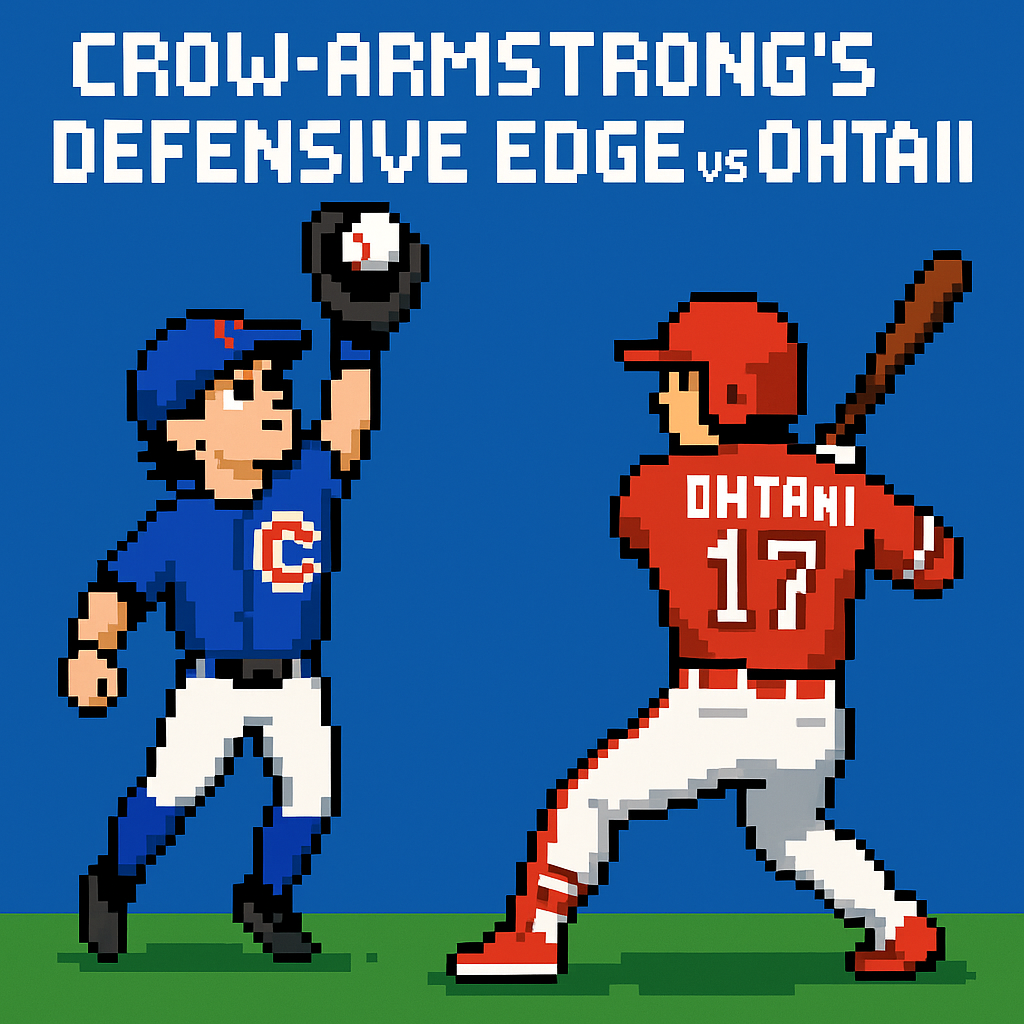
Crow-Armstrong’s Defensive Edge vs Ohtani | Analysis by Brian Moineau

TL;DR

  • The Crow-Armstrong vs. Ohtani NL MVP race has shifted from vibe to variance: sportsbooks now price Pete Crow-Armstrong as a slight favorite over Shohei Ohtani as of August 19, 2026, reflecting defensive value and Ohtani’s uncertain pitching volume. [2][5]
  • Statcast has Crow-Armstrong leading MLB outfielders at +23 Outs Above Average in 2026; if you translate those runs to wins, his glove alone is contributing roughly two-plus wins — a hidden edge in a close ballot. [3][6]
  • Unless Ohtani meaningfully returns to the mound in September, the two-way tiebreaker evaporates; LA’s own updates suggest opener-style stints rather than full starts are likelier down the stretch. [4][5]

What the source said

ESPN frames the National League MVP debate as a daily coin flip between two elite but radically different stars in 2026: Dodgers phenom Shohei Ohtani and Cubs center fielder Pete Crow-Armstrong. The feature contrasts Ohtani’s two-way upside with Crow-Armstrong’s contact-speed-defense stack, using evaluator quotes and on-field examples from Los Angeles and Chicago. It stresses how voters must weigh a DH’s thunderous bat (plus a possible pitching return) against a center fielder’s run prevention and baserunning, with Statcast feeds shaping the case on both coasts. The tone: a tightening race with divergent value components under a 2026 microscope. [1]

Why it matters

The real stakeholders aren’t only Cubs and Dodgers fans. The BBWAA electorate must reconcile modern tracking data (OAA, baserunning runs) with traditional MVP heuristics; VegasInsider’s lines already react to updates on Ohtani’s mound timeline; national TV partners want a September arc that keeps neutral fans watching. A mispriced narrative — “Ohtani if he pitches, otherwise PCA” — can distort betting markets, media framing, and even late-season usage decisions. [2]

Chicago’s front office built a run-prevention roster around Wrigley’s expansive outfield; a Crow-Armstrong MVP validates that 2026 strategy in a league drifting back toward athletic defense. For Los Angeles, the calculus is postseason-first at Dodger Stadium: they’re chasing a World Series three‑peat, and a healthy Ohtani on the mound matters more than an August odds swing — but that same opener-style choice could tip the award margin in September. [4][5]

Original analysis

Crow-Armstrong vs. Ohtani NL MVP race: value matrix

  • A named typology (Value Matrix)

    • Visible Offense, High Volume: Ohtani’s nightly DH thunder; the case most fans perceive in real time.
    • Visible Offense, Multirole: Ohtani’s two‑way ceiling if he returns to the mound with real innings.
    • Hidden Prevention, High Frequency: Crow-Armstrong vacuuming singles in center; every tracked route trims expected runs.
    • Hidden Prevention, Momentum Plays: Extra bases denied, 5‑star catches, “don’t test that arm” deterrence — the runs no box score credits but Statcast tallies. [3]
  • Back‑of‑envelope calculation (with the math)

    • Crow-Armstrong’s 2026 Statcast OAA: +23, MLB-best among outfielders as of August 19, 2026. [3]
    • Rule of thumb: roughly 10 runs ≈ 1 win (the conversion varies with run environment; FanGraphs outlines the method). [6]
    • If we treat OAA as a proxy for defensive runs saved (intuition aid): +23 OAA ≈ ~+2.3 wins.
    • Add his 2026 baserunning “Baserunning Runs” of +5 on Savant (component-level estimate) and you’re near +0.5 wins more; together, that’s roughly three wins of non-bat contribution before the slash line enters the chat. [3][6]
  • The pitching variable that props up Ohtani’s case has softened

    • Dodgers updates from late July and early August cite knee-driven caution, bullpen sessions, and a likely “multi‑inning opener” path rather than 5–6 inning starts before October. That caps pitching WAR accumulation and, crucially, the narrative torque of “two‑way” in voters’ eyes. [4][5]
    • If he logs opener stints, Ohtani’s offense must carry the rest. That recasts the race as bat-only Ohtani versus two‑phase Crow-Armstrong (defense + baserunning), not true two-way versus glove-first CF. [4][5]
  • Markets are already tilting

    • As of August 19, VegasInsider’s consolidated board lists PCA at roughly -160 and Ohtani in the +125 to +150 range (books vary), implying a ~61–65% chance for PCA versus ~40–44% for Ohtani before juice. [2]
  • Stakeholder breakdown (one‑liners)

    • Dodgers (Dave Roberts, front office): Prioritize October; opener stints protect health but surrender the regular-season two-way aura that sways MVP votes. [4][5]
    • Cubs (Craig Counsell, Jed Hoyer): Keep PCA in center daily; defense and baserunning compound even when the bat cools at Wrigley Field.
    • BBWAA voters: This is the cleanest test yet of whether Statcast‑driven prevention (OAA, extra bases prevented) earns equal billing with HR/RBI in MVP math. [3]
    • Sportsbooks: Price risk around Ohtani’s mound timeline more than day‑to‑day wRC+ splits; status updates move lines faster than a single 3‑for‑4. [2][4]
    • MLB broadcast partners: The split‑screen September — Ohtani’s bullpen cams vs. PCA’s nightly jumps — fuels prime‑time segments in Los Angeles and Chicago.
  • A contrarian read

    • Consensus: “If Ohtani throws even a handful of September starts, the MVP is his to lose.”
    • The case against: LA’s public posture makes full-length starts unlikely before October; the likelier opener usage doesn’t create enough delta in pitching WAR or narrative to overcome PCA’s day‑to‑day prevention lead and Chicago’s highlight‑caliber plays in a playoff chase. Betting markets — cold-blooded aggregators of that probability tree — already reflect this shift. [2][4][5]

What others are missing

Coverage keeps circling WAR totals but undersells the play-by-play mechanics giving Crow-Armstrong his edge: Statcast’s “Extra Bases Prevented” and “Outfielder Jump.” In 2026, PCA sits at +23 OAA with elite jump components (reaction +1.9 ft, route +4.6 ft vs. average on tracked plays) and positive “Fielder Runs” in outfield defense; that mix slashes liners in front and gashes in the gaps while shrinking first‑to‑third attempts (four runs credited in baserunner deterrence). Those micro-denials reduce stressful pitches and shorten innings for a Cubs bullpen that benefits at Wrigley Field every night. [3]

What to watch next

  1. By September 25, 2026, the Dodgers will use Ohtani only in opener-style regular-season pitching appearances (≤3 IP each), with no traditional 5+ inning start before the postseason. [4]
  2. By September 30, 2026, Crow-Armstrong will finish the regular season with ≥20 OAA and rank first among all MLB outfielders in OAA. [3]
  3. By September 20, 2026, NL MVP odds will widen to PCA -250 or shorter at at least one major book aggregator if Ohtani has not logged a 5+ inning start by then. [2][4]

My take

Give me Crow-Armstrong for NL MVP in 2026. The two-way tiebreaker that usually hands Ohtani the crown won’t materialize if Los Angeles keeps him on an opener leash — and they should, because October at Dodger Stadium matters more than plaques. Meanwhile, PCA’s Statcast record is a metronome: +23 OAA, top‑tier jump, and real baserunning runs that change innings. In a season where the margins are thin, the right answer isn’t the loudest bat — it’s the player who erases the most runs while adding enough with the stick. [3][6][4][2]

Sources

  1. Crow-Armstrong vs. Ohtani NL MVP race — ESPN MLB (https://www.espn.com/mlb/) — The debate setup: contrasting PCA’s defense/speed with Ohtani’s two‑way ceiling through opponent/evaluator perspectives in 2026.

  2. 2026 MLB Most Valuable Player Odds — VegasInsider (https://www.vegasinsider.com/mlb/odds/mvp/) — Current market pricing as of August 19, 2026: PCA favored over Ohtani across major books; establishes the live tilt.

  3. Pete Crow-Armstrong — Baseball Savant Statcast page (https://baseballsavant.mlb.com/savant-player/pete-crow-armstrong-691718?season=2026) — Verifies +23 OAA (rank 1 among OF), 2026 outfielder jump components, sprint speed, and 2026 fielding/baserunning run values.

  4. Dodgers/Ohtani pitching status updates — MLB.com Dodgers news (https://www.mlb.com/dodgers/news/) — Late July–early August notes: bullpen sessions resumed; regular-season workload framed toward multi‑inning opener stints.

  5. Shohei Ohtani’s return to the mound remains unclear — Los Angeles Times (https://www.latimes.com/sports/dodgers) — Independent reporting that LA had not reached a shut‑down decision but acknowledged uncertainty around regular-season pitching volume.

  6. Converting Runs to Wins — FanGraphs Sabermetrics Library (https://library.fangraphs.com/misc/war/converting-runs-to-wins/) — Explains the runs‑to‑wins conversion and the “~10 runs per win” rule of thumb used in the back‑of‑envelope calculation.


Related update: We recently published an article that expands on this topic: read the latest post.

Related update: We recently published an article that expands on this topic: read the latest post.

Acuña Jr. Activated, Returns Tuesday | Analysis by Brian Moineau

TL;DR

  • Ronald Acuña Jr. is back: Atlanta activated him Monday and targeted him to play Tuesday in Miami after a left hamstring strain on May 2; this is more than a feel‑good headline. [1]
  • The real swing is wins above replacement: FanGraphs projects Acuña for ~4.3 WAR the rest of the way; replacing a 1.4‑WAR stopgap in right field is roughly a three‑win bump in four months. [4]
  • Walt Weiss won’t run him into the ground, and that creates a domino effect for Atlanta’s DH/right‑field usage and how they manufacture runs during a soft May/June schedule. [3]

What the source said

ESPN reports the Braves activated Ronald Acuña Jr. from the 10‑day injured list ahead of Monday night’s series opener against the Marlins, clearing the way for him to play Tuesday in Miami. He had been sidelined since May 2 because of a strained left hamstring. The framing is straightforward: roster move made, timing set, and a return date circled for the second game of the series. The piece situates the move within Atlanta’s road trip and emphasizes the club’s intention to get the reigning star back on the field after a two‑plus‑week absence. [1]

Why it matters

Two groups have the most on the line: Atlanta’s clubhouse and everyone chasing them in the NL East. For the Braves, a healthy Acuña instantly alters baserunning pressure, lengthens the lineup in front of Matt Olson and Austin Riley, and changes who gets squeezed out of DH/right‑field at‑bats. For the Phillies, Mets, and Marlins, three incremental Atlanta wins gained by upgrading from a stopgap to an MVP‑caliber leadoff hitter is the difference between a late‑September race and a mid‑August concession. [4][5]

There’s also portfolio risk management. Hamstrings recur when teams get greedy; Atlanta remembers 2021’s injury spiral and the sting of missing pieces in 2024. Weiss signaling “not every day” use is a tell that process, not emotion, will drive playing time—exactly what a club with roughly 78–80% division‑odds should do in May. [3][4]

Original analysis

Ronald Acuña Jr. to play Tuesday at Miami: what it really changes

The surface‑level read is obvious: Acuña returns, Braves get better. The deeper story is how much—and in what ways—Atlanta improves, and how they’ll ration the upgrade in late May.

  • Back‑of‑envelope calculation (wins swing, with math shown)

    • FanGraphs projects Ronald Acuña Jr. for 4.3 WAR the rest of the season (575 PA; 24 HR; 25 SB; 146 wRC+). [4]
    • A typical RF stopgap on Depth Charts sits near 1.4 WAR RoS. [4]
    • Delta ≈ 4.3 − 1.4 = 2.9 wins above replacement for the remainder of 2026. [4]
    • Said differently: over roughly 110–115 remaining games, Atlanta banks about +0.025 wins per game simply by having Acuña’s bat/legs instead of a competent platoon outfielder. [4]
    • That 2.9‑win swing matters in a postseason where seeding and a first‑round bye shift advancement odds by percentage points; FanGraphs listed Atlanta at 78.8% to win the NL East and 11.0% for the World Series on May 19, 2026. [4]
  • Named‑stakeholder breakdown

    • Walt Weiss (manager): He confirmed Acuña would play Tuesday but also telegraphed a non‑everyday cadence. Expect DH starts and occasional sit days to reduce sprint‑load spikes. [3]
    • Alex Anthopoulos (front office): This return lets AA evaluate whether the club still needs a right‑handed bench bat or late‑inning outfield defender by June 15, rather than forcing a May trade. The projections say patience is profitable. [4]
    • Matt Olson and Austin Riley: More first‑inning traffic. Acuña’s pre‑IL OBP sat at .362—below his peak but still premium table‑setting that forces fastballs into the heart of the order. [2]
    • NL East rivals (Phillies, Mets): Playoff‑odds math turns cruel. A three‑win RoS swing on Atlanta’s side erases your margin for bullpen meltdowns in July. [4][5]
    • Kyle Farmer (INF): His 10‑day IL stint was the corresponding move; his absence consolidates infield innings with Orlando Arcia and Ozzie Albies, which in turn tightens the DH/OF at‑bat crunch. [2]
  • A contrarian read

    • Consensus: “Acuña’s back; the Braves immediately regain their 2023‑level thunder.”
    • Counter: The first‑order gain is not slug—it’s reach base, run pressure, and pitch‑selection leverage. Before the strain, Acuña’s line was .252/.362/.378; the walk rate and OBP traveled, the lift didn’t. Expect DH starts and station‑to‑station baserunning for a week while he reloads the A‑swing, which still forces strike‑throwing for Olson and Riley and drives starter pitch counts in innings 1–3. [2]
  • A quick table: three deployment modes and their tradeoffs (next 10–14 days)

    Mode Usage Upside Risk Likely when
    DH‑heavy 5–6 DH starts/week; 0–1 RF Keeps hamstring load down; maximizes PAs Less outfield value; DH crunch with others Immediately vs Miami and entering Nationals series
    Mixed 3–4 DH, 2 RF Balances defense and rest; tests sprints Moderate reinjury risk if sprint spikes stack After first homestand if he responds well
    Full RF 5+ RF starts/week Restores baserunning + arm value Highest soft‑tissue risk before full ramp Late June if no setbacks

    The Washington Post’s line—he’ll play Tuesday, but not every day—tracks with “DH‑heavy, then mixed” while the staff watches how he comes out of high‑effort turns and first‑to‑third reads. [3]

Two final context levers to watch. First, Atlanta didn’t need to panic; even before Monday’s shutout loss, MLB.com’s team notes had the Braves leading or near the top in hits, slugging, average, RBIs, and runs. Adding a ~.360 OBP leadoff threat pushes the chain along without demanding instant long balls. [2] Second, Tuesday showed the blueprint: in his return, Acuña doubled, walked twice, and scored three times in an 8–4 win at loanDepot park. That is run manufacturing by presence, not just power. [5]

What others are missing

Coverage focuses on whether Acuña plays and where he bats; it glosses the cascading effect on role players and how that affects October seeding. Kyle Farmer’s IL move plus a DH‑tilted Acuña means fewer DH reps for Matt Olson off‑days and tighter lanes for Travis d’Arnaud and Jarred Kelenic, who each project for non‑zero RoS WAR. That subtly transfers late‑inning plate appearances to star bats more often—fewer “rest the core” days in June—at the cost of in‑game defensive flexibility. In a league where FanGraphs pegs Atlanta near a .544 rest‑of‑season win percentage, flipping even two toss‑up games via better ninth‑inning lineups can decide a bye. [2][4][5]

What to watch next

  1. By May 31, Acuña starts at DH in at least 6 of his first 10 team games back, with ≤3 starts in right field, reflecting a measured ramp. [3]
  2. By June 15, Atlanta’s leadoff OBP is ≥.370 over a rolling two‑week window, driven by Acuña’s walk rate stabilizing even if slug lags behind (.440 or lower in that span). [2]
  3. By the All‑Star break (mid‑July 2026), Acuña accrues ≥2.0 FanGraphs WAR on the season, consistent with his 4.3 RoS projection pace if health holds. [4]

My take

I’d treat Ronald Acuña Jr. like a blue‑chip asset in a portfolio that already beats the market. Let him terrorize pitchers from the DH slot for 10–14 days, accept a power lag, and weaponize his on‑base skill to tilt counts for Olson and Riley at Truist Park and on the road. The math says the upgrade from a 1.4‑WAR stopgap to a 4.3‑WAR superstar is worth roughly three wins; the risk says don’t chase the fourth by pushing him into right field too soon. [2][4][5]

Sources

[1] Braves’ Ronald Acuña Jr. to play Tuesday at Miami — ESPN (https://www.espn.com/mlb/story/_/id/48810095/atlanta-braves-activate-ronald-acuna-jr-injured-list) — News of activation from the 10‑day IL and the plan to play Tuesday versus Miami.

[2] Ronald Acuña Jr. activated from injured list — MLB.com (https://www.mlb.com/braves/news/ronald-acuna-jr-activated-from-injured-list) — Confirms activation, Kyle Farmer’s IL move, pre‑IL slash line, and Atlanta’s offensive leaderboards.

[3] Braves activate outfielder Ronald Acuña Jr. from the injured list — The Washington Post (https://www.washingtonpost.com/sports/mlb/2026/05/18/braves-ronald-acuna-activated/44d42a8e-530e-11f1-9c40-7a0a12d9e745_story.html) — Adds manager Walt Weiss’s “not every day” guidance and timeline context.

[4] 2026 Projections — Depth Charts (RoS), Atlanta Braves — FanGraphs (https://www.fangraphs.com/projections?fantasypreset=dashboard&lg=&pageitems=30&players=0&pos=all&sortcol=&sortdir=desc&statgroup=dashboard&stats=bat&team=16&type=rfangraphsdc) — Projects Acuña at 4.3 WAR RoS and a typical RF stopgap near 1.4 WAR; contextualizes team odds and RoS strength.

[5] Acuña scores three times in return as Braves beat Marlins 8–4 — The Washington Post (https://www.washingtonpost.com/sports/mlb/2026/05/19/atlanta-braves-miami-marlins-score/769de190-53e2-11f1-9c40-7a0a12d9e745_story.html) — Documents Tuesday’s game, Acuña’s double, two walks, and three runs, plus confirms series context.

[6] Braves’ Ronald Acuna: Back in lineup at DH


Related update: We recently published an article that expands on this topic: read the latest post.