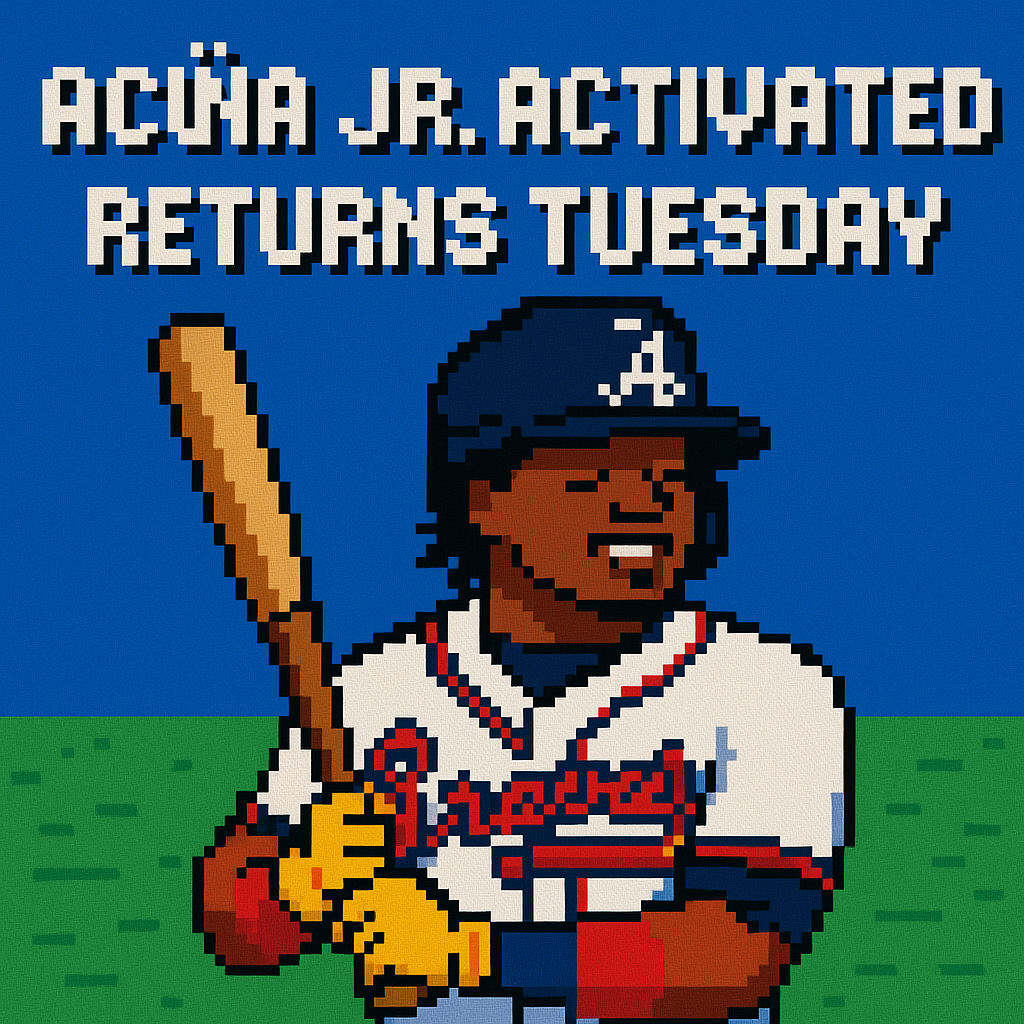
Acuña Jr. Activated, Returns Tuesday | Analysis by Brian Moineau

TL;DR

  • Ronald Acuña Jr. is back: Atlanta activated him Monday and targeted him to play Tuesday in Miami after a left hamstring strain on May 2; this is more than a feel‑good headline. [1]
  • The real swing is wins above replacement: FanGraphs projects Acuña for ~4.3 WAR the rest of the way; replacing a 1.4‑WAR stopgap in right field is roughly a three‑win bump in four months. [4]
  • Walt Weiss won’t run him into the ground, and that creates a domino effect for Atlanta’s DH/right‑field usage and how they manufacture runs during a soft May/June schedule. [3]

What the source said

ESPN reports the Braves activated Ronald Acuña Jr. from the 10‑day injured list ahead of Monday night’s series opener against the Marlins, clearing the way for him to play Tuesday in Miami. He had been sidelined since May 2 because of a strained left hamstring. The framing is straightforward: roster move made, timing set, and a return date circled for the second game of the series. The piece situates the move within Atlanta’s road trip and emphasizes the club’s intention to get the reigning star back on the field after a two‑plus‑week absence. [1]

Why it matters

Two groups have the most on the line: Atlanta’s clubhouse and everyone chasing them in the NL East. For the Braves, a healthy Acuña instantly alters baserunning pressure, lengthens the lineup in front of Matt Olson and Austin Riley, and changes who gets squeezed out of DH/right‑field at‑bats. For the Phillies, Mets, and Marlins, three incremental Atlanta wins gained by upgrading from a stopgap to an MVP‑caliber leadoff hitter is the difference between a late‑September race and a mid‑August concession. [4][5]

There’s also portfolio risk management. Hamstrings recur when teams get greedy; Atlanta remembers 2021’s injury spiral and the sting of missing pieces in 2024. Weiss signaling “not every day” use is a tell that process, not emotion, will drive playing time—exactly what a club with roughly 78–80% division‑odds should do in May. [3][4]

Original analysis

Ronald Acuña Jr. to play Tuesday at Miami: what it really changes

The surface‑level read is obvious: Acuña returns, Braves get better. The deeper story is how much—and in what ways—Atlanta improves, and how they’ll ration the upgrade in late May.

  • Back‑of‑envelope calculation (wins swing, with math shown)

    • FanGraphs projects Ronald Acuña Jr. for 4.3 WAR the rest of the season (575 PA; 24 HR; 25 SB; 146 wRC+). [4]
    • A typical RF stopgap on Depth Charts sits near 1.4 WAR RoS. [4]
    • Delta ≈ 4.3 − 1.4 = 2.9 wins above replacement for the remainder of 2026. [4]
    • Said differently: over roughly 110–115 remaining games, Atlanta banks about +0.025 wins per game simply by having Acuña’s bat/legs instead of a competent platoon outfielder. [4]
    • That 2.9‑win swing matters in a postseason where seeding and a first‑round bye shift advancement odds by percentage points; FanGraphs listed Atlanta at 78.8% to win the NL East and 11.0% for the World Series on May 19, 2026. [4]
  • Named‑stakeholder breakdown

    • Walt Weiss (manager): He confirmed Acuña would play Tuesday but also telegraphed a non‑everyday cadence. Expect DH starts and occasional sit days to reduce sprint‑load spikes. [3]
    • Alex Anthopoulos (front office): This return lets AA evaluate whether the club still needs a right‑handed bench bat or late‑inning outfield defender by June 15, rather than forcing a May trade. The projections say patience is profitable. [4]
    • Matt Olson and Austin Riley: More first‑inning traffic. Acuña’s pre‑IL OBP sat at .362—below his peak but still premium table‑setting that forces fastballs into the heart of the order. [2]
    • NL East rivals (Phillies, Mets): Playoff‑odds math turns cruel. A three‑win RoS swing on Atlanta’s side erases your margin for bullpen meltdowns in July. [4][5]
    • Kyle Farmer (INF): His 10‑day IL stint was the corresponding move; his absence consolidates infield innings with Orlando Arcia and Ozzie Albies, which in turn tightens the DH/OF at‑bat crunch. [2]
  • A contrarian read

    • Consensus: “Acuña’s back; the Braves immediately regain their 2023‑level thunder.”
    • Counter: The first‑order gain is not slug—it’s reach base, run pressure, and pitch‑selection leverage. Before the strain, Acuña’s line was .252/.362/.378; the walk rate and OBP traveled, the lift didn’t. Expect DH starts and station‑to‑station baserunning for a week while he reloads the A‑swing, which still forces strike‑throwing for Olson and Riley and drives starter pitch counts in innings 1–3. [2]
  • A quick table: three deployment modes and their tradeoffs (next 10–14 days)

    Mode Usage Upside Risk Likely when
    DH‑heavy 5–6 DH starts/week; 0–1 RF Keeps hamstring load down; maximizes PAs Less outfield value; DH crunch with others Immediately vs Miami and entering Nationals series
    Mixed 3–4 DH, 2 RF Balances defense and rest; tests sprints Moderate reinjury risk if sprint spikes stack After first homestand if he responds well
    Full RF 5+ RF starts/week Restores baserunning + arm value Highest soft‑tissue risk before full ramp Late June if no setbacks

    The Washington Post’s line—he’ll play Tuesday, but not every day—tracks with “DH‑heavy, then mixed” while the staff watches how he comes out of high‑effort turns and first‑to‑third reads. [3]

Two final context levers to watch. First, Atlanta didn’t need to panic; even before Monday’s shutout loss, MLB.com’s team notes had the Braves leading or near the top in hits, slugging, average, RBIs, and runs. Adding a ~.360 OBP leadoff threat pushes the chain along without demanding instant long balls. [2] Second, Tuesday showed the blueprint: in his return, Acuña doubled, walked twice, and scored three times in an 8–4 win at loanDepot park. That is run manufacturing by presence, not just power. [5]

What others are missing

Coverage focuses on whether Acuña plays and where he bats; it glosses the cascading effect on role players and how that affects October seeding. Kyle Farmer’s IL move plus a DH‑tilted Acuña means fewer DH reps for Matt Olson off‑days and tighter lanes for Travis d’Arnaud and Jarred Kelenic, who each project for non‑zero RoS WAR. That subtly transfers late‑inning plate appearances to star bats more often—fewer “rest the core” days in June—at the cost of in‑game defensive flexibility. In a league where FanGraphs pegs Atlanta near a .544 rest‑of‑season win percentage, flipping even two toss‑up games via better ninth‑inning lineups can decide a bye. [2][4][5]

What to watch next

  1. By May 31, Acuña starts at DH in at least 6 of his first 10 team games back, with ≤3 starts in right field, reflecting a measured ramp. [3]
  2. By June 15, Atlanta’s leadoff OBP is ≥.370 over a rolling two‑week window, driven by Acuña’s walk rate stabilizing even if slug lags behind (.440 or lower in that span). [2]
  3. By the All‑Star break (mid‑July 2026), Acuña accrues ≥2.0 FanGraphs WAR on the season, consistent with his 4.3 RoS projection pace if health holds. [4]

My take

I’d treat Ronald Acuña Jr. like a blue‑chip asset in a portfolio that already beats the market. Let him terrorize pitchers from the DH slot for 10–14 days, accept a power lag, and weaponize his on‑base skill to tilt counts for Olson and Riley at Truist Park and on the road. The math says the upgrade from a 1.4‑WAR stopgap to a 4.3‑WAR superstar is worth roughly three wins; the risk says don’t chase the fourth by pushing him into right field too soon. [2][4][5]

Sources

[1] Braves’ Ronald Acuña Jr. to play Tuesday at Miami — ESPN (https://www.espn.com/mlb/story/_/id/48810095/atlanta-braves-activate-ronald-acuna-jr-injured-list) — News of activation from the 10‑day IL and the plan to play Tuesday versus Miami.

[2] Ronald Acuña Jr. activated from injured list — MLB.com (https://www.mlb.com/braves/news/ronald-acuna-jr-activated-from-injured-list) — Confirms activation, Kyle Farmer’s IL move, pre‑IL slash line, and Atlanta’s offensive leaderboards.

[3] Braves activate outfielder Ronald Acuña Jr. from the injured list — The Washington Post (https://www.washingtonpost.com/sports/mlb/2026/05/18/braves-ronald-acuna-activated/44d42a8e-530e-11f1-9c40-7a0a12d9e745_story.html) — Adds manager Walt Weiss’s “not every day” guidance and timeline context.

[4] 2026 Projections — Depth Charts (RoS), Atlanta Braves — FanGraphs (https://www.fangraphs.com/projections?fantasypreset=dashboard&lg=&pageitems=30&players=0&pos=all&sortcol=&sortdir=desc&statgroup=dashboard&stats=bat&team=16&type=rfangraphsdc) — Projects Acuña at 4.3 WAR RoS and a typical RF stopgap near 1.4 WAR; contextualizes team odds and RoS strength.

[5] Acuña scores three times in return as Braves beat Marlins 8–4 — The Washington Post (https://www.washingtonpost.com/sports/mlb/2026/05/19/atlanta-braves-miami-marlins-score/769de190-53e2-11f1-9c40-7a0a12d9e745_story.html) — Documents Tuesday’s game, Acuña’s double, two walks, and three runs, plus confirms series context.

[6] Braves’ Ronald Acuna: Back in lineup at DH


Related update: We recently published an article that expands on this topic: read the latest post.


Hidden Real Estate Gold: Industrial Lots | Analysis by Brian Moineau

The quiet land rush: industrial outdoor storage is stealing the spotlight

When someone says “real estate boom,” most of us picture gleaming warehouses, data centers or apartment towers. But there’s a quieter, dirt-under-your-nails story unfolding on paved and gravel lots across the U.S.: industrial outdoor storage (IOS). Once the domain of mom-and-pop operators and dusty truck yards, IOS is suddenly seeing explosive demand, sharp rent growth and major institutional attention — and it’s reshaping how investors and occupiers think about industrial land.

Why IOS matters now

  • IOS is simply land for things that live outside: containers, trucks, construction equipment, generators, bulk materials and fleet parking. Buildings — if present — typically occupy <25% of the site.
  • These parcels sit where movement matters: near highways, ports, intermodal nodes and data center construction sites. That adjacency makes them invaluable for staging and logistics.
  • Two forces collided to raise IOS’s profile: the ongoing industrial logistics reshuffle (e-commerce, fleet decentralization) and the data-center/A.I. construction boom. Data centers in particular need vast outdoor staging yards for generators, cooling equipment and construction fleets during buildouts.

Quick snapshot of the market

  • IOS rents have surged — Newmark reports rents rose roughly 123% since 2020, outpacing bulk warehouses by a wide margin. (Newmark’s “Lots to Gain” research is a useful primer.) (nmrk.com)
  • Vacancy is tight in many markets, and supply is constrained by zoning and land-use policies that often discourage industrial outdoor uses. That scarcity gives owners pricing power. (nmrk.com)
  • Institutional capital is moving in: private equity and large managers have formed JV’s and provided financing for IOS portfolios, turning what was once fragmented into investable, scalable pools of assets. Recent portfolio deals and credit commitments illustrate the shift. (danielkaufmanreal.estate)

The investor dilemma: high return, specific risks

  • Why investors are excited

    • Strong rent growth and low vacancy create attractive cash flows compared with many traditional industrial segments.
    • Many IOS assets are irreplaceable in the short-to-medium term because municipalities often restrict new IOS zoning.
    • Some markets show IOS rents that, when normalized per acre, rival bulk warehouse pricing — signaling potential revaluation upside. (nmrk.com)
  • What keeps cautious investors awake at night

    • Zoning and local politics: IOS is often labeled “non-productive” (low job density, limited tax generate), so expansion can be politically fraught. That’s both a supply limiter and a land-use risk. (nmrk.com)
    • Cyclical demand drivers: IOS benefits from spikes in trade, imports, construction and data center build cycles. If any of these cool materially (tariffs, weaker imports, slower AI/data-center rollouts), demand can ease. (globest.com)
    • Environmental and community pushback: stormwater, dust, visual blight and traffic impacts can invite stricter local controls or redevelopment pressure.
    • Standardization and liquidity: pricing and lease structures are still maturing. While institutional owners are professionalizing the sector, IOS is less homogeneous than a modern logistics park.

Where the value is concentrated

  • Inland logistics hubs (Phoenix, Memphis, Atlanta) have been leaders in rent growth; Southern California showed earlier strength but has seen more variability. Market-by-market performance diverges, so hyper-local analysis matters. (globest.com)
  • Sites close to ports, intermodal yards and major highway junctions command premiums — the same adjacency logic that drives warehouse economics, applied to land rather than buildings.

Practical takeaways for stakeholders

  • For investors

    • Treat IOS like a specialty industrial play: underwrite with conservative scenarios for zoning friction and cyclical demand swings.
    • Look for operators with platform capabilities — portfolio management, standardized leases, environmental controls and local permitting expertise.
    • Consider income-plus-value strategies: strong current cash flow today and limited-to-no new supply could yield outsized appreciation.
  • For occupiers (logistics firms, contractors, data-center developers)

    • Secure long-term yard capacity near critical nodes now; relocation costs and scarcity can be expensive later.
    • Negotiate site improvements and environmental protections into leases to reduce operating headaches and community pushback.
  • For municipalities and planners

    • Recognize IOS’s role in the logistics ecosystem but balance it with community concerns: permit management, stormwater controls and buffer zones can help make IOS less contentious.

A note on the data and narrative

This momentum is visible in market analytics and multiple industry reports: Newmark’s “Lots to Gain” research lays out national rent and vacancy trends, while trade coverage documents portfolio transactions and financing that signal institutionalization. Press consolidation, Yardi and market-specific deal reports corroborate the lift in rents and investor interest. (nmrk.com)

My take

IOS is one of those asset classes that looks boring until it outperforms. The category’s fundamentals — scarce, well-located land plus diversified, mission-critical demand — create an appealing combination. That said, it’s specialist investing: success will belong to owners who can navigate zoning, operationalize outdoor-land asset management and time exposure to cyclical infrastructure waves. Institutions will continue to professionalize the market, but the best returns are likely for those who pair local knowledge with the ability to scale.

Final thoughts

Industrial outdoor storage is no longer an afterthought. It’s a strategic piece of the industrial ecosystem, increasingly essential for logistics, construction and the buildout of digital infrastructure. For investors and occupiers, that means treating IOS with the same diligence long applied to warehouses — but with an added emphasis on land use, political risk and operational flexibility. In a market where dirt — literally — has become a scarce resource, those who see the value in the lot can find performance hiding in plain sight.

Sources

Snitker Steps Down: Braves Face New Era | Analysis by Brian Moineau

Brian Snitker Steps Down: A New Chapter for the Braves

In a surprising turn of events, the Atlanta Braves have announced that Brian Snitker, the beloved manager who led the team to its most recent World Series title in 2021, will not be returning to the dugout next season. After nearly half a century with the organization, Snitker’s departure marks the end of an era for the Braves, leaving fans and players alike reflecting on his indelible impact on the franchise.

A Legacy Built on Dedication and Success

Brian Snitker has been a key figure in the Atlanta Braves organization since 1977, serving in various roles from minor league manager to third base coach before taking the helm as the team’s manager. His tenure culminated in one of the most memorable moments in Braves history: the 2021 World Series championship. Under Snitker’s leadership, the Braves not only won the title but also fostered a culture of resilience and teamwork, leading to a rejuvenation of the franchise’s competitive spirit.

Despite the ups and downs, Snitker remained a steady presence, guiding the team through challenges and celebrating its victories. His strategic acumen and ability to connect with players transformed the Braves into perennial contenders. However, after a disappointing 2023 season, the Braves have decided to transition to a new managerial direction.

Key Takeaways

End of an Era: Brian Snitker will not return as Braves manager after nearly 50 years with the organization. – World Series Triumph: Snitker led the Braves to the 2021 World Series championship, solidifying his place in the team’s history. – Legacy of Leadership: His management style was characterized by fostering strong relationships with players, which contributed to team unity and success. – Future Outlook: The Braves are likely to seek a new manager who can build on Snitker’s foundation while bringing a fresh perspective to the team.

A New Chapter for the Braves

As the Braves prepare for the next season, the organization faces the challenge of finding a new leader who can carry forward Snitker’s legacy while adapting to the evolving landscape of Major League Baseball. While change can be daunting, it also brings a sense of excitement and opportunity. Fans will undoubtedly be eager to see how the Braves pivot and adapt in this new era.

Brian Snitker’s contributions to the Braves will not be forgotten. His journey from a minor league player to a World Series-winning manager is a testament to hard work, loyalty, and the deep-rooted culture of the franchise. As we say goodbye to Snitker in the dugout, we also look forward to the possibilities that lie ahead for the Braves.

Sources

– AP News. “Brian Snitker, who managed Braves to 2021 World Series title, won’t return to dugout next season.” [AP News](https://apnews.com/article/brian-snitker-braves-manager-2021-world-series-title-ff3c9e8e8c6d5e6d7d5d1d0c8a8a0b8a)


Related update: We recently published an article that expands on this topic: read the latest post.


Related update: We recently published an article that expands on this topic: read the latest post.

Atlanta’s Growth Streak Has Come to an End – The Wall Street Journal | Analysis by Brian Moineau

Atlanta’s Growth Streak Has Come to an End - The Wall Street Journal | Analysis by Brian Moineau

Atlanta's Growth Streak: A Pause, Not a Period

Atlanta, the bustling heart of the South, has long been the poster child for economic growth and urban development. But according to a recent Wall Street Journal article, this vibrant city's growth streak has seemingly hit a speed bump. While the headline might sound like a harbinger of doom, let's take a step back and view this development not as a full stop but rather as a comma in Atlanta's ongoing narrative.

The Rise of the Empire State of the South

Atlanta's growth over the past few decades has been nothing short of remarkable. From hosting the 1996 Summer Olympics to becoming a hub for Fortune 500 companies, such as Coca-Cola and Delta Airlines, the city has consistently proven its mettle on both national and global stages. Its airport, Hartsfield-Jackson, remains the busiest in the world, a testament to the city's global connectivity.

However, like many major urban areas, Atlanta is not immune to the ebbs and flows of economic cycles. The recent halt in its growth streak might be attributed to a variety of factors, including rising housing costs, infrastructure challenges, and perhaps a shift in the business landscape as companies explore remote work and decentralized operations.

A Broader Economic Context

Atlanta's situation is not unique. Cities across the globe are grappling with similar challenges as they balance growth with sustainability and quality of life. Take San Francisco, for instance, which has seen a tech boom that led to soaring living costs and a subsequent exodus of its creative class. Similarly, New York City has been navigating the complexities of maintaining its status as a financial powerhouse while addressing socio-economic inequalities exacerbated by the pandemic.

Moreover, the recent global focus on environmental sustainability has led cities to reconsider how they grow. Urban planners are increasingly advocating for green spaces, public transit, and mixed-use developments to create more livable and sustainable urban environments. Atlanta, with its rich history of innovation, is well-positioned to lead in this new paradigm.

A Silver Lining: Innovation and Resilience

Despite the apparent slowdown, Atlanta remains a city of resilience and innovation. The city is home to a burgeoning tech scene, with startups and innovation hubs sprouting up across its landscape. The presence of major universities like Georgia Tech and Emory provides a steady stream of talent and research initiatives that could spearhead the next wave of economic growth.

Additionally, Atlanta's cultural scene continues to thrive. The city's vibrant music and arts communities, coupled with its historical significance in the civil rights movement, ensure that it remains a beacon of creativity and cultural richness.

Final Thoughts

While Atlanta's growth streak may have paused, it’s by no means the end of its story. The city stands at a crossroads, with an opportunity to redefine what growth looks like in the 21st century. By focusing on sustainable development, embracing innovation, and addressing socio-economic challenges, Atlanta can emerge stronger and more vibrant than ever.

In the grand tapestry of urban evolution, pauses are not setbacks but opportunities for introspection and reinvention. Atlanta, with its spirit of resilience and innovation, is poised to turn this chapter into yet another success story. After all, it's not about how fast you grow, but how well you adapt and thrive in an ever-changing world.

Read more about AI in Business

Read more about Latest Sports Trends

Read more about Technology Innovations

Atlanta Braves at Cardinals rain delay updates – Battery Power | Analysis by Brian Moineau

Atlanta Braves at Cardinals rain delay updates - Battery Power | Analysis by Brian Moineau

Title: When It Rains, It Pours: Navigating the Storms of Baseball and Beyond

Baseball, like life, is full of unexpected delays and curveballs. Just ask the Atlanta Braves and St. Louis Cardinals, who recently found themselves at the mercy of Mother Nature. As the skies opened up and rain poured down, fans were left with little to do but ponder the unpredictability of both the game and the weather. It’s a scene reminiscent of the classic baseball movie "Field of Dreams," where the elements often play an unexpected role in the drama unfolding on the diamond. In this blog post, we’ll muse on the rain-soaked delays in baseball and draw parallels to other happenings in the world.

The Unpredictability of the Game

Baseball is a game of patience, strategy, and timing. Yet, even the most meticulously planned game can be thrown off course by a sudden downpour. The Braves, known for their resilience and skill, have seen their share of rain delays over the years. This time, as they faced the Cardinals, the heavens decided to remind everyone that the weather has its own schedule. Historically, rain delays have been both a source of frustration and an opportunity for teams to regroup and strategize. For fans, it’s a chance to grab an extra hot dog or engage in spirited discussions about the season's prospects.

Storms in the World of Sports and Beyond

The recent rain delay reminds us of other unexpected "storms" in the sports world. Consider the 2021 Tokyo Olympics, held amidst a global pandemic. Athletes had to adapt to new norms and compete in unprecedented conditions. Similarly, the world of cricket often deals with rain-interrupted matches, affecting not just strategies but entire tour outcomes. The Duckworth-Lewis method, a mathematical formula devised to calculate target scores, is a testament to how sports adapt to the whims of weather.

Outside sports, the unpredictability theme resonates globally. The past few years have shown us that weather patterns and climate phenomena are becoming more erratic, impacting everything from agriculture to daily commutes. The increasing frequency of storms and natural disasters points to larger conversations around climate change and sustainability. Just like a baseball team, we are all trying to navigate these challenges, adapt strategies, and find ways to thrive amidst uncertainty.

A Light-Hearted Look at Delays

Despite the inconvenience, rain delays offer a unique charm. Fans often engage in impromptu entertainment, from rain dances to trivia contests. Social media lights up with memes and jokes, providing a community feel even when the game is on hold. It’s a testament to the human ability to find joy and camaraderie, even when plans are put on pause.

Final Thoughts: Embracing the Unpredictable

In the grand tapestry of baseball and life, rain delays are a reminder that not everything is within our control. The Atlanta Braves and St. Louis Cardinals, like the rest of us, must navigate these unexpected moments with grace and adaptability. As the skies clear and the game resumes, there’s a sense of renewed focus and appreciation for the sport.

Ultimately, whether on the field or in our daily lives, it's about how we handle the unexpected that defines us. So next time a storm’s a-comin’, grab your umbrella (or your glove), and get ready to ride it out with a smile. After all, rain delays are just another part of the beautiful unpredictability of baseball—and life itself.

Read more about AI in Business

Read more about Latest Sports Trends

Read more about Technology Innovations

Atlanta Braves RHP AJ Smith-Shawver has a torn UCL in his throwing arm, per report – Battery Power | Analysis by Brian Moineau

Atlanta Braves RHP AJ Smith-Shawver has a torn UCL in his throwing arm, per report - Battery Power | Analysis by Brian Moineau

Title: The Curveball No One Saw Coming: AJ Smith-Shawver's Unfortunate UCL Tear

Well, this is awful! If you're a fan of the Atlanta Braves—or just baseball in general—you've likely heard the disheartening news: promising right-handed pitcher AJ Smith-Shawver has suffered a torn UCL in his throwing arm. For those unfamiliar with the acronym UCL, it stands for ulnar collateral ligament, a vital component in a pitcher's arm. This injury often leads to the dreaded Tommy John surgery, a phrase that no pitcher or fan wants to hear.

The Braves have been riding high in recent seasons, boasting a formidable lineup and a dynamic pitching staff. AJ Smith-Shawver was one of the bright young stars expected to shine in the Braves' rotation. At just 20 years old, Smith-Shawver had already shown flashes of brilliance, with a fastball that can touch the upper 90s and a developing arsenal that scouts were raving about. His potential seemed limitless, and he was on a trajectory to make a significant impact in Major League Baseball.

This injury is particularly heart-wrenching for Braves fans who have seen their fair share of pitching woes in recent years. Remember Mike Soroka's battle with Achilles injuries? It feels like déjà vu for Braves supporters, a recurring theme of "what could have been" for their talented young pitchers. However, the Braves' organization has been resilient, consistently finding ways to remain competitive despite setbacks.

Beyond the baseball diamond, there's an interesting parallel to be drawn with another high-profile sports figure dealing with a significant setback: soccer superstar Neymar, who recently suffered an ACL injury. Both athletes are at pivotal points in their careers—Neymar trying to regain his form with Brazil and Al-Hilal, and Smith-Shawver looking to establish himself in the big leagues. These injuries remind us that the path to greatness is rarely a straight line. It's riddled with unexpected detours and challenges that test an athlete's resolve and passion for their sport.

AJ Smith-Shawver, despite this setback, has time on his side. Many pitchers have successfully returned from Tommy John surgery, often coming back stronger and more determined. Consider the case of Jacob deGrom, who underwent the procedure early in his career and went on to become one of the most dominant pitchers in baseball. Smith-Shawver's youth and potential for growth offer hope that he can follow a similar path.

For Braves fans, it's essential to keep perspective. Yes, the injury is a blow, but this team has a history of resilience. And in the broader context of sports, injuries are a part of the game—albeit an unfortunate one. As we await Smith-Shawver's recovery and return, it's a reminder to celebrate the highs and persevere through the lows.

In the end, AJ Smith-Shawver's story is far from over. His journey will include overcoming this setback and, hopefully, returning to the mound to fulfill the promise he has shown. Until then, Braves fans and baseball lovers will be eagerly waiting and rooting for his successful comeback. After all, the best stories in sports are those of triumph over adversity, and AJ Smith-Shawver is poised to write one of those narratives. Keep your chin up, AJ—Braves Country is behind you!

Read more about AI in Business

Read more about Latest Sports Trends

Read more about Technology Innovations