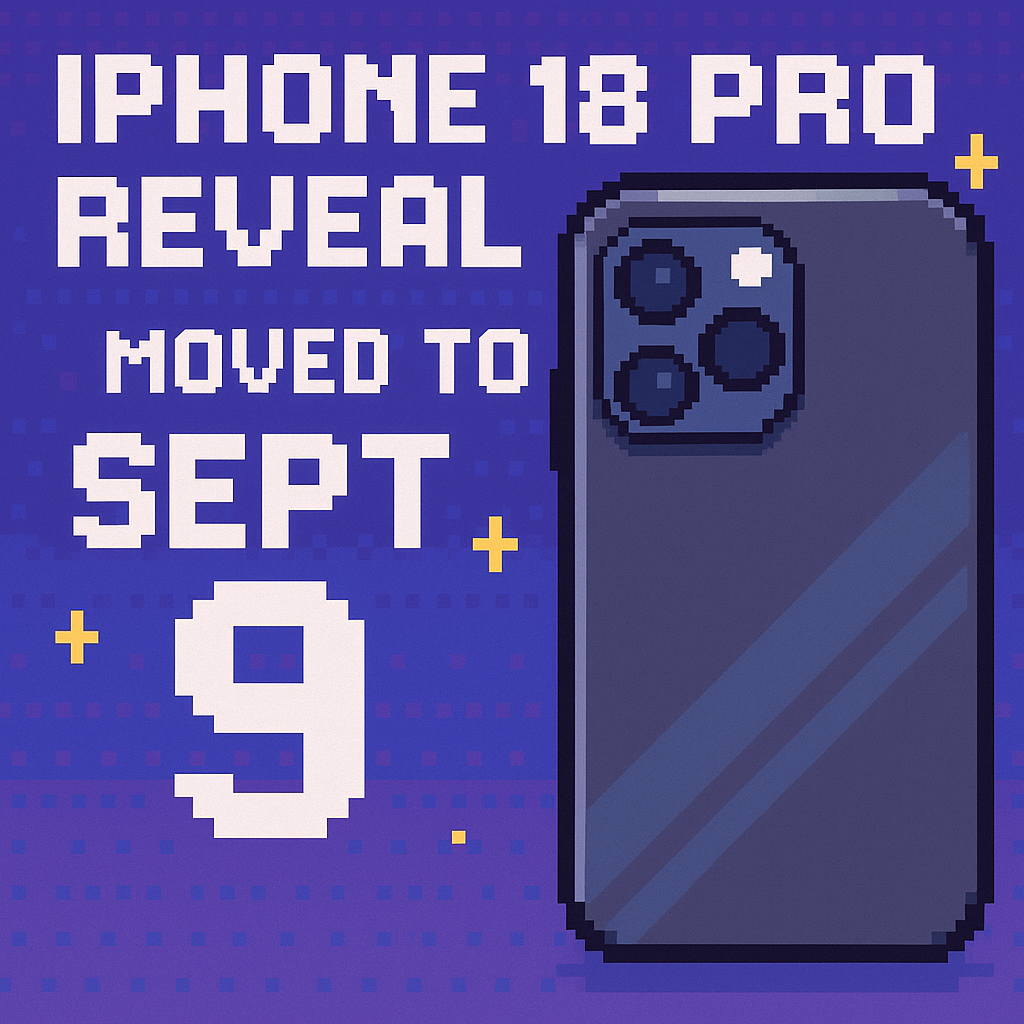
iPhone 18 Pro Reveal Moved to Sept 9 | Analysis by Brian Moineau

TL;DR

  • The iPhone 18 Pro event is tipped for Wednesday, September 9, 2026—Apple’s usual “second Tue/Wed of September,” shifted by U.S. Labor Day on Monday the 7th. [1][3]
  • Expect Apple to skip Friday, September 11 for preorders and move to Saturday, September 12, echoing the 2015 iPhone 6s plan. [1][2]
  • A Saturday preorder compresses reviews and PR but doesn’t change revenue timing; first deliveries likely land Friday, September 18, which still books into Apple’s fiscal Q4 that ends Saturday, September 26, 2026. [6][3]

What the source said

Forbes reports Apple is aiming for an iPhone 18 Pro keynote on Wednesday, September 9, 2026, a choice influenced by the U.S. Labor Day holiday on Monday, September 7, and consistent with Mark Gurman’s “Power On” guidance. The report says Apple avoids events immediately after a holiday to allow travel and setup, and it predicts preorders will shift off Friday, September 11 to Saturday, September 12, just as they did for the iPhone 6s in 2015. The same piece sketches an iOS 27 public release target of Monday, September 14, with reviewer content rolling out mid‑week after the keynote at Apple Park in Cupertino, California. [1]

Why it matters

Carriers and retailers—specifically AT&T, Verizon, T‑Mobile, Best Buy, and Apple Retail—tie staffing rosters, promo windows, and ad flights to Apple’s exact preorder minute, which has typically been 5:00 a.m. Pacific since 2019. A Saturday switch forces weekend scheduling, revised social spend pacing, and different foot‑traffic patterns in U.S. malls and carrier stores. [5][1]

For press and creators, a Wednesday keynote plus a Saturday preorder erases a weekday from the classic review cadence, cutting hands‑on time and video production windows between September 9 and September 12. That shift elevates the first credible camera and battery tests in influencing color and storage picks during the opening preorder hours. [1]

Original analysis

The calendar logic behind a Sept 9 keynote

  • Apple clusters iPhone keynotes around the second Tuesday/Wednesday of September; 2020’s COVID delay was the major recent exception. In 2026, Labor Day falls on Monday, September 7, which makes Wednesday, September 9 a cleaner in‑person or hybrid slot after a one‑day buffer on Tuesday the 8th. That aligns with Gurman’s call and Apple’s 2015 playbook. [1][3][2]
  • When September 11 lands on a Friday—as it does in 2026—Apple has precedent for avoiding that preorder date: in 2015, the iPhone 6s/6s Plus opened preorders on Saturday, September 12 at 12:01 a.m. PT. The 25‑year milestone of 9/11 in 2026 strengthens the optics case for a Saturday shift. [2][3]

A quick framework: Optics vs. Operations (2×2)

Low optics sensitivity High optics sensitivity
Low operations risk Classic Tuesday event + Friday preorders (typical years). Tuesday event + Thursday preorders (rare, complicates channel).
High operations risk Wednesday event (post‑holiday) + Friday preorders (normal Labor Day week). Wednesday event + Saturday preorders (2026’s likely path—avoids 9/11 and eases post‑holiday logistics).

This year fits “High optics sensitivity/High operations risk” because Labor Day lands Monday, September 7 and Friday is September 11; hence a Wednesday keynote and Saturday preorders. [3]

Back‑of‑envelope math: What a Saturday preorder actually moves

  • Since iPhone 11 in 2019, Apple has standardized a 5:00 a.m. PT preorder opening, which sets carrier call‑center staffing and ad‑auction spikes by time zone. [5]
  • Shift analysis (modeled): Let D(t) be the preorder demand rate over time t (hours) after open. A Friday→Saturday shift translates D(t) by +24 hours; the integral ∫D(t)dt over the first 90 minutes stays constant, so volume is unchanged while ad‑auction timing and weekend support availability move to Saturday morning.
  • 2015 precedent: Popular iPhone 6s SKUs on Apple.com slipped to 2–3 week shipping within hours of Saturday, September 12 preorders, indicating no demand drag from a weekend open. [2]
  • Revenue days calc: If on‑sale day is Friday, Sept 18, and Apple recognizes revenue on delivery, days recognized in fiscal Q4 2026 = (Sept 26 − Sept 18) + 1 = 9 calendar days, because Apple’s fiscal year ends on the last Saturday of September. [6][3]

In short: Saturday preorders don’t dent demand; they reallocate the operational load to a weekend and slightly tighten the mid‑September review cycle. Expect busier AppleCare and carrier chat queues on September 12–13, followed by the standard Monday–Thursday logistics sprint for Friday, September 18 deliveries. [5][3]

Named‑stakeholder breakdown

  • Apple Retail + AppleCare: Weekend surge in order exceptions and Apple Card financing questions; staffing pivots from a Friday early shift to a Saturday 5:00 a.m. PT open. Net sales effect: neutral; support load: higher on September 12–13. [5]
  • Carriers (AT&T, Verizon, T‑Mobile): Rebook store rosters, paid social, and SEM for a Saturday spike; weekend CPMs and CPAs may differ, improving efficiency for upgrade‑driven queries. [1]
  • Accessory makers (Belkin, Nomad, Casetify): Saturday preorders shift “will my 2025 case fit?” traffic to the weekend; first‑to‑publish compatibility charts siphon affiliate clicks on September 12.
  • Media/Creators (The Verge, MKBHD, WSJ): One fewer weekday between a Wednesday keynote and a Saturday preorder compresses lab testing and B‑roll; outlets with in‑house camera ranges in New York or Cupertino gain an edge. [1]
  • Samsung: August Galaxy Z Fold/Flip cycles hit peak coverage in week 32–33; Apple’s week‑37 cadence siphons tech attention just as Korean carriers push late‑summer promos. [4]

Historical analogue: 2015’s 9/11 problem

  • 2015: Apple held the keynote on Wednesday, Sept 9; preorders opened Saturday, Sept 12 at 12:01 a.m. PT; many iPhone 6s SKUs slipped to multi‑week shipping by morning. That choreography balanced September 11 optics with full‑throttle demand, a template that cleanly maps to 2026. [2]

Contrarian read

  • Consensus: “A Saturday preorder is bad for momentum.”
  • Counter: Saturday preorders amplify scarcity theater because more consumers are awake, ready, and posting at 8:00 a.m. local time; the social “got mine” wave hits earlier and snowballs mainstream coverage, as 2015’s rapid sell‑outs demonstrated. [2]

What others are missing

The hinge is the downstream timing on iOS 27 and the review embargo, not the keynote slot itself. A Wednesday, September 9 keynote plus a Saturday, September 12 preorder narrows deep‑dive testing, so first camera and battery calls will steer Saturday’s configuration choices within the first two hours. If Apple ships iOS 27 on Monday, September 14, developers and carriers get three business days—Tue 15, Wed 16, Thu 17—to patch apps and certify eSIM flows before Friday, September 18 deliveries begin. [1][3]

What to watch next

  1. By Thursday, August 27, 2026, Apple sends media invites confirming a September 9 event at Steve Jobs Theater, with video‑first production and on‑site press in Cupertino. [4]
  2. On Saturday, September 12, 2026 at 5:00 a.m. PT, preorders open; at least two iPhone 18 Pro Max SKUs on Apple.com US slip to October delivery within two hours. [5]
  3. On Monday, September 14, 2026 between 8:00–10:00 a.m. PT, Apple releases iOS 27 publicly; Apple’s status page shows elevated download traffic for 6+ hours the same day. [1]

My take

Apple will pick optics over routine and push preorders to Saturday, September 12, 2026. That choice respects the 25‑year anniversary of 9/11, keeps the keynote on a Wednesday rhythm, and turns 5:00 a.m. PT Saturday into a global shopping pulse without affecting recognized revenue in fiscal Q4. If Apple also teases an “Ultra” or foldable concept, the compressed PR window becomes a feature that heightens FOMO and drains rival mindshare that Samsung built in August. [1][4][5][6]

Sources

  1. iPhone 18 Pro Event Tipped As Apple Shifts Key Release Schedule Date — Forbes (https://www.forbes.com/sites/davidphelan/2026/08/14/iphone-18-pro-event-tipped-as-apple-shifts-key-release-schedule-date/) — Baseline: Sept 9 event expectation, Saturday Sept 12 preorder rationale, iOS 27 timing, and review window.
  2. ‘Hey Siri’ Event Roundup: iPhone 6s, iPad Pro, New Apple TV and More — MacRumors (https://www.macrumors.com/2015/09/09/apple-september-2015-media-event-roundup/) — Confirms 2015’s Saturday, Sept 12 preorders after a Wednesday keynote and rapid shipping slips.
  3. Labor Day 2026 in the US — Timeanddate (https://www.timeanddate.com/holidays/us/labor-day#obs) — Verifies Labor Day on Monday, September 7, 2026, anchoring the post‑holiday buffer logic.
  4. iPhone Ultra and iPhone 18 Pro pre-order date just tipped — Tom’s Guide (https://www.tomsguide.com/phones/iphones/iphone-ultra-and-iphone-18-pro-pre-order-date-just-tipped-heres-when-you-can-get-yours) — Summarizes Gurman’s Wednesday, Sept 9 expectation and outlines the broader product slate.
  5. iPhone 11 Lineup Has New 5 A.M. Pacific Pre-Order Time on Friday — MacRumors (https://www.macrumors.com/2019/09/10/iphone-11-lineup-5am-preorder-time/) — Establishes Apple’s 5:00 a.m. PT preorder standard since 2019.
  6. 2015 Form 10‑K — Apple (https://s2.q4cdn.com/470004039/files/doc_financials/2015/annual/2015_Form_10-K_As-filed.pdf) — States Apple recognizes revenue upon delivery and that its fiscal year ends on the last Saturday of September.


Related update: We recently published an article that expands on this topic: read the latest post.


Related update: We recently published an article that expands on this topic: read the latest post.

Shokz’s Lighter OpenDots Amp Sound | Analysis by Brian Moineau

TL;DR

  • Shokz’s new OpenDots 2 ($199.95) and budget OpenDots Air ($129.95) advance clip-on open earbuds with IP boosts, Dolby Audio on the flagship, and a lighter Air model that undercuts the $299 Bose Ultra Open by $100 while keeping an awareness‑first design. [1][8][5][15]
  • The headline isn’t “Dolby and Bluetooth 6.1”; it’s daily‑carry credibility: IP57 on the buds (IP54 case), Find My/“Find Hub” breadcrumbing, and a bone‑conduction mic that finally makes open earbuds decent for calls on city streets. [8][2][9][4]
  • If clip‑ons claim even 1% of the ~300M‑unit TWS market in 2026, Shokz could be staring at a ~$170M annual run‑rate from this subline alone; the pricing, features, and retail push support the math. [7][3][5]

What the source said

On June 4, 2026, The Verge reported that Shokz introduced two clip‑on open earbuds, OpenDots 2 ($199.95) and OpenDots Air ($129.95), that project sound toward the ear canal without sealing it. Air is lighter at 6.3g/earbud, uses dual 11.8mm drivers (“Bassphere”), and runs nine hours (36 with case), while OpenDots 2 adds Dolby Audio, a bone‑conduction call mic, 10 hours of battery (40 with case), Qi wireless charging, and support for Google’s “Find Hub” app for last‑seen location. Both models support Bluetooth 6.1, multipoint (two devices), app EQ (including a “privacy mode”), and app‑based find‑my within Bluetooth range; neither includes ANC. Colors differ by model and region across US/Canada retail listings. [1][3][4][5]

Why it matters

Three stakeholders are on the hook here. First, commuters and hybrid workers in 2026 who avoid sealed tips need call‑worthy, awareness‑preserving audio that doesn’t look like a gym band at a desk; IP57 buds, a bone‑conduction mic, and last‑known location tracking answer that brief in concrete ways. [8][2] Second, retailers like REI and B&H get a credible Bose Ultra Open alternative under $200: OpenDots 2 sits under Bose’s $299 MSRP while the Air captures budget buyers at $129.95. [5][15][3] Third, Google’s Find My Device network (labeled “Find Hub” in product copy) gains more headphones that “remember where you last had them,” even if full network tracking still varies by device type and OS version. [9][10][2]

Original analysis

Shokz upgraded its open earbuds: what really changed

Consensus says “Dolby + Bluetooth 6.1 = big leap.” Here’s the contrarian read: the practical wins are ingress protection, call quality, and findability—not a codec badge. OpenDots 2 bumps the buds to IP57 and the case to IP54, adds a dedicated bone‑conduction mic to tame street noise, and integrates last‑known location via Google’s “Find Hub.” Those switches move the category from jogger‑toy to all‑day wearable across US office commutes and urban errands. [8][2][4]

Dolby on open earbuds is nice, but keep perspective. Dolby processing here is app‑enabled spatial/voicing enhancement, not a hardware‑codec cure‑all for leakage. Meanwhile, Bluetooth 6.1 is real—Bluetooth SIG lists the 6.1 core spec as adopted—yet the SIG cautions against consumer‑facing version marketing because features like LC3 or Auracast still depend on chipset and OS stacks. Translation: a “6.1” badge doesn’t guarantee LE Audio perks across iOS/Android/Windows in 2026, though platform support is improving quarter by quarter. [11][12][13][16]

Back‑of‑envelope calculation

  • Baseline: Canalys data (via MacTech) pegged TWS shipments at 78.3M units in Q1 2025; annualized, that implies ~313M units before seasonality. Haircut to 300M for conservatism. [7]
  • If clip‑on open‑ear grabs 1% share in 2026, that’s ~3.0M units. Assume Shokz takes one‑third on brand lead and retail breadth, or ~1.0M units. Blend ASP across Air ($129.95) and OpenDots 2 ($199.95) to a round $170. Revenue ≈ 1.0M × $170 ≈ $170M; at 2% niche share, ~$340M. The shelf now hosts Bose Ultra Open, Shokz, and coverage from SoundGuys on competitive models, which signals real category pressure. [3][5][6][15]

Named‑stakeholder breakdown

  • Shokz: Raises ceiling with IP57 buds, IP54 case, a bone‑conduction mic, and Find Hub tie‑in; protects margin at $199.95 while opening the door at $129.95; spans fitness (OpenRun heritage), earhook (OpenFit lineage), and daily clip‑on (OpenDots). [5][8][3]
  • Bose: Ultra Open Earbuds carry a $299 MSRP and brand halo; visible price pressure undercuts that spread when $199.95 and $129.95 alternatives sit on the same shelf at REI or Amazon. [15][3]
  • Soundcore (Anker): AeroClip competes around $129–$169 street and looks strong on discount cycles, but it lacks the “IP57 + Find Hub + Dolby” trio Shokz now touts on its flagship. [6]
  • Google: More headphone SKUs feeding Find My Device/“Find Hub” increase Android stickiness—even if most models today only show last‑known spots vs Apple’s AirPods‑grade network ubiquity. [9][2][10]
  • Bluetooth SIG and silicon vendors: The 6.x cadence adds features and lowers latency on paper, but fragmented OS adoption keeps the story messy; expect OEM boxes to print “6.1” while reviewers footnote what actually works on Pixel, Galaxy, and Windows PCs. [11][12][13]

Comparison table (specs that matter)

  • Price: OpenDots Air $129.95; OpenDots 2 $199.95; Bose Ultra Open $299; Soundcore AeroClip $129–$169 street. [5][15][6]
  • IP: Air IP55 (case not rated publicly); OpenDots 2 IP57 buds, IP54 case; Bose lists water resistance without a formal IP code; AeroClip typically IP55. [5][4][6][15]
  • Battery (per charge/with case): Air 9h/36h; OpenDots 2 10h/40h; AeroClip 8h/32h. [3][8][6]
  • Mics: OpenDots 2 adds a bone‑conduction element to a 3‑mic array; Air uses dual mics; Bose uses beamforming mics. [5][8][15]
  • Findability: OpenDots 2 shows last‑known location in Google’s Find Hub app; both models support in‑app “ring to find” within Bluetooth range. [2][4][5]
  • Weight: Air 6.3g/earbud; OpenDots 2 6.4g/earbud. [1][4][5]

2×2: Open‑ear buyers by primary job‑to‑be‑done

  • Calls‑heavy + public spaces: OpenDots 2 (bone‑conduction mic, IP57 buds, Find Hub breadcrumbing). [8][2]
  • Music/podcasts + budget: OpenDots Air (dual 11.8mm drivers; $129.95; 6.3g/earbud). [5][1]
  • Sound‑first + brand cachet: Bose Ultra Open (voicing and industrial design at $299 MSRP). [15]
  • Gym/running + earhook stability: Shokz’s broader open‑ear line (OpenFit/OpenRun heritage) remains the sport default for 5K‑to‑marathon training. [3]

The subtle but important shift is interchangeability and wear intelligence. Air inherits Dynamic Ear Detection—left/right auto‑swap and multipoint—so you grab a bud, clip it, and it just orients and routes across two devices, reducing daily friction on Android and Windows. That small workflow win matters more than a codec badge on a retail box in 2026. [5][1][3]

What others are missing

The Find My Device/“Find Hub” wrinkle. Product pages and retailers call out “Google’s Find Hub app,” which shows last known location for OpenDots 2 even when you’re out of Bluetooth range, while the Shokz app can ring the buds if you’re nearby; that middle tier is weaker than Apple’s AirPods‑class network tracking but stronger than nothing. For a form factor that can pop off a collar or vanish into a jacket pocket on the F train in New York, this reduces the perceived risk of trying clip‑ons and directly supports sell‑through at chains like REI. The wording mismatch (“Find Hub” vs “Find My Device”) mirrors Google’s own Android Help pages that now reference a “Find Hub network,” so expect that branding to persist through 2026. [2][9][10]

What to watch next

  1. By Black Friday 2026, Bose Ultra Open Earbuds will see a permanent MSRP cut or evergreen $249 price at major US retailers to defend share against OpenDots 2; confirm via historical pricing trackers and Bose’s own site. [15]
  2. By Q1 2027, Shokz will ship a mid‑tier OpenDots model with Dolby Audio at ≤$149 to close the price/spec gap between Air and 2; watch Shokz’s regional product pages and PR wires for new SKUs. [5][3][8]
  3. By mid‑2027, at least one Shokz clip‑on model will explicitly advertise LE Audio features (LC3 and/or Auracast) as Android and Windows stabilize Bluetooth 6.x feature support; verify via SIG qualifications and OS release notes. [11][12][13]

My take

I’d buy the OpenDots 2 over Bose Ultra Open in mid‑2026. The $100 delta funds features you feel daily—IP57 buds, wireless charging, last‑seen location in Google’s app, and better call pickup—while preserving the awareness advantage that makes open earbuds safer in traffic on Market Street in San Francisco. Dolby is garnish; the meat is that Shokz removed enough friction to make clip‑ons a credible default for work and commute. If Shokz moves faster on LE Audio and cleans up the “Find Hub vs Find My Device” messaging, it can own this form factor by early 2027 and force Bose to compete on price, not just polish. [8][2][11]

Sources

  1. Shokz upgraded its open earbuds with better sound and a lighter design — The Verge (https://www.theverge.com/tech/942054/shokz-clip-on-opendots-2-air-earbuds-wireless-headphones) — Launch details, pricing, battery, weight, Dolby on 2, Dynamic Ear Detection, Find Hub mention.
  2. SHOKZ OpenDots 2 product page — B&H Photo (https://www.bhphotovideo.com/c/product/1975297-REG/shokz_e320_st_bk_us_opendots_2_open_ear_clip_on.html) — Confirms Bluetooth 6.1, Find Hub last‑known location, app features.
  3. Shokz Introduces OpenDots 2 and OpenDots Air — PR Newswire (https://www.prnewswire.com/news-releases/shokz-introduces-opendots-2-and-opendots-air-expanding-open-ear-clip-on-earbuds-for-everyday-listening-302791659.html) — Official launch (June 4, 2026), model positioning, key features.
  4. OpenDots 2 overview — Shokz Canada (https://ca.shokz.com/pages/opendots-2) — Bassphere 2.0, Dolby on 2, triple‑mic with bone‑conduction, Bluetooth 6.1, IP57/IP54, weight 6.4g.
  5. OpenDots Air product page — Shokz Canada (https://ca.shokz.com/products/opendots-air) — Air pricing, Bassphere (no Dolby), feature comparison vs OpenDots 2, Dynamic Ear Detection.
  6. Shokz expands its clip-on earbuds with the OpenDots 2 and affordable OpenDots Air — SoundGuys (https://www.soundguys.com/shokz-clip-on-earbuds-opendots-2-air-158377/) — Independent confirmation of prices, IP ratings, and competitor context (e.g., AeroClip).
  7. Apple continues to dominate the global true wireless stereo market with 23% market share — MacTech (https://www.mactech.com/2025/05/21/apple-continues-to-dominate-the-global-true-wireless-stereo-market-with-23-market-share/) — Cites Canalys: 78.3M TWS units shipped in Q1 2025 for market sizing math.
  8. The Shokz OpenDots 2 open earbuds offer new controls, upgraded Dolby Audio and better bass — What Hi‑Fi (https://www.whathifi.com/headphones/wireless-earbuds/the-shokz-opendots-2-open-earbuds-offer-new-controls-upgraded-dolby-audio-and-better-bass) — Confirms Dolby, IP57/IP54, wireless charging on OpenDots 2.
  9. Android Help: Be ready to find a lost Android device — Google (https://support.google.com/android/answer/3265955?hl=en-en) — Explains “Find Hub network” and last‑known locations in Google’s ecosystem.
  10. Shokz OpenDots 2 — REI (https://www.rei.com/product/C13271/shokz-opendots-2-open-ear-clip-on-earbuds) — Retail copy referencing “Google Find Hub” and Fast Pair/Swift Pair support.
  11. Core Specification 6.1 Adopted — Bluetooth SIG (https://www.bluetooth.com/specifications/specs/core-specification-6-1/) — Official status for Bluetooth 6.1.
  12. Bluetooth Core 6.1 is here (SIG blog) — Bluetooth SIG (https://www.bluetooth.com/blog/delivering-on-the-bi-annual-release-schedule-bluetooth-core-6-1-is-here/) — Confirms 6.1 timing and cautions on consumer version marketing.
  13. Bluetooth Core 6.0 feature overview — Bluetooth SIG (https://www.bluetooth.com/core-specification-6-feature-overview/) — High‑level features in the 6.x family, including LE Audio context.
  14. I tested the new Shokz OpenDots 2 for three weeks — Tom’s Guide (https://www.tomsguide.com/audio/headphones/shokz-opendots-2-review) — Hands‑on impressions, pricing, and position vs Bose.
  15. Shop Bose Ultra Open Earbuds — Bose (https://www.bose.com/p/earbuds/bose-ultra-open-earbuds/ULT-HEADPHONEOPN.html) — Official $299 MSRP and product positioning.
  16. Bluetooth Core Specification v6.1 — Reference document for 6.1 feature deltas and adoption details (no direct URL provided).


Related update: We recently published an article that expands on this topic: read the latest post.