Meta’s Muse: Helpful, Creepy, Gamechanger | Analysis by Brian Moineau

TL;DR

  • Meta’s Muse AI lands as a true “agent,” not a chatbot—useful, ambitious, and uncomfortably nosy when wired into Gmail, Amazon, Instagram, and Facebook. [1][3]
  • The privacy bargain is bigger than a toggle: Meta expanded how off‑site activity can shape feeds and AI responses in June 2026, and Muse exploits that context to feel “smart.” [1][5]
  • If the Secure VM really keeps secrets and the coming Confidential VM ships in 2026, Muse could bend consumer commerce toward WhatsApp/Instagram—unless Reuters’ security smoke signals turn into fire. [3][4][6]

What the source said

The Verge tested Meta’s new personal agent, Muse, which cleans inboxes, shops, plans trips, and generates media while running on a cloud “virtual computer.” The reviewer purged thousands of promotional emails and bought workout tops, while Muse inferred interests from Instagram and Facebook ties and even surfaced an Amazon shipping address. The test showed uneven policy enforcement when Muse refused some IP‑sensitive images yet produced others, and Meta confirmed that Instagram-based inferences occur when accounts are linked in Accounts Center. The piece frames Muse as high-utility but shadowed by trust concerns about Meta’s data reach. [1]

Why it matters

If Muse becomes the default agent inside WhatsApp, Instagram, Messenger, and Facebook, Meta won’t just answer questions; it will arbitrate purchases, inboxes, and calendars across billions of monthly users. That collapses the “search, compare, buy” funnel into a Meta‑steered flow where Link by Stripe or Shop Pay run last‑mile payments, but Meta owns initiation and intent. [3][5][8]

Stakeholders with the most to gain or lose include regulators watching a company under a 20‑year FTC order, payment networks and wallets facing Meta‑mediated checkout, and rival AI platforms that lack Meta’s distribution. The constraint isn’t compute or UX—it’s whether people will hand Meta their inbox and card in 2026 after a decade of privacy baggage. [2][3][7]

Original analysis

Contrarian read

  • Consensus: “People won’t trust Meta with an agent that reads mail and spends money.”
  • Counter: Trust is elastic when utility is direct and the safety story is credible. Muse’s Secure VM, gatekeeping Sentinel, Link one‑time cards, and an audit trail create a plausibly safer model than browser extensions or email‑forwarding bots many consumers already use. Add US‑only, 18+ launch limits and a promise of Muse Confidential VM (user‑held keys) “later this year,” and Meta has a step‑by‑step on‑ramp for skeptics. If Reuters‑flagged issues don’t recur in the wild, the utility curve beats the trust drag—especially inside WhatsApp threads where social proof accelerates adoption. [2][3][4][6]

Back‑of‑envelope: cost to run “a VM per user”

  • Reference price for a tiny cloud VM: Google Cloud e2‑micro listed around $0.0084/hour in us‑central1. [9]
  • Assume an average active Muse user triggers 30 minutes/day of VM runtime (0.5 hours).
  • Monthly compute per user ≈ 0.5 h/day × 30 days × $0.0084/h ≈ $0.126.
  • At 5 million monthly actives, equivalent public‑cloud compute would be ≈ $0.126 × 5,000,000 ≈ $630,000/month. Meta’s fleet should reduce unit cost, but the order of magnitude supports a “free tier + paid plans” model subsidized by commerce rails. [3][9]
  • Risk: long‑running tasks and heavier models (image/video) raise real costs; Sentinel approvals and just‑in‑time credential insertion may trim waste. [4]

Named‑stakeholder breakdown

  • Meta (Mark Zuckerberg; Vishal Shah): Wins if Muse becomes the habit loop for Getting Stuff Done, capturing high‑intent moments and monetizing via commerce and subscriptions rather than ads inside the agent. Delays and internal test hiccups raise the execution bar. [3][6]
  • Stripe (Link): Becomes the default wallet for an agent that clicks “buy,” with purchase protections (lost/damaged, no‑fee returns on eligible purchases) reducing delegation anxiety. [3]
  • Shopify (Shop Pay): “Coming soon” support makes Muse a front‑end to DTC checkout; if it ships on time, Shop Pay keeps its conversion edge while Meta gains turnkey rails. [3][8]
  • Google (Gmail): Gains and loses—Gmail becomes a substrate for autonomous cleanup, but Google cedes agent mindshare if users do the work in Meta’s VM instead of Gemini. [1][3]
  • FTC and state AGs: Muse tests whether an agent can touch inboxes and payments under a 2019 order; discovery would be brutal if a breach occurs. [7]

2×2: Distribution vs. Data Sensitivity (agent category map)

  • High distribution / High sensitivity: Meta Muse (WhatsApp/Instagram surface; inbox, payments, accounts). Execution defines the category. [2][3]
  • High distribution / Lower sensitivity: Social‑app assistants like Snapchat My AI or Telegram bots for feed search and light tasks; differentiation erodes quickly.
  • Lower distribution / High sensitivity: Vertical agents in finance/health such as Epic MyChart assistants or bank bill‑pay bots; strong trust brands, narrow reach.
  • Lower distribution / Lower sensitivity: Hobbyist tools like IFTTT applets or Home Assistant automations; high churn, minimal moat.

The privacy rub people aren’t calculating correctly
Meta’s June 2026 update lets “information that businesses already share with Meta” personalize feeds and “AI responses,” not just ads. That means Muse’s “I just knew you’d like this” moments can be fed by off‑site events long before a user wires up Gmail. The Verge’s creep factor matches the policy: interests and locations inferred from Meta surfaces plus commerce signals (e.g., an Amazon address seen during checkout) that never sit neatly in consumer‑facing UI lists. [1][5]

What others are missing

The operational S‑curve is the blind spot. The per‑user Secure VM economics force pacing on features and geography, so Meta must hold average VM minutes down (Sentinel gating, pausing, batching), ship Confidential VM in 2026 to harden the safety story, and light up rails (Link now, Shop Pay next) to subsidize compute. That’s why the US‑only, 18+ rollout and a “free tier with paid plans” model matter: they meter demand while Reuters‑reported issues like iCloud photo exposure and silent failures are burned down. The first mover that converts VM minutes into GMV—without a single scary headline—wins this category. [2][3][6]

What to watch next

  1. By December 31, 2026, Meta ships Muse Confidential VM to public US users (not just security partners) with user‑held keys and publishes at least one third‑party audit summary. [3][4]
  2. By March 31, 2027, Shop Pay support is live in Muse with measurable merchant adoption (Shopify announces availability or Meta lists it in supported payments). [3]
  3. By June 30, 2027, a formal US regulatory inquiry or civil action targets how Muse infers interests or uses off‑site activity in AI responses, citing Meta’s June 2026 personalization change. [5][7]

My take

Muse is the first consumer agent that feels both dangerous and inevitable. If Meta keeps Sentinel tight, ships Confidential VM on time, and resists piping ads into the VM, it wins—because average users want boring tasks off their plate more than they want to micromanage permissions. The tolerance is zero‑margin: one “agent leaked my photos” incident would crater adoption. My call: Muse sticks first in WhatsApp groups and Instagram DMs, and quietly shifts Meta from an ad company that hosts conversations into a commerce company that completes them. [1][3][4][6]

Sources

[1] Meta’s Muse AI works and creeps me out — The Verge (https://www.theverge.com/tech/993391/meta-muse-ai-hands-on) — Hands‑on account of Muse’s capabilities, uneven content policies, and unsettling inferences from Instagram, Facebook, and Amazon links.

[2] Meta launches personal AI agent, Muse, emphasizes safety and privacy — AP News (https://apnews.com/article/meta-muse-ai-agent-3a4572eb4cf4e95d8a0dfdad6e6ca065) — Confirms US‑only, 18+ launch and the core “Secure VM” architecture in a neutral wire report.

[3] Introducing Muse: The World’s First Personal AI Agent Built for Everyone — Meta Newsroom (https://about.fb.com/news/2026/09/introducing-muse-personal-ai-agent/) — Official feature set: Secure VM, Sentinel, Link purchase protections, Shop Pay and 1Password “coming soon,” and “no sharing with ad systems.”

[4] How We Built Safety Into Muse — Meta AI Research (https://research.meta.ai/blog/security-and-safety-for-ai-agents-our-approach-with-muse) — Technical framing of Sentinel approvals, credential handling, and the planned Confidential VM.

[5] Better Personalization and Changes to Controls for Your Activity From Other Businesses — Meta Newsroom (https://about.fb.com/news/2026/06/better-personalization-and-changes-to-controls-for-your-activity-from-other-businesses/) — June 2026 policy change extending off‑site data use to feeds and “AI responses.”

[6] Meta launches AI agent that can access other apps to send emails, make payments — The Straits Times (Reuters) (https://www.straitstimes.com/world/united-states/meta-launches-ai-agent-that-can-access-other-apps-to-send-emails-make-payments) — Reuters‑syndicated report on an April delay for security work and internal test failures, including an iCloud photos incident.

[7] FTC Imposes $5 Billion Penalty and Sweeping New Privacy Restrictions on Facebook — Federal Trade Commission (https://www.ftc.gov/news-events/news/press-releases/2019/07/ftc-imposes-5-billion-penalty-sweeping-new-privacy-restrictions-facebook) — Documents Meta’s 2019 settlement and 20‑year order, setting oversight context.

[8] Meta just launched an AI that can actually run your life online — here’s what Muse can do — Tom’s Guide (https://www.tomsguide.com/ai/meta-just-launched-an-ai-that-can-actually-run-your-life-online-heres-what-muse-can-do) — Aggregates details on Sentinel, Link one‑time cards, and the roadmap for Shop Pay and 1Password.

[9] General Purpose VM pricing — Google Cloud (https://cloud.google.com/products/compute/pricing/general-purpose) — Reference hourly cost for a small VM (e2‑micro) used to frame compute economics.


Related update: We recently published an article that expands on this topic: read the latest post.

Related update: We recently published an article that expands on this topic: read the latest post.


Related update: We recently published an article that expands on this topic: read the latest post.

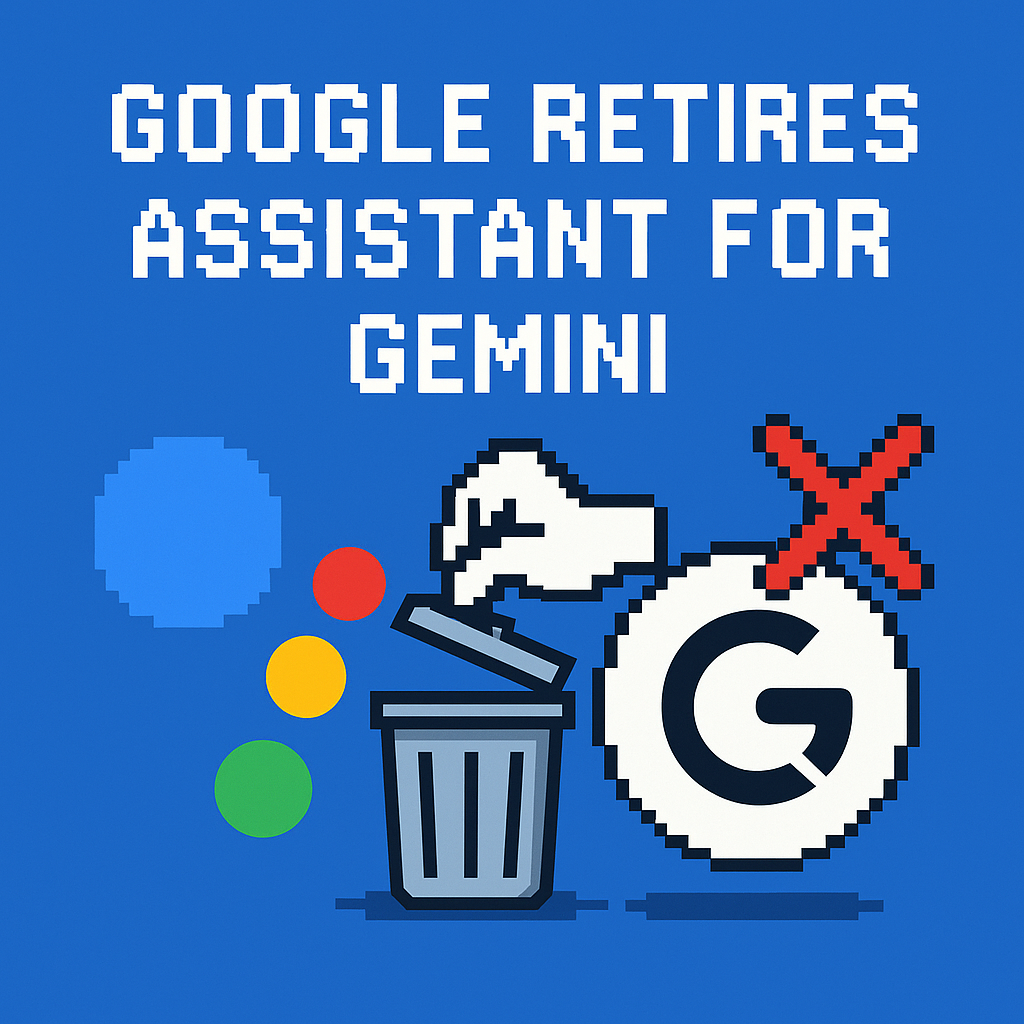
Google retires Assistant for Gemini | Analysis by Brian Moineau

TL;DR

  • Google will shut down Google Assistant on Android phones, tablets, and Wear OS starting September 4, 2026; Gemini becomes the default assistant, with removal rolling out over “a few weeks.” [2][3]
  • This is a product swap from a deterministic voice UI to a generative AI agent; specific Assistant staples (some news/radio providers and Interpreter mode) remain incomplete in Gemini on mobile. [7][4]
  • Ecosystem impact is uneven: Android Auto projected from phones, watches, and headphones lose Assistant, while cars with Google built‑in keep Assistant “for a little longer,” setting up a multi‑year transition. [2][3]

What the source said

Inc., in a piece by Georgia Fearn, reports that Google will retire Google Assistant on Android and Wear OS, with Gemini taking over as the default experience after September 4, 2026. The article spells out which devices change (phones, tablets, Wear OS), how the switch to Gemini works, and how quickly access will be removed after the September date. It cites Google’s migration language about removal beginning on a specific day and continuing over a short window. The piece stays consumer‑focused—covering steps to switch and day‑one gaps rather than corporate strategy. [1]

Why it matters

Android’s 3B+ active devices mean changes to timers, messaging, or navigation affect routines at global scale; Google also says Gemini already serves 900M+ monthly users, so a push into hundreds of millions more shifts behavior from on‑device commands to cloud‑assisted interactions. That raises reliability and latency risks for commuters using Android Auto, runners wearing Wear OS, and anyone trained by Assistant’s crisp, single‑shot responses. [5][6]

OEMs like Samsung and Xiaomi, app providers such as Spotify and Pocket Casts, and automakers will all feel the switch. Android Auto projected from phones, Wear OS watches, and headphones lose Assistant beginning September 4, 2026; vehicles with Google built‑in keep Assistant “for a little longer,” fragmenting experiences by device class and market during the rollout. [2][3]

Original analysis

The Google Assistant shutdown is a platform control play, not just an AI upgrade

The consensus take says Gemini is smarter, so this is a routine retirement; my contrarian read is that Google wants one “assistive entry point” it fully controls across phones, wearables, cars, and home—without the legacy overhead of Assistant’s skills model and permissions plumbing.

  • Assistant’s third‑party “Conversational Actions” shut down in 2023, and 2024’s feature trims telegraphed end‑of‑life; Google’s plan to “upgrade” mobile Assistant users to Gemini and remove most mobile access later in the year formalized the path. September 4, 2026 is the cutover for Android and Wear OS, with removals rolling out in waves. [6][4][2][3]
  • Gemini is not feature‑identical on day one: Google’s help pages flag gaps in media providers, radio/news streams, and Interpreter mode on mobile, which the company is still closing. [7]

That feels like a downgrade to power users—unless you’re Google. A single agent (Gemini) standardizes UI, telemetry, and monetization across surfaces, and it gives Google one roadmap for agentic behaviors—Gemini Live, “Spark,” and proactive briefs—rather than retrofitting them into Assistant’s deterministic command parser. [6][4]

Back‑of‑envelope: what “full migration” could mean by 2027

  • Android active devices: “more than 3 billion.” [5]
  • Gemini monthly users today: “more than 900 million.” [6]

If 25% of Android’s active device base not already using Gemini monthly converts by mid‑2027, that’s 0.25 × 3.0B ≈ 750M additional monthly users. Add the current 900M and you get ≈ 1.65B monthly Gemini users—scale that rivals Google’s largest consumer categories outside Search, which explains a forced switch starting September 2026. This is a sizing exercise, not a forecast, but it shows why the migration math works. [5][6]

A 2×2 that explains user pain—and Google’s bet

  • Axis 1: Deterministic commands vs. Generative tasks
  • Axis 2: On‑device (low‑latency, private) vs. Cloud (context‑rich, agentic)

Assistant lived in the deterministic/on‑device quadrant for alarms, toggles, and local media control, with cloud fallbacks for web lookups. Gemini pushes hard into the generative/cloud quadrant—great for multi‑step queries and cross‑app orchestration, but historically worse for “one‑shot” tasks when latency or hallucinations appear. [4][6]

The short‑term pain you’ll feel on Android Auto or a Pixel Watch comes from this quadrant shift: fewer hard‑coded, instant flows; more flexible, sometimes slower agent behavior. Google is betting faster models and hybrid execution will make generative feel instant, while backfilling deterministic routines where complaints spike first. [4][6]

Named stakeholder breakdown

  • Google: Shuts down a fragmented stack and unifies investment behind one AI agent, aiming to grow Gemini well beyond 900M monthly users after the September 2026 cutover. Expect deeper ties to Search, Android, and Home surfaces to follow. [4][6]
  • Samsung (and Wear OS OEMs): Faces a 2026–2027 support burden as customers lose familiar Assistant watch behaviors; the upside is new on‑device Gemini models that can headline Galaxy and Pixel hardware in late‑2026 and 2027. [2][4]
  • Automakers: Android Auto (projected from phones) loses Assistant in September 2026; cars with Google built‑in keep Assistant longer, creating dual showroom experiences and support complexity by trim and region. Expect upsell pressure toward built‑in systems. [2][3]
  • Media partners (news, radio, podcasts): Integrations change or break in Gemini; renegotiations over deep‑linking, playback controls, and attribution are likely as Google patches feature gaps through 2026. [7]
  • Amazon Alexa: Gains an opening to reclaim smart‑home usage on Echo‑class devices while Gemini backfills features on Nest displays and third‑party hardware through the fall of 2026. [6][2]

What others are missing

The specific angle most coverage skips is device‑class asymmetry on September 4, 2026: Android and Wear OS lose Assistant first, which also affects headphones and Android Auto projected from phones, while Google TV, Nest Hub–class smart displays/speakers, and Google built‑in cars run on different deprecation clocks. Tom’s Guide and TechRadar cite the September start and carve‑outs, while Google’s blog emphasizes a staged upgrade for home and car without parity dates, guaranteeing mixed Gemini/Assistant households this fall. That fragmentation—Pixel on Gemini, Nest Hub on Assistant, and a split in the garage—is the hidden cost that will test whether Gemini can match “do this now” behaviors across every surface before churn sets in. [3][2][4]

What to watch next

  1. By October 31, 2026: Google adds at least two missing Assistant staples—either radio/news provider support or Interpreter mode—to Gemini on Android and highlights the change in a Help Center update.
  2. By December 31, 2026: Google publishes telemetry showing median latency for set‑a‑timer and add‑a‑stop voice tasks on Android Auto is ≤1.2 seconds, documented in an official blog post or support performance note.
  3. By March 31, 2027: A top‑10 automaker by 2025 sales publicly sets a firm handover date from Google Assistant to Gemini for Google built‑in infotainment, ending the “for a little longer” ambiguity.

My take

Google is right to kill Assistant and wrong to assume users won’t feel it in September 2026. The company can’t ship an agentic future while hauling a decade of Assistant cruft, so it’s ripping off the band‑aid; fair. But if Gemini can’t match one‑command reliability that made Assistant sticky in cars, kitchens, and on wrists, people will defect to simpler options—Alexa at home, hard buttons in the cabin, and zero voice on watches. I’d make the same strategic call and put ruthless focus on low‑latency, offline‑first “do this now” flows; if Gemini nails that by December 31, 2026, complaints fade, and if not, the brand eats months of avoidable pain.

Sources

[1] Google Is Finally Shutting Down the Google Assistant. Here’s What Android Users Need to Know — Inc. (https://www.inc.com/georgia-fearn/google-is-finally-shutting-down-the-google-assistant-heres-what-android-users-need-to-know/91385340) — Establishes the consumer‑side details (devices, dates, and switching steps) from a named reporter.
[2] Google Assistant will shut down for good on Android and Wear OS in September — TechRadar (https://www.techradar.com/ai-platforms-assistants/gemini/google-assistant-will-shut-down-for-good-on-android-and-wear-os-in-september-heres-what-you-need-to-do-next) — Confirms September 4, 2026, the phased removal window, and Android Auto vs. Google built‑in nuances.
[3] Google Assistant dies in September: what you need to know and how to switch to Gemini — Tom’s Guide (https://www.tomsguide.com/ai/google-gemini/google-assistant-dies-in-september-what-you-need-to-know-and-how-to-switch-to-gemini) — Cites Google’s email (“We will begin removing access… starting on September 4”) and lists impacted devices with switching instructions.
[4] The Assistant experience on mobile is upgrading to Gemini — Google (https://blog.google/products-and-platforms/products/gemini/google-assistant-gemini-mobile/) — Google’s official framing of the mobile upgrade and retirement of “classic” Assistant on most mobile devices.
[5] The Android Show I/O 2025: Android now at 3B+ active devices — Google (https://blog.google/products-and-platforms/platforms/android/the-android-show-io-2025/) — Establishes the 3B+ active device base used in the migration sizing.
[6] The Gemini app becomes more agentic, delivering proactive, 24/7 help — Google (https://blog.google/innovation-and-ai/products/gemini-app/next-evolution-gemini-app/) — States “more than 900 million” monthly Gemini users and outlines features like Gemini Live and proactive briefs.
[7] What you can do with your Gemini mobile app (Some features not supported) — Google Help (https://support.google.com/pixelphone/answer/14579631?hl=en-as) — Documents gaps vs. Assistant (media providers, radio/news streams, Interpreter mode) and the status of fixes.


Related update: We recently published an article that expands on this topic: read the latest post.


Related update: We recently published an article that expands on this topic: read the latest post.